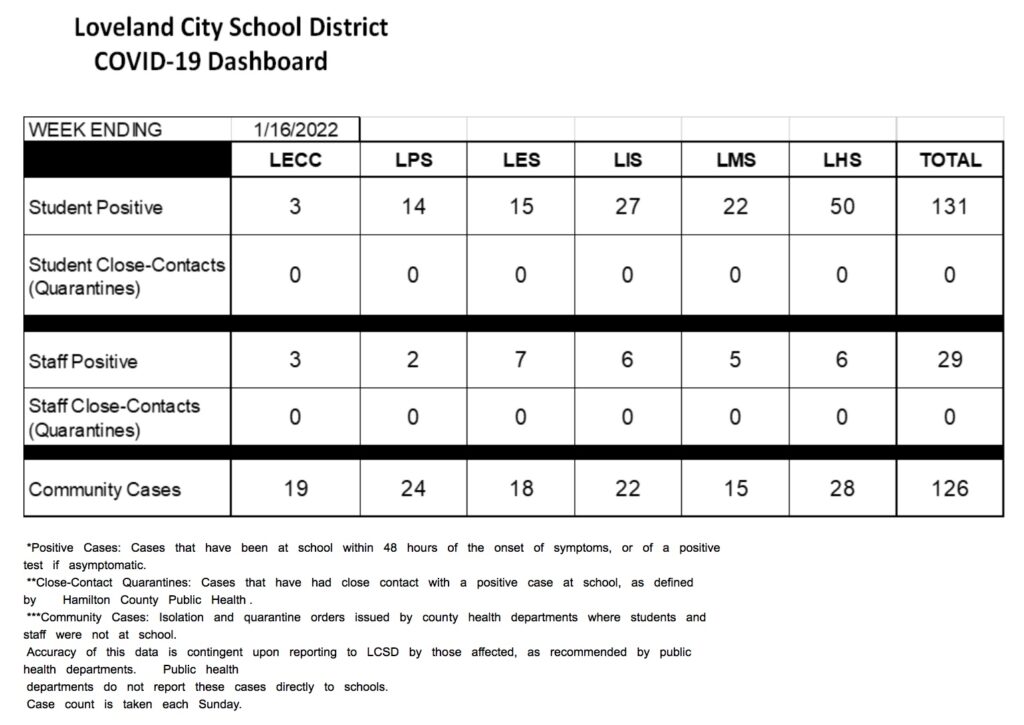
Loveland, Ohio – After publishing the Loveland School District’s latest COVID 19 Dashboard on Tuesday, January 18, many readers wondered how there could be so many positive cases in the schools but zero students or staff who were quarantined.
In an email yesterday I asked Superintendent Mike Broadwater: “I have a question that has come up after we published the latest COVID 19 Dashboard image yesterday. People are wondering why there were no quarantine figures on it.”
Broadwater answered via email saying, “In regards to the Dashboard, there are no more quarantines with the new guidelines set forth by ODH (Ohio Department of Health). The only time you will see a quarantine would be if the family opts to quarantine their child rather than mask to stay. You’ll notice all zeroes with the exception of a few single quarantines since the new guidelines were released.”
New CDC Guidelines were implemented 1/3/2022 and are reflected in subsequent reporting.
Readers can view all of the COVID 19 Dashboard reports at this LINK.
The current District quarantine and mask policy is found on the District website and states:
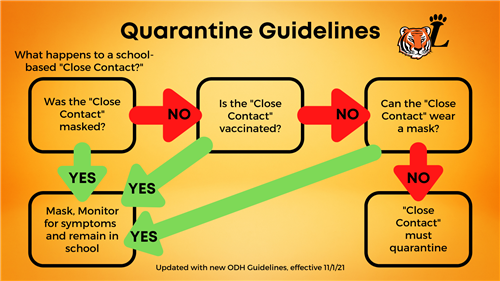
Effective November 1, 2021
The Ohio Department of Health (ODH) has made a few minor changes to the quarantine recommendations for K-12 schools, and these new guidelines should help us keep our students healthy and in the classroom, where they learn best.
These guidelines will not change our current masking policy, but will change how we handle situations where a student has been identified as a “close contact/direct contact.”
Mask to Stay/Test to Play
Direct contacts, regardless of vaccination or masking status, may remain in the classroom environment if they do the following:
Wear a mask for 14 days after their last date of exposure.
Self-monitor, or parent-monitor, for symptoms of COVID-19.
Isolate and get tested if they start to experience symptoms associated with COVID-19 (regardless of the level of severity).
Consistent with guidance for others quarantining in lower-risk environments, students and staff may discontinue these quarantine procedures after seven days – if they don’t develop symptoms and test negative between days 5-7.
Direct contacts may continue to participate in extracurricular activities if they do the following:
Wear a mask when able. (This includes: transportation; locker rooms; sitting/standing on the sidelines; and anytime the mask will not interfere with breathing, the activity, or create a safety hazard.)
Test on initial notification of exposure to COVID-19.
Test again on days 5-7. If they are negative at this time, they will test out of quarantine.
The Ohio Children’s Hospitals Association made a direct appeal on Tuesday, September 14 to school superintendents to require masks for staff and students during the current surge of the coronavirus.
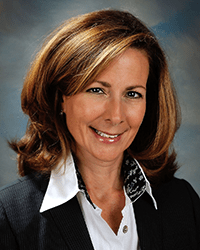
Patty Manning, MD, is the Chief of Staff at Cincinnati Children’s Hospital Medical Center (Photo by CCHMC)
Patty Manning, MD, Chief of Staff, Cincinnati Children’s Hospital Medical Center said, “Our inpatient numbers are the highest they’ve been. Our ICUs are caring for more patients than there’s ever been. More children are on ventilators than there has ever been. There are more children than ever entering our emergency departments and our urgent care centers. That impacts the care of all children, not just those that are COVID-19 positive.”
The plea was made during a virtual meeting with superintendents and the clinical leadership from six Ohio children’s hospitals including Dayton Children’s Hospital, ProMedica Russell J. Ebeid Children’s Hospital, Cincinnati Children’s Hospital Medical Center, Nationwide Children’s Hospital, Akron Children’s Hospital, and University Hospitals Rainbow Babies & Children’s Hospital.
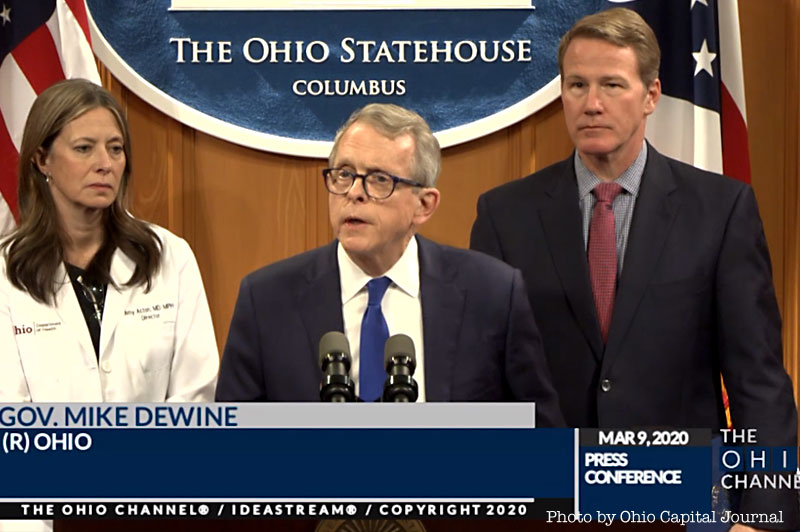
“The data are now clear that there is a higher level of COVID-19 in school districts where masks are not required,” said Governor DeWine. “If we want our schools to stay open, the best way to do that is for those 12 and over to get vaccinated. But because those under 12 are still too young to be vaccinated, we need students who come in to school to wear a mask until we get through this.”
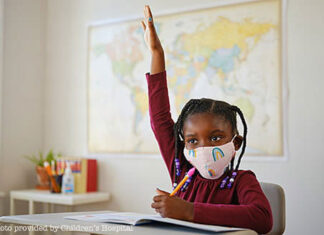
The current policy of the Loveland City School District is that students in grades PreK-6 are required to wear a mask indoors. Students in grades 7-12 do not have to wear face coverings. All others, while in the buildings must wear masks.
Efforts to reach Loveland Superintendant Mike Broadwater via email, asking him if he attended the virtual meeting and had any comment about it have not been successful securing an email response.
In the background of this urgent plea is that State Reps. Jean Schmidt (R-Loveland/Miami Township) announced on August 25 she has introduced House Bill 400, which would prohibit public schools from mandating students to wear a mask. The bill introduction comes as statewide concerns from parents have heightened as several public schools, including the Loveland District have implemented school mask mandates for some of their students.
Data that support this appeal according to a new release from the Ohio Children’s Hospitals Association include:
Since August 15, 2021, there have been 29,823 Ohio school-aged kids ages 5 to 17 with confirmed and probable cases of COVID-19.
Cases among this age group increased 198 percent from the week of August 15th as compared to the week ending September 4.
As reported yesterday by the American Academy of Pediatrics, COVID-19 cases among children have increased 240 percent nationally since early July when the Delta variant began to surge. During that same period in Ohio, there has been a 2000 percent increase in cases among Ohio children.
COVID-19 cases are increasing at nearly twice the rate among school-aged kids as compared to the rest of the population. This past week Ohio saw a 44 percent increase among school-aged children and only a 17 percent increase among the rest of the population.
Over the two-week period ending September 4, 2021, there was an average of 909 cases per 100,000 school-aged Ohio kids versus 561 cases per 100,000 people comprising the rest of the population.
The 16 days with the highest number of cases per day throughout the entire pandemic for kids aged 5 to 17 in Ohio have all been in the last 19 days. This includes every day except the three days of the Labor Day weekend.
In Ohio school districts where masks are optional, among school-aged kids, there are both higher case rates per 100,000 at 945.7 and a greater week-over-week increase in cases. School districts where masks are optional have seen a 54 percent week-over-week increase compared to a 34 percent increase in school districts where masks are either required for all or required for some (usually K-8th grade).
Nick Lashutka, President and CEO of the Ohio Children’s Hospital Association “This is a perfect storm, and it’s impacting kids like it hasn’t before. It’s a combination driven by COVID-19 cases increasing, primarily driven by the Delta variant, increasing respiratory illnesses, more mental health challenges, and staffing challenges. Everyone can agree that our number one goal is to keep children in schools five days a week, and that’s what we shared with the state’s superintendents today.”
Debbie Feldman, President and CEO of Dayton Children’s Hospitals “Ohio is truly blessed to have some of the best children’s hospitals in the country. We pride ourselves on meeting the needs of our kids. Our commitment is really threatened right now. For a long time, COVID-19 was perceived as a disease that didn’t impact children. That’s not the case anymore. Today, 25 percent of COVID-19 cases are in kids. We’re feeling that in our children’s hospitals.”
Paula Grieb, DNP, RN, Chief Nursing Officer, ProMedica Russell J. Ebeid Children’s Hospital “In the city of Toledo and at Ebeid Children’s Hospital, we’ve seen significant in-patient and out-patient volumes, and we’ve seen a significant increase in kids with respiratory illnesses. We had a significant event occur last night in Lucas County. That means if a rescue squad responded to a 911 call and picked up a patient to take them to a hospital that was on EMS bypass, that rescue squad would not be allowed to stop at that hospital. The county EMS system would have to dispatch each call one at a time. That means a patient wouldn’t necessarily go to the hospital closest to them or best-suited to take care of the patients’ needs.”
Rustin Morse, MD, CEO, Nationwide Children’s Hospital “We are in uncharted territory. Not just in children’s hospitals, but adult hospitals as well. The infrastructure is strained like it hasn’t been before. We are asking people to get vaccinated if they aren’t already, and we are asking them to wear masks.”
Patty Manning, MD, Chief of Staff, Cincinnati Children’s Hospital Medical Center
“Our inpatient numbers are the highest they’ve been. Our ICUs are caring for more patients than there’s ever been. More children are on ventilators than there has ever been. There are more children than ever entering our emergency departments and our urgent care centers. That impacts the care of all children, not just those that are COVID-19 positive.”
David Miller is the Publisher and Editor of Loveland Magazine
By David Miller
Dear Loveland School Board.
Given that COVID infections caused by the now predominant delta variant are likely to go undetected and children attending school with what appears to be a mild cold, what measures, if any, do you propose to use to prevent the spread of COVID-19 throughout the Tiger school community?
The predominant delta variant is much more contagious than the version of COVID-19 Loveland school children faced last year.
Here is a list of things to consider and do before your meeting on Tuesday, August 10 – eight days before classes begin for the school year. I have provided the resource materials below that you will need to complete your assignment.
You know this but does it bear repeating? Loveland students eleven years old and younger cannot currently receive any benefit a vaccination will provide.
Only approximately 18% of our students who are eligible for a vaccine are fully vaccinated.
The tracking system of the Centers for Disease Control and Prevention (CDC) has now moved Clermont and Warren Counties to the highest level of warning for the transmission of COVID 19. Hamilton County remains in the “Substantial” range.
There will be no remote learning opportunities (Remote Academy) for Loveland teachers or students as all school buildings will return to full capacity in-person classes in August. Find out how many more students will be attending each building and riding buses as classes begin.
Find out how many students, staff, and teachers became infected and how many were quarantined last school year when there were far fewer persons in the buildings and on buses than there will be this year.
Review the comprehensive study ($66K “Pandemic Preparedness and Planning” services) that you purchased before school began last year. Review which of the recommended COVID protocols were implemented and whether or not you are going to abandon them as school starts on August 18.
Your current policy states that you will follow any “mandates” of a list of what you call your “Directing Entities”. Since none of these “Directing Entities” have mandated protocols and nothing in current Ohio law prevents you from adopting any recommendation you choose – review their recommendations and choose one.
Below is a list of what your “Directing Entities” are currently recommending for K-12 schools.
Also, below for your review, are the recommendations contained in the $66,000 report you purchased.
With all due respect, none of you or your staff are smarter or have any greater insight as to what is the best way to start this school year than the medical and scientific community of your Directing Entities.
And, with all due respect to the parents of the District, “parental choice” of your child wearing a mask or not – is not your decision to make. You can be the loudest voice in the classroom of social media, but just as the elected Board of this District relies on known experts to decide which textbooks teachers use or what is served in the cafeteria – providing a healthy classroom is in their job description.
Board, please follow the latest advice from the health experts, your “Directing Entities” and from your own “consultant experts” that you hired in 2020.
Let’s get back to school. Let’s do so in a way that fully protects our children, teachers, and our friends that work as District staff. Don’t allow any of them to be put in the potentially lethal classroom petri dish experiment of this new delta variant.
During the week of November 8-14, there was a 140 percent increase in the number of daily cases in Clermont County.
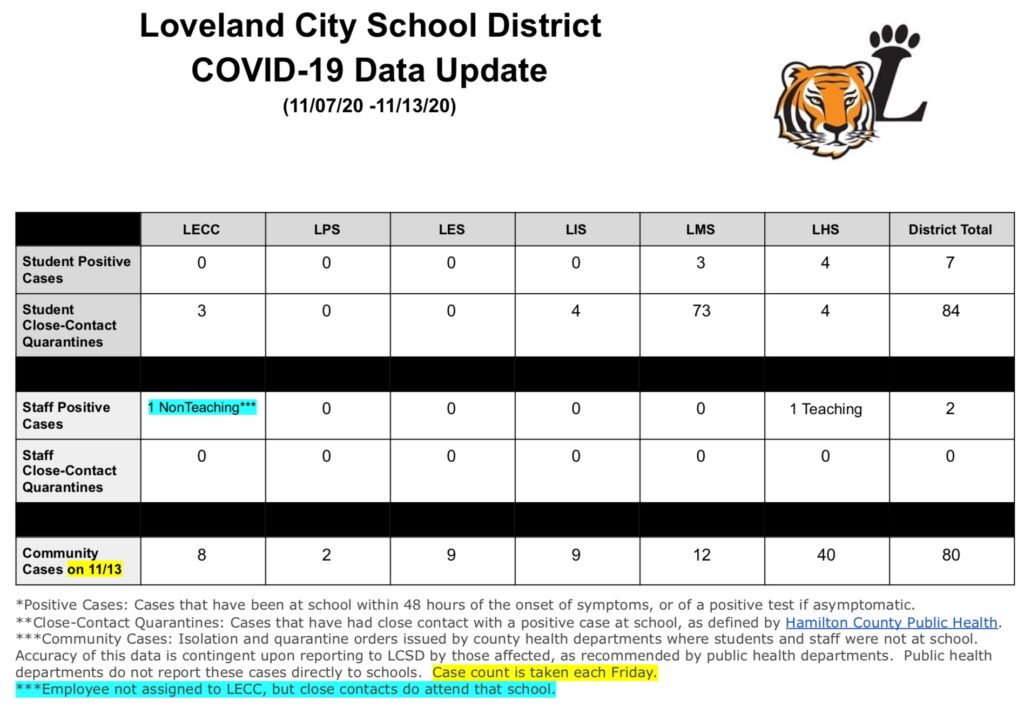
The Loveland City School District reported 16 new COVID 19 CASES since last Wednesday.
Batavia, Ohio – The number of new cases of COVID-19 in Ohio and Clermont County is increasing at an alarming rate according to a statement issued by the Clermont County health district today. The department reports a high of 186 new cases was reported in Clermont County on November 13 and the state of Ohio reported an all-time high of 8,071 new cases.
As of November 12, when the latest public health advisory system numbers were released, Clermont County had a rate of 410 new cases per 100,000 residents. For comparison, on October 1, the county’s rate was only 62 new cases per 100,000 residents. During the week of November 8-14, there was a 140 percent increase in the number of daily cases in Clermont County.
The exponential growth in the number of new cases in Clermont County has made it nearly impossible to keep up with disease investigation and contact tracing. “Up until this point, our goal has been to begin disease investigations within 24 hours of each new case being reported to us,” said Health Commissioner Julianne Nesbit.
Disease investigations take time and involve a public health staff member calling each individual who has tested positive and get details like where they may have been exposed, every location they have been in the previous few days, and every person they may have been in contact with.
After public health does their initial investigation, then they begin the process of contact tracing. That usually involves calling each person who was considered a close contact with the infected person and advising them to quarantine for 14 days from the date of exposure.
“We have hired additional contact tracers, but it’s still not enough to keep up with the demand,” said Nesbit. “Our staff is doing everything we possibly can to keep up with the new cases, we are physically and emotionally exhausted, but we are continuing to do this important work to the best of our ability to protect our community.”
“Our staff is doing everything we possibly can to keep up with the new cases, we are physically and emotionally exhausted
“We have hired additional contact tracers, but it’s still not enough to keep up with the demand,” said Nesbit. “Our staff is doing everything we possibly can to keep up with the new cases, we are physically and emotionally exhausted, but we are continuing to do this important work to the best of our ability to protect our community.”
In addition to hiring additional contact tracers, Clermont County Public Health (CCPH) has been using staff members from every other department to fill in the gaps and assist with contact tracing. CCPH also has a contract with the Ohio Department of Health for additional contact tracers that are being cross-trained to assist with disease investigations.
Public Health has switched from making phone calls in some situations to sending emails to provide information on quarantine to save time. Now, with this many new cases, they have also begun mailing letters to each person that tests positive to save time. Phone calls are still being made when CCPH is aware of situations where there are a large number of contacts and the potential for further spread of the disease.
The letters notify each person that tests positive what to do while they are in isolation and asks them to identify their contacts, who are advised to quarantine. “We are seeing so many new cases, we just cannot possibly keep up at this rate,” said Nesbit.
“Local hospitals are already being stressed,” said Nesbit. “While all hospitals have surge plans in place where they can add more beds and take in more patients, they are going to run out of healthy, experienced workers to care for the sick patients, if this trend continues.”
“We saw in the spring that we can flatten the curve, but we must be extra vigilant now, especially with the holidays coming up,” urged Nesbit.
ccc
The Loveland City School District reported 16 new COVID 19 CASES since last Wednesday.
• On 11/16/20, the district was notified that a student at the Loveland Early Childhood Center tested positive for COVID-19. This student was last at school on 11/12/20.
• On 11/16/20, the district was notified that a student at Loveland High School tested positive for COVID-19. This student was last at school on 11/09/20.
• On 11/16/20, the district was notified that a student at Loveland High School tested positive for COVID-19. This student was last at school on 11/13/20.
• On 11/16/20, the district was notified that a non-teaching staff member from Transportation and Loveland Primary School tested positive for COVID-19. This staff member was last at work / school on 11/12/20.
• On 11/13/20, the district was notified that a staff member at the Loveland Early Childhood Center tested positive for COVID-19. This staff member was last at school on 11/10/20.
• On 11/13/20, the district was notified that a Board of Education Central Office staff member tested positive for COVID-19. This staff member was last at work on 11/12/20.
• On 11/14/20, the district was notified that a staff member at Loveland High School tested positive for COVID-19. This staff member was last at school on 11/6/20.
• On 11/12/20, the district was notified that a student at Loveland High School tested positive for COVID-19. This student was last at school on 11/4/20.
• On 11/13/20, the district was notified that a student at Loveland Middle School tested positive for COVID-19. This student was last at school on 11/10/20.
• On 11/13/20, the district was notified that a student at Loveland High School tested positive for COVID-19. This student was last at school on 11/5/20.
• On 11/12/20, the district was notified that a student at Loveland High School tested positive for COVID-19. This student was last at school on 11/4/20.
• On 11/13/20, the district was notified that a student at Loveland Middle School tested positive for COVID-19. This student was last at school on 11/10/20.
• On 11/13/20, the district was notified that a student at Loveland High School tested positive for COVID-19. This student was last at school on 11/5/20.
• On 11/12/20, the district was notified that a student at Loveland Middle School tested positive for COVID-19. This student was last at school on 11/9/20.
• On 11/12/20, the district was notified that a student at Loveland High School tested positive for COVID-19. This student was last at school on 11/6/20.
• On 11/12/20, the district was notified that a staff member at Loveland High School tested positive for COVID-19. This staff member was last at school on 11/6/20.
The District does not publish quarantine data during the week, only on Fridays.
Right-Click on the image and open in a new tab to see a larger view.
What can you do to help?
Stay home if you are sick.
Quarantine yourself if you have been around someone who recently tested positive for COVID-19.
Wear a mask whenever you are in public.
Avoid large crowds.
Keep at least six feet of space between yourself and others.
Limit contact with people outside of your immediate household. If you are tested and receive a positive test result, you should:
Isolate yourself in your own home, away from others, as much as possible, for at least 10 days after your symptoms first appeared.
Notify each person you had direct contact with (defined as someone within six feet of you for a length of 15 minutes or longer within 24 hours) and ask them to quarantine in their house for 14 days after the potential exposure occurred. For more information or resources, visit the Ohio Department of Health’s coronavirus website at www.coronavirus.ohio.gov or Clermont County Public Health’s website at www.ccphohio.org.
Columbus, Ohio – Governor Mike DeWine Thursday declared that “We’re in a crisis S/state in Ohio.” He was speaking at a COVID 10 news briefing in Columbus.
The governor dithered. The state legislature said no way.
So on Tuesday, the Springfield City Commission took it upon itself to pass a resolution (which lacks the force of law) calling for all residents to cover their faces while indoors, a practice research says will slow the spread of COVID-19 through Ohio.
By Wednesday, Dayton became the first major city in Ohio to require masks by law. Similarly,Yellow Springs passed a resolution andBexley passed a local ordinance requiring masks.
“The mask is a symbol of freedom,” said David Estrop, a Springfield city commissioner, at a hearing, echoing comments from the governor. “It allows us to continue to reopen this state, yet do so in a way that’s safe.”
By Wednesday, Dayton became the first major city in Ohio to require masks by law. Similarly, Yellow Springs passed a resolution and Bexley passed a local ordinance requiring masks.
On Wednesday, the Ohio Department of Health reported more than 1,000 new cases, the first time that stat has reached quadruple digits since officials mass-tested inmates in three state prisons in late April. Wednesday marks 16 days of the coronavirus accelerating its spread, as measured by the 10-day average new caseload.
Despite the worsening coronavirus outlook in Ohio and nationwide, state lawmakers continue to whip up anti-mask fervor. While Gov. Mike DeWine encourages everyone to wear masks, he has refrained from issuing any statewide mandate as the national epidemic worsens and states pause their economic re-openings.
DeWine demurs
In April, Gov. Mike DeWine took a hardline stance on masks, saying they’d be the only way business can reopen after he lifted the stay-at-home order.
Last week, referencing worsening outbreaks in Montgomery and Hamilton counties, DeWine floated the idea of implementing a mask mandate on a county-by-county basis.
However, he has yet to issue any such order. A spokesman declined to say whether DeWine will announce any mask requirement at his next briefing.
In a statement Wednesday, DeWine applauded Dayton Mayor Nan Whaley, a Democrat, for requiring the use of face coverings.
“Wearing a mask will allow us to help keep businesses open and help prevent further spikes,” he said. “I encourage other communities to consider following Dayton’s lead.”
Voted down
Where masks have found friends in the public health community and Ohio cities, they found enemies in the GOP-controlled state General Assembly.
Where masks have found friends in the public health community and Ohio cities, they found enemies in the GOP-controlled state General Assembly.
Both the Speaker of the House and the Senate President have refused to wear masks at legislative functions.
“It’s my RIGHT not to wear a mask, and I do NOT support a government that tries to quarantine the healthy,” he wrote.
Rep. Nino Vitale, R-Urbana, takes to social media regularly to promote baseless conspiracy theories about masks limiting blood oxygen or how they “force virus into the brain.”
Rep. Candice Keller, R-Middletown criticizes Bureau of Workers’ Compensation for distributing masks to Ohio businesses.
Rep. Candice Keller, R-Middletown,produced a Facebook video June 25 criticizing Ohio’s Bureau of Workers’ Compensation for distributing masks to Ohio businesses.
Despite the lawmakers’ claims, research suggests masks are an effective, inexpensive and non-invasive way to slow the spread of COVID-19.


![[Watch video] Ohio Children’s Hospital leaders briefing for school administrators – September 14, 2021](https://lovelandmagazine.com/wp-content/uploads/2021/09/Childrens-Hospitals-Association-video.jpg)