we’re still learning the details of the deadly mass shooting at the FedEx facility in Indianapolis, Indiana. Eight people were shot and killed, and several others were wounded. We mourn for the victims and the survivors, and our hearts are with their loved ones and all those impacted by yet another mass shooting in the U.S.
In the last several weeks, our country has witnessed multiple acts of gun violence. In Chicago, a police officer shot and killed 13-year-old Adam Toledo. In Brooklyn Center, Minnesota, a police officer shot and killed 20-year-old Daunte Wright. In Charlotte, North Carolina, two trans women were shot and killed in hotel rooms. In Knoxville, Tennessee, multiple students from Austin-East High School have been fatally shot in recent weeks. And in mass shootings in Boulder, Colorado; Baltimore County, Maryland; Orange, California; Allen, Texas; Rock Hill, South Carolina; and Atlanta, Georgia, multiple people were shot and killed in each location.
In addition to each of these tragic shootings, so many others occur and never make headlines. The tragedy in Indianapolis is at least the 251st mass shooting since January 2009.1 And every day in the U.S. on average, more than 100 people are killed with guns, and more than 230 are wounded—the majority of which do not take place during mass shootings.
The U.S. Senate needs to listen to the will of the American public and pass background check legislation now; it would be their first major gun safety law in 25 years. And at every level of government, lawmakers must prioritize gun safety and work to end gun violence in all of its forms. In the last year, Indiana’s weak gun laws and the pandemic have exacerbated gun violence, with multiple cities—including Indianapolis—seeing elevated numbers of gun homicides in 2020.
The news of the mass shooting in Indianapolis comes at a time when we’re already thinking about the history of gun violence in America: Today marks 14 years since the mass shooting at Virginia Tech, which left 32 people shot and killed, and 17 others wounded. For all of the victims and survivors of gun violence across the country, we must honor their lives with action.
Thank you for being a part of this movement, and thank you for everything you do to help end our country’s gun violence crisis.
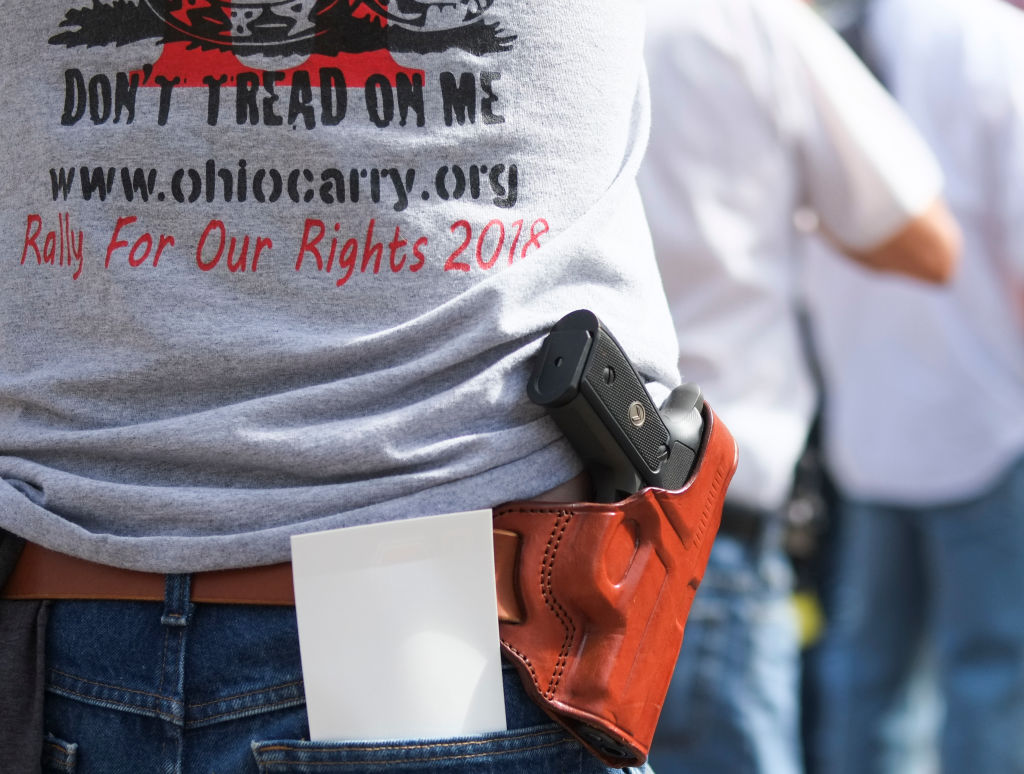
Columbus, Ohio – After a spate of seven mass shootings around the U.S. in seven days, Ohio House Republicans introduced legislation that would allow Ohioans aged 21 and older to carry a concealed weapon without a license.
House Bill 227, introduced Tuesday by Republican Reps. Thomas Brinkman and Kris Jordan and co-sponsored by 20 more, also contains other gun rights expansions including:
Removing the requirement that licensed gun owners “promptly” notify a police officer during a stop that they have a weapon in the car. They would only need to tell the officer about the weapon if asked.
Creating an expungement system for people previously convicted of concealed weapons offenses
Under current law, Ohioans must seek licensure from their local sheriff to lawfully carry a concealed weapon. They must complete eight hours of firearms training and complete criminal background and mental competency checks.
Constitutional carry bills like HB 227 have been introduced in every recent legislative session. However, gun advocates see this two-year session as critical, given it’s the last assembly comprised of members representing gerrymandered districts drawn on partisan lines that favor Republicans.
“This is the session in which we need to pass a constitutional carry bill,” said Rob Sexton, legislative affairs director of Buckeye Firearms Association, discussing the bill and redistricting in a podcast last month.
“This is the time to get it done.”
The bill’s introduction comes on the heels of seven mass shootings (four or more killed or wounded) in seven days in the U.S., according to a CNN report.
Ohio House Speaker Bob Cupp, R-Lima, declined to comment on the legislation while speaking to reporters Tuesday, saying he’s “reserving judgement” until he reads the bill. However, he generally affirmed his support for the Second Amendment to the U.S. Constitution.
Should the bill advance through the legislature, Gov. Mike DeWine could be a wildcard.
After nine died and 27 were injured in a mass shooting in Dayton, he pushed for a comparatively modest set of gun control measures like increasing gun crime penalties and expanding a current legal mechanism allowing a judge to temporarily seize weapons from people with substance abuse or mental health problems.
Lawmakers shelved the proposal and instead passed “stand your ground” legislation last year, removing the legal requirement to retreat before using deadly force in self-defense. DeWine repeatedly raised concerns with the bill, but unexpectedly signed it in the “spirit of cooperation” with lawmakers, he said at the time.
DeWine spokesman Dan Tierney said the governor has not yet taken a position on the legislation.
In 2004, Gov. Bob Taft signed Ohio’s constitutional carry program into law. Ohio Republicans expanded places where license holders can carry and decreased training requirements to obtain the license on multiple occasions since then.
In 2020, more than 169,000 Ohioans were licensed to carry a concealed weapon. More than 400 licenses were revoked for causes including felony convictions and mental incompetence, according to a report from the attorney general.
Columbus, Ohio – Ohio Governor Mike DeWine today announced a series of legislative reforms to address gun violence and outlined further action to increase mental health prevention, identification, and treatment to better protect Ohioans.
“Gun violence doesn’t just take the form of mass shootings, people are victims every day in Ohio and across the country,” said Governor DeWine. “I believe that this is both a public safety issue and an individual wellness issue – we must address both sides to help solve the problem. It’s time to do something, and that is exactly what we are going to do.”
This series of solid, workable reforms will help get guns out of the hands of people who should not have them under the law while protecting the rights of law-abiding citizens who are entitled to the right to bear arms and will help prevent and treat those struggling with mental illness.
Governor DeWine’s proposals include:
Safety Protection Orders
Governor DeWine is asking the legislature to pass a law to allow courts to issue Safety Protection Orders which would remove firearms from potentially dangerous individuals and get them the mental health treatment they need all while maintaining an individual’s right to due process.
Increased Access to Inpatient Psychiatric Care
Over the past several years, Ohio’s state psychiatric hospitals have become predominantly used by patients who are court-ordered there for restoration to competency to stand trial. This week 79% of the adults in our state psychiatric hospitals are under court order. The Ohio Department of Mental Health and Addiction Services (OhioMHAS) is working to create a process where courts and community-based providers can work together to restore competency for those to stand trial in an outpatient setting which will free more hospital beds and decrease wait time for admission. The Ohio General Assembly will need to pass legislation to create this community-based misdemeanor competency restoration process.
Early Intervention
As part of the 2019-2020 biennium operating budget, the state is investing $675 million in wrap-around services for schools to design individualized programs, working with local mental health providers or social service organizations, to address the social and emotional challenges our students face.
Access to Behavioral Health Services
The Ohio Department of Medicaid is investing $15 million in telehealth mental health services to students, so no matter where a child lives, they have access to high-quality mental health care.
Risk Factor and Resource Identification
OhioMHAS will be working with communities to increase knowledge of risk factors, help parents identify when their child is showing warning signs of a mental illness. The department will share screening tools with clinicians and help connect community-based services to link parents, families, and schools with proven supports and strategies to manage a child’s wellness over the child’s lifetime.
Background Checks
Governor DeWine is calling on the Ohio General Assembly to pass a law requiring background checks for all firearms sales in the state of Ohio with certain limited, reasonable exceptions, including gifts between family members.
Increased Penalties for Felons Who Illegally Possess Firearms
Gun violence occurs in neighborhoods and communities every day across Ohio and the nation. Law enforcement reports that the majority of this violence is perpetrated by a relatively small number of individuals who don’t have the right to possess a gun. Governor DeWine is calling on the General Assembly to increase penalties on felons who illegally possess or use guns.
Increased Penalties for Violent Felons Who Illegally Possess Firearms
Governor DeWine is calling on the General Assembly to increase penalties violent felons and other people found with a gun they do not have the legal right to possess. The crime of having a weapon while under a disability is currently a third-degree felony punishable by a maximum of three years in prison. On a first offense, the crime should be a second-degree felony punishable by two-to eight-years in prison, and for subsequent offenses, it should be a first-degree felony punishable by three- to eleven-years incarceration.
Increased Penalties for People Who Commit Felonies while in Possessing Firearms
This proposal would increase penalties for people who commit felonies with a firearm or who possess a firearm while committing a felony to a mandatory additional one- to three-year sentence.
Increased Penalties for Brandishing a Gun
The General Assembly should pass a law that increases the penalty for those who commit a felony while brandishing a firearm to a mandatory three- to five-year sentence.
Increased Penalties for Straw Purchases
So-called “straw” purchases, the act of purchasing guns for or giving guns to another individual are currently illegal under Ohio and federal law. However, this practice is far too common, so Governor DeWine is calling on the General Assembly to increase the penalty for a straw purchase to a second-degree felony punishable by two to eight years in prison.
Increased Penalties for Illegally Obtained Guns
We should increase the penalty for a person who possesses a firearm that they know was obtained through an illegal or fraudulent purchase in order to avoid a federal background check. A person who possesses the gun should be punished in the same manner as a person who bought the firearm, increasing the penalty to a second-degree felony punishable by two- to- eight years in prison.
Increased Penalties for Those Who Improperly Provide Firearms to Minors
Too many kids are carrying guns on the streets often with tragic consequences. Adults who furnish firearms to minors must be held accountable. Governor DeWine proposes that the General Assembly increase the penalty for improperly providing a firearm to a minor to and a third-degree felony punishable by up to three years in prison.
School Tip Line
The DeWine administration is expanding the state’s school safety tip line, where kids and adults can call or text anonymously to 844-723-3764 with tips about potential school violence.
Social Media Monitoring
In a 24-7 world of social media, threats can arise at any time. The Hub at the Ohio Department of Public Safety is expanding its ability to monitor and track potential threats on social media and will share that information with local school and local law enforcement.
Community Safety
The operating budget provides nearly $9 million to help harden soft targets like non-profits and religious organizations to make their facilities more secure.
School Safety and Intervention Programs
Working closely with Sandy Hook Promise, Ohio’s schools are implementing their “Know the Signs” safety program across the state. This program equips school staff with knowledge and skills to identify potential threats of violent action and take steps to intervene. There are 23 training dates already scheduled.
“I believe these proposals fulfill three important requirements. They can pass the legislature, they make meaningful progress toward safer communities, and they are Constitutional. Passing them won’t be easy, but this is the right thing to do and this is the right time to do it,” Governor DeWine added. “We can pull together to do meaningful things to protect lives. It won’t be easy, but I believe in this state, and I believe in our people.”