Tag: Matt Borges

  • Ohio utility regulator front and center in massive bailout scandal

    Ohio utility regulator front and center in massive bailout scandal

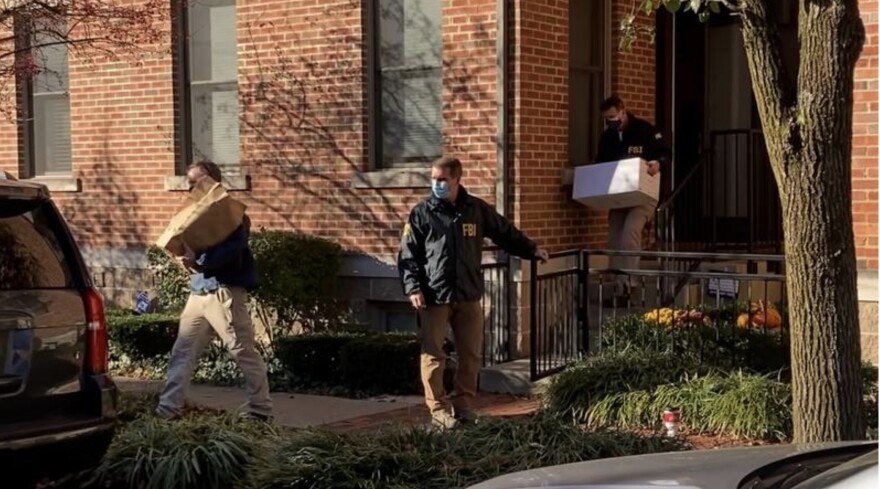
    FBI agents remove boxes of materials from PUCO Chairman Sam Randazzo’s condo in Columbus Nov. 17, 2020. Photo courtesy of Daniel Konik/Statehouse News Bureau.

    BY: MARTY SCHLADEN – Ohio Capital Journal

    CINCINNATI — Ohio’s utility regulator is at the center of a massive bribery and money laundering scandal that has been the focus of a trial here since late last month. In 2019, its chairman and a very recent senior official played a central role in writing corrupt bailout legislation that would give more than $1 billion in subsidies to companies the Public Utilities Commission of Ohio was supposed to be regulating.

    But did their role in the process violate any PUCO rules? The answer is unclear.

    When it comes to being a consumer watchdog, the PUCO doesn’t have the best track record. 

    Since 2008, it has granted more than $1 billion in electric rate increases that were later declared illegal by the Ohio Supreme Court. But, thanks to the way the increases — or “riders” — were written, there’s no way to force utilities to return those ill-gotten gains to ratepayers.

    In at least one of those instances, a regulator might have known the rate hike was illegal when he voted to grant it.

    In June of 2019 — as Akron-based FirstEnergy was funneling millions through dark-money groups to pass the bailout that is the subject of the trial here — the Supreme Court struck down an increase that had already paid the company a non-refundable $460 million. Asim Haque, who months earlier was chairman of the PUCO, sent a FirstEnergy executive a text suggesting that Haque knew the increase was illegal when he voted for it. Haque then said he was just kidding.

    Then, just last month, the PUCO approved an increase of more than 50% in fixed rates for Columbia Gas without making the company go through a formal process to show that it needs the money. That means that after five years throughout much of Ohio, it likely will cost nearly $60 a month just to have gas service  — regardless of whether you live in a 500 square-foot apartment or if you live in a mansion on a five-acre lot. Any payments for gas itself will be in addition to that amount.

    It doesn’t appear that Columbia owner NiSource needed the money. Last year, before the PUCO allowed the rate hike, NiSource’s profits came in $217 million — or 41% — higher than expected. Then, a month after the increase was granted, NiSource announced it was increasing its profit forecast for 2023.

    In a press release, the company boasted of “strong regulatory execution” — including by winning the fixed-rate increase from the PUCO.

    And then there’s House Bill 6, the 2019 law that is the subject of the trial in federal court here that has been ongoing since Jan. 23.

    Former Ohio House Speaker Larry Householder and former Ohio Republican Party Chairman Matt Borges are on trial for their participation in what prosecutors say is likely the biggest bribery and money laundering scandal in Ohio history. They allege that $61 million that mostly came from FirstEnergy was used to make Householder speaker in 2019, and then to pass and protect the $1.3 billion bailout. Most of that money was intended to prop up FirstEnergy’s failing nuclear and coal plants.

    No current or former PUCO employees have been charged in the scandal. But, to put it charitably, the conduct of at least two of them was puzzling — given that the agency’s mission is to protect ratepayers who don’t have a choice about buying the utilities’ products.

    In January 2019, Householder won the speakership and was beginning his push for a FirstEnergy bailout. At the same time,  FirstEnergy lobbyist Ty Pine sent PUCO senior advisor Pat Tully’s resume to Jeff Longstreth, Householder’s right-hand man, according to testimony in the trial. Within weeks, Tully had moved from his PUCO job to one as senior advisor for energy policy in the House Republican Caucus.

    Sam Randazzo, a former FirstEnergy consultant, was confirmed as Gov. Mike DeWine’s nominee to chair the utility commission in April 2019. When he nominated Randazzo, DeWine brushed off warnings that his nominee had “opaque and undisclosed” ties to FirstEnergy.

    In the Householder trial, Tully testified that while Randazzo was still a nominee, he met with Tully, Householder and Rep. Nino Vitale R-Urbana. From there, Tully worked with Randazzo to help draft the utility bailout, HB 6, and to reconcile it with draft legislation submitted by FirstEnergy. The bill secured final passage in July 2019 — months after Randazzo had taken the helm at the utility commission.

    In other words, Ohio’s top utility regulator helped write a law that gave a billion-dollar bailout to a company he was supposed to be regulating on the ratepayers’ behalf. And he was heading an agency that over the previous decade had awarded electric utilities more than $1 billion in illegal, non-refundable rate hikes.

    Randazzo would later resign after the FBI in 2020 raided his Columbus condo. And in a deferred prosecution agreement, FirstEnergy admitted that it paid him $4.3 million just before he became PUCO chairman.

    But does the PUCO have any rules against the role Randazzo played in drafting HB 6? 

    Asked if the agency had a policy prohibiting a commissioner from helping write legislation affecting a utility he or she is supposed to be regulating, spokesman Matt Schilling initially seemed to say that it did not.

    “The PUCO is a state agency and will always be responsive to requests for information or technical assistance to the Ohio General Assembly on matters related to utilities and commercial transportation,” Schilling said in an email last week.

    But in answer to a follow-up, Schilling seemed to say something different. He was asked if that means PUCO believes there was nothing inherently improper about its chairman helping to draft legislation creating subsidies for utilities the agency regulates.

    “No, I never stated anything like that,” Schilling replied. “The PUCO does not comment on ongoing proceedings or court cases.”

    So what about commission employees doing as Tully did when he had a FirstEnergy lobbyist passing out his resume? After all, you might pull punches as a regulator if you’re hoping to land a job with one of the companies you’re supposed to be regulating.

    Schilling’s response might not be very reassuring. He cited a law that “prohibits Commission employees from seeking employment with utilities regulated by the Commission.”

    But Schilling also sent along agency guidance that contains a pretty big loophole.

    “Although this law prohibits Commission employees from soliciting Commission-regulated utilities for employment, it does not prevent employees from considering employment opportunities with these utilities in instances in which the utility approaches the employee,” it said.

    It seems that, after the fact, it might be difficult for the PUCO to figure out who approached whom when an employee jumps ship for a well-paid utility job. And its protections against conflicts of interest during the hiring process don’t seem ironclad.

    “However, if you are contacted by a utility concerning a possible job offer, you must immediately advise your supervisor of the contact so that your supervisor can limit your duties to matters which do not involve the utility in question while any discussions are taking place,” the guidance said.

    In Tully’s case, he didn’t end up directly on FirstEnergy’s payroll. But he did help write a law that the company paid more than $60 million for.
  • Defense lawyer boils over in Ohio utility bailout and political bribery racketeering trial

    Defense lawyer boils over in Ohio utility bailout and political bribery racketeering trial

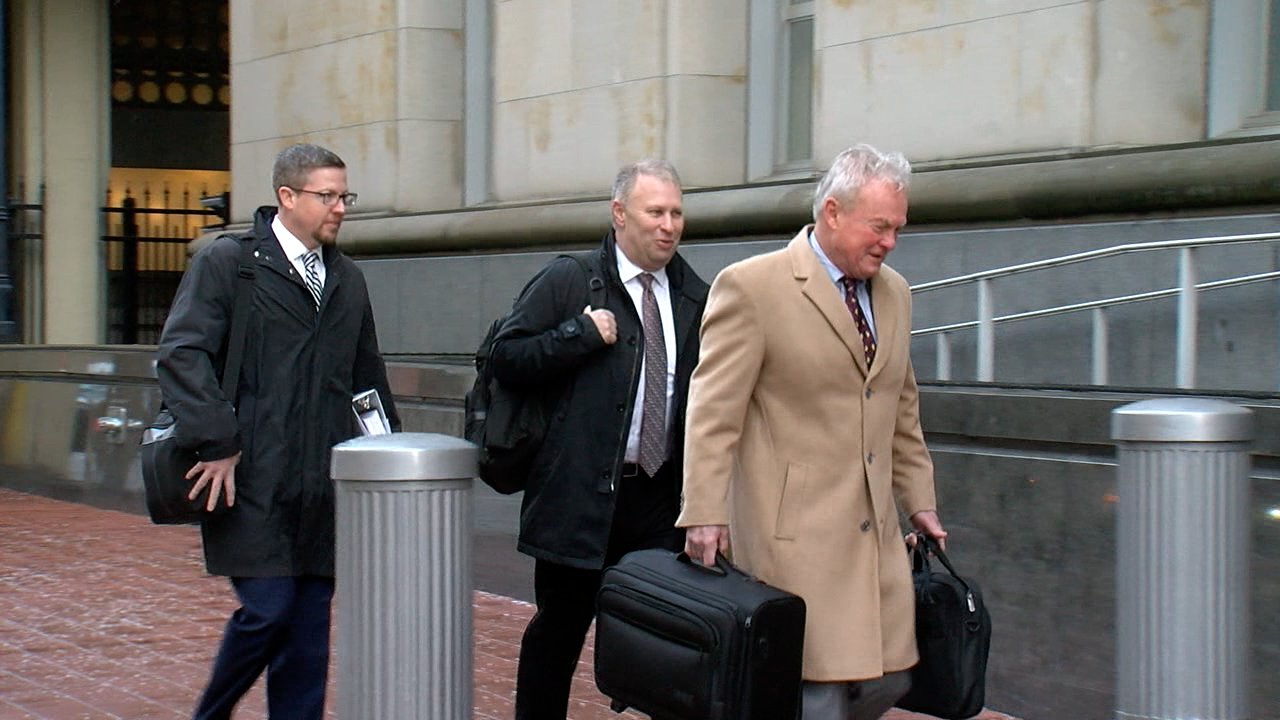
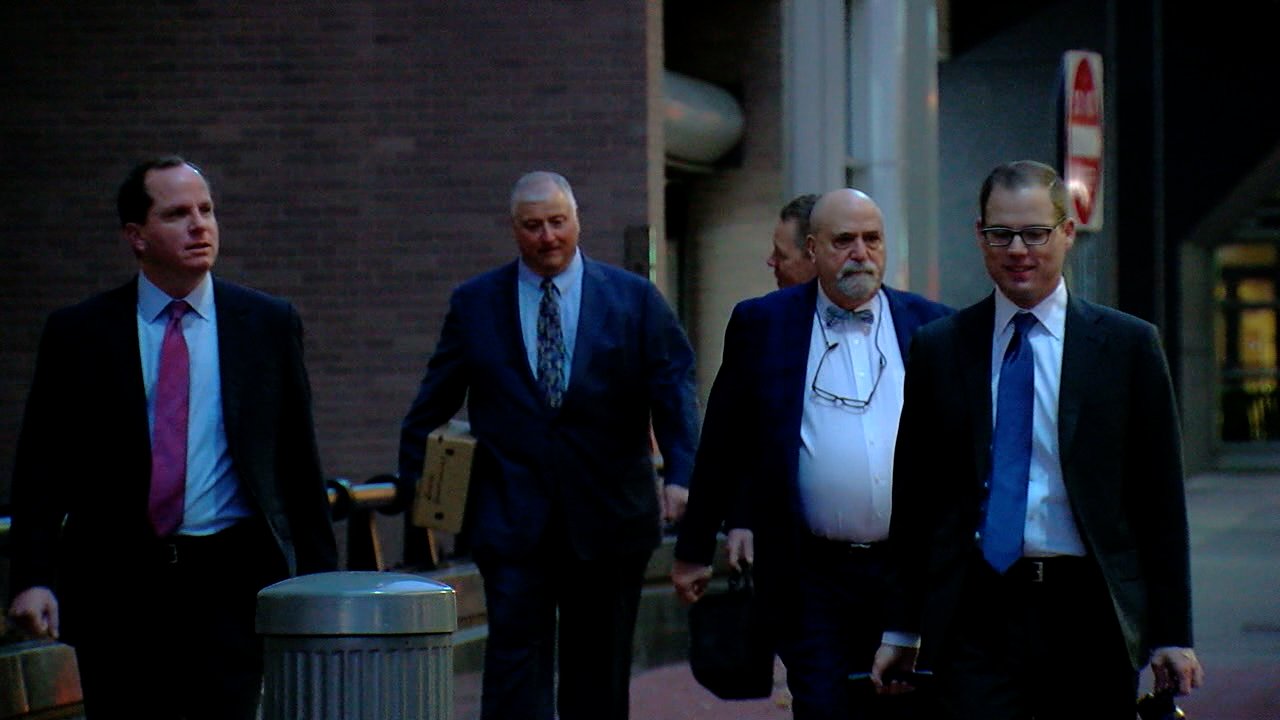
    Former Ohio House Speaker Larry Householder, a Perry County Republican, second from left, with attorneys outside of his racketeering trial. Photo courtesy of WEWS.

    BY: MARTY SCHLADEN – Ohio Capital Journal

    CINCINNATI — The defense of former Ohio House Speaker Larry Householder erupted Thursday in Householder’s epic corruption trial.

    Defense attorney Mark Marein of Cleveland suggested it was because of U.S. District Judge Timothy Black’s unfairness. But it came after a day in which the defense team’s attempts to undermine prosecution witnesses’ credibility might have come to naught.

    The sparks flew in the fourth week of the trial. Householder and former Ohio Republican Party Chairman Matt Borges are accused of racketeering in a scheme to use $61 million in utility money to make Householder speaker and pass a $1.3 billion bailout that mostly benefited Akron-based FirstEnergy, the primary contributor.

    Earlier on Thursday, defense attorney Steven Bradley cross examined Jeffrey Longstreth, who operated as Householder’s right-hand man through his bid for the speakership and the 2019 passage and defense of the bailout law, House Bill 6.

    Longstreth was arrested along with Householder, Borges, and two others in July 2020. He is now cooperating with prosecutors in exchange for a sentencing recommendation of less than six months.

    The dinners

    During direct examination Wednesday, Longstreth described fancy dinners with Householder and FirstEnergy’s top executives during Donald Trump’s inauguration in 2017 in Washington, D.C. 

    At one, Longstreth described being at one end of a long table with FirstEnergy Vice President Michael Dowling in a noisy steakhouse, while Householder sat with company CEO Chuck Jones at the other. Longstreth said he couldn’t hear the conversation at the other end of the table, but at his end Dowling told him FirstEnergy needed help and it wanted to help Householder become speaker.

    Dowling instructed Longstreth to set up an organization to receive FirstEnergy’s millions, Longstreth said. 

    “He said (the money) needed to be undisclosed and unlimited contributions,”  Longstreth testified on Wednesday.

    Apparently seeking to impeach Longstreth’s memory, Bradley on Thursday showed the jury an itinerary indicating that Jones took the FirstEnergy corporate jet to D.C. the morning after the steakhouse dinner. He also produced a credit card receipt showing that Jones attended a dinner at a different restaurant the following night than where a second, more-intimate dinner was described by Longstreth on Wednesday.

    But Assistant U.S. Attorney Emily Glatfelter asked Longstreth if itineraries change. He agreed they often do.

    She then produced credit card receipts and car records that indicated Jones may well have been in D.C and could have attended the first dinner as Longstreth described. She also showed that on the following night, the dinner Bradley said Jones attended ended about 30 minutes before the one Longstreth said he attended began.

    Longstreth testified that it was common at presidential inaugurations to attend multiple receptions and dinners in the same evening. Apparently that’s a major purpose of the quadrennial gatherings: To stay in $600 hotels, eat multiple $200 dinners, and figure out how to split up the taxpayers’ —or  ratepayer’s — money.

    Whistleblower former state Rep. Dave Greenspan

     Former State Rep. Dave Greenspan, R-Westlake. Official photo.

    After Longstreth left the stand, the prosecution called former state Rep. Dave Greenspan, R-Westlake. He said he never voted to make Householder speaker and he never supported House Bill 6. 

    “I didn’t believe in corporate bailouts,” Greenspan said, explaining that this one was especially hard to support because FirstEnergy hadn’t shown that it needed the money and the bill put no restrictions on how it was spent. “There was nothing in the bill that required FirstEnergy to do anything.”

    As a sign of how unpopular the bill was, 17 Republicans voted against it when it passed the House in April 2019. And it’s an important reminder that it would never have become law without the support of Ohio House Democrats.

    Greenspan described the intense pressure he was under from Householder and lobbyist Neil Clark to vote for the bill. He was so disturbed by it that he contacted a member of the U.S. Marshal’s Service, who put him in touch with the FBI.

    During cross examination, Marein, another of Householder’s attorneys, seemed dumbfounded that Greenspan contacted the FBI, which he referred to as the “Federal Bureau of Investigation” in a tone that in many places would pass for shouting.

    Then, as he tried to read lengthy passages of Greenspan’s grand jury testimony, Judge Black repeatedly cut the attorney off and told him to ask a question.

    Another attack at the judge

    On Feb. 1, Marein undertook a risky gambit by accusing the judge of bias, saying that Black had it in for his client because Householder opposed Black’s run for Ohio Supreme Court 22 years ago. After the jury filed out Thursday afternoon, Marein doubled down.

    He started off so loudly that Black admonished Marein to show the same respect for him that Black believed he’d shown Marein.

    A little more quietly, Marein said, “You’re really tying our hands. Overruling our objections. Quite frankly, I don’t know what’s going on.”

    Then he added, “Is there something personal against Mr. Householder?”

    When Marein finished, Black asked, “Is that all?”

    Marein said yes, Black banged his gavel and said, “We’re in recess.”

  • Former associate testifies that ex-Ohio GOP Chair Borges paid to spy on bailout repeal effort

    Former associate testifies that ex-Ohio GOP Chair Borges paid to spy on bailout repeal effort

    BY: MARTY SCHLADEN – Ohio Capital Journal

    CINCINNATI — Former Ohio Republican Party Chairman Matt Borges paid $15,000 off the books in 2019, a witness testified Tuesday. It was in an attempt to gather inside information about the campaign to repeal a $1.3 billion utility subsidy that had just been passed by the legislature, a Borges associate said.

    In addition, the chairman of the company that benefited most from the subsidy in an email referred to the scheme as a “black op” and said he was prepared “to do whatever it takes” to defeat the repeal effort, the witness, Juan Cespedes, said. Coincidentally, the chairman, John Kiani, started his career at Enron, a Houston Energy company that collapsed under a wave of unmet contracts and accounting scandals in 2001.

    It was the 11th day in the federal court trial of Borges and former Ohio House Speaker Larry Householder, R-Glenford. Borges is accused of assisting Householder and others in a scheme to use $61 million from Akron-based FirstEnergy to make Householder speaker and pass the massive bailout.

    The bulk of the bailout was intended to benefit money-losing nuclear and coal plants owned by FirstEnergy subsidiary FirstEnergy Solutions. It was going through bankruptcy proceedings and executives with the parent company and the subsidiary desperately wanted the bailout to complete the bankruptcy, spin off FirstEnergy Solutions and possibly sell the nuclear plants.

    Gov. Mike DeWine signed the bailout the same day it passed in 2019, but a repeal effort started amid reports that it was “the worst energy bill of the 21st century.” Not only did it prop up 70-year-old coal plants under the guise of being a “Clean Air Program,” it also gutted the state’s renewable energy standards.

    Borges was part of a team of lobbyists who worked to pass and protect the bailout, House Bill 6. And, because of his long experience in Ohio politics, he was asked to make use of some of his relationships in the effort, Cespedes, another member of the team, testified.

    Cespedes was also charged with racketeering, but he pleaded guilty and is cooperating with prosecutors.

    The off-the-books payment

    One of the primary acts Borges is charged with has to do with a $15,000 payment he made during the repeal effort to Tyler Fehrman, who was helping manage the campaign to gather enough valid signatures to get the repeal on the ballot. 

    Inside information was valuable to the pro-H.B. 6 team because it enabled them to gauge the strategy and likelihood of success of the repeal effort.

    Cespedes testified that he tried to keep the plan to recruit Fehrman from Kiani, the FirstEnergy Solutions chairman whose company financed a big portion of the fight against the repeal. Kiani was a hard-charging executive and Cespedes believed that once he learned of the spying effort, he would press the operatives relentlessly. 

    However, Cespedes said, Borges told Kiani about it, and it seems Cespedes’s worries were well founded.

    In an Aug. 31, 2019 text, Kiani asked “what happened to the black ops?” in a reference that Cespedes said was to the spying effort. Then, in a Sept. 2, 2019 text, Cespedes told Borges that Kiani, “reiterated to do whatever it takes to get this information.”

    It appears that Fehrman was paid, but it’s unclear what he was paid for.

    In taped conversations played earlier in the trial, Borges discussed paying Fehrman, but he claimed to Fehrman that it was for work Fehrman might do some time in the future. But Borges made other statements that seemed to show that he knew the two were doing something wrong.

    “It would be bad for both of us if the story came out,” he told Fehrman in a recording that Fehrman made with the help of the FBI. “But it would be worse for you.”

    On Tuesday, Cespedes testified that he roughed out a budget at the time of the repeal campaign. He made an entry in it to pay $25,000 to an “employee.” Cespedes said the money was intended for Fehrman.

    Asked why he used “employee” to label the entry, Cespedes said, “I wasn’t going to write ‘bribe.’ I wasn’t going to write anything nefarious.”

    Prosecutors displayed a photograph of what they said was a contemporaneous budget that Borges roughed out in a notebook that Cespedes had photographed. Cespedes testified that when he asked Borges why a payment to Fehrman wasn’t in it, Borges “simply said it wasn’t something he wanted to write down.”

    Cespedes testified that Fehrman later went quiet on Borges and Cespedes assumed that their deal had fallen through. But after the repeal campaign had failed, an accounting showed that the $15,000 had been paid, Cespedes said. 

    When he asked Borges about it, “He said, ‘I just wanted to keep him quiet,’” Cespedes testified.

    Earlier in the HB 6 fight, Borges and Cespedes were struck by Kiani’s connections to Enron, which ceased to exist after one of the biggest corporate scandals to that point in American history.

    “The shocking thing last night was learning that Kiani came from Enron,” Borges said in a text.

    Kiani went from there to work as a hedge fund manager and then he made his way onto the FirstEnergy Services board as an activist investor. Cespedes testified that a Kiani aide told him that Kiani would make $100 million from the sale of FirstEnergy Solutions’ nuclear plants. 

    Regardless of whether that’s accurate, Kiani clearly was willing to spend lots of corporate money to win subsidies for them. To fund a statewide, eight-week media campaign for the bailout, bankrupt FirstEnergy Solutions approved a $15 million budget, Cespedes testified.

    That amount would grow after the bill passed and the repeal fight got underway.

    Kiani continues to be executive chairman of Energy Harbor, the new name for FirstEnergy Solutions after it emerged from bankruptcy. His company bio credits him with “the successful operational and financial turnaround of Energy Harbor into a leading, carbon free power infrastructure and energy supply company.”

  • Fate of former Ohio House speaker could hinge on whether he took an “official act”

    Fate of former Ohio House speaker could hinge on whether he took an “official act”

    Larry Householder addresses reporters after lawmakers voted to expel him from the General Assembly. He has pleaded not guilty to a racketeering charge and awaits trial. Photo by Jake Zuckerman, OCJ.

    BY: MARTY SCHLADEN – Ohio Capital Journal

    It appears that federal prosecutors have a mountain of evidence they want to present to the jury in their racketeering case against former Ohio House Speaker Larry Householder and former Ohio GOP Chairman Matt Borges. 

    They have emails, text messages, wiretap transcripts, and the testimony of undercover agents and confidential informants. They have so much material that U.S. District Judge Timothy Black said prosecutors and defense attorneys labored mightily before the trial even started to agree on what could be presented to the jury. The process was meant to avoid bogging down what’s already expected to be a six-week ordeal.

    But all that evidence could miss the mark if none of it shows that Householder undertook an “official act” in exchange for all the millions Akron-based FirstEnergy funneled into 501(c)(4) dark money groups to support the effort to elect friendly Republicans who would vote to make Householder speaker. The U.S. Supreme Court overturned a public corruption conviction on that basis just six years ago.

    Householder is accused of masterminding a conspiracy to use $61 million from FirstEnergy and other utilities to make himself speaker and in return ramming through a $1.3 billion ratepayer bailout of failing nuclear and coal plants. His trial began last week, but after two days of testimony it was delayed — first because of weather and then because a juror was diagnosed with COVID.

    But last week, FBI Special Agent Blane Wetzel testified about conduct that made both Householder and FirstEnergy look pretty bad.

    Householder is accused of using about $500,000 from the dark money groups to pay off credit card debt, settle a lawsuit, and repair a Florida home. Meanwhile, FirstEnergy was losing so much money on its nuclear and coal plants that in 2016 it started the process that would send the subsidiary that owned them into bankruptcy.

    But even as the company and Householder were swimming in red ink, he and the company’s CEO flew to Washington, D.C., on private jets in January 2017 for three days of dinners and drinks at some of the city’s swankiest bars and restaurants, Wetzel said. 

    Within two weeks, FirstEnergy money was flowing into Householder-controlled dark-money accounts. In November of 2018, enough Householder-friendly Republicans were elected — many with the help of money from those accounts — to make him speaker the following January. Less than six months later, on May 28, 2019, the House passed its first version of the billion-dollar bailout, House Bill 6. The body passed a final version on July 23, 2019 and Gov. Mike DeWine signed it the same day.

    When former U.S. Attorney David M. DeVillers announced Householder’s arrest almost exactly a year later, he called the scheme with FirstEnergy “likely the largest bribery and money-laundering scheme ever in the state of Ohio.”

    But did Householder undertake an official act in exchange for money corruptly received from FirstEnergy and other Ohio utilities? The answer might not be as straightforward as you think.

    For their part, Householder’s attorneys are arguing that their client was merely raising money like any effective politician would and that he only wanted to subsidize the power plants to save Ohio jobs and the tax bases of school districts.

    In addition, the Supreme Court in 2016 threw out the conviction of former Virginia Gov. Bob McDonnell even though he and his wife took more than $170,000 worth of loans and gifts from a businessman in exchange for hosting him at functions, recommending his product to state agencies, and trying to persuade state universities to study it.

    At issue was whether any of those were “official acts.”

    In that case, Jonnie Williams, CEO of Star Scientific, supported the Virginia Republican’s successful 2009 campaign. Once in office, the gifts really started to flow — including $20,000 worth of designer clothing for McDonnell’s wife, Maureen McDonnell, and a Rolex watch that Maureen gave Bob for Christmas.

    Williams was peddling a compound found in tobacco as a nutritional supplement called Anatabloc. In 2011, the McDonnells hosted an event at the Governor’s Mansion that Williams testified was intended to launch the product. He wanted scientists at the state’s universities to research it, but neither he nor the McDonnells could interest them in the supplement.

    The governor also told the state secretary of administration and the director of the Virginia Department of Human Resources that it would be a good idea for all state employees to take Anatabloc like he was. The officials apparently didn’t take the hint. 

    Investigators caught wind of the McDonnells’ arrangement with Williams and charged them with numerous crimes related to bribery.

    In 2014, they were convicted in federal court and Bob and Maureen were sentenced to two and one year in prison, respectively. They appealed, but the 4th U.S. Circuit Court of Appeals in Richmond upheld the conviction.

    However, when the case made it north to the U.S. Supreme Court, in Washington, D.C., it was overturned. Unanimously.

    Chief Justice John Roberts, the author of the ruling, said that the court took up the case expressly “to clarify the meaning of ‘official act.’” 

    In his trial, “Governor McDonnell had requested the court to further instruct the jury that the ‘fact that an activity is a routine activity, or a ‘settled practice,’ of an office-holder does not alone make it an ‘official act,’ and that ‘merely arranging a meeting, attending an event, hosting a reception, or making a speech are not, standing alone, ‘official acts,’ even if they are settled practices of the official,’ because they ‘are not decisions on matters pending before the government.’” Roberts wrote.

    Instead, McDonnell’s lawyers argued, an official act must be intended to “influence a specific official decision the government actually makes — such as awarding a contract, hiring a government employee, issuing a license, passing a law, or implementing a regulation.”

    In overturning the convictions, the high court agreed, ruling that the McDonnells could still be prosecuted, but the “Government must identify a ‘question, matter, cause, suit, proceeding or controversy’ that ‘may at any time be pending’ or ‘may by law be brought’ before a public official. Second, the Government must prove that the public official made a decision or took an action ‘on’ that question, matter, cause, suit, proceeding, or controversy, or agreed to do so.”

    How much comfort Householder should take from the ruling is uncertain, however. Roberts ended the ruling with what seems to be a warning to politicians thinking of doing shady stuff.

    “There is no doubt that this case is distasteful; it may be worse than that,” he wrote. “But our concern is not with tawdry tales of Ferraris, Rolexes, and ball gowns. It is instead with the broader legal implications of the Government’s boundless interpretation of the federal bribery statute. A more limited interpretation of the term ‘official act’ leaves ample room for prosecuting corruption, while comporting with the text of the statute and the precedent of this Court.”

  • Corruption trial delayed by COVID

    Corruption trial delayed by COVID

    Former Ohio House speaker Larry Householder arrives for day two of his racketeering trial. Photo by Morgan Trau, WEWS.

    BY: MARTY SCHLADEN – Ohio Capital Journal

    CINCINNATI — A federal court trial over allegations of epic public corruption has been interrupted at least until Monday after a juror was diagnosed with COVID on Wednesday.

    “The Court was advised this afternoon that a juror has tested positive for COVID-19,” U.S. District Judge Timothy Black wrote in an order Wednesday evening. “In an effort to ensure everyone’s safety, jury trial will not convene for the duration of the week. The recess is CONTINUED until Monday, 1/30/2023 at 9:30 a.m.”

    In the trial, former Ohio House Speaker Larry Householder and lobbyist Matt Borges are accused of racketeering. 

    Householder is accused of masterminding a scheme in which $61 million — mostly from Akron-based FirstEnergy — was used to help elect Republican lawmakers who would make Householder speaker in 2019. In exchange, prosecutors say, Householder shepherded through a $1.3 billion utility bailout package and then protected it from a ballot initiative intended to repeal the measure.

    Borges is accused of acting corruptly in the successful effort to block the repeal.

    The great majority of the ratepayer money was intended to prop up two failing nuclear plants in Northern Ohio owned by FirstEnergy subsidiary FirstEnergy Services. Some went to “recession proof” coal-fired plants owned by the subsidiary that FirstEnergy management regarded as unsellable. 

    Even though the law was billed as a “clean air” measure, the rest of the package went to subsidize coal plants owned by utilities other than FirstEnergy — including a plant that’s not even in Ohio. Of the three tranches of subsidies, that is the only one that’s still in effect after FirstEnergy entered into a deferred-prosecution agreement.

  • Judge scolds former GOP chairman, forbids him from intimidating whistleblower

    Judge scolds former GOP chairman, forbids him from intimidating whistleblower

    Photo by Getty Images.

    BY: JAKE ZUCKERMAN Ohio Capital Journal

    A federal judge lambasted a suspect in a criminal public corruption case for posting a FBI informant’s social security number and address on the internet.

    U.S. District Judge Timothy Black said he finds it “entirely incredible” that lobbyist and former GOP Chairman Matt Borges accidentally posted the information of the whistleblower online, as Borges claimed.

    “Indeed, page 3 of the file alone includes [the informant’s] name, address, phone number, spouse’s name, spouse’s phone number, and [the informant’s] social security number, all of which are listed in large, bold font, at the very top of the page,” Black said, using the visual emphasis in his court order.

    “It is virtually impossible for anyone to scroll through the file and not see that it contains unredacted personal identifiers.”

    Federal prosecutors have accused Borges of participating in a scheme alongside former GOP House Speaker Larry Householder and three others to take $60 million from FirstEnergy Corp. and enrich themselves while ensuring passage of favorable legislation for the company.

    FirstEnergy has since admitted to giving $60 million to a nonprofit secretly controlled by Householder in exchange for his help passing House Bill 6 in 2019. Borges allegedly used $15,000 of the money to bribe a political operative for inside information about a campaign to overturn the recently-passed legislation via a ballot referendum.

    Borges worked as a lobbyist for a FirstEnergy subsidiary at the time, with deep Republican connections from his time running the state party.

    Prosecutors asked Black earlier this week to modify the conditions of Borges’ bond. They said an FBI agent noticed in June that Borges posted the informant’s employment file online, including his tax documents and photocopies of his social security card and driver’s license. They requested the judge block Borges from posting the information in a continued effort to intimidate a witness.

    In charging documents, the informant was not personally identified. However, consultant Tyler Fehrman has since acknowledged he’s the unnamed whistleblower in media reports.

    Prosecutors called Borges’ actions an “attempt to intimidate and retaliate against” the informant. They requested Black forbid him from posting Fehrman’s sensitive information online.

    Attorneys for Borges said he obtained the employment file via public records request and sharing the personal identifying information online was “inadvertent.”

    Black sided with prosecutors. Besides the financial risks of posting a social security number online, he said, “financial harm is by no means the most severe consequence that could result from publicly exposing and disparaging a confidential government source.”

    According to the prosecution, Borges told Fehrman that if he provided inside information from the campaign, Borges would give him a job or money to pay off his debts. Fehrman —who managed field workers soliciting signatures to put the repeal on the ballot — covertly recorded the conversation.

    “Borges further indicated that others are getting ‘fat’ off the HB 6 issue, so they might as well benefit, too,” prosecutors alleged in court filings.

     Screenshot of a text prosecutors say they obtained from Matt Borges.

    Fehrman declined the bribe, according to prosecutors. Borges, in a text message, responses with an order to “No matter what — don’t ever tell anyone about our conversation from earlier.” At the behest of FBI officers, Fehrman went on to accept the bribes and provide information to Borges, who allegedly shared information with others involved in protecting the newly passed HB 6.

    The file containing Fehrman’s information appeared on a website Borges created to raise funds for his legal defense. Borges, on the site, accuses the prosecutors of running a “politically motivated” prosecution and claims he told the prosecutors to “go f*ck themselves” when offered a plea deal.

  • Nearly a year after a racketeering indictment, Ohio House expels Larry Householder

    Nearly a year after a racketeering indictment, Ohio House expels Larry Householder

    By Jake Zuckerman and Ohio Capital Journal

    Larry Householder addresses reporters June 16 after lawmakers voted to expel him from the General Assembly. Photo by Jake Zuckerman.

    Federal prosecutors accused the men of secretly accepting $61 million from FirstEnergy Corp

    The Ohio House voted Wednesday to expel Larry Householder, arrested on charges of public corruption nearly one year ago, from the chamber his Republican — and even some Democratic — colleagues thrice elected him to control.

    The expulsion could mark the end of Householder’s decades-long political career, which has included a previous tenure as speaker of the House in the 2000s that was derailed by a separate FBI investigation. No charges were filed.

    The House voted 75-21 to eject Householder. All but one Democrat voted in support.

    Wednesday’s vote extinguishes Householder’s political flame, but he remains innocent until proven guilty as his criminal trial draws nearer. Both he and former Ohio Republican Party chairman turned lobbyist Matt Borges await trial.

    Jeff Longstreth, Householder’s former political adviser, and Juan Cespedes, a lobbyist, both pleaded guilty to racketeering charges. Neil Clark, a lobbyist and once a towering figure in Ohio politics, was charged as well but pleaded innocent. He died by suicide before trial.

    Federal prosecutors accused the men of secretly accepting $61 million from FirstEnergy Corp via a dark money, pass-through entity. They allegedly used the funds for personal enrichment and to engineer the passage of House Bill 6, a coal and nuclear bailout worth an estimated $1.3 billion to the company.

    After his July 2020 arrest, House lawmakers quickly dethroned Householder as speaker. However, all but a handful of Republicans voted down an effort from Democrats to expel him. Speaking to House leadership on Tuesday, a confident Householder denied the allegations against him. On Wednesday, he listened from the House floor in silence as lawmakers publicly debated his fate.

    Those seeking his ouster emphasized the House is not a courtroom and thus can apply its own professional standards. They said the 43-page indictment and the plea deals entered into by two allies (and one dark money political entity) warrant his ouster from public office.

    “If selling legislation does not count as disorderly conduct, then frankly, nothing does,” said Rep. Brian Stewart, R-Ashville, who sponsored the expulsion resolution along with Rep. Mark Frazier, R-Newark.

    Rep. Kyle Koehler, a Republican who voted against HB 6, dismissed those trying to reduce Householder’s indictment as “allegations.” He identified himself as the anonymous “Representative 6” in the indictment itself, which describes the unnamed lawmaker subjected to political pressure funded by FirstEnergy for his vote.

    “These things occurred,” Koehler, one of few who have publicly demanded Householder’s ouster in recent months. “They’re not accusations. They’re not speculations.”

    Householder’s defenders argued it’s premature to punish Householder before he faces trial. Some argued that the allegations against him don’t qualify as “disorderly conduct,” the undefined Constitutional threshold for expulsion.

    “This is about due process. It’s about the Constitution. It’s not about that man sitting right over there,” said Rep. Al Cutrona, R-Canfield, pointing at Householder.

    What’s more, he won reelection in November, despite the indictment against him.

    “We do not get to choose who represents someone else’s district,” said Rep. Nino Vitale, R-Urbana, who chaired a committee specially created by Householder to review HB 6.

    At around 3 p.m., Householder began what would be his last floor speech of the 134th General Assembly.

    He reiterated a claim of his innocence, said that the allegations against him do not qualify as disorderly conduct, and criticized lawmakers for banishing from a chamber without gathering any evidence of their own.

    “I have not, nor have I ever, took a bribe, or provided a bribe,” he said. “I have not, nor have I ever, solicited a bribe. And I have not, nor have I ever, sold legislation.”

    After the vote, Householder approached the clerk and walked out from the chamber. He reiterated claims of his innocence to reporters gathered outside. There, he left open the possibility of a return to public office, and issued a warning to those who he feels crossed him.

    “Fellow elected officials who didn’t like public citizen Householder, are really not going to like private citizen Householder,” he said.

    This is a developing story and will be updated.

  • Consumer advocate wants to know where utility got $60M from in alleged bribery scandal

    Consumer advocate wants to know where utility got $60M from in alleged bribery scandal

    cccc

    Ohio’s official utility watchdog wants to know where Akron-based FirstEnergy got the $60 million that federal prosecutors say fueled the largest bribery scandal in Ohio history.

    The Office of Ohio Consumers’ Counsel on Tuesday evening filed several motions with the Ohio Public Utilities Commission

    • A request for an investigation and a management audit of FirstEnergy.
    • A requirement that the company show that it hadn’t misused consumer money to support the passage of a nuclear bailout. 
    • And that the regulator reopen a probe into how FirstEnergy spent money intended to upgrade the electricity grid.

    In July, the U.S. Attorney’s office charged then-House Speaker, Larry Householder, R-Glenford, in an alleged scheme to funnel FirstEnergy money through 509(c)(4) “dark money” groups in a corrupt effort to elect supportive lawmakers and make Householder speaker. 

    The feds say the goal was to pass House Bill 6, a $1.3 billion bailout that went primarily to two failing nuclear power plants, but also subsidized two failing coal-powered generators. In addition, the money was used to fund a xenophobic campaign to stop a voter repeal of HB 6 and to line the pockets of Householder and his alleged conspirators, federal officials said.

    Also charged were Matt Borges, a lobbyist who was formerly chairman of the Ohio Republican Party, Neil Clark, a lobbyist who owns Grant Street Consulting, Juan Cespedes, also a lobbyist, and Householder’s aide, Jeffrey Longstreth.

    In its filing, the consumers’ counsel said it was asking the utilities commission to do its job.

    “The (Public Utilities Commission of Ohio) has the right and duty to regulate public utilities, for the protection of the public,” it said. “The PUCO should require FirstEnergy to show that money it collected from consumers, including the distribution modernization charge money, was not improperly used regarding House Bill 6 and that it did not violate any utility regulatory laws or PUCO orders regarding House Bill 6.”

    A FirstEnergy spokeswoman said her company will comment through official channels.

    “We are unable to comment on pending litigation, but we will respond to the motion by September 23 as required,” External Communications Manager Jennifer M. Young said in an email.

    In its filings, the consumers’ counsel noted that “Long before the House Bill 6 subsidies, FirstEnergy was authorized to charge its consumers nearly $7 billion for these and other FirstEnergy power plants as part of the transition to power plant competition (and a supposed end to future power plant subsidies) under Ohio’s 1999 electric deregulation law.”

    The documents also focused on $465 million FirstEnergy was allowed to collect from Ohio ratepayers in 2017 and 2018 as a “distribution modernization rider.” In other words, the charge was meant to fund improvements to the lines and poles and other equipment needed to efficiently deliver electricity in Ohio.

    The consumers’ counsel pointed to an independent audit showing that at least some of the money was used for other purposes. For example, it was placed in FirstEnergy’s “Regulated Utility Money Pool,” where its out-of-state utilities could borrow from it.

    The dividends FirstEnergy paid shareholders also took a big jump once the company started collecting more from ratepayers, supposedly to improve the power grid. The money for dividends from FirstEnergy’s Ohio utilities went from $141 million in 2016 to $350 million in 2017 — the first year of the subsidy — to $400 million in 2018.

    The Ohio Supreme Court subsequently declared the charge to be unlawful, but the money wasn’t refunded to ratepayers. 

    After the court ruling, the utilities commission shut down an investigation into the extra charge and how the money was used. But now the consumers’ counsel says it “should be reopened in light of the new information alleged in the U.S. Criminal Complaint about FirstEnergy’s use of extraordinary amounts of money in its efforts for the passage of House Bill 6.”

    After other interested parties have a chance to respond to the consumers’ counsel motions the utilities commission will decide whether to approve them.


    Marty Schladen

    Marty Schladen has been a reporter for decades, working in Indiana, Texas and other places before returning to his native Ohio to work at The Columbus Dispatch in 2017. He’s won state and national journalism awards for investigations into utility regulation, public corruption, the environment, prescription drug spending and other matters.
  • Ohio House speaker, four others arrested amid massive dark-money, pay-to-play allegations

    Ohio House speaker, four others arrested amid massive dark-money, pay-to-play allegations

    All are charged with racketeering

    Make no mistake – the $61 million came from Company A’s ratepayers and ultimately extorted from every residential and commercial electrical utility user in Ohio. The racketeering scheme of lies and deception corrupted Ohio citizen’s ability to overturn corrupt legislation at the ballot box. – David Miller, Loveland Magazine Publisher

    By Marty Schladen The Ohio Capital Journal and David Miller/LovelandMagazine
    ddd

    Cincinnati, Ohio – Ohio House Speaker Larry Householder, four political operatives and a dark-money group were charged Tuesday in a criminal complaint that an Ohio energy company paid them $61 million to get a $1.5 billion nuclear bailout from taxpayers.

    Read the Press Release issued by the Department of Justice

    Neil Clark, a lobbyist who owns Grant Street Consulting – Photo from Grant Street Consulting who exclaim, “Clark’s decades of experience and role in shaping Ohio’s political landscape makes him an indispensable resource to Ohio’s elected leaders, to whom he often serves as a trusted and highly sought after campaign advisor.”

    Charged along with Householder were Matt Borges, a lobbyist who was formerly chairman of the Ohio Republican Party, Neil Clark, a lobbyist who owns Grant Street Consulting, Juan Cespedes, also a lobbyist, and Householder’s aide, Jeffrey Longstreth.

    All are charged with racketeering, which carries a prison sentence of up to 20 years.

    David M. DeVillers, U.S. Attorney for the Southern District of Ohio

    The alleged conspiracy, which revolved around the bailout of two failing nuclear plants in Northern Ohio, is “likely the largest bribery and money-laundering scheme ever in the state of Ohio,” David M. DeVillers, U.S. Attorney for the Southern District of Ohio, said at a Tuesday afternoon press conference.

    Shortly after the press conference, Ohio Gov. Mike DeWine called on his fellow Republican to step down.

    “I am deeply concerned about the allegations of wrongdoing in the criminal complaint issued today by the U.S. Attorney’s Office,” DeWine, who last year signed the bailout into law, said in a written statement. “Every American has the presumption of innocence until proven guilty.  Because of the nature of these charges, it will be impossible for Speaker Householder to effectively lead the Ohio House of Representatives; therefore, I am calling on Speaker Householder to resign immediately. This is a sad day for Ohio.”

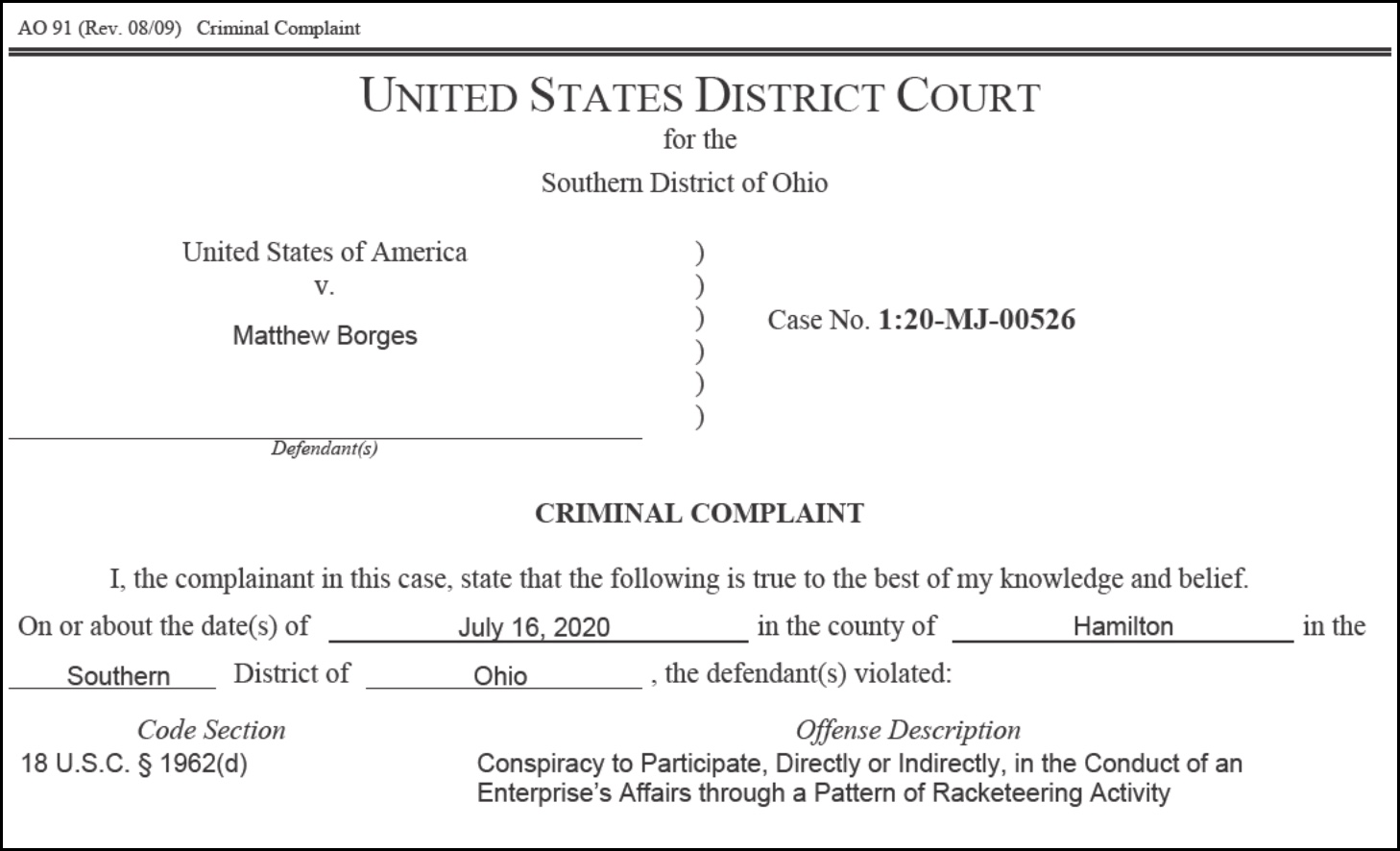
    Read the Criminal Complaint

    ccc

    The criminal complaint says that “Company A,” the former FirstEnergy Solutions of Akron, worked to save its failing nuclear plants by funneling $61 million into Generation Now, a 501(c)(4) “dark money” group controlled by Householder.

    On September 9, 2019, President Donald Trump nominated DeVillers for the United States Attorney in the Southern District of Ohio. The Senate confirmed the nomination in October, and DeVillers took his oath on November 1, 2019.

    “Make no mistake, this is Larry Householder’s 501(c)(4),” the U.S. attorney said.

    The money was used for three general purposes, the complaint said. First it was used to build “Team Householder” through campaign contributions and other measures that helped Householder win the speakership in 2019.

    “In exchange for payment from Company A, Householder’s enterprise helped pass House Bill 6, legislation described by an enterprise member as a billion-dollar ‘bailout’ that saved from closure two failing nuclear power plants in Ohio affiliated with company A,” the complaint said

    The money was also used for the personal benefit of Householder and the other conspirators, DeVillers said. Householder got about $500,000, he said.

    Despite the companies claims of poverty, the interests behind the bailout spent millions — much of it in the form of hard-to-trace dark money on campaign contributions, a xenophobic ad campaign and then on an aggressive effort to stymie a petition drive to repeal the bailout DeWine signed into law a year ago.

    And the money was used to fend off a petition effort to repeal HB6, going so far as to buy plane tickets for and pay $1,000 each to people circulating it to get out of town, DeVillers said.

    The federal prosecutor said that it was crucial to keep the investigation secret until Tuesday. Now it begins a new phase that might be causing some lawmakers, energy executives and some others to lose sleep.

    “We are not done with this case,” he said. “There were things we couldn’t do before. People we couldn’t interview. People we couldn’t subpoena. Documents and search warrants we couldn’t execute. 

    “As of this morning there are a lot of FBI agents knocking on a lot of doors asking a lot of questions, serving lots of subpoenas. That’s going to go on for days.”

    “It takes courage for citizens to assist law enforcement in the ways detailed in the affidavit,” U.S. Attorney David M. DeVillers said. “We are grateful to those who felt a moral duty to work together with agents in bringing to light this alleged, significant public corruption.”

    House Bill 6 is adding $1.5 billion in additional taxpayer bailouts to the $10.2 billion that Akron-based FirstEnergy Solutions and its former parent company, FirstEnergy Corp, have received from taxpayers since 1999. Most of the funds have gone to prop up the Davis-Besse and Perry nuclear power plants in Northern Ohio.

    The company that owns the plants was renamed Energy Harbor after emerging from bankruptcy earlier this year.

    Despite the companies claims of poverty, the interests behind the bailout spent millions — much of it in the form of hard-to-trace dark money on campaign contributions, a xenophobic ad campaign and then on an aggressive effort to stymie a petition drive to repeal the bailout DeWine signed into law a year ago.

    The interests behind the nuclear bailout also contributed heavily to the effort at the beginning of 2019 to elect Householder speaker. He ended up winning the support of 26 Republicans and 26 Democrats, His opponent, Ryan Smith, R-Bidwell, got the votes of 34 Republicans and 12 Democrats.

    The Ohio Republican Party didn’t respond Tuesday to requests for comment.

    The Ohio Democratic Party didn’t respond when asked about the fact that Householder wouldn’t have worn the speakership without Democratic votes. However, the party chairman, David Pepper called on Householder to step down as speaker.

    “As the U.S. attorney indicated, this investigation is ongoing, and we will wait to hear all the facts as they emerge. However, given what was revealed in today’s complaint and the taint of corruption over Ohio legislative activity, we believe Speaker Householder should step down from leadership immediately as he avails himself of his due process rights,” Pepper said in a written statement.

    House Bill 6, which passed 51-38, was quickly signed into law by Gov. Mike DeWine. Under the bill, from 2021 until 2027, every Ohio electricity customer will have to pay a new monthly surcharge that ranges from 85 cents for residential customers to $2,400 for large industrial plants. Ratepayers around the state would also have to chip in up to $1.50 monthly (and up to $1,500 per month for commercial and industrial users) to subsidize coal plants in Ohio and Indiana run by the Ohio Valley Electric Corporation.- cleveland.com

    Starting next January, ratepayers around the state would also have to chip in up to $1.50 monthly (and up to $1,500 per month for commercial and industrial users) to subsidize coal plants in Ohio and Indiana run by the Ohio Valley Electric Corporation.

    This isn’t Householder’s first encounter with federal law enforcement. 

    In 2006, the Justice Department told the FBI that it wouldn’t pursue charges against Householder. The FBI had been told two years earlier that Householder had used his post as head of the House Republican Campaign Committee to overpay some vendors in exchange for kickbacks from them.

    Nor is Householder, 61, of Glenford, the first Ohio House speaker to find himself in the FBI’s crosshairs. In 2018, Speaker Cliff Rosenberger, a Republican, resigned amid an FBI probe of his overseas travel. He has not been charged, but the investigation remains open.

    cccc