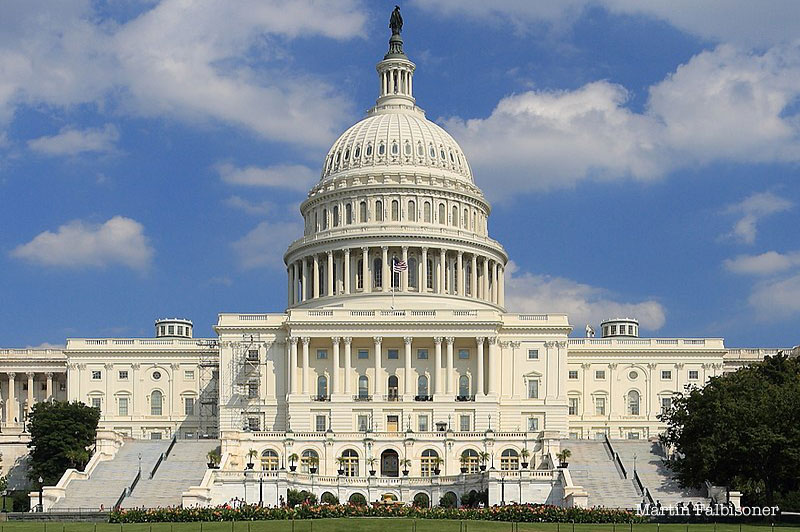
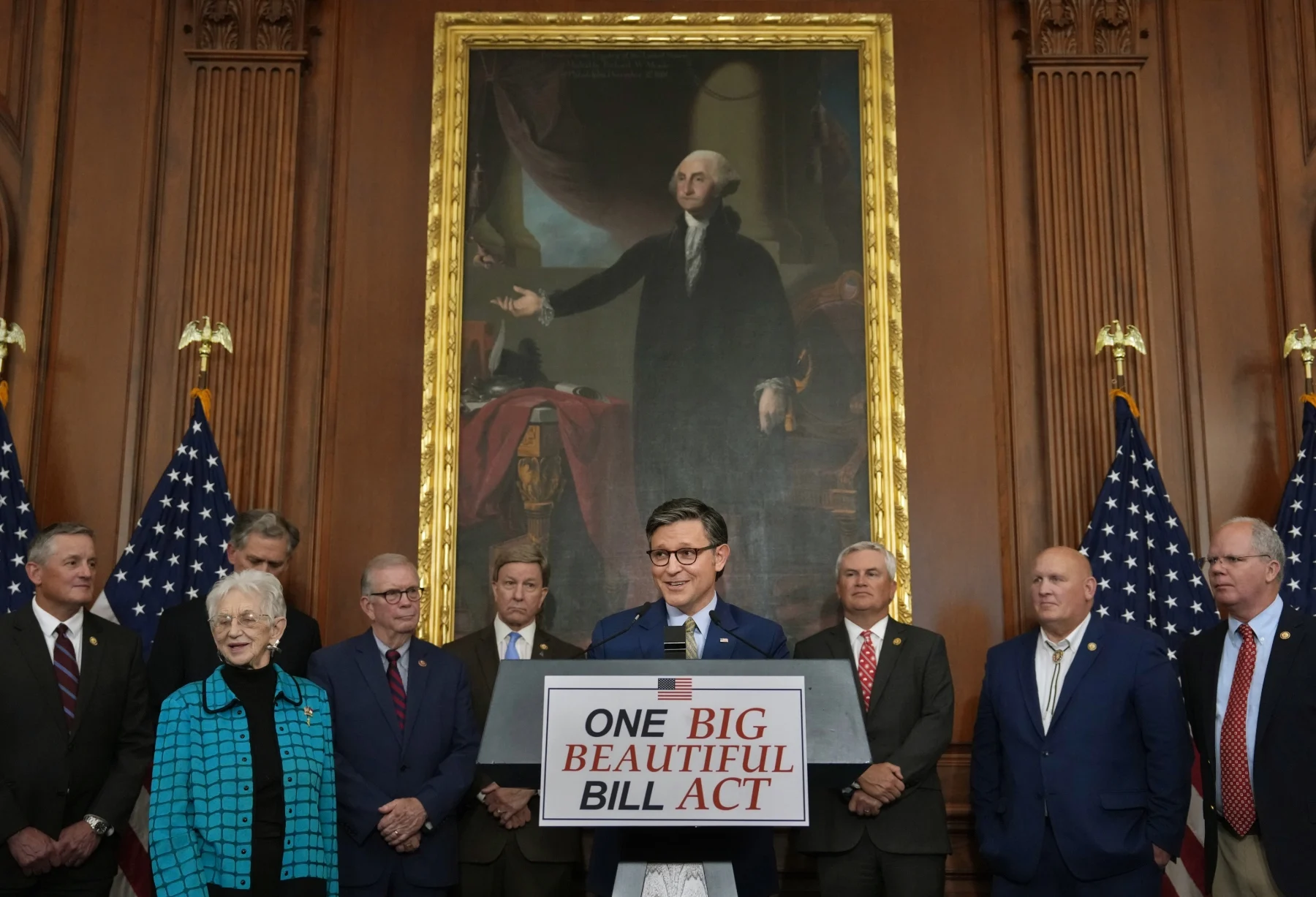
U.S. Speaker of the House Mike Johnson (R-LA) speaks to the media after the House narrowly passed a bill forwarding President Donald Trump’s agenda at the U.S. Capitol on May 22, 2025 in Washington, DC. The tax and spending legislation, called the “One, Big, Beautiful Bill” Act, redirects money to the military and border security and includes cuts to Medicaid, education and other domestic programs.(Kevin Dietsch/Getty Images)
House Republicans approved a sweeping package early Thursday morning that contained deep cuts to programs assisting low-income Americans, including Medicaid and SNAP food stamp eligibility.
by Amanda Becker Washington Correspondent
Read Amanda Becker’s Loveland, Ohio connection in her Bio below.
President Donald Trump wanted “one, big, beautiful bill” and GOP Speaker Mike Johnson pushed to get the package through the House before the Memorial Day recess. The bill now moves to the Senate, where it is expected to undergo significant changes.
The proposal approved in the House would slash $1.7 trillion in government spending to pay for the renewal of the tax cuts from Trump’s first term, which largely benefited corporations and the wealthy. Some of the largest cuts would come from Medicaid, the popular government health insurance program that covers more than 70 million lower-income Americans. House Republicans also agreed on significant changes in eligibility to the Supplemental Nutrition Assistance Program (SNAP), commonly known as food stamps, which helps more than 40 million Americans buy groceries every month. Both programs are disproportionately used by women and children.
Democrats have been largely on the sidelines because Republicans in the Senate will use a process called reconciliation, which allows the majority party to bypass the 60-vote filibuster requirement and approve legislation by a simple majority vote. There are 53 Republicans in the 100-seat Senate.
It has become common for both parties to take advantage of reconciliation when they control the White House and both chambers of Congress. Republicans used reconciliation to enact the 2017 Trump tax cuts that they are now attempting to renew. Democrats used it to enact President Joe Biden’s COVID-19 stimulus bill and the Inflation Reduction Act.
Here are the programs serving women and children that House Republicans’ bill would change:
Medicaid
House Republicans’ proposal aims to slash $625 billion from Medicaid over the next decade, leading to an enrollment drop of more than 10 million people, according to KFF, a nonpartisan health organization.
The federal-state health insurance program covers more than 40 percent of all births in the country, and about 37 percent of those enrolled are children. Three million Americans enrolled in Medicaid report that they are unable to work due to caregiving responsibilities, according to an AARP analysis.
The legislation approved by the House would cut Medicaid spending in part by imposing a strict 80-hours-a-month work requirement for adults without children or disabilities. The 19th has reported on how these stepped-up work requirements would disproportionately impact middle-aged and older women.
The bill also would make it easier for states to cancel Medicaid coverage if recipients do not provide additional paperwork to show they meet eligibility requirements; force states to require co-payments for some types of care for Medicaid enrollees who live above the federal poverty threshold; and reduce the reimbursement rate for states that use their own funds to cover immigrants not lawfully in the country, according to a detailed analysis by KFF.
The version of the bill passed by the House would prohibit Medicaid from covering care for non-abortion services provided by Planned Parenthood clinics, which are already banned from using federal funds to pay for abortions. It also would limit coverage of gender-affirming care as an essential benefit under Affordable Care Act plans and prohibits Medicaid and the Children’s Health Insurance Program (CHIP) from covering the treatment. Earlier drafts limited this prohibition to care for minors; the approved bill extends it to care for all ages.
The package passed by House Republicans would require more SNAP recipients in their 50s and 60s to work and provide fewer exemptions for parents.
The proposal would lower the age at which work requirements end by a decade, to 54. Right now, parents with dependent children under 18 are exempt from working; the bill lowers that age to 7.
Additionally, the Republican-approved legislation would require states to take on more of the costs of administering SNAP and limit the ability of future administrations to raise benefit amounts.
Changes to SNAP could affect school nutrition programs, as many students qualify for free meals based on whether they and their families are eligible for food stamps.
The Congressional Budget Office has not yet evaluated the SNAP provisions in the reconciliation bill. Their analysis of past similar legislation adding new work requirements showed that it could result in more than 3 million fewer people participating in the federal nutrition program.
The House Republicans’ tax bill would increase the amount of the child tax credit to $2,500 from $2,000 through 2028, the last year of Trump’s term. The tax credit would then drop back down and be indexed to inflation.
Another provision in the approved House version would require a child’s parents to have a Social Security Number to access the credit, even if the child also has a Social Security Number.
The intent is to block immigrant parents in the country illegally and without work authorization from claiming the benefit; these parents are already typically excluded from accessing the credit. In mixed immigration status households, where one parent has a Social Security Number and the other does not, the child would still be ineligible for the credit.
The House version of the tax bill also caps the refundable portion of the child tax credit at $1,400 per qualifying child, down from $1,700. This change would limit the ability of the country’s lowest-income parents to access the credit.
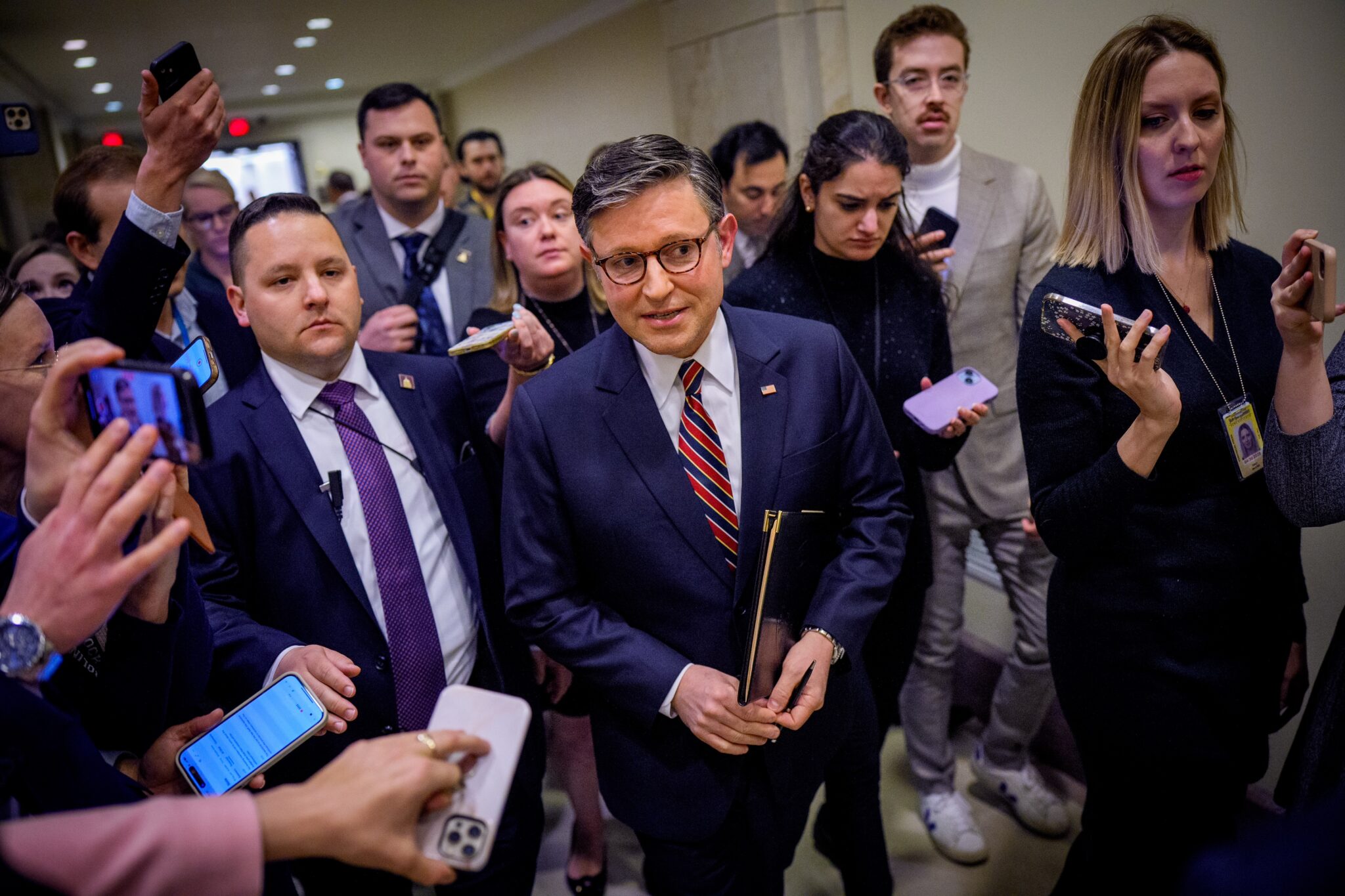
U.S. Speaker of the House Mike Johnson, R-La., speaks to reporters as he leaves a news conference following a House Republican Conference meeting at the U.S. Capitol on April 8, 2025, in Washington, D.C. (Photo by Andrew Harnik/Getty Images)
The U.S. House Republican budget bill could spell significant losses for low-income families in Ohio, specifically those in need of food assistance and those on Medicaid.
Advocates for Medicaid and anti-hunger leaders have said reductions and eliminations connected to the two programs would negatively affect Ohioans as a whole, as well as the state’s economy and spending power.
Only one Republican U.S. representative from Ohio voted against the congressional budget bill, passed early Thursday with a vote of 215-214. U.S. Rep. Warren Davidson, posted on X, formerly Twitter, Thursday morning that he supported “many things in the bill,” but that “deficits do matter and this bill grows them now.”
“The only Congress we can control is the one we’re in,” he wrote, alongside a bar graph showing the Congressional Budget Office’s analysis of the bill’s deficit effect. “Consequently, I cannot support this big deficit plan.”
U.S. Rep. Joyce Beatty, D-Ohio, stood with all other Democrats in voting against the bill, saying in a statement after the vote that the bill is “a cruel and catastrophic budget that rips health care, food and opportunity from Ohioans and millions of other Americans just to bankroll bigger and better tax breaks for billionaires.”
Medicaid
Beatty’s statement said the bill, which now moves to the U.S. Senate, includes “the largest cut to Medicaid in American history,” at $698 billion, and $267 billion from the Supplemental Nutrition Assistance Program (SNAP) over the next decade.
“In Ohio, that means potentially substantial new costs shifted onto our state, and fewer hospitals, fewer nursing homes, fewer services for our most vulnerable neighbors,” according to Beatty. “It’s not just bad math – it’s moral failure.”
Ohio would see direct impact from the bill in its own state operating budget, currently being drafted by the General Assembly.
The Ohio House’s version of the bill kept a provision proposed by Republican Gov. Mike DeWine in his executive budget to eliminate the state’s Medicaid expansion group if the federal government reduced the contribution it makes to the program.
Currently, the federal government pays 90% of the Medicaid funding in Ohio, with the state covering the other 10%.
In the Ohio House’s version of the budget bill, Ohio would eliminate Group VIII — another name for the Medicaid expansion group that covers more than 700,000 Ohioans who live above the income requirements for traditional Medicaid but are still in need of assistance — if the federal government’s share of the funding dips below 90%.
GET THE MORNING HEADLINES.
Medicaid advocates and experts have said losing this expansion group would cause Ohio’s uninsured rate to go up, and those dropped from the program to seek self-pay medical options, or skip care all together, causing the health of the state to suffer.
According to Ohio child advocacy group Groundwork Ohio, nearly 48% of Ohio children younger than six rely on Medicaid for health coverage, and the program covers about 50% of all births in the state.
The Center for Community Solutions found in a recent study that Medicaid covers 2 in 5 children in the state, as well as 1 in 5 working-age adults, and 1 in 10 adults aged 65 and older. The largest group covered in Ohio’s Medicaid program, 53.2% of cases, is families and children.
SNAP funding
The national Food Research & Action Center said the cuts would represent a nearly 30% reduction in SNAP funding, and would increase each state’s share of spending for the food assistance.
“The bottom line is this bill would end up costing America,” wrote Crystal FitzSimons, president of FRAC, in a statement. “Rural communities would be disproportionately impacted. We would see higher rates of hunger and poverty, increased health care costs, reduced academic outcomes, less productivity and an economy that will be hit hard.”
The Congressional Budget Office said the cuts, particularly to Medicaid and SNAP, would create a 2% decrease in household income nationwide in 2027 for the 10% of Americans in the lowest income brackets, going to 4% by 2033. Households in the highest income brackets, however, could see raises.
The loss of SNAP funding, along with Medicaid, would reduce access to services that “are vital for everyday Ohioans in every Congressional district,” according to Joree Novotny, executive director of the Ohio Association of Foodbanks.
Novotny said the current proposal would shift nearly $500 million in SNAP costs per year onto the state of Ohio.
“That’s about the same as all the state general revenue spent to operate the entire Ohio Department of Job and Family Services each year,” Novotny said.
The food banks and other anti-hunger advocates are already asking the state to support bipartisan legislation that would create supplemental benefits for SNAP participants in Ohio.
Ohio House Bill 178, which has received two hearings in the House Community Revitalization Committee, would require the Ohio Department of Job and Family Services to provide “supplemental benefits to households receiving (SNAP) benefits if the household includes a member who is 60 years of age or older and receives a monthly SNAP benefit that is less than $50.”
The supplements would cost the state $12.5 million in fiscal year 2026, and $21.4 million in 2027, according to a fiscal analysis of the bill.
In supporting the bill, Hope Lane-Gavin, director of nutrition policy and programs for the state association of food banks said the average SNAP benefit in Ohio is $171 per month per person, or less than $6 per person per day.
The federal minimum SNAP benefit is $23 per month, according to Lane-Gavin. There are about 70,000 households with adults 60 or older as the head of them in which the household receives less than $50 per month.
“Access to SNAP benefits can reduce food insecurity, increase medication adherence and contribute to health care savings,” she told the committee.
If SNAP funding changes drastically, food banks will not be able to fill the gap, even as they served more than 230 million meals in 2024, according to Novotny. The language in the budget would force state governments including Ohio’s to “make impossible choices.”
“This cost shift wouldn’t just hurt families, it would impact local grocery stores, farmers and food suppliers, threatening jobs and access to fresh food in communities across Ohio,” Novotny said.
Susan Tebben
Susan Tebben is an award-winning journalist with a decade of experience covering Ohio news, including courts and crime, Appalachian social issues, government, education, diversity and culture. She has worked for The Newark Advocate, The Glasgow (KY) Daily Times, The Athens Messenger, and WOUB Public Media. She has also had work featured on National Public Radio.
Ohio Capital Journal is part of States Newsroom, the nation’s largest state-focused nonprofit news organization.
State legislators and medical experts in Ohio are decrying the nomination of Robert F. Kennedy, Jr., to the U.S. Department of Health and Human Services.
Democratic lawmakers and a leader at the Toledo Lucas County Health Department expressed particular concern over access to health care and the future of vaccination requirements and information.
“I think the question is are you going to trust somebody to run our entire health enterprise in this country who has no scientific background to understand why doctors, nurses, dentists are recommending that we actually do these things,” said Dr. Jonathan Ross, board president for the TLCHD.
State Rep. Michele Grim, D-Toledo, who holds a master’s in public health, said the comments Kennedy, Jr., has made about vaccines in the past makes her nervous about his leadership of a federal medical agency with a multi-billion-dollar budget.
“I know that vaccines save lives,” Grim said during a press conference hosted by Protect Our Care. “We eradicated small pox with vaccines, we almost eradicated polio, but now that is coming back because of the vaccine hesitancy.”
Grim also takes issue with Kennedy’s “arcane” views on HIV/AIDS, something she focused on as part of her public health education. She said the views he’s expressed, are “very problematic in that space.”
Ross, Grim and her fellow state Reps. Terrence Upchurch and Elgin Rogers said they hope the Trump administration will reconsider Kennedy, Jr.’s appointment, but failing that, they urged the U.S. Senate to conduct thorough questioning of the nominee, ultimately stopping the appointment.
“I think that this appointment is probably the most dangerous, because it has a great impact on the public health, not just of the people of Ohio, but everyone in this country,” Upchurch, D-Cleveland said.
GET THE MORNING HEADLINES.
Ross and the legislators are concerned about the state of the overall national health care system with the appointment of Kennedy, Jr., but they see potential problems at the state level as well.
“I think what impacts we’ll see is there could be less funding for our health departments, there could be some vaccine hesitancy, and I think we’ve seen that on the local level and also on the state level,” Grim said.
Ross pointed to the possible reversal of insurance protections for Americans up to age 26 and undoing of Medicaid expansion as issues that could lead to increased health issues, and increased economic issues on top of everything else.
With a loss of coverage in the Medicaid space, and if threats the Trump administration has made previously about repealing the Affordable Care Act come to fruition, crippling medical debt could fall on more and more Americans, leading to bankruptcies, along with unnecessary hospitalizations because of a lack of health coverage.
“Being poor is also very bad for your health,” Ross said.
Rogers, D-Toledo, said the disparities that already exist in health care for communities of color could also get worse with leaders lacking the information they need to make positive change.
“If you have leaders who don’t understand the science, who are willing to ignore the science, they’re going to ignore other factors across the state of Ohio and that impact the people of Ohio who come from the most trying conditions,” Rogers said.
A way forward could include state-level legislative action to protect certain aspects of the health care system that may be impacted by the new administration, and the new appointment. Ross said Medicaid work requirements that were considered in Ohio and federally would not be the way forward, and keeping an eye on efforts to require work as part of the Medicaid eligibility would help preserve the health care landscape.
“People are more likely to be able to work if they have health care coverage, so precluding health care coverage for people who are not working is the opposite of what you want to do,” according to Ross.
The legislators pledged to keep public health at the forefront of the minority caucuses priorities, though they face a tough slog leading a charge in a Statehouse with GOP supermajorities in both chambers.
“I can see a world where there is another effort to attack vaccinations (on the state level),” Upchurch said.
For Grim, whether Kennedy, Jr., is confirmed or not, it’s up to legislators to make sure the public and their fellow legislators know that a loss of Medicaid benefits or any hits to public health would negatively impact all Ohioans, not just a small minority.
“We need to make sure that our caucus is a voice for public health and the benefits of vaccines,” Grim said.
YOU MAKE OUR WORK POSSIBLE.
_______________
Susan Tebben
Susan Tebben is an award-winning journalist with a decade of experience covering Ohio news, including courts and crime, Appalachian social issues, government, education, diversity and culture. She has worked for The Newark Advocate, The Glasgow (KY) Daily Times, The Athens Messenger, and WOUB Public Media. She has also had work featured on National Public Radio.
Ohio Capital Journal is part of States Newsroom, the nation’s largest state-focused nonprofit news organization.
Medicaid might be a taxpayer-funded health program for the poor, but that doesn’t mean others aren’t getting rich off of it — including employees of a company the state is suing on antitrust grounds.
Several employees of drug middleman Express Scripts last year raked in bonuses of $750,000 each for getting the business of a managed-care company that depends on Medicaid for the bulk of its business.
It might be striking to the average taxpayer that people with huge corporations are profiting so lavishly off of programs for the poor. But one of the Express Scripts employees — who also helped prepare the company for a federal antitrust investigation — said the bonuses were “well earned.”
Ohio Attorney General Dave Yost in March sued Express Scripts and several other healthcare companies under the Valentine Act — Ohio’s antitrust law — claiming that the companies participate in “a complex ‘pay to play’ rebate system that, perversely, pushes manufacturers to increase drug prices in order to be placed on, or receive, preferred placement on PBM formularies.”
As a pharmacy benefit manager, or PBM, St. Louis-based Express Scripts represents health insurers — including parent company Cigna — in drug transactions. It decides which drugs are covered and uses that leverage to extract rebates from drug manufacturers who want to get their products on its “formularies,” or lists of covered drugs.
Express Scripts also creates networks of pharmacies and it decides how much to reimburse them for the drugs they dispense. And because it keeps much of the data about rebates and reimbursements secret, it’s hard to know how much they’re passing along to insurers and pharmacies and how much they’re pocketing.
It’s sure to be a lot. Two thirds of Cigna’s $110 billion in revenue last year came from its Express Scripts subsidiary, the PBM’s former president said in a sworn statement in June.
The executive, Amy Bricker, resigned her post earlier in January to take another with another vast healthcare player, CVS.
That company owns another huge PBM, CVS Caremark, and between it, Express Scripts and OptumRx (part of UnitedHealth) they control the prescription coverage of more than 70% of the insured people in the United States.
As part of her sworn statement, Bricker stuck to the company line.
“As a PBM, Express Scripts’ goal is to reduce the cost of prescription medication for its clients—the Payor Entities,” she said. “As President of Express Scripts, I was responsible for Express Scripts’ relationships with its (client insurance companies) as well as the tools/levers utilized to lower the cost of prescription medications.”
However, Yost and many others maintain that the big PBMs actually force drugmakers to raise list prices in order to provide ever-growing rebates to PBMs and there’s been some research to support that. And there’s the fact that an investigation found that in 2017, CVS Caremark and OptumRx billed Ohio Medicaid $223 million more for prescription drugs than they paid the pharmacies that had purchased and dispensed them.
Those claims and others last year prompted the Federal Trade Commission to open a major, ongoing investigation into the big PBMs.
Bricker said that while she was still president of Express Scripts, one of her duties was to help the company respond to the FTC investigation. But the whole reason she was making the statement centered around another major enterprise she led — acquiring the business of Centene.
That company, also based in St. Louis, is the largest Medicaid managed-care company in the United States. It acts as health insurer on behalf of states as they administer the federal-state health program for the poor.
When it acts as insurer, Centene hires PBMs to handle drug transactions. And in that capacity, the company has had its problems in Ohio and elsewhere. Yost sued Centene in early 2021 on claims that it used two of its own PBMs to bilk Ohio Medicaid out of tens of millions.
Within months, the company agreed to pay Ohio $88.3 million to settle the suit — and it announced that it was setting aside more than $1 billion to settle similar claims with more than 20 other states that hadn’t even sued it. Centene later announced that it would exit the PBM business.
Centene manages care in health sectors other than Medicaid, such as Medicare and for prisons. But last year it derived almost two-thirds of its revenue — or $94 billion — from its Medicaid business, according to the company’s financial statements. So roughly $23 billion of the new revenue Express Scripts is getting from the contract is coming from tax-funded health programs for the poor.
As president of Express Scripts, Bricker led the effort to snatch that business away from CVS. But early this year after Express Scripts parent company Cigna didn’t make her part of its top executive team, Bricker announced that she was leaving and going to work for… CVS.
Cigna and Express Scripts sued, citing a non-compete clause and expressing fears that Bricker might use insider knowledge to help win Centene’s business back for CVS. At least for now, a federal judge in Missouri has stopped Bricker from going to work for her erstwhile employer.
The back-and-forth court filings shed some light on how prescription drugs and taxpayer-funded health programs for the poor are used to pad the paychecks of the very rich.
In suing, Cigna cited the “high six-figure spot bonus” it gave Bricker after she got the Centene contract and it cited other big awards she received since 2019. The company is demanding that she repay $1.5 million in restricted stock and stock options that she received.
For her part, Bricker didn’t betray any sense of irony in her response as she defended the huge “spot bonus” she got for winning a big book of mostly Medicaid business.
“The Amended Complaint specifically references Express Scripts recent successful bid for the Centene contract, and that I earned a significant, one-time bonus for my integral role in achieving that business success,” she wrote in her sworn statement. “The bonus was $750,000. The context Cigna omits from its Amended Complaint is that the contract is worth billions of dollars to Cigna over its five-year term. Several members of the Express Scripts team received this one-time bonus which was appropriate given the magnitude of the contract and well earned.”
Cigna didn’t respond when asked how many such bonuses it awarded or what Bricker’s total compensation was. Nor did it respond when asked how it justified them, given that most of the new business ultimately is from taxpayer dollars intended to provide healthcare for poor people.
There’s a reason why Bricker might think a $750,000 spot bonus should be routine for a job well done. It pales in comparison to what the top bosses in her industry get.
Marty Schladen has been a reporter for decades, working in Indiana, Texas and other places before returning to his native Ohio to work at The Columbus Dispatch in 2017. He’s won state and national journalism awards for investigations into utility regulation, public corruption, the environment, prescription drug spending and other matters.
Nearly a quarter-million Ohio drivers have taken advantage of a program started at the end of 2020 that is intended to reduce license-reinstatement fees or waive them altogether, the Ohio Poverty Law Center said Monday.
The group released an analysis of the amnesty program, a bipartisan measure passed by the legislature. It found that nearly 223,000 drivers have participated and saved more than $136 million, with an average individual savings of $612.
“The program has provided a lot of relief from the financial barriers that prevent hundreds of thousands of lower-income Ohioans from driving legally,” Zack Eckles of the poverty law center said during a virtual press conference. “Driving is essential for economic participation in the state of Ohio.”
Suspensions stemming from driving under the influence of alcohol, drugs or with deadly weapons are not eligible for the amnesty. Instead, the program is aimed at people who just don’t have the funds to pay the fees to reinstate their licenses after being suspended for offenses such as driving with no proof of insurance.
“Although reinstatement fees are distinct from punitive fines, they have many characteristics of a fine,” the report said. “For example, they vary by the type of offense or increase in amount for repeated offenses, and they can be extremely burdensome. One particularly punitive reinstatement fee is for non-compliance suspensions, which occur when a driver does not show proof of insurance at a traffic stop or at the time of an accident. These non-compliance suspensions carry reinstatement fees of $100 for the first offense, $300 for the second offense, and $600 for the third and any subsequent offenses within a five-year period.”
To help ensure that only people who can’t afford reinstatement fees get reductions, the program requires that suspended drivers wait 18 months after at least one of their suspensions expire before they’re eligible. Presumably, people who can afford to pay won’t wait that long, but Eckles faulted the rule for holding those without funds “hostage” for 18 months before they can clear their fees and drive legally.
People eligible for Medicaid, Supplemental Security Income, Ohio Workers First, Supplemental Nutrition Assistance or the VA Pension Benefit are eligible to have their reinstatement fees canceled and don’t have to wait 18 months because their eligibility for those programs demonstrates their financial need. However, Ohioans eligible for the waiver made up only about 5% of those who have participated in the amnesty program.
Benefits of the amnesty extend well beyond making it easier for huge numbers of Ohioans to drive legally to work, school, medical appointments and the grocery store.
Of the drivers applying for fee reductions, 85% paid their fees in full, paying $23 million to the Bureau of Motor Vehicles that it otherwise likely wouldn’t have collected. And, with an estimated 75% of those with suspended licenses continuing to drive illegally, the amnesty program probably has greatly reduced the number of uninsured drivers because participants have to furnish proof of insurance to participate.
But even though nearly a quarter-million Ohioans participated in the program, that’s only a third of 748,000 that the BMV notified that they were eligible.
To improve participation in the amnesty program, the Ohio Poverty Law center made three recommendations:
Standardize reinstatement fees at $25
Eliminate suspensions strictly resulting from unpaid fines and fees. “Driver’s license suspensions should only be imposed for dangerous driving, not for a person’s inability to pay a fee,” the report said.
Expand the program so that all 14% of Ohioans living in poverty are eligible for full waivers
______________________________
MARTY SCHLADEN
Marty Schladen has been a reporter for decades, working in Indiana, Texas and other places before returning to his native Ohio to work at The Columbus Dispatch in 2017. He’s won state and national journalism awards for investigations into utility regulation, public corruption, the environment, prescription drug spending and other matters.
“As we begin the process of redetermining eligibility for the first time in three years, we must pay particular attention to children’s needs to minimize the number of children who lose coverage.”
A new study warns of a sharp rise in uninsured children in Ohio and across the country if pandemic-era coverage is allowed to fade away.
The Georgetown University Health Policy Institute’s Center for Children and Families studied the impact of the Children’s Health Insurance Program (CHIP) and Medicaid on bringing down state’s uninsured rate, finding that it “proved to be a critical lifeline for more than half of the nation’s children during the pandemic.”
Now that a March 2020 provision increasing the federal contribution to state Medicaid programs while requiring states to maintain continuous coverage for Medicaid patients during the COVID-19 public health emergency will be going away, the number of children falling under those protections will also be decreasing.
“These children are at grave risk of losing coverage inappropriately in states that do not handle the renewal process with the utmost care,” the study stated.
Because of a loss of income eligibility and “bureaucratic snafus,” the study estimates up to 6.7 million children in the U.S. will lose coverage because of the “unwinding” of pandemic-era programs, scheduled to happen on April 1.
“The uninsured rate for children could easily more than double if states have inadequate staffing levels and overwhelmed call centers and do not take the time and care needed to properly conduct eligibility checks after the federal protections lift,” the study stated.
From February 2020 to August 2022, Ohio saw a 26.7% increase in Medicaid and CHIP enrollment, ranking them 29th in the nation based on data from the Centers for Medicare & Medicaid Services. The share of enrollment made up by children in Ohio was 25.6%.
“As we begin the process of redetermining eligibility for the first time in three years, we must pay particular attention to children’s needs to minimize the number of children who lose coverage,” Kelly Vyzral, senior health policy associate for the Children’s Defense Fund-Ohio, said in response to the study.
The Children’s Defense Fund-Ohio said nearly half of children in Ohio are covered by Medicaid and other public health insurance programs. The study showed 54% of all American children are covered by Medicaid of CHIP.
Ohio already has the 12-month continuous Medicaid and CHIP child eligibility for those under age 19 recommended by the study to mitigate losses and gaps in coverage.
Continuous eligibility protects parents who see an increase in income during a 12-month period from losing child Medicaid or CHIP coverage.
Ohioans should verify contact information with local benefits offices or through the Medicaid patient portal to avoid cancellation of child insurance, Vyzral said.
Ohio must complete Medicaid eligibility checks by May 2024.
Michelle Diament for Disability Scoop reports that a newly approved $1.7 trillion federal spending bill will bring more funding for special education while expanding access to ABLE accounts and addressing the use of electric shock on people with disabilities.
The legislation, which funds the government through September, was signed by President Joe Biden just before the start of the new year.
It includes over $15 billion for special education, a $904 million jump over last year, and it extends Money Follows the Person, a Medicaid program that helps people with disabilities move from institutions to community-based living, through September 2027.
In addition, the measure increases the eligibility age for ABLE accounts, a special savings vehicle that allows people with disabilities a way to save money without jeopardizing their government benefits.
Maternal and infant health advocates and certified doulas alike expressed their support Monday for a bill currently awaiting consideration by the Ohio Senate to bring doula services into the state’s Medicaid program.
Participants in a meeting of the Ohio Legislative Children’s Caucus met with organizations employing and promoting the use of doulas as part of the childbirth process in Ohio, before, during and after a baby is born.
Caucus co-vice chair, state Rep. Susan Manchester, R-Waynesville, brought up a 2022 March of Dimes report card which gave Ohio a D+ in the area of preterm birth. Ohio has a 10.6% preterm birth rate, according to the report.
“Further opportunities to ensure access to appropriate health care services before, during, and after childbirth cannot be left on the table when the 134th General Assembly ends,” Manchester told the caucus at their Monday meeting.
Doulas are individuals with non-medical training, who are there to act as educators, resource coordinators, and advocates for their patients as they go through pregnancy and postpartum life. They work alongside a medical team, including a midwife, the medical professional who serves as complement to a doula.
Doulas are there to provide everything from sex education to postpartum depression screening, and everything in between, to provide emotional and physical support.
“We’re attending appointments with them, and then we’re going to review what the clinicians have said to them to make sure they’re actually understanding what they heard, and that they’re not just being spoken at,” said Jazmin Long, CEO of Birthing Beautiful Communities, a Cleveland and Akron-based non-profit.
Doulas go through rigorous training, with BBC providing an 80-hour training program, with the requirement that participants score 90% or higher on the certification exam to move forward with the organization. Long said BBC’s perinatal doulas are paid between $500 and $800 per birth.
With proper training, doulas are a “vital person in the care team,” according to Meredith Strayhorn, a certified doula who is also a student midwife and financial and operations director for the Cincinnati-based collective Blaq Birth Circle. The collective partners with Cradle Cincinnati and Caresource to provide doula services in the area.
“It’s especially important navigating through the hospital system, where we know there is a lot of systemic racism, there are a lot of providers who do not listen to clients, and I have actually seen that happen several times, which is really heartbreaking,” Strayhorn said.
Doulas can increase positive birth outcomes, which can mean less spending on health care. Strayhorn said research shows continuous doula support during and after pregnancy can decrease risk of cesarean sections and the use of pain medications, and increases patient satisfaction.
As part of the effort to make doulas more accessible to more Ohioans, Long and Strayhorn said House Bill 142 would be a good start, as it would establish five-year coverage programs for doula services for the state’s Medicaid program and within the Department of Rehabilitation and Correction.
The ODRC program would allow doula services to “inmates participating in any prison nursery program,” according to an analysis of the bill conducted by the Legislative Service Commission.
“From what I’m hearing, everyone’s been supportive,” said state Rep. Tom Brinkman, R-Mt. Lookout, who created the bill along with former Democratic state Rep. Erica Crawley.
Under the bill, doulas would have to hold a certificate from the Ohio Board of Nursing, and a “valid provider agreement.”
A registry of doulas would also be created by HB 142 within the Board of Nursing, along with a “doula advisory board” within the board, specifically for those serving the Medicaid program.
The board is to be made up of at least 13 members, all appointed by the Board of Nursing, with the requirement that at least three be members “representing communities most impacted by negative maternal and fetal health outcomes,” and at least six members who are currently certified doulas.
HB 142 passed the Ohio House, proving bipartisan support with a GOP supermajority present in the House. The Senate has a GOP supermajority as well, and Brinkman said he is hopeful the support will continue.
“The funding is there, and I think that once we do it … I think the insurance plans that provide private care will see that this is a savings in the number of C-sections and prescription medicine and epidurals,” Brinkman said.
As the legislation goes forward, the Ohio Department of Medicaid announced their own plan to implement doula services as part of a Maternal and Infant Support program, with the doula program to roll out at the end of a 2-3 year phase-in, announced in 2021.
The ODM doesn’t cover doula care as a billable service currently, but provided $1 million in Ohio Equity Institute grants to groups in Cuyahoga, Franklin and Lucas counties for such services between 2020 and 2021, according to the department.
The bill is not up for a hearing this week, but Brinkman said he is set to meet with Senate Health Committee chairman Steve Huffman, R-Tipp City, this week to discuss next steps for the bill.
Once the federal government declares the end of the PHE, the eFMAP will go away and states will once again resume normal eligibility operations which will result in some Medicaid members being disenrolled from the program.
The Ohio Department of Medicaid has materials and templates on its website to help prepare Medicaid members for the end of the COVID-19 public health emergency and any actions they need to take. The toolkit is for anyone who interacts with Medicaid members, including health care providers, advocates, elected officials, community organizations, schools and others. It includes a flyers, social media and text messages, and more.
COVID-19 Unwinding
The materials and templates included below are the best way for you to help prepare Medicaid members for the end of the public health emergency (PHE) and any actions they need to take. Updated September 16, 2022.
Overview
In March 2020, the Ohio Department of Medicaid (ODM) made a number of operational changes to its Medicaid program in response to the COVID-19 public health emergency (PHE). This included taking advantage of the flexibilities offered to states such as increasing service limits for home- and community-based waiver services, expanding telehealth, and adding Health Care Isolation Centers (HCIC) as a nursing facility benefit to name just a few. Additionally, with the passage of the Families First Coronavirus Response Act (FFCRA), the federal government provided states with an enhanced federal matching rate (eFMAP) of 6.2%. In exchange, states were prohibited from disenrolling members from Medicaid, even if they were found to be ineligible. This was to ensure members did not lose vital healthcare coverage during the pandemic.
Once the federal government declares the end of the PHE, the eFMAP will go away and states will once again resume normal eligibility operations which will result in some Medicaid members being disenrolled from the program.
While some renewals can be completed without a need to contact the member, some renewals will require members to respond to mail from their County Department of Job and Family Services (CDJFS).
It is imperative that Medicaid members ensure their contact information is up to date, watch for mail from their CDJFS, and respond to requests for information. If members do not respond to renewal letters or requests for information, they run the risk of losing their healthcare coverage, even if they are still eligible.
Key Messages
The materials and templates included in this toolkit are the best way for you to help prepare Medicaid members for the end of the public health emergency (PHE) and any actions they need to take. If you prefer to create your own communications, use the following key messages to ensure the information you share is simple, direct, and accurate.
You will receive another Partner Packet with updated messaging and materials for continued outreach to Medicaid members after the PHE ends.
If they don’t already have one, Medicaid members are strongly encouraged to create an Ohio Benefits Self-Service Portal (SSP) account as soon as possible at https://ssp.benefits.ohio.gov. This is the most convenient way for Medicaid members to complete a renewal or report any changes to their information. Through their SSP account, members can also easily check the status of their benefits.
Update their contact information. Any time a Medicaid member’s information changes, they should let their County Department of Job and Family Services (CDJFS) know. Make sure the CDJFS has their current contact information. Contact information includes: name, residential address, mailing address (if different from home address), phone number, and email address.
Medicaid members can update their contact information by:
Calling 1-800-324-8680. Help is available Monday through Friday, 8 a.m.-8 p.m. and Saturday 8 a.m.-5 p.m. ET.
Reporting changes online. Members with an existing Ohio Benefits Self-Service Portal (SSP) account can report changes online at https://ssp.benefits.ohio.gov. After logging in, they should click the Access my Benefits tile, then click Report a Change to my Case from the drop down and follow the prompts.
Checking their mail. The CDJFS mails letters to members when it is time to renew or when Medicaid needs more information from them to continue their healthcare coverage. Members should watch for mail from their CDJFS.
Responding to requests for information. If members get a letter telling them it is time to renew, or that their CDJFS needs more information, they should be sure to respond. Their CDJFS needs to hear from them to review their Medicaid eligibility.
If a Medicaid member has been notified they no longer qualify for Medicaid, they may be able to buy low-cost health coverage through the federally facilitated Marketplace at Healthcare.gov. If they need help understanding their options, trained, licensed healthcare Navigators are available at no cost to them. Contact Get Covered Ohio for free, unbiased assistance. Go to www.getcoveredohio.org or call 1-833-628-4467. Navigators can help in-person, online, or over the phone.
Medicaid members can ask to be represented by someone of their choosing to serve as their proxy in the application and renewal processes and decisions regarding their Medicaid coverage. These member-selected individuals serve as an “authorized representative” and must be age 18 or older and able to stand in their place. Members are asked to submit a written statement naming the authorized representative and the duties he or she may perform on the member’s behalf. The form to designate an authorized representative may be found on the Ohio Medicaid website. With this authorization, all notices and correspondence issued by Medicaid will be issued to both the member and the authorized representative.
After hitting a historically low rate in 2016, the number of uninsured children has gradually grown to eliminate progress made in the country. Ohio, alone, had a double-digit jump in the three-year study.
Susan Tebben is an award-winning journalist with a decade of experience covering Ohio news, including courts and crime, Appalachian social issues, government, education, diversity and culture. She has worked for The Newark Advocate, The Glasgow Daily Times, The Athens Messenger, and WOUB Public Media. She has also had work featured on National Public Radio.
In 2019, the rate had jumped to 5.7%, an increase of 726,000 more children since the Trump Administration took office in 2016, the study showed.
“Much of the gain in coverage that children made as a consequence of the Affordable Care Act’s major coverage expansions implemented in 2014 has now been eliminated,” the study noted in its key findings.
The data was collected from single-year estimates by the U.S. Census Bureau’s American Community Survey from the three years.
Ohio was one of several states that saw an increase of more than 20,000 uninsured children from 2016 to 2019.
Ohio’s uninsured rate went up 26% from 2016 to 2019. Data from 2019 show 131,000 Ohio children without insurance, up from 104,000 in 2016.
Ohio child health advocates say a lack of health insurance contributes to worse life outcomes, which extend to education and societal shortcomings.
“This damaging trend will have long-term consequences for children and communities across Ohio because without health coverage, children cannot access the care they need to grow and thrive,” said Tracy Najera, executive director of the Children’s Defense Fund Ohio, in response to the study.
The study attributed declines in Medicaid enrollment as the start of the decrease in insured children. Public coverage for children includes Medicaid and the Children’s Health Insurance Program (CHIP).
The largest national increase in uninsured children, 320,000, came between 2018 and 2019, and represents the largest annual jump in more than a decade, the authors of the study said.
“Moreover, since this data was collected prior to the pandemic, the number of uninsured children is likely considerably higher in 2020, as families have lost their jobs and employer-sponsored insurance, though it is impossible to know yet by precisely how much,” the study stated.
The study comes as some K-12 schools see spikes in COVID-19 rates, and cases in ages 0-19 represent the fifth highest age group in the state, according to state data.
Texas and Florida had the highest rates, representing 41% of the overall increase in child non-coverage, with about 1 million children in Texas lacking health insurance in 2019, and an estimated 343,000 uninsured children in Florida.











 MARTY SCHLADEN