Tag: Mifepristone

  • U.S. Supreme Court rejects attempt to limit access to abortion pill

    U.S. Supreme Court rejects attempt to limit access to abortion pill

    BY:  Ohio Capital Journal

    WASHINGTON — The U.S. Supreme Court ruled in a much-anticipated decision Thursday that mifepristone, one of two pharmaceuticals used in medication abortion, can remain available under current prescribing guidelines.

    The high court unanimously rejected attempts by anti-abortion groups to roll back access to what was in place more than eight years ago, writing that they lacked standing to bring the case.

    Those limits would have made it more difficult for patients to get a prescription for mifepristone, which the Food and Drug Administration has approved for up to 10 weeks gestation and is used in about 63% of U.S. abortions.

    Erin Morrow Hawley, senior counsel at Alliance Defending Freedom, who argued the case in front of the court on behalf of the legal organization, doesn’t believe this is the end of efforts to challenge access to mifepristone.

    She said on a call shortly after the ruling was released the three states that intervened in a lower court — Idaho, Kansas and Missouri — could still advance their arguments against mifepristone and potentially hold standing, the legal right to bring a case.

    “I would expect the litigation to continue with those three states,” Hawley said.

    Kavanaugh writes opinion

    Justice Brett Kavanaugh wrote the opinion in the united ruling from the Supreme Court, with Justice Clarence Thomas writing a concurring opinion.

    “Plaintiffs are pro-life, oppose elective abortion, and have sincere legal, moral, ideological, and policy objections to mifepristone being prescribed and used by others,” Kavanaugh wrote.

    The four anti-abortion medical organizations and four anti-abortion doctors who originally brought the lawsuit against mifepristone have protections in place to guard against being forced to participate in abortions against their moral objections, he noted.

    “Not only as a matter of law but also as a matter of fact, the federal conscience laws have protected pro-life doctors ever since FDA approved mifepristone in 2000,” Kavanaugh wrote. “The plaintiffs have not identified any instances where a doctor was required, notwithstanding conscience objections, to perform an abortion or to provide other abortion-related treatment that violated the doctor’s conscience.”

    “Nor is there any evidence in the record here of hospitals overriding or failing to accommodate doctors’ conscience objections,” he added.

    Alliance Defending Freedom has not “identified any instances where a doctor was required, notwithstanding conscience objections, to perform an abortion or to provide other abortion-related treatment that violated the doctor’s conscience since mifepristone’s 2000 approval,” the opinion said.

    Kavanaugh might have also included hints on how the court will rule later this session on a separate abortion access case that addresses the Emergency Medical Treatment & Labor Act, known as EMTALA.

    “EMTALA does not require doctors to perform abortions or provide abortion-related medical treatment over their conscience objections because EMTALA does not impose obligations on individual doctors,” Kavanaugh wrote.

    Thomas agrees but questions who can sue

    Thomas wrote a concurring opinion in the case, saying that he agreed with the court’s unanimous decision, which he did join, but brought up concerns with how a certain type of standing is used by the Court.

    “Applying these precedents, the Court explains that the doctors cannot establish third-party standing to sue for violations of their patients’ rights without showing an injury of their own,” Thomas wrote.

    “But, there is a far simpler reason to reject this theory: Our third-party standing doctrine is mistaken,” Thomas added. “As I have previously explained, a plaintiff cannot establish an Article III case or controversy by asserting another person’s rights.”

    Reaction pours in

    Politicians, anti-abortion groups and reproductive rights organizations all reacted to the ruling within hours of its release, often pointing to November’s elections as a potential next step.

    President Joe Biden released a written statement saying the “decision does not change the fact that the fight for reproductive freedom continues.”

    “It does not change the fact that the Supreme Court overturned Roe v. Wade two years ago, and women lost a fundamental freedom,” Biden added. “It does not change the fact that the right for a woman to get the treatment she needs is imperiled if not impossible in many states.”

    Former President Donald Trump, the Republican Party’s presumptive nominee, was in meetings most of Thursday with U.S. House Republicans and then separately with Republican U.S. Senators.

    Neither Trump nor his campaign released a statement by early Thursday afternoon addressing the Supreme Court’s ruling.

    Louisiana Republican Sen. Bill Cassidy, ranking member on the Health, Education, Labor and Pensions Committee, wrote in a statement that the justice didn’t actually address the merits of the case.

    “The Court did not weigh in on the merits of the case, but the fact remains this is a high risk drug that ends the life of an unborn child,” Cassidy wrote. “I urge FDA to follow the law and reinstate important safeguards.”

    President of the American College of Obstetricians and Gynecologists Stella Dantas related a statement saying the ruling “provides us with long-awaited relief.”

    “We now know that patients and clinicians across the country will continue to have access to mifepristone for medication abortion and miscarriage management,” Dantas wrote. “Decades of clinical research have proven mifepristone to be safe and effective, and its strong track record of millions of patient uses confirms that data.”

    Hawley from Alliance Defending Freedom wrote in a written statement the organization was “disappointed that the Supreme Court did not reach the merits of the FDA’s lawless removal of commonsense safety standards for abortion drugs.”

    “While we’re disappointed with the court’s decision, we will continue to advocate for women and work to restore commonsense safeguards for abortion drugs—like an initial office visit to screen for ectopic pregnancies,” Hawley wrote. “And we are grateful that three states stand ready to hold the FDA accountable for jeopardizing the health and safety of women and girls across this country.”

    Nancy Northup, president and CEO of the Center for Reproductive Rights, wrote in a statement she had “both relief and anger about this decision.”

    “Thank goodness the Supreme Court unanimously rejected this unwarranted attempt to curtail access to medication abortion, but the fact remains that this meritless case should never have gotten this far,” Northup wrote.

    “The FDA’s rulings on medication abortion have been based on irrefutable science,” Northup wrote. “Unfortunately, the attacks on abortion pills will not stop here — the anti-abortion movement sees how critical abortion pills are in this post-Roe world, and they are hell bent on cutting off access.”

    Scientific evidence argued

    The Supreme Court heard oral arguments in the case in March, during which Solicitor General Elizabeth Prelogar argued the FDA’s guidelines for prescribing mifepristone were based on reputable scientific evidence and years of real-world use.

    “Only an exceptionally small number of women suffer the kinds of serious complications that could trigger any need for emergency treatment,” Prelogar said. “It’s speculative that any of those women would seek care from the two specific doctors who asserted conscience injuries. And even if that happened, federal conscience protections would guard against the injury the doctors face.”

    Hawley of ADF told the court that conscience protections in federal law didn’t do enough to protect anti-abortion doctors from having to possibly treat patients experiencing complications from medication abortion.

    “These are emergency situations,” Hawley said. “Respondent doctors don’t necessarily know until they scrub into that operating room whether this may or may not be abortion drug harm — it could be a miscarriage, it could be an ectopic pregnancy, or it could be an elective abortion.”

    The case reached the Supreme Court within two years of ADF originally filing the lawsuit in the District Court for the Northern District of Texas, where ADF wrote the FDA “exceeded its regulatory authority” when it originally approved mifepristone in 2000.

    ADF filed the case on behalf of Alliance for Hippocratic Medicine, the American Association of Pro-Life Obstetricians and Gynecologists, American College of Pediatricians and Christian Medical & Dental Associations, as well as four doctors from California, Indiana, Michigan and Texas.

    Kacsmaryk ruling started journey to high court

    Judge Matthew Joseph Kacsmaryk essentially agreed with the anti-abortion groups, in a ruling in April 2023, where he wrote he did “not second-guess FDA’s decision-making lightly.”

    “But here, FDA acquiesced on its legitimate safety concerns — in violation of its statutory duty — based on plainly unsound reasoning and studies that did not support its conclusions,” Kacsmaryk wrote.

    The U.S. Supreme Court issued a stay at the request of the Justice Department, which put the district court’s ruling on hold until the appeal process could work itself out.

    The Justice Department also appealed the district court’s ruling to the 5th Circuit Court of Appeals in Louisiana, where a three-judge panel heard the case in May 2023.

    The panel — composed of Jennifer Walker Elrod, who was appointed by former President George W. Bush, as well as James C. Ho and Cory T. Wilson, who were both appointed by former President Donald Trump — issued its ruling in August 2023.

    The appeals court disagreed with the district court’s ruling that mifepristone’s original approval should be overturned, though it said that the FDA erred in making changes to prescribing guidelines in 2016 and 2021.

    “It failed to consider the cumulative effect of removing several important safeguards at the same time. It failed to consider whether those ‘major’ and ‘interrelated’ changes might alter the risk profile, such that the agency should continue to mandate reporting of non-fatal adverse events,” the appeals judges wrote. “And it failed to gather evidence that affirmatively showed that mifepristone could be used safely without being prescribed and dispensed in person.”

    That ruling didn’t take effect under the Supreme Court’s earlier stay.

    The Department of Justice wrote to the high court weeks later in September, urging the justices to take up an appeal of the 5th Circuit’s decision.

    “The loss of access to mifepristone would be damaging for women and healthcare providers around the Nation,” the DOJ wrote in the 42-page document. “For many patients, mifepristone is the best method to lawfully terminate their early pregnancies. They may choose mifepristone over surgical abortion because of medical necessity, a desire for privacy, or past trauma.”

    Briefs filed with court

    Dozens of abortion rights organizations and lawmakers filed so-called amicus curiae or friend of the court briefs to the Supreme Court calling on the justices to keep access to mifepristone in line with the FDA guidelines.

    A group of more than 16 medical organizations, including the American College of Obstetricians and Gynecologists and the American Medical Association, wrote that “restricting access to mifepristone will not only jeopardize health, but worsen racial and economic inequities and deprive women of the choices that are at the very core of individual autonomy and wellbeing.”

    Anti-abortion groups and lawmakers opposed to mifepristone wrote numerous briefs as well.

    Attorneys general from Alabama, Alaska, Arkansas, Florida, Georgia, Indiana, Iowa, Kentucky, Louisiana, Mississippi, Montana, Nebraska, North Dakota, Ohio, Oklahoma, South Carolina, South Dakota, Tennessee, Texas, Utah, West Virginia and Wyoming sent in a 28-page brief.

    They wrote that the availability of mifepristone undermined states’ rights, since some of their states had sought to restrict abortion below the 10 weeks approved for mifepristone use or had sought to bar access to medication abortion.

    “The FDA’s actions undermine these laws, undercut States’ efforts to enforce them, and thus erode the federalism the Constitution deems vital,” the attorneys general wrote. “Given these harms to federalism, this Court should view the FDA’s actions with skepticism.”

    During oral arguments in March, several Supreme Court justices brought up conscience protections that insulate health care workers from having to assist with or perform procedures they have a religious objection to, like abortion.

    Associate Justice Ketanji Brown Jackson said she was “worried that there is a significant mismatch in this case between the claimed injury and the remedy that’s being sought.”

    “The obvious, common-sense remedy would be to provide them with an exemption that they don’t have to participate in this procedure,” Jackson said.

    Associate Justice Neil Gorsuch said the case seemed “like a prime example of turning what could be a small lawsuit into a nationwide legislative assembly on an FDA rule, or any other federal government action.”


    Jennifer Shutt
    JENNIFER SHUTT

    Jennifer covers the nation’s capital as a senior reporter for States Newsroom. Her coverage areas include congressional policy, politics and legal challenges with a focus on health care, unemployment, housing and aid to families.

    Ohio Capital Journal is part of States Newsroom, the nation’s largest state-focused nonprofit news organization.

    MORE FROM AUTHOR

  • Ohio abortion rights groups add challenges to other laws to their 2021 telehealth lawsuit

    Ohio abortion rights groups add challenges to other laws to their 2021 telehealth lawsuit

    The FDA approved mifepristone under the brand-name Mifeprex. (Photo by Peter Dazeley/GettyImages).

    BY:  Ohio Capital Journal

    A long-standing lawsuit challenging Ohio law with regard to telehealth abortions might now challenge other abortion-related laws in the state, according to a new filing.

    The ACLU, the Planned Parenthood Federation of America and two other law firms filed an amendment to their original lawsuit, asking a Hamilton County Court of Common Pleas judge to add new complaints against state laws that keep certain medical professionals from prescribing a drug called mifepristone, commonly used in combination with misoprostol for medication abortions.

    A separate law being challenged prohibits physician assistants, nurse practitioners and certified nurse midwives from providing medication abortions, according to a press release by the ACLU announcing the new challenges.

    The amended complaint is an update to a lawsuit that has been active since 2021 in Hamilton County. The suit started out as a case against a law banning telehealth abortion services, that is, medication abortion appointments conducted virtually.

    Senate Bill 260

    Back in April 2021, Planned Parenthood groups sued to stop Senate Bill 260, which had been passed months prior to ban the telehealth option for medication abortions, requiring in-person visits with a physician to receive medication abortion treatment and making it a fourth-degree felony for a physician to violate the law.

    Hamilton County Common Pleas Judge Alison Hatheway has twice granted a preliminary injunction in the case, which keeps SB 260 from being enforced. The most recent preliminary injunction was put in place “until final judgment is entered in this case,” according to Hatheway’s order.

    The U.S. Food and Drug Administration lifted in-person dispensing requirements for mifepristone that same year.

    When the health clinics first sued the state over the law, they argued the law “irrationally prohibits abortion providers from using telemedicine to provide medication abortion to Ohioans.”

    The clinics also said the law violates the state constitution’s due process, equal protection and “free choice in health care” guarantees.

    An attorney for the Ohio Attorney General’s Office argued at the time that there was “no fundamental right at issue” in the case, and that the law impacted “a very narrow subset” of patients seeking abortions.

    As of November of last year, there’s a new amendment in the Ohio Constitution, one that protects the right to reproductive health, including abortion and miscarriage care. The mifepristone-misoprostol treatment can also be used in miscarriages, which are referred to in medical terms as “spontaneous abortions.”

    Attorneys hope to use the newest constitutional amendment as an argument against not only the telehealth law, but the other laws they’ve added in as well.

    “The Amendment therefore creates a new cause of action that applies directly to the challenged law … further rendering it unconstitutional,” attorneys wrote in the most recent court filing.

    They call the amendment’s passage “a major legal development” that “establishes a clear and unequivocal right to abortion” while also barring the state from interfering in abortion care.

    “Individually and collectively, the challenged laws ‘burden, penalize … interfere with, (and) discriminate against’ both Ohioans who seek to exercise their fundamental right to abortion and plaintiffs who assist Ohioans in exercising that right by providing abortion care, by delaying, impeding and restricting access to medication abortion,” court documents stated.

    Other law(suits)

    Ohio law already requires a minimum of two visits to a provider before an abortion can take place, identification of fetal cardiac activity before the procedure and a 24-hour waiting period before the procedure is conducted. All of these laws are now being challenged in one court case or another.

    In Franklin County, a lawsuit asks the court to eliminate the 24-hour waiting period before an abortion can take place and the requirements that doctors provide certain information and a fetal heartbeat exam before they can provide an abortion.

    A separate lawsuit is still chugging along in Hamilton County as well, seeking to kill the six-week abortion ban enacted in 2019. The law was almost immediately challenged, but the state was able to bring the ban back after the Dobbs decision by the U.S. Supreme Court that overturned the national abortion legalization in Roe. v. Wade.

    After the Ohio Supreme Court didn’t act on a lawsuit submitted to them, clinics moved the lawsuit to Hamilton County, where they successfully got the ban paused as the lawsuit continues.

    The state tried to appeal the pause to the state’s highest court, but the court cited “a change in law” when it rejected the appeal.

    Ohio Attorney General Dave Yost has pushed back against the Franklin County lawsuit, along with certain aspects of the six-week abortion ban suit.

    In both cases, he acknowledged the constitutional amendment “invalidated” the six-week ban, but he pushed back on arguments that the amendment covers abortion issues as broadly as abortion rights advocates think it does.

    In a filing related to the six-week abortion ban case, Yost said the amendment does not bar “all laws that touch on abortion – and even some laws that have nothing to do with abortion or anything else the amendment mentions.”

    Telehealth abortions went up following the U.S. Supreme Court decision in Dobbs. A national study from the Society of Family Planning showed 16% of abortions were conducted via telehealth as of September 2023, up from 4% pre-Dobbs.


    Susan Tebben
    SUSAN TEBBEN

    Susan Tebben is an award-winning journalist with a decade of experience covering Ohio news, including courts and crime, Appalachian social issues, government, education, diversity and culture. She has worked for The Newark Advocate, The Glasgow (KY) Daily Times, The Athens Messenger, and WOUB Public Media. She has also had work featured on National Public Radio.

    Ohio Capital Journal is part of States Newsroom, the nation’s largest state-focused nonprofit news organization.

    MORE FROM AUTHOR

  • Attorneys general from 23 GOP-led states including Ohio back suit seeking to block abortion pill

    Attorneys general from 23 GOP-led states including Ohio back suit seeking to block abortion pill

    BY: JENNIFER SHUTT – Ohio Capital Journal

    Attorneys general representing nearly two dozen Republican states are backing a lawsuit that would remove the abortion pill from throughout the United States after more than two decades, eliminating the option even in states where abortion access remains legal.

    The state of Missouri filed its own brief in the case Friday while Mississippi Attorney General Lynn Fitch filed a brief on behalf of her state as well as Alabama, Alaska, Arkansas, Florida, Georgia, Idaho, Indiana, Iowa, Kansas, Kentucky, Louisiana, Montana, Nebraska, Ohio, Oklahoma, South Carolina, South Dakota, Tennessee, Texas, Utah and Wyoming.

    “The serious nature of the FDA’s unlawful actions, and the agency’s decision to invite lawbreaking by private parties and government actors across the country, favors broad relief,” the 22 Republican attorneys general wrote in the multi-state brief.

    “The FDA and the Administration as a whole have no intention to respect the Constitution, the Supreme Court, or the democratic process when it comes to abortion. This Court’s decisive action is warranted,” they added.

    The case, Alliance for Hippocratic Medicine v. U.S. Food and Drug Administration, was originally filed in the U.S. District Court for the North District of Texas in mid-November by Alliance Defending Freedom, an anti-abortion legal organization.

    The lawsuit argues, on behalf of four anti-abortion medical organizations and four anti-abortion physicians, that the U.S. Food and Drug Administration exceeded its authority when it approved mifepristone to end pregnancies in 2000.

    The prescription medication was originally approved for up to seven weeks into a pregnancy but is now approved for up to 10. It is used as part of a two-drug regimen that includes misoprostol as the second pharmaceutical.

    The abortion pill, mifepristone, is legal at the federal level, though several GOP states have laws in place that restrict abortion to less than 10 weeks, setting up a dispute between state law and the federal government’s jurisdiction to approve pharmaceuticals.

    If the judge doesn’t pull the abortion pill entirely, the anti-abortion organizations’ lawsuit argues to move the dosage and prescribing process back to how it worked before 2016, when the FDA made changes to its approval.

    DOJ says suit ‘unprecedented’

    The U.S. Justice Department argued in its court filing the anti-abortion groups’ lawsuit “is extraordinary and unprecedented.”

    “Plaintiffs have pointed to no case, and the government has been unable to locate any example, where a court has second-guessed FDA’s safety and efficacy determination and ordered a widely available FDA-approved drug to be removed from the market — much less an example that includes a two-decade delay,” wrote attorneys for the U.S. Justice Department.

    The Republican attorneys general said in their Friday briefs that “while the FDA is authorized to evaluate new drugs for safety and effectiveness, States are primarily responsible for protecting the health and welfare of their citizens.”

    “Many States, including several amici here, have thus enacted laws to regulate abortion-inducing drugs and account for their dangers,” they wrote.

    “Such laws can include in-person examination and dispensing requirements, qualification requirements for prescribers, mandates for informed consent, bans on distribution by mailing, or some combination of these and other safety limitations.”

    The 22 attorneys general argued in their brief that the FDA’s approval of the abortion bill has two legal flaws.

    The first is that it “defies the agency’s own regulations” since the section the FDA first approved the drug under, Subpart H, “does not permit the agency to greenlight elective abortions on a wide scale.”

    The second, they wrote, is that allowing abortion medication to be sent via the mail is in direct contrast to a federal law that prohibits “using the mail to send or receive abortion-inducing drugs such as mifepristone.”

    Missouri Attorney General Andrew Bailey, in a separate brief, wrote that he agreed with the arguments made in the original lawsuit and by his fellow Republican attorneys general, but that he wanted to highlight facts “recently uncovered in litigation.”

    Missouri’s brief alleges that medication abortions, which have been used for more than two decades, “are much riskier than surgical abortions” and that “there is a lack of substantial information that the drugs will have the effect they purport.”

    Accessing abortions

    Dr. Jamila Perritt, president & CEO for Physicians for Reproductive Health, said during a press briefing this week on the court case that abortion medication is safe and effective, and that “when abortion is more difficult to access, we know that this means abortion gets pushed later and later into pregnancy as folks try to navigate these barriers.”

    If the judge in the case were to pull mifepristone, Perritt said, people in states where abortion is still legal would be able to access abortion using misoprostol alone since “there are approved regimens of managing medication abortion using only misoprostol.”

    Perritt added that “while it is equally safe … dosage and timing to completion of the abortion varies if mifepristone is not added to the equation.”

    Patients in legal states would also still have access to procedural abortion, Perritt noted.

    Reproductive health experts have said the suit is based on flawed evidence, selected studies and anecdotes.

    Dr. Iffath Abbasi Hoskins, president of the American College of Obstetricians and Gynecologists, said in a written statement in January that “restricting access to mifepristone interferes with the ability of obstetrician–gynecologists and other clinicians to deliver the highest-quality evidence-based care for their patients.”

    “Since 2020, continued usage of mifepristone for abortion care without the in-person dispensing requirement has been shown to be safe and effective,” she wrote when the FDA announced it would allow commercial pharmacies to fill prescriptions for mifepristone.

    The judge in the lawsuit, Trump appointee Matthew Joseph Kacsmaryk, could rule on whether to pull mifepristone from the market as soon as this month.

    Any ruling is likely to be appealed to the conservative-leaning 5th U.S. Circuit Court of Appeals and could eventually find itself in the U.S. Supreme Court.

  • Facts about Ohio’s abortion rate

    Facts about Ohio’s abortion rate

    The Ohio Department of Health’s 2017 Annual Abortion Report presents information derived from both the “Confidential Abortion Reports” and “Post-Abortion Care Reports for Complications” in Ohio. 

    Readers should note that abortion statistics in this report are limited to terminations occurring in Ohio; they do not include Ohio residents who obtained abortions outside the state. 

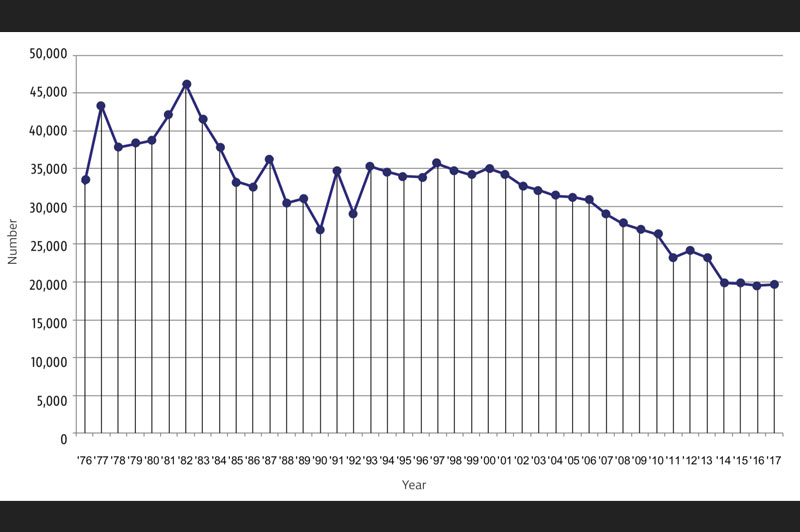
    Induced abortion statistics have been prepared in Ohio since 1976. Several trend comparisons in the 2017 Annual Abortion Report date back to 2003. A total of 20,893 induced pregnancy terminations were reported in Ohio for 2017, including 19,615 obtained by Ohio resident women (93.9%). This represents a 1% increase in induced pregnancy terminations from 2016 to 2017. Overall, since 2001 there has been a steady decline in terminations. When examined from 2001 to 2017, the annual decline averaged approximately 830 per year 

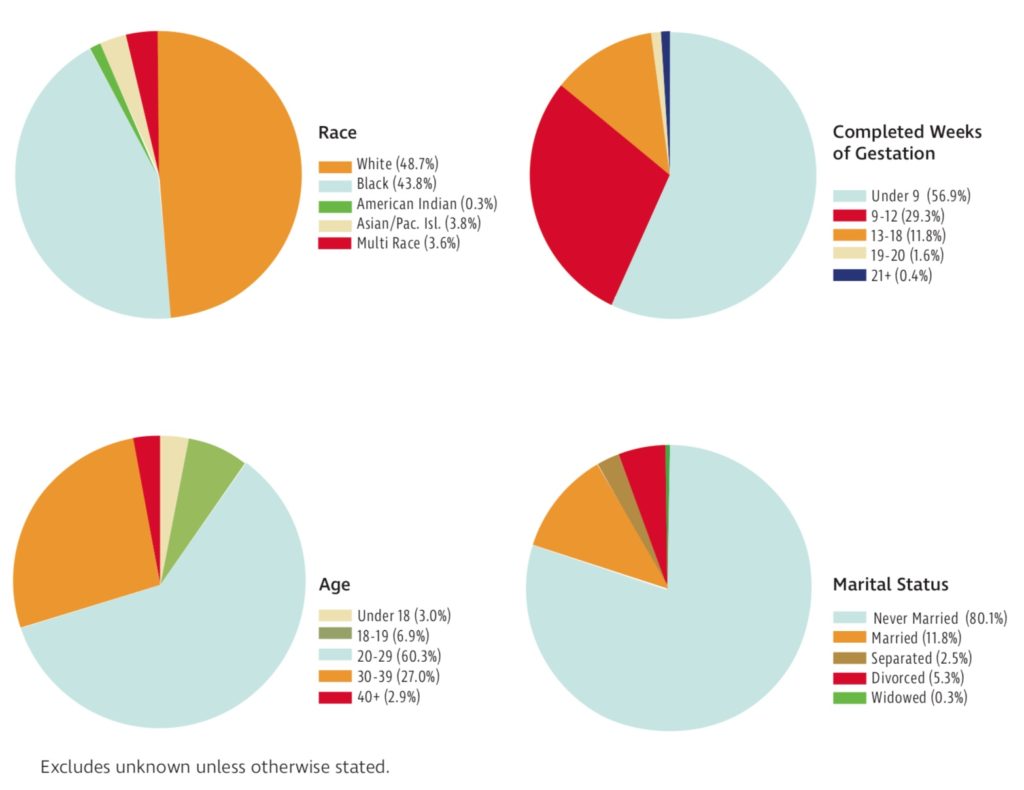
    Approximately one in ten women who obtained abortions in 2017 were under 20 years of age, with another one-third between the ages of 20-24 years of age. 

    While the age distribution of women obtaining abortions has remained relatively unchanged since 2001, the age-specific abortion rates for women under age 25 have steadily decreased. Approximately 85% of women with known marital status who obtained abortions were never married, divorced, or widowed. Fifteen percent of women who obtained abortions and whose marital status was known were married or separated. 

    Forty-nine percent of resident women who obtained abortions and for whom race was reported were White; 44% were African American; 4% were Asian/ Pacific Islander; and 4% reported more than one race (Figure 2). Five percent of women with known ethnicity who obtained abortions were of Hispanic origin. 

    The 2017 Ohio abortion rate was 8.9 per 1,000 resident women ages 15-44 years old; unchanged from the rate in 2016. The 2017 Ohio resident abortion ratio was 144 abortions per 1,000 live births; slightly increased from the ratio in 2016. 

    More than half of all induced abortions involved pregnancies of less than nine weeks (56%), with approximately 29% involving pregnancies of nine to 12 weeks. The proportion involving abortions of less than nine weeks increased from 49% in 1997, while the proportion between nine and 12 weeks declined from 35% to 29%. There were 454 abortions in 2017 involving pregnancies of 19 or more completed weeks of gestation. That represents a decrease from the 508 reported in 2016. The abortion reporting form requests method used to determine gestational age: ultrasound was used in 92% of cases. The vast majority of reported abortions were obtained in six major metropolitan areas of Ohio. 

    Curettage was the most used method of termination in 2017 (58%). That method has decreased since 2001, when 87% of terminations were by curettage. Mifepristone was reported as the medication for non-surgical termination for 5,279 abortions, followed by 489 terminations using misoprostol, and 40 terminations using methotrexate.

    View the full report and many more details HERE.

    Also READ this discussion of abortion laws under the U.S. Constitution and any restrictions by individual states in Wikipedia.

    Abortion in Ohio: What are the CURRENT LAWS?

    Ohio Abortion Law