Tag: money laundering

  • [BREAKING] Ex-First Energy executives, Ohio utility regulator charged by state in bailout and bribery scandal

    [BREAKING] Ex-First Energy executives, Ohio utility regulator charged by state in bailout and bribery scandal

    From left to right: Former PUCO Chair Sam Randazzo, former FirstEnergy CEO Chuck Jones, former FirstEnergy VP Michael Dowling. (Mugshots from the Summit County Sheriff’s Office. Graphic by WEWS.)

    BY:  AND  Ohio Capital Journal

    Ohio law enforcement authorities on Monday filed numerous felony charges against two former First Energy executives and a former top utility regulator in what has been called the biggest bribery and money-laundering scandal in Ohio history.

    Ohio Attorney General Dave Yost announced scores of felony charges against a former regulator who also has been charged federally, and against two people who haven’t — former top executives for Akron-based FirstEnergy whom the company admitted paid more than $60 million in bribes between 2016 and 2020 in exchange for a $1.3 billion ratepayer bailout.

    Charged were Sam Randazzo, former chairman of the Public Utilities Commission. Already facing felony charges in federal court, the state indictment charges him with 22 more, including grand theft, bribery, and money laundering. The indictment accuses him of taking bribes from FirstEnergy from 2010 until just before he became chairman of the commission in 2019.

    Also charged were former FirstEnergy CEO Chuck Jones and Vice President Michael Dowling. Between them, they face 22 felony charges similar to those faced by Randazzo.

    “This indictment is about more than one piece of legislation,” Yost said Monday. “It is about the hostile capture of a significant portion of Ohio’s state government by deception, betrayal, and dishonesty.”

    The state charges that were announced Monday didn’t deal with much of the activity addressed in the federal case. They instead focused on the relationship between Jones, Dowling, and Randazzo between 2010 and early 2019, when they paid him $4.33 million just as he was becoming the state’s top utility regulator.

    The House Bill 6 scandal

    Back in 2019, former Ohio House Speaker Larry Householder took $61 million in bribes in exchange for legislation to give FirstEnergy a $1 billion bailout, named House Bill 6, all at the expense of the ratepayers.

    The scheme was revealed in three main ways — two separate whistleblowers and a phone wiretap.

    In March 2023, a jury found Householder and former Ohio Republican Party leader Matt Borges guilty beyond a reasonable doubt for their involvement in the racketeering scheme that left four men guilty and another dead by suicide.

    In late June that year, federal judge Timothy Black sentenced Householder to 20 years in prison. Borges got 5 years. The two surviving defendants took plea agreements early on, helping the FBI, and are still awaiting their sentencing. The feds are asking for 0-6 months for them.

    Until Monday, only federal indictments had been handed out.

    HB 6 mainly benefited FirstEnergy’s struggling nuclear power plants, but those provisions were later repealed. There are aspects of the bill still in place, though.

    The Ohio Valley Electric Corporation (OVEC) got a handout from the scheme. It expanded a bailout of the OVEC plants and required Ohioans to pay for two 1950s-era coal plants— one in the Southern area of the state and the other in Indiana. The main beneficiaries of this are American Electric Power Company (AEP), Duke Energy and AES Ohio.

    Despite this scandal becoming public years ago, ethics laws in the state have not changed to prevent schemes like this from happening.

    There are numerous bipartisan efforts to repeal HB 6 totally and to put forward ethics laws. None are going anywhere, it seems.

    Monday’s indictments

    AG Yost was joined by Summit County Prosecutor Sherri Bevan Walsh and Sheriff Kandy Fatheree for the announcement Monday.

    “The crimes committed by these individuals impacted the pocketbooks of every hard working Ohioan and further shook our faith in the institutions and organizations that we count on to represent us and to provide us with essential services,” Fatheree said. “Today, we take another important step in ensuring that justice is served for these crimes and that those who took advantage of the public’s trust are held accountable.”

    FirstEnergy as a company has already admitted in a deferred prosecution agreement to bribing public officials in Ohio, including a $4.3 million bribe to Randazzo. Jones and Dowling allegedly paid this to him.

    Randazzo pleaded not guilty to the federal charges against him in December.

    The Sustainability Funding Alliance of Ohio and IEU-Ohio Administration Company are also named in the filing. Randazzo controlled each of them, and they were allegedly shell companies created to further his criminal activity.

    Reactions

    While Monday was probably not the best day for Randazzo, Jones and Dowling, it was a great day for whistleblower Tyler Fehrman.

    Fehrman is the Republican operative-turned-FBI informant who is credited with exposing this mass public corruption at the Statehouse — and he is cheering the AG and Summit County for these arrests.

    “These guys deserve to have everything taken away from them,” Fehrman said. “They deserve it.”

    Borges attempted to bribe Fehrman, and threatened him, to be a part of the scandal — even at one point telling him that if he snitches, Borges would “blow up his house.”

    That conversation was actually set up and recorded by the feds. Instead of staying quiet, Fehrman testified, helping the jury to return guilty verdicts in the federal trial.

    Fehrman ended up having to change careers and flee the state due to fears of retaliation — and because he was ostracized — but now he gets to watch as the scheme continues to unravel.

    “You can hide your actions in the dark for a little bit,” Fehrman said Monday. “But the sun always rises and the truth always comes out. Every time one of these guys gets indicted, especially the people that made it possible for Matt and Larry to have the opportunity to do what they did to me — to see them get in trouble, it’s extremely vindicating.”

    He agreed with Yost’s statement that there can be no justice without holding the check-writers and the masterminds accountable.

    Case Western Reserve University law professor Mike Benza believes these charges are going to be hard to fight. When asked the best possible scenario for them, other than pleading guilty, he said their best bet could be to argue this is politics as usual.

    “It seems that the focus from the defense side is going to be much like the focus from Householder and Borges — this is just how things get done in Columbus,” Benza said. “This is just the normal sausage-making of public policy and it may not be pretty and you may not like it, but this is the reality and it doesn’t equal corruption.”

    Clearly, that wasn’t a winning argument in federal court.

    Part of the reason why it may have worked so poorly in Black’s federal courtroom is because Householder went against the advice of the vast majority of criminal defense attorneys and decided to testify in his defense.

    The now-convicted felon used the bribe money to put himself and his allies into power, demolishing and threatening anyone in his path, as well as paying off credit card debt and renovations to his home in Florida.

    Benza believes Randazzo, Jones, and Dowling are facing difficult days ahead.

    “Randazzo is probably going to be looking at dying in prison,” Benza responded. “Jones and Dowling are probably in that same boat.”

    Ferhman is hoping for more indictments, including high-profile names.

    “The clock is ticking for the other people that were involved,” Fehrman said.

    He named Gov. Mike DeWine Lt. Gov. Jon Husted as people of interest for him.

    DeWine has been complying with a subpoena he received in a civil case connected to the scandal, he said.

    FirstEnergy investors are suing for being negatively impacted financially by the scandal. They have subpoenaed documents from DeWine, and they’re scheduling a sworn deposition with Husted.

    In a one-on-one interview with the governor, DeWine was asked if he was nervous about the scandal, or, more importantly — if was he worried for Husted. DeWine said no to both.

    Randazzo has been named as the mastermind behind HB 6, due to him being one of the creators of it — according to the feds. But DeWine was how he came into power.

    DeWine was asked in the same interview if he regretted naming Randazzo the state’s top utility regulator.

    “Oh, look, if I knew what I know now, if I knew that — I certainly would not have appointed Sam Randazzo to that position,” DeWine responded.

    DeWine said he was the best person for the job, claiming that he wasn’t aware that Randazzo was FirstEnergy’s handpicked man.

    “While our office was not privy to the indictment and have not yet reviewed it, the indictment alleges very serious acts,” DeWine’s spokesperson Dan Tierney said Monday afternoon. “Our office has full faith in the criminal justice system to adjudicate these serious allegations in an appropriate manner.”

    ________________

    Marty Schladen
    MARTY SCHLADEN

    Marty Schladen has been a reporter for decades, working in Indiana, Texas and other places before returning to his native Ohio to work at The Columbus Dispatch in 2017. He’s won state and national journalism awards for investigations into utility regulation, public corruption, the environment, prescription drug spending and other matters. MORE FROM AUTHOR

    Morgan Trau
    MORGAN TRAU

    Morgan Trau is a political reporter and multimedia journalist based out of the WEWS Columbus Bureau. A graduate of Syracuse University’s S.I. Newhouse School of Public Communications, Trau has previously worked as an investigative, political and fact-checking reporter in Grand Rapids, Mich. at WZZM-TV; a reporter and MMJ in Spokane, Wash. at KREM-TV and has interned at 60 Minutes and worked for CBS Interactive and PBS NewsHour. MORE FROM AUTHOR

  • Former Ohio speaker, GOP chair found guilty of racketeering

    Former Ohio speaker, GOP chair found guilty of racketeering

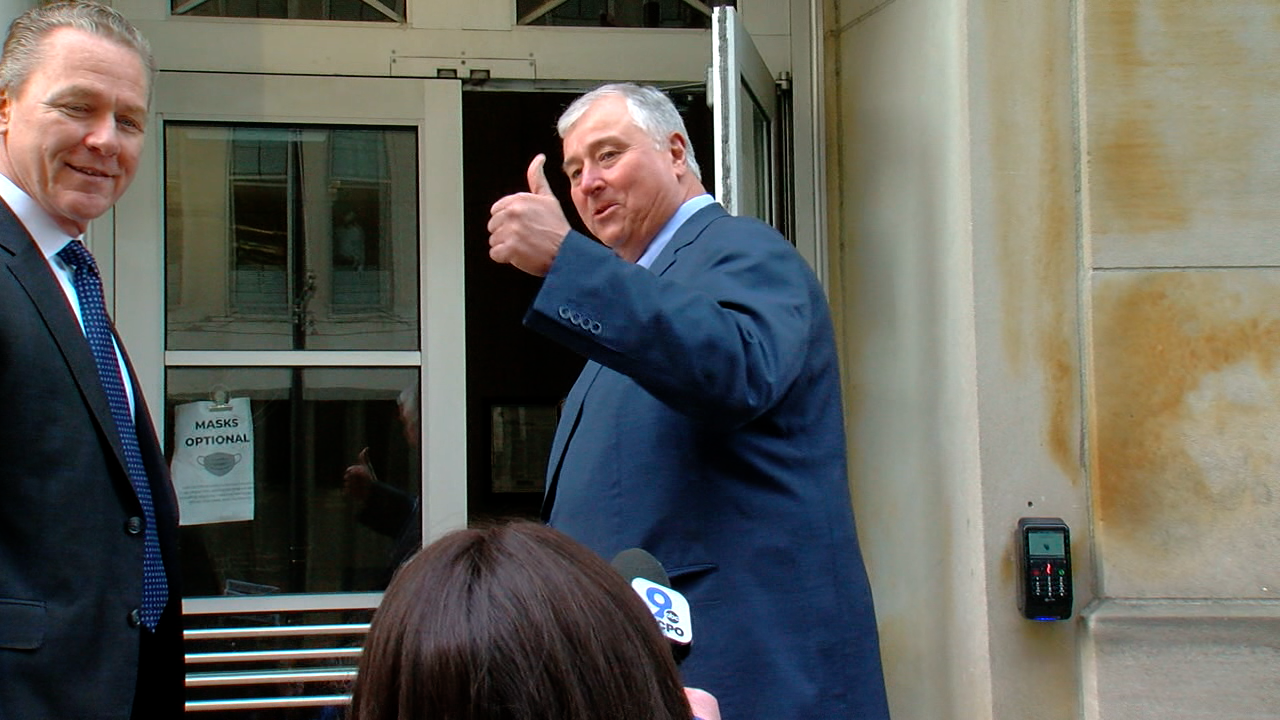
    Former Ohio House Speaker Larry Householder gives the thumbs up as he enters the courthouse where he is expected to testify Wednesday, March 1, 2023. Photo from WEWS.

    BY: MARTY SCHLADEN – MARCH 9, 2023 2:03 PM Ohio Capital Journal

    CINCINNATI — After more than nine hours of deliberation, a jury on Thursday found former Ohio House Speaker Larry Householder and state Republican Chairman Matt Borges guilty of felony racketeering charges in connection with a billion-dollar utility bailout that was passed in 2019.

    Both men face maximum sentences of 20 years in what prosecutors said was likely biggest bribery and money laundering scandal in Ohio history. U.S. District Judge Timothy Black will schedule a sentencing hearing.

    After the verdict, one of Householder’s attorneys, Steven Bradley, confirmed what observers have suspected almost from the start of testimony.

    “Of course we’re going to appeal the verdict,” he told reporters minutes after the jury left the courtroom. Householder stood off to the side in a blue business suit, clutching a camouflage trucker cap.

    He affirmed that he would continue to fight the charges.

     Convicted felon Larry Householder outside the federal courthouse in Cincinnati where a jury found him guilty of racketeering. Photo by Marty Schladen, Ohio Capital Journal.

    “This is just the first step in the process,” Householder said. “Stay tuned.”

    As part of the racketeering scheme, Akron-based FirstEnergy and other utilities paid tens of millions into an effort to elect friendly lawmakers in 2018 who would vote to make Householder speaker the following year. Immediately after taking the speaker’s gavel, Householder worked furiously to pass a $1.3 billion bailout, the vast majority of which benefited FirstEnergy subsidiary FirstEnergy Services.

    The company was being dragged down by losses from its nuclear and coal plants and executives were seeking a bailout. While it got more than $1 billion out of the deal, Householder got political power as well as more than $500,000 personally, jurors found. Borges played a smaller role, but he paid a $15,000 bribe to help defeat an attempt to repeal the bailout and he received more than $100,000 in funds that originated with FirstEnergy, prosecutors said.

    The verdict could have far-reaching implications for the use of “dark money” — funds paid into 501(c)(4) organizations that don’t have to reveal the sources of their funding. In the wake of the 2010 U.S. Supreme Court decision Citizens United v FEC, the use of such funds has become ubiquitous in state and national politics.

    Thursday’s verdict might start to start to draw some boundaries around such expenditures.

    In the case of the Ohio bailout, a financially strapped Householder found common cause with a financially ailing FirstEnergy. After paying billions to prop up a subsidiary with failing and nuclear and coal plants, the parent corporation in 2016 decided to send the subsidiary into bankruptcy. They wanted a ratepayer subsidy for the failing nuclear and coal plants so they could be sold off after the subsidiary emerged from bankruptcy.

    FirstEnergy’s top executives were seeking a bailout at the same time a financially strapped Householder was seeking a return to the Ohio speakership. Their relationship grew in luxurious settings that belied the financial problems besetting both.

    Householder attended a World Series game in November 2016 in the FirstEnergy box in Cleveland with CEO Chuck Jones. Two months later, Householder flew to Donald Trump’s inauguration aboard FirstEnergy’s private jet and stayed in the same $500-a-night hotel as Jones. Prosecutors showed the jury photos of Householder’s son and a FirstEnergy executive in the back of a limousine just outside a fancy steakhouse dinner.

    Within weeks of the inauguration, Householder’s underling set up Generation Now, a 501(c)(4) dark money group into which FirstEnergy almost immediately started pouring what would become tens of millions of dollars.

    The money was used to fund support staff for candidates who would vote to make Householder speaker and to finance attack ads against their opponents.

    When opponents started gathering signatures to repeal the bailout law, House Bill 6, FirstEnergy poured $36 million into an effort to block it. Householder took control of the push to block the repeal, while Borges assisted — both by pressuring Attorney General Dave Yost and by paying $15,000 for inside information about the petition campaign.

     Center, former Ohio Republican Party chair, and statehouse lobbyist, Matt Borges with his attorneys outside of the federal courthouse. Photo courtesy of WEWS.

    That money was used to finance a torrent of misleading, anti-China ads and a petition-blocking effort that in some cases devolved into outright battery, witnesses testified.

    And because it was dark money, the public couldn’t know that it was FirstEnergy that was financing the gargantuan fight to pass and protect a much larger bailout from which it benefited — until federal law enforcement stepped in. During the trial, investigators from the FBI described how they used accountants, informants, subpoenas and wiretaps to unravel the tangle of dark money groups and political-action committees that were used to obscure the origins of the funds that were used in the scheme.

    “Today was a victory for the people of Ohio,” U.S. Attorney Kenneth L. Parker said on the steps of the Potter Stewart U.S. Courthouse shortly after the verdict. Parker declined to answer whether further indictments can be expected in the case — including for Jones and other FirstEnergy executives who paid the money that the jury on Thursday determined to be bribes.

    Also unknown is whether Gov. Mike DeWine’s first appointee to chair the Public Utilities Commission of Ohio, Sam Randazzo, will be charged. Randazzo took $4.3 million from FirstEnergy shortly before being nominated to the post and once nominated, he helped write the bailout law, House Bill 6. He resigned shortly after the FBI searched his Columbus condo in 2020.

    The verdict might be sending shock waves around Capitol Square and other power centers because defense attorneys for Householder and Borges argued that the conduct described by prosecutors was perfectly legal — politics as usual.

    In a statement, Parker offered a different take.

    “As presented by the trial team, Larry Householder illegally sold the statehouse, and thus he ultimately betrayed the great people of Ohio he was elected to serve,” the U.S. attorney said. “Matt Borges was a willing co-conspirator, who paid bribe money for insider information to assist Householder. Through its verdict today, the jury reaffirmed that the illegal acts committed by both men will not be tolerated and that they should be held accountable.”

    Outside the courthouse, Householder said that he will go back to his Perry County farm to plant a garden and fish with his kids while federal authorities complete a pre-sentence report and a sentencing hearing is scheduled.

    That his attorneys plan to appeal has been suspected almost since testimony began on Jan. 23. On Feb. 1, they undertook the risky gambit of accusing Judge Black of being biased against their client in open court.

    They also took a risk by placing Householder on the stand to testify in his own behalf. During cross examination, Assistant U.S. Attorney Emily Glatfelter confronted Householder with numerous inconsistencies and apparent falsehoods.

    Householder was asked just after the verdict if he thought the decision to testify was a mistake. He said it wasn’t

    “I waited two-and-a-half years to tell my story,” he said. “I wanted the opportunity to speak.”

  • DeWine refuses to explain aide’s role in bailout scandal

    DeWine refuses to explain aide’s role in bailout scandal

    By Marty Schladen and Ohio Capital Journal

    If you asked most people to start up a dark money group and then funnel more than $1 million through it and into another such group, they’d probably want to know what it was going to be used for.

    But now that the second 501(c)(4) dark-money group, Generation Now, has pleaded guilty to being at the heart of one of the biggest bribery and money laundering scandals in Ohio history, Gov. Mike DeWine is refusing to discuss what one of his top aides was told when he formed the first dark money group, Partners for Progress.

    Generation Now pleaded guilty earlier this month to being the major conduit of money between Akron-based FirstEnergy and related organizations and the effort to pass House Bill 6, a $1.3 billion bailout that mostly went to two nuclear plants FirstEnergy started spinning off in 2016. DeWine signed the bill into law in 2019.

    Last summer, federal authorities arrested then-Speaker Larry Householder and four associates as part of the scandal and two of the associates later pleaded guilty.

    As he announced the arrests, U.S. Attorney David DeVillers stressed that the dark money made the massive scandal possible.

    “I don’t see how (the conspiracy) could possibly have happened” without it, DeVillers said.

    The feds haven’t accused DeWine’s aide, Legislative Affairs Director Dan McCarthy of wrongdoing, but they refer to his dark-money group in an affidavit supporting Householder’s arrest as “Energy Pass-Through.”

    Among the activities Generation Now pleaded guilty to was engaging in transactions “designed to conceal the nature, source, ownership and control of the payments” from FirstEnergy and associated companies.

    But DeWine and McCarthy don’t want to discuss whether McCarthy intended to obscure that FirstEnergy was bankrolling an effort to prop up nuclear plants it was spinning off.

    Asked last week about the matter, DeWine Press Secretary Dan Tierney pointed to a statement McCarthy issued last summer when The Cincinnati Enquirer first reported that he’d started a dark money group that helped fund the HB 6 effort.

    In it, McCarthy explained that in addition to his lobby work for FirstEnergy, he had also worked with people who had adversarial relationships with Householder and one of his indicted associates, Neil Clark, so “any insinuation I was involved in this disgusting scheme is without merit.” 

    But he didn’t explain why he founded Partners for Progress two days after the founding of Generation Now, or why a week later his dark money group got $5 million from FirstEnergy and within a month it was forwarding some of that money to Generation Now. 

    In early 2019, McCarthy stopped lobbying for FirstEnergy and resigned as president of Partners in Progress to become DeWine’s legislative affairs director. The following October, while McCarthy was advocating for HB 6 in that capacity, FirstEnergy and associates wired $20 million to McCarthy’s former money group and it forwarded $10 million of that to Generation Now the same month, the federal affidavit said.

    Despite these and other revelations about DeWine appointees, DeWine on Tuesday declined to give a more complete explanation of what McCarthy believed he was doing when he started Partners for Progress and began funneling money into a now-guilty dark money group.

    “As far as I know, Dan McCarthy has been well-respected for many, many years, long before he started working for me as our legislative director and I have faith in his integrity,” DeWine said.