

Tag: national abortion ban

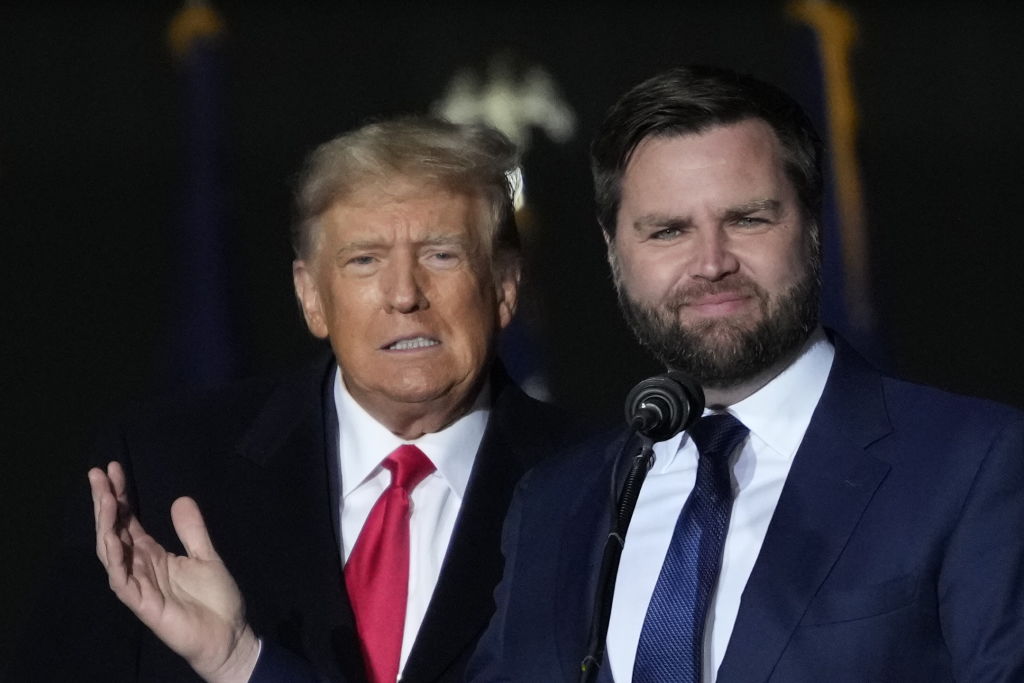
  • Former President Trump taps Ohio U.S. Sen. J.D. Vance as running mate in 2024

    Former President Trump taps Ohio U.S. Sen. J.D. Vance as running mate in 2024

    BY:  Ohio Capital Journal

    A little more than three years ago, J.D. Vance was just an author and conservative commentator. Now he might be next in line for the White House. It’s a dizzying political ascent for the 39-year-old man from Middletown, Ohio.

    Presumptive Republican Party presidential nominee Donald Trump announced Monday during the first day of the Republican National Convention that he has chosen Vance as his running mate in the 2024 Election.

    His 2016 memoir Hillbilly Elegy put him on the national stage as many were searching for an explanation to the rise of Donald Trump. At the time, Vance himself was extremely critical of the incoming president, but by the time he was running for office in 2022, Vance had reversed his thinking. Instead of “cultural heroin,” he argued Trump was the “greatest president in my lifetime.”

    Vance’s embrace of Trump helped him secure the former president’s endorsement in his U.S. Senate race, and since taking office, Vance has been one of Trump’s most consistent defenders. On cable news and Sunday talk shows, the Yale law grad has shown a knack for smoothing the sharp edges off of Trump’s latest pronouncements without walking back his point. As the Trump campaign works to extend beyond its conservative base, Vance’s skills as a communicator and translator — presenting a more palatable version of the nominee’s message — could help appeal to undecided voters.

    Still, there’s plenty in Vance’s own messaging that could turn some voters off. As a U.S. Senate candidate he leaned heavily into anti-immigrant rhetoric. On the campaign trail and in office, he has stridently opposed ongoing support for Ukraine. That stance is particularly notable given Ohio’s substantial Ukrainian community and Vance’s predecessor, U.S. Sen. Rob Portman co-founded and chaired the Senate Ukraine caucus. Critics argue Vance’s statements about the war mirror rhetoric coming out of the Kremlin.

    On the other hand, Vance has signed on to several bipartisan pieces of legislation. In addition to co-sponsoring rail safety and unfair trade legislation with U.S. Sen. Sherrod Brown, D-OH, Vance has backed U.S. Sen. Elizabeth Warren’s, D-MA, bill to claw back bonuses from executives at failed banks, and U.S. Sen. Sheldon Whitehouse’s, D-RI, bill that would eliminate a lucrative tax exemption for larger mergers.

    Vance has also praised FTC Chairwoman Lina Khan for taking a more critical view of business consolidation. That more aggressive posture has earned Khan the ire of traditional GOP allies like the U.S. Chamber of Commerce.

    What does he bring to the ticket?

    When a presidential nominee selects a running mate, they often attempt to answer a perceived shortcoming. The vice-presidential pick might come from an important state or region. Maybe they have strong connections with a particular interest group or represent a wing of the party. Perhaps they bring greater governing experience to the table.

    Ohio State political science professor emeritus Paul Beck argued Vance’s appeal for the ticket certainly isn’t geographic.

    “Well, I think one thing Vance doesn’t bring is votes in Ohio that Trump would need,” Beck said. “He doesn’t need them.”

    In 2016 and 2020, Trump won Ohio handily. In 2022, as Republicans nationwide underperformed, Vance and every other statewide Republican candidate won their races in Ohio.

    Beck contrasted Vance with former Vice President Mike Pence, who helped bring Christian evangelicals into the fold. Vance doesn’t have a similar affinity group to add, but Beck suggested he might help solidify support among one of Trump’s strongest groups of supporters — white working-class voters. Vance speaks their language, Beck argued, when it comes to trade and offshoring.

    “It could well be that he brings that group or at least solidifies that group in the Trump coalition,” Beck said, but allowed, “I don’t think Trump needs, necessarily, somebody who is going to strongly appeal to that particular part of his base. On the other hand he doesn’t want someone on his ticket, I would think, who would be opposed.”

    Instead, Beck emphasized Vance’s ability as a communicator. “He certainly has emerged as one of the most forceful and articulate defenders of a lot of conservative policy,” Beck argued. And as part of the ticket, he added, Vance could be an asset “downplay(ing) some of the major Democratic criticisms of Trump and deflect(ing) them in a way that is plausible.”

    Personal perspective

    Dan Driscoll first met Vance as part of a veteran’s group at Yale and described him a reassuring voice for a “scared, humbled, self-conscious” first year law student. In an interview Driscoll said he’s “thrilled for a friend I have a ton of respect for and our country to get an amazing leader.”

    Since graduating, Driscoll has settled in North Carolina. In 2020 he ran for the Republican nomination for the congressional seat vacated by former Trump chief of staff Mark Meadows. He lost in a crowded primary to the eventual winner, former Rep. Madison Cawthorn.

    Driscoll argued Vance’s run of success from a book, to a movie, to a venture capital fund — “most people, one of those would be an amazing lifetime achievement” — is no accident. He described the senator as “one of the single hardest workers” he’s ever met.

    And like Beck, he pointed to Vance’s communication skills as a kind of a “superpower,” but insisted it works because he’s saying what he believes.

    “My true genuine perspective is that he just wants to make a difference for a set of the population that seems to have been pretty overlooked since the 80’s or 90’s,” Driscoll said.

    He argued Vance is skeptical of elite political consensus on issues like trade because it has contributed the hollowing out of working-class communities like Middletown where he grew up. It was a familiar part of Vance’s stump speech throughout his U.S. Senate campaign. Driscoll brought up examples of Vance working with some of the most liberal lawmakers in the Senate, and argued he wouldn’t do so unless they shared concerns about policies impact those communities.

    “Even if what he’s saying doesn’t fit in these clean boxes of the left or the right, if he believes it, he will say it,” Driscoll argued. “And that’s really compelling to a lot of people, I think.”

    Ohio Republicans applaud

    Shortly after President Trump’s announcement came a wave of positive reaction from Ohio politicos.

    Gov. Mike DeWine, who will be tasked with finding a replacement if Republicans retake the White House, congratulated Vance and praised his “unique life story (which) will resonate with Republicans and Independent voters across the country.”

    DeWine has no shortage of options to fill the vacancy created by a Vance Vice Presidency, but whomever he settles on would face an election in 2026 to complete the remainder of Vance’s unexpired term.

    DeWine added that “J.D. will also bring a new generational perspective to the ticket,” and that his experience growing up poor in Middletown, Ohio will help him relate “to the many Americans who are struggling right now to make ends meet.”

    Republican U.S. Senate nominee Bernie Moreno has been an enthusiastic supporter of Vance, and the feeling is mutual. Vance endorsed Moreno for the U.S. Senate more than a year ago in hopes of avoiding a messy primary, and last November, he campaigned with Moreno outside Columbus — urging the crowd to “send me reinforcements.

    “President Trump made a brilliant selection in Senator J.D. Vance,” Moreno said in a statement.


    Moreno described Vance as a “dynamic, visionary leader” and the “perfect messenger” for Trump’s agenda.

    “He will fight with President Trump for our middle class, secure our border, and unleash American energy,” Moreno continued. I am proud to call J.D. a friend and I look forward to working with him to fire Joe Biden, Kamala Harris, and Sherrod Brown.”

    Several of the Ohio politicians who could be in the running if Vance’s seat opens up poured praise on the selection as well. On social media, State Treasurer Robert Sprague said “once again, President Trump hits it out of the park.” In a press release Attorney General Dave Yost called Vance a “perfect pick.”


    “Tough, smart and high-energy,” Yost went on. “He knows what it’s like to have to fight, what it’s like to win, and what it’s like to serve.”

    Both men are eyeing the governor’s mansion in 2026, and speculation has begun that DeWine might name a gubernatorial contender as way to create a less volatile GOP primary. Lt. Gov. Jon Husted is laying the groundwork to run for governor as well.

    Two recent U.S. Senate hopefuls congratulated Vance on his selection as well. State Sen. Matt Dolan, who DeWine endorsed in this year’s GOP primary, described the pick as “great news for Ohio and America. We are in need of new, results-driven leadership in Washington, DC.”

    Secretary of State Frank LaRose praised Vance as “an excellent choice,” who will “serve honorably.”

    “J.D. Vance is a patriot, a thought leader, and a fighter for America’s forgotten working class,” LaRose said.

    Ohio Democrats criticize Vance’s ‘political shapeshifting’

    In a nod to Vance’s previous comments against Trump, Ohio Democratic Party Chair Elizabeth Walters released a statement after the selection pointing to his “political shapeshifting.”

    “J.D. Vance is an out-of-touch millionaire who launched his political career by taking advantage of Ohio’s opioid crisis and has spent his time in the Senate humiliating himself in the service of a convicted felon instead of working to improve the quality of life for Ohioans,” Walters said. “His support for a national abortion ban and his twisted belief that women should stay in violent marriages for the benefit of their children exemplifies his dangerous extremism. He’s not just wrong for Ohio, he’s wrong for the country.”

    Follow OCJ Reporter Nick Evans on Twitter.


    Nick Evans
    NICK EVANS

    Nick Evans has spent the past seven years reporting for NPR member stations in Florida and Ohio. He got his start in Tallahassee, covering issues like redistricting, same sex marriage and medical marijuana. Since arriving in Columbus in 2018, he has covered everything from city council to football. His work on Ohio politics and local policing have been featured numerous times on NPR.

    Ohio Capital Journal is part of States Newsroom, the nation’s largest state-focused nonprofit news organization.

    MORE FROM AUTHOR

  • Ohio’s Republican U.S. Senate candidates spar in first televised debate

    Ohio’s Republican U.S. Senate candidates spar in first televised debate

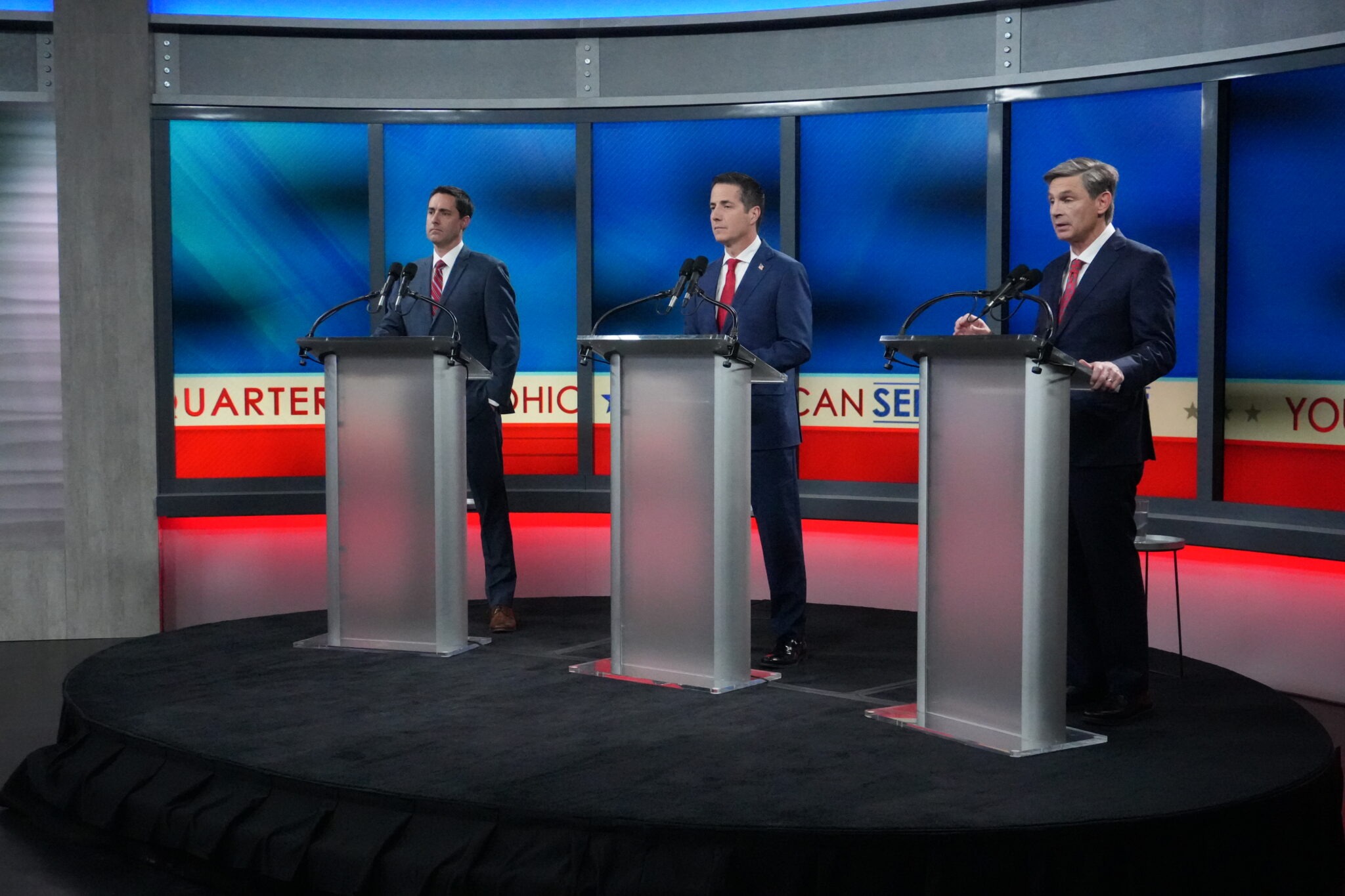
     (From left) Sec. of State Frank LaRose, Bernie Moreno, and state Sen. Matt Dolan, R-Chagrin Falls, on the debate stage. (Photo courtesy of WCMH-TV.)

    BY:  –  Ohio Capital Journal

    The three Ohio Republican candidates competing for their party’s U.S. Senate nomination met Monday in the race’s first televised statewide debate.

    State Sen. Matt Dolan, R-Chagrin Falls, Ohio Sec. of State Frank LaRose, and Cleveland-area businessman Bernie Moreno tussled over issues like immigration, abortion and the economy. Each insists they should be the state’s Republican standard bearer, while their competitors would fall flat against Ohio Democratic U.S. Sen. Sherrod Brown.

    The debate sets the stage for what could be a consequential and highly competitive race. While presidential campaigns have largely moved away from Ohio to focus on other battlegrounds, the state could help determine who controls the closely divided Senate.

    Ohio’s primary election is March 19.

     Ohio’s first televised statewide U.S. Senate debate for 2024. (Photo courtesy of WCMH-TV.) 

    Immigration

    The debate kicked off with a discussion of immigration and the U.S.-Mexico border. It’s been a perennial issue for Republicans and one that all three candidates have made a centerpiece of their campaigns. But the rhetoric has grown sharper since Ohio’s last U.S. Senate campaign in 2022.

    During the last cycle, now-U.S. Sen. J.D. Vance, R-OH, argued cartels should be designated terrorist organizations. Now, all three Republican candidates embrace the idea.

    Does LaRose agree the U.S. should use drone strikes against them? “100%,” he said, adding, “we must define these cartels as foreign terrorist organizations and use the full force of the U.S. military and the U.S. federal government to kill them so that they can’t kill our fellow Americans.”

    LaRose has also proposed deploying three military divisions to the border.

    Moreno criticized that rhetoric as “irresponsible.”

    “We have to work with Mexico to give Mexico the option,” he argued, “They can be our largest legal trading partner or our largest illegal trading partner — they can’t be both.”

    Similarly, Dolan argued the administration should threaten to withhold aid and trade with Mexico to compel its participation in fighting cartels.

    But all three candidates readily staked out an even more radical position — ending birthright citizenship. “Birthright citizenship is a bad idea,” LaRose argued, adding people who came to the country illegally should not be able to “take advantage of that.”

    It’s an idea former President Donald Trump has dangled for years, but birthright citizenship is guaranteed by the Fourteenth Amendment.

     Sec. of State Frank LaRose, left, and Bernie Moreno. (Photo courtesy of WCMH-TV.) 

    Abortion

    The candidates also made their case for a national abortion ban — even if they quibbled with the terminology.

    “You’re using that word, I’m not,” Moreno argued before pitching “a 15-week floor where there’s common sense restrictions after 15 weeks.”

    Dolan signed on to 15 weeks, with “the three exceptions,” presumably rape, incest, and health of the mother.

    LaRose argued “it’s not enough to be pro-birth” and insisted “we need to make sure there are supports available” for prospective mothers.

    Still, like the others, LaRose argued, “the states can set their own standards, but there should be a bare minimum that we look at at the federal level.”

    But after the U.S. Supreme Court’s decision overturning Roe v. Wade sent abortion policy back to the states, the moderators pressed the candidates on why they believe federal lawmakers should be involved at all.

    “I don’t want it to be a federal issue,” Dolan insisted, “but I don’t want late term abortions to be the norm in the United States of America because that is out of touch.”

    A few minutes later, however, the moderators asked Dolan whether federal lawmakers should pursue anti-trans legislation and he offered a different argument.

    “No,” he said, “the Tenth Amendment makes it clear. The issues that are not expressly stated in the Constitution are left to the states and in Ohio.”

     OH Sec. of State Frank LaRose, speaking, and Bernie Moreno. (Photo courtesy of WCMH-TV.) 

    The economy and federal spending

    When it comes to backing stopgap continuing resolutions to keep the federal government funded, LaRose and Moreno both readily embraced shutting down the federal government as a negotiation tactic.

    “You would never run a business that way,” Moreno said, dismissing the approach as kicking the can down the road. “Republicans need to go into a negotiation with nothing off the table,” he added.

    LaRose insisted “if the Democrats are unwilling to join us on border security, if they’re unwilling to get the out-of-control spending under control, you bet I’m willing to shut down the government.”

    He added it’s not something to “relish” but “absolutely a tool we have to be willing to use.”

    Dolan stands out for his experience actually drafting budgets as the Ohio Senate’s Finance committee chair. And while he said he wouldn’t use continuing resolutions, he emphasized his ability to get agreement.

    “You have to be willing to make difficult choices and I have a career where I have made difficult choices,” Dolan argued, “They always haven’t been the best political choice for me, but they’ve always been the best for Ohio.”

     Bernie Moreno, left, and state Sen. Matt Dolan, R-Chagrin Falls. (Photo courtesy of WCMH-TV.) 

    The Trump factor

    Moreno got the former president’s endorsement late last month — a boon for the candidate after Trump’s backing helped propel Vance’s primary victory in 2022.

    LaRose had sought Trump’s endorsement as well, and after falling short, argued what matters is who will have the president’s back in the Senate. But Moreno pushed back.

    “The reality is he did endorse me,” Moreno insisted. “He knows who Frank LaRose is and doesn’t think that Frank will have his back and understands that dynamic.”

    In this campaign, and his unsuccessful run in 2022, Dolan has made a point of not seeking Trump’s approval. He insists “I’m about enacting Trump policies,” but that his chief focus is on Ohio voters.

    “They know that I will fight for Ohio,” Dolan argued, “and they also know the only thing you can trust about my two opponents is that when the political winds change, they will change with it.”

    It’s one of the few areas in which the candidates diverge, even if it’s more a matter of style than substance.

    A much more significant divergence is evident when it comes to funding for Ukraine. All three have vocally supported aid for Israel — LaRose quoting the Bible in doing so. But when it comes to Ukraine, LaRose contends “not another penny will go to Ukraine until we’ve secured the southern border.”

    “The world’s most exceptional nation can do things to make sure that our world is safer and more importantly, that America is more secure,” LaRose argued, “and that means that we need to create the circumstances where the fight in Ukraine can end very rapidly.”

    Moreno wants nothing to do with additional aid to Ukraine, arguing instead “what we need to do is drive towards peace and end the killing in Ukraine.”

    But Dolan, noting he represents a substantial Ukrainian population, said he views the issue differently. “This isn’t a balance sheet war for them,” he said, “this is real.”

    “If the United States does not continue to provide ammunition, weaponry, and aid to Ukraine, then Ohio boys and girls will be fighting Russia, in Poland, Western Europe or the Baltics,” Dolan argued.

    “That is a result of their policies,” he said of LaRose and Moreno.

    Democratic prebuttal

    Meanwhile, Democrats in Ohio are feeling a bit optimistic after recent victories for marijuana and abortion rights ballot measures. After voters approved Issue 1, enshrining abortion access in the state constitution, the Ohio Democratic Party began arguing abortion would be on the ballot again in 2024. All three Republican candidates, party chair Liz Walters argued, support a national abortion ban.

    Even as Republicans have tried to steer the race onto more favorable territory, former President Donald Trump has dragged it back — calling the repeal of Roe v. Wade during his administration “a miracle.

    In a call with reporters before Monday’s debate, the party aimed to keep the issue front and center. Dr. Catherine Romanos, a family doctor in Columbus, said her patients “breathed a sigh of relief” after the passage of Issue 1 last November.

    “They asked me less often if what they’re doing is breaking the law and they seem confident to come and get the care that they need,” she said.

    Echoing the warning that Republican candidates would support national abortion restrictions, Romanos argued “They think they know better than Ohioans. They’re wrong.”

    Follow OCJ Reporter Nick Evans on Twitter.

    Nick Evans
    NICK EVANS

    Nick Evans has spent the past seven years reporting for NPR member stations in Florida and Ohio. He got his start in Tallahassee, covering issues like redistricting, same sex marriage and medical marijuana. Since arriving in Columbus in 2018, he has covered everything from city council to football. His work on Ohio politics and local policing have been featured numerous times on NPR.

    MORE FROM AUTHOR