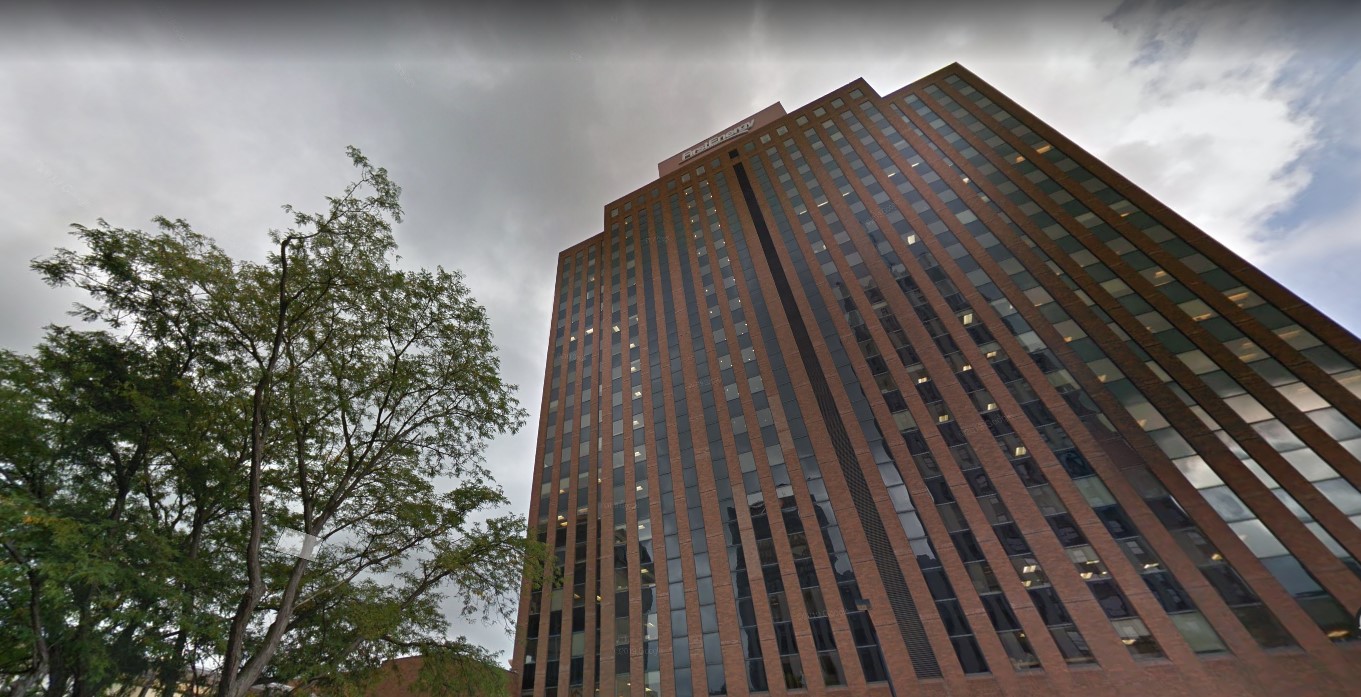
FirstEnergy’s headquarters in Akron. Source: Google Maps.
BY: JAKE ZUCKERMAN – Ohio Capital Journal
A judge who oversees utility cases was involved in writing a coal and nuclear bailout now at the center of what prosecutors have described as the largest public corruption case in Ohio history, subpoenaed documents show.
That same judge, Greg Price, is presiding over multiple regulatory cases in which a government watchdog agency is trying to investigate that same corruption. His orders, spanning 18 months, have blocked investigations into a utility at the center of the scandal on multiple fronts.
One ruling barred the agency from deposing a witness who worked on a FirstEnergy Corp. audit — an audit that the company’s CEO said in a text message that former PUCO chairman Sam Randazzo helped conceal. Another allowed FirstEnergy to attest to regulators its own innocence, as opposed to hiring an independent auditor to review the company’s practices after it was accused in court documents of participating in a bribery scheme.
As an attorney examiner at the Public Utilities Commission of Ohio, Price hears cases involving disputes between utility companies, residential interests, industrial interests, and others. Examiners — essentially administrative judges — preside over PUCO case hearings, issue procedural orders like what evidence must be turned over between parties in a case, and influence the five-member commission on final orders.
His involvement in the passage of House Bill 6 in 2019 came to light when the PUCO, which regulates utility companies and sets electric rates, submitted troves of records to the U.S. Department of Justice in response to two subpoenas.
The records show Price helped draft the legislative text, received regular updates about its legislative progress, formally reviewed HB 6 for the PUCO, and was briefed on its status as lawmakers launched efforts to repeal it after the FBI arrested the Ohio House speaker and four alleged co-conspirators.
The legislation, among other provisions, provided $1 billion from ratepayers to bail out two nuclear plants owned at the time by a FirstEnergy subsidiary; subsidized two coal plants jointly owned by several utility companies for an estimated $700 million from ratepayers; and allowed FirstEnergy to “decouple” its revenue from its energy sales, which its CEO said would “recession-proof” the company.
Prosecutors charged former House Speaker Larry Householder in July 2020 with using $60 million secretly provided by FirstEnergy to pass the bill, enriching himself personally and politically. FirstEnergy in 2021 entered into a deferred prosecution agreement with the DOJ, admitting to bribing not only Householder but former PUCO chairman Sam Randazzo. The company says it paid Randazzo $4.3 million for regulatory favors just before he was appointed.
Householder has pleaded not guilty and awaits trial. Randazzo has not been charged with a crime and has maintained his innocence. FirstEnergy paid a $230 million penalty and is cooperating with the investigation in an effort to avert a charge of honest services wire fraud.
Alongside the criminal probes, the PUCO has four open cases regarding FirstEnergy and House Bill 6. These have put Price in charge of answering questions about what kind of evidence FirstEnergy must turn over to outside investigators. Ashley Brown, a former PUCO commissioner and current executive director of the Harvard Electricity Policy Group, said this poses a conflict of interest for Price.
“It’s very, very strange to me that he would be both involved at the policy level and adjudicating those same policy issues later on,” Brown said. “If it were me, I’d recuse myself.”
In a brief phone call, Price declined to answer questions about the subpoenaed records or his role in the passage of HB 6. Matt Schilling, a PUCO spokesman, declined to answer written questions or make officials available for interviews, citing open PUCO cases and pending criminal investigations.
However, he defended Price’s apparent involvement in drafting HB 6.
“It is not unusual for the PUCO or its subject matter experts to be asked to review and share their expertise regarding legislation pertaining to public utility and commercial transportation law,” Schilling said.
Utility law is complex and requires specialized industry and legal knowledge to practice. But an administrative law judge like Price is supposed to be neutral and his actions transparent, said Neil Waggoner, an environmental advocate with the Sierra Club.
“The PUCO, especially under Randazzo’s tenure, showed itself to be neither of those things,” he said. “We need a full accounting of exactly what input and involvement PUCO commissioners and staff had in regard to HB 6 and repeal efforts, as well as an accounting for how that may or may not have impacted ongoing proceedings.”

Requests denied
Householder was arrested July 21, 2020. The PUCO, somewhat inexplicably, didn’t launch any investigation into FirstEnergy until Sept. 15 of that year.
When it finally did, it rejected requests from the Ohio Consumers’ Counsel to hire an independent auditor to determine whether the company broke any laws in the passage of the bill. Instead of bringing in a disinterested investigator, Price ordered a FirstEnergy official to answer to the PUCO whether it did so. The FirstEnergy official denied wrongdoing at the time.
Randazzo resigned as chairman in November 2020 after the FBI raided his condo and FirstEnergy first disclosed the $4.3 million payment to him. The company said it identified the payment via an internal investigation ordered by its board of directors after Householder’s arrest.
In September 2021, Price presided over a hearing over whether FirstEnergy would have to turn over that same internal investigation to the Ohio Consumers’ Counsel, a state-funded watchdog agency that represents residential consumers’ interests before the PUCO. Price ordered the company to give it to the PUCO to review privately, before ruling whether it should be turned over.
“We’ve heard a lot about this internal investigation, but we are in no position to make any rulings as to whether or not it’s privileged sight unseen,” Price said.
After review, the PUCO found the report to be protected by attorney client privilege and ruled it didn’t need to be released.
Around that same time, Price ruled FirstEnergy didn’t need to provide the Ohio Consumers’ Counsel with the documents it gave federal regulators who sought to investigate the HB 6 episode. Price denied the request until the Federal Energy Regulatory Commission issued its audit.
“If and when a public audit is released by FERC, we can revisit this issue at that time,” he ruled in August 2021, according to a hearing transcript.
FERC’s audit, released earlier this month, found FirstEnergy improperly used $71 million to lobby for the passage of HB 6 and ordered the company to develop a plan to refund customers. The Ohio Consumers’ Counsel has since asked Price to honor his word. The matter awaits a ruling.

‘Burning’ an audit
Before utility companies can add extra fees to users’ bills, they need the PUCO’s permission.
FirstEnergy in 2017 got that permission to apply a “Distribution Modernization Rider” (DMR) fee to its customers. Over the objections of the Consumers’ Counsel, the PUCO denied a request to attach a refund mechanism to the charge. The commissioners called adding a refund mechanism “counterproductive.”
Two years, one lawsuit, and $458 million collected from customers later, the Ohio Supreme Court deemed the charge unlawful and cut it off. The judges found the PUCO allowed the charge without making sure FirstEnergy uses the money to modernize the grid (despite the name). However, state law prohibits the court from demanding refunds unless PUCO explicitly creates such a mechanism.
When the PUCO allowed the charge, it hired Oxford Advisors to serve as a third-party monitor and file a final report auditing the funds. Oxford, through PUCO staff, requested a delay on its deadline to file the report. The commissioners, with Randazzo at the helm one year into his chairmanship, instead determined the audit would be “moot” and dismissed the case on Feb. 26, 2020.
Less than two weeks later, FirstEnergy CEO Chuck Jones sent a text to another company executive (the text was later obtained by the Consumers’ Counsel via records request).
In the text, Jones said Randazzo “will get it done for us but cannot just jettison all process.” He lists several favorable regulatory decisions, including “burning the DMR final report has a lot of talk going on in the halls of PUCO about does he work there or for us?”
Federal agents arrested Householder in July 2020. They raided Randazzo’s condo on Nov. 17, 2020, the same day FirstEnergy disclosed the $4.3 million payment to Randazzo (not named personally in the document) in afiling with the U.S. Securities and Exchange Commission.
In December 2020 and under heavy public scrutiny, the PUCO ordered a different firm, Daymark Energy Advisors, to resurrect the audit and determine how FirstEnergy used the money.
Citing the text as an impetus, the Ohio Consumers’ Counsel asked the PUCO to issue a subpoena for any draft version of the final Oxford audit, and to compel an Oxford employee to testify about it.
Price, in a ruling earlier this month, denied the requests relating to that final audit. He said the Counsel’s reliance on the text message shows its “obvious interest in investigating potential wrongdoing” admitted to by FirstEnergy “rather than investigating what the Commission actually has jurisdiction over investigating, which is whether [FirstEnergy] improperly used DMR funds.”
He ordered the auditor to testify at a PUCO hearing, but only about an earlier filing — not the report that was allegedly covered up.
Daymark’s final audit, released in January, could not trace the outcome of the DMR money because FirstEnergy commingled it with revenue from all 11 of its utilities. The auditors said they were unable to determine both whether the money was spent on modernizing the grid and whether it was spent on HB 6 lobbying.
However, Price, defending the decision to reject the Ohio Consumers’ Counsel’s subpoena, said the second audit “appears to fully address whether [FirstEnergy] properly expended the DMR funds.”
The Consumers’ Counsel has since appealed the case to the five commissioners on the PUCO, emphasizing the “extraordinary” nature of the case. The Counsel asked the PUCO’s legal director — not Price — to certify the appeal and sent to the full commission to overrule Price.
“To paint issues pertaining to the use of DMR funds as outside the PUCO jurisdiction is just plain wrong,” the Ohio Consumers’ Counsel wrote.

‘Nicely done Greg’
The most explicit reference in the subpoenaed records of Price working on HB 6 comes in the window between when law enforcement arrested Householder and when they raided Randazzo’s condo.
After the arrests, a state legislative committee considered a repeal of the bill. A state representative asked in writing whether Randazzo helped write or review the decoupling language in HB 6.
“We did make suggestions to mitigate some of the more objectionable language that, as I recall, would have given the PUCO limited/no discretion,” Randazzo said in an email to Scott Elisar, his former law partner who he hired as PUCO’s policy director.
“Tammy and Greg Price were involved I think. I do recall saying that it should be removed because it was going to be confusing when blended with other issues as well as the difficulties people were having distinguishing between [FirstEnergy] and [FirstEnergy Solutions].”
Most of the records are less clear as to Price’s involvement. They show that starting on April 12, 2019, the day HB 6 was introduced, Price was regularly updated on the bill’s developments. When Randazzo sought help with his testimony before lawmakers in May 2019, PUCO’s legal director Angela Hawkins added Price to an email thread.
“Will make him available to assist if necessary on the below issue,” she saidon May 6, 2019.
On May 20, 2019, Randazzo thanked the head of the Ohio Air Quality Development Authority, Christina O’Keeffe, for a visit to discuss HB 6. Price and other staff are copied onto the email chain, though it’s not clear who attended.
When the bill passed the House on May 29, 2019, a legislative report from the governor’s office listed Price, Elisar and the PUCO’s Statehouse liaison as legislative and legal reviewers for the agency on the bill. A similar reportfrom when the bill passed the Senate listed the designation as well. Price was listed as a “required attendee” for the PUCO on a July 15, 2019 hearing and received a briefing on it afterward.
In late September 2020, another PUCO lawyer wrote a formal legal memoanalyzing legislation to repeal HB 6. The memo is addressed to Price and Randazzo.
Months after the Householder arrests, Brown, a former PUCO Commissioner, wrote an op-ed in the Cleveland Plain Dealer criticizing the PUCO and calling on it to investigate FirstEnergy. Randazzo alleged Brown’s take on a 40-year-old regulatory issue involving the PUCO and a natural gas company was incorrect. He emailed Price and 10 other staffers requesting research assistance to refute Brown.
Price dug up an old news clip on the incident and sent it to the chairman.
“Nicely done Greg,” Randazzo said.