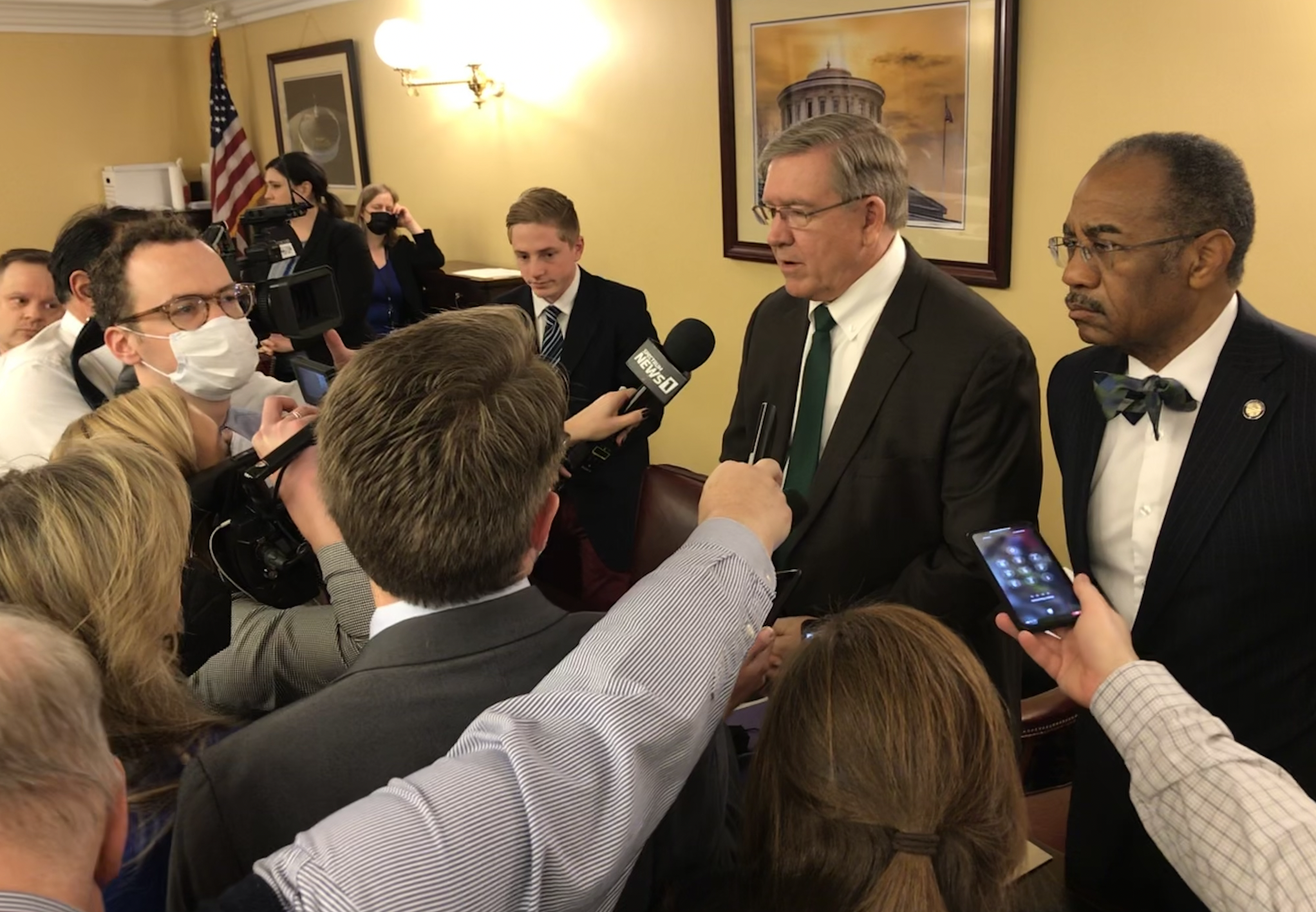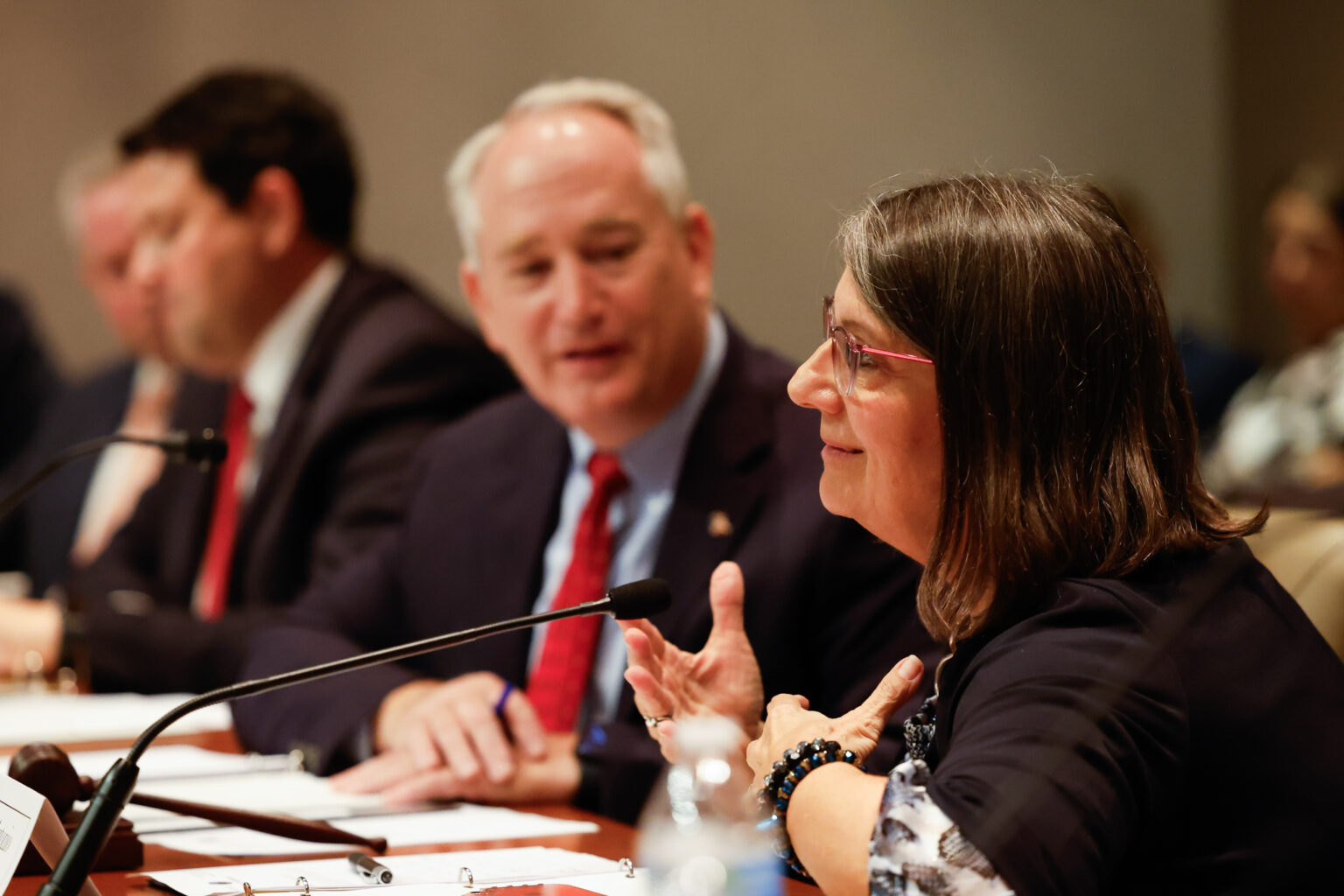
Redistricting concluded on Tuesday with the adoption of new Statehouse maps that had unanimous approval from all members of the Ohio Redistricting Commission.
The vote represents the first bipartisan agreement on maps, though the bipartisan agreement was lopsided, with only two Democrats on the current seven-member commission.
The maps give the GOP 61 of 99 seats in the Ohio House, and all but 10 of the 33 seats in the Senate. The maps show three Republican toss-ups and one Democratic toss-up in the Senate, and eight Dem-leaning toss-ups in the House, with the GOP seeing three toss-ups.
Both of the Dem members, Senate Minority Leader Nickie Antonio and House Minority Leader Allison Russo maintained during the meeting and after receiving criticism for their “yes” votes on the maps that the votes represented support for a future without a commission led by elected officials, and toward more redistricting reforms.
“I believe at the core of all this, the way we draw our district lines have to change,” Antonio, who was also a co-chair on the commission, told the OCJ on Thursday. “Because I do not believe even folks who are following the rules of a quorum should be doing it the way we’re doing it.”
Antonio’s compatriot, House Minority Leader Allison Russo prefaced her “yes” vote on Tuesday night by saying she was voting not because she supported the maps, but more because she wanted to take the process out of the hands of the current commission.
“Every step of this process has been nothing but political,” she said in a statement. “Every negotiating tactic has come with a political angle. Every district we’ve discussed has been viewed as a political pawn.”
Antonio said there was unity within the two Democrats on the commission, and in her mind, she and Russo had to agree before Antonio would go forward with a “yes” vote.
“I really believed that the only way I would consider a vote in the affirmative is if we were on the same page,” Antonio said.
The Senate minority leader defended her decision to vote for the maps, because moving forward without the attempt at negotiations with the majority GOP party would have ended with a much worse set of Statehouse maps.
“What we were presented … was a map that would have devastated us even more, and put us in a further minority than we are right now,” she said.
Faced with the idea of an even worse set of districts in a broken redistricting system, Antonio said she and Russo set their sights on stemming the bleed.
Negotiation for the two-person Dems versus the five-person GOP was admittedly unbalanced, but Antonio also said there was “an openness to sit down and talk” from the members on the other side of the aisle.
“There was give and take,” Antonio said. “I do believe we were listened to.”
What came from the negotiations was a change in lines in Cuyahoga County, something Antonio in particular pushed for, but also three Senate districts – 16, 6, and 24 – that she says are more competitive, and three more – 27, 18, and 3 – that she foresees as opportunities for Democrats in the future.
“Right off the bat, I’m telling you, this advances our representation and our competitiveness,” she said.
The Senate minority leader said she looks forward to returning to Ohio as a state where there is “a legislative body that swings with the pendulum of issues and population,” but with the system in place on Tuesday, she felt she had to play with the cards in her hand.
“I had to deal with today, and today my job was to do the best that I could for the people of Ohio,” Antonio said.
Map criticism
The maps passed on Tuesday night received criticism similar to that of the previous maps, which did not have the support of the Democratic members of the commission.
The Brennan Center for Justice at New York University’s law school, which has been a party in lawsuits challenging the previous maps, claim the maps once again violate the state constitution and “deny Ohioans fair representation.”
“This set of maps and its predecessors say one thing: the politicians on the Ohio Redistricting Commission from both parties can’t be trusted, not to follow the state constitution or honor basic fairness in elections,” said Yurij Rudensky, who is senior counsel for the Brennan Center’s Democracy Program, in a statement following the map adoption.
Members of the Ohio NAACP, the Ohio Organizing Collaborative and the Ohio Unity Coalition called out the maps for what they see as a lack of inclusion for communities of color, which leads to separated communities and voting districts that split common interests.
“By ignoring the racial impact of these new maps on these citizens, the commission has done a grave disservice by not assuring that districts are drawn that do not disenfranchise some voters at the expense of others,” said Petee Talley, executive director of the Ohio Unity Coalition, in a statement.
As yet, a plan for litigation hasn’t been confirmed by any advocacy group, though Freda Levenson, legal director for the ACLU of Ohio said the group is “considering all existing options to obtain fair maps for Ohioans, and litigation is not off the table.”
Rudensky cited former Ohio Supreme Court Chief Justice Maureen O’Connor in saying “the solution requires removing the power to draw these maps from the people who benefit most from them.”
“Litigation can only do so much if the politicians responsible for maps refuse to follow the law,” Rudensky said.
Advocacy groups may end up suing over the maps, but for now they are still more focused on the effort to get more redistricting reform on the ballot.
“We are working together on an amendment to ban politicians from map drawing so that Ohio voters get the impartial districts they fundamentally deserve, and lawmakers will be responsive to the people rather than mega-donors and lobbyists,” said Catherine Turcer, executive director of Common Cause Ohio.
How long will the maps last?
The potential ballot initiative could bring change by 2024, including an independent redistricting commission to redraw maps, but it will have to jump through a few hoops before it gets to voters.
Ohio Attorney General Dave Yost has considered and rejected the proposed ballot initiative twice now, but a third version has been submitted to Yost, and is awaiting a decision.
The maps that were passed most recently could be impacted if a ballot initiative were passed by voters, but there was confusion even among commission co-chairs as to whether the maps would last for the rest of the decade, even with bipartisan agreement.
“There are people who believe that if both Democrats vote for the map it will be an eight year map, there are also people that believe that you can’t have any longer than a 2-year map no matter who votes for it, because that chance to have a longer map passed in the first sitting,” Commission co-chair and Auditor of State Keith Faber said on Tuesday morning.
The chance of litigation also could throw the map’s future into uncertainty, but the Ohio Constitution’s current language, as much as it could regulate redistricting, matches the 8-year opinion.
“My reading of Article XI sections 8 and 9 suggest that the maps passed will indeed be in operation until 2030,” Collin Marozzi, deputy policy director for the ACLU of Ohio, told the Capital Journal. “It is clear that the current Article XI did not contemplate the scale and scope of failure of the commission to follow the process as approved by Ohio voters, so admittedly it is a little gray.”