

Tag: nursing home workers

  • ‘Trust issues’ prompt nursing home workers to decline COVID-19 vaccine, union says

    ‘Trust issues’ prompt nursing home workers to decline COVID-19 vaccine, union says

    By Jake Zuckerman and Ohio Capital Journal

    Nursing home workers are passing on their chance at early access to the COVID-19 vaccine, officials say, blowing a crosswind against a scarce supply of doses and a pandemic in a tailspin.

    Gov. Mike DeWine first drew attention to the issue Wednesday, claiming during a televised press briefing that roughly 60% of staffers who were offered the vaccine declined it.

    “I think in this case, [DeWine] is on target,” said Pete Van Runkle, executive director of an industry association representing Ohio’s long term care facilities.

    “I talk to a lot of members on a regular basis. They are reporting a pretty low uptake among staff.”
    Patrick Schwartz

    Patrick Schwartz, a spokesman for Leading Age Ohio, an elder advocacy group, said he’s hearing mixed reports of some providers finding that 90% of staff chose to take the vaccine while others are “well below 50%.”

    He attributed the shortfalls to misinformation and fear surrounding the potential for an adverse reaction to the vaccine.

    “Many staff are simply ‘not yet ready,’ which will hopefully change as they see more and more colleagues vaccinated without side effects and confidence continues to build,” he said.

    “By contrast, an overwhelming majority of residents seem willing to accept the vaccine, with many coming from the generation that saw polio and other deadly diseases wiped out by life-saving vaccines.”

    The local Service Employees International Union surveyed its members on the issue, it said in a statement Monday.

    The responses, according to SEIU 1199 President Becky Williams, indicate a trust problem between an exhausted, underpaid, underappreciated, and in many cases already-infected staff and health authorities.

    She said this is a “substantial issue” that’s bigger than just the union and requires outreach and education from the state.

    “Workers commented that the vaccine appeared rushed and unproven without enough data to show that it would be effective,” she said.

    “Some workers are also concerned that the vaccine could cause fertility issues among women who may want to have a child. There are trust issues among frontline health care workers — some of which preceded the pandemic. These trust issues continue after so many nursing home workers have been on the frontlines of the pandemic without hazard pay and support such as needed personal protective equipment.”

    Several news outlets have debunked this notion of ‘fertility issues’ related to the vaccine. A quick scroll through the right Facebook group can deluge visitors with this and similar pieces of misinformation relating to the vaccine.

    The Ohio Capital Journal called 13 state long-term care facilities Monday, who have each reported at least 100 COVID-19 cases among their residents, to discuss vaccination among their staffs. No administrators agreed to an interview.

    Two vaccines (one from Moderna and one jointly from Pfizer and BioNTech) are currently approved for emergency use against COVID-19. They are both two-dose vaccines, taken several weeks apart.

    Company data reviewed by the Food and Drug Administration shows both vaccines are about 95% effective preventing symptoms of COVID-19. While side effects (sometimes more intense than a standard flu vaccine) have been reported with both products, none of the vaccine trials have reported any serious safety concerns, according to information from Johns Hopkins University.

    Before coming to market, both vaccines underwent large scale clinical trials over the course of months. They are now under review via continuous monitoring for problems and side effects from the FDA and the CDC.

    The vaccine hesitancy comes as COVID-19 has infected 727,000 Ohioans, put about 39,000 in the hospital, and killed at least 9,143 since March.

    At least 4,856 of those deaths occurred among residents of Ohio’s long-term care facilities.

    Nationally, more than 353,000 Americans have died of COVID-19 and nearly 21 million have been infected.
    Tory Harper Hogan, PhD

    There are several theories as to why nursing home workers would rebuff a vaccine dose, according to Tory Hogan, an Ohio State University professor who researches nursing homes and infection control.

    She said some probably just don’t trust health authority; some have “been in the trenches” of the pandemic for a year now, prompting them to shrug off the unknown risk of vaccine for the better-known risk of infection; some probably just don’t want to be the guinea pigs.

    “There has been so much misinformation about everything in this process,” she said.

    Wood County Health Commissioner Ben Robison said he’s detected some vaccine hesitancy and refusal across all industries. However, some who deny at first are likely to come around.

    “Anecdotally, we’ve heard among some of the populations we’re reaching with our vaccine, some have initially said no and then later said yes,” he said.

    Some employers, especially in the health care industry, mandate the flu vaccine and other immunization. However, Van Runkle said the industry is already dealing with a widespread staffing shortage, only worsened by the pandemic.

    He said most of Ohio’s nursing homes do not even mandate the flu vaccine. Mandating a COVID-19 vaccine would worsen staffing problems.

    “We don’t need another reason for people not to work in our facilities,” he said.

    A vaccine mandate would backfire

    Hogan agreed that a vaccine mandate would backfire, and Williams, from SEIU, said education and outreach should drive universal vaccination.

    The Ohio Department of Health has shipped 341,100 Moderna first-doses, as well as 9,750 Pfizer first-doses plus another 9,750 Pfizer second-doses, according to ODH spokeswoman Melanie Amato. Only about 162,942 Ohioans have started the vaccination process, which is prioritizing health care workers, first responders and nursing home staff and residents.

    ODH said it is not actively tracking vaccine declination rates. CVS Health, a company administering the doses in state long term care facilities, isn’t either.

    “We do not have visibility to how many staff members at a facility decline to be vaccinated,” said CVS Health Spokesman Charlie Rice-Minoso.

    “While we aren’t provided with full staff rosters, based on feedback from our teams in the field we’re seeing more vaccine hesitancy among staff when compared with residents.”

    Walgreens, another company administering the vaccines, did not respond to inquiries.

    Looking at the bigger picture, Hogan said governments from the federal to local level need to do a better job understanding why some are declining vaccination. Similarly, she said they need to emphasize, as they did during the polio years, that vaccination is the patriotic thing for Americans to do.

    “It takes consistently pushing the right message, the correct and accurate information,” she said. “That takes money, a federal response, all levels. We’re struggling with that a lot.”
  • Ohio officials not tracking rate of vaccine refusals

    Ohio officials not tracking rate of vaccine refusals

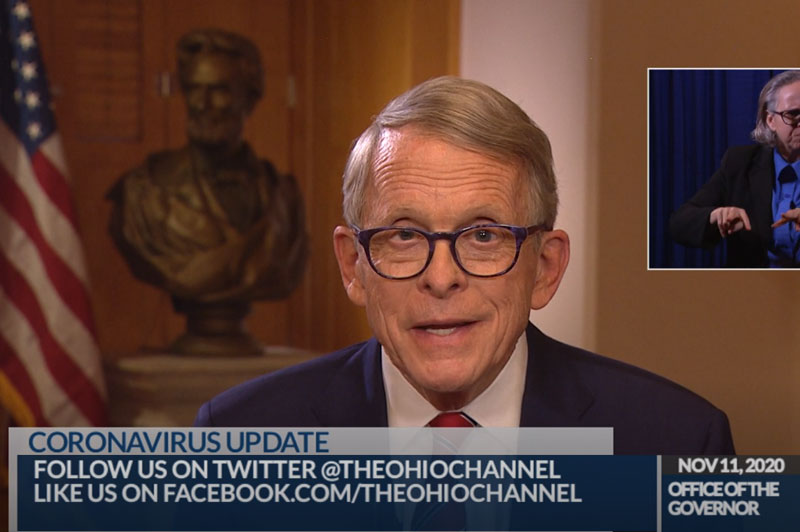
    Gov. Mike DeWine is pictured during his statewide address on Wednesday, Nov. 11. Photo courtesy Ohio Channel.

    By Marty Schladen and Ohio Capital Journal

    Columbus, Ohio – Ohio Gov. Mike DeWine got a lot of attention Wednesday when he said that 60% of nursing home workers who were offered a coronavirus vaccine refused to take it

    DeWine: 60% of Ohio nursing home workers are refusing vaccine

    But state health officials on Thursday said there’s no organized effort to track refusals among people they consider so critical that they’ve been given first crack at the scarce vaccines.

    In a press conference, DeWine implored people who are eligible for the vaccine to accept it, warning that it could be a long time before they get another chance. That argument might seem pretty compelling, given that a fast-spreading variant of the virus has popped up in two statesICU beds are filling and the two approved vaccines have trickled out at a rate far lower than the Trump administration promised.

    But DeWine lamented that many nursing home workers are passing on the vaccines anyway.

    “Our bigger concern is the amount of staff who are not taking it,” he said. “I don’t have data in front of me, but anecdotally, it looks like somewhere around 40% of staff at nursing homes are taking the vaccines and 60% are not taking it.”

    The statement went viral. A tweet about it generated more than 5 million impressions as of Thursday evening.

    Despite the obvious interest in how many people are refusing to be vaccinated, that’s not something the state is measuring.

    DeWine made his statement about nursing home workers “from some reports we have been hearing from our pharmacy partners,” Ohio Department of Health spokeswoman Melanie Amato said in an email Thursday. “It ranges in facilities, but this is a rough average. Remember the nursing home are largely being vaccinated by Walgreens/CVS as part of the federal program. We rely on them for the information. Same with hospitals. We track vaccines that have been given. We don’t track who would have refused.”

    Neither CVS nor Walgreens could immediately be reached for comment. While they are handling vaccinations in congregate settings such as nursing homes, they aren’t in charge of vaccinating hospital staff, paramedics and the like. Ohio health officials apparently aren’t tracking the rate at which those groups are refusing the vaccine, either.

    Dan Tierney, DeWine’s press secretary, said that despite the low level of nursing home workers agreeing to be vaccinated, the governor isn’t considering a mandate — at least for now.

    “On mandating the vaccine for these groups, we are still in the rollout of this phase, and our message to Ohioans is that if you are in group 1A, we urge you to take the vaccine now, because it may be months before there is another opportunity available to you,” he said. “We believe that increasing awareness will help increase the utilization rate. Ultimately, it is up to each health care provider to determine which workers they employ meets the criteria in group 1A to receive the vaccine in this phase.”

  • DeWine: 60% of Ohio nursing home workers are refusing vaccine

    DeWine: 60% of Ohio nursing home workers are refusing vaccine

    By Marty Schladen and Ohio Capital Journal

    As the coronavirus vaccine dribbles out far more slowly than promised, many of the people who can get it are refusing to do so.

    Gov. Mike DeWine on Wednesday said that a whopping 60% of nursing home workers who have been offered the vaccine have refused it. 

    The news comes amid disappointing vaccination numbers across Ohio, which was told by the Trump administration that it would receive more than 530,000 doses of the vaccines by the end of December. Just 94,000 so far have been administered.

    “I am not satisfied with where we are in Ohio,” DeWine said during a coronavirus press conference. “We’re not moving fast enough, but we’re going to get there.”

    He said he had a Wednesday morning conference call with CEOs of Ohio hospital systems and set a goal of getting the covid vaccine into people’s arms within 24 hours of when hospitals receive it. DeWine said the job of distributing the vaccine is more complex than many appreciate, but it’s vital to do it quickly.

    “There’s a moral imperative to get this out just as quickly as we can,” he said.

    But the numbers emerging from nursing homes might portend something just as bad.

    “Our bigger concern is the amount of staff who are not taking it,” DeWine said. “I don’t have data in front of me, but anecdotally, it looks like somewhere around 40% of staff at nursing homes are taking the vaccines and 60% are not taking it.”

    Those figures are disturbing not only because of what they might say about attitudes toward the vaccines among the larger population. They also mean that most staffers will be unprotected as they move between the outside world and nursing homes filled with vulnerable people — some of whom will not be able to take the vaccine for medical reasons.

    Even so, DeWine said he isn’t going to make anybody take it.

    “I’m not going to compel anybody to do it, but I’m urging people to take that vaccine,” he said. “It’s very important,” 

    It’s not clear why the governor isn’t imposing such a requirement. 

    All 50 states have laws requiring — with exemptions — that children be vaccinated before going to school. Also, many healthcare facilities require employees to be vaccinated.

    A DeWine spokesman didn’t immediately respond when asked why DeWine wouldn’t order Ohio nursing homes to follow suit.

    Ohio’s problems distributing the coronavirus vaccine come amid national problems producing and distributing the two vaccines that so far have received approval. With hospital beds filling, the country is falling far short of the Trump administration’s promises.

    The administration said that 20 million Americans would be vaccinated by the end of December, but so far, only 11.4 million doses have been sent to states and just 2.1 million people have received a first dose, the Washington Post reported Tuesday.

    At the current pace, it will take 10 years to vaccinate enough Americans to achieve herd immunity, NBC reported.

    Among those promising 20 million vaccinated Americans by the end of 2020 was U.S. Surgeon General Jerome Adams. He made the statement just 11 days ago in a press conference with DeWine.

    Adams dismissed reports that vaccine doses were coming to states at substantially lower levels than promised as blips that are to be expected in such a complex project. He also scoffed at the need to invoke the Defense Production Act to scale up production of approved vaccines, saying the manufacturers were operating at full capacity.

    Three days later, the New York Times reported that Pfizer, manufacturer of one of the vaccines, was close to a deal with the administration to use the Defense Production Act to obtain more of the materials to make it. Pfizer had been asking for such help since September, the story said.