Tag: ODE State Report Card

  • State education testing shows declines, may be waived in new legislation

    State education testing shows declines, may be waived in new legislation

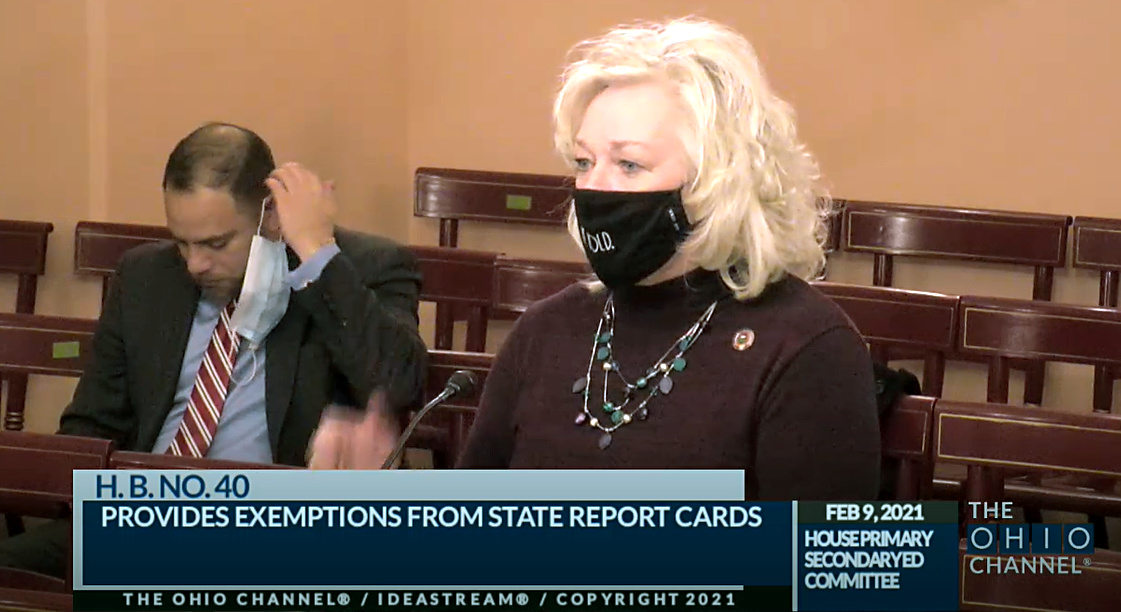
    Ohio state Rep. Lisa Sobecki testifies before the House Primary & Secondary Education Committee on Tuesday, on a bill seeking waivers on state and federal testing.

    by Susan Tebben and Ohio Capital Journal

    As state officials look for solutions to an education gap caused by the COVID-19 pandemic, two pieces of legislation introduced Tuesday hope to give more leniency on state and federal testing.

    Rep. Lisa Sobecki, D-Toledo, is a co-sponsor with Rep. Jeffrey Crossman, D-Parma on House Bill 40, to make exemptions for students in taking state report cards.

    The bill would waive state testing for the 2021-2022 school year and direct the Ohio Department of Education to seek a waiver for federal testing, as well as holding school districts harmless on state report cards to determine funding levels and eligibility for EdChoice private school vouchers and academic distress commissions.

    “We do need to see where our kids have been left behind, but I don’t need a test that’s going to tell us something after the kids have left,” Sobecki told the House Primary & Secondary Education Committee.

    She said the waiver of testing “appears to have broad, bipartisan support” within the legislature.

    Bipartisan support for state testing waivers came in the same Tuesday meeting, in the form of a separate bill brought by Republican state reps. Kyle Koehler and Adam Bird, to ask for many of the same things, including state and federal testing exemptions.

    “I am not asking to waive test requirements because we don’t need to know how testing will go,” Koehler told the committee. “I think we know it’s not going to go well. Students are going to be behind.”

    In further support of testing pressure relief, State Board of Education member Dr. Christina Collins released a proposed resolution directing the ODE limiting the use of state testing, and to “include a district designation of online, hybrid, or in-person on school building and district level report cards.”

    In the resolution, Collins writes that COVID-19 “has affected every student in Ohio, disrupting the structure of teaching and learning and emphasizing children’s dependency upon adults for nurture, protection and providing for health and well-being.”

    Along with the district designation, the board member asks that a disclaimer on state reports say that data “are for the purpose of understanding how learning was impacted as a result of extreme circumstances.”

    Earlier in the day, ODE Superintendent Paolo DeMaria said the test scores coming out of a pandemic’s worth of learning styles emphasize the need for students to get back to in-person instruction.

    DeMaria acknowledged a lower participation rate in the state testing, saying the ODE promoted a “safety first” mentality in taking the tests. But from the testing that did occur, the state saw an 8% increase in kindergarten-readiness scores considered “not on track.”

    Third-grade English Language Arts proficiency scores were also lower, which was also shown in a study released by the Ohio State University’s John Glenn College of Public Affairs.

    This third-grade test is set to occur this year starting from March 22 to April 23, part of why Sobecki said their legislation needs to be quickly moved through the statehouse and set up to be signed by the governor.

    “It’s February, folks,” Sobecki said.

    DeMaria, and the study itself, noted that the declining scores were even lower in minority and economically disadvantaged groups.

    State reports also showed a decrease in enrollment of 3%, particularly in pre-school and kindergarten.

    DeMaria spoke during Gov. Mike DeWine’s Tuesday press conference, in which he spent most of the time presenting the progress of vaccinating school teachers and personnel, something that the state started this month. While the state continues to vaccinate those 70 and older, they set aside some of the approximately 100,000 per week the state receives to give to school districts.

    Also on Tuesday, DeWine added a new project for school districts across the state, asking them to come up with an individualized plan to help students catch up on last year’s losses.

    “We need to be bold in our ideas, and we need to work with the Ohio General Assembly,” DeWine said, adding that a total of $2 billion in federal funding has been made available to schools to help with this problem.

    DeWine left the decisions up to the individual districts, but offered examples such as longer school years, longer school days, summer classes, tutoring, or even remote options as ways to fill the education gap.

    Districts have until April 1 to make their plans public and accessible to the General Assembly.

  • Measuring the success of our school district

    Measuring the success of our school district

    A Guest Column By Dr. Amy Crouse,

    Our collective mission at Loveland City Schools is to prepare students for tomorrow, today; this year, the state report card reflected that we are making strides to achieve just that. I have said before and will say again: I strongly believe the true value of a school district cannot be limited to a simple score on a standardized test, which is what the state report card reflects. I also believe that there will always be room for growth and
    improvement, regardless of the “grades” earned. So while the report card is just one tool of accountability, it provides us with useful information we can apply and reflect upon as we continue to provide the best educational experience we can for our students.

    In Loveland, we celebrate gains in the Progress and Achievement components, both of which echo the growth we have made in giving our students the tools they need to comprehend, retain and personalize the information they receive every day. Through our targeted improvement plans in the past year, we have made particular strides in the Progress component, which indicates the growth of our students based on past performance. Our grade in the Achievement component places Loveland in the top 22 percent of districts in our region, which means our students are one step closer to being more educated, empowered and prepared for tomorrow, today.

    We can also celebrate a gain in the Gap Closing component of the report card, meaning we are putting initiatives and programs in place to properly meet the performance expectations for all students in English language arts, math and graduation. We are one of only 14 (out of 49) districts in Hamilton, Warren, Butler and Clermont counties that earned an “A.” I am incredibly proud of this accomplishment because it reflects the dedication and hard work our staff has put toward ensuring each and every student can be successful.

    While we will continue to celebrate our successes, we will never ignore the areas that present opportunities for growth. After all, who wouldn’t love to receive an “A” across all measures? Who wouldn’t love to see every child succeed every day? Ultimately, our goal is that every Tiger student is empowered to learn, grow and embody our core values of care, respect and responsibility. That is success.

    Dr. Amy Crouse is Superintendent of the Loveland City School District

    The work we do every day in our classrooms is complex, and as a school district committed to high achievement and continuous growth, we monitor, analyze and factor in multiple data points when we consider the educational experience we strive to provide. I invite you to take a look at another source of data – our Quality Profile – which includes measures beyond the test scores to show the total value that our schools provide our Tiger students, staff and community. This publication is available by clicking on the image to the upper right. Residents will find an executive summary in the mailboxes shortly.

    As always, I thank you for supporting our educational mission. Please feel free to contact me should you have any questions or concerns regarding the state report card or our Quality Profile.

    In service to our Tigers.


      Loveland chiropractor Douglas Portmann, DC at Wards Corner Chiropractic & Sports Rehab is one of the best chiropractors in the Loveland area.


  • Opportunities for Tiger Growth – The State Report Card

    Opportunities for Tiger Growth – The State Report Card

    “It is my belief that the true value of any district cannot be limited to a simple grade on a standardized test.”

    By Dr. Amy Crouse,

    Our district mission is Preparing Students for Tomorrow, Today; our No. 1 district goal is Tiger academic growth. As such, our educational instructional leaders at every level – teachers in the classroom, principals managing the buildings and administrators specializing in Teaching & Learning at the Board Office – stay focused on measures of our performance. One data point we are equipped with to gauge performance is the annual State Report Card, which the Ohio Department of Education (ODE) released to the public Thursday, September 14.

    I want to be clear that – as an educator with 20-plus years of experience serving students – it is my belief that the true value of any district cannot be limited to a simple grade on a standardized test which is what the ODE State Report Card reflects. We are in the business of whole student growth, which encompasses the complete student experience, to include academic, social and emotional development. I invite you to take a look at the way we do business through our Quality Profile Report – it is a complement to the State Report Card scores and will give you a more intimate view of what it means to be a Tiger.   

    Whether we agree or disagree with our state assessments, I do have a strong belief in accountability, and understand that the State Report Card is one tool of accountability that can be of value. The State Report Card grades districts and schools on six components – Achievement, Progress, Gap Closing, Graduation Rate, K-3 Literacy and Prepared for Success. Districts and schools received an A-F grade on each of the six components and most of the individual measures. While this – on the surface – sounds like a simple pass/fail – the explanations behind those letter-grade measures are much more complex.

    In Loveland, we can celebrate a gain in the Gap Closing measure as all of our subgroups showed gains in reading, we made strides in the K-3 Literacy measure, and 20 out of 23 tested areas showed an increase in performance. While we will highlight our successes, we will not ignore the areas the State Report Card highlights as opportunities for growth.

    One area we are focused on is our Progress measure

    One area we are focused on is our Progress measure, which is an indicator of student growth. Our Board of Education made clear it was of paramount importance that we deliver on the expectation that every Tiger will demonstrate personal academic growth, which is the heart of our Growth goal for this school year. As such, entrenched in our building goals is increased time and focus for teachers to collaborate on: curriculum work planning lessons aligned to the state standards and vertically aligned to increase rigor for students as they progress through the grades; assessment work using student MAP data to meet students where they are and measure their individual growth; and, instruction work to improve student engagement and opportunities for their application of their learning. We feel strongly this focus will move the needle for us on Progress.

    We feel strongly this focus will move the needle for us on Progress.

    As always, I thank you for supporting our educational mission; I invite you to contact me directly should you have any questions or concerns regarding our State Report Card.    

    In service to our Tigers,

    Dr. Amy Crouse

    Dr. Crouse is Interim Superintendent of the Loveland City School District


    We are celebrating and proud to be a member of the Ohio News Media Association along with more than 250 Ohio daily and weekly newspapers including, The Columbus Dispatch, Plain Dealer, Cincinnati Enquirer, Akron Beacon Journal, Dayton Daily News, and The Toledo Blade. Loveland Magazine was the first “digital only member”.