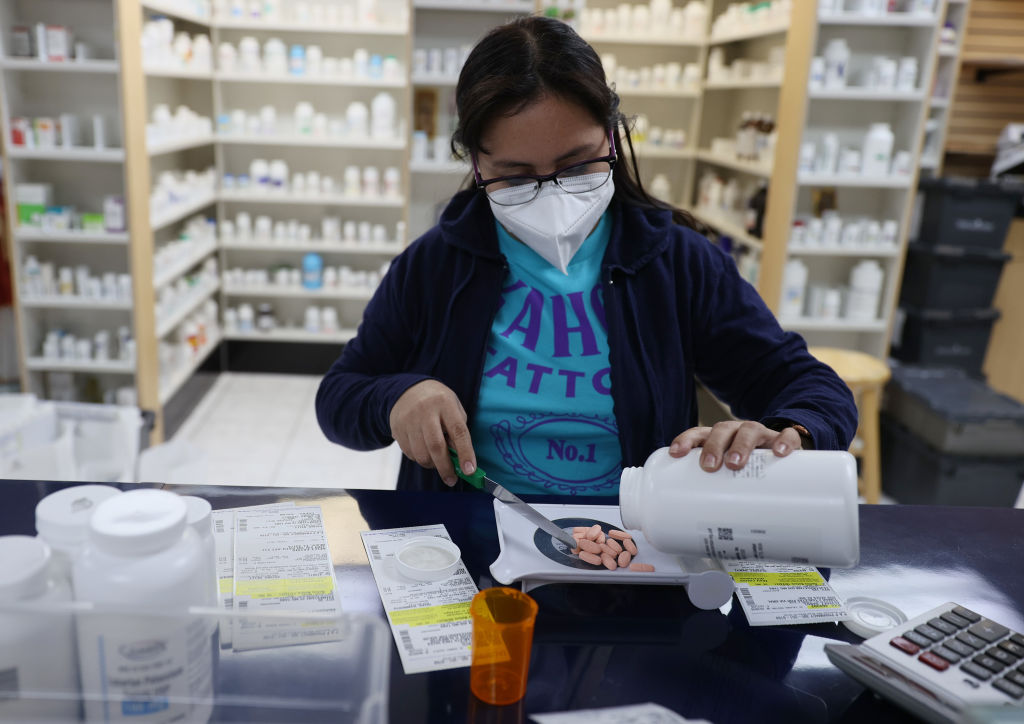
A CVS store. Photo by Lynne Terry, Oregon Capital Chronicle, States Newsroom.
After years of buying and closing competitors, CVS understaffing leads to chaos and delays, Ohio regulator says
BY: MARTY SCHLADEN – Ohio Capital Journal
At least eight CVS pharmacies in Ohio are so understaffed that they have seen rampant turnover, dirty conditions, lack of controls over dangerous drugs and wait times as long as a month for prescriptions, according to reports by the Ohio Board of Pharmacy.
The waits have been so long that a harried CVS pharmacist in Wooster said he was “actively triaging prescriptions to ensure lifesaving, life-sustaining medications are filled in a timely manner.”
In one case, pharmacy workers told inspectors they begged their superiors — unsuccessfully — to close their pharmacies so they could catch up. In another, a pharmacy did intermittently close, making it impossible for patients to get their medicines during the closures.
In another instance, Board of Pharmacy inspectors couldn’t tell if employees were stealing controlled substances. In yet another, they couldn’t tell if CVS was improperly billing insurers for scripts it didn’t fill.
And in several additional cases, inspectors repeatedly found expired and adulterated drugs on pharmacy shelves and filled prescriptions that gave patients the wrong instructions.
“Corners are cut to dispense prescriptions,” at least one employee at Toledo’s CVS store No. 10246 told investigators last year. Workers there added, “Supervisors/District Managers do not respond to staff calls for help,” the report said.
The accounts come from inspection reports going back to 2020 that the Capital Journal obtained under the Ohio Public Records Act. At least some of the inspections came in response to patient complaints to the board, which licenses Ohio pharmacies.
The inspections come after CVS — already the nation’s largest pharmacy retailer — has for years bought up competitors, closed them and moved the prescriptions of the closed pharmacies to existing CVS stores. Critics raised concerns about the practice, known as “buy and close,” at least as early as 2019.
“Staff at this location was not increased,” a pharmacist at Dayton’s CVS store No. 2528 said last September after the store had absorbed two other closed pharmacies’ prescriptions. She quit the following month.
For its part, CVS didn’t answer questions about specific allegations in the reports, which it referred to as “isolated incidents.”
“We’re working with the Board of Pharmacy to resolve allegations of isolated incidents, most of which date back a year or more,” Amy Thibault, director of communications for CVS Pharmacy said in an email Wednesday. “The health and well-being of our patients is our number one priority.”
Rampant turnover
Pharmacies across the country found themselves under siege as the coronavirus pandemic took hold in the spring of 2020. They were conducting tests and, when they became available, providing COVID vaccines in addition to already administering those for flu and shingles.
At the same time, some pharmacy employees were reluctant to work face-to-face with the public in a health care setting — especially before there were vaccines against a disease that has killed more than 1 million Americans.
But according to the Board of Pharmacy reports, turnover in the CVS stores they investigated seemed particularly bad. And it seemed to be linked to stress from overwork — as well as the parent corporation’s inability or unwillingness to do anything about it.
For example, when an inspector arrived at CVS store No. 2063 in Canton on Sept. 13, 2020, the staff was so harried that it took them 20 minutes to even acknowledge the inspector. The staff said that the store had lost a pharmacist and six technicians “within a short time.”
As workers scrambled, they sweltered in a pharmacy in which the air conditioning unit was broken and an alarm in a drug cooler failed to warn them that it was too warm at 46.4 degrees Fahrenheit.
“Pharmacy staff and an assistant store manager stated they have asked district leaders to close the store down temporarily to get caught up filling prescriptions as well as clean and organize the pharmacy, but this request was denied,” the report said.
When an inspector returned to the pharmacy on Oct. 29, 2021, things had only gotten worse.
“All pharmacy staff that was present for the September 2021 inspection quit or transferred out of CVS #2063,” the report said.
Even more alarmingly, understaffing there created delays that easily could have harmed patients’ health — despite workers’ best efforts to “triage” which prescriptions to fill first.
“The pharmacy was over a month behind in filling prescriptions,” the report said.
Especially bad at CVS
During the pandemic, conditions were universally difficult for pharmacies, but CVS might have been a special case.
An owner of an independent pharmacy in Northern Ohio said things were rough for everybody, and that he’s still having trouble keeping enough pharmacy technicians on his staff. But, he said, that never led him to consider temporary closures, or anything like the delays filling prescriptions and other problems seen at some CVS stores.
The pharmacist depends on CVS Caremark — the corporation’s gargantuan pharmacy benefit manager — for his business and asked not to be named. But, he said, he’s talked to CVS pharmacists who have been under pressure so great that it affected their mental health.
The stress appeared to extend even to the upper ranks of CVS’s pharmacy operation.
In July 2021, Ken Sidwell became leader of the district which includes Canton CVS store #2063. When he was interviewed by the Board of Pharmacy, he said the store was short-staffed when he got the job.
Just three months later, Sidwell was gone. On Oct. 29, 2021, the new district leader, Kenneth Cook, told the Board of Pharmacy that the store “is in the process of hiring new pharmacy staff as well as transferring staff from an overstaffed CVS location.”
CVS spokeswoman Thibault said the company’s policies ensure that its stores are not dangerously short of pharmacy workers.
“Decisions about staffing, labor hours, workflow process, technology enhancements and other operational factors are made to ensure we have appropriate levels of staffing and resources in place at our pharmacies,” she said. “We have comprehensive policies and procedures in place to support prescription safety and we continue to make important strides, including using technology to support our pharmacy teams.”
Buy and close
Not only is CVS the nation’s largest pharmacy retailer, its parent corporation also owns Aetna, a top-10 insurer. It’s also buying up medical centers and physicians practices, helping to make it the nation’s sixth-largest corporation.
And crucially for pharmacies everywhere, CVS owns the nation’s largest pharmacy benefit manager, CVS Caremark. It and Express Scripts and OptumRx are estimated to control more than 80% of the marketplace and they’re under investigation for possible anti-competitive practices by the Federal Trade Commission.
Pharmacy benefit managers, or PBMs, act as middlemen for insurers in the drug supply chain. They decide which drugs are covered, so they have great power to negotiate huge, non-transparent rebates and other discounts from drugmakers.
At the same time, they create pharmacy networks. And, because they control access to so many millions of patients, most small-chain and independent pharmacists think they have little choice about contracting with them on whatever terms the big PBMs choose.
“Take-it-or-leave-it” contracts, the pharmacists call them.
CVS has long said that it maintains strict firewalls between its retail and PBM operations, but small pharmacy operations in Ohio and elsewhere aren’t so sure.
After seeing their reimbursements from CVS Caremark plummet in late 2016, CVS’s “Acquisition Unit” in 2017 sent many of its competitor pharmacies letters saying that it knew times were hard for them and offering to buy them out.
In many instances, CVS didn’t put its sign on the store it had just purchased. CVS instead closed the stores and folded all of their prescriptions into an existing CVS pharmacy.
Some pharmacists call the practice “buy and close.”
In 2019, when CVS bought 20 stores owned by Medina-based Ritzman Pharmacy and closed all but three, critics said it was classic buy-and-close.
Two of the now-closed pharmacies were in Wooster, one of the cities in which inspectors now find problems in a still-open CVS pharmacy. Three more — in Sugarcreek, Millersburg and Dover — were to the rural south of Canton and Massillon, where CVS stores found themselves seriously stretched in the years since.
Mount Vernon-based Conway’s Pharmacy in 2019 partnered with Knox County to open a pharmacy in Danville on the edge of Amish Country after CVS bought and closed the only pharmacy there a few years earlier. The closure meant that Danville residents — many poor, disabled or both — had to drive 20 minutes or more to get their medicines or to consult with a pharmacist.
Such practices have fueled fears that pharmacy deserts are being created in Ohio and elsewhere.
Lack of accountability
The constant churn in CVS staffing found by Board of Pharmacy investigators led to breakdowns in accounting for dangerous drugs, including opioids, the inspection reports said.
For example, between June 10 and Sept. 22, 2022 Dayton’s CVS store No. 2528 reported 75 oxycodone, 100 hydromorphone and 70 amphetamine pills were missing. In each instance, “CVS Pharmacy was unable to determine a reason for the loss,” the inspection report said.
For most of that period, no “Responsible Person” was in charge.
The role is as the name implies. The Ohio Administrative Code says, “The Responsible Person shall be responsible for the practice of the profession of pharmacy, including, but not limited to, the supervision and control of dangerous drugs as required…”
That person would normally be the managing pharmacist at a drugstore. But for months after May 26, 2022, there was no such person at the Dayton CVS, according to the report. Inspectors interviewed pharmacist Jean Getter, who said she was asked to serve as temporary manager after the previous Responsible Person, pharmacist Tyler Philo, left.
Getter said that even though she wasn’t the Responsible Person, she asked for help sorting out the safe that contained controlled substances because “it was a mess.”
“She asked the previous Responsible Person and also the District Leader about cleaning up the safe, but it never happened,” the report said.
An inventory of dangerous drugs is supposed to be conducted whenever there is a change of Responsible Person at a pharmacy, but that kept not happening at the Dayton CVS, Getter said.
“No one ever became the permanent Responsible Person, which is why Ms. Getter left CVS in August,” the report said.
Then Pharmacy Board investigators interviewed Philo, the previous Responsible Person and learned something even more confounding.
“He was not aware (four months after he left that) he was still listed as the Responsible Person for CVS Pharmacy #2528,” the report said.
Controlled substances
Board of Pharmacy inspectors also found serious potential problems in CVS stores’ tracking controlled drugs — including the kinds of drugs that have fueled Ohio’s opioid crisis.
Some problems were as simple as leaving deliveries of dangerous drugs at the front of the store for nine hours because pharmacy staffers were too busy to get them. But others might have been more sophisticated.
At Toledo CVS store No. 10246, inspectors conducted, “Multiple audits consisting of 241 controlled substances were conducted by representatives from the Board between on or about November 11, 2021 and on or about April 27, 2022.”
In 42% of cases, they found that too much or too little of the drugs had been provided. They discovered “significant losses” of amphetamines and the painkiller tramadol.
“Additional losses and overages were discovered, some of which were reported to the board, but many were not reported at all, or not reported in a timely fashion,” report said. It added that auditing what happened to controlled substances was difficult “because CVS records showed multiple significant inventory adjustments and changes in medication counts…”
Counterintuitively, investigators found that on some days when controlled substances were delivered to the Toledo pharmacy, inventories of the drugs actually went down. That might indicate “diversion” — a term used in the industry for stealing drugs.
“It remains questionable if counts were entered as negative numbers in error, or if staff were entering negative numbers to mask the diversion of drugs received on that day,” the report said.
In the same store, inspectors discovered chaotic conditions.
On repeated visits, inspectors found “expired/adulterated” medications on pharmacy shelves and workers told them they hadn’t had time to address the issue. The inspectors also painted a picture of general chaos.
“Shelving for drug storage had collapsed and medications were crushed beneath the shelving units. Drug stock crowded the aisle floors,” the report said, adding, “The counter used for non-sterile compounding was overflowing with (over-the-counter) medications and return-to-stock bottles. Staff food and beverages were also stored in this area. Moldy/rotting food was found on the counter.”
Beyond delays and lacking controls, inspectors found another problem at the store that could endanger patients’ health.
Inspectors on March 3, 2022 reviewed 49 prescriptions filled at the store. They found that seven “had errors in the directions to patients.”
And when inspectors talked to employees, they heard echoes of the complaints at other CVS pharmacies they’d visited.
- “The pharmacy is always short staffed.”
- “The workplace was described as hectic. There is no downtime to catch up on tasks.”
- “Morale among store employees is poor.”
Delays and questions about improper billing
When inspectors visited CVS store No. 8248 in Massillon in late 2021, they found a pharmacy so understaffed that “the pharmacy would close intermittently,” meaning “patients were unable to pick-up/receive their prescriptions.”
They again found confusion over who was legally responsible.
“The Responsible Person, Abbey Yannerella, was listed as the Responsible Person at this location as well as CVS #2063; however, she was no longer working at” the Massillon store, the report said.
They found something else that raised serious questions.
The store in October 2021 had more than 2,000 prescriptions waiting to be filled, the oldest of which had been waiting for 13 days. A month later, the pharmacist on duty told inspectors that after scripts go unfilled for 14 days, they’re “deleted from the queue.”
The inspectors found one such prescription that was labeled “Print Ready.”
“The prescription’s status indicating ‘Print Ready’ means the prescription was processed through insurance,” the report said. “When a prescription is deleted from the queue, the pharmacy does not reverse the insurance claim.”
CVS didn’t respond directly when asked how often scenarios like this occur — or whether it routinely bills insurers for prescriptions it fails to fill for two weeks and then deletes from its system.
On Nov. 28, 2021 a new Responsible Person, pharmacist Nayan Patel, had been named. He told investigators that the deletion of prescriptions after 14 days was a requirement of the U.S. Centers for Medicare and Medicaid Services. He added that the scripts are placed back into the queue after their deletion.
However, “When asked to explain this process further, he could not elaborate,” the report said.
Then on Feb. 4, 2022, the Board of Pharmacy learned that Patel was Responsible Person for two CVS pharmacies without the special permission required by the board. When the board notified a CVS district leader of that fact, “The district leader notified the board Mr. Patel is no longer the Responsible Person of” Massillon CVS store No. 8248, the report said.
Penalties
The board has notified CVS that it can impose penalties ranging from fines to revoking their licenses as a “Terminal Distributor of Dangerous Drugs” at each of the locations in which it found violations.
So far, CVS store #3613 in Columbus received a $1,000 fine and a written reprimand last August, Board of Pharmacy spokesman Cameron McNamee said in an email Thursday. The violations outlined in that report seem considerably less severe than those found in some other CVS pharmacies.
Violations found at CVS’s Canton store No. 2063 — where staff turnover was particularly rampant — are slated to be considered at the board’s Nov. 7-8 meeting McNamee said.
Hearings for the other stores are yet to be scheduled.
MARTY SCHLADEN
Marty Schladen has been a reporter for decades, working in Indiana, Texas and other places before returning to his native Ohio to work at The Columbus Dispatch in 2017. He’s won state and national journalism awards for investigations into utility regulation, public corruption, the environment, prescription drug spending and other matters.
MORE FROM AUTHOR