Tag: ohio capital joiurnal

  • Ohio House holds first hearing for new nitrogen gas death penalty method

    Ohio House holds first hearing for new nitrogen gas death penalty method

    Ohio would join four other states that explicitly permit nitrogen hypoxia for executions if the bill passes

    BY: Ohio Capital Journal

    House lawmakers have begun hearings on a controversial new execution method known as nitrogen hypoxia. The protocol, used in Alabama for the first time recently, subjects a prisoner to a high concentration of nitrogen which causes them to eventually suffocate. Right now, four states explicitly allow nitrogen hypoxia and four other allow for “lethal gas” generally. Outside of Ohio, Nebraska lawmakers are considering the approach as well.

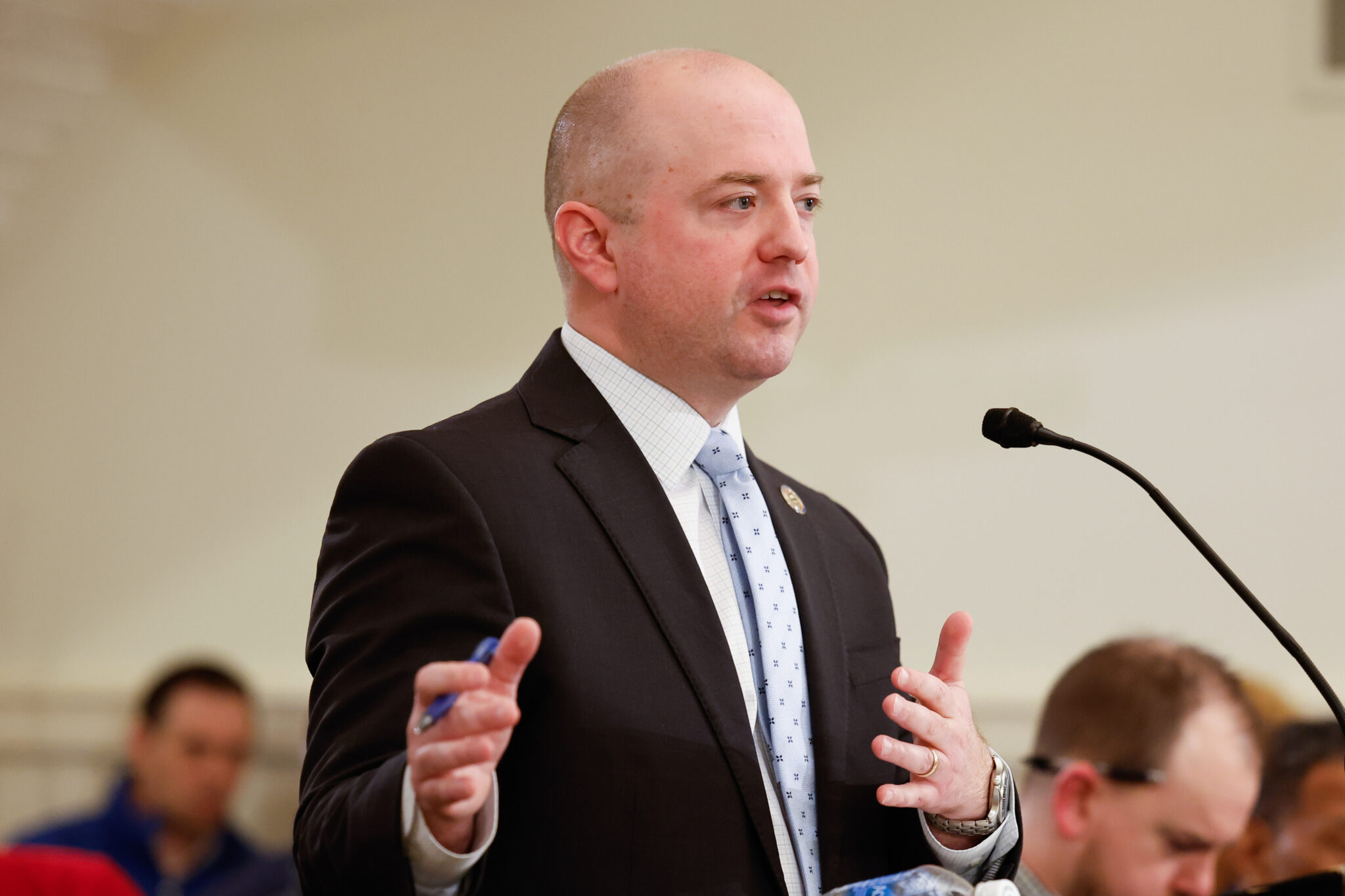
     State Rep. Phil Plummer, R-Dayton. State Rep. Phil Plummer, R-Dayton. (Photo by Graham Stokes for Ohio Capital Journal. Republish photo only with original article.) 

    In its initial hearing, Reps. Brian Stewart, R-Ashville, and Phil Plummer, R-Dayton, presented the proposal as procedural update rather than a wholesale change. Currently there are almost 200 people on death row in Ohio, but executions have been on hold since 2018.

    “We have a situation today where for six years, we have refused to carry out capital punishment — in violation of the law,” Stewart argued. “It is the law. And until this body votes to do something different, then we need to give (the Ohio Department of Rehabilitation and Corrections) the tools to carry out these sentences.”

    “Plan B”

    For the most part, Stewart sought to downplay the additional execution method. He cited an example of an inmate requesting nitrogen hypoxia, and defense attorneys arguing they believed the process is “humane” and “completely painless.”

    The inclusion of nitrogen hypoxia, Stewart argued, is a way to break up the backlog. Assuming lethal injection is available, death row inmates could select the method of their choice, and in the event that lethal injection drugs are unavailable, nitrogen hypoxia would allow executions to continue.

    “In our view nitrogen hypoxia is a plan B,” Stewart described. “It is a set of suspenders to go along with the belt. It would be preferable to continue using lethal injection, but we need to do something.”

    Stewart and Plummer presented their idea as a value-neutral response to a stated lack of lethal injection drugs. “Despite his decision to delay the executions,” Plummer said, “Governor DeWine has indicated that the legislature could address this issue by authorizing an alternative method.”

    Stewart dismissed criticism of Alabama’s “botched” nitrogen hypoxia execution as death penalty abolitionists speaking in sensational terms. An AP reporter who viewed the execution described Kenneth Smith thrashing and gasping as prison officials administered the gas. Stewart acknowledged their bill isn’t likely to change the minds of people who already oppose the death penalty.

    “Respectfully, though, I think there’s another bill for that,” Stewart said, referring to measures in the Ohio House and Senate that would abolish the death penalty.

    “This bill is saying we have the law that we have, and until we change it, we need to find a way to carry out what juries have already imposed,” he said.

    Pushback

    While some inmates may have requested nitrogen hypoxia and some defense attorneys have looked favorably on the protocol, it’s acceptance isn’t universal. The American Veterinary Medical Association, for instance, OK’d the procedure under some circumstances for euthanasia of chickens, turkeys and pigs. For all other mammals, though, the panel warned it’s inappropriate and likely to cause distress.s

    “Now, if we’re going to use gas, which, frankly, our veterinarians will not use on our animals, why would we use that on human beings?” state Rep. Michele Grim, D-Toledo, asked.

    Stewart argued it’s “vastly more humane” than the violence that put inmates on death row in the first place. He added that in countries where assisted suicide is legal, nitrogen hypoxia is one of the approaches people use.

    State Rep. Bill Seitz, R-Cincinnati, meanwhile, said the problem with Ohio’s capital punishment system is the length of time it takes to pursue appeals. “That is the problem in a nutshell,” he said, “plus the unavailability of the three-drug injection.” But he noted if the U.S. Supreme Court hasn’t explicitly blessed the protocol, the proposal might just lead to more appeals.

    “To my knowledge,” he said, “the United States Supreme Court has only signed off on hanging, electric chair, firing squad, and lethal drug injection as being constitutional — don’t violate the Eighth Amendment.”

    “I believe what you’re saying about nitrogen hypoxia,” Seitz added, “but it hasn’t yet been blessed, if you will.”

    Stewart argued the likelihood of nitrogen hypoxia passing muster in the court is high, but added their preferred method remains lethal injection. Notably, nothing about the long and complex appeals process unique to death penalty cases will change under Stewart and Plummer’s measure.

    Follow OCJ Reporter Nick Evans on Twitter.


    Nick Evans
    NICK EVANS

    Nick Evans has spent the past seven years reporting for NPR member stations in Florida and Ohio. He got his start in Tallahassee, covering issues like redistricting, same sex marriage and medical marijuana. Since arriving in Columbus in 2018, he has covered everything from city council to football. His work on Ohio politics and local policing have been featured numerous times on NPR.

    Ohio Capital Journal is part of States Newsroom, the nation’s largest state-focused nonprofit news organization.

    MORE FROM AUTHOR

  • At least seven Ohio universities are reviewing race-based scholarships after Supreme Court ruling

    At least seven Ohio universities are reviewing race-based scholarships after Supreme Court ruling

    College students walk on campus. (Klaus Vedfelt/Getty Images)

    The University of Akron, the University of Toledo, Cleveland State University, Kent State University, Ohio University, Ohio State University and Youngstown State University all said they are in the process of reviewing their scholarships.

    BY:  – Ohio Capital Journal

    At least seven Ohio public universities are reviewing scholarships in the wake of comments Ohio Attorney General Dave Yost made about race-based scholarships after the U.S. Supreme Court ruled against race-conscious admissions.

    Cleveland State University, Kent State University, the University of Akron, the University of Toledo and Youngstown State University all said they are in the process of reviewing their scholarships. This is in addition to Ohio University and Ohio State University, as previously reported by the Capital Journal.

    “The University of Toledo has paused the distribution of scholarships that consider race as a part of their award criteria following the U.S. Supreme Court ruling on the use of affirmative action in higher education admissions,” university spokesperson Tyrel Linkhorn said in email.

    This affects 6% of Toledo’s nearly 1,200 donor-supported scholarships, which is worth $500,000, he said in an email.

    “The University and The University of Toledo Foundation are actively working with donors to explore potential revisions to scholarship agreements so we can continue to support our donors’ goals in a way that fully complies with the Supreme Court decision,” Linkhorn said in an email.

    Kent State and Youngstown State mentioned the Supreme Court case and “guidance from the state of Ohio” as reasons for their review. Cleveland State just mentioned the Supreme Court case and Akron didn’t give a specific reason.

    The Capital Journal previously reported that Ohio University is “temporarily pausing” awarding race-based diversity scholarships and that Ohio State University is in the “process of updating scholarship criteria to ensure compliance with the law,” according to the university’s website.

    Ohio University has 130 gift agreements that are currently under review that represent $450,000 in potential scholarship awards, university spokesperson Dan Pittman said in an email.

    “The review is to ensure language in the gift agreements remains lawful,” Pittman said. “If deemed necessary, the University will work with donors to make revisions to language in the agreements.”

    Ohio State University expects to give away approximately $448 million dollars in financial aid this fiscal year, university spokesperson Ben Johnson said in an email.

    Bowling Green State University, Miami University, Northeast Ohio Medical Center, Shawnee State University, the University of Cincinnati and Wright State University did not answer questions about the status of their race-based scholarships.

    A university spokesperson for Central State University, Ohio’s only public historically Black university, said in email they don’t have race based scholarships.

    Supreme Court decision

    The U.S. Supreme Court. (Al Drago/Getty Images)
     The U.S. Supreme Court. (Al Drago/Getty Images) 

    Last summer, the U.S. Supreme Court ruled Harvard and the University of North Carolina violated the equal protections clause of the 14th Amendment by using race as a factor in applications.

    The next day, Yost sent a letter to Ohio colleges and universities saying “employees must immediately cease considering race when making admissions decisions,” according to the letter. It also said his office won’t legally protect someone at a college or university who uses race as a factor.

    The topic of race-based scholarships came up on a Jan. 26 call with universities, said Yost’s spokesperson Bethany McCorkle.

    “What was said in response to a question was after the recent Supreme Court decision, scholarships will need to be looked at to ensure compliance with the law,” McCorkle said in an email. “Although the Court did not expressly prohibit race-based scholarships, it indicated that ‘eliminating racial discrimination means eliminating all of it.’ Race-based scholarships discriminate on the basis of race in awarding benefits. Therefore, it would follow that such programs are unconstitutional.”

    The Harvard Supreme Court decision is being “weaponized to intimidate and create fear,” said Sara Kilpatrick, executive director of the Ohio Conference of the American Association of University Professors.

    “We obviously disagree with the Harvard decision, and we also disagree with how the Attorney General is trying to extrapolate it to apply to virtually anything that touches race,” she said. “We hope that institutions are not being pushed into a direction that ultimately will harm students.”

    If race-based scholarships are removed from universities, Kilpatrick said it could prevent Ohio students from earning degrees.

    “This is a dangerous slippery slope, and they should be cautious about how far they’re trying to push this,” she said. “This will undoubtedly dry up desperately needed revenue streams for institutions.”

    Follow OCJ Reporter Megan Henry on X.


    Megan Henry
    MEGAN HENRY

    Megan Henry is a reporter for the Ohio Capital Journal and has spent the past five years reporting in Ohio on various topics including education, healthcare, business and crime. She previously worked at The Columbus Dispatch, part of the USA Today Network.

    MORE FROM AUTHOR