

Tag: Ohio Citizens Redistricting Commission

  • Ohio Supreme Court approves redistricting summary with only two small revisions

    Ohio Supreme Court approves redistricting summary with only two small revisions

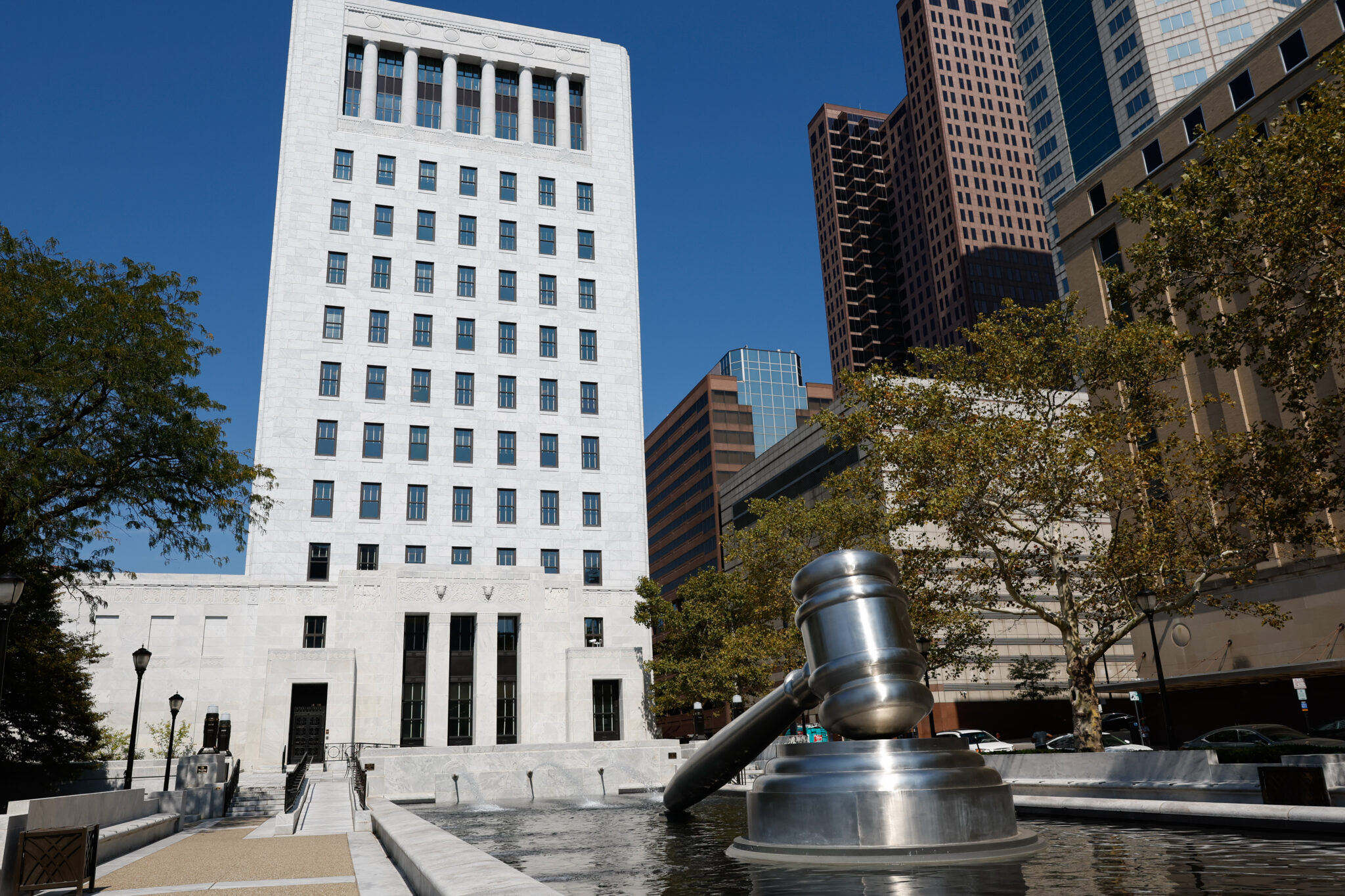
    The Gavel outside the Supreme Court of the State of Ohio, September 20, 2023, at 65 S. Front Street, Columbus, Ohio. (Photo by Graham Stokes for Ohio Capital Journal. Republish photo only with original article.)

    Republican majority rejects 6 of 8 changes requested by anti-gerrymandering advocates proposing the amendment

    By:  Ohio Capital Journal

    The Ohio Supreme Court largely approved ballot summary language for November’s Issue 1 anti-gerrymandering amendment on Monday, sending the language back to the Ohio Ballot Board for two revisions.

    A 4-3 Republican majority rejected 6 of 8 revisions requested by anti-gerrymandering advocates, while Democratic justices on the court said that was inadequate and that the summary needed “a nearly complete redrafting.”

    The summary was written by Ohio Secretary of State Frank LaRose, who opposes the amendment, and approved 3-2 by the Ohio Ballot Board, which is chaired by LaRose. LaRose is also a member of the current Ohio Redistricting Commission that the amendment proposes to replace with citizen commissioners.

    While the court allowed most of the summary language in a decision released Monday night, it ordered the board to include in the summary “language that accurately conveys” that “the public would have the right to express itself to the new redistricting commission” under the terms of the amendment, written by anti-gerrymandering coalition Citizens Not Politicians.

    “Distilled, the proposed amendment would provide the rights of public participation in the redistricting process through meetings, hearings and an online public portal, and would forbid communication with the commission members and staff outside the public-meeting and portal context,” the court wrote.

    The other change ordered by the court compels the ballot board to make it clear that judicial review of the amendment is not limited to a “proportionality standard.”

    The current seven-member Ohio Redistricting Commission includes the Ohio House Speaker and Ohio Senate President, along with the governor, secretary of state, auditor of state, and two minority party legislative leaders.

    If approved by the voters, the amendment would replace the politician commission with the Ohio Citizens Redistricting Commission, which would have 15 members made up of five Republican citizens, five Democratic citizens, and five independents.

    The summary language does not change the text of the proposed redistricting reform or what the amendment would actually do; it’s just the summary language used to describe the amendment on voter ballots.

    An average of Ohio voter preferences over the last 10 years including 2022 show a 56-43 Republican-to-Democratic preference of Ohio voters, but Republicans control supermajorities of 67 out of 99 Ohio House seats and 26 out of 33 Ohio Senate seats. Ohio voters were forced to vote under unconstitutionally gerrymandered districts in 2022 after Republicans on the Ohio Redistricting Commission ran out of time to produce constitutional maps and a split federal court ruled the maps that were declared gerrymandered by a bipartisan majority on the then-Ohio Supreme Court had to be used.

    Republican politicians on the Ohio Redistricting Commission battled with the bipartisan court majority for nearly two years over the maps in 2021 and 2022, with five Statehouse maps and two U.S. Congressional district maps being rejected as unconstitutionally gerrymandered. The swing vote in those cases, Republican Supreme Court Justice Maureen O’Connor, was forced to retire due to age. She is now leading the Citizens Not Politicians amendment effort.

    One provision challenged by Citizens Not Politicians but allowed by the court states the amendment would “repeal constitutional protections against gerrymandering approved by nearly three-quarters of Ohio electors participating in the statewide elections of 2015 and 2018, and eliminate the longstanding ability of Ohio citizens to hold their representatives accountable for establishing fair state and legislative and congressional districts.”

    Citizens Not Politicians attorneys argued mention of the vote margin and method were not necessary, and the court said challengers laid out arguments that the language was “tantamount to an argument against adopting the proposed amendment.”

    But the court majority found that “at worst” including the vote margin and method could be “questioned on relevance grounds” not on “accuracy grounds.”

    “This information is factually accurate, and relators have not shown that the information would ‘mislead, deceive or defraud the voters,’” the court majority stated in their decision.

    The court also allowed language added by state Sen. Theresa Gavarone during the Aug. 16 board meeting, which states the amendment would “establish a new taxpayer-funded commission of appointees required to gerrymander the boundaries of state legislative and congressional districts to favor the two largest political parties in the state of Ohio.”

    Justices dismissed Citizens Not Politicians arguments that the language leads voters to believe the amendment would “require gerrymandering,” despite the fact that the amendment states it would ban partisan gerrymandering.

    The court said “the fact that the proposed amendment announces that it would ‘ban partisan gerrymandering,’ … is of little assistance in ascertaining whether the ballot language’s use of the word ‘gerrymander’ is improper.”

    The court explored various definitions of “gerrymandering” in coming to its decision, finding that the requirement the amendment uses to dictate the drawing of Statehouse and congressional maps “falls within the meaning of ‘gerrymander.’”

    “Because the board’s use of the term ‘gerrymander’ is consistent with dictionary definitions and how the United States Supreme Court has used the term, it does not mislead, deceive or defraud voters,” the decision stated.

    The court did not order any changes to the ballot title, though that was included in the changes requested by Citizens Not Politicians.

    “We conclude that the secretary did not err in crafting the ballot title,” the court wrote.

    While all the justices agreed to the changes, they were split on how many changes needed to be made.

    In his concurrence, Justice Patrick Fischer claimed “gerrymandering, though in a bipartisan manner, is absolutely ‘required under the proposed amendment,” and that the state constitution “would dictate” that independent and third-party voters would have their voice “removed from Ohio’s political world.”

    Justice Michael Donnelly agreed to the decision that ordered changes to the ballot language, but “vehemently” disagreed “that those corrections are even remotely adequate to prevent the ballot language as a whole from being misleading.”

    He and Justice Melody Stewart joined Justice Jennifer Brunner in an opinion that agreed to the changes, but said the majority opinion “reflects an abject failure of this court to perform an honest constitutional check on the ballot board’s work.”

    “We should be requiring a nearly complete redrafting of what is perhaps the most stunningly stilted ballot language that Ohio voters have ever seen,” Brunner wrote.

    She went on to say the ballot board language “is tantamount to performing a virtual chewing of food before the voters can taste it for themselves to decide whether they like it or not.”

    While the summary language will appear on ballots in the November general election, the actual language of the proposed amendment will be posted in polling places.

    The Ohio Secretary of State’s office said the ballot board will meet to make the revisions on Wednesday morning.

    Reactions

    Citizens Not Politicians released a statement saying they disagreed with “much of the decision” but agreed with the court’s “repudiation of the politicians on the ballot board for violating the Ohio Constitution.”

    Ballot Board chair Frank LaRose released his own statement, calling the court’s decision “a huge win for Ohio voters, who deserve an honest explanation of what they’re being asked to decide.”

    Former Ohio Redistricting Commission co-chair and Auditor of State Keith Faber said the court was “thoughtful in its approach and they got it right.”

    Senate President Matt Huffman and Gov. Mike DeWine have both spoken against the measure publicly.

    Faber’s fellow co-chair Senate Minority Leader Nickie Antonio said while the decision “enables Ohioans to make a more informed choice by addressing some of the most deceptive language, other misleading and argumentative language still remains.”


    Susan Tebben
    Susan Tebben

    Susan Tebben is an award-winning journalist with a decade of experience covering Ohio news, including courts and crime, Appalachian social issues, government, education, diversity and culture. She has worked for The Newark Advocate, The Glasgow (KY) Daily Times, The Athens Messenger, and WOUB Public Media. She has also had work featured on National Public Radio.

    Ohio Capital Journal is part of States Newsroom, the nation’s largest state-focused nonprofit news organization.

    MORE FROM AUTHOR

  • Signature collection can begin anew after Ohio redistricting amendment passes next step

    Signature collection can begin anew after Ohio redistricting amendment passes next step

    The Republican members of the Ohio Redistricting Commission talk before a 2023 public hearing on statehouse district maps. (Photo: Susan Tebben, OCJ)

    BY:  – Ohio Capital Journal

    The newest measure to change the Ohio Constitution and reform the redistricting process in Ohio has cleared its most recent hurdle: a typo.

    The Ohio Ballot Board met Monday, quickly certifying a proposed constitutional amendment that would “replace the current politician-run redistricting process.” The board’s only role is to determine if an amendment follows the legal requirements that the measure only contain one amendment to the state’s constitution.

    The certification came as no surprise, since the board had previously certified the amendment in October. This time around, the re-certification was needed after the creator of the proposed amendment, anti-gerrymandering group Citizens Not Politicians, noticed a typo in one of the deadlines mentioned in the amendment.

    Attorney Don McTigue was present at Monday’s ballot board meeting, and said that nothing about the intent of the amendment changes with the correction of the error.

    The amendment also went through multiple rounds of revisions, after Ohio Attorney General Dave Yost rejected the measure twice, saying amendment reviewers identified “omissions and misstatements” that the AG said would “mislead a potential signer as to the actual scope and effect of the proposed amendment.”

    The amendment would replace the current redistricting process, also created through a constitutional amendment, and would eliminate the Ohio Redistricting Commission as it stands now, a seven-member panel made up of all elected officials, five from the GOP majority and two Democrats.

    The commission would be replaced with a “citizen-led commission,” chosen by a bipartisan panel. If approved by the voters, the amendment would create the Ohio Citizens Redistricting Commission, which would have 15 members, five matching the political party of the governor at the time, five from the party of the gubernatorial candidate who received the second-most votes in the most recent election, and five unaffiliated members.

    The amendment also specifically lays out anti-gerrymandering mechanisms that have been a sticking point throughout the last two years, as the Ohio Redistricting Commission tumbled through the process of six different statehouse district maps and two congressional maps, all but one of which (the most recent statehouse districts) has been rejected as unconstitutional by the Ohio Supreme Court.

    The statehouse districts adopted in September by the current commission are being challenged in a case before the state’s highest court, but no decision has been made.

    The ORC has been rife with chaos and uncertainty as well, as the last two years contained multiple line-up changes, arguments over deadlines and lack of action, and even a stumbled start to the most recent adoption process.

    In the new amendment proposal, the citizen-led commission would have to create a redistricting plan with political party proportions that “correspond closely to statewide partisan preferences of the voters of Ohio,” and the commission has to state how the districts’ partisan divide was determined.

    The group who wrote the measure defines “correspond closely” as no more than a 3-percentage-point difference between the redistricting plans and the statewide voter preferences, “unless arithmetically impossible.”

    The Ohio Supreme Court holds the jurisdiction for all court challenges of redistricting plans in the amendment, just as it does in the current system. That system was criticized, however, for not creating enough of an enforcement mechanism. The state supreme court rejected seven different district maps, but did not hold commission members in contempt for missing deadlines.

    The commission also did not receive any consequences for eschewing a proposal from court-ordered mapmakers, brought in on the taxpayers’ dime, and passing a map that was nearly identical to a previous, unconstitutional statehouse map.

    In the new process, if approved by voters, “special masters” would be chosen to “review the record before the commission and hold a public hearing” if a court challenged is filed against a redistricting plan. Then, a report must be issued “as to whether the commission abused its discretion in its determination that the adopted plan complies with the partisan fairness criteria required by the amendment for a redistricting plan.”

    Once the report from the special masters is released, objections to the report can be filed with the Ohio Supreme Court, who will ultimately rule on the maps.

    The commission would have an appropriation from the Ohio General Assembly of $7 million for 2025 redistricting under the new measure, plus more for the bipartisan panel who chooses the commission.

    The cost of the special masters would come from the Ohio Supreme Court’s budget, according to the amendment language.

    Signature collection for the initiative can begin again, now that the state ballot board has re-approved the measure. According to Citizens Not Politicians, the group must collect 413,487 valid Ohio voter signatures by July 3, 2024, to qualify for the general election next year.


    Susan Tebben
    SUSAN TEBBEN

    Susan Tebben is an award-winning journalist with a decade of experience covering Ohio news, including courts and crime, Appalachian social issues, government, education, diversity and culture. She has worked for The Newark Advocate, The Glasgow (KY) Daily Times, The Athens Messenger, and WOUB Public Media. She has also had work featured on National Public Radio.

    MORE FROM AUTHOR

  • Ohio politicians used redistricting for gerrymandered horse-trading. Kick them out of the process

    Ohio politicians used redistricting for gerrymandered horse-trading. Kick them out of the process

    COMMENTARY

    by David DeWitt

    It should be abundantly clear to all fair-minded Ohioans at this point that politicians have no business being involved in the redistricting process after lawmakers used the latest round of Ohio House and Senate district mapmaking to strike a bipartisan deal that amounts to little more than gerrymandered horse-trading.

    Fittingly under the cover of darkness late Tuesday night, Ohio Republican and Democratic politicians conducted a shrewd, self-serving negotiation to once again gerrymander Ohio’s Statehouse maps in behalf of their own short-term political power interests, instead of all working earnestly toward fair, representative maps.

    Ohio Democratic commissioners had a choice of whether to get whatever they could for now and hope voters pass reform, or to get raked by Republicans on the commission with worse maps than we have now, but this time likely destined to be rubber-stamped by a partisan right-wing Ohio Supreme Court. They chose the former.

    The Ohio Redistricting Commission’s bipartisan agreement among politicians show a Republican advantage of 61 to 38 in the Ohio House under the new map, with eight competitive Democratic toss-up seats and three competitive GOP toss-ups.

    In the Ohio Senate, the new map shows a 23 to 10 Republican advantage, with three competitive Republican toss-up seats and one competitive Democratic toss-up seat.

    Compare this to Ohio’s current unconstitutionally gerrymandered maps forced upon voters in 2022. Before the 2022 Election, the current gerrymandered districts showed a Republican advantage in 56 House seats. In the Ohio House, all 19 competitive districts under the current maps were Democratic, with zero competitive Republican districts.

    That meant that Democrats had to spend money and resources in 19 House districts and win every single one in order to maximize their House seats. Republicans didn’t have to “defend” a single seat, and could focus all of their money and resources on “pick-ups” — taking seats that lean Democratic on-paper.

    The Republicans’ unconstitutionally partisan mapmaking paid off. The 2022 Election saw Ohio Republicans winning 67 state House seats.

    In the Ohio Senate under the current maps, Republicans before the election looked to hold an edge in 18 Senate seats, and there were seven competitive toss-ups. Republicans ended up winning 26 Senate seats last November, while Democrats won seven seats total.

    So what are we looking at here with Tuesday night’s agreement among the bipartisan politicians?

    Democrats don’t have to spend the money and resources to defend nearly as many seats in the Ohio House. Instead of defending 19 seats, they will be defending eight seats and targeting three GOP seats. Essentially, their political resource management and allocation will be easier. Same thing in the Senate. They will be able to focus their resources on attempting to defend one seat and to pick up three GOP seats.

    Best case scenario for Democrats under the new maps: They pick-up six Senate seats total over their current number of seven, for a 20-13 Republican chamber; and/or they pick up nine seats total in the Ohio House over their current 32 seats by protecting their eight competitive seats and winning three GOP-leaning targets, for a 58-41 Republican chamber.

    That best case scenario for Democrats would break the GOP’s supermajorities; however, if Democrats were to not win the competitive Republican-leaning seats, the GOP would retain supermajorities of 61-38 in the Ohio House and 23-10 in the Ohio Senate.

    The best case scenario for Republicans would be not only to hold on to their supermajorities, but to win as many competitive Democratic-leaning districts as possible. If they were to defend their three competitive seats and win six out of the eight Dem-leaning competitive districts in the House, for instance, they would retain their current 67-32 advantage. Keep in mind that in 2022, they won 11 Dem-leaning competitive House seats.

    So by striking this deal on more gerrymandered maps, Democratic politicians gave themselves an easier time with money and resource allocation in 2024 and a very difficult but still possible shot to take away GOP supermajorities, and the GOP gave themselves a good chance to retain their supermajorities in both chambers while still having the opportunity to possibly expand them even further than the maps suggest now on-paper.

    But there’s more.

    Beyond this gerrymandered horse-trading on the Ohio House and Senate numbers, Democrats are indicating they are putting faith in the idea that the impact of gerrymandering lessens over time as the data used to draw the maps become outdated — so this deal prevents the GOP from both punishing Democrats severely right now, and from coming back for another redraw with fresh data to more efficiently gerrymander the maps again. Democrats also advocated Tuesday night for 2024 anti-gerrymandering reform, indicating they see this deal as a stop-gap measure before real reforms can take place thanks to voters.

    Republicans meanwhile have obtained a strong political cudgel to wield against that very effort to replace the Ohio Redistricting Commission made up of politicians with an Ohio Citizens Redistricting Commission that kicks the politicians out of the process. Republicans will say that the process worked, they obtained bipartisan agreement just as voters in 2015 intended with redistricting reform, that these maps are not gerrymandered, and in 2024, they’ll say something along the lines of, “Far-left special interests want to hijack the constitution and put power in the hands of unelected bureaucrats.”

    This process did not work.

    Redistricting in Ohio has been a two-year travesty with an ignominious conclusion for everyone involved, Republican and Democratic politicians alike.

    The prevailing motivation of every politician Tuesday night was shrewd political self-interest, not sacred obligation and duty to the public.

    No matter what anybody thinks of the advantages or disadvantages of the deal that was struck, it’s clear that these incentives for political horse-trading must be removed.

    The only incentive for mapmakers should be fair and representative maps that evenly maximize competitiveness.

    The way to remove these bad incentives to make these kind of damned-if-you-do, damned-if-you-don’t deals is to kick all of these politicians out of the process.

    Whether it’s partisan or bipartisan, gerrymandering must end. On Tuesday night in Ohio, it did not.


    David DeWitt
    DAVID DEWITT

    Ohio Capital Journal Editor-in-Chief and Columnist David DeWitt has been covering government, politics, and policy in Ohio since 2007, including education, health care, crime and courts, poverty, state and local government, business, labor, energy, environment, and social issues. He has worked for the National Journal, The New York Observer, The Athens NEWS, and Plunderbund.com. He holds a bachelor’s degree from Ohio University’s E.W. Scripps School of Journalism and is a board member of the E.W. Scripps Society of Alumni and Friends. He can be found on Twitter @DC_DeWitt

    MORE FROM AUTHOR