Tag: Ohio Controlling Board

  • Controversial ‘private corporation’ JobsOhio gets billions more without paying more to state

    Controversial ‘private corporation’ JobsOhio gets billions more without paying more to state

    Under the original agreement, JobsOhio was given control of the liquor franchise until 2039 in exchange for $1.41 billion to be paid to the state. The Ohio Controlling Board on Wednesday extended the agreement to 2053 for no additional money.

    By:  Ohio Capital Journal

    The Ohio Controlling Board on Wednesday awarded JobsOhio billions more in what used to be public money without demanding that the “private” corporation pay more for the privilege. Attorney General Dave Yost had questioned the arrangement, but his office wasn’t present at the hearing, nor did it answer questions on Thursday.

    JobsOhio was created in 2011. It was allowed to lease Ohio’s lucrative liquor franchise for less than it was worth so that it could provide economic incentives for businesses to locate in the Buckeye State, expand existing operations, or at least not leave. Even though it was created by the state legislature and it operated with what used to be public money, the new agency was deemed a private corporation and thus exempt from open-government laws.

    Under the original agreement, JobsOhio was given control of the liquor franchise until 2039 in exchange for $1.41 billion to be paid to the state. The Controlling Board on Wednesday extended the agreement to 2053 for no additional money.

    Yost last week asked how that was fair to taxpayers, given that JobsOhio operates on money that used to go into state coffers. Rep. Tristan Rader, D-Lakewood, repeated that question during Thursday’s Controlling Board hearing.

    Christina Frass, assistant director of the state Office of Budget and Management, replied that the money went to pay off specific debts that are now retired, so more isn’t needed.

    But that doesn’t mean Ohio is now flush with cash. For example, House Speaker Matt Huffman, R-Lima, has proposed slashing funding for public education, saying the state can’t afford it. As economic development priorities go, economists say a well-funded public school system should be high on the list.

    Perhaps more significantly, JobsOhio has struggled to show that the state has gotten value for the billions that have gone to it instead of the state treasury.

    Measuring the success of such “economic development” efforts is tricky because it’s hard to tell if businesses would have done the same thing if they weren’t given what are effectively public subsidies. Sure, they’re glad to get money that could have funded other public needs, but research has indicated that in at least 75% of cases, incentives effectively pay businesses to do what they would have done, anyway.

    GET THE MORNING HEADLINES.


    Rader noted that if JobsOhio is working as well as it claims, it’s not showing up in the big picture.

    Since the agency’s creation, “We haven’t been competitive with some of our neighboring states and we’ve been behind the national average in job creation, so I’m questioning the efficacy of this organization,” he said. “How is it a good deal for Ohio when we’re behind on growth, and places like Indiana, Michigan and Pennsylvania have been ahead of us? There’s no real transparency and accountability mechanism built into this.”

    Frass responded by citing a 2022 JobsOhio-funded analysis that said that since its creation, the agency was responsible for creating 240,000 jobs and $14.6 billion in new payroll. But in the scientific community and elsewhere, such industry-funded research is viewed with skepticism because of the inherent conflict — if you’re being paid by the outfit you’re analyzing, you have a strong incentive to arrive at conclusions favorable to your funder.

    Frass’s office was asked earlier this week what evidence it had that JobsOhio wasn’t in many cases paying businesses to do what they would have done, anyway. The Office of Management and Budget referred the question to JobsOhio.

    When it was asked, a spokesman for JobsOhio simply asserted without evidence that his agency was the difference maker in the vast majority of business decisions it refers to as “won projects.”

    “With very few exceptions, all JobsOhio assistance is provided for competitive projects that would have otherwise gone to another state or not moved forward without the support of JobsOhio,” the spokesman, Matt Englehart, said in an email.

    YOU MAKE OUR WORK POSSIBLE.


    Marty Schladen
    Marty Schladen

    Marty Schladen has been a reporter for decades, working in Indiana, Texas and other places before returning to his native Ohio to work at The Columbus Dispatch in 2017. He’s won state and national journalism awards for investigations into utility regulation, public corruption, the environment, prescription drug spending and other matters.

    Ohio Capital Journal is part of States Newsroom, the nation’s largest state-focused nonprofit news organization.

    MORE FROM AUTHOR

  • State Board of Education of Ohio gets emergency funding, avoids upping teacher license fees

    State Board of Education of Ohio gets emergency funding, avoids upping teacher license fees

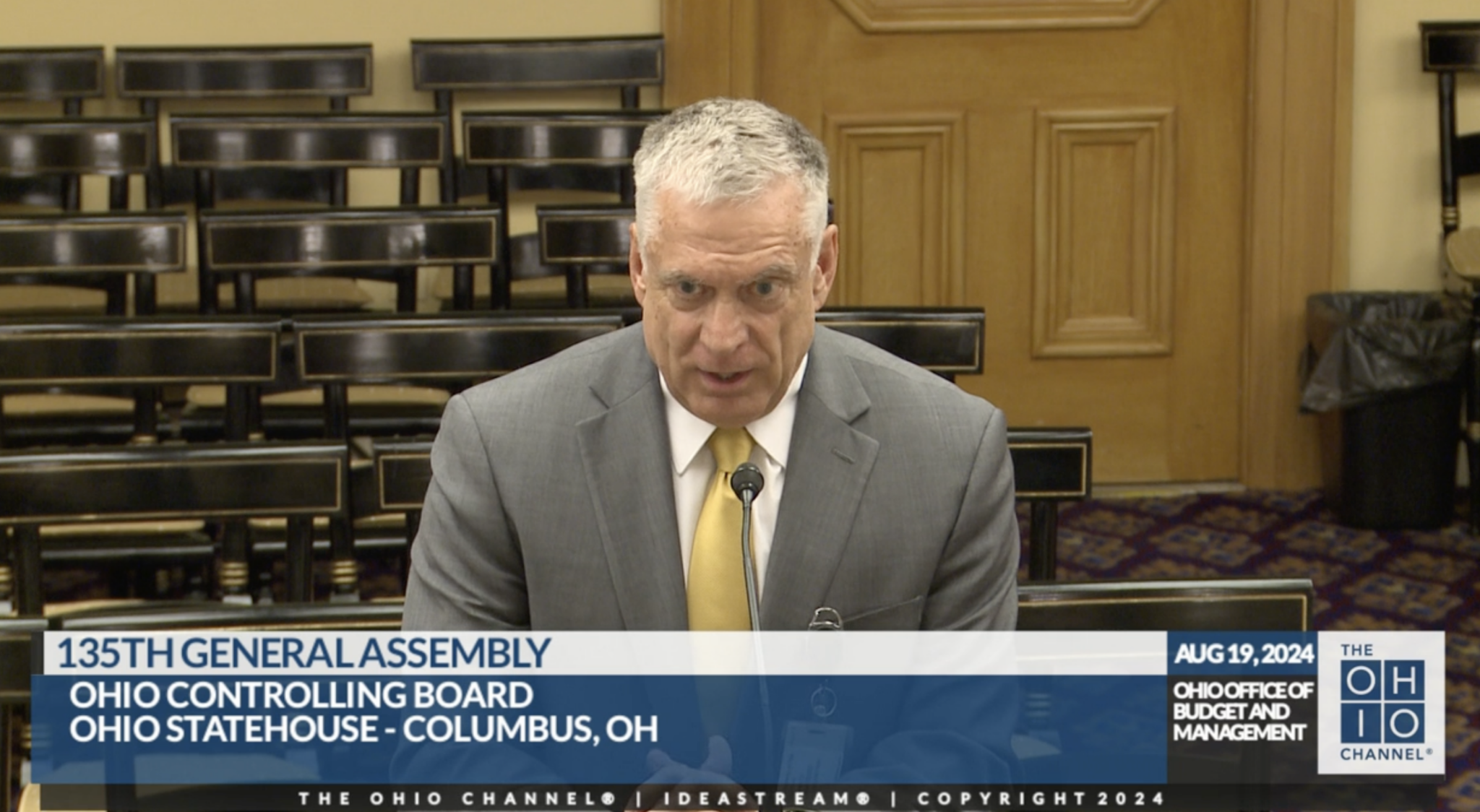
    Ohio Superintendent of Public Instruction Paul Craft speaks before the Ohio Controlling Board on Aug. 19. Screenshot via The Ohio Channel/Ideastream

    By:  Ohio Capital Journal

    Ohio’s State Board of Education will still be living lean on a bare-bones budget, but an influx of cash from the state will keep it going through the fiscal year.

    The Ohio Controlling Board, which directs appropriations and funding to state agencies, approved a $4.66 million emergency funding request last week for the board of education, to avoid having to raise teacher licensure fees and to cover a $3 million shortfall that may have impacted school staff background checks.

    “4.66 (million) is a number that gets us through this fiscal year,” State Superintendent of Public Instruction Paul Craft told the Capital Journal. “We’re still going to have some tough times.”

    The controlling board approval was amended from the original request made by the state’s Office of Budget and Management, which asked for only $1.85 million after working with the board of education on service sharing and funding cuts to get them through the year.

    “We completely were supportive of what OBM was doing,” Craft said. “That certainly keeps us where we are right now, which is extremely tight.”

    The SBOE has been warning of increasing and imminent shortfalls in their funding since they were separated from the Ohio Department of Education and Workforce, and left with only the teacher licensure fund to pay for all operating expenses.

    The funding they receive from the licensure fund isn’t year-round revenue, causing blocks of time during the year when the board has to sustain itself on very little incoming funds.

    “While we continue to strive for operational savings, because the majority of the revenue for this fund is received in the spring, the fund is projected to run a deficit starting this fall and continue until spring, when it will be back in a positive position,” the request to the controlling board stated.

    The split from the ODEW caused the board to reduce staffing by almost 20%, which included payroll and budget personnel, Craft told the Controlling Board at their Aug. 19 meeting to consider the emergency funds.

    “(Payroll and budget) are now being done as shared services through the Office of Budget and Management,” Craft said. “None of the money we requested brings back any of those staff.”

    The SBOE has also reduced board meetings to one day, instituted freezes on travel expenses and out-of-state conference costs. But the emergency funding is still needed to make sure teacher licensure fees can stay at their current rates, and the contract for Retained Applicant Fingerprint Database (RAPBACK) background checks can be paid.

    “I’ll tell you, I’ve never seen an agency in my 35 years in state government and military that’s running as lean as we are,” Craft said. “I’m so proud of what our staff has done in terms of making sure that Ohio’s 1.6 million kids interact with educators every day who are well-qualified and who show good moral character and judgment.”

    Some legislators on the controlling board expressed hesitation in using the funds from the controlling board’s “emergency purpose fund,” with state Sen. Shane Wilkins, R-Hillsboro, worrying that approving the emergency funds could cause the agency to come back next year for a request of the same amount.

    “For me, I would feel better if I knew, ‘hey, we really gave this a shot, the $1.8 (million original request) is not going to cut it,’” he said at the controlling board meeting.

    State Sen. Bob Hackett, R-London, questioned the need to push the funds specifically for the background checks, when Craft said the background checks would continue with or without the funding, and with the SBOE in contact with the Ohio Attorney General to find a solution to the funding shortage impacting the background check service.

    “It doesn’t really change our day-to-day at all,” Craft told Hackett and the controlling board. “On the other hand, I’ve signed (memorandums of understanding) with these agencies, and it would make me sleep better at night knowing that I agreed to these and they’re being made whole.”

    In offering the amendment that raised the funding provided for the SBOE to $4.66 million, state Rep. Jay Edwards, R-Nelsonville, said discussions have been going on for months about a solution to the SBOE funding issues. With the work the SBOE has already done to make cuts, the proposed funding number went from $10 million down to the $4.66 million that was eventually approved. He said it was incumbent upon state leaders make sure the funds were there to hold teacher licensure fees at current levels and maintain background checks.

    “The people that have been part of the discussion have heard that we will figure out how to pay for the background checks later,” Edwards said. “I don’t think it’s responsible of the people who hold the purse strings to allow the background checks to be figured out later.”

    He said the “mistake that was done during the budget … of the transfer to the Department of Education and Workforce,” should be corrected, not to mention he didn’t want “to be hearing from angry school teachers” if licensure fees increased.

    “We’re a conservative legislature that is constantly trying to cut taxes and cut fees and cut regulations for people out there,” Edwards said. “I don’t think teachers are getting rich in our state, I don’t want to see us raising teacher licensure fees.”

    Ohio House Democrats, including controlling board member state Rep. Beryl Brown Piccolantonio, D-Gahanna, said the funding “is a crucial lifeline that staves off a potential 75% increase in mandatory licensure fees.”

    “I look forward to addressing the remaining SBOE budget uncertainty on a more permanent basis in the next budget,” Piccolantonio said in a statement.

    Craft said the funding approval now allows the SBOE and the OBM to work together over the course of the fall to put together a plan for next year, as they await the governor’s executive budget plan and the state operating budget numbers.

    “It’s pretty early in the process and we’re looking at some other approaches, but this should get us through,” Craft told the Capital Journal.


    Susan Tebben
    Susan Tebben

    Susan Tebben is an award-winning journalist with a decade of experience covering Ohio news, including courts and crime, Appalachian social issues, government, education, diversity and culture. She has worked for The Newark Advocate, The Glasgow (KY) Daily Times, The Athens Messenger, and WOUB Public Media. She has also had work featured on National Public Radio.

    Ohio Capital Journal is part of States Newsroom, the nation’s largest state-focused nonprofit news organization.

    MORE FROM AUTHOR

  • Ohio Controlling Board approves purchase of modular shoot houses to train armed school districts

    Ohio Controlling Board approves purchase of modular shoot houses to train armed school districts

    BY:  Ohio Capital Journal

    The Ohio Controlling Board has approved a $78,028 purchase to buy two mobile modular shoot houses to help train school districts with armed staff.

    The Ohio Department of Public Safety made the request to the Controlling Board, which was approved during Monday’s meeting.

    The mobile modular shoot houses are from North Carolina-based Kontek Industries will “provide live fire and scenario-based training,” according to the Controlling Board agenda.

    The modular homes can be moved anywhere and feature “realistic-based training, rapid deployment, reconfigurable rooms, hallways and doors, weatherproof design and can build exact replicas of buildings,” according to the agenda.

    Ohio has 67 schools and school districts in 36 Ohio counties that have armed staff members. The law allowing local boards of education to decide whether to allow teachers and school staff went into effect in September 2022.

    The Capital Journal talked to four school districts with armed staff last year and they all said police response time to rural schools factored into their decision to arm staff.

    Ohio school staff were armed before the 2022 law went into effect, but an Ohio Supreme Court ruling in 2021 required school employees to undergo 700 hours of training to be armed at school. The 2022 law lowered the required training hours for armed personnel from 700 hours to at least 24. School boards have the authority to require more hours.

    This created the Ohio School Safety Center within the Ohio Department of Public Safety and school districts who want their staff to be armed are required to send their training plans for approval once their school board has approved the request to arm their staff.

    Follow OCJ Reporter Megan Henry on X.


    Megan Henry
    MEGAN HENRY

    Megan Henry is a reporter for the Ohio Capital Journal and has spent the past five years reporting in Ohio on various topics including education, healthcare, business and crime. She previously worked at The Columbus Dispatch, part of the USA Today Network.

    Ohio Capital Journal is part of States Newsroom, the nation’s largest state-focused nonprofit news organization.

    MORE FROM AUTHOR