Tag: Ohio Department of Mental Health and Addiction Services

  • University of Cincinnati, Cincinnati Children’s part of statewide mental health research initiative

    University of Cincinnati, Cincinnati Children’s part of statewide mental health research initiative

    News release from UC News

    SOAR Study to identify risk and resiliency factors to improve behavioral health outcomes

    headshot of Tim TedeschiBy Tim Tedeschi


    The University of Cincinnati and Cincinnati Children’s Hospital are part of a collaborative research initiative designed to identify contributors to the ongoing epidemic of persistent emotional distress, suicide and drug overdose in the state of Ohio.

    The SOAR Study investigates the role of underlying biological, psychological and social factors.

    The Ohio Department of Mental Health and Addiction Services (OhioMHAS) is funding this statewide research project with an initial $20 million grant. Like other areas of the country, Ohio has seen a rise in mental illness, suicide and deaths related to drug overdose over the past decade, and the COVID-19 pandemic exacerbated these problems.

    “The causes of these diseases remain largely a mystery to clinical experts and the public,” said LeeAnne Cornyn, director of OhioMHAS. “The SOAR Study has the potential to help future generations better understand risk factors, effective mitigation strategies and techniques to build resiliency — in short, the study has the potential to curb disease and save lives.”

    SOAR is studying Ohioans in their local communities, using an integrated “bring science to the people” approach. It is creating a statewide medical research and development ecosystem to drive continued advances in mental health, substance use prevention and treatment interventions.

    The SOAR Study has two parallel but connected projects.

    Better understanding biomarkers of risk and resilience among Cincinnatians is in line with our department’s vision to advance the understanding and treatment of psychiatric disorders. – Cal Adler, MD

    Focusing on breadth, the SOAR Wellness Discovery Survey is engaging as many as 15,000 people across all 88 Ohio counties. Researchers want to uncover how strengths and skills may be related to overcoming adversity. Those strengths will inform researchers about which factors to focus on to develop new treatments. This portion is underway, with more than 300,000 postcards mailed out to residents statewide.

    Focusing on depth, the SOAR Brain Health Study will comprehensively study as many as 3,600 Ohioans in family groups to examine the biological, psychological and social factors that help explain response to adversity, with longer-term goals of personalizing individual care.

    The SOAR Study will engage a multidisciplinary team of experts from UC and Cincinnati Children’s Hospital, Ohio State University, Bowling Green State University, Central State University, Kent State University, Nationwide Children’s Hospital, Northeast Ohio Medical University, Case Western/University Hospital-Cleveland, Ohio University, University of Toledo and Wright State University.

    CALEB ADLER WITH UC LAB COAT PSYCHIATRY
    Cal Adler, MD. Photo/University of Cincinnati.

    Faculty and staff in UC’s Department of Psychiatry and Behavioral Neuroscience will enroll approximately 500 Ohioans who will complete study procedures such as MRIs, EEGs, neuropsychological assessments, biospecimen collection and questionnaires.

    “Better understanding biomarkers of risk and resilience among Cincinnatians is in line with our department’s vision to advance the understanding and treatment of psychiatric disorders,” said Cal Adler, MD, professor, vice chair of research, co-director of the Division of Bipolar Disorders Research, director of the Center for Imaging Research in the Department of Psychiatry and Behavioral Neuroscience at UC’s College of Medicine and a UC Health physician. “We have already begun to enroll Ohio families and anticipate engaging over 200 participants over the next year.”

    “This important SOAR Study builds on our long-standing academic health mission, and we are proud to champion this vital research to help all Ohioans,” said John J. Warner, MD, chief executive officer at The Ohio State University Wexner Medical Center and executive vice president at Ohio State. “Mental health care is health care, and this study will help us inform prevention and treatment strategies to advance patient-centered care and influence the way we train our future care providers.”

    Leaders of the study say SOAR aims to do for addiction, mental illness and mental health what Framingham Heart Study researchers did for heart disease and heart health. Launched in 1948, the multigenerational Framingham Heart Study has enrolled more than 15,000 study participants over 75 years, resulting in major life-saving advancements about heart disease risk factors.

    “Our approach with the SOAR Study will allow us to identify the factors that can be modified to reduce risk and build resilience,” said SOAR Study principal investigator K. Luan Phan, MD, professor and chair of the Department of Psychiatry and Behavioral Health at Ohio State. “We won’t be able to ‘bend the curve’ on the growing number of deaths of despair, such as those from addiction and suicide, until we go upstream to better understand their etiology. SOAR is the first statewide, multigenerational comprehensive study in the nation that will offer a new roadmap for developing better treatments and cures that will improve and save lives.”

    Impact Lives Here

    The University of Cincinnati is leading public urban universities into a new era of innovation and impact. Our faculty, staff and students are saving lives, changing outcomes and bending the future in our city’s direction. Next Lives Here.

    If you are interested in participating in this study, please reach out to the UC study coordinator, Rachel, at 513-558-5319.

    If you or someone you know is struggling with thoughts of suicide, call or text the Suicide and Crisis Lifeline at 988.

  • Ohio launching $20 million, decade-long study to improve behavioral health outcomes

    Ohio launching $20 million, decade-long study to improve behavioral health outcomes

    Getty Images illustration of therapy session.

    The study seeks to better understand the root causes of mental illness, substance use disorders, and suicide.

    BY:  Ohio Capital Journal

    This story is about suicide. If you or someone you know needs support now, call or text 988 or chat 988lifeline.org.

    The state of Ohio is embarking on a decade-long study to better understand the root causes of mental illness, substance use disorders, and suicide.

    The Ohio Department of Mental Health and Addiction Services is providing a $20 million grant to fund the State of Ohio Action for the Resiliency (SOAR) study, Ohio Gov. Mike DeWine announced during a press conference Friday.

    “Currently, there’s a lot that we don’t know and the SOAR study is a huge step forward in advancing our understanding of mental health and substance use disorders,” said Ohio State University President Ted Carter. “This study will provide key data that will shape the future of mental health across Ohio and beyond.”

    “There’s nobody that is not affected by this,” Carter said. “There’s somebody that you know in your family, your community, your neighborhood that is affected by this.”

    The study will go for at least a decade with the hope it will continue for decades to come and will look at generations of families from all across Ohio who are affected by mental illness and substance abuse disorders, DeWine said. Funding for the SOAR study comes from the state’s two-year operating budget.

    “We know mental illness and substance use disorders are preventable, treatable, and people can and do recover,” said Ohio Department of Mental Health and Addiction Services Director LeeAnne Cornyn.

    The SOAR study has two main projects — the SOAR Wellness Discovery Survey and the SOAR Brain Health Study.

    The wellness study will study as many as 15,000 people across Ohio’s 88 counties to learn how skills may help overcoming adversity. The brain health study will look at 3,600 Ohioan in families to help look at the biological, psychological, and social factors that help people handle adversity.

    “There’s still an awful lot to know about mental health,” DeWine said. “And candidly, the research in this field has not been as robust as it has been in other areas. … It will give us a complete picture of each participant to uncover why, for example, two people in similar circumstances or with similar health have very, very different outcomes.”

    Ohio State University will lead the study and is partnering with hospitals and universities around the state: Bowling Green State University, Central State University, Kent State University, Nationwide Children’s Hospital, Northeast Ohio Medical University, Case Western Reserve University, University Hospital in Cleveland, Ohio University, the University of Cincinnati, Cincinnati Children’s Hospital, University of Toledo and Wright State University.

    The SOAR study will be led by Dr. Luan Phan, chair of the Department of Psychiatry and Behavioral Health at the Ohio State University College of Medicine.

    “Our approach … is to identify the factors that can be modified to reduce risk and build resilience in the face of stress, trauma and adversity,” Phan said. “It’s important to identify what we don’t know — the root causes, the risks, the preventive factors of mental illness, to explain what, I feel, are fairly simple, but fundamental questions: who gets ill? Why did they get ill? How do they get ill? And when do they get ill?”

    Researchers hope this study will do for mental health what the Framingham Heart Study has done for heart disease.

    The Framingham Heart Study was initiated by the United State Public Health Service in 1948 to investigate the risk factors for cardiovascular disease. It has enrolled more than 15,000 study participants.

    “Ohio represents a microcosm of our country,” Phan said. “What we learn here can be disseminated and scaled broadly. Other states will not only copy and adopt what we have done, they will be compelled to do so.”

    Suicide and opioid overdose deaths

    Nineteen Ohioans die prematurely every day from unintentional overdose and suicide, Phan said.

    Opioid overdose deaths increased by more than 300% since 2010 in Ohio, said Dr. John Warner, CEO of Ohio State University Wexner Medical Center.

    Suicide deaths in Ohio increased 8% to 1,766 deaths from 2020 to 2021 — meaning five Ohioans die by suicide every day, according to Ohio Department of Health’s Suicide Demographics and Trends 2021 report.

    The 988 Suicide & Crisis Lifeline received 8,793 calls from Ohio area codes from July 2022 to May 2023, according to the Ohio Department of Mental Health and Addiction Services.

    During that same time, there was an average of 2,014 texts and 2,007 chats per month to 988 from Ohio area codes.

    Follow OCJ Reporter Megan Henry on X.


    Megan Henry
    MEGAN HENRY

    Megan Henry is a reporter for the Ohio Capital Journal and has spent the past five years reporting in Ohio on various topics including education, healthcare, business and crime. She previously worked at The Columbus Dispatch, part of the USA Today Network.

    MORE FROM AUTHOR

  • Record-Breaking Cases & Hospitalizations, Statewide High Incidence

    Record-Breaking Cases & Hospitalizations, Statewide High Incidence

    CURRENT COVID-19 DATA
    There are 235,170 confirmed and probable cases of COVID-19 in Ohio and 5,461 confirmed and probable COVID-19 deaths. A total of 20,015 people have been hospitalized, including 3,969 admissions to intensive care units. In-depth data can be accessed by visiting coronavirus.ohio.gov.  Video of today’s full update, including versions with foreign language translation, can be viewed on the Ohio Channel’s YouTube page.  For more information on Ohio’s response to COVID-19, visit coronavirus.ohio.gov or call 1-833-4-ASK-ODH.

    Columbus, Ohio – Ohio Governor Mike DeWine and Lt. Governor Jon Husted today provided the following updates on Ohio’s response to the COVID-19 pandemic. 

    RECORD-BREAKING CASES & HOSPITALIZATIONS
    DeWine announced today that Ohio is once again breaking records in regard to COVID-19 cases and hospitalizations.

    • Between yesterday and today, health officials have reported a total of 4,961 new positive coronavirus cases in Ohio, the highest number of new cases in a 24-hour period to date.

    • There are currently 2,075 patients hospitalized with COVID-19 which is a 55 percent increase in hospitalized patients compared to two weeks ago. 

    • Of the hospitalized patients, 541 people are in intensive care. The previous record for intensive care admissions was 533 in April. 


    “This virus is flaring up, and we have to push it down – the economy depends on it,” said Governor DeWine. “If the virus continues to aggressively spread, people will lose confidence in their ability to safely go to stores, restaurants, and other businesses. If we want to keep our economy moving, we must all live with this virus and we must all be more careful.”

    Governor DeWine stressed that the new record number of cases is not due to increased testing capacity in the state. Since September 24, the total number of tests in Ohio has increased by approximately 44 percent, but positive cases have increased 280 percent in the same time period. If a person is tested multiple times, they are only counted once.

    STATEWIDE HIGH INCIDENCE 

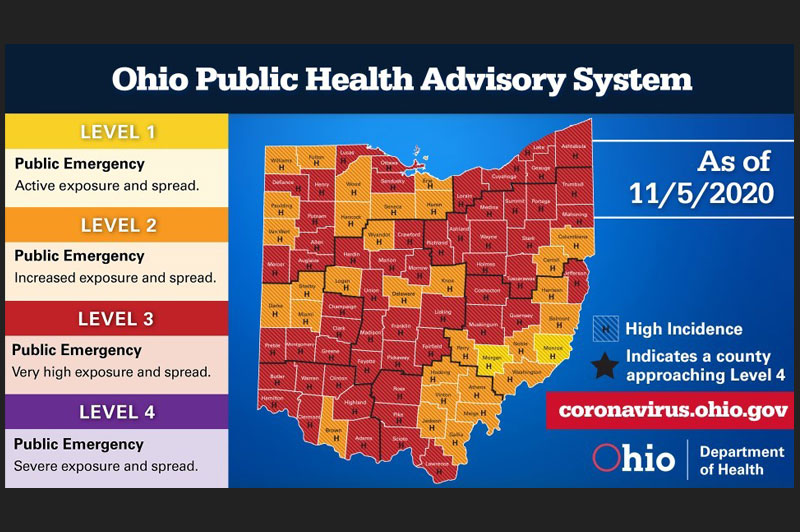
    New health data compiled by the Ohio Department of Health revealed today that all 88 counties in Ohio are now considered “high incidence” as defined by the Centers for Disease Control and Prevention. 

    “There have been so many cases in the past two weeks that the risk of catching this virus in every county of this state is very real and very concerning,” said Governor DeWine. “Again, I ask everyone to recognize their personal responsibility in slowing the spread of this deadly disease. It’s up to every citizen in Ohio to choose to slow the spread by wearing masks, distancing, and making overall smart decisions.”

    According to today’s updated Ohio Public Health Advisory System map, 56 counties are currently rated as having a very high risk of exposure and spread (Red Level 3), up from 43 counties last week. This represents the highest number of Red Level 3 counties since the launch of the advisory system in July. As of today, 86 percent of Ohioans are living in a Red Level 3 county. 

    A county-by-county breakdown outlining the presence of COVID-19 in all of Ohio’s 88 counties can be found on the Ohio Public Health Advisory System’s website.


    NEW OHIO DEPARTMENT OF HEALTH STRUCTURE

    Governor DeWine announced multiple key additions to the existing administration at the Ohio Department of Health (ODH). 


    Chief Medical Officer Dr. Bruce Vanderhoff: 
    Dr. Vanderhoff previously served for more than a decade as a Senior Vice President and as the Chief Medical Officer at OhioHealth. He has years of experience leading large teams in successfully dealing with important healthcare issues in Ohio and prepared OhioHealth to deal with the threat of Ebola and the H1N1 flu pandemic.  

    Director Stephanie McCloud: 
    Director McCloud previously served as Governor DeWine’s administrator of the Ohio Bureau of Workers’ Compensation, managing an agency of 1,800 colleagues and over $28 billion in assets. She has considerable experience in the area of mental health and addiction treatment which is a priority in Ohio’s health improvement plan. 

    Senior Deputy Lance Himes: 
    Himes had previously served as the interim director of ODH where he has played an integral role in running and managing many aspects of the pandemic response operation. He will lead the coordination of the state’s vaccine distribution plan and will continue to work directly with Ohio’s local health commissioners.

    Chief of Staff Kathleen Madden: 
    Madden had previously served as Assistant Director at the Ohio Office of Budget and Management and will now play a key role in keeping ODH’s pandemic and non-pandemic programs and operations on track. She will work to prioritize and resolve critical issues, provide oversight and guidance to ODH staff, and ensure that ODH funds are spent responsibly and strategically. Other key members of the ongoing COVID-19 response who will continue their roles in assisting ODH are: 

    Adjutant General Maj. Gen. John Harris, Ohio National Guard: 
    Maj. Gen. Harris will continue work to ensure complex operations, such as COVID testing and contact tracing, are well-coordinated, monitored, and improved when necessary.  He will also work directly with Senior Deputy Himes on the planning and logistics of the forthcoming vaccine distribution program.  

    Director Ursel McElroy, Ohio Department of Aging: 
    Director McElroy will continue to direct virus prevention efforts for older adults in the community and in long-term settings, including nursing homes and assisted living facilities.  

    Director Lori Criss, Ohio Department of Mental Health and Addiction Services: 
    Director Criss will continue to lead efforts to address the increasing mental health needs of citizens during the pandemic.

    NEW OHIO BWC ADMINISTRATOR
    Governor DeWine announced that John Logue, the Ohio Bureau of Workers’ Compensation’s (BWC) Chief of Strategic Direction, will become the new administrator of Ohio BWC effective on November 16. Logue has worked for 26 years in the industry. Before returning to BWC in 2019, he most recently served as the vice president of client services for International Absence Management Company where he focused on Ohio workers’ compensation.


  • Ohio Governor Mike DeWine’s Week in Review

    Ohio Governor Mike DeWine’s Week in Review

    The weekly press release from Ohio Governor Mike DeWine

    For the week ending April 24, 2020

    On Thursday, Governor DeWine and Lt. Governor Husted invited Mark Weir, Ph.D., an assistant professor of Environmental Health at The Ohio State University, to discuss how health risks change as changes are made to the environment.

    Dr. Weir explained that cough or sneeze droplets containing the virus spread through contact with others or contact with contaminated surfaces. He explained that minimizing the spread of the disease as Ohio begins the long process of reopening depends on personal and environmental controls. Personal precautions include interrupting the infection process by practicing good hand hygiene and wearing masks.

    Employers must take precautions by disinfecting surfaces often and maintaining distance between individuals. Finally, facility and building management can help interrupt the infection process by managing airflow and air filters.

    “Since COVID-19 can live up to 72 hours on plastics and stainless steel, it will take a combination of efforts from all of us to interrupt the disease process,” said Dr. Weir.

    On Friday, Governor DeWine announced that members of the newly formed Testing Strike Team, led by former Governors Celeste and Taft, have reached an agreement with Thermo Fisher, a company that makes reagent, that will substantially expand COVID-19 testing capacity in Ohio.

    As a result of collaborative efforts through the Ohio Manufacturing Alliance to Fight COVID-19, Governor DeWine announced that ROE Dental Laboratory in Cleveland will manufacture up to 1 million testing swabs to support Ohio’s testing efforts.

    This testing will dramatically increase Ohio’s ability to test in our priority areas, including nursing homes, hot spots, congregate living settings, food and grocery stores, and essential manufacturing facilities.

    As part of Ohio’s offense strategy, Governor DeWine announced that Ohio has started working with Massachusetts-based Partners in Health. Partners in Health will bring needed resources to Ohio to help increase the ability to trace contact exposure to the virus.

    Additionally, Governor DeWine announced that the state will cover the costs to keep more than 200 youth who are aging out of foster care in the foster care system until the COVID-19 pandemic ends.


    As of Friday afternoon, there were 15,169 confirmed and probable cases of COVID-19 in Ohio and 690 confirmed and probable COVID-19 deaths. A total of 3,053 people have been hospitalized, including 920 admissions to intensive care units. In-depth data can be accessed by visiting coronavirus.ohio.gov.

    For more information on Ohio’s response to COVID-19, visit coronavirus.ohio.gov or call 1-833-4-ASK-ODH.

    • EDITOR’S NOTE: Loveland school buildings are closed to the public, however remote learning is being conducted at the Loveland City School District.
  • Governor DeWine announces proposals to reduce gun violence, increase mental health prevention, treatment

    Governor DeWine announces proposals to reduce gun violence, increase mental health prevention, treatment

    Columbus, Ohio – Ohio Governor Mike DeWine today announced a series of legislative reforms to address gun violence and outlined further action to increase mental health prevention, identification, and treatment to better protect Ohioans.

    “Gun violence doesn’t just take the form of mass shootings, people are victims every day in Ohio and across the country,” said Governor DeWine. “I believe that this is both a public safety issue and an individual wellness issue – we must address both sides to help solve the problem. It’s time to do something, and that is exactly what we are going to do.”

    This series of solid, workable reforms will help get guns out of the hands of people who should not have them under the law while protecting the rights of law-abiding citizens who are entitled to the right to bear arms and will help prevent and treat those struggling with mental illness.

    Governor DeWine’s proposals include:

    Safety Protection Orders

    Governor DeWine is asking the legislature to pass a law to allow courts to issue Safety Protection Orders which would remove firearms from potentially dangerous individuals and get them the mental health treatment they need all while maintaining an individual’s right to due process.

    Increased Access to Inpatient Psychiatric Care

    Over the past several years, Ohio’s state psychiatric hospitals have become predominantly used by patients who are court-ordered there for restoration to competency to stand trial. This week 79% of the adults in our state psychiatric hospitals are under court order.  The Ohio Department of Mental Health and Addiction Services (OhioMHAS) is working to create a process where courts and community-based providers can work together to restore competency for those to stand trial in an outpatient setting which will free more hospital beds and decrease wait time for admission. The Ohio General Assembly will need to pass legislation to create this community-based misdemeanor competency restoration process.

    Early Intervention

    As part of the 2019-2020 biennium operating budget, the state is investing $675 million in wrap-around services for schools to design individualized programs, working with local mental health providers or social service organizations, to address the social and emotional challenges our students face.

    Access to Behavioral Health  Services

    The Ohio Department of Medicaid is investing $15 million in telehealth mental health services to students, so no matter where a child lives, they have access to high-quality mental health care.

    Risk Factor and Resource Identification

    OhioMHAS will be working with communities to increase knowledge of risk factors, help parents identify when their child is showing warning signs of a mental illness. The department will share screening tools with clinicians and help connect community-based services to link parents, families, and schools with proven supports and strategies to manage a child’s wellness over the child’s lifetime.

    Background Checks

    Governor DeWine is calling on the Ohio General Assembly to pass a law requiring background checks for all firearms sales in the state of Ohio with certain limited, reasonable exceptions, including gifts between family members.

    Increased Penalties for Felons Who Illegally Possess Firearms

    Gun violence occurs in neighborhoods and communities every day across Ohio and the nation. Law enforcement reports that the majority of this violence is perpetrated by a relatively small number of individuals who don’t have the right to possess a gun. Governor DeWine is calling on the General Assembly to increase penalties on felons who illegally possess or use guns.

    Increased Penalties for Violent Felons Who Illegally Possess Firearms

    Governor DeWine is calling on the General Assembly to increase penalties violent felons and other people found with a gun they do not have the legal right to possess. The crime of having a weapon while under a disability is currently a third-degree felony punishable by a maximum of three years in prison. On a first offense, the crime should be a second-degree felony punishable by two-to eight-years in prison, and for subsequent offenses, it should be a first-degree felony punishable by three- to eleven-years incarceration.

    Increased Penalties for People Who Commit Felonies while in Possessing Firearms

    This proposal would increase penalties for people who commit felonies with a firearm or who possess a firearm while committing a felony to a mandatory additional one- to three-year sentence.

    Increased Penalties for Brandishing a Gun

    The General Assembly should pass a law that increases the penalty for those who commit a felony while brandishing a firearm to a mandatory three- to five-year sentence.

    Increased Penalties for Straw Purchases

    So-called “straw” purchases, the act of purchasing guns for or giving guns to another individual are currently illegal under Ohio and federal law. However, this practice is far too common, so Governor DeWine is calling on the General Assembly to increase the penalty for a straw purchase to a second-degree felony punishable by two to eight years in prison.

    Increased Penalties for Illegally Obtained Guns

    We should increase the penalty for a person who possesses a firearm that they know was obtained through an illegal or fraudulent purchase in order to avoid a federal background check.  A person who possesses the gun should be punished in the same manner as a person who bought the firearm, increasing the penalty to a second-degree felony punishable by two- to- eight years in prison.

    Increased Penalties for Those Who Improperly Provide Firearms to Minors

    Too many kids are carrying guns on the streets often with tragic consequences. Adults who furnish firearms to minors must be held accountable.  Governor DeWine proposes that the General Assembly increase the penalty for improperly providing a firearm to a minor to and a third-degree felony punishable by up to three years in prison.

    School Tip Line

    The DeWine administration is expanding the state’s school safety tip line, where kids and adults can call or text anonymously to 844-723-3764 with tips about potential school violence.

    Social Media Monitoring

    In a 24-7 world of social media, threats can arise at any time. The Hub at the Ohio Department of Public Safety is expanding its ability to monitor and track potential threats on social media and will share that information with local school and local law enforcement.

    Community Safety

    The operating budget provides nearly $9 million to help harden soft targets like non-profits and religious organizations to make their facilities more secure.

    School Safety and Intervention Programs

    Working closely with Sandy Hook Promise, Ohio’s schools are implementing their “Know the Signs” safety program across the state. This program equips school staff with knowledge and skills to identify potential threats of violent action and take steps to intervene. There are 23 training dates already scheduled.

    “I believe these proposals fulfill three important requirements. They can pass the legislature, they make meaningful progress toward safer communities, and they are Constitutional. Passing them won’t be easy, but this is the right thing to do and this is the right time to do it,” Governor DeWine added. “We can pull together to do meaningful things to protect lives. It won’t be easy, but I believe in this state, and I believe in our people.”

    Click here for Governor DeWine’s prepared remarks.

    Click here for details on the Governor’s proposals.


  • School safety training grants available for schools in Ohio

    School safety training grants available for schools in Ohio

    Schools will have the flexibility to use these grants for things like training for school resource officers, safety and security materials, and programs to identify and help students who may be struggling with their mental health.

    Ohio Attorney General Mike DeWine has announced that he is awarding $12 million in grants to help enhance safety and security at schools across the state.

    All of Ohio’s public schools, chartered nonpublic schools, and schools operated by county boards of developmental disabilities will receive the greater of $2,500 or $5.65 per student to spend toward school safety programs and training.

    “Schools will have the flexibility to use these grants for things like training for school resource officers, safety and security materials, and programs to identify and help students who may be struggling with their mental health,” said DeWine

    The grants are funded with appropriations made by the Ohio legislature as part of House Bill 318. The bill, which was sponsored by state representatives Sarah LaTourette (R-Chesterland) and John Patterson (D-Jefferson), appointed the Ohio Attorney General’s Office to develop the school safety training grant program in consultation with the Ohio Department of Education and the Ohio Department of Mental Health and Addiction Services.

    The law requires that participating schools and county boards work with law enforcement in their jurisdictions to determine the best use of the grant funding.

    A full list of grant awards can be found on the Ohio Attorney General’s website.

    Other Resourses

    • Active Shooter Response: An Educator’s Guide: This 25-part video series was produced by the Attorney General’s Ohio Peace Officer Training Academy (OPOTA) to aid educators in preparing for and reacting to a potentially violent school incident, such as a school shooting. The brief videos are an update to the training offered by OPOTA beginning in 2013 that provided guidance to nearly 15,000 educators on how to intervene with students who could pose a danger and how to respond in a crisis situation.
    • Emergency Management Plan Aerial Photographs: Special agents with the Attorney General’s Ohio Bureau of Criminal Investigation (BCI) are available to take free aerial photographs of school buildings for inclusion in school emergency management plans. BCI currently has six drones that are used primarily to document crime scenes and assist in missing persons cases, but BCI is offering to use its drones to take aerial photos of school campuses to help law enforcement plan for and respond to an emergency. School administrators, in coordination with local law enforcement, can request photographs by calling 855-BCI-OHIO (855-224-6446).

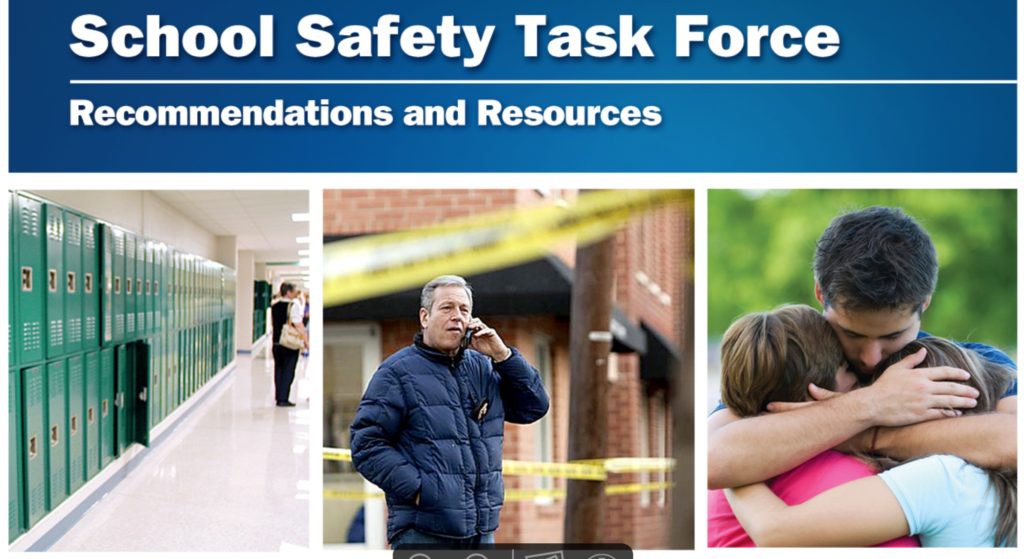
    Attorney General DeWine also worked with schools across the state to achieve greater compliance on school safety plans and convened a School Safety Task Force that issued dozens of school safety recommendations. The task force recognized that mental health awareness was essential for schools to identify and intervene with students who may be at risk.