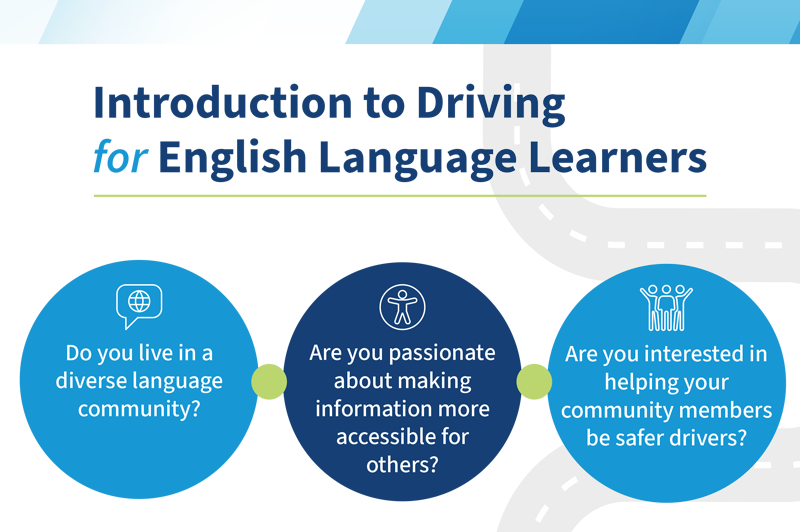
La Oficina de Seguridad Vial de Ohio (OTSO), una división del Departamento de Seguridad Pública de Ohio, anunció hoy que ahora hay nuevos recursos educativos disponibles para diversas comunidades de Ohio para ayudar a los estudiantes del idioma inglés a convertirse en conductores con licencia.
El plan de estudios y el programa de capacitación de capacitadores tienen como objetivo ayudar a las personas que no hablan inglés a aprender prácticas de conducción segura y prepararse para los exámenes escritos y de conducción en la Oficina de Vehículos Motorizados de Ohio (BMV). Incluye información sobre los requisitos para obtener una licencia de conducir en Ohio, el significado de las señales de tránsito y otras leyes básicas de seguridad vial.
“Es posible que las personas que no hablan inglés y son nuevas en Ohio no comprendan completamente las reglas de tránsito, lo que aumenta el riesgo de verse involucrados en un accidente”, dijo el director del Departamento de Seguridad Pública de Ohio, Andy Wilson. “Incluso la educación vial más básica ayuda a promover comportamientos seguros en nuestras carreteras, lo que beneficia a todos los conductores de Ohio”.
Un programa piloto se presentó por primera vez en la Cumbre de Seguridad Vial de Ohio de 2024 de OTSO en Columbus y ahora está listo para lanzarse en todo el estado. La capacitación proporciona información para que los participantes la compartan con estudiantes que aprenden inglés o con adultos que no hablan inglés y que quieran aprender a conducir en Ohio. Las capacitaciones se llevan a cabo en inglés y los participantes traducen el material para compartirlo en sus comunidades.
“Brindar educación sobre seguridad vial en varios idiomas ayuda a eliminar algunas barreras para los estudiantes de inglés de Ohio e integrarlos a la comunidad”, dijo Emily Davidson, directora ejecutiva de OTSO. “Esperamos que este nuevo programa educativo pueda ayudar a crear un entorno más seguro e inclusivo para todos los residentes”.
Es importante tener en cuenta que este plan de estudios no reemplaza la educación vial y que quienes lo presentan en comunidades lingüísticas diversas no se consideran instructores de capacitación vial con licencia en el estado de Ohio. Los conductores adolescentes todavía deben completar 24 horas de instrucción en el aula y 8 horas de capacitación al volante en una escuela de capacitación para conductores autorizada. Los conductores adultos que no aprueban el primer intento en el examen de manejo en la BMV deben completar el programa abreviado para adultos, que consta de 4 horas de instrucción en el aula y 4 horas de capacitación detrás del volante con un instructor autorizado o 24 horas de práctica de manejo con un conductor con licencia mayor de 21 años.
Hay recursos disponibles en el sitio web de OTSO para aquellos interesados en llevar este plan de estudios a su comunidad. El esquema del plan de estudios, las diapositivas de PowerPoint, la guía de recursos y otras ayudas de capacitación están disponibles de forma gratuita para cualquiera que los solicite.
Este anuncio sigue una serie de iniciativas de OTSO para fortalecer la educación vial, que incluyen casi $2,5 millones en subvenciones para financiar becas de capacitación vial para adolescentes elegibles en 42 condados. A principios de este año, se otorgaron $4.5 millones en financiamiento a través del nuevo programa de subvenciones Creación de Oportunidades para la Educación Vial (CODE) que apoya la expansión de las opciones de capacitación vial en áreas desatendidas.
The Ohio Traffic Safety Office (OTSO), a division of The Ohio Department of Public Safety, announced today new educational resources are now available for diverse communities in Ohio to help English Language Learners become licensed drivers.
The curriculum and train-the-trainer program is intended to help non-English speakers learn safe driving practices and prepare for the written and driving tests at the Ohio Bureau of Motor Vehicles (BMV). It includes information on the requirements for obtaining a driver license in Ohio, the meanings of traffic signs and signals, and other basic traffic safety laws.
“Non-English speakers who are new to Ohio may not fully understand the rules of the road, increasing their risk of being involved in a crash,” said Ohio Department of Public Safety Director Andy Wilson. “Even the most basic driver education helps promote safe behaviors on our roads, benefitting all drivers in Ohio.”
A pilot program was first introduced at OTSO’s 2024 Ohio Traffic Safety Summit in Columbus and is now ready to be launched statewide. The training provides information for participants to share with English Language Learners or non-English speaking adults that want to learn to drive in Ohio. Trainings are conducted in English, and participants translate the material to share in their communities.
“Providing traffic safety education in multiple languages helps to remove some barriers for Ohio’s English Language Learners and integrate them into the community,” said Emily Davidson, OTSO executive director. “We hope this new education program can help create a safer and more inclusive environment for all residents.”
It’s important to note that this curriculum does not replace driver education, and that those who present it in diverse language communities are not considered licensed driver training instructors in the state of Ohio. Teen drivers are still required to complete 24 hours of classroom instruction and 8 hours of behind-the-wheel training at a licensed driver training school. Adult drivers who fail the first attempt at the driving test at the BMV are required to complete the abbreviated adult program – which is 4 hours of classroom instruction and either 4 hours of behind the wheel training with a licensed instructor or 24 hours of driving practice with a licensed driver over the age of 21.
Resources are available on OTSO’s website for those interested in bringing this curriculum to their community. The curriculum outline, PowerPoint slides, resource guide, and other training aids are available free of charge to anyone that requests them.
This announcement follows a number of initiatives by OTSO to strengthen driver education, including nearly $2.5 million in grants to fund driver training scholarships to eligible teens in 42 counties. Earlier this year, $4.5 million in funding was awarded through the new Creating Opportunities for Driver Education (CODE) Grant program that supports the expansion of driver training options in underserved areas.
Columbus, Ohio – Ohio Governor Mike DeWine today announced the members of the Governor’s new Ohio School Safety Working Group.
Governor DeWine called for the creation of the working group in August when announcing the development of the Ohio School Safety Center, a new statewide office focused on assisting educators and law enforcement in preventing, preparing for, and responding to threats and acts of violence, including self-harm. The working group, which will be led by the Ohio Department of Public Safety, will evaluate current issues regarding school safety and advise the Ohio School Safety Center on its work.
“Members of this working group all have a common goal of making Ohio’s schools as safe as they possibly can be,” said Governor DeWine. “I’m confident that this group will be a great asset as they work to promote a safe environment for Ohio’s school students and school employees.”
Members of the Ohio School Safety Working Group include:
Tim Armelli, Teacher, Chardon High School
Melissa Wervey Arnold, CEO, American Academy of Pediatrics
Todd Barnhouse, CEO, Ohio Child Care Resource and Referral Association
Bobbie Boyer, Deputy Director of Prevention, Ohio MHAS
The Fire Academy at Great Oaks Career Campuses has earned a 3-year accreditation renewal from the Ohio Department of Public Safety, Division of EMS (ODPS). The announcement was made after a recent site visit from an ODPS team in which Great Oaks met all requirements with no recommendations for improvement.
The accreditation renewal certifies that Great Oaks can provide firefighter, EMT, Fire and EMS Instructor, and Fire Inspector courses leading to state certification in those fields.
“The site team complimented the operations and outcomes of our programs, with some very specific comments on our first-time and cumulative pass rate—which is among the best in the state (among training facilities,” said Great Oaks Fire Safety Services Supervisor Johnny Mason. “They were also complimentary of the vision, support and environment that we have created for our students.”
The Fire Academy at Great Oaks Career Campuses prepares adults for careers in fire fighting, and also provides area fire departments and industries with additional training and education. The Great Oaks Fire Academy is also one of just 63 agencies in the United States that is ProBoard Certified.
For more information about the services offered at Great Oaks, contact Fire and Safety Services Supervisor Johnny Mason at 513.612.5834 or masonj@greatoaks.com.
Columbus, Ohio – Ohio Governor Mike DeWine today announced a series of legislative reforms to address gun violence and outlined further action to increase mental health prevention, identification, and treatment to better protect Ohioans.
“Gun violence doesn’t just take the form of mass shootings, people are victims every day in Ohio and across the country,” said Governor DeWine. “I believe that this is both a public safety issue and an individual wellness issue – we must address both sides to help solve the problem. It’s time to do something, and that is exactly what we are going to do.”
This series of solid, workable reforms will help get guns out of the hands of people who should not have them under the law while protecting the rights of law-abiding citizens who are entitled to the right to bear arms and will help prevent and treat those struggling with mental illness.
Governor DeWine’s proposals include:
Safety Protection Orders
Governor DeWine is asking the legislature to pass a law to allow courts to issue Safety Protection Orders which would remove firearms from potentially dangerous individuals and get them the mental health treatment they need all while maintaining an individual’s right to due process.
Increased Access to Inpatient Psychiatric Care
Over the past several years, Ohio’s state psychiatric hospitals have become predominantly used by patients who are court-ordered there for restoration to competency to stand trial. This week 79% of the adults in our state psychiatric hospitals are under court order. The Ohio Department of Mental Health and Addiction Services (OhioMHAS) is working to create a process where courts and community-based providers can work together to restore competency for those to stand trial in an outpatient setting which will free more hospital beds and decrease wait time for admission. The Ohio General Assembly will need to pass legislation to create this community-based misdemeanor competency restoration process.
Early Intervention
As part of the 2019-2020 biennium operating budget, the state is investing $675 million in wrap-around services for schools to design individualized programs, working with local mental health providers or social service organizations, to address the social and emotional challenges our students face.
Access to Behavioral Health Services
The Ohio Department of Medicaid is investing $15 million in telehealth mental health services to students, so no matter where a child lives, they have access to high-quality mental health care.
Risk Factor and Resource Identification
OhioMHAS will be working with communities to increase knowledge of risk factors, help parents identify when their child is showing warning signs of a mental illness. The department will share screening tools with clinicians and help connect community-based services to link parents, families, and schools with proven supports and strategies to manage a child’s wellness over the child’s lifetime.
Background Checks
Governor DeWine is calling on the Ohio General Assembly to pass a law requiring background checks for all firearms sales in the state of Ohio with certain limited, reasonable exceptions, including gifts between family members.
Increased Penalties for Felons Who Illegally Possess Firearms
Gun violence occurs in neighborhoods and communities every day across Ohio and the nation. Law enforcement reports that the majority of this violence is perpetrated by a relatively small number of individuals who don’t have the right to possess a gun. Governor DeWine is calling on the General Assembly to increase penalties on felons who illegally possess or use guns.
Increased Penalties for Violent Felons Who Illegally Possess Firearms
Governor DeWine is calling on the General Assembly to increase penalties violent felons and other people found with a gun they do not have the legal right to possess. The crime of having a weapon while under a disability is currently a third-degree felony punishable by a maximum of three years in prison. On a first offense, the crime should be a second-degree felony punishable by two-to eight-years in prison, and for subsequent offenses, it should be a first-degree felony punishable by three- to eleven-years incarceration.
Increased Penalties for People Who Commit Felonies while in Possessing Firearms
This proposal would increase penalties for people who commit felonies with a firearm or who possess a firearm while committing a felony to a mandatory additional one- to three-year sentence.
Increased Penalties for Brandishing a Gun
The General Assembly should pass a law that increases the penalty for those who commit a felony while brandishing a firearm to a mandatory three- to five-year sentence.
Increased Penalties for Straw Purchases
So-called “straw” purchases, the act of purchasing guns for or giving guns to another individual are currently illegal under Ohio and federal law. However, this practice is far too common, so Governor DeWine is calling on the General Assembly to increase the penalty for a straw purchase to a second-degree felony punishable by two to eight years in prison.
Increased Penalties for Illegally Obtained Guns
We should increase the penalty for a person who possesses a firearm that they know was obtained through an illegal or fraudulent purchase in order to avoid a federal background check. A person who possesses the gun should be punished in the same manner as a person who bought the firearm, increasing the penalty to a second-degree felony punishable by two- to- eight years in prison.
Increased Penalties for Those Who Improperly Provide Firearms to Minors
Too many kids are carrying guns on the streets often with tragic consequences. Adults who furnish firearms to minors must be held accountable. Governor DeWine proposes that the General Assembly increase the penalty for improperly providing a firearm to a minor to and a third-degree felony punishable by up to three years in prison.
School Tip Line
The DeWine administration is expanding the state’s school safety tip line, where kids and adults can call or text anonymously to 844-723-3764 with tips about potential school violence.
Social Media Monitoring
In a 24-7 world of social media, threats can arise at any time. The Hub at the Ohio Department of Public Safety is expanding its ability to monitor and track potential threats on social media and will share that information with local school and local law enforcement.
Community Safety
The operating budget provides nearly $9 million to help harden soft targets like non-profits and religious organizations to make their facilities more secure.
School Safety and Intervention Programs
Working closely with Sandy Hook Promise, Ohio’s schools are implementing their “Know the Signs” safety program across the state. This program equips school staff with knowledge and skills to identify potential threats of violent action and take steps to intervene. There are 23 training dates already scheduled.
“I believe these proposals fulfill three important requirements. They can pass the legislature, they make meaningful progress toward safer communities, and they are Constitutional. Passing them won’t be easy, but this is the right thing to do and this is the right time to do it,” Governor DeWine added. “We can pull together to do meaningful things to protect lives. It won’t be easy, but I believe in this state, and I believe in our people.”
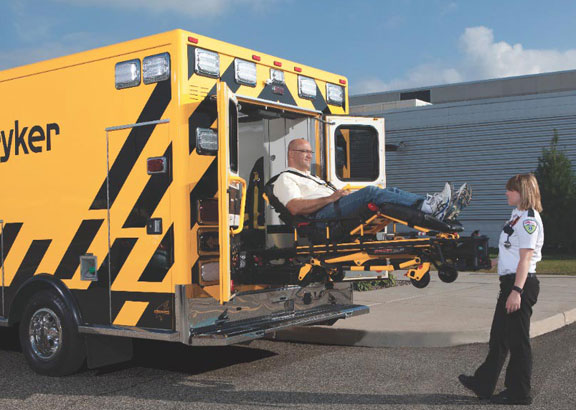
Stryker Powerpro XT Cot Systems will give firefighters and paramedics assistance with the lifting of patients up to 700 pounds
Photo above is a sample of the Stryker Powerpro XT Cot System
Loveland, Ohio – The Ohio Bureau of Workers’ Compensation has awarded a Safety Intervention Grant (SIG) to the Loveland-Symmes Fire Department (LSFD) for assistance with purchasing two Stryker Powerpro XT Cot Systems.
The Safety Intervention Grant is available to any Ohio state-fund or public employer who wishes to purchase equipment to substantially reduce or eliminate injuries associated with a particular task or operation. The Stryker Powerpro XT Cot Systems will give firefighters and paramedics assistance with the lifting of patients up to 700 pounds from the ground to a rolling transport level.
Lieutenant Kyle Riley, EMS Lieutenant for the Loveland-Symmes Fire Department said, “The awarded grant funds provide our firefighters with a major equipment upgrade that will provide a safer and more effective system. This will help them provide the highest quality service to our customers, while reducing the potential for injury to our personnel.”
The SIG Grant was a matching grant and it was nearly $40,000.00
According to the press release issued by the Department, “The Loveland-Symmes Fire Department is continuously seeking methods to improve the emergency medical services that are provided to their residents. The funds received from the SIG will be utilized to purchase essential EMS equipment that will improve the Loveland-Symmes Fire Department’s ability to provide critical care to their customers, while reducing the risk of injury to our members.”
PRIORITY ONE EMS GRANT
The purpose of the State Board of Emergency Medical, Fire, and Transportation Services Grant Program, administered by the Ohio Department of Public Safety, Division of Emergency Medical Services, is to improve and enhance EMS and trauma patient care in Ohio through the provision of grant funding for equipment, training, and research. There are six types of grants (Priorities 1-6) available. The amount awarded for each priority is determined by the State Board of Emergency, Medical, Fire, and Transportation Services and by the amount of funds available during the award year.
The Priority One Grant was for $3,075.00.
Deputy Chief Michael Books, Chief of EMS for the Loveland-Symmes Fire Department said, “The Priority One Grant is a grant offered by the State of Ohio to assist fire departments with the purchase of equipment, supplies, and personal protective equipment (PPE) that would not normally be able to be purchased.”
According to the press releases issued by the Department, “The Loveland-Symmes Fire Department is continuously seeking methods to improve the emergency medical services that are provided to their residents. The funds received from the SIG will be utilized to purchase essential EMS equipment that will improve the Loveland-Symmes Fire Department’s ability to provide critical care to their customers, while reducing the risk of injury to our members.”