Tag: Ohio Education Association

  • Opponents of new Ohio higher education law don’t have enough signatures to get a referendum

    Opponents of new Ohio higher education law don’t have enough signatures to get a referendum

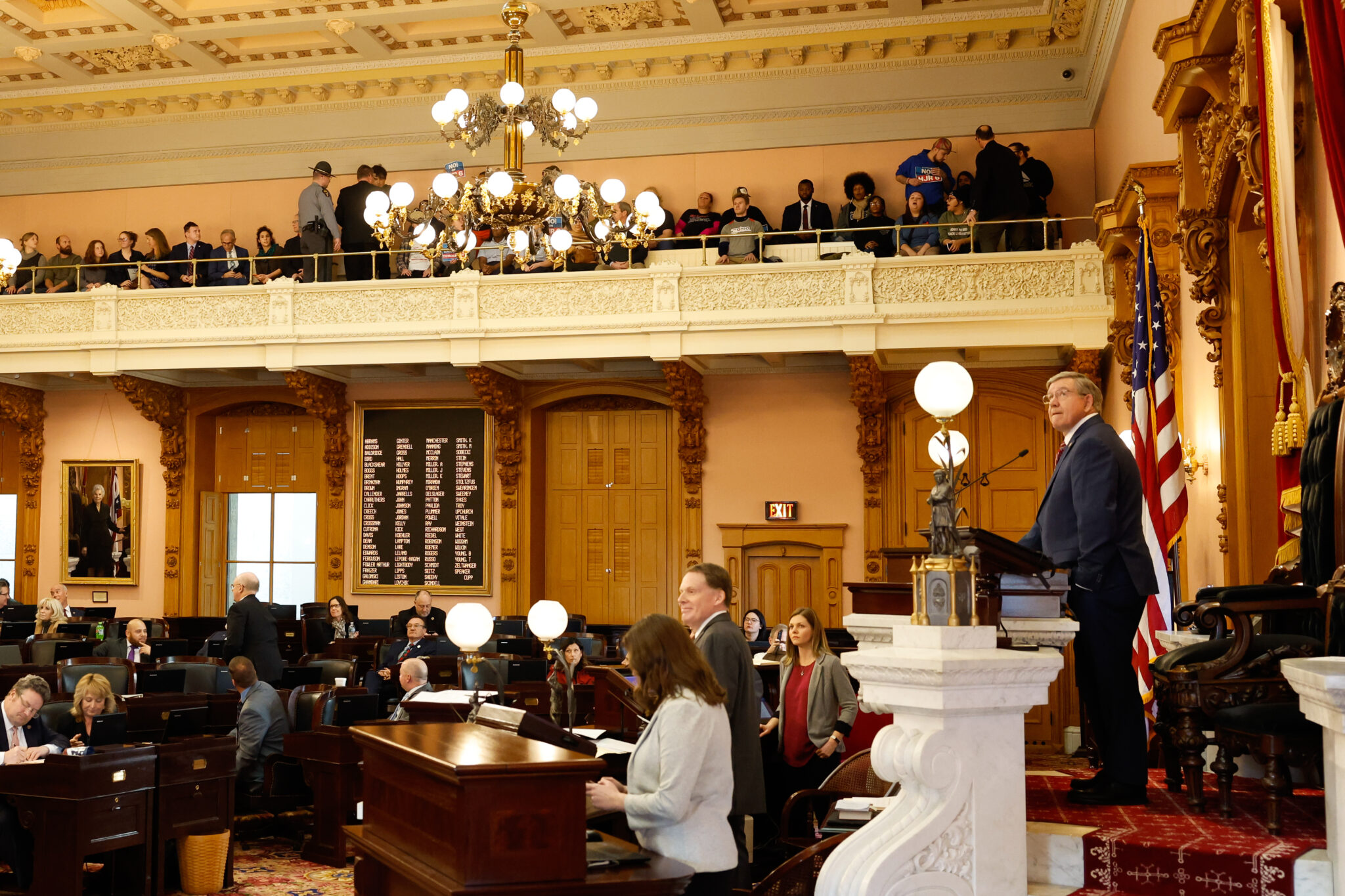
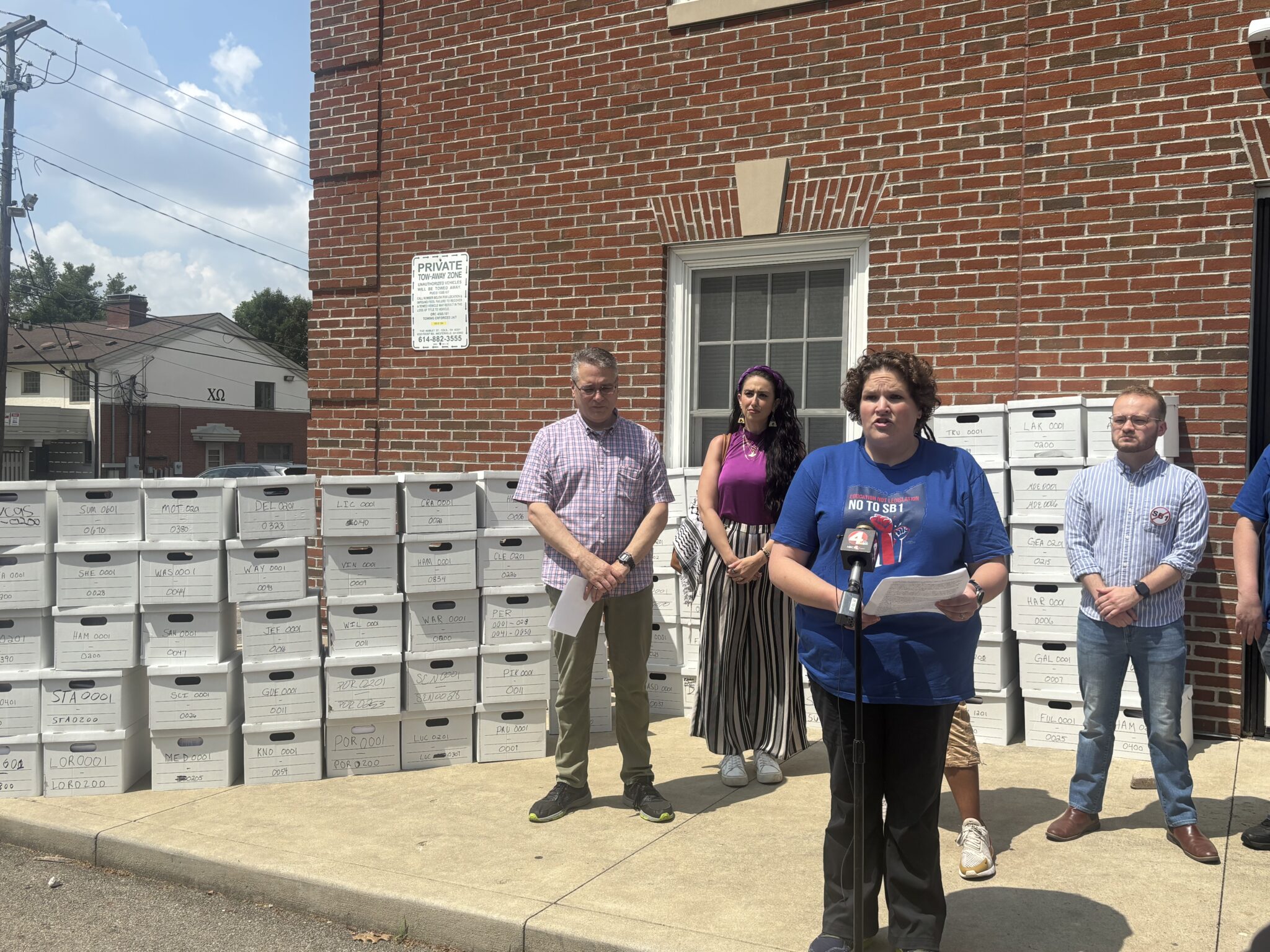
    Amanda Fehlbaum, one of three Youngstown State University faculty members who tried to get referendum on the Nov. 4 ballot to stop Senate Bill 1, spoke at a press conference on June 26. (Photo by Megan Henry, Ohio Capital Journal).

    By:  Ohio Capital Journal

    Opponents of Ohio Republican lawmakers’ higher education overhaul that bans diversity efforts and faculty strikes, and sets rules around classroom discussion, have failed to collect enough signatures to put a referendum on the ballot this year to block it.

    Members of the Youngstown State University’s chapter of the Ohio Education Association tried to get a referendum on the Nov. 4 ballot to stop Ohio Senate Bill 1, but said they ultimately ran out of time.

    GET THE MORNING HEADLINES.


    “Over the course of the last few days, we were collecting over 4,000 signatures a day, and that momentum was only increasing,” said Youngstown State’s Ohio Education Association President Mark Vopat. “It was only because we ran out of time that we weren’t able to get the required signatures. … I believe that if we’d had just a little bit more time, we could have gotten those numbers.”

    They needed to collect about 248,092 signatures from at least 44 of Ohio’s 88 counties — 6% of the total vote cast for governor during the last gubernatorial election.

    Instead, they collected nearly 195,000 signatures and met the signature requirements in at least 33 counties, said Amanda Fehlbaum, a Youngstown State faculty member who helped champion efforts to get a referendum.

    The plan was to submit the collected signatures to Ohio Secretary of State Frank LaRose on Thursday for him to verify the signatures. This was the deadline to submit signatures since the law goes into effect Friday.

    The new law creates post-tenure reviews, puts diversity scholarships at risk, sets rules around classroom discussion, and creates a retrenchment provision that blocks unions from negotiating on tenure, among other things. The law affects Ohio’s public universities and community colleges.

    “One thing is clear in all of this, the people do not want politicians making decisions about higher education,” Fehlbaum said. “The people do not like this legislation.”

    S.B. 1 quickly passed through the legislature earlier this year and Ohio Gov. Mike DeWine signed the bill into law on March 28.

    Fehlbaum said she thought another group “with infrastructure and funding” would come forward to challenge S.B. 1 after DeWine signed it into law, but that never happened so they decided to go the referendum route.

    Vopat and Fehlbaum along with fellow Youngstown State faculty member Cryshanna Jackson Leftwich started the referendum process in mid-April and Ohio Attorney General Dave Yost and the Ohio Secretary of State’s office gave them approval to start collecting signatures May 5.

    “I do think we could have pulled this off had we not wasted two weeks waiting on another group or groups to come forward,” Fehlbaum said.

    Vopat agrees they would have been able to get enough signatures if they had started the referendum process immediately after DeWine signed the bill into law.

    “That might have also given us the extra time we needed,” he said.

    The three Youngstown State faculty members said they are figuring out next steps and considering efforts to potentially try to get on the ballot in 2026.

    “This is not the end for us,” Jackson Leftwich said. “I want people to know that we’re going to use this momentum.”

    More than 1,700 people volunteered to collect signatures across the state. They ended up raising more than $43,000 in small dollar donations with $1,000 being their largest donation, Fehlbaum said.

    “I cannot underscore how much we did not have money,” she said. “We did not have paid consultants. We did not have paid petitioners. None of us are getting paid. …  There’s no dark money here.”

    But they said it ultimately came down to a lack of time, not a shortage of money.

    “I would love to take these boxes of petitions and put them on Jerry Cirino’s front door as a visible symbol of how detested this legislation is by the people,” Fehlbaum said. “We’re instead going to spend some of our remaining campaign funds on a shredding service so that information voters shared with us will not be mishandled.”

    Cirino is the Republican Ohio state senator who introduced S.B. 1.

    Some of Ohio’s public universities have started making decisions because of the new law. Ohio University announced it will close the Pride Center, the Women’s Center, and the Multicultural Center.

    The University of Toledo is suspending nine undergraduate programs. Kent State University is closing its LGBTQ+ Center, Women’s Center, and Student Multicultural Center.

    Referendums are rare and the last one that passed in Ohio was when voters overturned an anti-collective bargaining law in 2011.

    Follow Capital Journal Reporter Megan Henry on Bluesky.c


    Megan Henry
    Megan Henry

    Megan Henry is a reporter for the Ohio Capital Journal and has spent the past five years reporting in Ohio on various topics including education, healthcare, business and crime. She previously worked at The Columbus Dispatch, part of the USA Today Network.

    Ohio Capital Journal is part of States Newsroom, the nation’s largest state-focused nonprofit news organization.

    MORE FROM AUTHOR

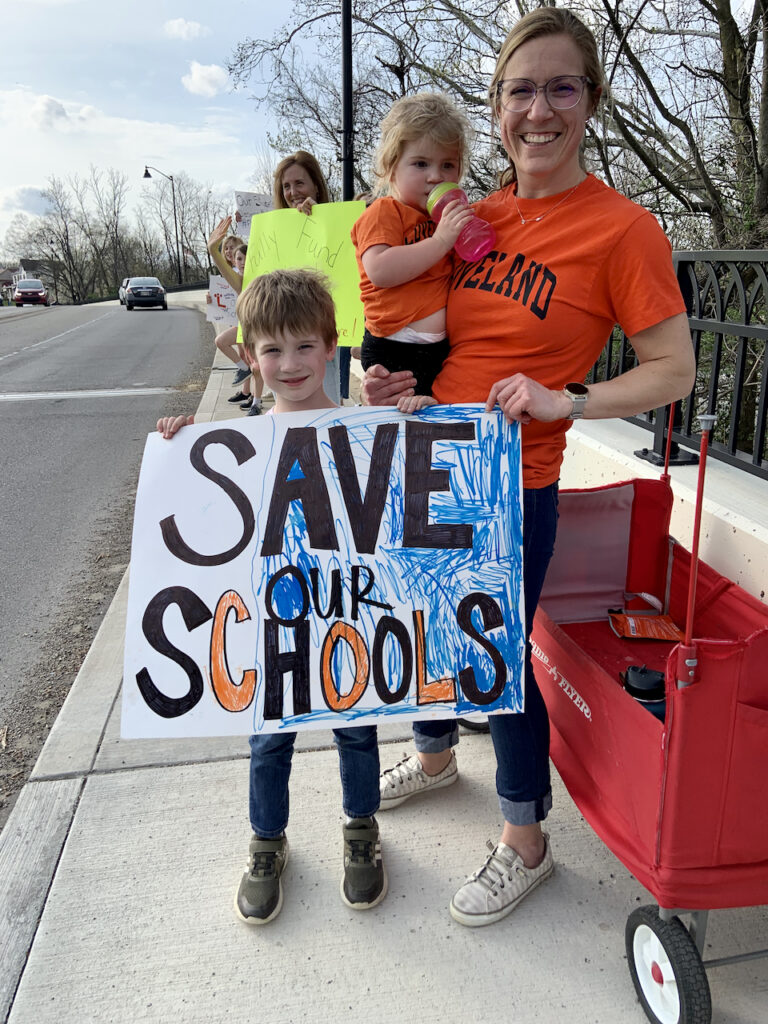
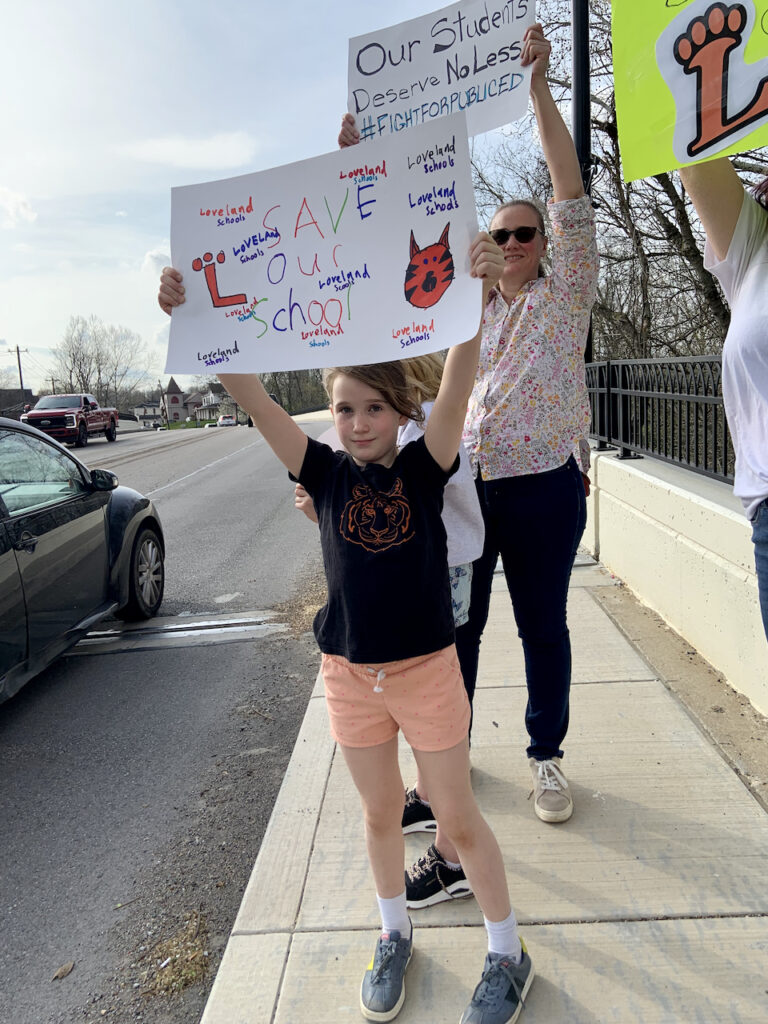
  • [VIDEO] Loveland parents and children rally on Col. Thomas Paxton bridge for fair school funding

    [VIDEO] Loveland parents and children rally on Col. Thomas Paxton bridge for fair school funding

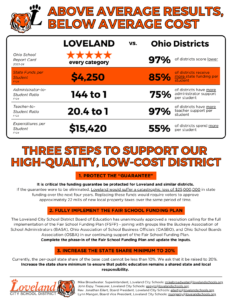
    Loveland, Ohio – Becca Moates and Cindy Daumeyer were on Loveland’s Col. Thomas Paxton bridge Wednesday evening along with many supports to send a message to Ohio Governor Mike DeWine and State legislators. The message was to urge the lawmakers to fully fund Ohio’s Fair School Funding Plan (FSFP) for public schools. They say that if the plan isn’t fully funded, the Loveland City School District may lose $2.5 million over the next five years. The FSFP is commonly referred to as the Cupp-Patterson plan. Backers are urging the full completion of its phase-in.

    Scott DiMauro, president of the Ohio Education Association, pointed out the potential effect on public schools, which he said serve 95% of Ohio students. He told the Public News Service in late March, “The governor has proposed a budget that would cut public schools by over $100 million, while at the same time increasing funding for vouchers for private schools and charter schools by $500 million. We know that is just absolutely unfair.”

    Becca Moates said on March 18 in a guest column published in Loveland Magazine, “The current budget proposal from Governor DeWine leads to lost funds for Loveland schools which will undoubtedly lead to additional revenue requests from the school district. Let’s continue to build the unity we have as community members to support the students who are the heart of our vibrant community.”

    In 2021, Governor DeWine signed the Fair School Funding Plan, which was supposed to be implemented three phases to support public school funding in Ohio. Over 90% of children in the State attend public schools. Only 66.67% of the planned funding levels have been implemented. The phase-in was set to reach full funding by fiscal year 2027. Once fully phased in, the FSFP is supposed to provide constitutionally appropriate funding levels for traditional school districts, Career Tech Centers, and Education Service Centers.

    Moates also said in her column, “It is time for our legislators to hear from all of us. We need Governor DeWine to endorse a bill that benefits our schools. We need to come together. Write letters, call legislators, and call the Governor.”

    DiMauro said that he worries such major shifts in funding could lead to larger class sizes and reduced services in public schools, placing additional burdens on local taxpayers to fill the gaps. He emphasized now is the time for Ohioans who are concerned about the issue and how it might affect their communities to contact their representatives in Columbus.

    Provided by Loveland Schools

    Who To Contact

    Download the list or click below PDF to enlarge.

    What to Say?

    Here are Moates’ suggestions for what to include in your phone calls, emails, and letters to state lawmakers:

    • Your name
    • Your role (parent, student, staff member, community member) in the Loveland City School District.
    • Your story (explain why you support Loveland City Schools, your family’s experience with Loveland City Schools, and why you are concerned about funding cuts for our district. Make it clear that decisions about funding impact children and communities.)
    • Your request (for example: protect the “guarantee” because reducing it would hurt funding for our district, fully implement the Fair School Funding Plan with updated inputs, and increase the state share minimum to 20%)
    • Your appreciation (thank them for their work in Columbus and their attention to this issue that is important to you and our community.)

    We suggest you write an email message to lawmaker, then use that message as a script for a phone call. The message can then be printed and mailed to lawmakers for an additional contact point.

    Read the Loveland District’s Lobbying Request.

    [pdf-embedder url=”https://lovelandmagazine.com/wp-content/uploads/2025/03/Loveland-State-Legislators-136th-General-Assembly-2025.pdf” title=”Loveland State Legislators – 136th General Assembly 2025″]

    _______________

  • Public school advocates take issue with new Ohio Speaker’s claim that funding model ‘unsustainable’

    Public school advocates take issue with new Ohio Speaker’s claim that funding model ‘unsustainable’

    (Stock photo from Getty Images)

    By:  Ohio Capital Journal

    As Ohio’s 136th General Assembly begins, the newly minted House Speaker has already taken a stand on education, saying spending for the state’s public school funding model is “unsustainable.”

    Priorities (and for that matter, legislative committees) have yet to be formally established, but comments by Speaker Matt Huffman, R-Lima, have already brought criticism from public school advocates across the state.

    Speaking to reporters after the first official meeting of the Ohio House under his leadership, Huffman was asked about the Cupp-Patterson public school funding plan, also called the Fair School Funding Plan by supporters.

    The funding model for state support of public schools has been through most of its six-year phase-in, seeing funding through the last two budget cycles. This year was set to be the last phase-in for the funding, but Huffman said there is no such thing as a “three-generation roll-out” and pointed to his comments when Cupp-Patterson was first considered by the legislature. Back then, he did not support funding the full measure all at once, because he said it would tie down future state legislatures with a funding method they may or may not be able to afford.

    “I don’t think there is a third phase to Cupp-Patterson,” Huffman said this week. “I guess the clearest statement I can say is that I think those increases in spending are unsustainable.”

    The new speaker went on to say the state needs to look at “whether these dollars are being spent wisely in some districts, we know they are in many.”

    Public school advocates have fought for the funding model, a model that focuses on real-time costs from district to district, rather than a blanket amount of state funding for all schools. While the comments from Huffman were criticized by advocates, they didn’t necessarily come as a surprise.

    “It’s certainly disappointing, but it doesn’t change anything for us,” said Scott DiMauro, president of the Ohio Education Association. “Implementing the Fair School Funding Plan is still our top priority.”

    YOU MAKE OUR WORK POSSIBLE.


    Without the funding, public schools will have to reach further into the pockets of taxpayers with levy-increase requests, something that shouldn’t have to happen under a system that constitutionally supports public schools.

    ” If the speaker thinks there isn’t enough education funding to go around, Ohio law is very clear,” Melissa Cropper, president of the Ohio Federation of Teachers, told the Capital Journal. “The legislature must fund public schools and make cuts to the costly and ineffective universal private school vouchers that were put in place by Speaker Huffman (as an Ohio senator) and other legislators,” said Melissa Cropper, president of the Ohio Federation of Teachers.

    Those who support the funding model pointed to the $1 billion that went to scholarship funds including the EdChoice private school voucher program in 2023, which the legislature approved to give Ohio students near-universal eligibility to move to private schools of their choosing if they live in public school districts considered under-performing.

    “If the speaker wants to talk about sustainability, you have to start with those numbers,” DiMauro said.

    Late last year, the legislature also removed provisions of a bill that would have added accountability measures to the private school voucher program, despite education advocates asking that accountability measures for private schools match those of public schools.

    That demand for accountability includes an ongoing lawsuit that seeks to eliminate EdChoice from the state’s educational portfolio. The group Vouchers Hurt Ohio is leading the effort in a court battle that has specifically targeted Huffman for answers on the process of passing legislative measures that support and fund EdChoice.

    Eric Brown, former Ohio Supreme Court chief justice and chair of the steering committee for Vouchers Hurt Ohio, said the group “never trusted that state lawmakers would fully fund public schools.”

    “Instead they are intent on giving refunds and rebates to wealthy families to pay for private schools and forcing homeowners and taxpayers to pay more for their local public schools,” Brown said in a statement. “We believe this system is unsustainable and unconstitutional.”

    DiMauro acknowledged that the Fair School Funding Plan will require inputting the real costs on an ongoing basis to account for inflation, and having the funding method keep up with those costs, but to do so would only be keeping up with what the constitution asks of state leaders, he said.

    “It means finally having a system that will meet the requirements of the constitution and serve the needs of the nearly 90% of students who are in our public schools,” DiMauro said.

    Aaron Churchill, Ohio research director for charter school advocates The Fordham Institute, said the cost of the Cupp-Patterson plan is “something that the legislature is just going to have to grapple with over the longterm.”

    Charter schools in Ohio have “long been underfunded,” Churchill said, and the fact that public school enrollment has seen a decline in recent years shows that public schools “should have less need for funding” but also more focus on putting the funding “where the needs are the greatest.”

    “Our school funding should be driven by enrollment and head counts,” Churchill said. “There’s a lot of money going to our public schools, so the dollars are going even further than they would if our state had a growing student population.”

    The enrollment in public schools has gone down slightly over the past few years, though some experts attribute that to a national decline in birth rates more than participation choices. The National Center for Education Statistics sets projections for enrollment, and estimates Ohio’s public school student enrollment will go down by 7.6% by 2031, a loss of more than 127,000 students.

    The most recent data from the Ohio Department of Education and Workforce showed more than 1.75 million students in public schools, versus 173,156 students in the state’s non-public schools.

    The public school numbers showed a loss of 5,400 students compared to numbers reported by the ODEW in fiscal year 2023. That’s down from 2022 as well, but public schools saw an increase of nearly 18,000 students between 2021 and 2022, according to state data.

    Non-public schools have seen gradual increases since fiscal year 2021, when enrollment was reported at 162,917.

    Still, in the 2022-2023 school year, the ODEW reported 88% of schools in Ohio were traditional public schools, followed by community schools at 9.4% and vocational schools at 2.1%.

    YOU MAKE OUR WORK POSSIBLE.

    _________________
    Susan Tebben
    Susan Tebben

    Susan Tebben is an award-winning journalist with a decade of experience covering Ohio news, including courts and crime, Appalachian social issues, government, education, diversity and culture. She has worked for The Newark Advocate, The Glasgow (KY) Daily Times, The Athens Messenger, and WOUB Public Media. She has also had work featured on National Public Radio.

    Ohio Capital Journal is part of States Newsroom, the nation’s largest state-focused nonprofit news organization.

    MORE FROM AUTHOR

  • Ohio education overhaul falls short

    Ohio education overhaul falls short

    BY: SUSAN TEBBEN – Ohio Capital Journal

    The Ohio House did not agree to Senate amendments to a bill banning trans athletes from participating in youth sports based on their gender identity, leaving behind more than a thousand pages of state education overhauls loaded in at the last minute.

    House Bill 151, with language from Senate Bill 178 attached to it was voted down in the House by a 46-41 vote after 2 a.m. on Thursday morning following an entire day of hemming and hawing.

    The education overhaul is not completely done yet. Even if lawmakers decline to move forward in the current General Assembly, Senate President Matt Huffman previously pledged to bring the bill back in the new year, with a General Assembly that will have an even larger GOP supermajority.

    The education overhaul part of the bill, which entered the House as a standalone this week after passing the Senate last week, would have restructured the Ohio Department of Education into the Department of Education and Workforce, and reduced the state Board of Education roles down to superintendent searches, teacher conduct and licensure issues.

    “The system is not working, it doesn’t prioritize our students,” said bill sponsor state Rep. Don Jones, R-Freeport.

    The department, and most of the roles currently under the state board of ed and state superintendent’s purview would have been put under the governor’s office umbrella, according to the bill.

    The State Board of Education put off hiring a search firm for the next superintendent due to concerns about budgetary changes SB 178 might bring and fears the legislative uncertainty might “pollute” the marketplace of candidates.

    The bill also received pushback from public school education advocates and some homeschooling groups. The Ohio Education Association and the Ohio Federation of Teachers both spoke against the bill in committee hearings, not only decrying claims that the ODE was unresponsive and inaccessible, but also criticizing the pace at which the bill came through the General Assembly.

    SB 178 sponsor state Sen. Bill Reineke, R-Tiffin, said attempts to redo the state agencies have been years in the making and urgency is needed to help improve student success.

    “I’m not looking at growing an organization; I’m looking at making it more efficient and more structurally purposeful,” Reineke said on Tuesday as he defended his bill in House Primary and Secondary Education Committee.

    It was up to that committee to pass the standalone bill over to the House for a full vote, something that didn’t happen in a Tuesday night committee that went until about 9 p.m., or a Wednesday morning meeting that recessed before the House’s session began, and didn’t return even after multiple recesses in that body.

    When committee chair state Rep. Gayle Manning, R-North Ridgeville, was asked the status of the bill or the committee at about 9 p.m. Wednesday night, she said she was waiting to see what the GOP caucus was thinking on the matter.

    Amidst the day-long discussion, the Senate decided to take matters into its own hands, inserting SB 178 into HB 151, originally meant to be a teacher mentorship bill that was made to include a ban on athletes competing on teams based on their gender identity.

    The Senate also tried to slide in language from a bill that would have banned COVID-19 vaccine mandates for K-12 students.

    After the additions, HB 151 passed on a party-line 23-7 vote in that chamber, moving it back to the House.

    The controversial part of HB 151 was added in another late-night move in June, when HB 151 was up for passage in the House before moving on to the Senate. The trans athletes part of the bill no longer includes a requirement for genital inspections of children suspected of being transgender, something Senate President Matt Huffman previously said he wouldn’t support.

    Verification of a student’s gender will be done using a birth certificate in the new version of the bill.

    The bill’s sponsor, state Rep. Don Jones, R-Freeport, wouldn’t speak on the trans athletes part of the bill when he introduced the bill in the Senate, but on the House floor he stood in support of it.

    “This bill only applies to K-12 education, so our daughters in grades kindergarten through 12 will not have to compete with biological males in primary and secondary schools,” Jones said.

    The bill would impact very few Ohio students and policies are already in place to keep equality in youth sports, causing LGBTQ advocates, education leaders and the Ohio High School Athletic Association to stand against the bill as unnecessary.

    The original language of the bill would make changes to the Ohio Teacher Residency Program and teacher mentorship.

    Democrats pushed hard for the House not to support the bill as amended, saying stakeholders needed to be involved and more time was needed to find out the impact of it.

    State Rep. Phil Robinson, D-Solon, continued an argument made by critics of the bill that the volume of the bill didn’t get the proper review by legislators or individuals in Ohio education.

    “Passing something at 1 o’clock or 2 o’clock in the morning that no one’s read and no one’s seen … is not the way to change education in the state of Ohio,” Robinson said.

    State Rep. Jeff Crossman, D-Parma, said the bill was “moving deck chairs on a sinking ship” by addressing issues that don’t solve the true problems in Ohio education.

    State Rep. Juanita Brent, D-Cleveland, said the bill would impact economic success in Ohio by making conferences question coming to the state and businesses wonder whether or not to bring employees to the state. She also said passage of the bill in the middle of the night would send a message to current Ohio voters as well.

    “We’re telling Ohioans who elected us that they can’t be seen in this process,” Brent said.

  • Education advocates say Ohio legislature should focus on funding, not regulating curriculum

    Education advocates say Ohio legislature should focus on funding, not regulating curriculum

    Getty Images

    BY: SUSAN TEBBEN – Ohio Capital Journal

    Groups keeping an eye on the Ohio legislature’s handling of education are hoping the General Assembly focuses on funding and appealing to new teachers, rather than bills regulating curriculum and “divisive” issues.

    The Ohio Education Association is continuing it’s push to eliminate mandatory retention from the third-grade reading guarantee, focusing their attention getting through to the state Senate.

    “I’m optimistic, I think now that we’re past election season, we can focus on finding common ground and really making sure that we’re addressing the needs of students,” said Scott DiMauro, head of the OEA.

    The association has already put out a series of recommendations for improving recruitment and retention strategies for teachers, including taking away financial barriers and prioritizing “the need to have a diverse teaching pool to serve all our communities.”

    “I’m encouraged that there have been a lot of productive conversations at the regional level and with policymakers who I think share this concern,” DiMauro said.

    The Ohio Federation of Teachers has also spotlighted the training of teachers and the retention of quality teachers as part of their state priorities.

    “Teachers are still tired and we need to look at how we make the education system work them,” said OFT executive director Melissa Cropper.

    What education policy groups don’t want to see is rushed legislation that flies through the lame duck session without the ability for transparency and accountability. This includes bills that have already been introduced, like House Bill 616, the most recent “divisive concepts” bill brought by state Reps. Jean Schmidt, R-Loveland, and Mike Loychik, R-Bazetta, to regulate the curriculums in schools, including legislating when and how sexual orientation and gender ideology can be included in school lessons.

    But Cropper isn’t as worried about “extremist” bills being pushed through before the end of the year because the Republican majority has increased based on general election results, theoretically giving the GOP no reason to fast-track bills or attach them quickly to other bills.

    “We are certainly opposed to anything being passed during a lame duck session when there’s not time for anything to be vetted,” Cropper said. “But given the results of the election, I don’t think that there’s any urgency on their part to do anything.”

    HB 616 is not currently scheduled to appear in committee this week, as the legislature comes back from its summer recess.

    DiMauro said he’s not sure what the prospects for education policy will be going into the lame duck session, but more than that, he wants to see more focus on “committing resources to a funding plan that primarily fits the needs of students and teachers.”

    “We know that it’s critical for the future of our state … that Ohio is a welcoming place for educators,” DiMauro said.

    Both education leaders were bolstered by the results of the Ohio State Board of Education races that took place on November 8, wherein two incumbents were unseated, and another race put a former Democratic legislator and teacher on the board to replace outgoing member Kirsten Hill.

    “I don’t think these are tiny changes, I think these are huge changes,” Cropper said. “We finally have some more people on (the board) who are there because they want to make this education system work for students and … is not about some culture war agenda.”

  • K-12 funding boost headed to districts, ACT/SAT opt-out bill headed to the House

    K-12 funding boost headed to districts, ACT/SAT opt-out bill headed to the House

    By Susan Tebben and Ohio Capital Journal

    Columbus, Ohio – The Ohio legislature approved COVID-19 pandemic-related measures to bring more federal monies to K-12 schools, and the House will review another bill to reduce testing requirements for students.

    The Ohio Senate unanimously passed House Bill 170 on Wednesday, with the House promptly agreeing to the Senate’s version of the bill the same day.

    “Parents, teachers and students in the communities that we represent are depending on this,” said state Sen. Teresa Fedor, D-Toledo, during the Senate session on Wednesday.

    The bill provides a total of $857 million to the Ohio Department of Education in federal CARES Act funding to K-12 schools.

    Included in the bill is $7 million for duties performed by the Ohio National Guard during the pandemic, and $173 million for the state Department of Health to expand COVID-19 testing and support.

    Another $154.9 million will go to the Emergency Assistance to Non-Public Schools, and $633 million to the Elementary and Secondary Relief (ESSER) funds.

    The bill also permits the Auditor of State to audit the spending by the Ohio Department of Education and each school district for money appropriated for fiscal year 2021 and funds received via COVID-19 stimulus packages, the CARES Act and the American Rescue Plan.

    A piece of legislation helping students and their schools avoid using standardized testing as a metric of learning is on its way for a full House full vote.

    House Bill 82 was quickly passed out of the House Primary & Secondary Committee this week, moving forward a measure to allow students to opt out of state-funded administration of the ACT and SATs.

    There was no discussion of the bill before it was passed out of committee, but the bill had the support of the Ohio School Counselor Association and the Ohio Education Association. The bill’s sponsors, GOP state Reps. Jon Cross and Don Jones, said the stress of the tests on students and a trend in higher education of making ACT/SAT scores optional for admission make state spending on the tests unnecessary.

    Currently, all high school juniors are required to take a college admission test as part of the state’s College and Work Ready Assessment System. The state pays $40 per student for the ACT and $36.35 per student for the SAT, according to an analysis by the Legislative Service Commission.

    That amounts to $4.9 million in state spending in fiscal year 2019, most of which was used for the ACT.

    Should the bill be passed and go into effect during the 2021-22 school year, the first class to be allowed to opt out would be the class of 2026.

  • Advocates, legislators want more from governor’s education budget

    Advocates, legislators want more from governor’s education budget

    Students in a classroom. Getty Images

    By Susan Tebben and Ohio Capital Journal

    With no changes planned for the state education funding formula included in Gov. Mike DeWine’s proposed budget, education advocates and some state legislators are left wanting more.

    “The devil is always in the details,” said Scott DiMauro, head of the Ohio Education Association, in a statement after the release of the budget. “Education spending must be a top priority in Ohio to ensure our students, educators and communities receive the resources they need to succeed.”

    Scott DiMauro

    DeWine’s budget proposal brings funding back to pre-pandemic levels and includes a jump in non-academic wraparound services, but saves the bulk of changes to education funding for the legislature to figure out.

    The OEA said they were encouraged by an expansion to broadband access and mental health services as part of the support for schools.

    “However, OEA is disheartened to see the same amount of general revenue fund money is going into the state’s foundation formula as in (fiscal year) 18,” the association wrote in their statement.

    Another of Ohio’s biggest teachers unions, the Ohio Federation of Teachers, agreed that DeWine “chose to punt” on overhauling the school funding system without acknowledging the Cupp-Patterson plan, some of which went into the capital budget last year, but for the most part stays in limbo as the General Assembly begins anew.

    Melissa Cropper

    “Additionally, the governor’s budget maintains the disastrous local funding deductions for charter and private schools that have been draining public school budgets,” said OFT President Melissa Cropper in a statement.

    The non-profit Ohio Children’s Alliance praised the “key investments for Ohio’s children and families” that the governor carried over from the previous biennial budget, and said they were pleased to see more money go toward student wellness and youth services.

    “With the unprecedented challenges COVID-19 has caused to communities and providers, targeting investments in telehealth and the child and family services workforce are critical parts of a comprehensive solution,” said Mark Mecum, CEO of the OCA.

    State Sen. Teresa Fedor

    State Sen. Teresa Fedor, D-Toledo, called the governor’s proposal “shortsighted” when it comes to education and support for children.

    “We should be fixing our unconstitutional funding formula — not continuing to siphon more public school dollars to private education,” Fedor said after the budget proposal was released.

    With the school funding now in the legislature’s hands, House Minority Leader Emila Strong Sykes, D-Akron, said it would be a primary issue as the House Democrats begin their work, including “fully and fairly funding our public schools.”

    “We look forward to digging into the details of the governor’s proposal to see how it makes sense long-term without one time money and that it delivers on the promise of opportunity for all Ohioans,” Sykes wrote.

  • Ohio Education Association urges statewide suspension of in-person classes

    Ohio Education Association urges statewide suspension of in-person classes

    By Susan Tebben and the Ohio Capital Journal

    The state’s largest public schools union is asking that all public schools suspend in-person instruction until mid-January “in light of the alarming explosion in community spread of the coronavirus in recent weeks.”

    The Ohio Education Association said in a statement that they plan on calling “state leaders and school districts” to discuss a new plan they have related to the COVID-19 pandemic.

    As part of the plan, the OEA wants all districts to go back to remote learning until Jan. 11, including a 14-day quarantine after Christmas.

    As part of the plan, the OEA wants all districts to go back to remote learning until Jan. 11, including a 14-day quarantine after Christmas.

    “This reset period, whether schools delay instruction educate student in a fully remote model, is critical not only to ensure student and staff safety, but also to give schools time to refine their delivery model and make other necessary adjustments to execute their instructional plan so students can receive the best education possible in the face of all the challenges the pandemic presents,” said Scott DiMauro, president of the OEA, in the statement.

    Currently, student cases in schools have surpassed 20,000 in the state, according to data from the Ohio Department of Health. As of Monday, children accounted for 37,623 reported COVID-19 cases in the state, or 8% of all cases. A total of 434 children have been hospitalized with COVID-19 and three children have died, according to state data.

    Scott DiMauro, president of the OEA

    Franklin County reported the most cases in children, with 5,432, followed by Hamilton (3,256), Cuyahoga (3,210) and Montgomery (2,231).

    Franklin County reported the most cases in children followed by Hamilton County

    The OEA board of directors adopted the recommended steps on Dec. 3. Along with the pushing districts to go online, the OEA’s plan would require approval of their “instructional model and staff safety plan” from the local board of health before reopening.

    “Schools that are unable to obtain sign-off must be required to operate fully remote and shall not hold extracurricular activities,” according to the plan.

    The Ohio Department of Education said the decision to hold classes in person or remotely “remains a local decision.”

    The ODE recently released “considerations for schools and districts in purple counties” on the state’s Public Health Advisory System. The map showed a total of seven purple counties as of Monday.

    “Ohio’s education system must continue to be flexible and responsive to ensure the health and safety of all students, teachers and employees,” the department said in it’s directive for districts in purple counties.

    The other two steps in the OEA recommendations are for state and local governments rather than school districts.

    The plan calls on governmental bodies to “do whatever is necessary to slow the spread of this disease and diminish its impact on the delivery of instruction.”

    “OEA fully supports maintaining the authority of the Governor and Ohio Department of Health to implement and enforce efforts to contain community spread, including but not limited to expanding contact tracing and testing programs and strict enforcement mask orders, limits on large gatherings, and closure of non-essential businesses and services that are known to increase the risk of community spread of the virus,” the OEA board of directors stated.

    The union also pushed for the funding of a new federal coronavirus relief bill, something Gov. Mike DeWine also did at a Monday press conference.

    14 new positive cases of COVID-19 in Loveland schools

    Loveland Magazine –  Dec 7, 2020

  • Teachers unions urge veto on school funding bill

    Teachers unions urge veto on school funding bill

    By Susan Tebben the Ohio Capital Journal

    Two of Ohio’s top teachers unions are asking the governor to veto a new education bill just passed by the legislature.

    The Ohio Senate and House passed Senate Bill 89 last week after it spent months in a conference committee being revised and developed into a bill that, among other things, focuses on the private school voucher program, EdChoice.

    The bill passed along partisan lines in both houses of the legislature, with Republican supporters saying the bill was necessary to keep the list of EdChoice eligible schools from ballooning to more than 1,200, and to address one of the biggest barriers to education — poverty.

    Democrats challenged the idea that the bill was a solution to the state’s problems, and accused supporters of pushing the bill through without the appropriate amount of public input.

    OEA President Scott DiMauro

    The leader of the Ohio Education Association said the current version of SB 89 “removes positive aspects of the bill passed by the House and increases voucher eligibility beyond 2020-2021 levels.”

    “By grandfathering in previously voucher-eligible students, whether they had used the vouchers or not, SB 89 fails to curb the destructive explosion of the voucher program, contrary to proponents’ claims,” wrote OEA President Scott DiMauro in a statement. “There was no compromise and no consultation with the education community to strike the deal that was passed out by the conference committee.”

    Melissa Cropper, head of the Ohio Federation of Teachers, said the bill would only exacerbate the already dire school funding crisis.

    Melissa Cropper, head of the Ohio Federation of Teachers

    “SB 89 throws more fuel on the fire without providing remedies to ensure that the 90% of Ohio students who attend public schools have the resources they need for a quality education,” Cropper said.

    The bill also comes as the House and Senate consider companion bills to overhaul the education system entirely, in response to a decades-old Ohio Supreme Court case that called the system wholly unconstitutional.

    DiMauro and Cropper both said if the governor doesn’t veto SB 89, “it is more critical than ever” that House Bill 305 be passed to directly fund charter schools and the voucher program.


  • Fraternal Order of Police, teachers, former law enforcement against armed teacher policy

    Fraternal Order of Police, teachers, former law enforcement against armed teacher policy

     
    by Susan Tebben – and the Ohio Capital Journal
     

    An organization representing more than 23,000 police officers, including school resource officers, says allowing teachers to bring guns to school under only a concealed carry permit could do more harm than good.

    The Fraternal Order of Police of Ohio said this in a brief to the Ohio Supreme Court, which is considering a case that would keep schools from allowing a firearms authorization policy. The police organization said they were not taking a stand on whether teachers should be armed, but rather the training involved.

    Susan TebbenSusan Tebben is an award-winning journalist with a decade of experience covering Ohio news, including courts and crime, Appalachian social issues, government, education, diversity and culture. She has worked for The Newark Advocate, The Glasgow Daily Times, The Athens Messenger, and WOUB Public Media. She has also had work featured on National Public Radio.

    “An interpretation holding that a school resource officer or security guard needs extensive training to carry a gun in school, but the art teacher does not, is neither just nor reasonable,” the group said in a brief to the court.

    While 17 other school districts argued that the “plain language” in the Ohio Revised Code allowed them the right to bring guns to school when authorized, the FOP read the “plain language” as advising schools to the contrary.

    “A teacher who carries a weapon into a classroom while teaching is, quite

    literally, both ‘armed’ and ‘on duty,’” the organization stated. “There is no reason to depart from this plain language because it yields a ‘just and reasonable’ result, as the Revised Code demands.”

    Agreeing with the language, a group of 284 current or former Ohio teachers or school staff members said the law was “unambiguous” in its explanation of the training requirements needed to bring guns to schools. The teachers and staff don’t say school districts should be banned from creating weapons policies.

    “But the General Assembly has required that, should they elect to arm teachers, school districts must ensure that they have adequate training, which the legislature has determined was satisfactory completion of an approved basic peace officer training program,” the brief by the teachers and staff stated.

    The FOP even went so far as to say the Madison Board of Education’s interpretation “would get people killed.”

    In arguing against the firearms policy, the police officer’s group brought up gun-retention skills, accuracy in a gunfight and situational awareness that they say would decrease if teachers were given the responsibility of defending themselves and others in a school shooting.

    The brief to the court also said a lack of training would make armed teachers a liability, causing law enforcement to have more difficulty stopping an active shooter, and “may get themselves shot in the process.”

    “If nothing else, police officers train on the ‘mental preparedness’ necessary to take a life,” the brief stated. “But in the context of a school setting, undertrained teachers will be mentally unprepared to kill one of their own students.”

    Several others submitted document in support of a decisions that keeps gun policies out of the board’s hands, including the Ohio Education Association and the Ohio Federation of Teachers. A group of “experts in school safety and firearms training,” including Dayton Police Department Chief Richard Biehl, a former leader of the Columbus Division of Police Training Bureau and a former Madison Local School District teacher who became a police officer after the 2016 school shooting there, joined in the support of the parents against the firearms policies.

    The cities of Columbus and Cincinnati also filed briefs showing their interest in the case, and support of the present law on training of armed personnel in schools.

    If an Ohio Senator has his way, the law will change regarding armed personnel in school. The bill passed the Senate Government Oversight & Reform Committee, and is awaiting a full floor vote before moving on to the Ohio House.