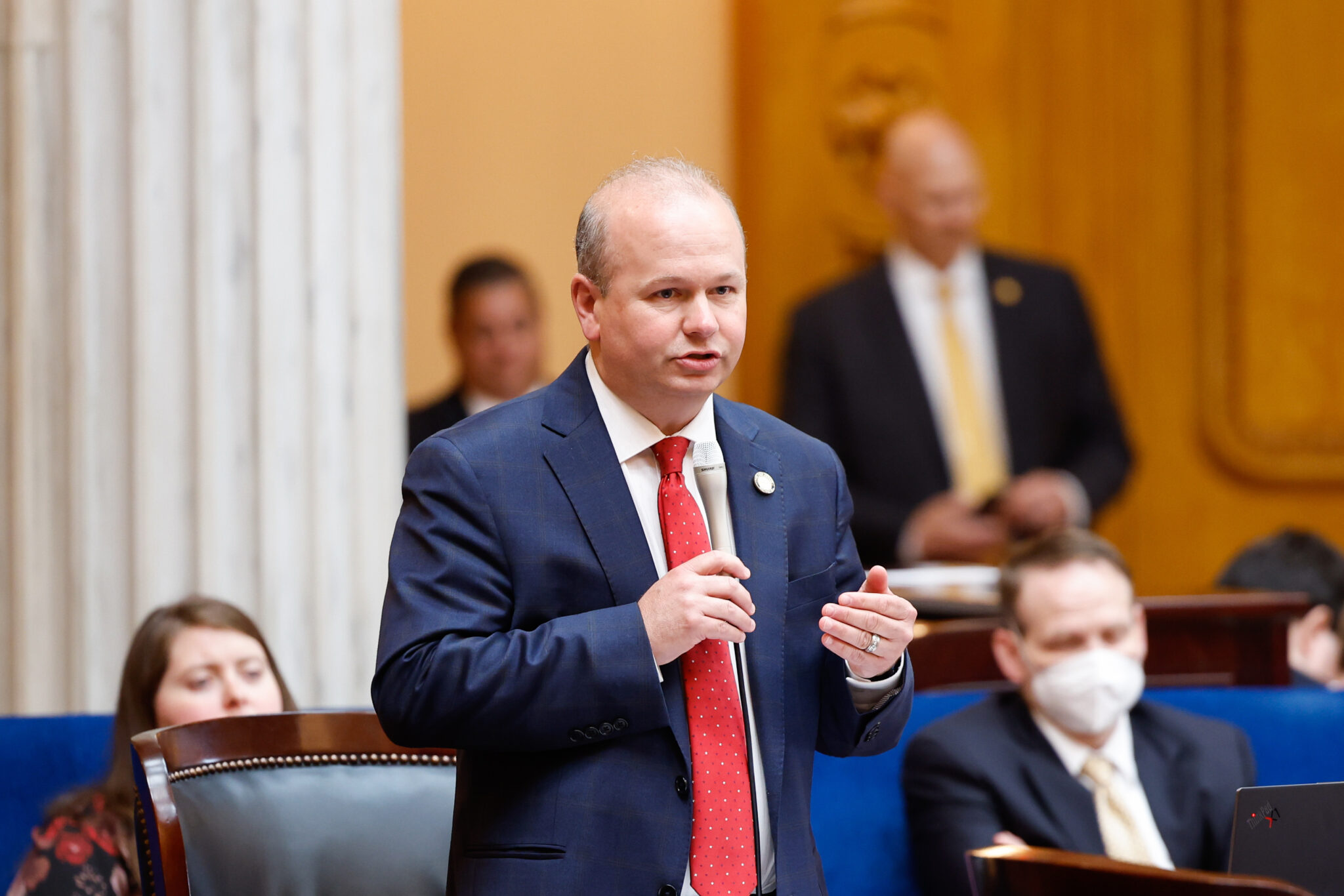
A recently offered resolution in the Ohio Senate urges the federal government to keep sexual orientation and gender identification out of anti-discrimination rules used in education funding.
State Sen. Andrew Brenner, R-Delaware, brought forth the resolution, Senate Concurrent Resolution 11, on Tuesday, asking the United States Department of Education to “exclude sexual orientation and gender identity from Title IX,” according to the resolution language.
Title IX is a 1970’s-era law that prohibits gender discrimination in education where federal funding is received. New changes would add the LGBTQ+ supports based on gender identity and sexual orientation, along with harassment protections for pregnant students and students with children. The changes were released by the DOE in April, and would take effect in August.
Brenner’s resolution states that, if passed, the 135th General Assembly in Ohio “find that this broad expansion of Title IX is damaging to all women’s sports,” and urges the U.S. DOE to “remove all references to sexual orientation and gender identity” from the law.
It also asks that Congress and President Joe Biden amend the law “to specify that ‘sex’ does not include sexual orientation or gender identity.”
A resolution is merely a request of the legislature, not a law or enforceable duty. But the resolution furthers messages from the Republican side of the General Assembly against transgender and other LGBTQ+ issues.
Bills currently under consideration in the Ohio Legislature related to transgender issues include House Bill 183, which would keep transgender students from using bathrooms and locker rooms assigned to their gender identity, and House Bill 8, which requires public schools to tell parents about sexuality content in class materials and allow alternatives to the content. HB 8 would also require school districts to notify parents about a student’s sexuality in a mandatory disclosure clause.
HB 183 was voted out of its committee recently, and HB 8 has already passed the House, with hearings continuing in the Senate Education Committee.
The General Assembly already passed House Bill 68, banning gender-affirming care for minors and keeping transgender students from playing on sports teams that fit with their gender identity.
Ohio Attorney General Dave Yost asked the Ohio Supreme Court to lift the temporary pause in enforcement of the law in a late-April filing, saying “one judge from one county does not have more power than the governor’s veto pen.”
Gov. Mike DeWine vetoed the bill, but his veto was overridden by legislators.
Yost has taken a state stance when it comes to Title IX as well. Before the new proposed resolution came about, the attorney general joined a lawsuit against changes to the Title IX language, announced at the end of April by Yost’s office.
He represents the state of Ohio in the suit led by Tennessee, and also joined by leaders in Kentucky, Indiana, Virginia and West Virginia against the U.S. DOE and the Secretary of Education, Miguel Cardona.
As part of the lawsuit, Yost argues the final Title IX rule with inclusion of sexual orientation and gender identity would “preempt Ohio laws governing athletics … causing irreparable harm to the State of Ohio’s sovereign lawmaking authority,” citing laws that provide separate teams for males and females.
The suit states that Ohio received more than $5.2 billion in federal funding in 2023, and “expects to receive additional funds of equal or greater amount in future fiscal years.”
SUSAN TEBBEN
Susan Tebben is an award-winning journalist with a decade of experience covering Ohio news, including courts and crime, Appalachian social issues, government, education, diversity and culture. She has worked for The Newark Advocate, The Glasgow (KY) Daily Times, The Athens Messenger, and WOUB Public Media. She has also had work featured on National Public Radio.
Ohio Capital Journal is part of States Newsroom, the nation’s largest state-focused nonprofit news organization.
COLUMBUS, OH — JANUARY 24: A protester asks senators to not override Gov. Mike DeWine’s veto of House Bill 68 that would limit medical care for transgender minors and block transgender girls from sports during the Ohio Senate session, January 24, 2024, at the Statehouse in Columbus, Ohio. (Photo by Graham Stokes for Ohio Capital Journal)
Both laws — banning gender-affirming care and local flavored tobacco regulations — are now set to take effect at the end of April.
The Ohio Senate voted to override two of Gov. Mike DeWine’s vetoes Wednesday — one on a bill blocking gender-affirming care for trans youth and the other blocking cities from banning flavored tobacco sales. Both laws are now set to take effect at the end of April.
The Senate voted 24-8 to override DeWine’s veto of House Bill 68, which blocks gender-affirming care for trans youth and prevents transgender athletes from playing women’s sports. The bill prohibits transgender youth from starting hormone therapy and puberty blockers.
“I think parents should make those decisions and not the government,” DeWine said before the vote Wednesday.
The Senate also voted 24-8 to override DeWine’s veto of a provision that would prevent cities from banning flavored tobacco sales. A flavored tobacco ban took effect in Columbus earlier this month after Columbus City Council voted to stop the sale of flavored tobacco products in December 2022.
“It will be a win for big tobacco and it will be a loss for Ohio,” DeWine said before the vote Wednesday.
A three-fifths majority vote from the members of the House and Senate is necessary to override the governor’s veto. The Ohio House voted to override HB 68 earlier this month and voted to override the flavored tobacco ban in December. State Sen. Nathan Manning of North Ridgeville was the only Republican to vote against overriding the Republican governor on the gender-affirming care ban, and state Sen. Louis Blessing of Colerain Township was the sole Republican to vote against overriding DeWine on the tobacco law.
The laws are set to go into effect 90 days after they are delivered to the Secretary of State’s office, meaning it would likely take effect April 23.
House Bill 68
COLUMBUS, OH — JANUARY 24: A protester asking senators to not override Gov. Mike DeWine’s veto of House Bill 68 that would limit medical care for transgender minors and block transgender girls from sports is removed from the gallery during the Ohio Senate session, January 24, 2024, at the Statehouse in Columbus, Ohio. (Photo by Graham Stokes for Ohio Capital Journal)
Ohio Senators discussed House Bill 68 for about an hour before taking a vote. Democrats said they celebrated DeWine’s veto while Republicans expressed their disappointment in last month’s veto.
“There are men and there are women and there are boys and there are girls and they are different,” said State Sen. Kristina Roegner, R-Hudson.
“Gender is not fluid. There is no such thing as a gender spectrum,” she claimed.
State Sen. Bill DeMora, D-Columbus, said this bill becoming law will lead to loss of life.
“Politicians have no business banning evidence-based, life-saving medical care – especially when it is endorsed by every major medical and mental health association,”said Ohio Senate Democratic Leader Nickie J. Antonio, D-Lakewood.
“We should listen to parents, providers and patients, not willfully and purposely pass harmful legislation that will add to the mass exodus of individuals from the state of Ohio,” Antonio said.
A protester was removed from the Senate chamber after she interrupted Roegner.
“Jesus loves the little children, all the children of the world, LGBTQIA,” she screamed. “Jesus would be here on their side today. We need to support them.”
HB 68 has a grandfather clause that would allow doctors who already started treatment on patients to continue.
Gender-affirming care is supported by every major medical organization in the United States. Children’s hospitals across Ohio, the Ohio Children’s Hospital Association, and the Ohio Academy of Family Physicians all oppose HB 68. No Ohio children’s hospital performs gender-affirming surgery on patients under 18 currently.
DeWine said his veto of HB 68 was “about protecting human life.”
“These are gut-wrenching decisions that should be made by parents and should be informed by teams of doctors who are advising them,” he said during a press conference on Dec. 29.
It’s likely this new law will end up in court.
Twenty-two other states have passed a law that bans gender affirming care for transgender youth, but most have faced legal challenges, according to the Human Rights Campaign.
Before the Senate voted to override his veto, DeWine said he does not plan to pursue legal against HB 68.
“The legislature has the constitutional right to override anything, any bill that I sign, or any or any bill that I veto,” DeWine said. “That’s part of our system. And I respect our system. It doesn’t mean I like the vote, but I respect our system.”
Senate President Matt Huffman, R-Lima, told reporters Wednesday he believes HB 68 will hold up in court.
“I do think that it’ll pass constitutional scrutiny,” he said.
State Rep. Gary Click
The bill’s author state Rep. Gary Click, R-Vickery, has denied that HB 68 has any religious backing, but Click can be heard saying in a recorded sermon from 2018 that trans people break from God’s plan for the family.
COLUMBUS, Ohio — JANUARY 10: State Rep. Gary Click, R-Vickery, celebrates the vote to override Gov. Mike DeWine’s veto of HB 68 during the Ohio House session, January 10, 2024, at the Statehouse in Columbus, Ohio. (Photo by Graham Stokes for Ohio Capital Journal. Republish photo only with original article.)
“You’re not born that way,” Click says about trans people during the sermon. “God’s not going to curse you in the wrong body. He’s not going to curse you with desires that cannot be adequately and appropriately and biologically fulfilled correctly.”
Click is a pastor at Fremont Baptist Church and celebrated Wednesday’s Senate vote.
“The SAFE Act and Save Women’s Sports Act are the civil rights issues of our day, ensuring that children have the right to grow up intact and that women are no longer subject to men invading their spaces,” he said in a statement.
Gender-affirming care
Gender-affirming care can “include any single or combination of a number of social, psychological, behavioral or medical interventions designed to support and affirm an individual’s gender identity,” according to the World Health Organization.
Puberty blockers use hormones to pause puberty development and are reversible.
Hormone therapy helps align a person’s body with their gender identity by giving testosterone hormones to those who were assigned female at birth and giving estrogen hormones to those who were assigned male at birth. This is partially reversible.
A 2022 study published in JAMA Network Open found access to hormones and puberty blockers for young people ages 13-20 was associated with a 60% lower odds of moderate to severe depression and a 73% lower odds of self-harm or suicidal thoughts compared to youths who didn’t get these medications.
Transgender athletes
House Bill 6, which prevents trans athletes from playing Ohio women’s sports, was rolled into HB 68 during the summer.
“It’s too bad that House Bill 68 and House Bill 6 were combined into one piece of legislation because the only commonality these two pieces of legislation have is they both target the same small portion of transgender kids,” said State Senator Kent Smith, D-Euclid.
Twenty-three states have passed similar laws in regards to transgender athletes since 2020, according to ESPN.
Currently, if a trans girl wants to play on a team with cis girls in Ohio, she must go through hormone treatments for at least one year or show no physical or physiological advantages, according to the Ohio High School Athletic Association.
“They think that they can erase transgender people with this legislation and the other legislation they’re passing, but our kids will still be trans and trans people will still be trans no matter what they do,” Zelch said. “And we’re here to fight and continue fighting.”
Human Rights Campaign President Kelley Robinson said the override of HB 68 will harm innocent children.
“Despite the fact that they have no medical training, these politicians believe they know better than parents and transgender youth seeking health care. It’s shameful,” Robinson said in a statement.
Dara Adkison, board secretary of TransOhio, said trans youth deserve better.
“Our community is strong and resilient in ways that hateful legislators can not comprehend, and trans Ohioans across the state cannot and will not be legislated away,” Adkison said.
Carson Hartlage, an Ohio medical student, said this is a dark day for the Ohio trans community.
“I was a trans kid who became a trans adult in Ohio, and it feels so dehumanizing to see my home state spend years trying to stop healthcare from my community,” Harlage said.
Tobacco
Back in January 2023, DeWine vetoed a bill that would have prevented any city or municipality from regulating smoking, vaping and other e-cigarette usage and sales. Before the Senate voted to override the tobacco veto, DeWine said a veto override would be horrible for Ohio children.
“I just don’t know how anybody thinks it was a great idea,” DeWine said. “To have more children in the state of Ohio become addicted (to nicotine).”
One out of every five children in Ohio vape, DeWine said.
“It’s the Tutti Frutti and all the other kinds of crazy flavors that masked all nicotine and it gets them addicted,” he said.
The American Cancer Society Cancer Action Network said lawmakers have turned their backs on Ohio kids with the veto override.
“Instead of offering solutions to address the health of Ohioans, lawmakers have now rolled back existing local laws regulating the sale of tobacco products and limited what local governments can do to prevent people from starting to use tobacco and help people quit,” ACS CAN said in a statement.
Municipal home rule gives cities and villages in Ohio the constitutional right to certain powers, including establishing laws in accordance with the self-government clause. Cities have the right to make their own policies, as long as it doesn’t get in the way of laws in the Ohio Revised Code.
Ohio Capital Journal reporter Zurie Pope contributed to this report.
Megan Henry is a reporter for the Ohio Capital Journal and has spent the past five years reporting in Ohio on various topics including education, healthcare, business and crime. She previously worked at The Columbus Dispatch, part of the USA Today Network.
The Burkle family huddled together to watch last week’s press conference where Ohio Gov. Mike DeWine vetoed a controversial bill that would have banned gender-affirming care for transgender youth.
“It was a brief sigh of relief,” mom Alicia Burkle said. “We were crying and hugging.”
Their 10-year-old daughter Astrid has socially transitioned, but has not yet started puberty blockers.
Ohio House Bill 68 would prevent transgender athletes from playing women’s sports and would ban transgender youth from accessing gender-affirming care, including puberty blockers and hormone therapy. DeWine said during last week’s press conference his focus was on the health care component of the bill.
The Burkles figured they had a couple of weeks before the lawmakers returned from winter break, but the Ohio House announced they will have session next Wednesday, Jan. 10. The Ohio Senate’s next schedule session is Jan. 24.
“It’s just so hurtful and it’s exhausting,” Burkle said.
The Ohio Capital Journal talked to three families with transgender children who were relieved DeWine vetoed HB 68, but are now concerned the legislature could override his veto.
“We do know that this was a math problem also and that the veto was not necessarily the end,” said Nick Zingarelli, the father of a transgender teenager.
A three-fifths vote of the members of the House and Senate is necessary to override the governor’s veto — meaning 60 representatives and 20 senators.
HB 68 passed in December with 24 votes in the Senate and 62 votes in the House. State Sen. Nathan Manning was the lone Republican senator to vote against the bill in December. Republican state Reps. Jamie Callender and Brett Hillyer voted against the bill when it originally passed the House with 64 votes in June.
Ohio House Speaker Jason Stephens, R-Kitts Hill, said last week he was disappointed in DeWine’s veto.
“We will certainly discuss as a caucus and take the appropriate next steps,” Stephens said in a statement.
Burkle family
When the Ohio House and Senate passed HB 68 on Dec. 13, the Burkles launched into action mode by asking their doctor what next steps they can take as well as emailing and calling DeWine. Astrid even sent DeWine some handwritten letters.
“We really didn’t get to truly enjoy the holiday because we were just so anxious about what was going to happen,” Alicia Burkle said.
Astrid is not currently on puberty blockers and wouldn’t be covered under the grandfather clause that would allow doctors who already started treatment on patients to continue.
“We don’t know that she would be (on puberty blockers) before the bill were to take effect, if it were to pass,” Alicia Burkle said.
DeWine said he would pursue administrative rules banning gender-affirming surgery on minors, collecting data, and combating clinics that might pop up to try to perform ideologically-driven care. No Ohio children’s hospital currently performs gender-affirming surgery on those under 18.
“Those are all really reasonable concessions,” Burkle said.
“It’s certainly one of the options that we’re keeping open if that’s what we’re forced to do,” Burkle said.
The Scagliones
While Kat Scaglione was impressed with DeWine’s veto, she said it feels like sitting in limbo waiting to see what happens next.
“What if this override happens?” she asked. “It feels like we’ve almost backpedaled and we’re back to where we started.”
She has a 14-year-old transgender daughter, a 13-year-old cisgender son, and a 10-year-old transgender daughter.
Amity, 14, is past the point of being able to get puberty blockers and is waiting on hormone treatment.
“I am supposed to be worrying about the next test I have to study for,” Amity said. “Not whether my rights are going to disappear. … It’s very scary to have that thought looming over your head, like all the time.”
Kat said waiting on the governor’s decision overshadowed the holiday season.
“My kids were sitting there writing Christmas lists and writing letters to send to the governor and to the representatives,” she said. “It didn’t feel like much of a holiday this year.”
Zingarelli family
The Zingarelli family celebrated DeWine’s veto.
“It was we’re going to take the next few days just to savor this victory, because it was a huge victory,” father Nick Zingarelli said.
His 14-year-old daughter is treated by Cincinnati Children’s Hospital Medical Center, so she would be able to continue receiving care under the grandfather clause but he wants to make sure all Ohio kids would have access to this kind of care.
He hopes DeWine’s veto will give other Republican lawmakers pause.
“I would hope that they would listen to the elected leader from their own party, and then consider that and say, ‘Am I on the wrong side of this issue?’ … We’re not gonna roll over on this battle. If they win in the legislature, we will see them in court,” he said.
Megan Henry is a reporter for the Ohio Capital Journal and has spent the past five years reporting in Ohio on various topics including education, healthcare, business and crime. She previously worked at The Columbus Dispatch, part of the USA Today Network.