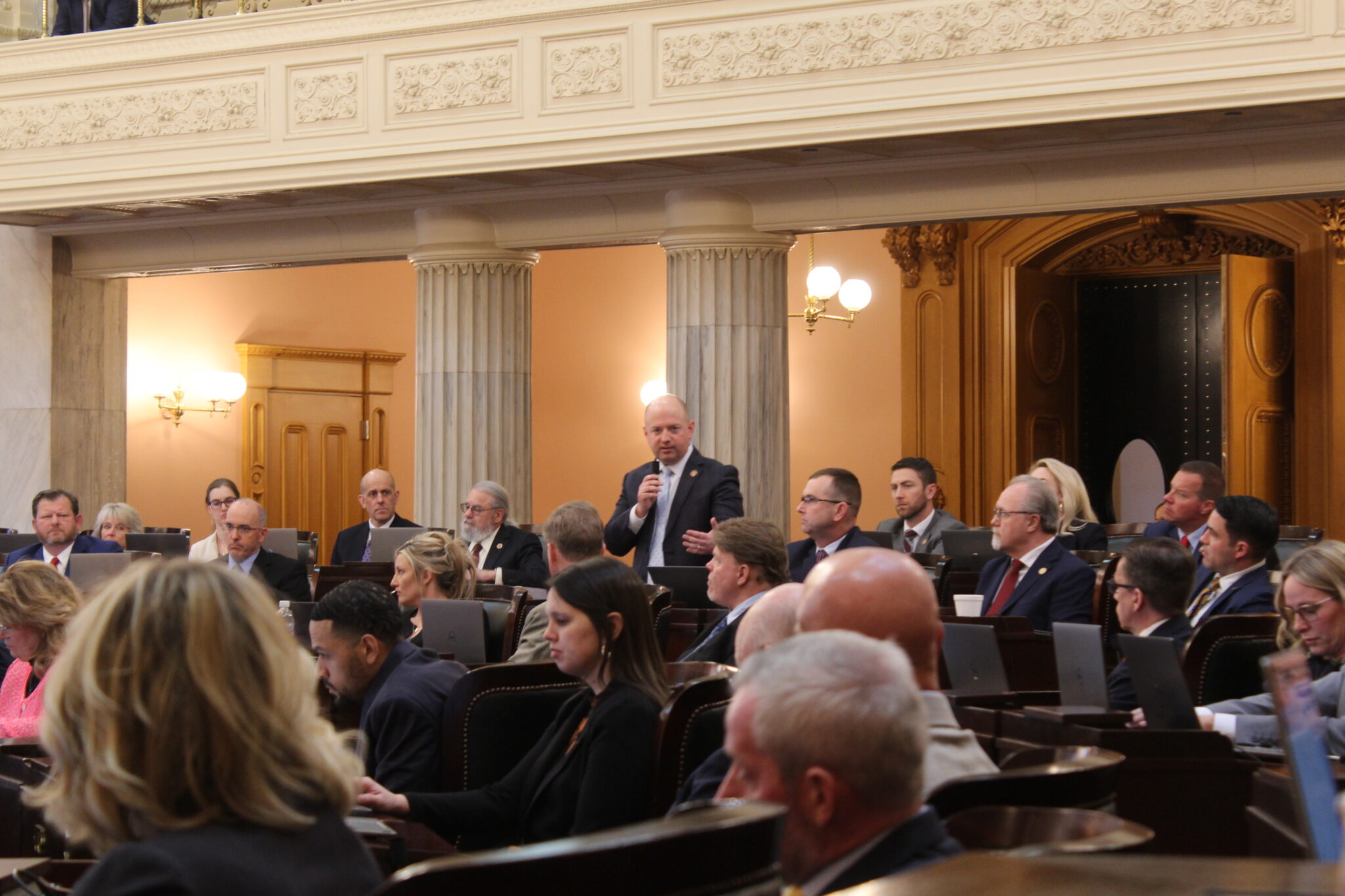
Rep. Brian Stewart, R-Ashville, testifying in the Ohio House. (Photo by Nick Evans, Ohio Capital Journal.)
____________________
In particular, Stewart and state Rep. Jean Schmidt, R-Loveland, complained about cases dragging on. Schmidt, like Stewart, has been on the receiving end of a multi-year OEC case.
____________________
Lawmakers argue the Ohio Election Commission has outlived its usefulness and the Secretary of State or county boards of elections should handle campaign finance violations
The Ohio House’s version of the budget would eliminate the independent group charged with enforcing state campaign finance laws. With the Ohio Election Commission gone, those duties would fall to the Secretary of State and county boards of elections. Lawmakers slipped the provision into the 5,000-plus page bill as part of a wide-ranging amendment the day before the vote.
But lawmakers’ frustrations with the commission became apparent months ago.
At a February hearing, state Rep. Brian Stewart, R-Ashville, expressed “grave concerns” about the commission and said its process is “substantially broken.”
“I’m getting texts and calls here from other members saying, this is the time to make some reforms,” he said at the time, “and I hope we do that as part of this process.”
Stewart’s irritation stems in part from his own case before the commission, which took roughly three years to resolve. The commission determined he made no violation; the challenger is appealing that decision.
Even critics of the House plan acknowledge the commission’s shortcomings. But they contend such drastic changes belong in a standalone bill with plenty of opportunity for public testimony.

Lawmakers’ complaints
GET THE MORNING HEADLINES.
With a current annual budget of about $642,000, the Ohio Elections Commission is a rounding error in a budget spending more than $44.5 billion General Revenue Fund dollars a year. The governor’s spending proposal pushed its annual budget north of $800,000. At that February hearing, OEC Executive Director Phil Richter showed up to explain how the extra funding would cover a new filing system and an additional employee to take over when he retires.
Instead, lawmakers lit into the commission.
In particular, Stewart and state Rep. Jean Schmidt, R-Loveland, complained about cases dragging on.
“There are multiple committees over the last several years,” Schmidt said, “who have been required to attend hearings, and the decisions go into a year, two years, delay, delay, delay, before a decision is rendered. Sir, that costs people time. It also costs people money.”

Schmidt, like Stewart, has been on the receiving end of a multi-year OEC case.
In an interview, Stewart argued lawmakers have been raising concerns about the commission for years. He pointed to a 2014 U.S. Supreme Court ruling invalidating an Ohio law against false campaign statements. That decision eliminated an entire class of OEC complaints, he argued, “but of course, (the) government never sort of adjusted and kind of right-sized the operation.”
Stewart also brushed off concerns about lawmakers who have faced OEC complaints leading the effort to eliminate the agency.
“The best people in the position to reform an agency,” he argued, “are those who have spent years being drug through the mud and seeing how completely inefficient it is.”
More important, Stewart stressed, lawmakers aren’t changing campaign finance law — they’re looking for better enforcement.
“Everything that’s legal is still legal,” he said. “Everything that’s illegal is still illegal, and you will still have all the same appeal rights that you do today to take your matter to court.”
Traffic cops
Chris Hicks hates a liar. Talking with him for 10 minutes and it’s obvious his skin crawls seeing powerful people get away with it. He’s unabashedly conservative but has no problem going after members of his own party if they’re breaking the law. He’s filed numerous complaints with OEC, including the ones against Stewart and Schmidt.
In Hicks’ telling, it started with a different candidate named Allen Freeman. In 2020, he was one of several candidates backed by then-House Speaker Larry Householder. Freeman blanketed Cincinnati airwaves with ads, which struck Hicks as weird — the vast majority of that audience wasn’t in his district, and he reported spending only about $15,000.
Hicks found Federal Communications Commission reports of more than $100,000 in ad buys on Freeman’s behalf, paid for by Householder-aligned groups. The OEC eventually fined Freeman $50,000, but his campaign wound up burning through its cash to pay for his defense.
Hicks explained the Freeman case was just a starting point for him. “Some of these invoices had a bunch of other candidates on them,” he said. Since then, he’s driven back and forth more than a dozen times from his home outside Cincinnati to OEC hearings in Columbus, pursuing various campaign finance cases.
“I have no love for the OEC at all, as you can tell,” he said. “But everything about what’s happening right now is demonstrative of how f-ed up things in Ohio are.”
He complained about lawmakers “dumping” the changes into the budget to evade public hearings and can’t believe Democrats aren’t making a bigger issue of it.
Hicks thinks maybe it’s got to get worse before it gets better.
“The funny part is, if it stays in there, it’s probably better than the OEC,” he said. “Because it’s going to create absolute chaos — absolute chaos.”

Putting the process in the hands of county boards, whose members are often local party leaders, or a state hearing officer, hand-selected by the Secretary of State, will remove any semblance of neutrality, he contended.
Catherine Turcer, who heads up the government watchdog group Common Cause Ohio, has her own frustrations with the OEC, but she’s decidedly against the burn-it-all-down approach. She agrees the process takes too long and the results can be lackluster, but she argued lawmakers abolishing the commission is the wrong answer.
“As opposed to thinking about how they could create greater transparency,” she said, “and how they could make an elections commission that would be functional and strong and robust, they’re thinking about eliminating it.”
Turcer criticized lawmakers for scrapping the commission as part of the budget, rather than in a standalone bill. And she rejected Stewart’s suggestion that nothing’s lost in handing off the commission’s responsibilities.
“That doesn’t take care of making sure that these, you know, traffic cops, essentially, that they’re as independent as possible,” she argued. “I think the problem is, by eliminating it, you’re essentially setting up a system of cronyism.”
The stakes
Phil Richter understands the complaints about his agency and said he’s open to working on improvements. But he insists the foundational idea — an independent body overseeing campaign finance — was a good one.
“For the state of Ohio to take this step, and step away from an independent, bipartisan organization reviewing these kinds of matters, I think that, to me, would be a black mark on the state,” he said.
With oversight in the purview of partisan actors, he warned, any decision will be open to claims of partisanship. Beyond the optics, Richter argued devolving decisions to county boards could be a mess. He described explaining the House proposal to a former member recently who interrupted, “wait a minute, that means there could be 88 different versions and 88 different interpretations of the statutes.” Richter added there’s a conflict of interest in asking the same body to audit campaign filings and judge cases, too.
“Again,” he said, “that’s why this commission was created — was to separate those instances.”
None of those concerns make an impact on Stewart.
“You have seven folks who don’t even have to be lawyers, playing judge and trying to hear cases over a period of years,” he said. “That’s a silly system.”
Follow Ohio Capital Journal Reporter Nick Evans on X or on Bluesky.