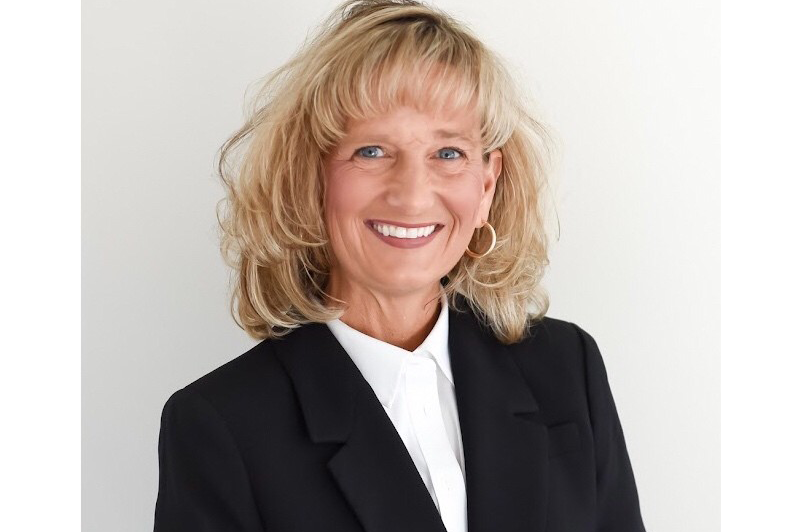
Loveland, Ohio and Warren County – State Representative Michelle Teska (R-Clearcreek Township) took the oath of office Monday to begin her first term as a member of the Ohio House of Representatives. She represents the 55th House District, which encompasses most of Warren County.
“I am truly honored to advocate as a strong voice for the 55th House District,” said Teska. “I look forward to working on legislation that delivers tax relief to all Ohioans and uplifts our small businesses.”
Teska serves is a co-owner and President of Miami Valley Golden Heart Senior Care. She also has more than 20 years of combined sales experience with Cox Media Group and Sales for Boost Management.
Democrat Laura Marie Davis and Republican Teska competed to succeed Rep. Scott Lipps, R-Franklin, who had served the maximum four two-year terms.
Yesterday’s session marked the beginning of the 136th General Assembly.
Sam Cao, 17, at left, seen with Sam Lawrence, 19, at right. The two teenaged Sams are running as Democrats for seats in the Ohio House. Source: Sam Lawrence.
Sam Cao worked out a plan with his principal and superintendent. They had to figure out how Cao could potentially balance constituent work in the Ohio House of Representatives with classwork at Mason High School.
At Miami University, Sam Lawrence mulled a similar plan for his upcoming sophomore year. Ohio University’s Rhyan Goodman is likely doing the same for his junior year.
The three Democrats would be quite young for elected office. Cao is 17 but turns 18 before Election Day, which allows him to run; Lawrence is 19; Goodman was 19 when he announced his run in February.
If elected, they could shape state policy on everything from Ohio’s $74 billion biennial budget, civil and criminal justice, women’s rights, gun policy and countless others. All three are running in districts where Republicans have recently won with commanding margins, leaving them with uphill paths to office.
They can serve in wars and vote. They can’t lawfully buy a drink. And they don’t think their age should preclude them from public office.
“The one thing I’d like to point out is it’s not no experience; it’s different experience,” Lawrence said.
“I would like to ask every one of our legislators if they were attending school while all these terrible school shootings are happening. They were not in school when we had these high-powered assault weapons that could mow down tens of children at a time. Those people don’t have those life experiences.”
Some current incumbents started their terms just a few years older. Sen. Niraj Antani, R-Miamisburg, started in the House in 2018 at 23 years old. Rep. Jena Powell, R-Arcanum, first won in 2018 at 24. Rep. Thomas Hall, R-Madison Twp., won office in 2020 at 25. Rep. Bride Rose Sweeney, D-Cleveland, won in 2018 at 26.
Several (older) Democrats asked about the youthful insurgents rebuffed concerns of a lack of life or work experience from the candidates. They also rejected the trend as any signs of a party unable to attract more established candidates. Instead, they characterized it as a reflection of members of a new generation who are aghast at increasingly extreme legislation coming from the Statehouse and inspired enough to seek to affect change on their own.
“They’re going to be limited based on their life experiences, but at the same time, there is something romantic about it,” said Dennis Willard, a Democratic political consultant.
“In a sane world, this might seem insane. But were not living in a sane world with the Ohio Legislature. I know who I’d vote for.”
There’s some historical precedent too. U.S. Sen. Sherrod Brown, the dean of Ohio’s struggling Democratic Party, won his first state House race at 21 in 1974. In 2000, 18-year-old Derrick Seaver won a seat as a Democrat (he switched parties a few years later).
In an interview, Seaver, now 40 and the director of the San Jose Chamber of Commerce, expressed ambivalence about teenagers running for office. Youth has its perks — young people can be listeners and learners who bring new perspectives to older and pastier general assemblies. Plus, the media attention they attract can make the difference in tough races.
However, they’re less situated to understand the nuances or interconnectedness of public policy, he said. Plus, if they lose an election, they don’t have a college degree or developed work experience to fall back on.
“I will say that since that time, and I don’t want this to come across as discouraging, but certainly I feel that maybe I should have waited until I was older,” he said.
Sam Cao
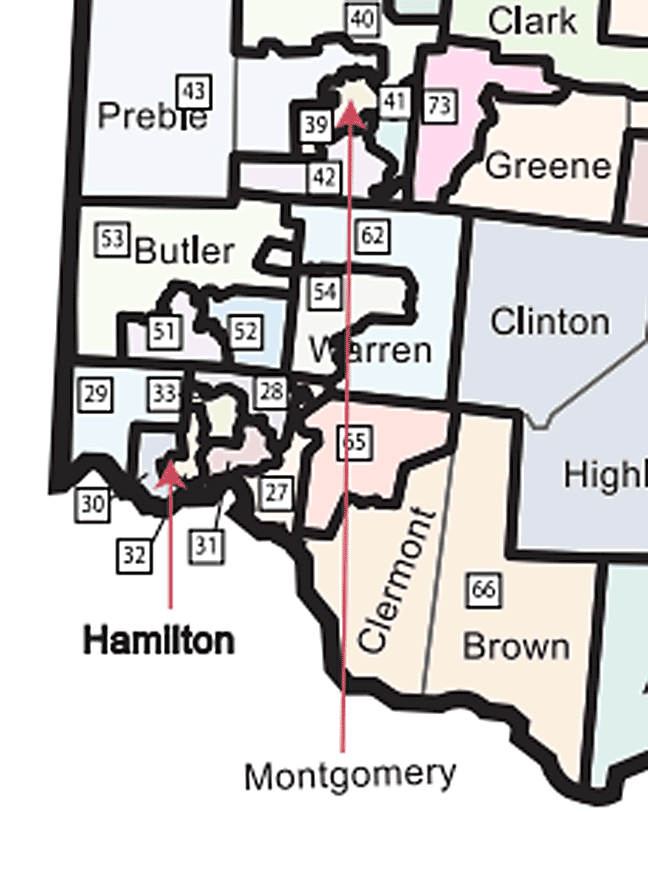
Ohio’s new 56th House District contains swaths of Warren County including the cities of Lebanon and Mason. More than 62% of its voters are Republican, according to Dave’s Redistricting App.
Cao grew frustrated when COVID-19 grew so prevalent in the county that his high school closed its doors when it ran out of healthy substitute teachers. He tried to contact Zeltwanger, to no avail. Then he tried to contact the Democrat running for the seat, only to learn no such person exists. He credits his AP Government teacher with encouraging him to take a shot for himself.
To prepare, he’s looking to history. For one, there are his role models — Brown, the U.S. Senator; Robert Kennedy, the liberal icon and former U.S. Attorney General; and William Proxmire, another U.S. Senator who famously replaced the demagogic Sen. Joe McCarthy and declared his predecessor a “disgrace to Wisconsin, to the Senate, and to America.”
Cao has also been seeking guidance from the last four Democrats who tried and failed to win the seat.
“You know what you’re entering, kid?” he said, relaying their advice.
“We call this the arena for a reason. You’re a minnow. And sharks come in. These legislators at the Statehouse, they’re not playing with you. They could eat you up.”
His path to the general election ballot is no guarantee — he’s facing Joy Bennett, a freelance writer, in the looming Aug. 2 primary.
In an interview, he boiled his policy goals down to three items. For one, he wants to vote against abortion restrictions and gun rights expansions, which are likely to come in the GOP-dominated legislature. For two, he wants to improve the state’s infrastructure — one example being a lack of roads leading to his own high school, the largest in the state, causing regular traffic jams. Third, he wants to support legislation introduced by Sen. Tina Maharath (another young and Asian-American Democratic lawmaker) to develop curriculum teaching Asian-American history in school classrooms.
“Look beyond our age,” Cao said. “I know our age is like, the wow factor or the pizazz factor about who we are as candidates, but I want you to look at the policies. I want you to look at what values we stand for.”
Sam Lawrence, at left, and Sam Cao at right. Source: Sam Lawrence.
Sam Lawrence
In Hamilton County, Lawrence is running against Rep. Sara Carruthers, a two-term incumbent Republican. It’s a similarly tough district for Democrats — more than 60% of its voters are registered Republicans, according to Dave’s Redistricting App.
His goals in office include protecting abortion access for women, legalizing and taxing marijuana for recreational use, bringing intrastate train access to Ohio, and expanding clean energy generation like wind and solar in Ohio.
He said a House full of only 19-year-olds would likely destroy the state. But having a few of them around has its value — who better to represent the interests of young Ohioans? Who better to understand the realities of seeking student loans in an inflationary economy? Or evaluating recently passed legislation that allows teachers to carry arms in Ohio, which he called “incredibly unpopular” among young people.
He considers former presidential candidate and current U.S. Secretary of Transportation Pete Buttigieg a role model. He has knocked on doors for House Minority Leader Allison Russo, D-Columbus, and volunteered for Congressman Tim Ryan’s U.S. Senate Campaign as well.
“Something everyone should know about us: We are taking this extremely seriously,” he said. “There is a reason that this Democratic process is in place. There is a reason that, by law, you are allowed to run at my age. There is a reason that people have won at my age. I think we should test that theory.”
Rhyan Goodman
Of the three teenagers, Goodman has the best shot at winning as far as the raw demographics go. His Athens County district splits 52-45 for Republicans.
He’ll face Rep. Jay Edwards, R-Nelsonville, a successful fundraiser and former member of House leadership seeking his fourth term in office. Edwards has won in a landslide every election since 2016.
Goodman doesn’t have any campaign website that could be located. He did not respond to calls or text messages seeking an interview.
His nascent political career has already met scandal. In April, he resigned from Ohio University’s student senate before facing an impeachment trial. According to The New Political, a student publication, Goodman was accused of coordinating an effort to remove former Treasurer Simar Kalkat from her position. He allegedly encouraged student senators to accuse Kalkat of intimidation.
Columbus, Ohio – After a discredited doctor’s conspiracy theories involving COVID-19 vaccines, magnetics and 5G towers made a mockery of the Ohio House of Representatives, the Health chairman blamed the sponsor of anti-vaccination legislation for inviting the doctor to testify before the committee.
House Health Committee Chairman Scott Lipps, R-Franklin, said in an interview that fellow Republican Rep. Jennifer Gross of West Chester personally requested that Cleveland area physician Dr. Sherri Tenpenny testify in support of Gross’ bill, the “Vaccine Choice and Anti-Discrimination Act.”
Lipps said he warned against Tenpenny, but Gross “vehemently” overrode his objections.
Tenpenny is a prominent anti-vaccination advocate who was deemed “unreliable” by a special master in federal court, who forbade her testimony as an expert witness in an alleged vaccine injury case.
Gross also personally invited Fremont attorney Tom Renz to testify at the hearing. A federal judge similarly blasted as “incomprehensible” a federal lawsuit Renz filed alleging “tyranny” from Ohio’s government regarding the pandemic.
Lipps said Gross and Stephanie Stock, president of anti-vaccination advocacy group Ohio Advocates for Medical Freedom, were adamant.
“We did not include Tom Renz or Sherri Tenpenny on our agenda,” he said. “They protested, called me personally, and said they wanted Renz and Tenpenny.”
Renz and Tenpenny both testified in support of Gross’ House Bill 248, which would prohibit colleges, insurers, hospitals, nursing homes, employers and others from requiring, incentivizing or asking about vaccination — all vaccines, not just for COVID-19. Public health experts have said in previous interviews the legislation would suppress Ohio’s vaccination rates against a number of diseases and increase the likelihood of outbreaks of infectious disease.
The bill drew huge public interest, prompting the committee to allow only certain, invited witnesses to testify.
“There has been people who have long suspected there was some sort of an interface, yet to be defined, an interface between what’s being injected in these shots, and all of the 5G towers,” Tenpenny said.
See footage of Tenpenny’s comments to the committee here.
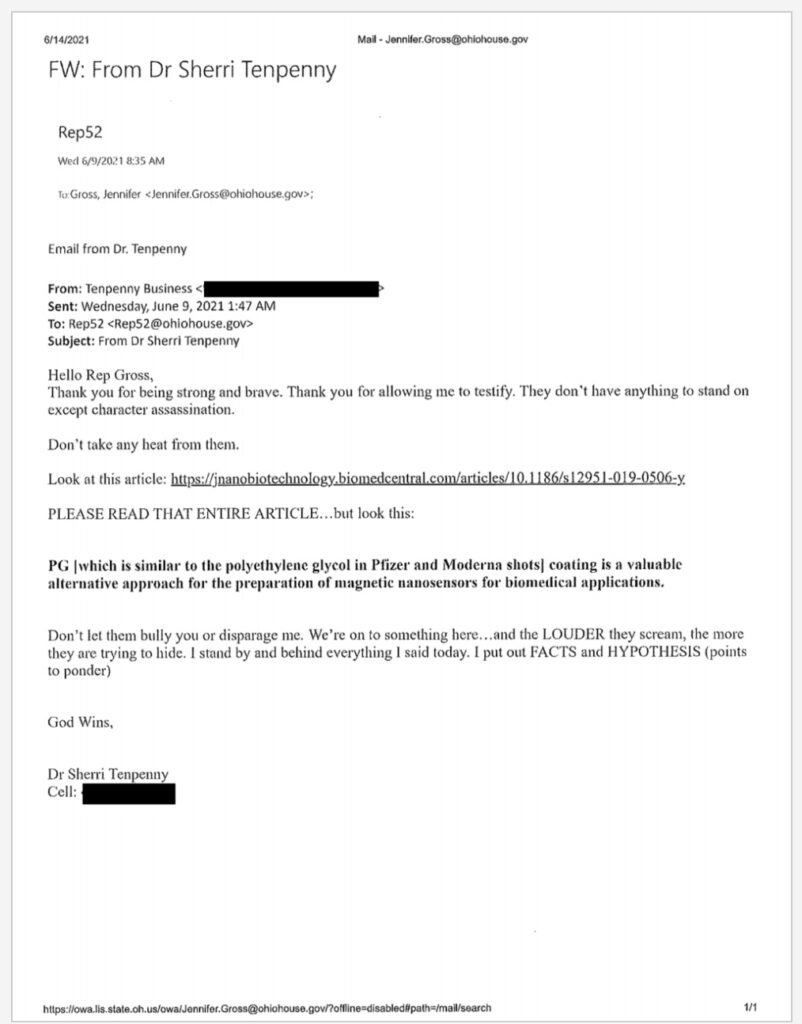
At 1:47 a.m. the day after Tenpenny’s comments, the doctor emailed Gross to thank the lawmaker for being “strong and brave” and allowing her to testify, according to an email obtained in a public records request.
In the email, Tenpenny sent a largely unrelated article from the Journal of Nanobiotechnology examining the biochemical functionality of magnetic particles as nanosensors, which are used in cancer diagnosis and treatment. Tenpenny seemed to claim it as proof of her comments regarding COVID-19 vaccines.
“Don’t let them bully you or disparage me,” she wrote. “We’re on to something here… and the LOUDER they scream, the more they are trying to hide. I stand by everything I said today. I put out FACTS and HYPOTHESIS (points to ponder).
God Wins,
Dr. Sherri Tenpenny.”
The day after the testimony, with the comments going viral online, Gross came to Lipps’ office and said she needed help with “damage control,” according to Lipps’ remarks in an interview.
Gross declined to confirm or deny Lipps’ account or answer emailed questions. She said she’s busy and considers the questions “old news.” However, she claimed Lipps praised Renz’s testimony and alleged he thought Tenpenny “sounds great.”
Ohio House Health Chairman Scott Lipps. Source: Ohio General Assembly.
Lipps denied saying this.
“I would expect nothing different from Rep. Gross,” he said in a text message to the Capital Journal. “I have quickly learned she [accepts] no responsibility for her actions or decisions and is quick to blame anyone and everyone. Also, the first agenda we [put] out for proponent testimony had NO Renz and NO Tenpenny. Rep. Gross vehemently objected.”
When the House Health Committee met a week after the comments went viral, Lipps defended the practice of bringing in witnesses like Tenpenny, even if doing so made people “uncomfortable.” He emphasized the importance of hearing from those one disagrees with.
“Please step outside your own little world and understand that people are not all the same, and they don’t all believe the same,” he said. “You are not always right.”
On a recent episode of her podcast, Tenpenny interviewed pillow magnate Mike Lindell, who is among the loudest backers of former President Donald Trump’s lie that the 2020 election was rigged. Lindell and his company are also facing libel suits related to these claims.
While Tenpenny has repeated similar claims of election fraud, her primary focus is vaccines and wrongfully depicting them as dangerous.
“Vaccines are now, and people, listen to this closely, always have been a method of mass destruction, a method of depopulation,” she claimed earlier in 2021.
Tenpenny’s anti-vaccine activism has generated multiple related revenue streams for her. She hosted a “boot camp” this year for $623, training people to convince others to refrain from vaccination. In May, she hosted a live streaming training event to explain the “20 mechanisms of injury from the shots” — platinum package tickets went for $199. Her 2008 book, “Saying No to Vaccines: A Resource Guide for all Ages,” isavailable on Amazon for $877.95, one of several similar titles she has authored.
Despite this work, Tenpenny does not follow acceptable scientific methodology, her testimony is “unreliable” and she is “unqualified” to address vaccine injury, according to Special Master Richard Abell, appointed by the U.S. Court of Federal Claims.
Abell made these remarks in a 2010 ruling that blocked Tenpenny’s testimony on behalf of a man who alleged a hepatitis B vaccination gave him Guillain-Barre syndrome, a rare side effect of vaccination.
The legal standard, he wrote, calls on judges to presume admissibility of testimony of an expert witness. However, he found her methodology “so divergent from the scientific method as to be nonsensical and confusing,” prompting his ruling.
“Her ideas on vaccine injury have not been exposed to any critical analysis of those in the relevant field, let alone peer-reviewed medical journals,” he said. “There is no way to ascertain whether Dr. Tenpenny’s opinion is credibly accepted by those who would know; there are only the patent defects in her report that militate for the opposite.”
Tenpenny did not respond to repeated phone calls.
Tom Renz speaks to the House State and Local government Committee Feb. 17. Source: Ohio Channel.
Who is Tom Renz?
After Tenpenny wrapped up her testimony on June 8, Fremont attorney Tom Renz addressed the committee.
The lawsuits are sprawling, some stretching over 100 pages, and are rife with claims that the COVID-19 death count is “inflated,” that asymptomatic spread of disease is a “fallacy,” that masks don’t work and a deluge of other inaccurate and often debunked claims.
No cases have yet received any significant rulings. U.S. District Judge James Carr described the first lawsuit against DeWine as “a jumble of alleged facts, conclusory and speculative assertions, personal and third-party allegations, opinions, and articles of dubious provenance and admissibility.”
Renz withdrew the lawsuit and has since filed a similar case that awaits a ruling. Ohio Stands Up, a citizens group that acts as plaintiffs in the cases, created a crowdsourced legal fund to pay Renz and his partner, Robert Gargasz. The fund has raised nearly $140,000 since it launched around September 2020.
Earlier this year, Renz testified before a separate committee regarding a pandemic-related bill. YouTube ultimately removed footage of the hearing from its site for violating its COVID-19 misinformation policy.
Renz didn’t respond to an email.
Ohio Stands Up recently posted on Facebook a flier for an August fundraiser: “An Evening With Dr. Sherri Tenpenny and Attorney Thomas Renz.” Tickets cost $75.
Ohio’s redistricting process is in a state of turmoil, with a delay in Census data leading the state to worry about there not being enough time to adequately draw new legislative maps.
Republicans and Democrats have both presented plans for how Ohio can deal with these delays. In essence, legislative leaders from both parties want to push back the deadline for completing the new maps that will be in place starting in the 2022 elections.
But the sides propose two very different ways to achieve that goal.
The next few days will be critical as Ohio lawmakers determine the preferred way of moving forward. The results from this week could have lasting implications for Ohio’s legislative government over the coming decade.
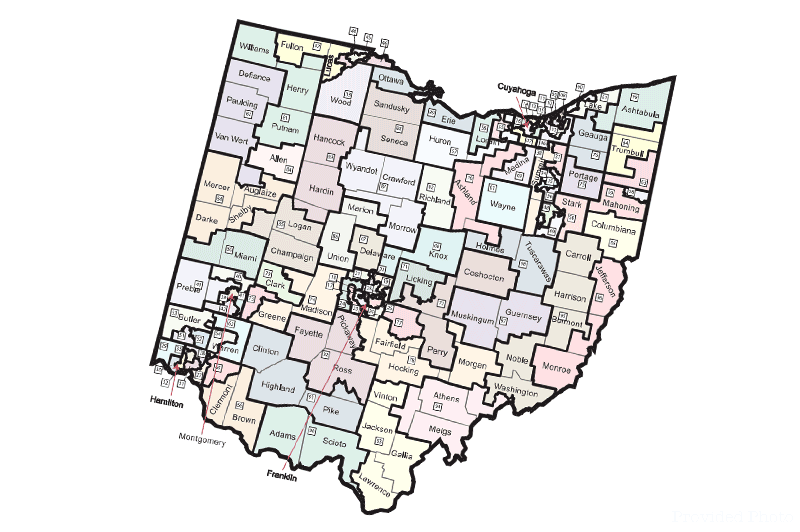
The current district map for the Ohio House of Representatives.
Not how Ohio voters drew it up
Each decade, Ohio redraws its federal legislative seats in the U.S. House of Representatives and state legislative seats in both the Ohio Senate and Ohio House of Representatives.
This is done to reflect changes in population and coincides with the U.S. Census, which is also conducted every 10 years.
After the last redistricting effort a decade ago, Ohio voters chose to reform the process for this year and the decades to follow. In short, voters approved a new system which puts a greater emphasis on transparency and bipartisanship.
These new plans — for federal and state maps — were approved via constitutional amendments on the 2018 and 2015 ballots, respectively.
These plans set specific deadlines to meet during the redistricting process.
Ohio voters could not have anticipated a global pandemic would occur at the same time the U.S. Census Bureau conducted its decennial count of American residents. The pandemic not only made the count more difficult, but has led to delays in processing and distributing census data used by officials to draw new legislative districts.
The Census Bureau announced this redistricting data will be provided to states by Sept. 30.
That’s a major problem — Ohio would therefore miss its redistricting deadlines:
This flow chart shows the new process for redrawing Statehouse districts. Circled is the deadline in question due to the delay in U.S. Census data.
This flow chart shows the new process for redrawing congressional districts in Ohio. Circled is the deadline in question due to the U.S. Census data delay.
Plan A involved a federal lawsuit from Attorney General Dave Yost seeking to get the redistricting data released earlier. The case was quickly dismissed. Now the two parties are offering some ideas for Plan B.
Back to the drawing board
If the government won’t release data early enough to match Ohio’s deadlines, officials here propose shifting the deadlines back to account for the late data.
This is not an easy fix. The 2021 deadlines were approved by voters and are thus embedded in the Ohio Constitution.
Senate President Matt Huffman, R-Lima, suggests the state get approval from voters to move back the deadlines as part of a one-time fix for this unique circumstance.
State Sen. Matt Huffman, R-Lima. Screenshot courtesy the Ohio Channel.
The next opportunity to get a constitutional amendment before Ohio voters would be the Aug. 3 special election.
Both chambers of the Ohio General Assembly (House and Senate) would have to pass a joint resolution to place the constitutional amendment on the August ballot. A three-fifths majority is required in each chamber for passage.
The deadline for filing this joint resolution with the Ohio Secretary of State’s Office is 90 days before the August election — that’s this Wednesday, May 5.
It’s possible, but the Republican leadership would need to work quickly. As of Monday morning a joint resolution has not yet been formally introduced.
An amendment requires a majority statewide vote to pass.
House Democratic Minority Leader Emilia Strong Sykes. Source: Ohio General Assembly.
Democratic leaders in the General Assembly say there are better options for handling the census delays than a hurried constitutional amendment attempt.
House Minority Leader Emilia Strong Sykes, D-Akron, and Senate Minority Leader Kenny Yuko, D-Richmond Heights, outlined their party’s own take on Friday for how to move forward.
“Constitutional amendments should be our final options,” Sykes argued, “not our first.”
The Democrats believe the best option is to ask the Ohio Supreme Court for an extension of the deadlines as other states, including Michigan, have done.
Senate Minority Leader Kenny Yuko is pictured at the Ohio Statehouse in 2018. Source: The Ohio General Assembly.
“I think (the Supreme Court) could understand that the people have spoken loud and clear, twice already, asking us to put an end to gerrymandering,” Yuko said. “What we’re proposing will do just that.”
While both plans call for extending the redistricting deadlines, neither party is suggesting to push back the 2022 primary election day to keep the full timeline intact.
All On The Line Ohio, a left-leaning organization which advocates for a fair mapmaking process, is calling for the primary election to get pushed back by a few weeks.
Sykes and Yuko said the Democrats would be introducing a plan to ensure the public has an adequate chance to provide input during what could be a truncated redistricting timeline.
DISTRICT MAPS
Every 10 years, following the decennial census, Ohio General Assembly and Congressional districts are redrawn to reflect changes in the state’s population in two parallel, but separate processes. The goal of each is to preserve the important one person-one vote principle – that all citizens are equally represented at the Statehouse and in the United States Capitol.
These maps were drawn based on data from the 2010 U.S. Census and are in effect from 2012-2022.
The Secretary of State’s office provides, for reference purposes, historical district maps dating back to 1972. Click here to request a ZIP file of these maps(opens in a new window). The file will be e-mailed to you. For up-to-date county district information, contact your county Board of Elections.
Although it is legal in Ohio for LGBTQ+ couples to adopt, some GOP legislators want the state law to only acknowledge the adoption rights of heterosexual couples.
A dispute over a single line in the 2,057-page state budget bill — passed by the Ohio House of Representatives on Wednesday — has some civil rights advocates frustrated as they continue urging the enactment of an anti-discrimination law in this state.
Married LGBTQ+ couples have been allowed to adopt children in Ohio since the U.S. Supreme Court’s 2015 Obergefell v. Hodges ruling legalized same-sex marriage across the country.
Ohio’s adoption law, last updated in 1996, states that “a husband and wife together” may adopt so long as one of them is an adult.
State Rep. Scott Oelslager, R-North Canton, leads the House Finance Committee.
As part of his comprehensive budget plan, Gov. Mike DeWine proposed to update the language to instead read that any “legally married couple” can adopt.
Republican lawmakers rejected that change and opted to keep the “husband and wife” language in place.
House Finance Chairman Scott Oelslager said doing so carries no legal weight and that LGBTQ+ couples retain their right to adopt children.
“It’s a semantic issue. It does not prevent adoptions (for) same-sex couples,” the North Canton Republican said. “It’s just simply a semantic definition so to speak, or semantic statement that was in the code.
“It was just something some of our members wanted and part of my job as Finance Chairman, and the Speaker’s job, is to listen to our membership … our members feel strongly about it and that’s why we kept it in,” Oelslager continued.
Oelslager was asked by reporters on Thursday to identify the Republican lawmakers who requested the state adoption law keep its “husband and wife” wording. He declined to name them.
Later on Thursday, the Ohio Capital Journal obtained the budget amendment requests. Two Republican state representatives in particular asked that budget drafters strike the “legally married couple” reference and reinsert “husband and wife” — Reps. Reggie Stoltzfus, R-Paris Twp., and Derek Merrin, R-Monclova.
Both EqualityOhio and the ACLU of Ohio oppose this decision from the House Republicans.
“To uphold ‘husband and wife’ language in the budget plan is not only inaccurate, it’s also antiquated and exclusionary,” ACLU of Ohio executive director J. Bennett Guess said in a provided statement.
Seen is an original draft of the budget considered by the Ohio House of Representatives. Gov. Mike DeWine proposed changing the adoption eligibility language to read “legally married couple,” but GOP Reps. Reggie Stoltzfus and Derek Merrin requested the decades-old “husband and wife” language remain in state law.
Guess said it is “essential that inclusive, equality-based definitions” be reflected in state law.
Dominic Detwiler, the public policy strategist for EqualityOhio, too said the organization would like to see the language updated.
More broadly, Detwiler said EqualityOhio is focused on the enactment of the Ohio Fairness Act — proposed legislation that would prohibit discrimination on the basis of sexual orientation or gender identity. The bill would protect LGBTQ+ Ohioans from housing and job discrimination.
Lawmakers have worked toward passing this anti-discrimination legislation for two decades, though advocates are encouraged by the bill’s prospects this time around.
That’s partially due to the bipartisan support it has received in what is now the 10th attempt, as both the House and Senate versions are sponsored by a Republican and Democratic legislator. Every other Democrat in the Ohio General Assembly has signed on as a cosponsor, while three Republicans have done so.
“The momentum is building and I think everybody understands that protecting people from discrimination isn’t really a partisan issue,” Detwiler said.
There has yet to be a committee hearing on the Ohio Fairness Act, which is endorsed by the Ohio Chamber of Commerce and other organizations.
Oelslager said Thursday that besides those supporting the legislation, there are also groups in Ohio that “push back very hard” against prohibiting LGBTQ+ discrimination.
“That’s the balance that we have to, the legislature would have to address here,” he said, adding there is not just “one side” to this issue. “Both sides are very sincere in their efforts.”
Loveland, Ohio – Ohio took a step closer toward a constitutional school funding model with the passage Wednesday of a two-year operating budget in the Ohio House of Representatives, a sweeping bill that also proposes an across-the-board income tax cut, a broadband internet expansion plan and more spending to aid businesses struggling from the pandemic.
The House passed a two-year, $74.4 billion budget for Fiscal Years 2022 and 2023 by a vote of 70 to 27.
Democrats took issue with certain portions of the budget, but its education funding reforms helped lead a dozen of them to ultimately join the Republican majority in approving the bill.
The budget now heads to the Ohio Senate, which will negotiate its own version over the coming months. Members of both legislative chambers will eventually hash out disagreements before a final version is sent to Gov. Mike DeWine for approval this summer.
“We are investing in Ohio’s priorities and Ohio’s future,” said Rep. Scott Oeslager, R-North Canton, who serves as the House budget chairman as he has for several previous budget cycles.
Oeslager said the ongoing pandemic has presented a wide array of challenges for Ohio, and the ongoing needs associated with the crisis are evident. He complimented House members for crafting a “balanced, responsible and truly meaningful” budget.
This budget does not include any federal spending from the American Rescue Plan. Speaker Bob Cupp, R-Lima, said Ohio has not yet received this relief funding and a forthcoming committee would determine how best to spend it.
Here are budget highlights as approved by the Ohio House of Representatives.
Education funding model overhaul
Amesville Elementary in the Federal Hocking School District. Photo from district website. Lawmakers approved a new education funding model in the House budget passed on Wednesday.
It has been more than 24 years since the DeRolph v. State decision was handed down by the Ohio Supreme Court, which ruled Ohio’s state funding model does not provide an equal opportunity for all students to learn and is therefore unconstitutional.
Lawmakers were tasked with determining a more equitable, constitutional funding model — something they have failed to accomplish in the decades since.
Cupp has led a renewed push to reform the funding system in recent years and said after Wednesday’s vote he was glad this budget achieves that goal.
The House-approved budget includes a nearly $2 billion increase in school funding, with most districts expected to receive more funding over the next six years. (A spreadsheet showing the funding estimates for each individual district in Ohio was published by The Columbus Dispatch.)
The Loveland City School District may receive $941,996 additional State tax dollars according to the Columbus Dispatch.
Cupp said he did not want to speculate on potential disagreements the Senate may have with this funding plan, but hoped there would be more productive conversations between members of the two chambers on this subject.
“We think they will agree that it is a very good plan going forward,” he said.
Detailed Ohio Capital Journal reporting on the education reforms included in this budget is forthcoming.
More spending for COVID-19 relief, and vacating penalties for public health violations
The budget includes relief spending to benefit a variety of Ohio businesses.
Millions of dollars would go toward helping entertainment venues, bars, restaurants and hotels. Additionally, there is a “New Business Relief Grant” program to specifically help those businesses that opened after Jan. 1, 2020.
Republicans also inserted a budget provision that would vacate all public health violations incurred by Ohio businesses since March 2020.
A number of Ohio bars, including several on the island village of Put-In-Bay, were cited in 2020 for violating COVID-19 health orders. The House budget would expunge these violations and repay any fines levied against businesses. Photo from the Ohio Investigative Unit.
Businesses that have faced penalties for violating public health orders, such as not enforcing mask and distancing mandates, would have their violation records expunged. Any disciplinary actions currently in progress would be halted.
The state would be forced to repay any fines levied and reinstate licenses revoked. The Legislative Service Commission (LSC) estimates this would amount to $100,000 in fines repaid to health order offenders.
Cupp defended this provision by saying Ohio businesses failed to abide by public health orders because the virus was an “unknown” phenomenon in 2020.
“The restrictions were new, they were different, and a lot of businesses sort of got caught up in this administrative web. As we work our way out of the pandemic, we think it’s important to take another look at (the violations) and to give them some sort of the benefit of the doubt…,” Cupp said.
Tax cuts
Another main portion of the bill involves income tax cuts and deductions.
There is a 2% personal income tax cut for all earners, which LSC estimates would save taxpayers around $380 million in the coming two years.
“Once more, the wealthy and big businesses will fare far better than working families under this budget,” said Rep. Michael Skindell, D-Lakewood, who unsuccessfully proposed taking out the tax cut and diverting it to other priorities.
Those earning under $40,000 per year would receive virtually no benefit from this tax cut, the study found. Ohioans earning between $40,000-61,000 per year would see their taxes cut by an average of $7 over the course of an entire year.
The top 1% of Ohio earners, those making more than $490,000 per year, would comparatively see their taxes cut by an average of $612 each year.
Skindell said the tax cut shows a “huge disparity and continues the tax shift in this state.”
Separately, the House budget institutes an income tax deduction on capital gains earnings for Ohio-based “venture capital operating companies.” Such investors could deduct all of their earnings from investments in Ohio businesses and 50% of earnings from investments in businesses elsewhere.
LSC estimated this provision may cost the state tens of millions of dollars per year in income tax revenue lost.
Broadband internet expansion
The House budget includes $190 million in funding toward new broadband internet expansion projects. (Photo by Leonardo Fernandez Viloria/Getty Images).
Ohio lawmakers have worked toward a bipartisan effort this year of expanding broadband internet access in the state.
The budget allocates $190 million over the next two years toward grants to pay for new broadband expansion infrastructure projects.
Other pieces of the budget
Here are some other noteworthy provisions from the budget bill:
The governor had proposed changing antiquated language in Ohio law to clearly state all couples can adopt children (LGBTQ couples are legally allowed to in Ohio). The governor suggested changing the phrase “husband and wife” to read “legally married couple,” but Republican lawmakers took out this change to leave the original language in place.
The budget allocates millions of dollars for firefighting equipment and training, along with millions more for a law enforcement training program.
The budget provides $25,000 to Ohio domestic violence groups to give clients travel vouchers, gas cards and ridesharing credits.
Millions of dollars will go toward the Foundation for Appalachian Ohio, as well as money for workforce development around the state and in Appalachian communities.
The budget includes greater investments for maternal/infant health programs.
The budget does not include several major proposals from the governor, including gun safety reforms and a $50 million public relations campaign for Ohio.
The House passed a bill on Thursday to require abortion providers to bury or cremate fetal remains, despite arguments from religious groups and health clinics in the state.
State representatives passed the bill on a 60 to 35 vote along party lines.
The bill passed out of the House Civil Justice Committee the same day where members of state right-to-life groups acknowledged existing law regarding disposal of fetal remains, but said Senate Bill 27 was needed to further specify the role of abortion providers.
“Current Ohio law requires the humane disposition of fetal remains but it is vague and open to interpretation,” said Meg DeBlase, of Right to Life of Greater Cincinnati.
Opponents to the bill noted that the bill requires the burial or cremation of fetal remains from surgical abortions, but leaves out those from medication abortions, stillborns, miscarriages, and embryos from fertility clinics.
Several opponents to the bill held a press conference Thursday morning because they felt due to the pandemic it was unsafe to testify at the Ohio Statehouse. During the press conference, members of clinics who provide abortions and abortion access advocacy groups said the bill had little to do with the need for burial services, and more to do with closing abortion clinics by creating another cost for them.
Chrisse France, of Pre-Term Cleveland, said the law “does not serve any public health interest,” and places the legislature as a faith advisor and doctor, rather than lawmaking body. According to Lauren Blauvelt-Copeland, of Planned Parenthood of Ohio, the laws already made in the state cover what Senate Bill 27 does.
“There are already laws in place that require safe medical tissue disposal and Planned Parenthood and other providers follow them,” Blauvelt-Copeland said.
On the House floor, state Rep. Erica Crawley, D-Columbus, called it “unacceptable” that the General Assembly has quickly taken up the measure while legislation regarding infant mortality and maternal mortality remain stalled in committees. Ohio stands as one of the top states in infant and maternal mortality rates.
“That leaves me to believe that we are okay with women dying during childbirth or after, and babies dying within one year of their life,” Crawley said. “I do not hear the same passion for these women and infants who are dying.”
State Rep. Candice Keller, R-Middletown, one of the authors of the the total ban on abortion in the state which is currently being fought in court, stood in support of the bill, saying the abortion “industry” should take up the cost of disposing of the fetal remains.
She also accused a Democratic legislator, state Rep. and physician, Beth Liston, D-Dublin, of “age discrimination” for arguing that fetal remains at a certain point are about the size of a grain of rice, and therefore “untenable” to dispose of in a burial or cremation.
“This industry can afford to bury these babies, and they deserve it, and their mothers deserve it,” Keller said.
The bill now moves to the governor for a signature, and with a pattern of support for anti-abortion measures, Gov. Mike DeWine is expected to support the bill.
The arrest of former Ohio House Speaker Larry Householder and others in July revealed how the use of dark money organizations enabled an alleged $60 million conspiracy to sway elections and provide costly bailouts to noncompetitive nuclear and coal plants.
As federal and state court cases move forward, questions remain about what can be done to restore confidence in the legislature and to prevent similar situations in the future.
“Dark money is really how special interests win right now,” said Jay Costa, executive director at Voters’ Right To Know. When corporations use shell groups to hide their political spending, they “gain a level of credibility they wouldn’t otherwise have,” he explained. “I like to think of it as the ‘Wizard of Oz’ effect.”
In other words, voters don’t get to see who’s behind the curtain.
Two months after the federal government’s criminal complaint and indictment in July, Ohio Attorney General David Yost has filed a state court lawsuit. The complaint alleges a “pattern of corrupt activity,” and seeks injunctive relief to prevent FirstEnergy, FirstEnergy Solutions, Energy Harbor and others from reaping benefits from the bailouts under House Bill 6. A hearing on a preliminary motion for that relief is currently scheduled for Friday, Oct. 2.
Meanwhile, it’s unclear whether Ohio lawmakers will actually repeal House Bill 6, the bailout law passed as a result of the alleged conspiracy. Both Democratic and Republican lawmakers called for a swift repeal in late July and early August. However, leadership in the Ohio House has so far refused to allow a full House vote on any pending repeal bills.
‘Dragging their feet’
Rep. David Leland, D-Columbus
“They’re just dragging their feet,” said Rep. David Leland, D-Columbus. “We have 58 members of the legislature who are willing to repeal HB 6 right now.”
Instead, Speaker Robert Cupp, R-Lima, has referred the bill to a House Select Committee on Energy Policy and Oversight. So far, those hearings have largely been a general review of the pros and cons of HB 6, rather than a focused oversight of the alleged corruption that led to its passage and whether it should be repealed in order to repair any claimed harm to public trust in the legislature’s integrity.
“The only way that we can prove that Ohio is not for sale is by repealing HB 6,” Leland said. “The polling we’ve seen shows that people by an overwhelming margin are going to punish those people who have voted for HB 6 and have done nothing to repeal it.” Early and absentee voting in Ohio begins on Oct. 6.
“Our legislators are supposed to act in the public interest,” said political scientist Leah Stokes at the University of California at Santa Barbara. Corporations’ interests may sometimes conflict. But, she adds, “it’s really politicians’ and regulators’ job not to be listening to those special interests. That basic responsibility of democracy has failed in Ohio with House Bill 6.”
A straight repeal would mostly restore Ohio energy law to before HB 6 became effective, subject to some follow-up regulatory matters before the Public Utilities Commission of Ohio. A quick replacement could potentially reenact all or much of the law, which also gutted the state’s clean energy standards.
Advocates say that rushing to ram through anything more than a simple repeal this year would either just repeat bad policy or create more problems, even aside the alleged conspiracy’s past influence on the current makeup of the Ohio House of Representatives. Even at that, a repeal bill would now need either an emergency clause or an injunction sought by the state attorney general in order to stop the nuclear subsidies slated to start in January. The committee adjourned on Sept. 30 and no additional meetings are currently scheduled.
HB 6 “is so questionable at this moment. The vehicle itself and the way it was sold is all just a pack of lies,” said Rachael Belz, executive director of Ohio Citizen Action. “We need them to repeal it, and then we need to go from there.” And that second step will take time, she said.
“It’s complicated and complex legislation and policy. And we have to get it right,” said Chris Neme, a principal and co-founder of Energy Futures Group. “Passing a bill in less than a couple of months like the way HB 6 was just leads us down the road of unintended consequences.”
Shining a light on dark money
The bigger question is how to prevent similar abuses in the future. Utilities and fossil fuel interests have given heavily to Ohio political campaigns since the state enacted a 1999 law calling for competition in electricity generation. And the level of giving went up dramatically once a competitive market actually began to develop in the state.
Utilities’ political spending has continued during this election season. FirstEnergy spokesperson Jennifer Young said that its political action committee has since canceled campaign donations it had originally reported as going out in July shortly before Householder’s arrest.
Campaign donations shown for August have in fact been sent out, Young said. FirstEnergy has denied any wrongdoing in connection with its political donations or the alleged Householder scandal.
Meanwhile, a 2010 Supreme Court case, Citizens United, “really opened up the floodgates of fossil fuel and electric utility influence over politics,” Stokes said. Utilities’ political spending is “particularly pernicious,” in her view, because customers “have to buy from these companies” to get electricity delivered to their homes.
At the same time, reporting requirements currently apply only to immediate spenders on political issues and campaigns. They don’t reach all the way up the chain to the original source of the money.
“It’s basically this Russian nesting doll scenario, where you have one donor giving to another donor, giving to another donor, to get to the person who finally spends the money to influence the voters,” Costa explained.
In the case of HB 6, money flowed into Generation Now from multiple sources, with a lion’s share allegedly originating with Company A — understood to be FirstEnergy — and its subsidiaries, according to the federal complaint.
Some of the money in turn then went to a political action committee. Or, it went to other organizations that directly funded pro-HB 6 ads. One such ad claimed a debunked Chinese conspiracy was behind last year’s failed effort to put a referendum on the law on the ballot this fall. A for-profit group called Ohioans for Energy Security paid for that ad. When asked last year, lawyers at the firm that set up the corporation, Isaac Wiles, would not answer questions about the source of its funding.
“The notion that dark money is something some people don’t like is not part of the elements of the crime,” Mark Weaver, an attorney at that firm, said at a Columbus Metropolitan Club forum after news broke about the Householder arrest.
Asked if there was too much money sloshing around at the statehouse, he said it’s “a lot of money, no doubt,” but it “pales in comparison” to the amount that Americans spend on Halloween candy and costumes every year. And he said that the First Amendment protects the right to conduct political speech anonymously.
“Of course, state and local governments may (depending on how they draft) pass additional 501(c)4 disclosure requirements that could meet constitutional scrutiny,” Weaver later added.
Ian Vandewalker, Ian PHOTO CREDIT: Courtesy of Brennan Center for Justice
“There is no absolute right to anonymous speech,” said attorney Ian Vandewalker at the Brennan Center for Justice at New York University School of Law. Elections are treated differently from general speech, because of the overriding interest in making sure elections function properly, he explained at a panel organized by the League of Women Voters of Ohio.
“That requires informed voters. And it requires policies to not be able to cheat the public,” Vandewalker said. “And so those interests require that there be a level of transparency.”
“No regulation, no law, no set of ethical rules substitutes for American voters paying attention to who’s running for office — pressing them hard on what they stand for, looking closely at the issues, and going into the ballot box having done your homework,” Weaver said.
“The reason that information is important and transparency is important is so that voters are educated,” said Catherine Turcer, executive director of Common Cause Ohio. “You can’t make the argument that voters need to be better educated but you shouldn’t give them actual education. It doesn’t make any sense.”
Moreover, disclosure needs to be timely, said Heather Taylor-Miesle, executive director for the Ohio Environmental Council. In the case of HB 6, Generation Now didn’t report its 2017 spending to the Internal Revenue Service until late 2019. By then, millions more had been spent to influence the 2018 elections, the passage of HB 6, and the failed referendum effort against it.
Pending bills
Several bills introduced by Democratic and Republican lawmakers could make a strong start toward improved disclosure, including HB 737, HB 739, and SB 347. Those bills should be broadened to include digital media, as well as more traditional campaign spending, Turcer said.
The bills should also call for disclosure not only of the name of an organization, but the identity of the top three original donors of funding, Turcer added in her Sept. 16 testimony in support of SB 347. “Otherwise, wealthy special interests will attempt to avoid disclosure by creating pop-up shell groups,” she said.
And while Ohio voters won’t know who’s behind all the groups funding attack ads or other political spending this election season, information is available about how lawmakers voted on HB 6. The Akron Beacon Journal has also compiled some information on how some funds were used in the 2018 Ohio House campaigns.
“People should contact their legislators about HB 6” if they want to speak out about the issue, Stokes said, noting that the law passed with support from a mix of both Republicans and Democrats.
“When the public is outraged about an issue and really shows up, these issues get reversed,” Stokes added. “There’s a lot of leverage right now.”
[Note: the original version of this story took additional comments made by Mr. Weaver and summarized them to help the story flow better and to highlight the most relevant points. Mr. Weaver contacted Eye on Ohio and the Energy News Network after publication expressing his concern that the summary was not an accurate representation of his public comments. While we do not share that view, we are happy to share the full text from which that summary was taken. We know our readers are smart and can draw their own conclusions regarding their meaning. Beneath this article is that text, as well as a link to the entire video.]
Mark Weaver: Blaming Citizens United for this I think is wrongheaded. The New York Times, it’s sort of been proven that their collusion story about Russia has fallen completely apart and yet I don’t blame the First Amendment for the right to print what they printed. I think they had a right to print all that. I think it was substantively wrong, but I wouldn’t go after their ability to print that stuff.
And so what the Supreme Court said in Citizens United was, if a few of us get together and want to form a group to communicate, we ought to have a right to do that under the First Amendment.
And a lot of donors are looking at what’s happening in America right now with the doxxing, or the releasing of personal information and targeting people for shame. So that’s why some donors don’t want to give. Now some may have less noble notions for wanting to keep their money and their name private. But we saw what happened to Amy Acton for example where her personal home was targeted by protesters– that’s just wrong.
The notion that- I disagree with you so I’m going to personally vilify you and show up at your house where your family or your children are- so many donors see that as part of 2020 current affairs and so many of them want to avoid that. And I know not everyone has that reason.
Mike Thompson: But the problem comes in not just that somebody gives $500 to a candidate or a cause they believe in. It’s that somebody gives– $61 million or $35 million, let’s be conservative, and we don’t know that’s happening. Is there a middle ground where we can say, okay I can protect your identity, your First Amendment rights, but you can’t have THAT much influence?
Weaver: Well, not Constitutionally, no. It’s not just Citizens United. There was a case out of Ohio called McIntyre vs. the Ohio Elections Commission. This is the 7-2 Supreme Court case that said it’s legal to keep yourself anonymous when spending politically, based out of Ohio, in Westerville, Mrs. McIntyre. I used to teach the case. This morning I looked at it again and I had forgotten about this quote. This is not a close call. 7-2. This is Supreme court on anonymous speech: “It’s not a pernicious, fraudulent practice but an honorable tradition of advocacy and of dissent.”
And they pointed to the Federalist Papers that were written anonymously, to avoid scrutiny of the authors and focus on the ideas. So this notion of anonymous speech is one that’s protected by Supreme Court precedent.
Thompson: Laura, there are efforts at the statehouse to make it more transparent. Is it just lip service or are they serious efforts?
Laura Bischoff: You know it’s interesting. I do think the conditions are probably better now for reform than they were six months ago. So, there’s a couple of different bills pending. One is House Bill 737, which is sponsored by Gayle Manning, a Republican from North Royalton, and Jessica Miranda, a Democrat from Cleveland. And it’s got the support of the Ohio Secretary of State, Frank LaRose. And it would require, if you’re going to have a 501c(4) that’s spending in Ohio on political matters then it would require reporting through the state. Louis Brandeis said that the best disinfectant is sunshine. And so, this kind of works on that premise– transparency and disclosure will help clean it up.
Thompson: Derrick, It comes down to the Supreme Court. And the courts have said money equals speech. How much money? We have unlimited amounts of Free Speech. We can stand on a street corner, 24 hours a day, 7 days a week, and as long as we don’t yell fire in a crowded theatre we can do all we want. Should that same apply to the amount of money someone can give to a campaign? Or to a political cause?
Derrick Clay: Well you know if you have the money to give it, that’s your discretion whether you want to give that money to a c(4). You know, right now we’re under the law from that Citizens United case where people can give unlimited amounts of money to a c(4) nonprofit. So until that court case is overturned or challenged, then that’s the law of the land that we all have to abide by unfortunately.
Thompson: Is it too much money sloshing around at the statehouse? And you guys [points at Weaver and Clay] have both advocated for groups, and helped raise money and spent money that’s been raised. I mean, you’re part of the system-
Weaver: It’s a lot of money, no doubt. But when you look at what America spends on Halloween candy and costumes every year it pales in comparison. There’s lots of money done for lots of things.
Halloween candy and costumes don’t have the protection of the First Amendment. Remember, the Supreme Court has been very clear: the speech that aggravates us the most gets the most protection. And when you’re laying out what’s protected, political speech is the highest. And so whatever laws get passed, and I’m interested to read the details, and I’m interested in whatever laws are being put out there, they will have to withstand First Amendment scrutiny just like the news organizations represented today.
This article first appeared on Eye on Ohio and is republished here under a Creative Commons license.
With his impeachment effort against the governor making little progress, state Rep. John Becker pulled up his email and brainstormed a late-night solution.
It was almost 2 a.m. when Becker typed out a request to the Legislative Service Commission, a nonpartisan group that conducts law and policy research for lawmakers.
Becker is among the biggest critics of DeWine in the state legislature
“I believe that Governor DeWine is in violation of (Ohio Revised Code) 2921.45,” Becker wrote in the Sept. 1 email. “What is the process for criminal charges to be filed? Can the (Attorney General) do that? Other options?”
Still waiting for an answer, Becker sent another 2 a.m. request a few days later. He sought more “legislative history and legal case law” involving the 2921.45 section of code.
The law states: “No public servant, under color of his office, employment, or authority, shall knowingly deprive, or conspire or attempt to deprive any person of a constitutional or statutory right.” Violators are guilty of a first-degree misdemeanor, punishable by up to 180 days in jail and a $1,000 fine.
Becker is among the biggest critics of DeWine in the state legislature and views the governor’s response to COVID-19 as amounting to a “constitutional crisis.” The decision to delay primary election voting, the temporary closure of some businesses, the mask mandate — to Becker, these are the instances of DeWine assuming “dictatorial powers” and violating Ohioans’ constitutional rights.
Becker wants to see if DeWine can face criminal punishment for his pandemic response.
“My goal is to get the state opened up and the abuse of power to come to an end,” Becker said to the Ohio Capital Journal.
Impeachment and criminal charges?
Throughout 2020, DeWine has relied on a separate section of state law which gives the Ohio Department of Health authority to make “special or standing orders … for preventing the spread of contagious or infectious diseases.”
On Aug. 24, Becker announced he had drafted articles of impeachment against DeWine. Three fellow Republican legislators immediately gave support for impeachment: Reps. Nino Vitale of Urbana, Candice Keller of Middletown and Paul Zeltwanger of Urbana.
There have been a slew of lawsuits and legislative challenges to that authority. Becker sponsored one of the first bills seeking to limit the power of the state health director and many other Republican-sponsored bills have followed. DeWine has vowed to veto any such bill which interferes with the state’s pandemic response.
On Aug. 24, Becker announced he had drafted articles of impeachment against DeWine. Three fellow Republican legislators immediately gave support for impeachment: Reps. Nino Vitale of Urbana, Candice Keller of Middletown and Paul Zeltwanger of Urbana.
“For my colleagues, it’s put up or shut up,” Becker said.
Becker claims there was support for impeachment from at least one Republican member who wound up not joining as a sponsor.
There was swift backlash from Ohio Republican leaders the day articles were drafted, which Becker thinks quashed any desire for others to join the effort.
“Nobody wants to touch it,” Becker said.
Becker had planned to officially file the articles a week or so after drafting them, but instead is holding off. Once they are filed, no one else can sign on as a sponsor. He’s holding out hope that legislative sentiments may change before the end of 2020.
It would take a majority vote from the Ohio House of Representatives to impeach DeWine, then a two-thirds vote from the Ohio Senate to convict him. With only four representatives currently on board, they are 46 supporters short.
Speaker of the House Bob Cupp, R-Lima, has come out against the impeachment effort, saying that policy disagreements do not rise to the level of removing the governor.
“For my colleagues, it’s put up or shut up,” Becker said.
In a recent YouTube video, Becker acknowledged his colleagues believe the disagreements should be resolved legislatively rather through impeachment.
“Frankly I agree,” Becker said. “Legislation was the way to do it and we have tried that, and the governor has promised to veto everything that we’ve put out there attempting to roll back his power.”
Beyond impeachment, Becker alleges the governor has committed a number of crimes. Among them: that DeWine illegally canceled and rescheduled the primary election.
Hours before the polls were set to open Ohio Department of Health Director Dr. Amy Acton signed an order preventing the polling places from opening. DeWine and Acton feared holding an in-person election would lead to the virus spreading.
Ohio primary election dates are set by the state legislature. Lawmakers unanimously approved a new primary election plan involving an all-mail vote conducted throughout all of April. Becker voted for that plan.
Becker also alleges the mask mandates at churches, public places and businesses are in violation of Ohioans’ civil liberties.
Becker also alleges the mask mandates at churches, public places and businesses are in violation of Ohioans’ civil liberties.
Chief Justice John Roberts, an appointee of President George W. Bush, wrote in the majority opinion that the church restrictions were level with social distancing requirements at other public gatherings. Given the lack of treatment, cure, vaccine or sufficient knowledge about the new disease, he wrote, it’s too early to deem the restrictions unconstitutional.
“Although California’s guidelines place restrictions on places of worship, the restrictions appear consistent with the Free Exercise Clause of the First Amendment,” he wrote.
Tyler Buchanan is an award-winning journalist who has covered Ohio politics and government for the past decade. A Bellevue native and graduate of Bowling Green State University, he most recently spent 6 1/2 years as a reporter and editor of The Athens Messenger and Vinton-Jackson Courier newspapers. He is a member of the BG News Alumni Society Board and was a 2019 fellow in the Kiplinger Program in Public Affairs Journalism.
Make no mistake – the $61 million came from Company A’s ratepayers and ultimately extorted from every residential and commercial electrical utility user in Ohio. The racketeering scheme of lies and deception corrupted Ohio citizen’s ability to overturn corrupt legislation at the ballot box. – David Miller, Loveland Magazine Publisher
By Marty Schladen The Ohio Capital Journal and David Miller/LovelandMagazine
ddd
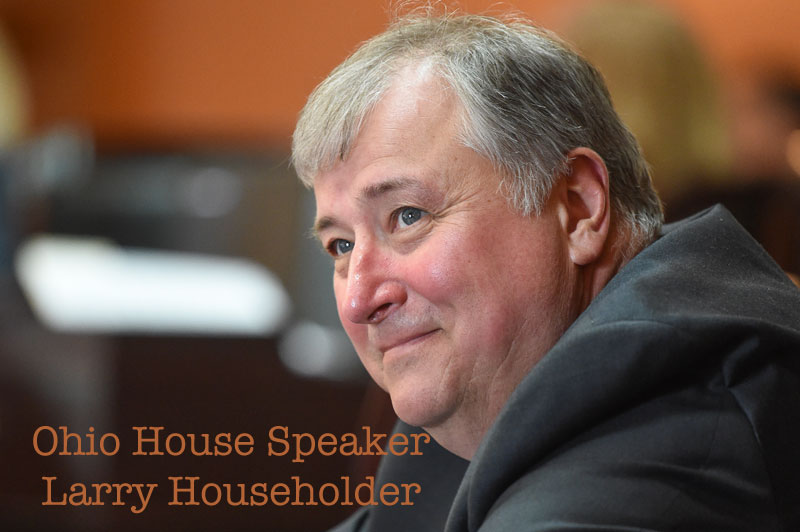
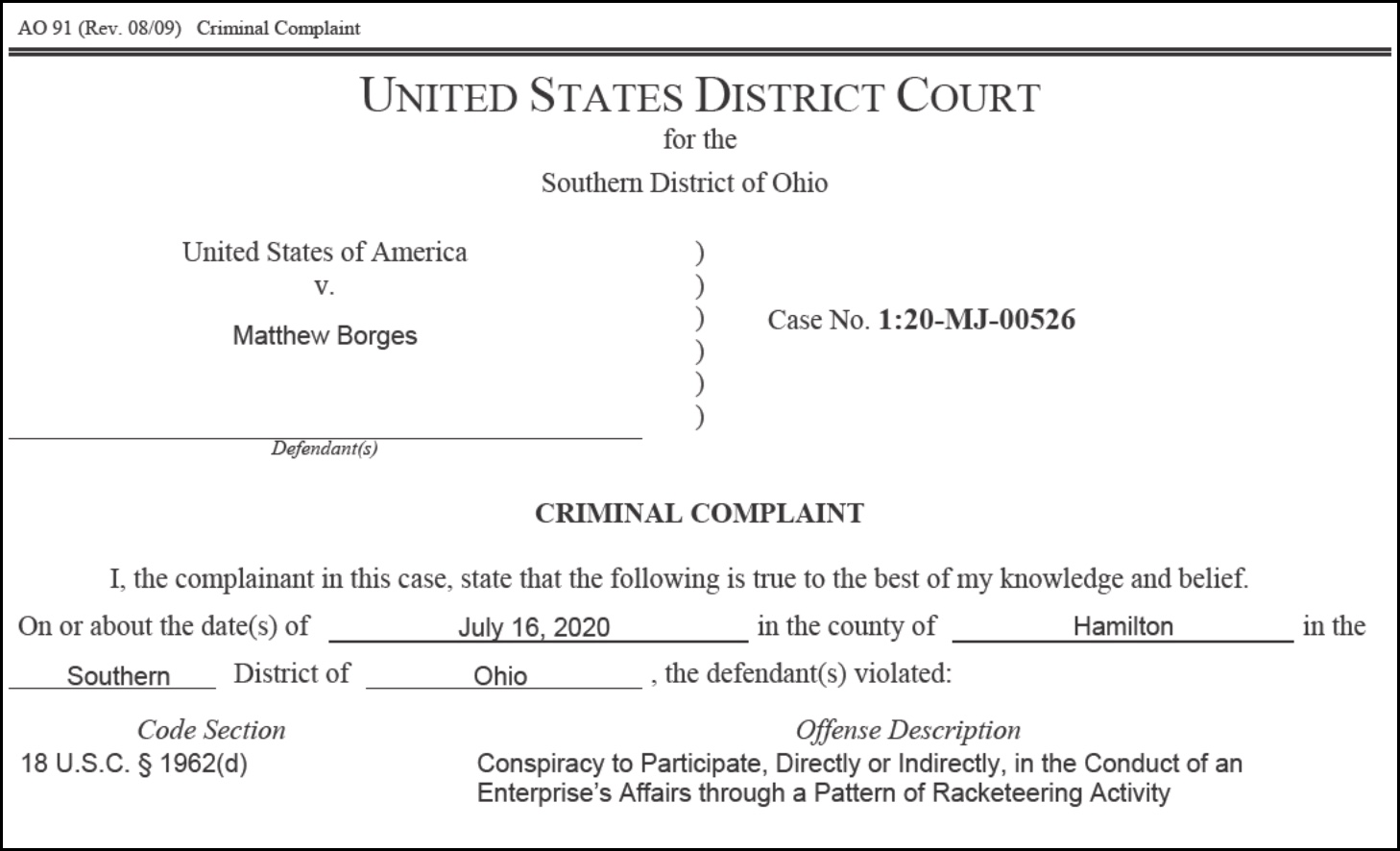
Cincinnati, Ohio – Ohio House Speaker Larry Householder, four political operatives and a dark-money group were charged Tuesday in a criminal complaint that an Ohio energy company paid them $61 million to get a $1.5 billion nuclear bailout from taxpayers.
Read the Press Release issued by the Department of Justice
Neil Clark, a lobbyist who owns Grant Street Consulting – Photo from Grant Street Consulting who exclaim, “Clark’s decades of experience and role in shaping Ohio’s political landscape makes him an indispensable resource to Ohio’s elected leaders, to whom he often serves as a trusted and highly sought after campaign advisor.”
All are charged with racketeering, which carries a prison sentence of up to 20 years.
David M. DeVillers, U.S. Attorney for the Southern District of Ohio
The alleged conspiracy, which revolved around the bailout of two failing nuclear plants in Northern Ohio, is “likely the largest bribery and money-laundering scheme ever in the state of Ohio,” David M. DeVillers, U.S. Attorney for the Southern District of Ohio, said at a Tuesday afternoon press conference.
Shortly after the press conference, Ohio Gov. Mike DeWine called on his fellow Republican to step down.
“I am deeply concerned about the allegations of wrongdoing in the criminal complaint issued today by the U.S. Attorney’s Office,” DeWine, who last year signed the bailout into law, said in a written statement. “Every American has the presumption of innocence until proven guilty. Because of the nature of these charges, it will be impossible for Speaker Householder to effectively lead the Ohio House of Representatives; therefore, I am calling on Speaker Householder to resign immediately. This is a sad day for Ohio.”
The criminal complaint says that “Company A,” the former FirstEnergy Solutions of Akron, worked to save its failing nuclear plants by funneling $61 million into Generation Now, a 501(c)(4) “dark money” group controlled by Householder.
On September 9, 2019, President Donald Trump nominated DeVillers for the United States Attorney in the Southern District of Ohio. The Senate confirmed the nomination in October, and DeVillers took his oath on November 1, 2019.
“Make no mistake, this is Larry Householder’s 501(c)(4),” the U.S. attorney said.
The money was used for three general purposes, the complaint said. First it was used to build “Team Householder” through campaign contributions and other measures that helped Householder win the speakership in 2019.
“In exchange for payment from Company A, Householder’s enterprise helped pass House Bill 6, legislation described by an enterprise member as a billion-dollar ‘bailout’ that saved from closure two failing nuclear power plants in Ohio affiliated with company A,” the complaint said
The money was also used for the personal benefit of Householder and the other conspirators, DeVillers said. Householder got about $500,000, he said.
Despite the companies claims of poverty, the interests behind the bailout spent millions — much of it in the form of hard-to-trace dark money on campaign contributions, a xenophobic ad campaign and then on an aggressive effort to stymie a petition drive to repeal the bailout DeWine signed into law a year ago.
And the money was used to fend off a petition effort to repeal HB6, going so far as to buy plane tickets for and pay $1,000 each to people circulating it to get out of town, DeVillers said.
The federal prosecutor said that it was crucial to keep the investigation secret until Tuesday. Now it begins a new phase that might be causing some lawmakers, energy executives and some others to lose sleep.
“We are not done with this case,” he said. “There were things we couldn’t do before. People we couldn’t interview. People we couldn’t subpoena. Documents and search warrants we couldn’t execute.
“As of this morning there are a lot of FBI agents knocking on a lot of doors asking a lot of questions, serving lots of subpoenas. That’s going to go on for days.”
“It takes courage for citizens to assist law enforcement in the ways detailed in the affidavit,” U.S. Attorney David M. DeVillers said. “We are grateful to those who felt a moral duty to work together with agents in bringing to light this alleged, significant public corruption.”
House Bill 6 is adding $1.5 billion in additional taxpayer bailouts to the $10.2 billion that Akron-based FirstEnergy Solutions and its former parent company, FirstEnergy Corp, have received from taxpayers since 1999. Most of the funds have gone to prop up the Davis-Besse and Perry nuclear power plants in Northern Ohio.
The company that owns the plants was renamed Energy Harbor after emerging from bankruptcy earlier this year.
Despite the companies claims of poverty, the interests behind the bailout spent millions — much of it in the form of hard-to-trace dark money on campaign contributions, a xenophobic ad campaign and then on an aggressive effort to stymie a petition drive to repeal the bailout DeWine signed into law a year ago.
The interests behind the nuclear bailout also contributed heavily to the effort at the beginning of 2019 to elect Householder speaker. He ended up winning the support of 26 Republicans and 26 Democrats, His opponent, Ryan Smith, R-Bidwell, got the votes of 34 Republicans and 12 Democrats.
The Ohio Republican Party didn’t respond Tuesday to requests for comment.
The Ohio Democratic Party didn’t respond when asked about the fact that Householder wouldn’t have worn the speakership without Democratic votes. However, the party chairman, David Pepper called on Householder to step down as speaker.
“As the U.S. attorney indicated, this investigation is ongoing, and we will wait to hear all the facts as they emerge. However, given what was revealed in today’s complaint and the taint of corruption over Ohio legislative activity, we believe Speaker Householder should step down from leadership immediately as he avails himself of his due process rights,” Pepper said in a written statement.
House Bill 6, which passed 51-38, was quickly signed into law by Gov. Mike DeWine. Under the bill, from 2021 until 2027, every Ohio electricity customer will have to pay a new monthly surcharge that ranges from 85 cents for residential customers to $2,400 for large industrial plants. Ratepayers around the state would also have to chip in up to $1.50 monthly (and up to $1,500 per month for commercial and industrial users) to subsidize coal plants in Ohio and Indiana run by the Ohio Valley Electric Corporation.- cleveland.com
Starting next January, ratepayers around the state would also have to chip in up to $1.50 monthly (and up to $1,500 per month for commercial and industrial users) to subsidize coal plants in Ohio and Indiana run by the Ohio Valley Electric Corporation.
This isn’t Householder’s first encounter with federal law enforcement.
In 2006, the Justice Department told the FBI that it wouldn’t pursue charges against Householder. The FBI had been told two years earlier that Householder had used his post as head of the House Republican Campaign Committee to overpay some vendors in exchange for kickbacks from them.
Nor is Householder, 61, of Glenford, the first Ohio House speaker to find himself in the FBI’s crosshairs. In 2018, Speaker Cliff Rosenberger, a Republican, resigned amid an FBI probe of his overseas travel. He has not been charged, but the investigation remains open.