Tag: Ohio House

  • In GOP flip, August special election will return

    In GOP flip, August special election will return

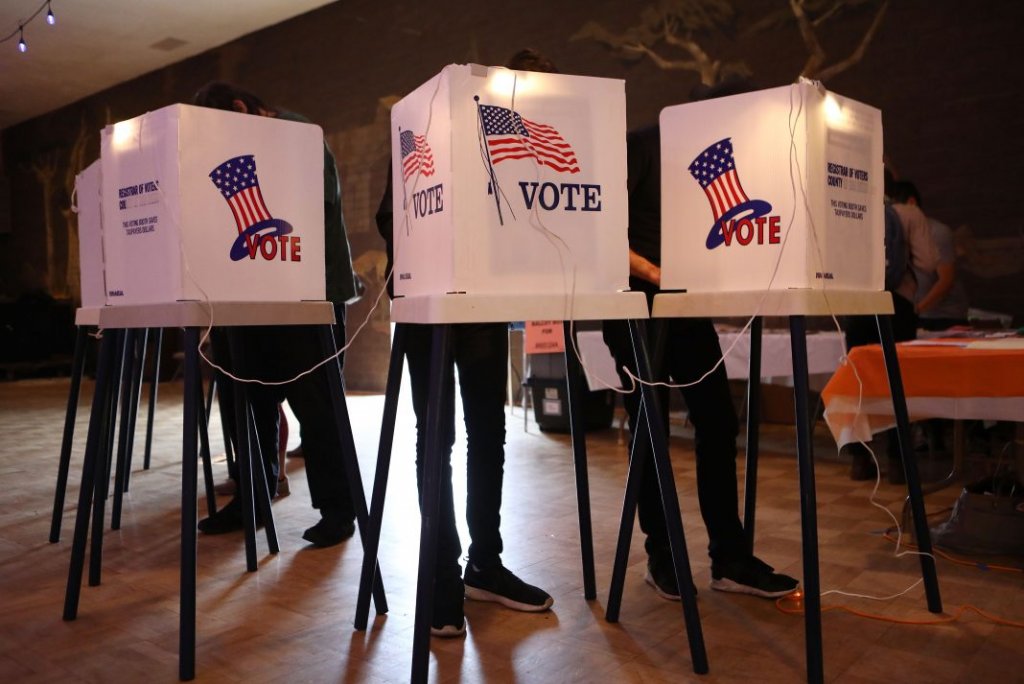
    Voters casting ballots. | Mario Tama/Getty Images

    Bill, along with SJR 2 constitutional amendment bill, directly impact abortion rights ballot initiative

    BY:  – Ohio Capital Journal

    Less than half a year after proclaiming August elections to be too expensive for the turnout they attract, the Senate Republican majority expanded the use of a special election this year, complete with $20 million in funding.

    “This is legislative whiplash, and we do it really well here in Columbus,” said state Sen. Kent Smith, D-Euclid.

    In a mostly party-line vote, Senate Bill 92 was passed Wednesday by the body. The only Republican to vote against SB 92 was state Sen. Nathan Manning, R-North Ridgeville.

    The vote came immediately after the state senate also passed an increase in the threshold for passing a constitutional amendment from 50% to 60% along party lines.

    The threshold bill, SJR 2, is a companion bill to HJR 1, which has been making its way through the Ohio House, but has yet to come up for a floor vote. The House resolution passed its committee after three hours of testimony on Wednesday, most of which spoke in opposition to the bill.

    Both bills could lead to a ballot measure where voters would approve or deny a constitutional amendment to raise that threshold.

    With the approval of SB 92, August special elections will now be held “for consideration of a General Assembly proposed constitutional amendment,” to fill a congressional vacancy or hold a special primary for congressional party candidates.

    The bill also appropriates $20 million to conduct “a one-time August special election on August 8, 2023,” a funding influx made while the bill was in committee.

    That August election would be to send a constitutional voter threshold to the ballot for voters to approve an legislature-initiated amendment to raise the threshold from 50% to 60%.

    Republicans pushed back on comparisons between previous August elections, including last year’s that saw an abysmal 8% turnout, with the argument that this time around, voters will care.

    “With this being a bonafide, statewide question, and with it being an important question … I would say the turnout is going to be markedly higher in this August election,” McColley told his colleagues on the Senate floor.

    The legislative measures seem to be direct hits at a potential constitutional amendment that would codify abortion rights if it makes it to the ballot box and is approved by voters in November. Abortion rights advocates are currently collecting the needed signatures. State law currently requires more than 400,000 in 44 of the 88 states.

    One of the pro-abortion rights groups helping with the ballot measure, Pro-Choice Ohio, called the passage of SB 92 “both expected and incredibly disappointing” in a post on Twitter.

    Last year, after redistricting confusion rocked the legislature, Republicans all-but eliminated the August election in a move that they said would save the state money and get rid of an unneeded annual election date that historically had low voter turnout.

    In August of last year, the special primary election included statehouse races because the redistricting maps were rejected by the Ohio Supreme Court before they could be included in the May election. A U.S. District Court then intervened in the legal snarl that swept up the redistricting process, and allowed the state to use a map previously deemed unconstitutional by the Ohio Supreme Court as the map for the August primary.

    That map is still in effect currently.

    Speaking in opposition for SB 92, state Sen. William DeMora, D-Columbus, quoted Ohio Secretary of State Frank LaRose who spoke in support of reducing August special election usage last year, when he said they “aren’t good for taxpayers, election officials, voters or the civic health of our state.”

    “(SB 92) is so bad that (LaRose) Secretary LaRose couldn’t even find the time to come and testify about it in committee,” DeMora said.

    State Sen. Theresa Gavarone, R-Bowling Green, said claims that the August special elections were eliminated last year was an exaggerated claim.

    “We’re not reinventing the wheel on this legislation,” Gavarone said, pointing out that certain occasions allowed for an August special election.

    SB 92 now moves to the House for consideration.

    _____________________

    Susan Tebben is an award-winning journalist with a decade of experience covering Ohio news, including courts and crime, Appalachian social issues, government, education, diversity and culture. She has worked for The Newark Advocate, The Glasgow (KY) Daily Times, The Athens Messenger, and WOUB Public Media. She has also had work featured on National Public Radio.


    MORE FROM AUTHOR

  • Ohio education overhaul falls short

    Ohio education overhaul falls short

    BY: SUSAN TEBBEN – Ohio Capital Journal

    The Ohio House did not agree to Senate amendments to a bill banning trans athletes from participating in youth sports based on their gender identity, leaving behind more than a thousand pages of state education overhauls loaded in at the last minute.

    House Bill 151, with language from Senate Bill 178 attached to it was voted down in the House by a 46-41 vote after 2 a.m. on Thursday morning following an entire day of hemming and hawing.

    The education overhaul is not completely done yet. Even if lawmakers decline to move forward in the current General Assembly, Senate President Matt Huffman previously pledged to bring the bill back in the new year, with a General Assembly that will have an even larger GOP supermajority.

    The education overhaul part of the bill, which entered the House as a standalone this week after passing the Senate last week, would have restructured the Ohio Department of Education into the Department of Education and Workforce, and reduced the state Board of Education roles down to superintendent searches, teacher conduct and licensure issues.

    “The system is not working, it doesn’t prioritize our students,” said bill sponsor state Rep. Don Jones, R-Freeport.

    The department, and most of the roles currently under the state board of ed and state superintendent’s purview would have been put under the governor’s office umbrella, according to the bill.

    The State Board of Education put off hiring a search firm for the next superintendent due to concerns about budgetary changes SB 178 might bring and fears the legislative uncertainty might “pollute” the marketplace of candidates.

    The bill also received pushback from public school education advocates and some homeschooling groups. The Ohio Education Association and the Ohio Federation of Teachers both spoke against the bill in committee hearings, not only decrying claims that the ODE was unresponsive and inaccessible, but also criticizing the pace at which the bill came through the General Assembly.

    SB 178 sponsor state Sen. Bill Reineke, R-Tiffin, said attempts to redo the state agencies have been years in the making and urgency is needed to help improve student success.

    “I’m not looking at growing an organization; I’m looking at making it more efficient and more structurally purposeful,” Reineke said on Tuesday as he defended his bill in House Primary and Secondary Education Committee.

    It was up to that committee to pass the standalone bill over to the House for a full vote, something that didn’t happen in a Tuesday night committee that went until about 9 p.m., or a Wednesday morning meeting that recessed before the House’s session began, and didn’t return even after multiple recesses in that body.

    When committee chair state Rep. Gayle Manning, R-North Ridgeville, was asked the status of the bill or the committee at about 9 p.m. Wednesday night, she said she was waiting to see what the GOP caucus was thinking on the matter.

    Amidst the day-long discussion, the Senate decided to take matters into its own hands, inserting SB 178 into HB 151, originally meant to be a teacher mentorship bill that was made to include a ban on athletes competing on teams based on their gender identity.

    The Senate also tried to slide in language from a bill that would have banned COVID-19 vaccine mandates for K-12 students.

    After the additions, HB 151 passed on a party-line 23-7 vote in that chamber, moving it back to the House.

    The controversial part of HB 151 was added in another late-night move in June, when HB 151 was up for passage in the House before moving on to the Senate. The trans athletes part of the bill no longer includes a requirement for genital inspections of children suspected of being transgender, something Senate President Matt Huffman previously said he wouldn’t support.

    Verification of a student’s gender will be done using a birth certificate in the new version of the bill.

    The bill’s sponsor, state Rep. Don Jones, R-Freeport, wouldn’t speak on the trans athletes part of the bill when he introduced the bill in the Senate, but on the House floor he stood in support of it.

    “This bill only applies to K-12 education, so our daughters in grades kindergarten through 12 will not have to compete with biological males in primary and secondary schools,” Jones said.

    The bill would impact very few Ohio students and policies are already in place to keep equality in youth sports, causing LGBTQ advocates, education leaders and the Ohio High School Athletic Association to stand against the bill as unnecessary.

    The original language of the bill would make changes to the Ohio Teacher Residency Program and teacher mentorship.

    Democrats pushed hard for the House not to support the bill as amended, saying stakeholders needed to be involved and more time was needed to find out the impact of it.

    State Rep. Phil Robinson, D-Solon, continued an argument made by critics of the bill that the volume of the bill didn’t get the proper review by legislators or individuals in Ohio education.

    “Passing something at 1 o’clock or 2 o’clock in the morning that no one’s read and no one’s seen … is not the way to change education in the state of Ohio,” Robinson said.

    State Rep. Jeff Crossman, D-Parma, said the bill was “moving deck chairs on a sinking ship” by addressing issues that don’t solve the true problems in Ohio education.

    State Rep. Juanita Brent, D-Cleveland, said the bill would impact economic success in Ohio by making conferences question coming to the state and businesses wonder whether or not to bring employees to the state. She also said passage of the bill in the middle of the night would send a message to current Ohio voters as well.

    “We’re telling Ohioans who elected us that they can’t be seen in this process,” Brent said.

  • Minimum wage increase brought to Ohio House committee

    Minimum wage increase brought to Ohio House committee

    BY: SUSAN TEBBEN – Ohio Capital Journal

    A new push for a $15 minimum wage was introduced in the Ohio House, attempting to speed up the progress of a constitutional amendment passed nearly two decades ago.

    Democratic state Reps. Dontavius Jarrells and Brigid Kelly said their new bill not only addresses criticisms of quick implementation of a minimum wage increase, but also make a difference for struggling Ohioans.

    “We heard concerns of colleagues and made a longer runway for the increases,” Kelly told the House committee on Commerce and Labor. “But the longer we wait to act, the less impactful this action will be.”

    House Bill 69 would phase in those increases to reach $15 per hour by 2027.

    Since the bill never received a hearing after it was initially filed in February of 2021, an amendment would be needed to change the language, which set the first increase to happen on Jan. 1, 2022.

    The sponsors pointed to a constitutional amendment passed in 2006 that raised minimum wage in Ohio yearly with the rate of inflation. With inflation at the highest level since the Reagan administration, the minimum wage starting January 2023 will be $10.10 per hour, and $5.05 for tipped employees.

    “The bottom line is this: When people have more money in their pockets, they spend it and they spend it in businesses and communities all across Ohio,” Kelly said.

    Jarrells said he receives calls to his office often talking about hard decisions families in Ohio are making, like putting food on the table in lieu of needed medications, because affording both isn’t an option.

    “When we think about the impact of just not thinking critically about how do we make sure salary or wages match our productivity, there are families who simply are going without,” Jarrells said.

    Debate in the committee centered around whether adding more money would solve problems, namely bringing people back to the workforce.

    State Rep. Don Jones, R-Freeport, argued that some businesses are offering more than $15 per hour, or at least increasing pay, and still aren’t able to bring more employees in. He said the issue was the workforce, not the wage.

    “We can sit here and raise the minimum wage to $15 an hour, and people are going to want $20,” Jones said.

    He used the example of a McDonald’s offering $13 an hour, though he didn’t specify whether the job was full-time or part-time.

    Kelly said though food serve and retail workers are among those struggling to pay bills because of low wages or low hours, the problem extends to other categories of workers, like home health services. She and Jarrells agreed that while they see wage as a fixable issue on its own, there’s no reason not to work on both wage and workforce.

    “We can think about what we would like aspirationally to be true, or we can think about what people are experiencing right now, which a lot of time is multiple part-time jobs, no benefits, challenges with transportation, challenges with housing security, and also working with governmental agencies to get benefits that aren’t necessarily aligned with one another,” Kelly said.

    The bill is flanked by a proposed ballot initiative, which would bring the minimum wage to $15 per hour in 2028.

    But if neither the bill — which faces a Republican supermajority and a quick timeline with the General Assembly set to end Dec. 31 — nor the ballot initiative are successful, that doesn’t mean more legislative measures aren’t on the horizon. Kelly expressed confidence that Jarrells would continue the efforts in the next General Assembly.

    “We can continue to ignore it at our own peril, but Ohioans deserve better, they’ve earned and deserve a raise,” Kelly said.

  • Anti-LGBTQ discrimination bill with bipartisan support introduced again in Ohio House committee

    Anti-LGBTQ discrimination bill with bipartisan support introduced again in Ohio House committee

    A LGBTQ+ rights demonstration. Photo by Susan J. Demas, Michigan Advance, States Newsroom.

    BY: SUSAN TEBBEN – Ohio Capital Journal

    State Rep. Michael Skindell, D-Lakewood, set off Tuesday on his 20th year leading the charge to provide anti-discrimination protections to LGBTQ Ohioans.

    With the introduction of HB 208 in the Ohio House Commerce & Labor Committee, Skindell and his Republican co-sponsor, state Rep. Brett Hillyer, said they have more bipartisan support than they’ve ever had in the past, though the uphill battle of the GOP supermajority isn’t without its challenges.

    The bill before the committee now, also called the Ohio Fairness Act, has been awaiting consideration since March 2021. It would change any part of the Ohio Revised Code regarding discrimination to include not just “sex,” but also “sexual orientation” and “gender identity or expression.”

    Existing religious exemptions would still be a part of law if the bill is passed.

    The earliest iterations of the bill didn’t have the support of businesses across the state, which Skindell said was a barrier to passage for the previous versions.

    Now, the sponsors say businesses are behind the bill, and employment laws that are inclusive to LGBTQ individuals are part of the “scoring” Hillyer said companies use to decide locations for expansion and job creation.

    Ohio Business Competes, a coalition in support non-discrimination policies for LGBTQ Ohioans, has seen its membership triple to more than 1,000 businesses, according to Skindell.

    “It is also important to mention that the Ohio Chamber of Commerce, the Ohio Manufacturing Association, Greater Cleveland Partnership, Columbus Chamber of Commerce, and the Cincinnati USA Regional Chamber of Commerce support this pro-business, non-discrimination legislation,” Skindell told the committee on Tuesday.

    Along with business support, 37 cities in the state have passed their own local ordinances against sexual orientation and gender identity discrimination in categories like housing and employment.

    While Hillyer acknowledges the bipartisan support isn’t overwhelming for the bill, he expects to see more GOP backing based on the party’s desire to keep Ohio economically competitive.

    “Unfortunately, this particular issue, the issue that is in front of us, divides us,” Hillyer said. “It hurts our caucus, it hurts Ohioans when you start talking about what do we stand for as representatives and people.”

    To truly be business friendly, Hillyer said the party, and the legislature as a whole, has to “get back down to supply economics” and not fight anti-discrimination measures.

    “Let’s go fight our real battles that we want to argue about and hit each other over the head with all day, but let’s leave this issue off the table and make Ohio open for business,” Hillyer said.

  • Jean Schmidt’s newest ‘divisive concepts’ bill enters Ohio House

    Jean Schmidt’s newest ‘divisive concepts’ bill enters Ohio House

    Prohibits all Ohio schools from “teaching or providing training that promotes or endorses divisive or inherently racist concepts.”

    BY: SUSAN TEBBEN –  Ohio Capital Journal

    The newest bill to regulate school curriculums and keep out what legislators see as “divisive concepts” entered the Ohio House on Tuesday.

    State Reps. Jean Schmidt, R-Loveland, and Mike Loychik, R-Bazetta, brought House Bill 616 to the State and Local Committee, which prohibits all Ohio schools from “teaching or providing training that promotes or endorses divisive or inherently racist concepts.”

    Though the co-sponsors said they want to deputize the State Board of Education with making decisions about what those concepts would be, the bill includes “critical race theory,” a misnomer used by conservatives to refer to the teaching of race in American history, and name the “1619 Project,” a New York Times project that laid out the chronology of slavery and racism, as concepts that would be prohibited under the bill.

    “Diversity, equity and inclusion learning outcomes” (DEI) are also named as “divisive or inherently racist concepts” under the bill. When asked to explain DEI and why it’s being prohibited, Loychik connected DEI to “critical race theory,” saying the two are connected based on research he and Schmidt had made.

    “The word ‘critical race theory’ was not very well accepted at that point in time, so it was re-developed into DEI – diversity, equity and inclusion – and based off our research, like I said before, it’s very, very similar to the teachings under critical race theory,” Loychik told the committee.

    DEI trainings have been used in schools to train employees about learning disparities that can happen in education.

    The well-known conservative public policy think tank The Heritage Foundation connects CRT and DEI, saying diversity trainings “pressure employees to become activists or to discuss controversial topics in the workplace.”

    Part of the bill prohibits teaching kindergartners about topics related to gender.

    “It ensures that sexual orientation and gender ideology are not taught in kindergarten through third grade,” Loychik said. “Starting in fourth grade it must be age appropriate.”

    Loychik has made his feelings on gender in schools clear through posts on his Twitter, in which he said “the left thinks a 6-year-old should be able to change their gender but an 18-year-old shouldn’t be able to buy a firearm,” and asks for support not to allow “teaching transgenderism or allowing teachers to discuss their sex life with kindergarteners.”

    Under the newest bill, the State Board of Education would also be required to “establish a procedure by which individuals may file complaints against a teacher, school, administrator, or school district superintendent alleging a violation of the bill’s prohibitions and to adopt rules to govern the implementation of and monitor compliance with the bill’s provisions,” according to Legislative Service Commission analysis of the bill.

    Democratic committee members pushed back on the bill’s language, decrying it as “censorship” and questioning the vague language used, and the state board of education’s role in defining the off-limits topics in school curricula.

    “That’s the responsibility of legislators to define these terms,” said state Rep. Mike Skindell, D-Lakewood.

    The co-sponsors said they would be willing to consider amendments to the bill, but said the focus of the bill is on curriculum, not disciplinary regulations or hallway disagreements.

    Loychik said the school district’s role would be to address disciplinary problems, and “hall monitors” could deal with school-day disagreements regarding “divisive concepts.”

    Schmidt said “invited guests,” such as state legislators, would be allowed to “talk about what they want to talk about,” because it’s not a part of the curriculum, answering a question from state Rep. Tavia Galonski, D-Akron.

    “There is a lot to discuss in the schools, and by no means would any kind of prohibition or any type of censorship be the answer for it,” Galonski said.

    Education groups like Honesty for Ohio Education have criticized the bill as a “nationally coordinated educational gag order.”

    This is the third “divisive concepts” bill to come through the Ohio legislature, with the last bill receiving heavy criticism after one of the co-sponsors said equal time should be given on both sides of Holocaust lessons. Neither bill has passed through the General Assembly.

  • House bill would make voters choose safety measures in schools

    House bill would make voters choose safety measures in schools

    Getty Image

    BY: SUSAN TEBBEN – Ohio Capital Journal

    A bill that may be up for a vote soon in the Ohio House would put the decision of whether or not to have a school resource officer up to the voters in each school district.

    House Bill 501 seeks to change Ohio law that the sponsors of the bill say doesn’t define “school safety and security,” though it does include mental health services, safety training and safety personnel.

    School resource officers, which are typically certified law enforcement officers use through an agreement with the officer’s police or sheriff’s department, would be included in the “safety personnel” part of Ohio law, under the new bill.

    If passed, the bill would leave that school safety and security definition up for voters by authorizing school boards to levy property tax “for the specific purpose of providing for SRO services, as opposed to safety and security in general,” according to an analysis of the bill by the Legislative Service Commission.

    Municipalities and townships will also be able to levy property taxes “for the specific purpose of funding SRO services for school districts located within their territory” under the bill, according to the LSC.

    The bill had its third hearing in House Ways and Means Committee on Tuesday, with no testimony and not changes to the SRO part of the bill. Committee chair state Rep. Derrick Merrin said the bill may be voted on at the next committee meeting.

  • Ohio HB 616: This type of legislation and mentality must be met head-on and forcefully resisted and debunked

    Ohio HB 616: This type of legislation and mentality must be met head-on and forcefully resisted and debunked

    Aaron West

    by Aaron West

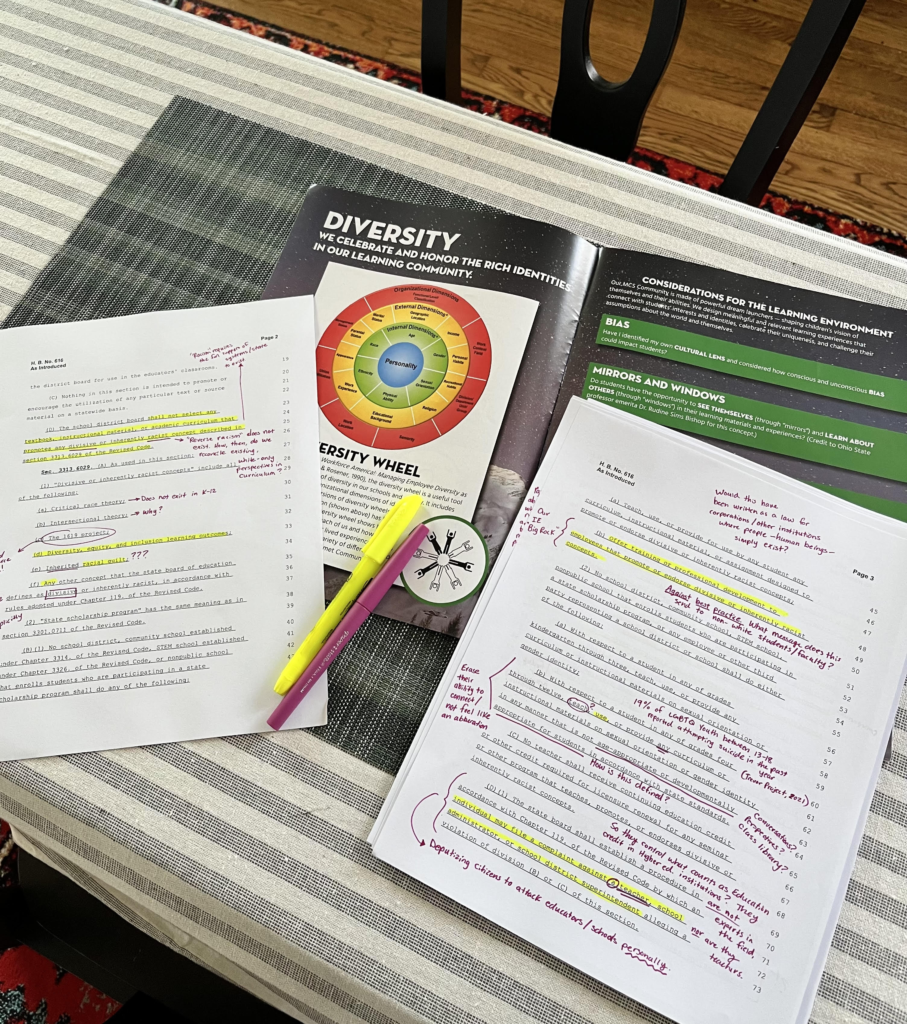
    At the beginning of each school year, I teach my students how to annotate. I want them to pay close attention to what they read, and I encourage them to ask questions about it. Today, I had to practice what I teach. I grabbed a highlighter and every teacher’s friend (a felt-tipped pen) all because of one proposed bill: Ohio HB 616.

    If you aren’t familiar, this bill copies and pastes direct lines from both Florida’s recently-passed ‘Don’t Say Gay’ bill and a litany of other bills passed by certain legislatures attacking Critical Race Theory (which doesn’t exist in K-12 classrooms), “divisive” concepts, and anything that might make anyone feel “guilty.” 

    I have read all 18 pages of this bill and placed here for you two particular ones next to an open copy of my district’s Inclusion guide. I want to show you, firsthand, just how antithetical this is to the field of education. Culturally-responsive education that acknowledges students’ identities is best practice—and we will be at risk of losing our licenses and funding for it should this bill—or any similar form of it—pass. We will be targeted and discharged for doing what is actually right by the professional standards in our field.

    We will be targeted and discharged for doing what is actually right by the professional standards in our field.

    In this bill, you’ll find vague language that isn’t defined; the enabling of any citizen to personally report teachers, administrators, and superintendents for discipline; the threat of punishment for including diversity/equity/inclusion training for staff or students; and consequences for using any curriculum (including my own classroom library) that includes any “divisive” or “racist” (here meaning “non-white”) perspectives or concepts.

    Most personal to me, this bill needlessly includes language whose intention is to further alienate and marginalize LGBTQ+ youth. For the first twenty-six years of my life, I was afraid to admit that I was gay. Had my experience in school (and elsewhere) been different, more representative, that may have been different. I may have been healthier and felt like there was a place for me, my identity—as I was.

    I don’t know if this bill will make it through a committee or whether it will ultimately be passed, but here’s what I do know.

    • 19% of LGBTQ+ youth ages 13-18 reported attempting suicide at least once in 2021 (The Trevor Project)

    • Some form of this bill, and more of the like, will continue to crop up—in Ohio and elsewhere across the U.S.

    • This type of legislation, and really, these mentalities, must be met head-on and forcefully resisted and debunked.

    • We must continue to vote en masse. In every election—locally and otherwise. Vote for people who will not make a culture war of the most vulnerable lived experiences. Vote for your teachers, your medical professionals, your neighbors who are Black or gay or some other “divisive” subset. Inclusion at the elected level is an antidote to the misguided assumption that this is desirable or even acceptable to most.

    • It’s important to remember that one of the noblest goals of quality public education is to make space for all; it is about more seats at the proverbial table. This bill seeks to send a chilling reminder that—still, in 2022—so many must raise their voices as though to ask permission to simply exist or belong.

    If you live in Ohio, you can make your voice heard on this bill by contacting the following:

    House Speaker Robert Cupp (R): (614) 466-9624

    Caucus Minority Leader Allison Russo (D): (614) 466-8012

    Other Ohio House Representatives

    Rep. Jean Schmidt (R-Loveland) Co-introduced HB 616 with Rep. Mike Loychik

    Rep. Mike Loychik (R-Bazetta) Co-introduced HB 616 with Rep. Jean Schmidt

  • Governor appoints former lawmaker to elections board who hyped up 2020 voter fraud claims

    Governor appoints former lawmaker to elections board who hyped up 2020 voter fraud claims

    Christina Hagan-Nemeth. Source: Ohio General Assembly.

    BY: JAKE ZUCKERMAN – Ohio Capital Journal

    Gov. Mike DeWine appointed a former lawmaker to a state board that oversees political campaigns who has publicly amplified debunked notions of election fraud in 2020.

    Christina Hagan-Nemeth, who served in the Ohio House before mounting two unsuccessful congressional bids, was appointed Tuesday to the Ohio Elections Commission. Her term runs through the end of 2026.

    A review of her public social media posts and talk radio appearances show she amplified the unsupported and repeatedly discredited claim that President Joe Biden somehow stole the election from Donald Trump. With the appointment, she now sits on a panel responsible for reviewing allegations of campaign finance violations and other offenses. The commission can levy fines, make criminal referrals, and intervene in campaigns at politically sensitive junctures.

    “The American people are entitled to an honest election,” Hagan wrote on social media Nov. 7, 2020, the day TV networks first projected Biden would win enough states to clinch the electoral college.

    “All legal votes should be counted. If you think these are controversial statements you must not agree w/safeguarding the sacred value of our individual votes as Americans.

    Ten days later, she made similar comments.

    “I’ve never prayed for fraud. But I have prayed that if it exists and especially to the degree to which its exposure can change the media’s projected outcome of the election…That it should be brought to light in a profound and irrefutable way,” she wrote. “I’m on team #EveryLegalVoteShouldCount.”

    Hagan, a Republican, did not respond to a phone call, text, or message to her personal Facebook account.

    DeWine has walked a tightrope since 2020 of denying the existence of widespread voting fraud but refraining from criticism of Trump — the leading proponent of the “stop the steal” movement. Speaking to CNN’s Jake Tapper on Jan. 3, 2021, DeWine refused to answer when asked why so many people believe that widespread election fraud occurred in 2020.

    He didn’t answer questions about Hagan’s statements, only noting through a spokesman that her appointment was recommended by Republican leaders in the state House and Senate.

    On Jan. 6, 2021, a crowd of hundreds of Trump supporters, swept up in his claims of a stolen election, violently stormed the U.S. Capitol seeking to halt certification of the 2020 election. Over the course of about seven hours, the attackers injured 114 police officers and caused about $1.5 million in damages, according to a U.S. Government Accountability Office report. Several officers died in the aftermath, including four by suicide. A Trump supporter was shot and killed after crawling through a transom window toward members of congress.

    Two weeks later, Hagan posted to her Facebook page an article written by Tony Perkins, leader of the Family Research Council, an anti-LGBTQ organization. The article depicts some Jan. 6 rallygoers as “peaceful protesters who desperately wanted to be counted.” Others, it states, weren’t peaceful but “were just as concerned about the future of elections after what happened in November.”

    Discussing the one-year anniversary of the riot on a conservative talk radio show, Hagan mocked a comment from Vice President Kamala Harris comparing Jan. 6 to other hallowed days in American history like 9/11 or the attack on Pearl Harbor.

    “I think the most dramatic word that we can accurately use [to describe Jan. 6] would be a riot, but not even, because there were really — nothing was defamed, nothing was attacked to any degree,” she said.

    In February 2021, Hagan shared an article from a conservative news outlet about the Supreme Court’s review of election fraud lawsuits.

    “SCOTUS now adds ELECTION FRAUD LAWSUITS to List of Cases To Be Considered… Not Loving the timing… But better late than never,” she said.

    She made similar comments a few days later, saying it “could get interesting” that the Supreme Court is scheduled to consider voter fraud cases in three states Biden won. The Supreme Court denied the request to consider the cases later that month.

    On a few occasions, she has accused Democrats of election fraud. In May 2020, the U.S. House passed legislation that would have prohibited states from requiring any form of identification to obtain an absentee ballot. Hagan said this shows that Democrats are trying to “rig the next election.” She made similar comments on talk radio about two bills that would overhaul election administration via prohibiting voter identification requirements, reinstating parts of the Voter Rights Act that were struck down by the Supreme Court, and more.

    “They are always, always aiming to undermine,” Hagan said. “And every single word that comes out of their mouth is orchestrated for that intentional destruction.”

    Elections commission

    The Ohio Elections Commission is a seven-member panel comprised of three Republicans, three Democrats, and one independent.

    On Tuesday, DeWine also appointed John Lyall, a Democrat, to serve on the commission.

    As recently as last week, Hagan circulated petitions to run for congress, according to the Cleveland Plain Dealer. But on March 4, she publicly announced she wouldn’t run for the seat.

    She first won office to the Ohio House in 2010 at the age of 21, where she served for eight years, the constitutional maximum. In 2018, she lost in a congressional primary to current Rep. Anthony Gonzalez — one of 10 Republicans who voted to impeach Trump in connection with Jan. 6 and has denounced the idea that the election was stolen.

    At the time, she used a campaign ad calling for a need to “secure our borders” and stop illegal immigration from Mexico. Snopes, the fact checking website, later reported the ad used footage from an Italian TV network showing Moroccan immigrants crossing into Spain.

    Trump endorsed Hagan in her 2020 run for the same seat, according to WKYC.

  • House to vote on removing training, background check requirements for concealed carry

    House to vote on removing training, background check requirements for concealed carry

    File photo from Wikimedia Commons attributed to St. Louis Circuit Attorney’s Office.

    “Guns don’t kill people, people kill people”

    House Speaker Bob Cupp

    BY: JAKE ZUCKERMAN – Ohio Capital Journal

    The Ohio House will vote, once again, on legislation to remove training and permitting requirements to carry a concealed handgun in the state.

    House Speaker Bob Cupp, R-Lima, said the legislation, which a House committee passed out on Tuesday, will be up for a passage vote at a floor session Wednesday afternoon.

    Because the House adopted two amendments to the bill, it will need to return to the Senate for approval. Cupp said it will “hopefully” pass over in time for a Senate concurrence vote, meaning the bill could be sent to the governor’s desk come Wednesday afternoon.

    However, Senate President Matt Huffman, R-Lima, indicated the Senate would not vote on the bill Wednesday so members could analyze the changes. The Senate passed the legislation in December in a 23-8 vote, with all but one Republican in support. All Democrats opposed the legislation.

    Senate Bill 215, sponsored by Republican Sen. Terry Johnson of McDermott, would remove the requirement under current law that gun owners obtain a license to carry a concealed weapon from their local sheriff. The application requires completion of an 8-hour training course and clearing a background check.

    Instead, any Ohioan aged 21-and-up who can lawfully possess a gun would be allowed to conceal and carry the weapon.

    Between 3,000 and 5,000 concealed carry applications are typically denied per year, according to data from the attorney general’s office. Possible reasons for denial include certain felony and misdemeanor convictions, a previous court finding of mental illness, being the subject of a civil protection order and others.

    Looming passage of the bill comes as 2021 has overtaken 2020 as the record-setting year for gun deaths in Ohio, according to data from the state health department. GOP Rep. Shane Wilkin, R-Hillsboro, who leads the committee that passed the legislation Tuesday, said he “doesn’t really understand the question” about how he thinks about passing a gun rights expansion amid a surge in gun violence.

    Cupp brushed aside a similar question.

    “Guns don’t kill people; people kill people,” he said. “Also it was the deadliest year for the highways, as I understand it. So not sure there’s a connection.”

    Several activists with Moms Demand Action, an anti-gun violence organization that formed in the wake of the Sandy Hook School Shooting that left 20 children dead, pleaded with lawmakers Tuesday to drop the bill in something of a last-ditch effort.

    Rebecca Gorski cited a June 2021 incident in which a local TV station reported a man accidentally shot himself in the face at a Geauga County gun range. Scott Hildenbrand, the local sheriff, was quoted encouraging the man to go through some gun training. Hildenbrand has since spoken out against the proposed legislation.

    At the hearing, Republicans voted down a series of amendments from Democrats generally aimed at reducing gun violence. One would have created an “extreme risk protective order” mechanism, in which families or law enforcement can petition a judge to temporarily seize weapons from a person experiencing a mental health crisis. Another would close a loophole that allows the purchase of firearms in some settings like gun shows without a background check. Another would have required licensed gun sellers to issue a one-page pamphlet to buyers about Ohio’s gun carrying, possession and use laws.

    Democrats — citing opposition testimony on the legislation from the Fraternal Order of Police, Hamilton County Sheriff Charmaine McGuffey and others — emphasized law enforcement opposition to the legislation and characterized it as a threat to the general welfare.

    “SB 215 is anti-public safety and anti-police,” said Rep. Tavia Galonski, D-Akron. “This legislation puts Ohio law enforcement officials in the line of fire and makes them less safe. We need to be taking steps to make our communities safer, and this dangerous bill does the opposite.”

    The Buckeye Firearms Association, a prominent gun lobby group, has declared the bill (informally known as “constitutional carry” or “permitless carry”) to be a major priority issue as primary elections near.

    As such, both the House and Senate, under firm Republican control, have passed dueling yet substantively similar versions of the bill. With the Senate legislation as the vehicle of choice, the House must pass the legislation and send it to the Senate. The Senate can either accept the House’s changes (minor in nature) or bring the matter to a conference committee to iron out any differences.

    However, Rep. D.J. Swearingen, R-Huron, who offered the amendments, indicated Tuesday that they were introduced with the sponsor’s blessing. The Ohio House passed a different but nearly identical bill in November on a party line, 60-32 vote.

    Should the Senate pass the legislation, it goes to the desk of Gov. Mike DeWine. The governor has reserved comment publicly on the bill, but he privately told Buckeye Firearms during his 2018 campaign that he would sign constitutional carry legislation if it reached his desk.

    Public health researchers and anti-gun violence researchers draw links between relaxed gun policies and homicide rates and others. For instance, researchers with the American Journal for Public Health found states with permitless carry laws were associated with an 11% increase in handgun homicide rates. The National Bureau of Economic Researchers found states experienced about a 14% higher rate of violent crime after adopting a new concealed carry permitting system similar to Ohio’s current one.

    Gun advocates argue that those who plan to illegally carry a weapon or use it for nefarious purposes will already do so, regardless of any permitting requirement. Additionally, they say Ohio laws already allow for the open carry of firearms, so it’s somewhat incongruous that the law doesn’t allow for the concealed carry of firearms.

    Some bill supporters, including Senate President Huffman, have argued the legislation is a logical extension of the Second Amendment to the U.S. Constitution. However, the Ohio Supreme Court ruled in 2003 that “there is no constitutional right to bear arms.”

    Susan Tebben contributed to this report.

  • Abortion bill passage could bring clinic closures in Cincinnati and Southwest Ohio

    Abortion bill passage could bring clinic closures in Cincinnati and Southwest Ohio

    BY: SUSAN TEBBEN Ohio Capital Journal DECEMBER 9, 2021 12:50 AM

    The newest abortion bill to pass the Ohio House could spell the closure of Southwest Ohio clinics and the criminalization of doctors.

    Despite multiple Democrat attempts to amend the bill and remove the language that would affect doctors’ ability to transfer patients from abortion facilities, Senate Bill 157 passed Wednesday afternoon along party lines, 59-33.

    State Rep. Allison Russo, D-Upper Arlington, attempted to bring in the same amendment she tried to include in committee hearings on the bill, to remove the bill’s provision prohibiting physicians who are affiliated with and funded by public medical schools and institutions from having transfer agreement variances with abortion clinics.

    This would effectively close clinics in Southwest Ohio, Russo emphasized in Wednesday’s House session.

    “As a reminder to my colleagues, these consulting physicians that are required in order to get a variance from these transfer agreements, do not actually perform abortion services,” Russo said. “They are only consulted by the facility in the very rare case when there is an emergency and the need to transfer a patient to the hospital.”

    After the bill was passed, Planned Parenthood’s Southwest Ohio region confirmed this would in fact be true, and is something they plan to fight against.

    “Stripping abortion care from Southwest Ohio will cause havoc that disproportionately impacts our communities,” said Kersha Deibel, CEO of Planned Parenthood Southwest Ohio. “This isn’t the end, and we will continue to fight — abortion is still legal in Ohio.”

    The organization said the closure of Planned Parenthood and Women’s Med of Dayton through this bill “would make Cincinnati the biggest metropolitan (area) in Ohio without an abortion provider.”

    The bill was originally slated by sponsors to prevent doctors from allowing a fetus born alive after an attempted abortion to die without medical intervention, and to create another reporting system for “failed abortion” cases.

    The chairman of the House committee that passed SB 157, state Rep. Susan Manchester, R-Waynesfield, stood in support of the bill on the House floor on Wednesday.

    “This is an important piece of legislation that provides a system to protect infants that are born alive after an abortion by enforcing the administration of prevailing standards of care that apply to every child,” Manchester said.

    Testimony made throughout the Senate and House committee process by abortion and pro-choice advocates focused on current law that already prohibits doctors from failing to provide care in a life-saving situation, and reporting requirements already in place by the Ohio Department of Health.

    Opponents of the bill also said “failed abortions” are a rare occurrence, as shown by state data.

    The bill became more controversial once the amendment on physician variance agreements was added, after which abortion advocates called the bill “dangerous,” even saying the bill would impact complicated pregnancies in hospitals, not just abortions in surgical facilities.

    Another amendment tabled by the GOP majority attempted to remove the criminal charges physicians face for not following documentation procedure created in the bill. State Rep. Beth Liston, D-Dublin, presented the amendment just as she did in the previous House committee.

    In the bill, doctors could face felony charges for failing to provide care to infants after an attempted abortion (something that is already a part of Ohio law), and for failing to file the proper paperwork on “failed abortions” as prescribed in the bill.

    Liston said the bill impacts “futile” medical situations in which resuscitation of the baby isn’t scientifically possible and keeping the parent from holding the child only adds to the trauma of the situation.

    “The only situations this bill impacts are those emergency circumstances where the woman’s life is at risk or there is a serious complication with the fetus,” Liston said. “These are desired pregnancies and devastating situations to all involved.”

    State Rep. Kristen Boggs, D-Columbus, tried to add an amendment for workplace protection for pregnant Ohioans, and state Rep. Stephanie Howse, D-Cleveland, also tried to amend the bill to make workplace accommodations for pregnancies. Also attempted as an amendment was the inclusion of paid family leave, which has been a measure state Rep. Janine Boyd, D-Cleveland Heights, has championed for multiple general assemblies.

    All amendments were tabled along party lines.

    The bill is headed to conference committee because of a technical change added during hearings in the House Families, Aging & Human Services Committee, and could head to Gov. Mike DeWine’s desk in the next week.

    DeWine has consistently approved of anti-abortion legislation, so it seems unlikely he will veto the bill.

    Abortion is legal up to 22 weeks gestation in Ohio.