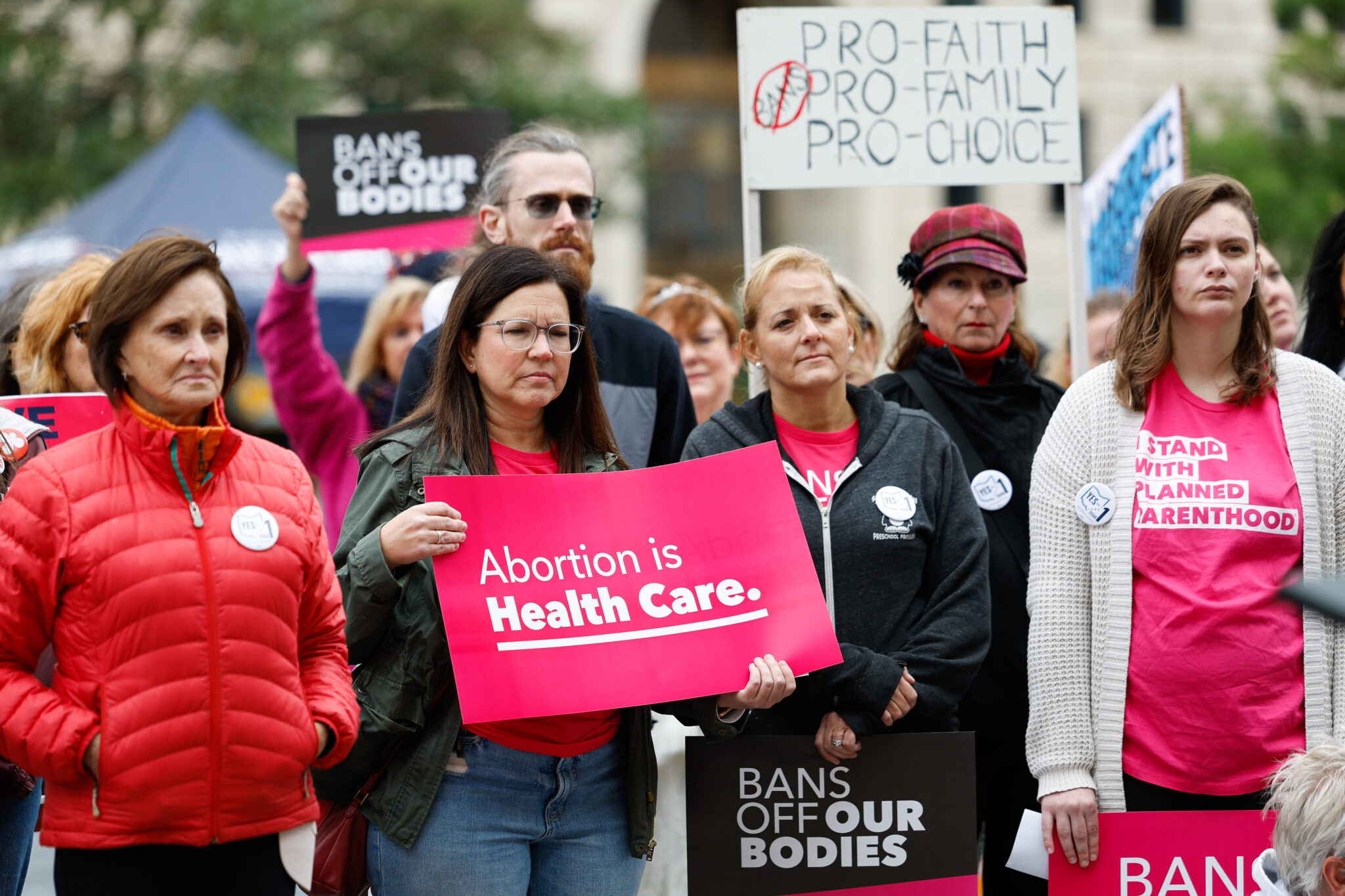
Ohio Attorney General Dave Yost will appeal a Hamilton County court’s decision to strike down the state’s six-week abortion ban with no exceptions for rape or incest that was put into effect for several months after Roe v. Wade was overturned in 2022.
Yost, along with Ohio Department of Health director Bruce Vanderhoff and the State Medical Board of Ohio’s Kim Rothermel and Bruce Saferin, were listed in the notice of appeal filed this week in the 1st District Court of Appeals. The 1st District is the appellate court that oversees Hamilton County.
GET THE MORNING HEADLINES.
Ohio Attorney General Dave YostThe state attorney general is appealing Hamilton County Judge Christian Jenkins’ decision in October which struck down a 2019 law that banned abortions after six weeks gestation, a time at which supporters of the law said fetal cardiac activity could be detected.
The law was blocked in court almost from the moment it was enacted, with abortion rights advocates suing to stop enforcement of the law.
When the U.S. Supreme Court overturned Roe v. Wade in the summer of 2022, Yost asked a federal court the same day for the law to be released from its injunction.
The law then went into effect for several months, but was then tied up in court again after abortion rights advocates like Preterm Cleveland and Planned Parenthood Southwest Ohio Region asked the Ohio Supreme Court, and then a Hamilton County court, to stop the law once again.
When 57% of Ohio voters approved a reproductive rights constitutional amendment in November 2023, attorneys for the abortions rights groups sought to get the law permanently overturned, with the rights enshrined in the new amendment.
During the case, after the amendment was passed by voters, Yost argued that the law shouldn’t be thrown out entirely. He argued that some provisions didn’t conflict with the amendment passed by voters and should be kept, such as mandatory waiting periods and multiple appointments required for abortion care.
This past October, Jenkins agreed with the groups, saying the new amendment “now unequivocally protects the right to abortion” and that the law should be permanently overturned “to give meaning to the voice of Ohio’s voters.”
“Unlike the Ohio Attorney General, this court will uphold the Ohio Constitution’s protection of abortion rights,” Jenkins wrote in his decision. “The will of the people of Ohio will be given effect.”
Jenkins used Yost’s own legal analysis of the amendment (written prior to its passage) against him in the ruling. Yost wrote in the analysis that the amendment “would give greater protection to abortion to be free from regulation than at any time in Ohio’s history.”
“Ohio would no longer have the ability to limit abortions at any time before a fetus is viable,” Yost wrote. “Passage of Issue 1 would invalidate the Heartbeat Act, which restricts abortions (with health and other exceptions) after a fetal heartbeat is detected, which is usually at about six weeks.”
Jessie Hill, cooperating attorney for the ACLU of Ohio, who represented abortion rights groups in the case, said they intend to “keep fighting to ensure that the amendment is enforced, and Ohioans’ rights are protected.”
“We are disappointed that the attorney general continues to spend taxpayer money on this lawsuit and disregard the very clear message that Ohioans sent when an overwhelming majority approved the Reproductive Freedom Amendment to our constitution,” Hill said in a statement Tuesday afternoon.
The Capital Journal has reached out to the Attorney General’s Office for comment.
YOU MAKE OUR WORK POSSIBLE.
__________
Susan Tebben
Susan Tebben is an award-winning journalist with a decade of experience covering Ohio news, including courts and crime, Appalachian social issues, government, education, diversity and culture. She has worked for The Newark Advocate, The Glasgow (KY) Daily Times, The Athens Messenger, and WOUB Public Media. She has also had work featured on National Public Radio.
Ohio Capital Journal is part of States Newsroom, the nation’s largest state-focused nonprofit news organization.
October 31, 2024 – Farah Siddiqi, Public News Service (OH)
In Ohio, the debate over Issue One has stirred strong emotions among residents and community leaders.
For many, the proposal to establish a citizens’ redistricting commission transcends politics. It represents a push for fair representation.
Marian Stewart, a retired pastor from Greene County, is a vocal supporter of the measure and frames the issue as a moral imperative.
“Rigging the maps is not fair; it’s cheating,” Stewart asserted. “Disenfranchising voters and limiting accountability does not value or respect all of our voices. It’s just wrong. That’s why I joined with faith leaders across Ohio in voting yes on Issue One.”
Stewart’s words echoed the concerns of many Ohioans who believe gerrymandered districts limit the political voice of everyday citizens. Proponents argued Issue One will ensure a fairer process by empowering a bipartisan citizens’ commission to draw electoral maps.
Critics of the measure, including some conservative groups, countered it could introduce new forms of political bias into redistricting. The opposing group had the language of the ballot issue changed to include the word “gerrymander.”
For advocates of Ohio’s labor community, the proposal is about ensuring working people’s interests are not drowned out by political manipulation.
Ted Linscott, president of the Southeast Ohio Central Labor Council, described how unfair districts can sideline Ohio’s working-class voices.
“Working people need fair voting districts so their voices can be heard,” Linscott contended. “Workers don’t need extreme right or left. We need fairness.”
The League of Women Voters of Ohio has been advocating for anti-gerrymandering reforms since 1981, underscoring the need for a responsive government.
Jen Miller, the group’s executive director, views Issue One as an important step toward accountability, noting the first initiative had support from the Ohio Republican Party but was opposed by Democrats, who held power at the time.
“The first thing that mappers did was look at the addresses of their favorite candidates and incumbents and draw lines around them, rather than drawing districts that keep communities together and make sure that Ohioans have meaningful elections,” Miller pointed out.
Ohio’s Issue One has drawn support from a diverse coalition, including labor unions, faith leaders and civic organizations, all advocating for a more representative government. As voters head to the polls, they are faced with a question beyond party lines: Should Ohio’s electoral districts be shaped by politicians or by the people they serve?
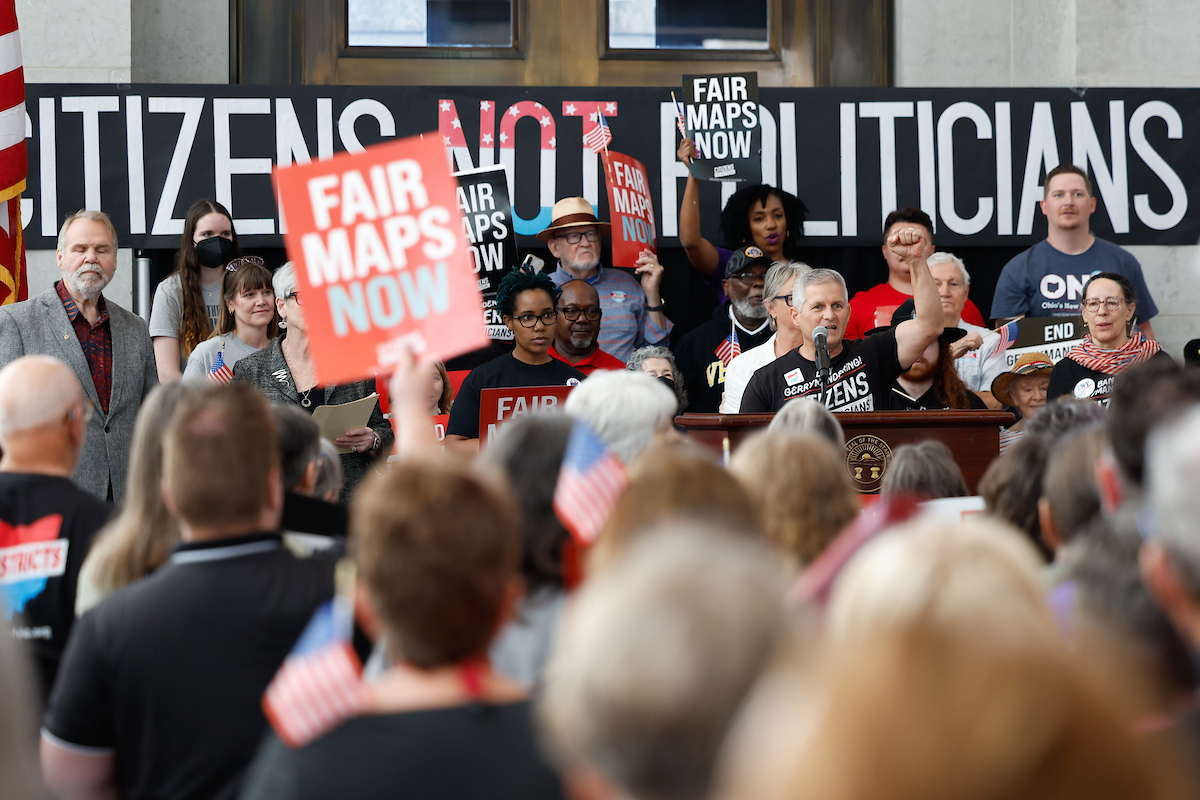
Mike Ahern, an Independent voter from Blacklick speaks to supporters at the Citizens Not Politicians rally, July 1, 2024, at the Statehouse in Columbus, Ohio. (Photo by Graham Stokes for Ohio Capital Journal. Republish photo only with original story.)
This article was originally published in Bolts, a nonprofit newsroom covering the nuts and bolts of power and political change, from the local up.
When Songgu Kwon went to the polls earlier this month, he was eager to help Ohio adopt an independent redistricting commission. The comic book writer and illustrator, who lives near Athens, dislikes the process with which politicians have carved up Ohio into congressional and legislative districts that favor them, enabling Republicans to lock in large majorities. So he was pleased that voting rights groups had placed Issue 1, a proposal meant to create fairer maps, on the Ohio ballot this fall.
“I’m in support of any measures that make the process more fair to reflect the will of the people, instead of letting the politicians decide how to gerrymander,” says Kwon.
In the voting booth, he reviewed the text in front of him. His ballot read that voting ‘yes’ would set up a panel “required to gerrymander the boundaries of state legislative and congressional districts,” and that it would “repeal constitutional protections against gerrymandering.”
So Kwon voted ‘no’ on the measure—given what he’d just read, he thought, that had to be the way to signal support for independent redistricting. He’d gone in planning to vote ‘yes,’ but he was thrown off by this language he saw; he guessed that he must have been wrong or missed some recent development. “The language seemed really specific that if you vote ‘yes’, you’re for gerrymandering,” he now recalls in frustration.
But when he left the polling station and compared notes with his wife, he quickly figured out that he’d made a mistake: He had just voted to preserve the status quo. To bring about the new independent process and remove redistricting from elected officials, as was his intention, he would have had to vote ‘yes.’
Kwon says he got confused by the language that was crafted and placed on the ballot by Republican Ohio officials. The official most directly responsible for this language, Secretary of State Frank LaRose, had a direct hand in drawing the gerrymandered maps that Kwon opposes and that the reform would unwind.
“I didn’t think that they would go so far as to just straight up lie and use a word that means one thing to describe something else,” Kwon told me. “They are using the term gerrymandering to describe an attempt to actually fix the gerrymandering.”
He added, “I thought this was a serious document, and that there would be some standard.” Other Ohioans have come forward with similar stories in recent days, complaining they meant to vote ‘yes’ but got tricked by the ballot language into not doing so.
Now the fate of Ohio’s redistricting reform hinges on whether its proponents can dispel this confusion and get the word out to all the residents who intend to support it.
The result will determine who gets to draw future state congressional and legislative districts, and it may shift seats as early as 2026. But more than that, the dispute adds to a larger saga over the viability of direct democracy in Ohio. Just last summer, the GOP pushed an amendment that would have made it much less likely for future citizen-initiated measures to succeed. That proposal failed, but Mia Lewis, associate director of Common Cause Ohio, told me at the time that she expected Republican leaders to “come back and try again” this year. Now she says that’s exactly what they did when they skewed this latest measure’s ballot language.
Lewis helped organize Issue 1 this year. And just like in the summer of 2023, she said, state officials “are threatened by the idea that the people of Ohio would have power.”
“They have understood that Ohioans don’t want gerrymandering, they have nothing good to say about voting ‘no’,” she said, “so the only thing they can say is, if you vote ‘yes,’ on this, you’re requiring gerrymandering, which is the exact opposite of the truth.”
Issue 1 would amend the state constitution to create a new panel to draw Ohio districts. It would be made up of 15 citizens selected by retired judges from a pool of applicants; the body would need to include five registered Republicans, five registered Democrats, and five people who are neither. Elected officials would be barred from serving on the commission.
An independent commission would mark a huge change from current law, which grants the authority to draw districts to a panel of elected officials, including the governor, the secretary of state, and appointees of legislative leaders. The constitution already requires that new maps respect certain principles of fairness. But when Ohio’s high court in 2022 struckdown GOP gerrymanders seven separate times, ordering the process to be more equitable, GOP leaders ignored the rulings and ran out the clock until they landed a more conservative court in the 2022 midterms. Issue 1 would also codify more stringent fairness criteria for the new commission to respect.
The coalition that drafted Issue 1 collected enough signatures to put it on the ballot. But as the secretary of state, LaRose got the opportunity to write the measure’s official summary. LaRose had been an active player in the redistricting process that drew the current maps that favor the GOP, but wrote his proposed summary in a way that suggested Issue 1 would make it likelier that Ohio gets gerrymandered. Proponents of Issue 1 immediately complained that his text was misleading.
They got more angry after LaRose’s draft went up for review in front of the Ohio Ballot Board, a five-person body that includes LaRose and has a GOP majority. During that process, Republican state Senator and board member Theresa Gavarone proposed the specific wording that Kwon says tripped him up most: She suggested using the term “gerrymander” to describe the way Issue 1 would require a commission to divide up the state.
Gavarone’s proposed tweak was met by gasps and startled laughter from the audience. (This can be heard in the recording’s 1:35:20 mark.) State Representative Terrence Upchurch, one of two Democrats on the board, then laughed in bewilderment when given the opportunity to respond to Gavarone. Still, a majority of the board approved LaRose’s draft and Gavarone’s amendment.
Ohio Ballot Board Chair, Secretary of State Frank LaRose listens to board member State Sen. Theresa Gavarone, R-Bowling Green at a meeting of the Ohio Ballot Board. (Photo by Graham Stokes for Ohio Capital Journal. Republish photo only with original story.)
Voting rights groups rushed to court, asking for the language to be struck down. But the state supreme court, which has a narrow GOP majority, rebuffed them in September and upheld most of the ballot summary.
The four Republican justices said it was accurate to say that the new independent commission would “gerrymander” Ohio since it would be tasked with taking partisanship into account, even if it’s to draw a more evenly divided map.
The three Democratic justices disagreed furiously. Justice Jennifer Brunner wrote in a dissent, “We should be requiring a nearly complete redrafting of what is perhaps the most stunningly stilted ballot language that Ohio voters will have ever seen.”
According to Derek Clinger, an Ohio-based lawyer who has litigated past ballot language cases in front of the Ohio Supreme Court, many states use a system like Ohio’s: They ask elected partisan officials to draft ballot summaries. Still, some do it differently. Oregon, for instance, randomly selects citizens to meet and write statements summarizing each ballot measure.
But what frustrates Clinger is that Ohio’s state constitution does contain “workable standards” that are meant to enable oversight onto the decisions made by state officials; it states that language on the ballot can’t “mislead, deceive, or defraud the voters.” Clinger said, “You have this standard, but you had a majority [on the state supreme court] that disregarded that.”
Some Ohio justices take the view that they’re not supposed to play a strong oversight role. Pat DeWine, a Republican justice who is also the son of Ohio’s governor, even has a forthcoming law review essay on the matter. DeWine admits that the Ohio Ballot Board “is composed of partisan actors who may have incentives to draft language that at least subtly favors one side or the other.” But the court should be wary of second guessing them, he writes: It “polices only the outer boundaries of the board’s discretion.”
Clinger, who now works at the State Democracy Research Initiative, a research hub at the University of Wisconsin Law School, disagrees. He points to a separate dispute that unfolded in Utah this fall: There, Republicans advanced a referendum meant to allow lawmakers to more easily overturn citizen-initiated measures, while also crafting ballot language claiming that their proposal would “strengthen the initiative process.”
The Utah supreme court voided this measure in September, writing that a referendum must be placed “on the ballot in such words and in such form that the voters are not confused thereby.”
“Despite the partisan implications of the case, the Utah Supreme Court seemed able to assess in good faith whether the ballot language fairly described the proposal,” Clinger said. “The big takeaway for me is that the personnel of the court is so important.”
The composition of Ohio’s supreme court is on the line this fall since the state is holding elections for three of its seven seats. The GOP could expand its majority from 4-3 to 6-1, but Democrats also have an opportunity to flip the court in their favor.
Neither Gavarone nor LaRose responded to Bolts’ requests for comment for this story. LaRose said in a statement last month that the court’s decision was “a huge win for Ohio voters, who deserve an honest explanation of what they’re being asked to decide.”
If Issue 1 passes, the state would have to quickly set up a new commission to create new maps by the 2026 midterms. But for now, proponents of the reform are focused on getting the measure across the finish line.
A poll conducted this month by YouGov found that support for Issue 1 had a large lead of over 20 percentage points. But the survey did not use the actual language that people are seeing on their ballot; instead, it asked how respondents would vote after telling them that “a ‘yes’ vote would establish a new bipartisan redistricting commission” and “ban partisan gerrymandering.” That’s precisely the explanation that proponents are fretting won’t be on the measure.
“I’m not going to rest easy at all until election results have come in,” Lewis said. She says she is worried about “a lot of confusion and purposeful misinformation” during the campaign, like the incorrect claims by GOP opponents of the measure that law enforcement officers and veterans would not be eligible to be on the redistricting commission, for instance.
Mia Lewis, right, and other Ohio advocates on the day they turned in signatures for Issue 1 in July (Photo from Paul Becker, Becker1999/Flickr)
Citizens Not Politicians, the committee running the “yes” campaign, is working to reach voters and explain what the measure actually does. The group launched an ad this fall in which former Chief Justice Maureen O’Connor tells voters that politicians opposed to Issue 1 have “lied” to them. O’Connor, a Republican, voted to strike down GOP gerrymanders in 2022; since leaving office two years ago, she has helped champion Issue 1.
The committee behind the “no” campaign, Ohio Works, is running ads as well. They have used the same strategy as the Ohio Ballot Board, of trying to associate Issue 1 with gerrymandering. In response to the criticism that some voters feel tricked by this characterization, a spokesperson for Ohio Works has said that, “If people go in and intend to vote for Issue 1, read the ballot language and vote no, they are not confused.”
But Kwon, the comic book writer, gives this warning to other Ohio voters: “Be careful. When you read the description, they’re going to refer to any attempt to change the current districting as gerrymandering. That’s what really threw me.”
“I would just say that, if you’re voting ‘yes,’ you’re voting to reform the current districting system,” he added.
Kwon feels frustrated that he unintentionally undercut a reform he supports and canceled out his wife’s vote. But together they’ve been burning up their friend network ever since to share word of his misfortune.
He said, “If me sharing the story prevents somebody from getting tricked like I was, or one or two people from getting tricked, hopefully that will balance it out.”
Daniel Nichanian, Bolts
Daniel Nichanian is the founder and editor-in-chief of Bolts.
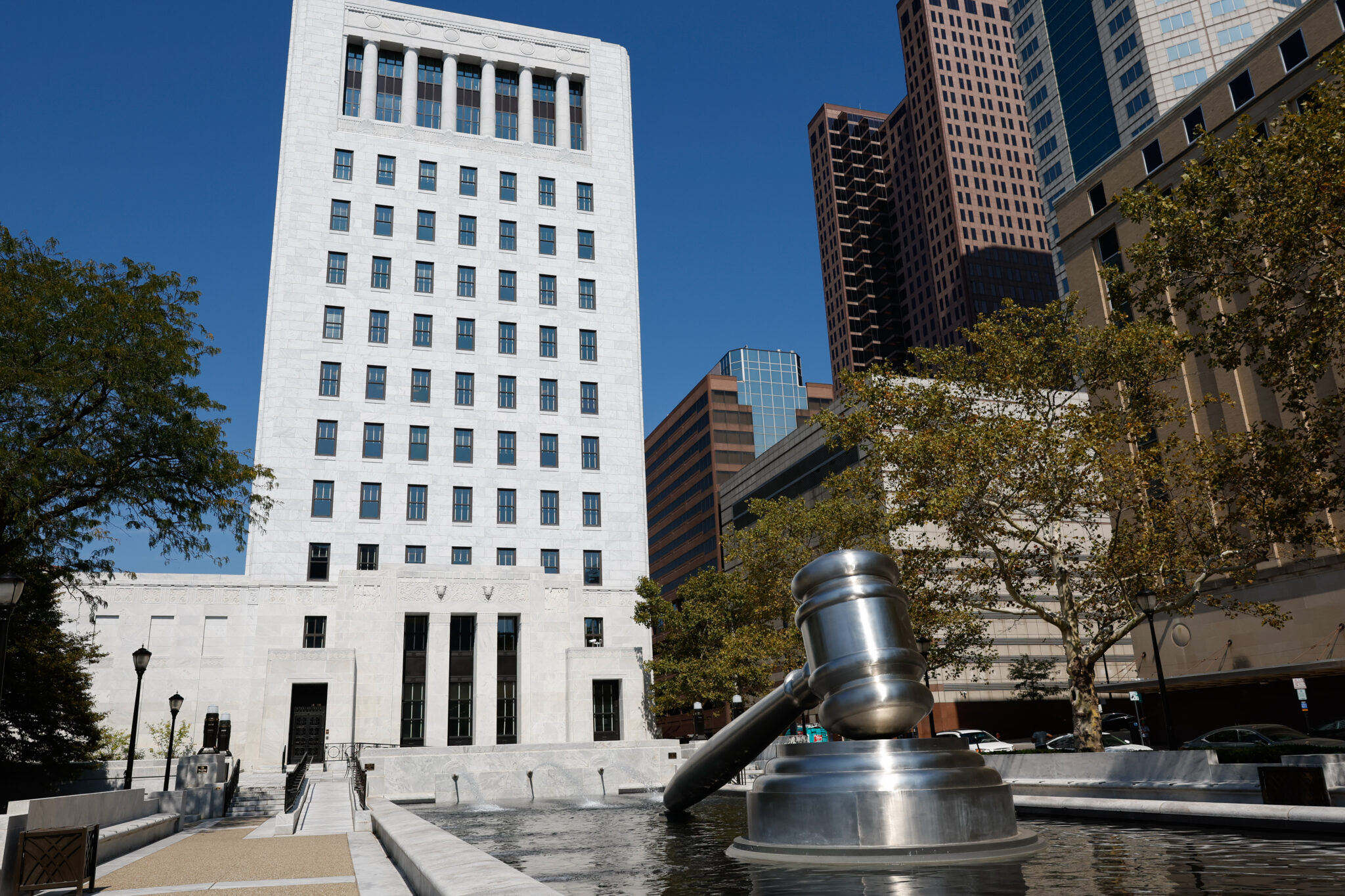
The Gavel outside the Supreme Court of the State of Ohio, September 20, 2023, at 65 S. Front Street, Columbus, Ohio. (Photo by Graham Stokes for Ohio Capital Journal. Republish photo only with original article.)
Republican majority rejects 6 of 8 changes requested by anti-gerrymandering advocates proposing the amendment
The Ohio Supreme Court largely approved ballot summary language for November’s Issue 1 anti-gerrymandering amendment on Monday, sending the language back to the Ohio Ballot Board for two revisions.
A 4-3 Republican majority rejected 6 of 8 revisions requested by anti-gerrymandering advocates, while Democratic justices on the court said that was inadequate and that the summary needed “a nearly complete redrafting.”
The summary was written by Ohio Secretary of State Frank LaRose, who opposes the amendment, and approved 3-2 by the Ohio Ballot Board, which is chaired by LaRose. LaRose is also a member of the current Ohio Redistricting Commission that the amendment proposes to replace with citizen commissioners.
While the court allowed most of the summary language in a decision released Monday night, it ordered the board to include in the summary “language that accurately conveys” that “the public would have the right to express itself to the new redistricting commission” under the terms of the amendment, written by anti-gerrymandering coalition Citizens Not Politicians.
“Distilled, the proposed amendment would provide the rights of public participation in the redistricting process through meetings, hearings and an online public portal, and would forbid communication with the commission members and staff outside the public-meeting and portal context,” the court wrote.
The other change ordered by the court compels the ballot board to make it clear that judicial review of the amendment is not limited to a “proportionality standard.”
The current seven-member Ohio Redistricting Commission includes the Ohio House Speaker and Ohio Senate President, along with the governor, secretary of state, auditor of state, and two minority party legislative leaders.
If approved by the voters, the amendment would replace the politician commission with the Ohio Citizens Redistricting Commission, which would have 15 members made up of five Republican citizens, five Democratic citizens, and five independents.
The summary language does not change the text of the proposed redistricting reform or what the amendment would actually do; it’s just the summary language used to describe the amendment on voter ballots.
An average of Ohio voter preferences over the last 10 years including 2022 show a 56-43 Republican-to-Democratic preference of Ohio voters, but Republicans control supermajorities of 67 out of 99 Ohio House seats and 26 out of 33 Ohio Senate seats. Ohio voters were forced to vote under unconstitutionally gerrymandered districts in 2022 after Republicans on the Ohio Redistricting Commission ran out of time to produce constitutional maps and a split federal court ruled the maps that were declared gerrymandered by a bipartisan majority on the then-Ohio Supreme Court had to be used.
Republican politicians on the Ohio Redistricting Commission battled with the bipartisan court majority for nearly two years over the maps in 2021 and 2022, with five Statehouse maps and two U.S. Congressional district maps being rejected as unconstitutionally gerrymandered. The swing vote in those cases, Republican Supreme Court Justice Maureen O’Connor, was forced to retire due to age. She is now leading the Citizens Not Politicians amendment effort.
One provision challenged by Citizens Not Politicians but allowed by the court states the amendment would “repeal constitutional protections against gerrymandering approved by nearly three-quarters of Ohio electors participating in the statewide elections of 2015 and 2018, and eliminate the longstanding ability of Ohio citizens to hold their representatives accountable for establishing fair state and legislative and congressional districts.”
Citizens Not Politicians attorneys argued mention of the vote margin and method were not necessary, and the court said challengers laid out arguments that the language was “tantamount to an argument against adopting the proposed amendment.”
But the court majority found that “at worst” including the vote margin and method could be “questioned on relevance grounds” not on “accuracy grounds.”
“This information is factually accurate, and relators have not shown that the information would ‘mislead, deceive or defraud the voters,’” the court majority stated in their decision.
The court also allowed language added by state Sen. Theresa Gavarone during the Aug. 16 board meeting, which states the amendment would “establish a new taxpayer-funded commission of appointees required to gerrymander the boundaries of state legislative and congressional districts to favor the two largest political parties in the state of Ohio.”
Justices dismissed Citizens Not Politicians arguments that the language leads voters to believe the amendment would “require gerrymandering,” despite the fact that the amendment states it would ban partisan gerrymandering.
The court said “the fact that the proposed amendment announces that it would ‘ban partisan gerrymandering,’ … is of little assistance in ascertaining whether the ballot language’s use of the word ‘gerrymander’ is improper.”
The court explored various definitions of “gerrymandering” in coming to its decision, finding that the requirement the amendment uses to dictate the drawing of Statehouse and congressional maps “falls within the meaning of ‘gerrymander.’”
“Because the board’s use of the term ‘gerrymander’ is consistent with dictionary definitions and how the United States Supreme Court has used the term, it does not mislead, deceive or defraud voters,” the decision stated.
The court did not order any changes to the ballot title, though that was included in the changes requested by Citizens Not Politicians.
“We conclude that the secretary did not err in crafting the ballot title,” the court wrote.
While all the justices agreed to the changes, they were split on how many changes needed to be made.
In his concurrence, Justice Patrick Fischer claimed “gerrymandering, though in a bipartisan manner, is absolutely ‘required under the proposed amendment,” and that the state constitution “would dictate” that independent and third-party voters would have their voice “removed from Ohio’s political world.”
Justice Michael Donnelly agreed to the decision that ordered changes to the ballot language, but “vehemently” disagreed “that those corrections are even remotely adequate to prevent the ballot language as a whole from being misleading.”
He and Justice Melody Stewart joined Justice Jennifer Brunner in an opinion that agreed to the changes, but said the majority opinion “reflects an abject failure of this court to perform an honest constitutional check on the ballot board’s work.”
“We should be requiring a nearly complete redrafting of what is perhaps the most stunningly stilted ballot language that Ohio voters have ever seen,” Brunner wrote.
She went on to say the ballot board language “is tantamount to performing a virtual chewing of food before the voters can taste it for themselves to decide whether they like it or not.”
The Ohio Secretary of State’s office said the ballot board will meet to make the revisions on Wednesday morning.
Reactions
Citizens Not Politicians released a statement saying they disagreed with “much of the decision” but agreed with the court’s “repudiation of the politicians on the ballot board for violating the Ohio Constitution.”
Ballot Board chair Frank LaRose released his own statement, calling the court’s decision “a huge win for Ohio voters, who deserve an honest explanation of what they’re being asked to decide.”
Former Ohio Redistricting Commission co-chair and Auditor of State Keith Faber said the court was “thoughtful in its approach and they got it right.”
Senate President Matt Huffman and Gov. Mike DeWine have both spoken against the measure publicly.
Faber’s fellow co-chair Senate Minority Leader Nickie Antonio said while the decision “enables Ohioans to make a more informed choice by addressing some of the most deceptive language, other misleading and argumentative language still remains.”
Susan Tebben
Susan Tebben is an award-winning journalist with a decade of experience covering Ohio news, including courts and crime, Appalachian social issues, government, education, diversity and culture. She has worked for The Newark Advocate, The Glasgow (KY) Daily Times, The Athens Messenger, and WOUB Public Media. She has also had work featured on National Public Radio.
Ohio Capital Journal is part of States Newsroom, the nation’s largest state-focused nonprofit news organization.
Ohio Gov. Mike DeWine stood in staunch opposition Wednesday to an anti-gerrymandering proposal heading to voters in November that would replace politicians with a citizen redistricting commission, but he stopped short of presenting a competing proposal this year.
DeWine held a press conference on Wednesday, not only to criticize the Citizens Not Politicians ballot initiative, but to acknowledge the process that’s currently in place in Ohio — a process that includes him — doesn’t work either.
“We need to end this writing and re-writing of our constitution, and we must defeat this misguided ballot initiative,” DeWine said.
Asked whether he thought it was possible the initiative headed to the ballot could work, despite his misgivings, the governor said, “No. No way in hell.”
DeWine instead presented his preference for an “Iowa plan,” where Ohio lawmakers would draw up a redistricting amendment proposal of their own early next year, based on the state of Iowa’s.
Iowa has a non-partisan legislative services agency draw maps for approval by lawmakers and the governor. If a map doesn’t get passed by the legislature and governor on its first two attempts, Iowa lawmakers are able to make amendments to the map plan as they see fit on the third attempt. This gives Iowa lawmakers final authority on maps.
In a response issued after DeWine’s news conference, Citizens Not Politicians leader and retired Republican Ohio Supreme Court Chief Justice Maureen O’Connor issued a statement saying that the “disinformation from the governor today is insulting to everyone in Ohio.”
Redistricting in Ohio
The governor was a member of the Ohio Redistricting Commission (as dictated by current state law regarding redistricting), so he saw firsthand the process over the two years that the commission adopted six Statehouse maps and two U.S. congressional maps.
All of the maps were challenged in court, with five of the Statehouse maps rejected by the Ohio Supreme Court, and both of the congressional maps ruled unconstitutionally partisan. The sixth map was not rejected by a state supreme court led by new Chief Justice Sharon Kennedy, rather than the previous swing vote on all the maps, now-retired Chief Justice Maureen O’Connor.
The process also saw two independent map-drawers, who were brought in at the behest of the court, but whose suggestions and draft maps were rejected by the commission at the last minute, in favor of a previous draft drawn up by Republican staffers.
“This was a decision that I have consciously made after having watched the turmoil, political partisanship that’s been going on for a long time in Ohio,” DeWine said on Wednesday as he decried the Citizens Not Politicians proposal.
The one thing DeWine said did need to happen in redistricting reform that matches up with the current ballot proposal is a removal of politics as part of the process.
“Ohio should have a constitutional provision that instructs the mapmakers that they can not consider past voting data, that the map-drawers know will lead to a pre-determined partisan outcome,” he said.
He said the proposal set to come before voters would need replaced once again after voters realized they were “unhappy,” and that the new process “will make things much worse.”
“If this ballot proposal were to be adopted, Ohio would actually end up with a system that mandates, that compels map-drawers to produce gerrymandered districts,” DeWine alleged.
The proposal headed for voters after the Ohio Ballot Board approves ballot language for it, would create a 15-person independent redistricting commission made up of citizens, and without elected officials, according to the proposal. The citizens would be chosen through a vetting process done by local judges, and public hearings would be a part of the process as maps are drafted, Citizens Not Politicians has stated.
The main problem with the proposal for DeWine is that proportionality “supersedes” all when it comes to drawing maps and determining Statehouse and congressional districts. Proportionality requires representation based on the voting trends in past elections.
The governor critiqued the initiative for having proportionality supersede things like communities of interests and township/county/municipality lines.
Ohio Gov. Mike DeWine points to a proposed Ohio voting district during a Wednesday press conference. At the press conference, he spoke out against the Citizens Not Politicians redistricting reform proposal, and brought up his own plan for reform after the November election. (Photo by Susan Tebben, Ohio Capital Journal.)
Using two examples of maps drawn with the simulation software Dave’s Redistricting App — one done by “Kevin” with a proportionality score of 100 out of 100, and another officially submitted by the Ohio Democrats — he endeavored to show possible problems with maps that focus solely on proportionality.
He mentioned the “snake on the lake” — a nickname for a northeast district based on its shape — comparing it to a district in one simulation that connected Sandusky and Lorain counties. He said another district in the proposals reminded him of an ice cream cone in its “scooping” out of parts of the area.
“This is what proportionality does if you adhere to it,” he said.
DeWine’s plan
Whether or not the Citizens Not Politicians initiative goes through, Ohio might see DeWine and the legislature attempting to rewrite the constitution again.
If the initiative doesn’t pass, DeWine was resolute in his plan to “work with the General Assembly to introduce a resolution in the next session.”
“We’ll vet that proposal, there’ll be hearings on it, we’ll hear from citizens on all sides,” DeWine said. “And I hope then, approve the resolution to place an initiative on the ballot for voters to approve the way the process should be.”
He said he will ask for passage of “a version of the Iowa ballot language that’s been in effect … for about 40 years now.”
The Iowa system has gone through its share of changes, but in the 1980 legislative session, state legislators established the current process, in which the Legislative Service Bureau, “a nonpartisan bill drafting agency of the General Assembly” is given the “primary responsibility for drawing proposed congressional and legislative districts, subject to legislative and gubernatorial approval,” according to a legislative guide to the process produced by the Iowa Legislative Services Agency, a combination of agencies including the LSB.
The plan requires a first redistricting plan to be submitted to the General Assembly, after which a “Temporary Redistricting Advisory Commission” holds at least three hearings in “different geographic regions of the state,” submitting a report after the hearings.
If that map fails to be approved by the legislature or the governor, specific reasons must be given via resolution or governor’s veto message. The GA then has 35 days to get a second plan to a vote. No public hearings are required for the second plan.
If there is need for a third plan, the process repeats, but this time “the third plan is subject to amendment in the same manner as any other bill,” meaning that Iowa lawmakers can make desired changes directly.
If no agreement can be made or if that plan is legally challenged, judicial intervention from the state supreme court begins.
The Iowa Constitution “provides that the Iowa Supreme Court will likely assume or be given the responsibility for establishing a valid redistricting plan,” according to the LSA.
As DeWine explained the Iowa process, he said the Legislative Service Commission in Ohio would be the non-partisan entity to start the process, but Ohio’s version would perhaps not follow the rest of the process, including the provision that states the Iowa Legislature has the formal passage power on maps.
As for enforcement measures to keep the redistricting leaders in check under the plan he’s proposing, DeWine said “none of that changes” from the process now.
The biggest part of the system that DeWine wants to see in Ohio is the map-drawing criteria.
“The Iowa criteria makes it impossible for someone legally following the constitution to use partisan politics,” the governor said.
He acknowledged Iowa’s smaller population and more compact counties, but said the “basic principle” works in both states.
“Do you want politics in it, or do you want politics prohibited from being in it?”
If an Ohio GA plan “deviates very much” from the Iowa system, DeWine said he “will not be in favor of it.”
Even if the ballot measure does pass in November, DeWine still wouldn’t rule out the possibility that he would push for the Iowa plan to be on the ballot at a later date.
“What I’m not going to say is ‘never, never, never’ will I ever do that, I’m not going to say it,” DeWine said. “What I hope happens is that we can defeat this in the fall … and I will push and I will do whatever I can to lead so that we end up with something that’s better than what we have now.”
He went further, saying even if the legislature does not bring about the plan he envisions, “I will do everything I can to get it on the ballot by initiative.”
Despite his fervor for the plan, DeWine said he would not be calling a special session for the legislature to work on the initiative now, to try to beat the Aug. 7 petition-filing date.
“I don’t have time to go to the ballot, number one; number two, I don’t know that at this late date if there’s support in the House to do that; three, the advantage that you have by waiting …is that we can go through a normal process where there are public hearings and things can be vetted,” DeWine told reporters on Wednesday.
The governor alleged that the Citizens Not Politicians amendment had not been properly vetted, saying if voters understood the proposal, they wouldn’t want it, even if they support proportionality as a lead method in redistricting. The proposal made the ballot with 535,005 valid Ohio voter signatures.
“The idea of proportionality sounds good, it sounds fair,” DeWine said. “However, we see how requiring a map-drawer to draw districts, each of which favors one political party … obliterates all other good government objectives.”
Reactions
The Citizens Not Politicians leaders were unsurprisingly against DeWine’s comments and his new plan.
“The disinformation from the governor today is insulting to everyone in Ohio, and especially insulting to the half-a-million Ohioans – Republicans, Democrats and Independents – who put the Citizens Not Politicians amendment on the November ballot,” said retired Chief Justice Maureen O’Connor, in a statement with Citizens Not Politicians.
O’Connor offered to sit down with the governor and “explain” the plan since, she said, “the governor demonstrated in his rambling and disjointed press conference today that he does not understand our amendment.”
Senate Minority Leader Nickie Antonio, D-Lakewood, who was on the Ohio Redistricting Commission with DeWine when they passed the most recent statehouse district map, said the governor’s proposal “appears to be another eleventh-hour attempt to subvert the will of the people and keep a stranglehold on the GOP artificial supermajority.”
House Minority Leader Allison Russo, D-Upper Arlington, also served on the commission with DeWine through a number of maps, and commented after the most recent map adoption that she agreed to the map solely to take the process out of the hands of the ORC.
On Wednesday, she called the DeWine’s press conference a “manufactured attempt to confuse and misdirect voters from the truth.”
“Republicans are desperate because they know their gerrymandered grip on power is coming to an end, so they’re once again attacking Ohioans’ fundamental freedoms and putting their own self-interest ahead of the interest of the people,” Russo said in a statement.
The governor wasn’t without his supporters in the effort, however. A spokesperson for Senate President Matt Huffman said the governor “is correct about proportionality, also known as ‘representational fairness,’ it is the textbook definition of gerrymandering.”
“It’s important to remember that the current system, approved by more than 70% of the voters, produced a unanimous bipartisan vote that approved maps for the General Assembly over the remainder of the decade,” spokesperson John Fortney said.
House Speaker Jason Stephens posted a statement on X after DeWine’s press conference, saying “I look forward to working with the governor, the Senate and the entire GOP Caucus to defeat Issue 1 in November.”
“Once Issue 1 is defeated, we will continue to work to ensure all Ohioans voices are heard and represented,” the statement read.
Susan Tebben
Susan Tebben is an award-winning journalist with a decade of experience covering Ohio news, including courts and crime, Appalachian social issues, government, education, diversity and culture. She has worked for The Newark Advocate, The Glasgow (KY) Daily Times, The Athens Messenger, and WOUB Public Media. She has also had work featured on National Public Radio.
Ohio Capital Journal is part of States Newsroom, the nation’s largest state-focused nonprofit news organization.
Edison Research collects all Election Results for the National Election Pool, which consists of ABC, NBC, CBS, and CNN
Loveland, Ohio – With Ohio Issue 1 and 2 on the ballot tomorrow, Edison Research has engaged Loveland Magazine to telephone them with local results as soon as the polls close. To provide their “projections” they do not wait until local boards of elections post results on the Internet. They need results as soon as they are posted on the door of local precincts.
Edison Research is the sole provider of election data, race projections, and analysis to ABC News, CBS News, CNN, and NBC News. In an effort to improve quality, streamline data collection, and expand election coverage in 2018, ABC News, CBS News, CNN, and NBC News ended their arrangement with the Associated Press for vote tabulation and now exclusively partner with Edison Research for these data. Edison Research projections are made in all 50 states for statewide races and ballot measures.
Tomorrow night when you hear projections about the results of Ohio’s abortion amendment or the legalization of marijuana, the data Loveland Magazine provided will go into the complex calculation of “projecting” winners and losers. If Steve Kornacki pulls out his “Big Board” Tuesday night and projects the outcome of the two big Ohio issues, he will be relying in part on data collected by Loveland Magazine.
Loveland Magazine will also publish local results tomorrow on the important Loveland School Board and City Council elections.
Gen Z and millennial voters could play an important role in deciding fate of reproductive rights amendment and marijuana law
by David DeWitt
For Gen Z and millennial Ohio voters, Issue 1 and Issue 2 are critically important. Whether we vote and how we vote will shape what kind of rights and freedoms we have for ourselves and our loved ones well into the future.
Issue 1 would establish a state constitutional right to “make and carry out one’s own reproductive decisions,” including decisions about abortion, contraception, fertility treatment, miscarriage care, and continuing pregnancy.
Issue 2 would create a new state law to legalize and regulate recreational marijuana for adults aged 21 and above, including cultivation, processing, sale, purchase, possession, and home growth.
Tussling over legal access to abortion care and the criminalization of marijuana has shaped American politics for decades, and they stand as two issues where the consequences of law and policy fall heaviest on younger people.
In an average of births in Ohio between 2019 and 2021, 4.9% were to women under the age of 20, and 2.5% were to women ages 40 and older, while 92.6% were to women ages 20 to 39, according to the March of Dimes.
Using Ohio Department of Health statistics for 2022, patients 17 and under received 2.5% of abortions performed, and patients over age 40 received 3% of abortions performed, while patients between the ages of 18 and 40 received 94.5% of abortions performed.
According to the FBI Crime Data Explorer — which does not sort by type of drug involved in state-by-state data — 60% of drug violations in Ohio in 2022 were charged against people between the ages of 20 and 39, a far higher percentage than any other age group. Nationwide, it wasn’t until 2020 that other drugs took over marijuana possession as the No. 1 reason for a drug-related arrest. Nevertheless, more than 315,000 people across America were arrested for marijuana possession in 2020, accounting for 27.5% of drug-related arrests. Also in 2020, Black Americans accounted for about 38.8% of marijuana possession arrests despite representing just 13.6% of the population.
Younger voters are notoriously unreliable at showing up to vote during non-presidential elections, much less odd-number year elections. Even during presidential elections they show up to the polls at lower rates than other age groups.
The 2020 presidential election, for instance, had the highest turnout of the 21st century, with 66.8% of citizens 18 years and older voting, but for voters ages 18 to 24, only 51.4% cast ballots, according to U.S. Census Bureau reports. In 2018, Americans ages 18 to 29 made up 11% of voters and 30% of non-voters, according to Pew Research Center. In 2022, they made up 10% of voters and 27% of non-voters.
This Nov. 7 in Ohio, the stakes are highest for millennial and Gen Z voters. What kind of present and future do we want for ourselves and for Ohio?
What rights do we want to establish in the constitution, or would we rather leave it up to the politicians to determine our generations’ access to reproductive medical care?
What kind of freedom do we think adults 21 and over should have from criminal marijuana charges, or should Ohio continue to saddle adults with drug offense records over cannabis possession?
Voting is our most precious and fundamental right, the spigot from which all of our other rights and freedoms flow. Gen Z and millennial generation voters must participate in these critical decisions, or we are relinquishing significant power over our lives to others who do not bear the same burdens of impact.
As the writer David Foster Wallace observed, “In reality, there is no such thing as not voting: you either vote by voting, or you vote by staying home and tacitly doubling the value of some Diehard’s vote.”
Early voting in Ohio has begun. Here is everything voters need to know:
Citizens can no longer vote on Nov. 6, the Monday before the election.
Mailed absentee ballots must be postmarked by Nov. 6.
On Election Day Nov. 7, vote at your polling location. Find your polling place by clicking or tapping here.
Polls are open from 6:30 a.m. to 7:30 p.m. on Election Day. If you are in line at the time polls close, stay in line, because you can still cast your ballot.
If absentee ballots are not returned by mail, they must be received by your board of elections by 7:30 p.m. on Election Day.
What do I need to vote?
In order to cast a ballot, voters must have an unexpired Photo ID such as a passport or driver’s license. Previously, voters were able to use non-photo documentation such as bank statements, government checks or utility bills to vote. That is no longer the case under a new law passed in Ohio last year. Student IDs are not considered valid under that law.
CLICK HERE for more information on ID requirements.
Here is the list of acceptable types of valid photo ID:
Ohio driver’s license
State of Ohio ID card
Interim ID form issued by the Ohio BMV
A US passport
A US passport card
US military ID card
Ohio National Guard ID card
US Department of Veterans Affairs ID card
More information for voters
To check your voter registration status, find your polling place, view your sample ballot and more, head to the Ohio Secretary of State’s VoteOhio.gov website.
DAVID DEWITT
OCJ Editor-in-Chief and Columnist David DeWitt has been covering government, politics, and policy in Ohio since 2007, including education, health care, crime and courts, poverty, state and local government, business, labor, energy, environment, and social issues. He has worked for the National Journal, The New York Observer, The Athens NEWS, and Plunderbund.com. He holds a bachelor’s degree from Ohio University’s E.W. Scripps School of Journalism and is a board member of the E.W. Scripps Society of Alumni and Friends. He can be found on Twitter @DC_DeWitt
Editor’s Note: This article is part of a series looking at the language of Ohio Issue 1 and the reproductive rights it would impact. The full language of the amendment can be found here.
__________
The topic of parental rights does not appear in Ohio Issue 1 on the ballot Nov. 7.
There is no mention of denying any rights to parents in the process of enshrining reproductive rights like abortion, contraception, miscarriage care and infertility treatment into the Ohio Constitution.
“I don’t think Issue 1 would affect parent’s rights at all,” said Tracy Thomas, the Seiberling Chair for Constitutional Law and director of the University of Akron’s Center for Constitutional Law.
Having studied reproductive rights cases in Ohio and nationwide, including the Dobbs case that overturned Roe v. Wade, Thomas said historically, “parental rights have consistently been retained.”
“I would expect that those (rights) can all stay consistent,” Thomas told the Capital Journal.
Ohio Attorney General Dave Yost also acknowledged that previous abortion rights court cases have upheld parental consent in a legal analysis of Issue 1 he released in early October.
Yost went on to say “the amendment does not specifically address parental consent.”
But, Yost argued, that consent “would certainly be challenged on the basis that Issue 1 gives abortion rights to any pregnant ‘individual,’ not just to a ‘woman.’”
The term “individual” is currently used 36 times in the Ohio Constitution, including in the definition of “health care system,” the eligibility of officeholders, and clauses on temporary housing and corporate property.
Only one use of the word “individual” is connected to a gender specifier: the constitutional language on marriage status “only one man and one woman” can be in a marriage “valid or recognized by this state,” and “relationships of unmarried individuals” can not hold the same legal status.
COLUMBUS, Ohio — OCTOBER 06: Sister Amor of the Bridgettine Sisters of Columbus holds a sign on High Street during the Ohio March for Life against November’s Issue 1 reproductive rights amendment, October 6, 2023, outside the Statehouse in Columbus, Ohio. (Photo by Graham Stokes for Ohio Capital Journal. Republish photo only with original article.)
Still, Religious lobbies and anti-abortion rights groups that oppose the amendment have used that message as one of their primary arguments against the measure since the effort to get it on the ballot began.
In a new ad for the Issue 1 opposition group Protect Women Ohio, a coalition including Ohio Right to Life and other anti-abortion rights groups, Gov. Mike DeWine and First Lady Fran DeWine feature as leaders against the measure.
Fran DeWine is shown in the ad saying Issue 1 “would deny parents the right to be involved when their daughter is making the most important decision of her life.”
Gov. DeWine admits in the ad that Ohioans “are divided on the issue of abortion,” but calls Issue 1 “not right for Ohio.”
The Catholic Conference of Ohio pointed to the first line of the proposed amendment and the word “individual,” saying the use of the word would allow anyone under age 18 to “have an abortion, or make any reproductive decision without their parents’ consent or notification.”
State Sen. Kristina Roegner, R-Hudson, the sponsor of the six-week abortion ban law that is currently on hold as court cases determine its fate, co-sponsored a resolution in the Ohio Senate on Oct. 11 officially standing against Issue 1.
In opposing Issue 1, she said the measure was “extreme, nefarious” and would “harm women and take away parental rights.”
The resolution passed with the GOP majority unanimously approving it. The seven Democratic senators all voted against the measure.
The resolution itself proclaims “parents are the ultimate arbiter of what is best for their children.”
In one paragraph of the resolution, sponsors Roegner and state Sen. Michele Reynolds, R-Canal Winchester, write that Issue 1 “will eliminate many, if not all, state laws regarding abortion,” including “parental notification requirements.”
In the next paragraph, the resolution states Issue 1 “may” eliminate parental rights.
Senate Minority Leader Nickie Antonio, D-Lakewood, pushed back against the resolution by bringing up a decade-old legal process present in Ohio called “judicial bypass.”
Judicial bypass, as it stands now, has been around since 2012 in the state, after then-Gov. John Kasich signed a law that prohibits forcing a minor to have an abortion, but leaves in place a legal way for minors to petition juvenile court to bypass parental consent.
The Ohio Supreme Court explained the process in Rule 23 of a 2015 amendment to its “rules of superintendence,” an internal operations document for all Ohio courts.
The legal method uses the court system to allow underage individuals to make decisions for themselves where parental consent would typically be necessary, such as in cases of abuse.
“If the court finds by clear and convincing evidence that the minor is sufficiently mature and well enough informed to decide intelligently whether to have an abortion, the court shall grant the petition and permit the minor to consent to the abortion,” the law states.
Susan Tebben is an award-winning journalist with a decade of experience covering Ohio news, including courts and crime, Appalachian social issues, government, education, diversity and culture. She has worked for The Newark Advocate, The Glasgow (KY) Daily Times, The Athens Messenger, and WOUB Public Media. She has also had work featured on National Public Radio.
Editor’s Note: This article is part of a series looking at the language of Ohio Issue 1 and the reproductive rights it would impact. The full language of the amendment can be found here.
When Roe v. Wade was overturned in June 2022, the physicians at Ohio Reproductive Medicine took to their website, hoping to reassure patients that their care would still be available.
“It is truly hard to fathom that in 2022, our reproductive freedom, a fundamental human right, is now at risk,” the statement on the website read.
Though the Columbus business said it strongly opposed the overturning of Roe as a whole, the focus of their statement was on those undergoing or considering fertility treatments.
“We ardently stand alongside our current and past patients — as well as anyone who wishes to build a family in the future with the help of fertility treatments,” according to the statement.
The effects that repealing nationwide abortion access would have on fertility treatments like in-vitro fertilization (IVF) weren’t clearly spelled out by the U.S. Supreme Court in its Dobbs decision, but physicians have worried about what various bans mean when it comes to fertilized embryos and the definition of the start of life.
A hard-fought battle
Infertility can happen for 10% to 15% of couples, according to the American Society for Reproductive Medicine, and CDC data found 1 in 5 women in the U.S. couldn’t get pregnant after a year of trying.
For those who have insurance and/or can afford fertility treatments, the process is long, arduous, and often involves disappointment along the way if an implanted embryo fails to turn into a pregnancy, or becomes a medical complication.
Ohioans have expressed worry that they won’t be able to utilize fertility treatments in the same way if abortion is banned in the state, whether that be at six-weeks under current law (though that law is held up in court and not currently being enforced), or if other regulations fall into place keeping physicians from treating life-threatening ectopic pregnancies or miscarriages, which are considered “spontaneous abortions” by the medical community.
After the Dobbs v. Jackson Women’s Health Organization ruling from the U.S. Supreme Court overturning nationwide abortion rights, the fears regarding fertility treatments came closer to home, as state Rep. Gary Click, R-Vickery, introduced a bill that would have considered the start of “personhood” to be the moment of conception.
That, physicians said, could include fertilized embryos sitting in cryogenic chambers at their facilities.
The “life begins at conception” message has been used by anti-abortion groups nationwide for many years, though the medical community does not universally agree on the beginning of life, or if there’s one certain point when cardiac activity begins in a fetus.
At a rally one year ago to support anti-abortion causes, state Rep. Jena Powell, R-Arcanum, spoke of ways to “abolish abortion” in the state, making the claim that the “science is crystal clear” that “life begins at conception.”
Powell urged support for the “personhood” bill.
“The shackles are no longer holding us back as state legislators, and we can and we must be a voice for the unborn child in Ohio,” Powell said at the time.
The cost of access
Fertility treatments and the freezing of embryos has become a common practice, but that doesn’t mean it’s available to everyone, because it’s a costly endeavor with complicated insurance regulations.
The Center for Reproductive Rights says barriers to access include “limited information, restrictive laws and policies, stigma, high costs and more.”
“Issues surrounding assisted reproduction implicate core human rights — including the rights to health, sexual and reproductive health, decision making about reproductive life (such as if and when to have children), benefit from scientific progress, equality and non-discrimination and informed consent,” the center said in a statement.
The center’s research on infertility and IVF access in the United States showed that in 2020, clinical infertility impacted about 12% of women ages 15-44, but only 24% of people in the U.S. seeking care for infertility could access it.
“The limited number of private insurance markets and public programs covering infertility services, combined with high out-of-pocket expenses, result in significant economic barriers to needed infertility treatment,” the CRR stated in the report.
Self-pay packages at the University Hospitals Fertility Center in Northeast Ohio, for example, price IVF, including lab work and one embryo transfer at $12,775.
An egg donor package runs $14,030 for self-pay patients, and a surrogate (also called a “gestational carrier”) is priced at more than $15,000.
Ohio law mandates that private health insurance cover basic services, including “medically necessary” services that could fall under fertility treatment. The Ohio Revised Code includes “infertility services” under “preventative health care services.”
Though this could include the diagnosis of infertility and treatment of reproductive system problems, other services involved in the process may not be included.
“Many procedures fall into a gray zone, including IVF, which leaves much interpretation and denial of claims,” according to Ohio Reproductive Medicine.
In 2021, Ohio added “reproductive health services” into the Ohio Administrative Code, allowing Medicaid-eligible individuals access to “pregnancy prevention services,” including “contraceptive management,” pregnancy testing and “fertility awareness.”
What is not covered under Medicaid is infertility treatment, including IVF, “assisted reproductive technologies,” artificial insemination, or surgery to “promote or restore fertility.”
Ohio is not alone in keeping Medicaid recipients out of the fertility treatment landscape, as very few states nationally extend those services through Medicaid.
Susan Tebben is an award-winning journalist with a decade of experience covering Ohio news, including courts and crime, Appalachian social issues, government, education, diversity and culture. She has worked for The Newark Advocate, The Glasgow (KY) Daily Times, The Athens Messenger, and WOUB Public Media. She has also had work featured on National Public Radio.
Editor’s Note: This article is part of a series looking at the language of Ohio Issue 1 and the reproductive rights it would impact. The full language of the amendment can be found here.
In the Nov. 7 general election, Ohioans will decide whether or not to approve Issue 1, a constitutional amendment for reproductive rights.
While the language of the amendment focuses primarily on abortion, it also lists other rights that would be cemented into the state constitution, including miscarriage care, fertility treatments, contraception, and the right to continue one’s own pregnancy. Today we will look at how and why the proposed amendment seeks to protect access to contraception.
The use of contraception is not illegal in Ohio, and though it’s commonly called “birth control,” the medications are also used for other conditions, like ovarian cysts, polycystic ovary syndrome and endometriosis symptoms.
Push to ‘reconsider’ contraception case
Contraception has long been a target of debate, with fears of further regulations increasing after U.S. Supreme Court Justice Clarence Thomas brought up Griswold v. Connecticut during his concurrence to Dobbs v. Jackson Women’s Health, the 2022 decision that overturned the half-century of abortion legalization given in Roe v. Wade.
The ruling in Griswold overturned a Connecticut law from the 1800s that banned the use of “any drug, medical device or other instrument in furthering contraception,” particularly in marriages. The question at the heart of the Griswold case: “Does the Constitution protect the right to marital privacy against state restrictions on a couple’s ability to be counseled in the use of contraceptives?”
The court found that the right to privacy held in the Bill of Rights prohibited states from banning contraception for married couples.
However, in agreeing with the Dobbs decision, Thomas said the nation’s highest court should also “reconsider” cases such as Griswold, with new reflection on the 14th Amendment.
“After overruling these demonstrably erroneous decisions, the question would remain whether other constitutional provisions guarantee the myriad rights that our substantive due process cases have generated,” Thomas wrote in his 2022 concurrence.
A congressional effort that was put forth in July 2022 to codify birth control access passed the U.S. House. The effort had unanimous Democratic support, but only had the support of one Ohio GOP representative, former Rep. Anthony Gonzalez.
There is federal law that requires health insurance coverage for prescription female contraceptives, but federal law also allows for a refusal clause “that allows churches, associations of churches, religiously affiliated elementary and secondary schools and, potentially, some religious charities and universities to refuse,” according to an analysis by the Guttmacher Institute.
The institute’s analysis also showed that, as of September 2023, Ohio’s only state-level regulation is an insurance coverage requirement for extended supplies of contraception.
“The state’s law allows pharmacists to dispense the full amount of a prescription at one time, including contraception, but there is no requirement that health insurance plans cover the cost of accessing a year’s worth of contraceptives at one time,” the Guttmacher research stated.
Medicaid recipients are allowed access to “pregnancy prevention services” under the Ohio Administrative Code, including “contraceptive management,” along with “fertility awareness, natural family planning (the use of fertility awareness to track ovulation), and risk factor reduction,” according to the code.
In an August debate on the previous Issue 1, Secretary of State Frank LaRose joined Ohio Right to Life leader Mike Gonidakis in calling claims that contraception regulations could be on the table in the state “fear-mongering,” saying “no reasonable person is talking about banning the use of contraceptives.”
Researchers and advocacy groups say abstinence-only education and anti-abortion politics have already had their impact in the state, and the need to keep contraception at the forefront continues.
Even in his analysis of Issue 1, Ohio Attorney General Dave Yost spoke of access to contraception (and other rights listed in the proposed amendment), saying those topics “are harder to assess because Ohio does not have specific statutes addressing minors’ access to these medical treatments or products.”
When Roe v. Wade — the landmark U.S. Supreme Court case that legalized abortion nationwide — was overturned in 2022, Ohio groups immediately feared the already inconsistent sex education standards in the state would take a hit as well.
State law requires Ohio schools to emphasize abstinence, but does not require them to include lessons on consent, sexual orientation, or gender identity, according to a review by the Sexuality Information and Education Council of the United States (SIECUS).
In fact, Ohio House GOP members introduced a bill in 2022 that would ban the use of sexual orientation and gender identity as a topic in Ohio schools. State Rep. Mike Loychik, R-Bazetta, the bill’s co-sponsor, said at the time that the bill would “ensure that sexual orientation and gender ideology are not taught in kindergarten through third grade.”
But bills like House Bill 616 could also “impact age-appropriate sex education,” according to SEICUS, which said those and other policies pushing abstinence-only or no education at all to certain ages can result in district-by-district decisions on sex education.
“Local control over sex education presents unique challenges that have resulted in glaring disparities in the quality of sex education that students receive,” SEICUS said in an Ohio analysis.
The March 2023 research used CDC data from the 2019-2020 school year that showed only 38.3% of Ohio’s schools required a course on methods of contraception other than condoms in grades 6, 7 or 8, whereas 82.5% taught high schoolers about methods other than condoms.
According to the CDC data, only 37% of Ohio schools grades 6 through 12 require more than one health education course.
The impact of a lack of standardized sex education could have longterm effects, advocates suggest, particularly in the area of unintended pregnancies.
The U.S. Department of Health and Human Services encourages the use of contraception in its “Healthy People 2030” objective, to help with pregnancy planning and prevention of unintended pregnancies.
“Nearly half of pregnancies in the United States are unintended, and unintended pregnancy is linked to many negative outcomes for both women and infants,” the federal agency stated on its Healthy People 2030 website.
Though they acknowledge that teen pregnancy has gone down in the U.S., they cite data that shows “close to 200,000 babies are born to teen mothers every year in the United States.”
“Adolescents are at especially high risk for unintended pregnancy,” HHS stated.
This article clarifies the vote of Ohio’s U.S. Representatives on the federal birth control bill.
SUSAN TEBBEN
Susan Tebben is an award-winning journalist with a decade of experience covering Ohio news, including courts and crime, Appalachian social issues, government, education, diversity and culture. She has worked for The Newark Advocate, The Glasgow (KY) Daily Times, The Athens Messenger, and WOUB Public Media. She has also had work featured on National Public Radio.











 by David DeWitt