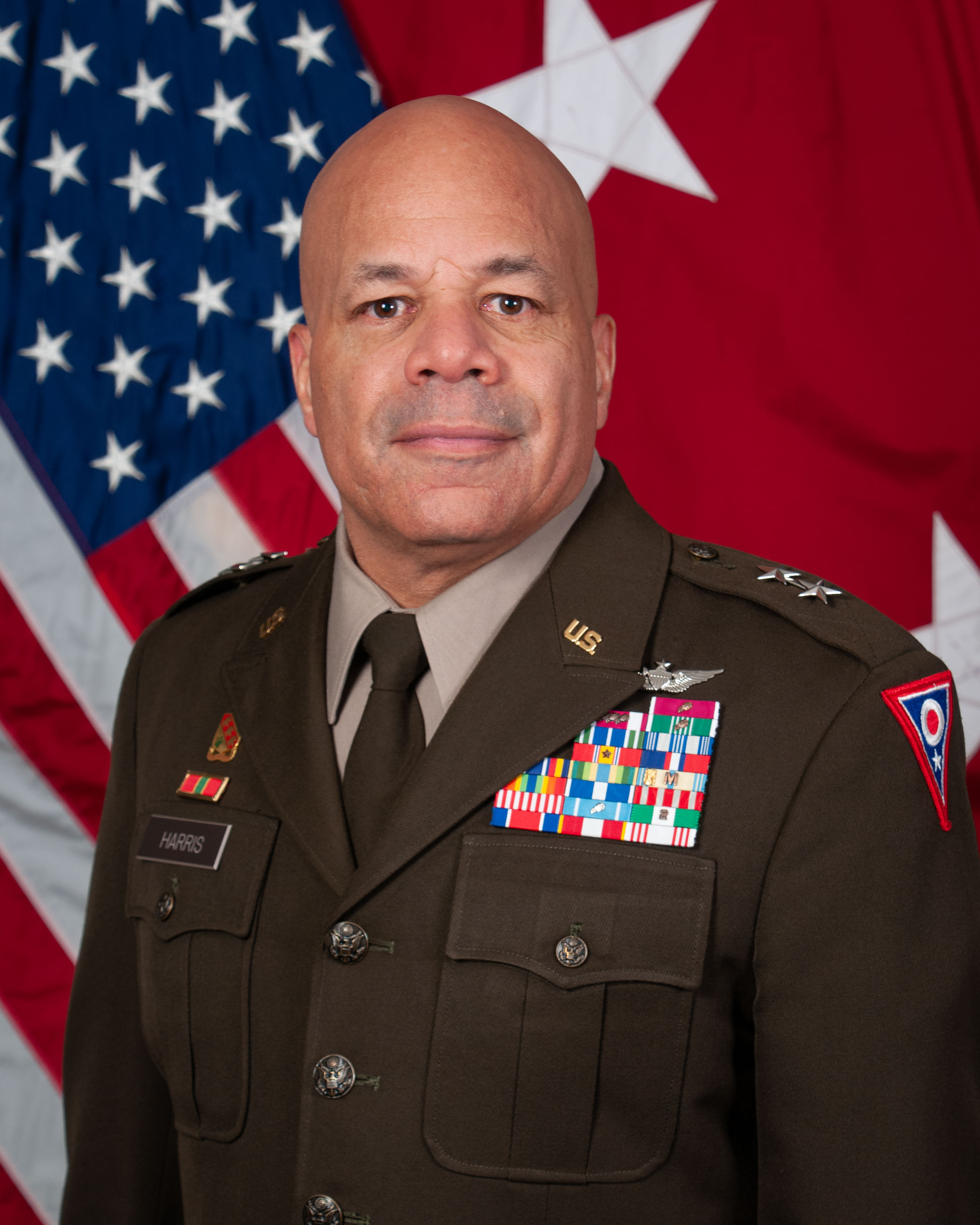
A CH-47 Chinook helicopter Sgt. Steven Galimore – US Army
Ohio Governor Mike DeWine has activated additional members of the Ohio National Guard to support the state of North Carolina in its recovery from flooding and damage caused by Hurricane Helene.
Following a request this afternoon from North Carolina for additional Ohio National Guard support, Governor DeWine has activated 10 Airmen from the Homeland Response Forces, 121st Air Refueling Wing to support first responders in fatality search and recovery.
This deployment is in addition to the activation announced earlier today of six Soldiers from Company B, 3rd Battalion, 238th Aviation Regiment to support North Carolina officials in moving supplies, equipment, and personnel via a CH47 helicopter.
North Carolina requested this assistance from the Ohio National Guard under the Emergency Management Assistance Compact, which is a national mutual aid partnership agreement allowing state-to-state assistance during state or federally declared emergencies.
Ohio Governor Mike DeWine announced today that he has ordered the mobilization of an additional 1,250 members of the Ohio National Guard to support hospitals with the most critical needs across the state. The mobilization comes on the same day the state set an all-time high for the total number of COVID-19 hospitalizations during the pandemic.
The Ohio Hospital Association reported today that 5,356 people are currently hospitalized with COVID-19. One in four patients are COVID-19 positive. This surpasses the previous hospitalizations record of 5,308 on Dec. 15, 2020. Of today’s hospitalizations, 1,228 patients are in the ICU, which is approaching the record high of 1,318 ICU patients reported on Dec. 15, 2020.
While Southwest Ohio is not seeing the same volume of patients as northern parts of the state, Richard P. Lofgren, MD, President and Chief Executive Officer, UC Health, expressed concerns about the surge in cases making its way across the entire state during the coming weeks.
Ohio National Guard Deployment As hospitals struggle with staffing to support the surge in COVID-19 patients, Governor DeWine announced during a press conference today, that he has asked Major General John C. Harris, Jr., Adjutant General, Ohio National Guard, to mobilize an additional 1,250 members of the Ohio National Guard, bringing the total deployment of National Guard members working with Ohio’s healthcare systems to 2,300 members.
“This is not something we take lightly… We are asking them to leave their families, their jobs and homes. This is a huge sacrifice,” Governor DeWine said.
Governor DeWine previously authorized the deployment of 1,050 Ohio National Guard members on Friday, Dec. 17. Major General Harris said the Ohio National Guard’s goal is to augment hospitals’ medical staff and wraparound services. Teams including nurses and medics will provide clinical care and non-medical teams will offer support services such as food service, patient transportation within facilities, and administrative support.
Approximately 460 Guard members are deployed in the Cleveland area; more than 160 in the Toledo area; about 100 in Columbus area. Smaller numbers of the Guard will be deployed in the coming days in Mansfield, Dayton, and Lima to support hospitals. Guard personnel are also supporting testing sites in Cleveland and Akron.
“The National Guard has been indispensable,” said Robert Wyllie, MD, Chief Medical Operations Officer, Cleveland Clinic.
The Ohio Department of Health and the Ohio Hospital Association are working daily with Ohio hospitals to assess staffing needs to determine the most appropriate support from the Ohio National Guard.
“Everybody agreed when the decision was made to send in the National Guard to our hospitals … All the way through this, we are going to be guided by where they are needed most today. It should give people confidence that everybody is on the same page here. Let’s deploy them where they are needed the most,” Governor DeWine said.
Hospitals Hospitals have been taking extraordinary measures to manage this COVID-19 surge, including postponing elective surgeries, while battling staffing shortages as a result of COVID-19 infection or exposure, and burnout.
The northern parts of Ohio have been particularly hard hit, especially the greater Cleveland area, where one in three patients are COVID-19 positive, including ICU patients, according to OHA data.
“The hospital systems are under significant stress in Northern Ohio,” Dr. Wyllie said. “We are running 2,000 tests a day. Let me tell you about those tests: 36% of the people going into the Walker Center for testing are testing positive for COVID.”
The state’s strategic hospital zone and region structure has allowed hospitals to work together with neighboring hospitals to balance the load of patients. This structure continues to be vital as cases and hospitalizations dramatically rise statewide and staffing remains a significant concern.
While Southwest Ohio is not seeing the same volume of patients as northern parts of the state, Richard P. Lofgren, MD, President and Chief Executive Officer, UC Health, expressed concerns about the surge in cases making its way across the entire state during the coming weeks.
“Unfortunately, the pandemic is not over … we are seeing more cases now than we have ever seen along the way,” he said. “Now, the spread of Omicron is adding fuel to this raging fire. One of the things that I want to make sure that people understand, is that this not only affects the care of people with COVID, but also affects people who don’t have COVID. It squeezes out our ability to take care of patients with other life-serious or life-threatening problems, such as heart attacks and strokes.”
Governor DeWine also spoke with Jennifer Hollis, a critical care nurse at OhioHealth Riverside Methodist Hospital in Columbus, about her experience in the hospital.
“I just want everybody to be able to walk a mile in my shoes and kind of understand as a critical care nurse, what I am seeing when I am coming into work. It is beyond difficult,” Hollis said. “Our beds are full. There is nowhere else to go, and we are just as short-staffed as everyone else is seeing as well … We are tired, we are frustrated, and we want the best for all of our patients.”
Hollis urged Ohioans to get vaccinated to protect themselves, their loved ones, and their communities. “I’ll continue to fight for you, when you won’t fight for yourself. Please get vaccinated. Quarantine if you are symptomatic. Get tested,” she said.
Vaccination, prevention Governor DeWine emphasized that the COVID-19 vaccines remain a powerful tool to keep people out of the hospital. Since June 1, 2021, there have been 35,962 admissions, and 92.5% of those have been among people who are not fully vaccinated.
Now more than ever, it’s critical to follow prevention strategies including getting vaccinated, getting a booster shot if eligible, wearing face masks, washing your hands frequently, getting tested, and staying home if sick, even if symptoms are mild.
“We are looking now at an impact of COVID-19 that is unlike anything we’ve seen before in this pandemic,” said Bruce Vanderhoff, MD, MBA, Director, Ohio Department of Health. “We have access to a powerful tool that can really shield us from the worst outcomes of COVID-19, and that is vaccination.”
As of today, more than 6.9 million Ohioans have received at least their first dose of a COVID-19 vaccine. That’s 63% of those Ohioans eligible (ages 5 and older). More than 2.6 million have received an additional dose, or a booster dose.
Masking in Schools Today, the Ohio Hospital Association also distributed a letter from the Ohio Hospital Association and Ohio Children’s Hospital Association to Ohio school superintendents, administrators and school board members encouraging them to implement a masking requirement when students return from the holiday break. A masking requirement in schools will help limit community spread of COVID-19 and keep students in school, the letter said.
Holidays Dr. Vanderhoff encouraged Ohioans to celebrate safely this holiday weekend so we can all have a healthy start to 2022. “As we get ready to ring in a new year, please, think about the steps you can take to prevent COVID-19 spread before you gather. Keeping vaccinations up to date, appropriate testing, staying home if you feel the least bit sick, masking especially in crowded indoor environments, proper ventilation, and regular handwashing can all help prevent the spread of COVID-19, flu, and other illnesses this season,” he said.
It cost the state of Ohio more than $1 million to send hundreds of troops to the Ohio Statehouse last month to protect against acts of political violence.
All told, taxpayers spent millions of dollars to pay for enhanced security in Columbus and Washington, D.C. following the Jan. 6 events at the U.S. Capitol.
After the deadly insurrection at the nation’s capital, DeWine mobilized around 1,000 troops to D.C. to help with security for President Joe Biden’s inauguration. DeWine also authorized 480 troops to be stationed at the Ohio Statehouse during planned protests on inauguration week.
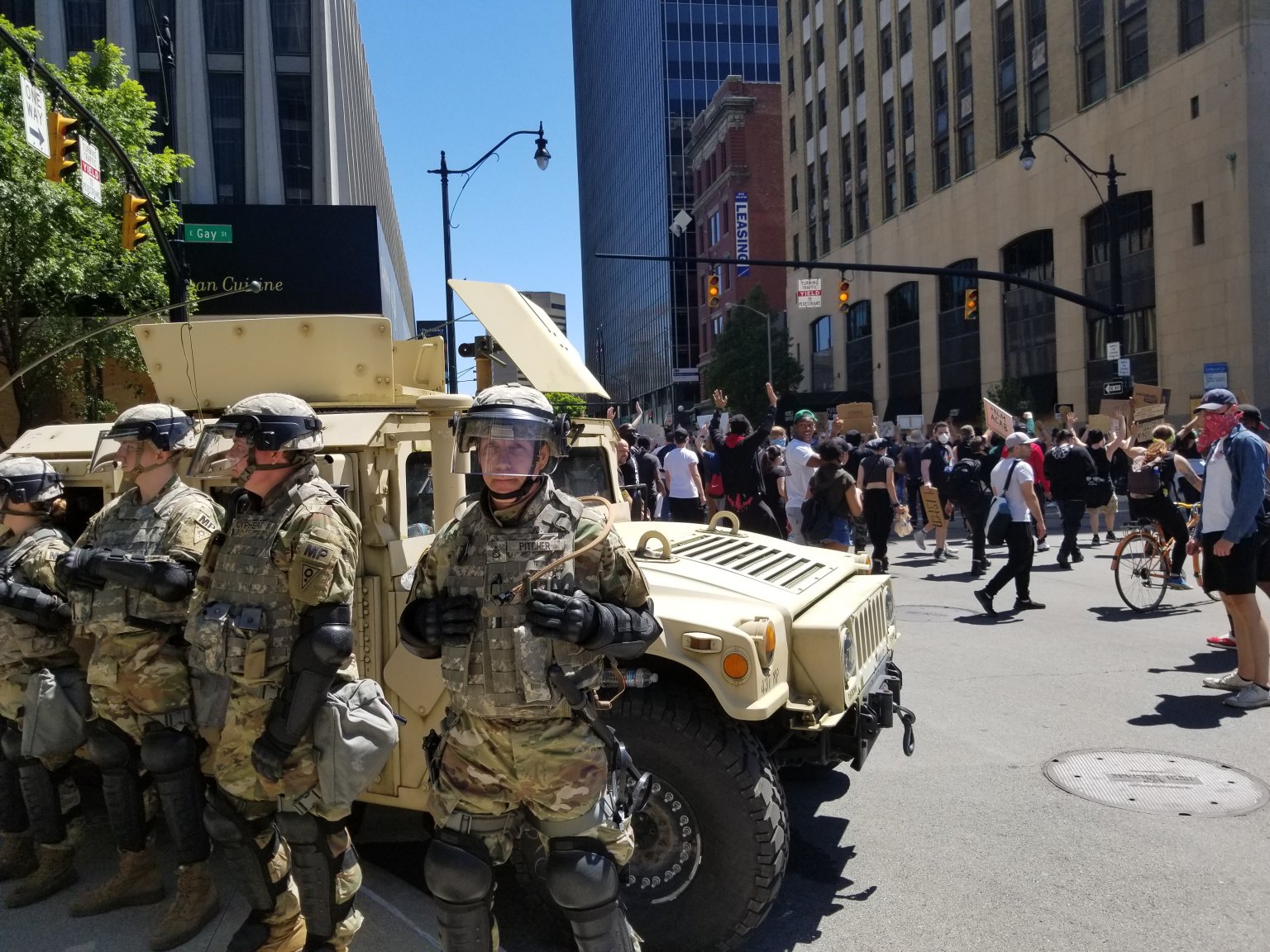
Military vehicles were placed around the Ohio Statehouse in mid-January. Photo by Jake Zuckerman.
The Ohio State Highway Patrol, normally in charge of protecting the Statehouse grounds, also ramped up security last month.
The cost of stationing troops in Columbus, as approved by the Ohio Controlling Board on Monday, was $1,035,000. Most of this amount ($695,000) went to payroll, with the remainder spent on food, travel costs and other supplies.
The deployment of Ohio troops in D.C. cost more than $2.1 million, but this is paid for by the federal government, according to Stephanie Beougher, the public information officer for the Ohio National Guard.
Public officials had worried about the potential for violence as online extremists turned their attention from the U.S. Capitol to the 50 state capitals. The Ohio Statehouse and other government buildings in downtown Columbus were closed for four days.
Protesters caused more than $150,000 in damage at the Statehouse last May and more than $1 million in damage to nearby businesses and offices. In response, the governor deployed Ohio National Guard troops to Columbus and Cleveland at an eventual cost of $3.2 million.
A Republican state senator recently proposed a bill to install security cameras at the Statehouse and increase the penalties for arson and vandalism.
Columbus, Ohio – Governor Mike DeWine issued a proclamation yesterday that authorizes the Ohio National Guard to provide security support at local jails if needed.
The proclamation was issued in response to the significant number of COVID-19 infections amongst state, county, and local corrections officers that has reduced staffing levels required to maintain safe and adequate security at some facilities.
Governor DeWine previously ordered the Ohio National Guard into state active duty to assist the Ohio Department of Rehabilitation and Correction with security at state prisons, and today’s proclamation amends that order to also permit Guard members to maintain security at any correctional facility, county jail, or confinement facility in the state.
More information can be found in the proclamation at governor.ohio.gov.
BREAKING UPDATE: Bloomberg News has reported this morning (12-2-2020) that the Pfizer vaccine scheduled for the Loveland Area has received approval in Britain. “The emergency authorization clears the way for the deployment of a vaccine that Pfizer and its German partner have said is 95% effective in preventing illness. The shot will be available in Britain from next week.” This is ahead of decisions in the U.S. and European Union. Read on…
Today, Ohio Governor Mike DeWine toured the Ohio Department of Health’s Receipt, Store, and Stage (RSS) warehouse facility located in Central Ohio, to see the facility and review the process that will be used to redistribute the COVID-19 vaccine in Ohio.
The Ohio Department of Health’s Vaccine Preparedness Office has been preparing for the arrival of the vaccine for months, distributing adult influenza vaccine with the same process that will be used to distribute the COVID-19 as a test exercise, and running daily drills with prototype packaging to break down and repackage the vaccine in smaller units.
There are currently 2,931 active COVID 19 cases in Clermont County
There are currently 33,498 active COVID 19 cases in Hamilton County.
There are currently 9,421 active COVID 19 cases in Warren County.
On Monday, the Ohio Department of Health took part in a nationwide end-to-end training exercise with the packaging that will be used to distribute the Pfizer vaccine. The Pfizer vaccine is expected to be the first manufacturer to receive the Emergency Use Authorization (EUA) by the Food and Drug Administration (FDA). The vaccine will be shipped to Ohio using the following process:
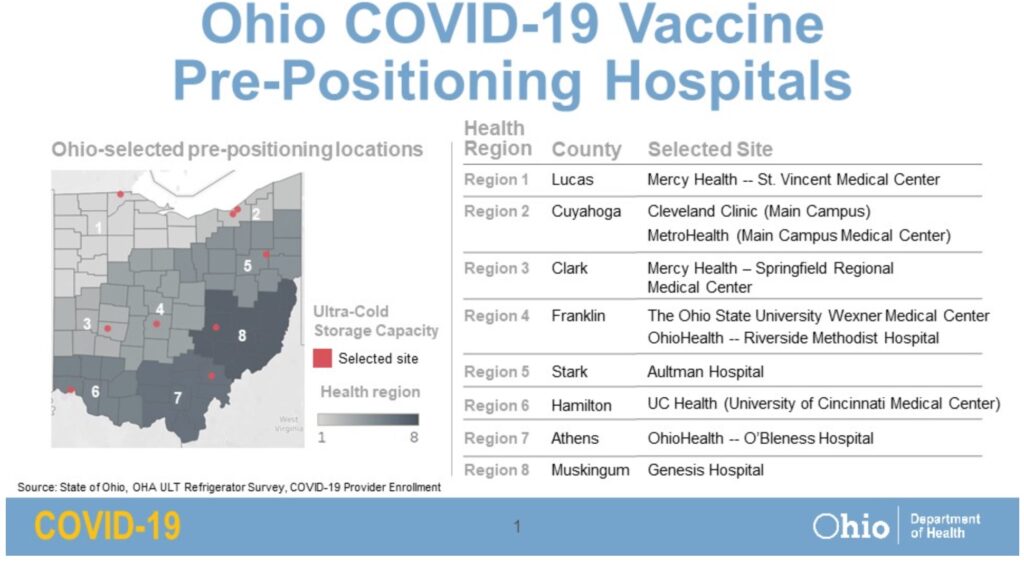
The Pfizer vaccine will be shipped directly to Ohio’s 10 prepositioned hospital sites. As vaccine supply increases, additional providers will receive direct shipments if ordering 975 doses or more of the vaccine.
Providers requiring fewer than 975 doses, such as smaller local health departments and physician’s offices, will not receive a direct shipment from Pfizer. In these cases, Pfizer will ship the vaccine to the ODH RSS warehouse, where the vaccine will be redistributed in increments of 100. The warehouse is equipped with ultracold freezers that can each hold up to 720,000 doses to be stored in the RSS at any one time.
When vaccinations are ready to be shipped from the RSS warehouse, they must be removed from ultracold storage and repackaged with dry ice in under two minutes. To ensure the vaccine can be repackaged safely, quickly, and effectively, ODH staff and members of the Ohio National Guard are running daily practice drills that include the following steps:
Each box is transported to a table where the vials are counted.
The box is closed and handed off to another team member who will place the vaccine box in a larger cold shipping container lined with bubble wrap..
Once the correct number of doses are placed in the larger cold shipping container, dry ice is added to the package, along with a sheet of cardboard. The lid is replaced and the package proceeds to the next step.
The package is sealed, a shipping label is applied, and the package is moved out for delivery.
All packages will be delivered to the providers within six hours. The vaccine will remain stable if sealed in the original shipping container from the RSS warehouse with dry ice for up to 5 days.
Vaccine National Drug Control (NDC) and lot number information will all be tracked electronically, and parcels will be tracked as they are delivered. Each delivery vehicle will contain a GPS enabled device.
Here is video of ODH staff and members of the Ohio National Guard practice drills
Upon granting of an emergency use authorization, it is anticipated that the Moderna vaccine will be shipped directly to providers administering the vaccine and will not be processed by ODH at the RSS warehouse.
Health care workers and nursing home residents should be at the front of the line when the first coronavirus vaccine shots become available, an influential government advisory panel said on Tuesday.
The Advisory Committee on Immunization Practices who make recommendations to the Centers for Disease Control and Prevention voted 13-1 today that Health care workers and nursing home residents should receive coronavirus vaccine shots when they become available.
CURRENT COVID-19 DATA There are 235,170 confirmed and probable cases of COVID-19 in Ohio and 5,461 confirmed and probable COVID-19 deaths. A total of 20,015 people have been hospitalized, including 3,969 admissions to intensive care units. In-depth data can be accessed by visiting coronavirus.ohio.gov. Video of today’s full update, including versions with foreign language translation, can be viewed on the Ohio Channel’s YouTube page. For more information on Ohio’s response to COVID-19, visit coronavirus.ohio.gov or call 1-833-4-ASK-ODH.
Columbus, Ohio – Ohio Governor Mike DeWine and Lt. Governor Jon Husted today provided the following updates on Ohio’s response to the COVID-19 pandemic.
RECORD-BREAKING CASES & HOSPITALIZATIONS DeWine announced today that Ohio is once again breaking records in regard to COVID-19 cases and hospitalizations.
• Between yesterday and today, health officials have reported a total of 4,961 new positive coronavirus cases in Ohio, the highest number of new cases in a 24-hour period to date.
• There are currently 2,075 patients hospitalized with COVID-19 which is a 55 percent increase in hospitalized patients compared to two weeks ago.
• Of the hospitalized patients, 541 people are in intensive care. The previous record for intensive care admissions was 533 in April.
“This virus is flaring up, and we have to push it down – the economy depends on it,” said Governor DeWine. “If the virus continues to aggressively spread, people will lose confidence in their ability to safely go to stores, restaurants, and other businesses. If we want to keep our economy moving, we must all live with this virus and we must all be more careful.”
Governor DeWine stressed that the new record number of cases is not due to increased testing capacity in the state. Since September 24, the total number of tests in Ohio has increased by approximately 44 percent, but positive cases have increased 280 percent in the same time period. If a person is tested multiple times, they are only counted once.
STATEWIDE HIGH INCIDENCE
New health data compiled by the Ohio Department of Health revealed today that all 88 counties in Ohio are now considered “high incidence” as defined by the Centers for Disease Control and Prevention.
“There have been so many cases in the past two weeks that the risk of catching this virus in every county of this state is very real and very concerning,” said Governor DeWine. “Again, I ask everyone to recognize their personal responsibility in slowing the spread of this deadly disease. It’s up to every citizen in Ohio to choose to slow the spread by wearing masks, distancing, and making overall smart decisions.”
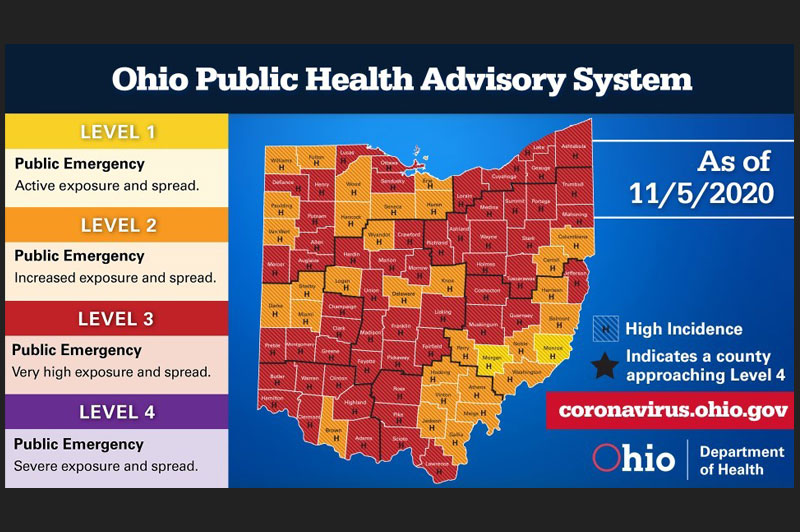
According to today’s updated Ohio Public Health Advisory System map, 56 counties are currently rated as having a very high risk of exposure and spread (Red Level 3), up from 43 counties last week. This represents the highest number of Red Level 3 counties since the launch of the advisory system in July. As of today, 86 percent of Ohioans are living in a Red Level 3 county.
Governor DeWine announced multiple key additions to the existing administration at the Ohio Department of Health (ODH).
Chief Medical Officer Dr. Bruce Vanderhoff: Dr. Vanderhoff previously served for more than a decade as a Senior Vice President and as the Chief Medical Officer at OhioHealth. He has years of experience leading large teams in successfully dealing with important healthcare issues in Ohio and prepared OhioHealth to deal with the threat of Ebola and the H1N1 flu pandemic.
Director Stephanie McCloud: Director McCloud previously served as Governor DeWine’s administrator of the Ohio Bureau of Workers’ Compensation, managing an agency of 1,800 colleagues and over $28 billion in assets. She has considerable experience in the area of mental health and addiction treatment which is a priority in Ohio’s health improvement plan.
Senior Deputy Lance Himes: Himes had previously served as the interim director of ODH where he has played an integral role in running and managing many aspects of the pandemic response operation. He will lead the coordination of the state’s vaccine distribution plan and will continue to work directly with Ohio’s local health commissioners.
Chief of Staff Kathleen Madden: Madden had previously served as Assistant Director at the Ohio Office of Budget and Management and will now play a key role in keeping ODH’s pandemic and non-pandemic programs and operations on track. She will work to prioritize and resolve critical issues, provide oversight and guidance to ODH staff, and ensure that ODH funds are spent responsibly and strategically. Other key members of the ongoing COVID-19 response who will continue their roles in assisting ODH are:
Adjutant General Maj. Gen. John Harris, Ohio National Guard: Maj. Gen. Harris will continue work to ensure complex operations, such as COVID testing and contact tracing, are well-coordinated, monitored, and improved when necessary. He will also work directly with Senior Deputy Himes on the planning and logistics of the forthcoming vaccine distribution program.
Director Ursel McElroy, Ohio Department of Aging: Director McElroy will continue to direct virus prevention efforts for older adults in the community and in long-term settings, including nursing homes and assisted living facilities.
Director Lori Criss, Ohio Department of Mental Health and Addiction Services: Director Criss will continue to lead efforts to address the increasing mental health needs of citizens during the pandemic.
NEW OHIO BWC ADMINISTRATOR Governor DeWine announced that John Logue, the Ohio Bureau of Workers’ Compensation’s (BWC) Chief of Strategic Direction, will become the new administrator of Ohio BWC effective on November 16. Logue has worked for 26 years in the industry. Before returning to BWC in 2019, he most recently served as the vice president of client services for International Absence Management Company where he focused on Ohio workers’ compensation.
Ohio’s new stay at home order goes into effect at midnight tonight.
Columbus, Ohio –Ohio Governor Mike DeWine, Lt. Governor Jon Husted, and Dr. Amy Acton, MD, MPH, provided the following updates on Ohio’s response to the COVID-19 pandemic this afternoon.
HOSPITAL CAPACITY
The announcement said that Ohio must double its hospital capacity due to the oncoming COVID-19 surge, Ohio has developed a plan to expand healthcare services at alternative sites in addition to the traditional medical care facilities. Representatives from health care systems, local governments, county emergency management agencies, state agencies, the Ohio National Guard, among others, examined buildings across the state that could support large numbers of patients.
The following sites have been selected based on considerations such as distance to an existing hospital, conditions safe for patients and health care professionals, and space to meet the region’s expected needs, including the Duke Energy Convention Center in downtown Cincinnati.
Seagate Convention Center, Lucas County
Case Western University’s Health Education Campus, Cuyahoga County
Dayton Convention Center, Montgomery County
Covelli Convention Center, Mahoning County
Duke Energy Convention Center, Hamilton County
Greater Columbus Convention Center, Franklin County
These facilities would be used for the mildly ill, while the sickest patients will be housed in traditional hospitals.
Assessments of other sites will continue if needed.
The press release from the Governor’s office said that health care regions in southern and southeastern Ohio have determined the existing hospital facilities in their areas will, with additional equipment, be capable to handle a surge in patients without going to an off-site location.
OHIO NATIONAL GUARD TO ASSIST FEDERAL PRISON
Governor DeWine announced that he has authorized the Ohio National Guard to assist federal authorities in the Elkton Federal Correctional Institution in Columbiana County where seven inmates have tested positive for COVID-19, and three inmates have died from the disease.
“To be clear, this is not a state facility, it is a federal prison – but, this prison is in Ohio. Ohio citizens work there, and their families live here,” said Governor DeWine. “As we’ve said for weeks, we’re all in this together, and providing state help for this federal prison is the right thing to do.”
The Ohio National Guard’s mission will be focused on providing medical assistance. They will not be armed, nor will they be providing security.
The guardsmen and women will assist in the prison’s infirmary with non-COVID-19 cases and with patients who are showing symptoms of the disease. These soldiers, who all work in the medical field, will have N-95 respirators for protection while they work to augment the current prison medical staff. They will treat those they can and triage others with serious symptoms for hospital care.
The guard also stands ready to help with transporting the seriously ill patients to the hospital in the event of a surge of sick inmates. In addition to staff, the guard will bring equipment and ambulances with them as well.
Governor DeWine also requested that the Federal Bureau of Prisons and U.S. Department of Justice cease accepting new inmates at the facility.
DISPUTE RESOLUTION
Lt. Governor Husted announced that the administration’s Dispute Resolution Commission, which was initially announced last week, is now prepared to receive submissions from essential businesses as well as county health departments.
The panel, which includes Ohio Department of Commerce Director Sheryl Maxfield, Development Services Agency Director Lydia Mihalik, and Public Utilities Commission of Ohio Chairman Sam Randazzo, will specifically seek to resolve disputes when two county health departments disagree on whether a type of business should or should not be deemed essential during the state of emergency. The purpose of the commission is to provide clarity and ensure that similarly-situated businesses are treated fairly, regardless of which side of a county line they operate.
Ohio’s new stay at home order goes into effect at midnight tonight. You can find the full order at coronavirus.ohio.gov.
Retailers will be required to determine a maximum number of customers allowed in the store to account for proper physical distancing. That number must also be displayed at the businesses’ entrances.
REMINDER – SNOWBIRDS MUST SELF-QUARANTINE
Governor DeWine today reminded “snowbirds” that they must quarantine for 14 days once they arrive in Ohio.
“I know that many of our Ohio snowbirds will soon be returning from places like Florida, and we want to make sure that you remain healthy and that those around you remain healthy,” said Governor DeWine.
In addition to those returning after spending winter elsewhere, anyone who has traveled outside of Ohio for any other reason must also self-quarantine for 14 days upon their return. This order excludes truckers, healthcare workers, other workers providing essential services, and those who live on the state border.
CURRENT OHIO DATA
There are 4,450 confirmed cases of COVID-19 in Ohio and 142 deaths. A total of 1,214 people have been hospitalized, including 371 admissions to intensive care units. In-depth data can be accessed by visiting coronavirus.ohio.gov.
4,450 – Confirmed Cases in Ohio
371 – Number of ICU admissions
1,214 – Number of Hospitalizations in Ohio
142 – Number of Deaths
<1–101 – Age Range
54 – Median Age
48%* – Sex – Males
52%* – Sex – Females
LAST UPDATED: 04/06/20 (UPDATED DAILY AT 2 P.M.) *<1% SEX NOT REPORTED
In Clermont County there are 27 cases, 4 hospitalizations, and 1 death.
In Hamilton County there are 394 cases, 66 hospitalizations, and 9 deaths.
In Warren County there are 37 cases, 5 hospitalizations, and 0 deaths.
In Butler County there are 75 cases, 29 hospitalizations, and 2 deaths.
Video of today’s full update, including versions with foreign language closed captioning, can be viewed on the Ohio Channel’s YouTube page.
For more information on Ohio’s response to COVID-19, visit coronavirus.ohio.gov or call 1-833-4-ASK-ODH.
Columbus, Ohio – Governor Mike DeWine issued a proclamation today authorizing specified members of the Ohio National Guard to provide emergency aid to the Commonwealth of Puerto Rico after a series of powerful earthquakes caused massive destruction and widespread power outages.
Governor DeWine’s proclamation allows the Ohio National Guard unit to remain on active duty until the disaster recovery assistance is complete and an emergency no longer exists.
Beginning on December 28, 2019, the U.S. territory experienced hundreds of earthquakes, culminating in a 6.4 magnitude earthquake on January 7, 2020, and multiple aftershocks, near Guanica on the island’s southwestern coast.
Puerto Rico’s governor declared a state of emergency due to the widespread damage and utility disruption.
“I have authorized the mobilization of the Ohio National Guard to provide emergency assistance until basic services in the impacted areas are restored,” said Governor DeWine. “I have instructed Ohio’s Adjutant General
to take whatever actions are necessary to assist local authorities to protect the lives, safety, health, and property of citizens affected by these devastating earthquakes.”
The Ohio Air National Guard 200th RED HORSE (Rapid Engineer Deployable Heavy Operational Repair Squadron Engineer) Squadron will support earthquake relief efforts by establishing two Disaster Relief Bed-down Systems, which are deployable kits capable of providing basic housing and life support facilities, such as tents, showers, and latrines, for up to 150 military personnel responding to the disaster.
Disaster relief missions and supporting our homeland is why America has a National Guard to call when the nation and her citizens need us most.
“Disaster relief missions and supporting our homeland is why America has a National Guard to call when the nation and her citizens need us most. Our Ohio Air National Guard Airmen at the 200th RED HORSE Squadron are ready and anxious to support earthquake relief efforts in Puerto Rico. This is what we do,” said Maj. Gen. John C. Harris Jr., the Ohio adjutant general.
The 200th RED HORSE Squadron, headquartered in Port Clinton, Ohio, with a detachment in Mansfield, is equipped to provide engineering, construction, and logistics capabilities worldwide on short notice.
“Being able to support another state for domestic response is exciting,” said Col. Michael Hrynciw, commander of the 200th RED HORSE Squadron.”
“Being able to support another state for domestic response is exciting,” said Col. Michael Hrynciw, commander of the 200th RED HORSE Squadron. “We train for this all the time in support of our friends and neighbors. The Ohio National Guard leads the way in helping others.”
Major General John C. Harris, Jr.
Governor DeWine’s proclamation allows the Ohio National Guard unit to remain on active duty until the disaster recovery assistance is complete and an emergency no longer exists.
Governor DeWine’s proclamation allows the Ohio National Guard unit to remain on active duty until the disaster recovery assistance is complete and an emergency no longer exists.
The Ohio National Guard is deploying the equipment and personnel as part of the Emergency Management Assistance Compact, which allows states to send personnel, equipment, and commodities to assist with response and recovery efforts in other states or territories.






![[VIDEO] Governor visits RSS Warehouse site as State prepares for vaccine distribution](https://lovelandmagazine.com/wp-content/uploads/2020/12/hypo-needle.jpg)