Tag: Ohio Republicans

  • Ohio Republicans start the year by throwing public education under the school bus

    Ohio Republicans start the year by throwing public education under the school bus

    Ohio Gov. Mike DeWine gets off a school bus as part of the first Ohio School Bus Safety Working Group meeting at the Ohio Department of Public Safety Atrium on Sept. 11, 2023. (Photo by Megan Henry, Ohio Capital Journal).

    Commentary

    by Marilou Johanek – Ohio Capital Journal

    It didn’t take long. The new legislative session began in Columbus with Republican chieftains in the state throwing the future of public education in Ohio under the school bus.

    First it was the billion-dollar voucher king, Ohio House Speaker Matt Huffman, to hedge his bets on giving Ohio’s 611 school districts what they need to provide a quality education to the 1.7 million students they serve.

    Then it was Huffman’s patsy in the executive branch, Ohio Gov. Mike DeWine, who added his two cents worth of wishy-washy about how a leaner state budget ahead means something’s gotta give — like fully funding the education system used by the vast majority of Ohio families and their children. “Sometimes these are very, very difficult, difficult choices,” said the gutless wonder. What leadership.

    Educating future generations of Ohioans with high-quality public schools is your job, governor. It’s the No. 1 responsibility of the state to ensure a thorough and efficient system of funding for public schools. ‘Says so right in the Ohio Constitution. It also says, “no religious or other sect, or sects, shall ever have any exclusive right to, control of, any part of the school funds of this state.” But DeWine and his puppet master in the Ohio House ignored that part years ago when the state began diverting hundreds of millions of education funds to private and mostly religious schools.

    Clearly, the politicians calling the shots in state government have no regard for the state constitution. Adhering to the rule of law is optional when political power is absolute. Huffman, who thumbed his nose at the Ohio Constitution on fair redistricting (to pull off even more egregious gerrymandering in legislative and congressional districts) is doing the same thing on adequately funding public education.

    He’s looking to cut revenue to public schools while spending a ton of tax dollars on private school vouchers — with aspirations to fund more private school facilities to increase demand for those vouchers. Call it the Great GOP Phase-out of Public Education. Last week, Huffman dropped a calculated bombshell to prepare Ohio’s public-school districts for another financial hit from the state.

    YOU MAKE OUR WORK POSSIBLE.


    The Lima Republican said the state couldn’t afford to fully fund public schools or finally fix a school funding formula ruled unconstitutional nearly three decades ago. The Ohio Supreme Court’s 1997 ruling said the state’s failure to provide and distribute sufficient resources for public education and its over-reliance on local property taxes to cover that shortcoming violated the law.

    Yet Ohio lawmakers never remedied the problem. School districts had to keep going back to voters just to maintain and operate local schools. Homeowners carried the weight of school funding, not the state. They were/are understandably tapped out on school levies, especially as changes in property evaluations jack up tax bills.

    But in 2021, after years of collaboration between former Republican Ohio House Speaker Bob Cupp, former Democratic state Rep. John Patterson and scores of public education stakeholders, Ohio came close to meeting its constitutional obligation of ensuring a thorough and efficient system of funding for public schools. “What we really wanted to do was figure out what it really costs to educate a student and then what a district can really do to support its fair share, and then the state would compensate with the rest,” said Patterson.

    The Cupp-Patterson spending formula, known as the Fair School Funding Plan, was enacted as part of the 2021-23 state budget. The new system weighed a district’s expenses to come up with the base per-pupil funding amount — instead of a blanket amount of state funding for all schools — and changed the way the local community’s share was measured depending on property tax value and the income of local residents.

    That was a big deal and a significant step forward to address the long-running inequities of an unconstitutional school funding system that had failed generations of K-12 students. The quality of their education often depended on where they lived. Wealthy school districts in Ohio had every advantage over high poverty districts that struggled to pay for even basics in the classroom.

    The Fair School Funding Plan initiated a level of fairness and reliability in state support that past spending programs lacked. Complete state funding of the FSFP (around $2 billion altogether) was to be phased in over a six-year period through two-year budget cycles. The goal was to continue expanding state funding for districts in successive biennial state budgets until the Fair School Funding Plan was fully funded.

    The last installation, or third phase, was to be paid in full in the upcoming 2026-2027 operating budget. But that expectation hit a wall when Huffman nixed increased spending to public schools as “unsustainable.”

    His excuses for not making good on fully funding Cupp-Patterson — less state revenue to work with, less federal pandemic relief money, more scrutiny needed for school money already allocate — don’t apply to his expansive voucher outlays to religious schools that reached $966.2 million for the 2023-2024 school year. Enough to fully fund Fair School Funding Plan.

    But Huffman is laying the ground to shave more off the FSFP and showing his utter indifference to the acute financial challenges facing countless districts. Tough luck for the nearly 90% of Ohio students who attend public schools with slashed opportunities. It didn’t take long.

    GET THE MORNING HEADLINES.

    __________
    Marilou Johanek
    Marilou Johanek

    Marilou Johanek is a veteran Ohio print and broadcast journalist who has covered state and national politics as a longtime newspaper editorial writer and columnist.

    MORE FROM AUTHOR

  • Ohio Republicans propose requiring proof of citizenship for voting, removal of dropboxes

    Ohio Republicans propose requiring proof of citizenship for voting, removal of dropboxes

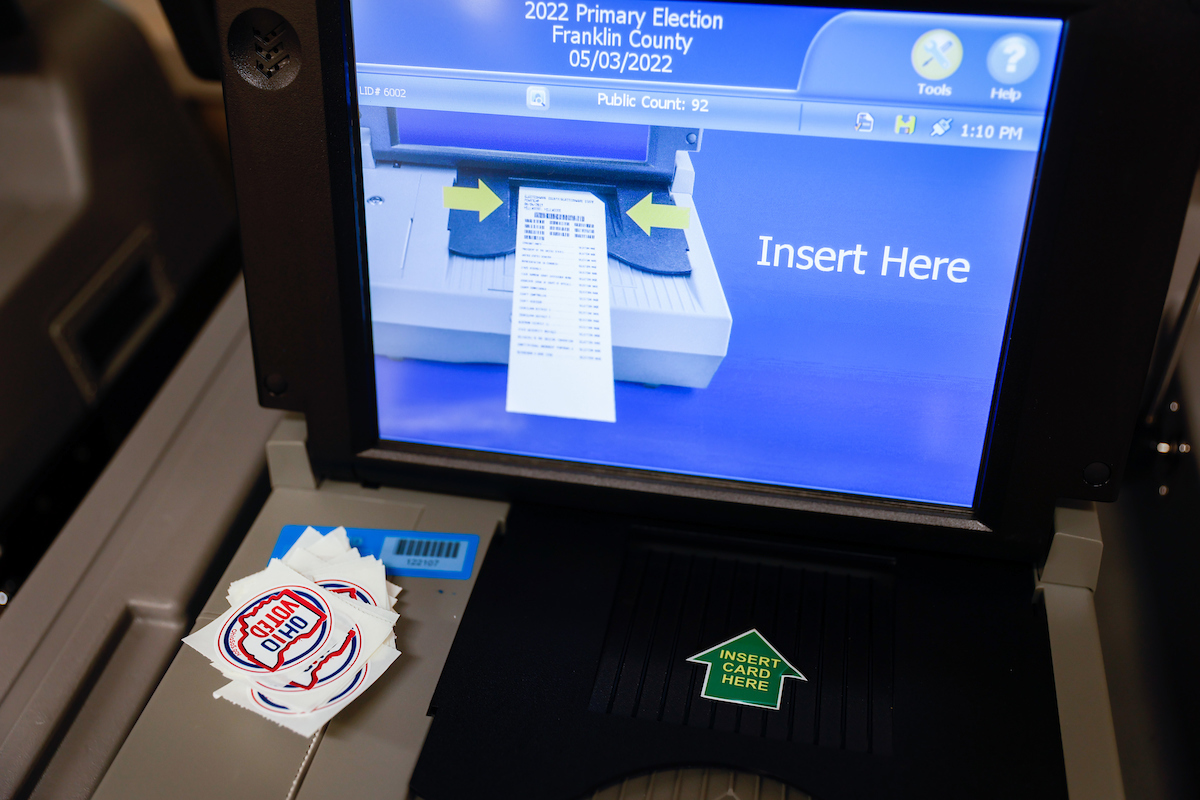
     A ballot counter machine. (Photo by Graham Stokes for the Ohio Capital Journal. Republish photo only with original story.)

    November’s election went off without a hitch and it was a great day for the GOP, but some members still want additional voting restrictions

    By:  Ohio Capital Journal

    Another election has come and gone in Ohio with no reports of widespread fraud. That hasn’t stopped a handful of Republican state senators from advancing legislation to place new restrictions on how Ohioans cast their ballots.

    State Sen. Niraj Antani, R-Miamisburg, has put forward a bill requiring Ohioans show proof of citizenship to register to vote or update their existing registration. Sens. Theresa Gavarone, R-Bowling Green, and Andrew Brenner, R-Delaware, filed another bill imposing proof of citizenship requirements, and the elimination of ballot drop boxes.

     COLUMBUS, OH — FEBRUARY 22: State Sen. Niraj Antani, R-Miamisburg. (Photo by Graham Stokes for Ohio Capital Journal) 

    That state legislation takes its cue from efforts at the federal level backed by U.S. House Speaker Mike Johnson. That proposal, known as the SAVE Act, had little chance of passage with Democrats in control of the U.S. Senate. Now, with a Republicans in control of all three branches of government, it stands a better chance of passing.

    It’s already illegal to register or vote as a non-citizen at the state and federal level. Despite that threat of criminal prosecution, backers still worry current law allows voters to register with little more than a promise.

    It appears that approach has worked exceptionally well, though. Actual reviews of the voter rolls have found cases of actual fraud are vanishingly rare and nowhere close to enough to affect the outcome of races.

    What’s more, the effort to protect voting by demanding citizenship documentation, risks disenfranchising eligible citizens. One University of Maryland study estimated 21 million Americans don’t have ready access to the required documents. After Kansas imposed similar requirements about a decade ago, more than 30,000 voters had their registration suspended or canceled.

    GET THE MORNING HEADLINES.

    Proof of citizenship

    Both measures lay out the same list of documents for verifying citizenship. A U.S. Passport, birth certificate or naturalization certificate will all work, but they lean heavily on existing records held by the Bureau of Motor Vehicles. Lawmakers seem to envision a system in which most initial registrations or updates get verified behind the scenes, with county boards checking with the BMV that it received citizenship documents when a voter got their license.

     COLUMBUS, Ohio — JUNE 07: State Sen. Andrew Brenner, R-Delaware. (Photo by Graham Stokes for Ohio Capital Journal) 

    For people whose information doesn’t match, for instance due to a name change, marriage or divorce, they’ll need to provide a court order or marriage certificate.

    In a press release, Brenner framed their proposal as strengthening laws and adding protections “so that Ohioans continue to know there is a reliable system in place when they cast their vote.”

    Gavarone insisted Ohio remains the “gold standard” for election integrity, but that her bill “addresses areas of the election law we can improve, including an extra layer of protection to enforce our state constitution’s citizenship requirement.”

    “This is a simple fix that strengthens trust and integrity in our institutions,” she added.

    But the proposals could actually see Ohio sacrificing simplicity in the name of security. Federal law does not require proof of citizenship to vote, and so even if lawmakers approve some version of the requirement, they can only really apply it to state forms and state elections. As in Arizona, Ohio voters would still be able to register with federal forms, but they would only be able to vote in federal elections, and ineligible to sign initiative petitions.

    Dropboxes

    While Antani’s proposal sticks to the citizenship requirements, Brenner and Gavarone go a step further and outlaw the use of ballot drop boxes. Although there have been no credible allegations of voter fraud tied to drop boxes, they have been a persistent bugaboo for skeptics.

     COLUMBUS, Ohio — MAY 31: State Sen. Theresa Gavarone, R-Bowling Green. (Photo by Graham Stokes for Ohio Capital Journal) 

    In the most recent election, Ohio Secretary of State Frank LaRose imposed rules effectively limiting their use to individual voters dropping off their own ballot. In an August letter, he urged state lawmakers to consider removing drop boxes altogether.

    Apparently Brenner and Gavarone were listening.

    Their legislation restricts ballot drop-offs to hand delivery — explicitly prohibiting board from accepting ballots “returned by personal delivery to an unattended receptacle.”

    According to the Secretary of State’s early vote dashboard, voters aiming to get their ballot in early were far more likely to vote early in person or mail in their absentee ballot. The roughly 181,000 ballots returned by drop box represented less than 7% of the total. Mail ballots and early in person ballots accounted for 31% and 59% respectively.

    Gavarone justified the drop box rollback with reference to incidents in Oregon and Washington where incendiary devices were placed in drop boxes.

    Follow Ohio Capital Journal Reporter Nick Evans on Twitter.


    Nick Evans
    Nick Evans

    Nick Evans has spent the past seven years reporting for NPR member stations in Florida and Ohio. He got his start in Tallahassee, covering issues like redistricting, same sex marriage and medical marijuana. Since arriving in Columbus in 2018, he has covered everything from city council to football. His work on Ohio politics and local policing have been featured numerous times on NPR.

    Ohio Capital Journal is part of States Newsroom, the nation’s largest state-focused nonprofit news organization.

    MORE FROM AUTHOR

  • COMMENTARY: Change to 88 counties under State Issue 1 would effectively kill Ohio grassroots amendment proposals

    COMMENTARY: Change to 88 counties under State Issue 1 would effectively kill Ohio grassroots amendment proposals

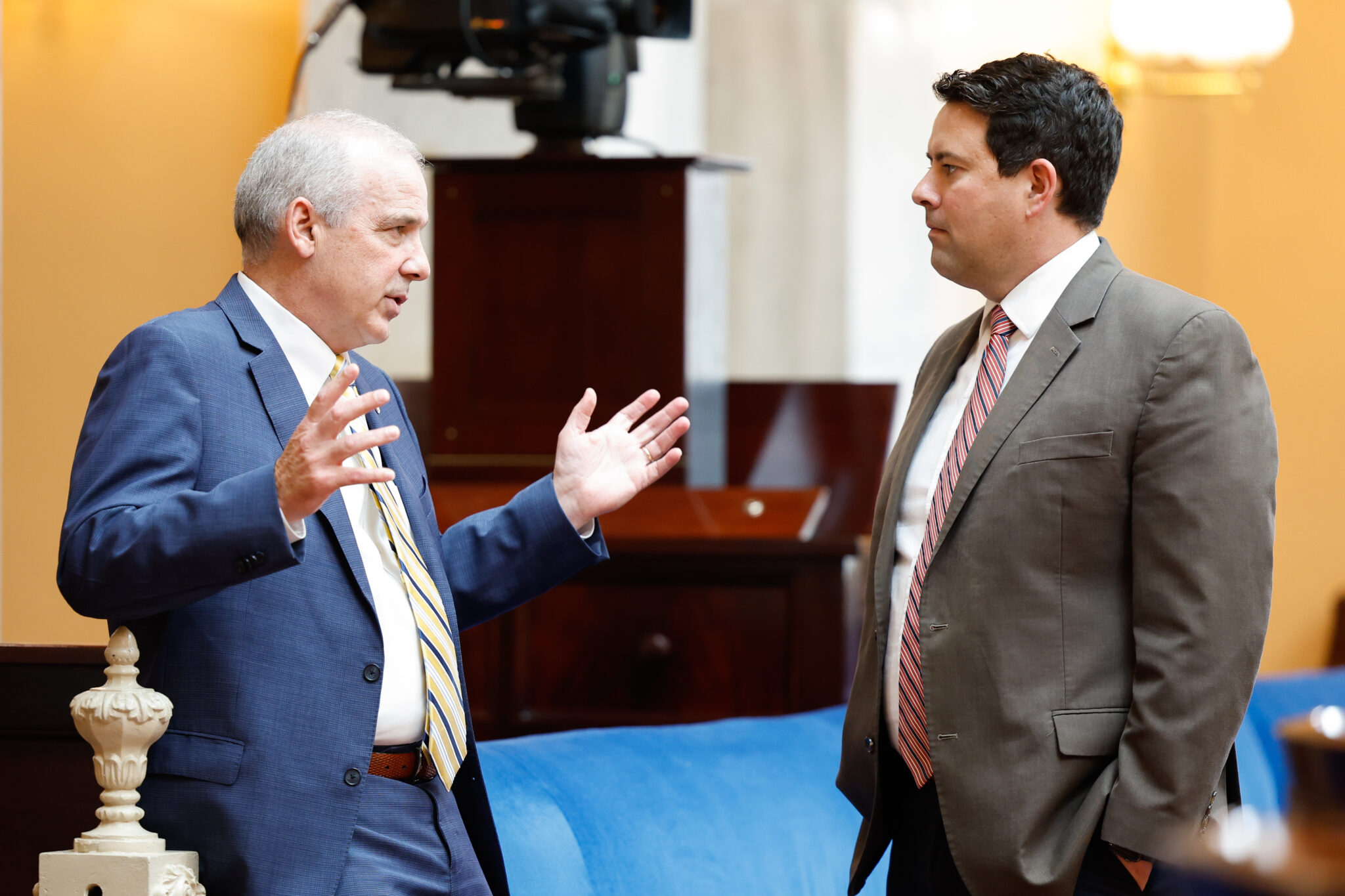
    COLUMBUS, Ohio — MAY 31: Senate President Matt Huffman, R-Lima (left), talks to Senate Majority Floor Leader Rob McColley, R-Napoleon, after the Ohio Senate session, May 31, 2023, at the Statehouse in Columbus, Ohio. (Photo by Graham Stokes for Ohio Capital Journal. Republish photo only with original story.)


    by DAVID DEWITT – Ohio Capital Journal

    By far the most burdensome part of collecting signatures for citizens to amend the Ohio Constitution is the current requirement that they be gathered in 44 out of our state’s 88 counties.

    Organizers typically try to gather double the number of signatures they need to get a proposal on the ballot, because so many things can go wrong and they need that much of a buffer to ensure they have enough valid and accepted signatures to get a proposal through. It’s a slog, requiring a tremendous amount of time, money, resources, volunteers, and dedicated effort for Ohio citizen groups to fulfill. And that’s fair.

    But Ohio Republicans moving the goal posts from 44 counties to 88 counties, as they propose to do with State Issue 1 on the ballot Aug. 8, would effectively destroy the ability of grassroots Ohio citizen groups to succeed in getting proposed amendments on the ballot ever again. The only groups that would have even a remote shot of success would be the most wealthy and powerful special interest groups imaginable.

    Ohio’s unconstitutionally gerrymandered, extremist Republican supermajority in the Ohio Statehouse is the first legislature in Ohio history to try to roll back the constitutional power of Ohio voters, proposing with State Issue 1 to destroy majority voter authority and raise the threshold for passing amendments to 60%.

    Ohio voters have had a majority say over the Ohio Constitution since 1851, and the power to bring citizen ballot initiatives since 1912. Now Ohio Republicans want to eliminate the last possible avenue of accountability for voters against our corrupt, out-of-control legislature.

    Republican leaders have admitted in private and in public that their effort is really aimed to stop an abortion rights amendment slated for the November ballot, and to stop voters from any effort toward further anti-gerrymandering reform.

    After months of denying that the attempt to roll back majority voter authority and enshrine 41% minority rule over our constitution was tied to abortion, Ohio’s two-faced Secretary of State Frank LaRose was recorded telling Seneca County Republicans this is “100% about keeping a radical pro-abortion amendment out of our constitution.”

    LaRose has used his position as our state’s chief elections official to write the most manipulative ballot language possible for the proposal, once again violating the Ohio Constitution as he did when he ignored a bipartisan Ohio Supreme Court, the voters, and the rule of law, to force through unconstitutionally gerrymandered maps.

    Ballot language is constitutionally mandated to be both neutral and accurate. State Issue 1 as written for the ballot by LaRose fails in both regards. In trying to defend the language, which is now the subject of a lawsuit, the state openly admits that it is inaccurate, but claims that’s not a “material defect.”

    The misleading ballot language LaRose and Ohio Republicans are forcing Ohio voters to consider 1.) Fails to state clearly the current process and standards, and how exactly they would change by comparison under the amendment, 2.) Uses weighted language about “elevating” the standards instead of neutral language about raising the threshold for passage from 50% to 60%, and 3.) Inaccurately describes the signature requirement as needing at least 5% of eligible voters in each county, instead of the truthful and accurate 5% of the ballots cast in each county during the most recent election for governor.

    Meanwhile, Ohio Senate President Matt Huffman, also guilty of assaulting the voters, Ohio Constitution, and rule of law with gerrymandering, is now using the state budget process to extort Statehouse lobbyists into supporting this attack on voters.

    Huffman has most recently proposed underfunding the August election by only allocating $15 million for it in the state budget, instead of $20 million as was spent on the August 2022 election. This will stretch county boards of election resources thin and hamper their ability to conduct this election, especially in Oho’s most populous counties, which are the most likely to strongly oppose the amendment.

    Frank LaRose and Matt Huffman are using their elected positions of public trust to deploy every dirty trick in the book against Ohio voters to try to get us to strip ourselves of power and kneel down in subservience to their wanton extremism and corruption.

    But the real kicker is that they plan on spending $6 million in TV ads — with financial backing of an extremist out-of-state billionaire — to try to convince Ohio voters this is about protecting our constitution from out-of-state special interests, when what the amendment would actually do is hand over all keys of power to the most wealthy and extreme special interests.

    This brings us back to the change from 44 counties to 88 for signature gathering and the amendment’s elimination of a “cure period” after signatures have been turned in where organizers can correct things like wrong addresses listed on petitions.

    “Requiring potentially hundreds of thousands of more signatures is bad enough,” the ACLU of Ohio’s Gary Daniels told House lawmakers in testimony against the proposal. “Eliminating the cure period in a state where many often move residences and are unnecessarily purged from voting rolls is even worse. The switch from 44 to 88 counties guarantees that the only campaigns that will qualify for the ballot are the most extremely rich ones.”

    As we’ve seen in scandal after scandal — whether it’s payday lenders, corrupt charter schools, FirstEnergy bribing lawmakers and regulators for a billion-dollar bailout, or an Illinois billionaire trying to rewrite more than 100 years of Ohio Constitutional voter powers — our gerrymandered Statehouse is captured by corrupt, big money special interests.

    By enshrining 41% minority rule, eliminating the signature gathering grace period, and mandating the near-impossible task of gathering thousands of signatures from every single Ohio county, State Issue 1 would guarantee that the only people who have influence on Ohio government are the most wealthy special interests and the corrupt Ohio politicians who keep selling out Ohioans, our state, and our future for pennies on the dollar.


    David DeWitt
    DAVID DEWITT

    OCJ Editor-in-Chief and Columnist David DeWitt has been covering government, politics, and policy in Ohio since 2007, including education, health care, crime and courts, poverty, state and local government, business, labor, energy, environment, and social issues. He has worked for the National Journal, The New York Observer, The Athens NEWS, and Plunderbund.com. He holds a bachelor’s degree from Ohio University’s E.W. Scripps School of Journalism and is a board member of the E.W. Scripps Society of Alumni and Friends. He can be found on Twitter @DC_DeWitt

    MORE FROM AUTHOR

  • Poll: 60% of Ohio GOP primary voters say election was stolen

    Poll: 60% of Ohio GOP primary voters say election was stolen

    BY: JAKE ZUCKERMAN – Ohio Capital Journal

    Nearly two in three Ohio Republicans likely to vote in the upcoming primary election believe the election was “stolen” from President Donald Trump, according to polling conducted late last month.

    Of 800 “likely” voters sampled in late January, 62% said they believed the election was stolen and 29% believed there was “some fraud” but President Joe Biden won. Only 8% indicated Biden won with “no fraud.”

    Top issues from voters in the poll, conducted by the firm Fabrizio Lee on behalf of a PAC supporting U.S. Senate Candidate J.D. Vance, included “border security and immigration” (16%), followed by “election and voting security” (13%) and several economic areas like inflation, taxes, government spending and jobs (all around 11%).

    “While every single message tests well, the best of the bunch are cutting federal aid to localities that allow non-citizens to vote, requiring proof of citizenship to get public assistance, and allowing border states to complete the border wall with Mexico,” the polling states, in advice to Vance.

    There’s no evidence to suggest the election was stolen. Trump’s administration officials have said there was no fraud at enough scale to sway the election, as have state audits and media investigations. However, Trump and his allies in politics and media have insisted the 2020 election was fraudulent regardless.

    In the U.S. Senate GOP primary for the open seat to be abdicated by incumbent Sen. Rob Portman, nearly all the leading candidates — Josh MandelVanceMike Gibbons, and Jane Timken — have embraced Trump’s claim that the election was stolen.

    Only Sen. Matt Dolan, R-Chagrin Falls, has unequivocally rejected the election fraud theory and called out leaders who “perpetuated lies.” The recent polling shows 15% of his likely voters believe the election was stolen.

    “Dolan voters differ greatly from the rest of the electorate, but they are only 3% of the vote,” the polling states.

    The polling was first reported and obtained by Politico last week. Fabrizio Lee earned a “B/C” grade from FiveThirtyEight, a data-driven politics blog that rates pollsters based on their methodology and historical accuracy.

  • Transgender athlete bills don’t solve any pressing issue. They’re just bullying

    Transgender athlete bills don’t solve any pressing issue. They’re just bullying

    Getty Image

    Commentary by David C. DeWitt and Ohio Capital Journal

    Two bills are working their way through the Ohio General Assembly that do not solve any pressing issues in high school athletics; they simply target and needlessly victimize five Ohio children in a cynical attempt to score cheap political points.

    I’m referring to Ohio House Bill 61 and Senate Bill 132, which would ban transgender girls from joining female teams in high school and college athletics. They are sponsored by state Rep. Jena Powell, R-Arcanum, and state Sen. Kristina Roegner, R-Hudson.

    As OCJ has reported, out of about 400,000 Ohio high school athletes competing this year, five transgender girls opted to follow their gender identity and compete in women’s sports. Four transgender girls obtained approval in 2019-2020, two in 2018-2019, and none were approved between 2015 and 2017, according to the Ohio High School Athletic Association (OSHAA).

    OSHAA Director of Compliance Kristin Ronai (LinkedIn photo)

    OSHAA already has a policy regarding transgender athlete eligibility, and it seems to be working fine as OSHAA Director of Compliance Kristin Ronai told OCJ, “I personally, and the rest of our office, have not received one complaint about transgender athlete participation in the state of Ohio.”

    There’s no evidence of transgender girls taking scholarship opportunities away from anyone, she added, saying OSHAA’s policy for this exceedingly small population was crafted by experts, and no real problem exists for the legislation to solve.

    In North Carolina, Republican House Speaker Tim Moore killed a similar bill, telling the Associated Press it simply isn’t needed as there has been no verifiable problem with transgender women playing sports.

    Meanwhile, an expert who helped the NCAA establish its policy for transgender participation in 2011 and also advised the International Olympic Committee on the issue told NPR recently these bills are discriminatory when school sports are supposed to be about inclusivity, team-building and personal well-being, and they have no basis in science.

    “We know that men have, on average, an advantage in performance in athletics of about 10% to 12% over women, which the sports authorities have attributed to differences in levels of a male hormone called testosterone. But the question is whether there is in real life, during actual competitions, an advantage of performance linked to this male hormone and whether trans athletes are systematically winning all competitions. The answer to this latter question, are trans athletes winning everything, is simple — that’s not the case. And higher levels of the male hormone testosterone are associated with better performance only in a very small number of athletic disciplines: 400 meters, 800 meters, hammer throw, pole vault — and it certainly does not explain the whole 10% difference,” said Dr. Eric Vilain.

    “And lastly, I would say that every sport requires different talents and anatomies for success. So I think we should focus on celebrating this diversity, rather than focusing on relative notions of fairness. For example, the body of a marathon runner is extremely different from the body of a shot put champion, and a trans woman athlete may have some advantage on the basketball field because of her height, but would be at a disadvantage in gymnastics. So it’s complicated.”

    So why are Ohio Republicans and their colleagues in roughly 35 state legislatures around the country pursuing these bills?

    Well, it’s about the only LGBTQ+ issue remaining that polls well for them — and by “well” I mean it still polls in favor of the discrimination that they support. Complicated issues require thoughtfulness. Cultural hate-baiting does not.

    Back in 2004, Republicans were cynically wedging voters by using public opposition back then to same-sex marriage, driving voter turnout and banning it that year in 11 states including Ohio. The public in 2004 was opposed to same-sex marriage with 55% supporting changing the U.S. Constitution to ban it. Now support for same-sex marriage is at an all-time-high 70%.

    So if it’s no longer politically popular to promote discrimination against the LGBTQ+ community at-large, what is? Targeting transgender athletes and, really, targeting transgender people in general.

    The saddest thing about this to me is that transgender people — especially transgender people of color — have been leading the activist charge toward equality for the entire community since the beginning, literally throwing the first bricks at the Stonewall riots. And since the beginning, they’ve been the most victimized. Now they remain the most targeted and victimized, and they deserve allyship and support as much or more than ever.

    Given the polls and their own words, I have no doubt many of these Republican politicians are earnest in their support for discriminating against transgender people, but they also know it’s good politics for them. Perhaps they believe this is an actual issue that needs addressed. Perhaps. But the facts do not bear that out, and if they did an honest evaluation of the situation based on facts, expert testimony and science instead of political calculations and polling they would know that.

    So it remains that our Republican supermajority state legislature is spending its days crafting legislation to needlessly attack five children.

    These proposals victimize and attempt to villainize in the public mind an already vulnerable minority not to solve any real issue but for cynical political point-scoring. In essence, these politicians are saying that exploiting outrage politics is more important than acknowledging transgender people’s basic humanity and the harmful consequences of needlessly promoting discrimination against them.

    Driving public policy with this intentional wedge issue at the expense of children is at the least highly unethical and at worst horribly immoral. It’s bullying, and it encourages more bullying.

  • Ohio Republicans go full Calhoun on nullification. Never go full Calhoun

    Ohio Republicans go full Calhoun on nullification. Never go full Calhoun

    Commentary by David C. DeWitt from Ohio Capital Journal


    Ohio Republicans in the state legislature have apparently decided to go full Calhoun with a proposed bill attempting to nullify not only any federal gun laws they don’t like but also any court rulings related to gun laws with which they disagree.

    They do not possess the power to do this under the U.S. Constitution, the Ohio Constitution, or precedent set by the U.S. Supreme Court, the highest court in the land that some Ohio Republicans seemingly believe they have the power to flout. Again, they do not.

    As they’ve spent much of the COVID-19 pandemic wailing ignorantly in misunderstanding about the separation of powers in the Constitution and the checks and balances among government branches, they’ve turned most recently to proposing and passing laws defying these elemental aspects of American civics.

    Take first Ohio Senate Bill 22, which bestowed upon the state legislature veto authority over executive branch emergency and public health orders by concurrent resolution. Statehouse Republicans declared this was a response to the executive branch allegedly overstepping its authority — the authority the legislative branch itself gave the executive branch through law more than a hundred years ago — and their solution was to overstep their own authority.

    You see, the Ohio Constitution requires the General Assembly to actually pass law to exercise the power of law, not resolution. Laws must be signed by a governor, or a governor’s veto overridden by the legislature, in order to be enacted. This is an intentionally cumbersome process. A resolution requires neither. So simply ignoring the Ohio Constitution relieves them of this constitutional burden. The non-partisan Legislative Services Commission warned Republicans of the unconstitutionality of their proposal, and they ignored the LSC too.

    This middle finger in the face of the Ohio Constitution was even shepherded through the Ohio House by current speaker and former Ohio Supreme Court Justice Bob Cupp, who should definitely know better.

    Why did they do this? They do have the authority to rewrite law if they so wish. They could rewrite Ohio Revised Code and override the governor’s veto in doing so just as well. But apparently ignoring constitutionality was easier. This middle finger in the face of the Ohio Constitution was even shepherded through the Ohio House by current speaker and former Ohio Supreme Court Justice Bob Cupp, who should definitely know better.

    Now comes House Bill 62 that seeks to declare any federal law, executive order, administrative action, or court ruling to be “null, void, and of no effect in this state” if it infringes upon the Second Amendment. This attempt by a state legislature to overrule federal law and courts is called nullification, and as a concept, it has never once been upheld in federal court in American history. Its most ignominious test came when the state of South Carolina attempted to nullify federal tariff law in 1832-33, led by slaver and slavery advocate John C. Calhoun.

    Courts at the state and federal level, including the U.S. Supreme Court, repeatedly have declared that under the Supremacy Clause of the U.S. Constitution, federal law is superior to state law, and that under Article III of the U.S. Constitution, the federal judiciary has the final power to interpret the Constitution. Ohio even lost its own fight over nullification in a battle against the Bank of the United States in 1824.

    But Ohio Statehouse Republicans’ self-contradictory views of home rule and local control appear to be based exclusively on their own political whims and no discernable standards or principles for the exercise of self-government.

    Plastic bags? According to the General Assembly, local government has no right to home rule or local control in regulating them. Nor, say Ohio Republicans, can locals decide against allowing the fossil fuel industry to run amok in their communities, injecting waste into their land while these fracking wells provide zero economic benefit to the area affected. But sustainable energy is a severe threat to home rule, the foulest tyranny, according to the Ohio General Assembly and its blissful lack of self-awareness.

    And how can we forget the gun issue itself? Ohio Statehouse Republicans appear to believe that the state can trump federal laws relating to guns and ignore any and all courts, but Ohio cities have stepped high above their station indeed for attempting to regulate guns themselves without the General Assembly’s approval.

    Power for me and not for thee appears to be Statehouse Republicans’ only real governmental operating ethos.

    Power for me and not for thee appears to be Statehouse Republicans’ only real governmental operating ethos.

    While the self-contradictions on the roles of levels of government show a political agenda with no consistent civic principles behind it, the real failure here is to take any sort of thoughtful long-view. I can only imagine their caterwauling if Statehouse Republicans were the victims of this kind of power grab instead of the perpetrators. I don’t even have to imagine it. Former Ohio Gov. John Kasich ate Statehouse Republicans’ lunch by using executive power to expand Medicaid in Ohio under the Affordable Care Act against their wishes.

    But let’s say Ohio Republicans don’t manage a permanent supermajority in the Statehouse, and that some day, perhaps decades from now, a Democratic General Assembly declares itself above the authority of the courts to decide issues of religious freedom, or abortion rights, or LGBTQ rights, or gun rights. Do you think Ohio Republicans would humbly accept the consequences of the path they’ve endorsed and chosen, or do you think they’d play the shameless hypocrite and contradict themselves entirely? I know my bet.

    It’s hard to take people seriously who do not take themselves nor the basics of American civics seriously.

    Due to extreme gerrymandering and the extremist and corrupt politics it breeds, however, Ohioans will be forced to continue to endure for some time longer a General Assembly that sees a radical faction of one political party and high-dollar donor special interests as their only true constituencies.

    The rest of us and our pesky constitutions, judicial precedents, rule of law, checks and balances, and separation of powers be damned.