Tag: Ohio school districts

  • How dismantling the U.S. Department of Education would affect Ohio school districts

    How dismantling the U.S. Department of Education would affect Ohio school districts

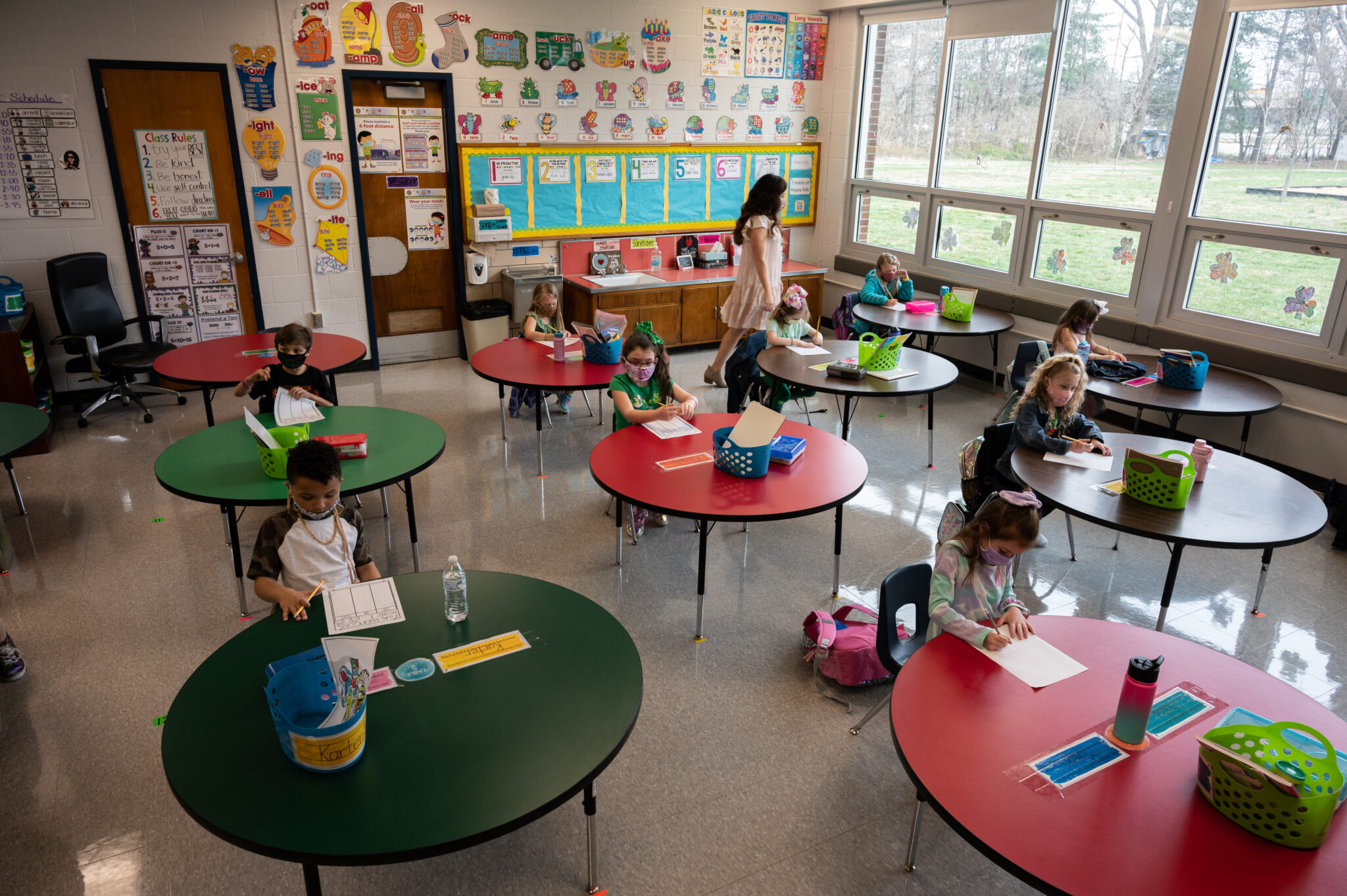
     (Stock photo by Maskot/Getty Images)

    Ohio school districts, on average, receive about 10% of their revenue from the federal government, according to the Ohio Education Association.

    By:  – Ohio Capital Journal

    As President Donald Trump continues to talk about dismantling the U.S. Department of Education, Ohio educators worry what that could mean for federal funding that school districts across the state rely on.

    Trump could issue an executive order targeting the department and he recently told his pick for education secretary, Linda McMahon, “to put herself out of a job.” However, Trump cannot get rid of a federal agency without congressional approval.

    Ohio education advocates said that Trump’s efforts would hurt Ohio’s vulnerable schoolchildren the most.

    “Students in poverty and students with disabilities are the ones who are most at risk of losing the support they need to succeed,” said Ohio Education Association President Scott DiMauro.

    GET THE MORNING HEADLINES.


    The federal department doesn’t determine what is taught in schools. Instead, learning standards are set at the state level and curriculum is adopted by local school boards.

    Ohio school districts on average receive about 10% of their revenue from the federal government, DiMauro said. About 90% of Ohio students attended public school during the 2023-24 school year, according to the Ohio Department of Education and Workforce.

    “Districts that have a higher percentage of students in poverty depend even more on the federal government for support,” DiMauro said. “So in higher poverty, rural, and urban districts, we can see those percentages be 20% to 25% or even more.”

    It’s unclear what would happen to all that funding if the department was eliminated, DiMauro said.

    The department allocates Title I funds, which are federal funds given to school districts with a high percentage of low-income students.

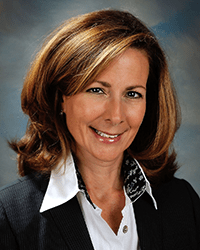
    Linda McMahon, President Donald Trump’s nominee to be secretary of Education, testifies during her Senate Health, Education, Labor and Pensions Committee confirmation hearing in the Dirksen Senate Office Building on Feb. 13, 2025, in Washington, D.C. (Photo by Win McNamee/Getty Images)
     Linda McMahon, President Donald Trump’s nominee to be secretary of Education, testifies during her Senate Health, Education, Labor and Pensions Committee confirmation hearing in the Dirksen Senate Office Building on Feb. 13, 2025, in Washington, D.C. (Photo by Win McNamee/Getty Images) 

    “We see Title I dollars go to virtually every single district in the state,” DiMauro said. “Over 808,000 students in Ohio directly benefit from Title I support.”

    Central Ohio educator Larry Carey noted how much harm would be caused if the funds were taken away.

    “These resources help schools address learning gaps, provide interventions, and create safe, inclusive environments,” Carey said. “Without them, the futures of our most vulnerable students hang in the balance.”

    The department also administers the Individuals with Disabilities Education Act (IDEA), a law guaranteeing a free public education for children with disabilities.

    “Losing these protections would strip away vital services from children who depend on them the most,” Carey said.

    Traci Arway, a Columbus City Schools special education coordinator, is particularly worried about what this could mean for education funding for those living with disabilities.

    “It’s really scary,” she said. “How is that going to impact all of the service providers and employees, like myself, who a portion of our salaries are paid through IDEA funding to provide services?”

    About 16% of Ohio public school students had a disability during the 2023-24 school year, according to the Ohio education department.

    If the federal education department was eliminated, there would be fewer student support staff members and fewer wraparound services such as reading and math coaches, Arway said.

    “I worry about our profession,” she said. “We are trying to prepare the future workforce of our country … It is hard to come in every day and mask the frustrations because the students shouldn’t have to feel that.”

    Linda McMahon

    Trump nominated McMahon to be education secretary on Nov. 19 and the Senate Health, Education, Labor, and Pensions Committee held her confirmation hearing last week. The committee will vote on whether her nomination moves to the full Senate on Thursday.

    McMahon is best known for her time as the CEO of World Wrestling Entertainment. She led the U.S. Small Business Administration for about two years during Trump’s first term and served for about a year on Connecticut’s State Board of Education more than a decade ago.

    “In some ways it’s like déjà vu all over again,” DiMauro said. “I think it’s important to have somebody who’s got a perspective of what it’s like to work with students in the classroom, or to run a school, or lead an education program. We just don’t have that here.”

    Trump appointed Betsy DeVos to be secretary of education during his first term in office, despite her having no previous work experience in education.

    “The bar was set pretty low with Betsy DeVos and McMahon just goes right under it,” Arway said. “Who knew the bar could go lower?”

    Follow Capital Journal Reporter Megan Henry on Bluesky.

    YOU MAKE OUR WORK POSSIBLE.

    ___________
    Megan Henry
    Megan Henry

    Megan Henry is a reporter for the Ohio Capital Journal and has spent the past five years reporting in Ohio on various topics including education, healthcare, business and crime. She previously worked at The Columbus Dispatch, part of the USA Today Network.

    Ohio Capital Journal is part of States Newsroom, the nation’s largest state-focused nonprofit news organization.

    MORE FROM AUTHOR

  • Ohio Senate bill aims to help students with math interventions, including high-dosage tutoring

    Ohio Senate bill aims to help students with math interventions, including high-dosage tutoring

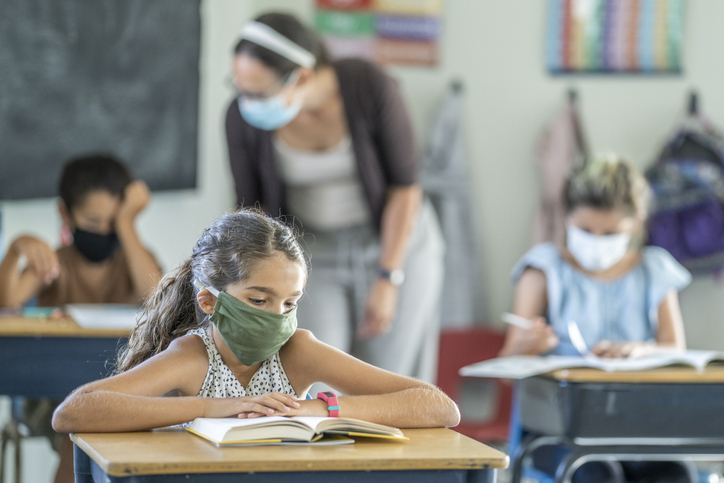
    (Getty Images)

    By:  Ohio Capital Journal

    As Ohio math scores continue to be below pre-pandemic levels, a proposed bill would bring math interventions to Ohio school districts that score below certain proficiency standards.

    Ohio Sen. Andrew Brenner, R-Delaware, recently introduced Senate Bill 19 which would require school districts or individual schools to come up with a math achievement improvement plan if they don’t have at least 52% of students receive a proficient score in math comprehension. A student’s comprehension is rated at one of five levels of proficiency: limited, basic, proficient, accomplished, and advanced.

    The bill would also require every district to create a math improvement and monitoring plan for students who qualify for math intervention services.

    During the 2022-23 school year, almost a third of Ohio students scored “limited” on their math proficiency, Brenner said Wednesday during his sponsor testimony.

    “Clearly, a disturbing number of Ohio children are in need of significant and prolonged academic intervention before it is too late to address their desperately-needed learning deficiency,” Brenner said to the Senate Education Committee.

    He introduced a similar bill in the last General Assembly and it passed unanimously in the Senate, but died in the House Primary and Secondary Education Committee.

    “It is still needed to address the critical need for learning acceleration for Ohio’s students most in need of additional academic support,” Brenner said in his sponsor testimony.

    GET THE MORNING HEADLINES.


    Under the bill, schools would be required to develop math improvement and monitoring plans for each student that qualifies for math intervention services within 60 days after getting the student’s third grade assessment math results.

    A math improvement and monitoring plan would identify the student’s “specific math deficiencies,” describe the additional instructional services they will receive, offer a chance for their parent or guardian to be involved, outline a monitoring process and offer high-dosage tutoring at least three days a week.

    Alabama, Mississippi, and Tennessee have enacted math legislation similar to what Ohio is proposing and those states have seen their math scores improve, said Lindsey Henderson, math policy director for ExcelinEd.

    “It’s never too late to get policy in place to move the needle on math improvement,” she said. “It’s really exciting to see states really taking a leap and going after it like they did literacy.”

    A lot of education policy at the state level has focused on reading in recent years.

    Ohio’s 2023 budget included provisions that are going toward implementing the science of reading, which is based on decades of research that shows how the human brain learns to read and incorporates phonemic awareness, phonics, fluency, vocabulary, and comprehension.

    Forty states and the District of Columbia have passed or implemented new policies related to evidence-based reading instruction since 2013, according to Education Week.

    “Reading has taken a lot of oxygen, for good reason,” Henderson said. “Reading and writing is a skill you can’t be an engaged citizen without, but the next most important skill is going to be mathematics. … We would never say I’m not a literacy person, that’s not socially acceptable. But to say that I’m not a math person is a socially acceptable thing to say, and we’re really trying to change that narrative.”

    S.B. 19 is not just limited to math. The bill would also require school districts to provide evidence-based academic intervention services to students based on their English language arts state assessment.

    National Report Card

    Ohio math and reading scores continue to be below pre-pandemic levels, according to the latest report from the National Center for Education Statistics.

    The Nation’s 2024 Report Card was released this week and the only increase at the national level was a slight bump in fourth grade math. There was no significant change with eighth grade math and scores declined in four and eighth grade reading.

    Approximately 235,000 fourth-graders from 6,100 schools and 230,000 eighth-graders from 5,400 schools participated in the 2024 math and reading assessments between January and March of last year.

    For Ohio, the average fourth-grade math score was 239, two points higher than the national average and one point higher than the state’s fourth grade math scores in 2022. The scale for NAEP scores is 0-500.

    The state’s average eighth-grade math score was 279, seven points higher than the national average and three points higher than the state’s 2022 test.

    Ohio’s average fourth-grade reading score was 216, two points higher than the national average, but three points less than the state average in 2022.

    The state’s average eighth-grade reading score was 260, three points higher than the national average, but two points lower than Ohio’s score in 2022.

    Aaron Churchill, Ohio Research Director for the Thomas B. Fordham Institute, called the state’s NAEP scores a disappointment.

    “Overall, these results indicate that far too many Ohio students are struggling to master core math and reading skills,” he said in a statement.

    Follow OCJ Reporter Megan Henry on Bluesky.

    YOU MAKE OUR WORK POSSIBLE.

    _________________
    Megan Henry
    Megan Henry

    Megan Henry is a reporter for the Ohio Capital Journal and has spent the past five years reporting in Ohio on various topics including education, healthcare, business and crime. She previously worked at The Columbus Dispatch, part of the USA Today Network.

    Ohio Capital Journal is part of States Newsroom, the nation’s largest state-focused nonprofit news organization.

    MORE FROM AUTHOR

  • Republican bill would require Ohio school districts post their Pledge of Allegiance policy

    Republican bill would require Ohio school districts post their Pledge of Allegiance policy

    Getty Image

    By:  Ohio Capital Journal

    Republican lawmakers want to require Ohio school districts to make their Pledge of Allegiance policy publicly available.

    State Reps. Gail Pavliga, R-Portage County, and Tracy Richardson, R-Marysville, introduced House Bill 657 over the summer and testified in support of their bill Tuesday during the Ohio House Primary and Secondary Committee Meeting, calling it a transparency bill.

    “Many of you grew up reciting the Pledge of Allegiance in school and may be surprised to discover that not all schools and classrooms in Ohio are currently learning or reciting the Pledge,” Richardson said. “Some parents too are unaware that their children are not being taught this important practice. Parents have a right to know.”

    The bill would not require students to recite the Pledge of Allegiance, it would just require school districts to post the policy on their website.

    “Very little would need to be done by each school district, the policy already exists, and most schools already have a website,” Pavliga said.

    The United States Supreme Court ruled in 1943 that students are not required to recite the Pledge of Allegiance at public schools if it goes against their religious beliefs. This case came after Jehovah’s Witnesses students were expelled from their West Virginia school for not reciting the Pledge of Allegiance. At the time, West Virginia Board of Education required public school students to salute the flag and Jehovah’s Witnesses do not say the Pledge of Allegiance because it conflicts with their Bible teachings around worshipping God.

    Learning the Pledge of Allegiance teaches students to respect the flag, Richardson said.

    “Reciting it builds unity and nationalism by affirming our commitment to our values,” she said. “At a time when many seem polarized, it is a meaningful tradition that brings all Americans together.”

    GET THE MORNING HEADLINES.


    As a former teacher, State Rep. Sean Patrick Brennan, D-Parma, said it broke his heart when students would not take part in the Pledge of Allegiance.

    “I don’t think it was because of a religious exemption,” he said. “I think it was simply apathy.”

    He asked Pavliga and Richardson how school districts and parents can motivate students to want to recite the Pledge of Allegiance.

    “I think that, as we bring more awareness to this issue, that I think that you will see more parents being more vocal with their children and with the school district,” Pavliga said. “And I think it will start and spark some discussions.”

    State Reps. Jodi Whitted, D-Madeira, asked the bill’s sponsors if they have received questions from parents who were unable to find their school district’s policy on the Pledge.

    “No, it was something that we had talked about, and just felt that the time was right to be able to have it out there,” Pavliga said. “And we’re kind of a bit shocked by the fact that the school system might have a policy in place, but they weren’t required to publish it.”

    If the bill were to become law, a school district that already has their Pledge of Allegiance policy posted on their website would already be in compliance, Pavliga said.

    The current General Assembly will finish at the end of the month, meaning any bills that don’t pass will die and would have to be re-introduced next General Assembly.

    Follow OCJ Reporter Megan Henry on X.

    YOU MAKE OUR WORK POSSIBLE.

    ______________
    Megan Henry
    Megan Henry

    Megan Henry is a reporter for the Ohio Capital Journal and has spent the past five years reporting in Ohio on various topics including education, healthcare, business and crime. She previously worked at The Columbus Dispatch, part of the USA Today Network.

    Ohio Capital Journal is part of States Newsroom, the nation’s largest state-focused nonprofit news organization.

    MORE FROM AUTHOR

  • Study shows Ohio K-12 teacher burnout rates higher than any other industry

    Study shows Ohio K-12 teacher burnout rates higher than any other industry

    BY: SUSAN TEBBEN – Ohio Capital Journal


    Ohio educators say burnout is real, but with pending legislation regulating lesson-plan choices and security roles in schools, they feel “demoralized” as well.

    A national survey showed 44% of K-12 teachers in the U.S. “always” or “very often” feel burned out, a stat that has surpassed other industries.

    The Gallup poll showed more than 4 in 10 K-12 workers felt that way, topping college/university employees, retail workers and the government/public policy industry in the survey, conducted in February but released this week.

    Researchers found that K-12 workers have “consistently” been leaders in burn-out in the country, but the COVID-19 pandemic “exacerbated existing challenges,” while also introducing new ones.

    Female teachers reporter higher burnout levels than male teachers, at a split of 55% to 44%.

    “The result is a workforce that is burned out and unfortunately leaving the profession at a high rate,” according to the Gallup poll.

    Those who teach in Ohio agree that the increased workload has taken its toll, but to also see mounting legislation regulating their careers and what they see as a continued lack of appropriate support from the state adds a new amount of weight to educators’ shoulders.

    “When you talk about burnout, you’re talking about when you’ve extinguished a flame,” said Wendi Davis, band director and music teacher at Cory-Rawson Local Schools in northwest Ohio. “Teachers, they love what they do, and when they’re put in situations like what they’re dealing with right now, it’s more demoralization than burnout.”

    Teachers have had to don ever-multiplying caps: as teachers, as standardized test guides, as social workers and as guidance counselors. Faced with all those issues already, teachers then faced a pandemic, according to Shari Obrenski, president of the Cleveland Teachers Union.

    “What the pandemic did was essentially lay bare all of the problems that existed in education,” Obrenski said. “More and more is being put on (a teacher’s) plate and nothing is being taken off.”

    When pandemic learning is combined with legislation currently being considered in the Ohio legislature that would dictate the subjects that teachers can discuss, and a recently passed and governor-signed law that allows teachers to carry weapons in school, Obrenski said educators get pushed to their limits.

    That is, the teachers that are still there. Cleveland is short about 200 teachers going into the new school year, not to mention the ongoing shortage of substitute teachers, in the hundreds as well.

    “And we’re not as bad off as other districts,” Obrenski said.

    As school districts struggle to recruit and retain teachers and substitute teachers, teachers also struggle to be heard in their own districts and in their state government.

    “Teachers need to be empowered at the local level by their administrators,” Davis said. “They need to have a voice at the table.”

    Paying teachers more and funding schools in a way that supports the role they play is definitely a need, according to Obrenski, but so, too, is respecting teachers as professionals in order to keep them in schools.

    “Something that is really important is a teacher’s voice in decision-making; Having teachers be part of the solution instead of condemning them as part of the problem,” Obrenski said.

  • [Watch video] Ohio Children’s Hospital leaders briefing for school administrators – September 14, 2021

    [Watch video] Ohio Children’s Hospital leaders briefing for school administrators – September 14, 2021

    by David Miller

    The Ohio Children’s Hospitals Association made a direct appeal on Tuesday, September 14 to school superintendents to require masks for staff and students during the current surge of the coronavirus.

    Patty Manning, MD, is the Chief of Staff at Cincinnati Children’s Hospital Medical Center (Photo by CCHMC)

    Patty Manning, MD, Chief of Staff, Cincinnati Children’s Hospital Medical Center said, “Our inpatient numbers are the highest they’ve been. Our ICUs are caring for more patients than there’s ever been. More children are on ventilators than there has ever been. There are more children than ever entering our emergency departments and our urgent care centers. That impacts the care of all children, not just those that are COVID-19 positive.”

    The plea was made during a virtual meeting with superintendents and the clinical leadership from six Ohio children’s hospitals including Dayton Children’s Hospital, ProMedica Russell J. Ebeid Children’s Hospital, Cincinnati Children’s Hospital Medical Center, Nationwide Children’s Hospital, Akron Children’s Hospital, and University Hospitals Rainbow Babies & Children’s Hospital. 

    “The data are now clear that there is a higher level of COVID-19 in school districts where masks are not required,” said Governor DeWine. “If we want our schools to stay open, the best way to do that is for those 12 and over to get vaccinated. But because those under 12 are still too young to be vaccinated, we need students who come in to school to wear a mask until we get through this.” 

       The current policy of the Loveland City School District is that students in grades PreK-6 are required to wear a mask indoors. Students in grades 7-12 do not have to wear face coverings. All others, while in the buildings must wear masks.
    

    Efforts to reach Loveland Superintendant Mike Broadwater via email, asking him if he attended the virtual meeting and had any comment about it have not been successful securing an email response.

    In the background of this urgent plea is that State Reps. Jean Schmidt (R-Loveland/Miami Township) announced on August 25 she has introduced House Bill 400, which would prohibit public schools from mandating students to wear a mask. The bill introduction comes as statewide concerns from parents have heightened as several public schools, including the Loveland District have implemented school mask mandates for some of their students.

    Data that support this appeal according to a new release from the Ohio Children’s Hospitals Association include: 

    • Since August 15, 2021, there have been 29,823 Ohio school-aged kids ages 5 to 17 with confirmed and probable cases of COVID-19.
    • Cases among this age group increased 198 percent from the week of August 15th as compared to the week ending September 4.
    • As reported yesterday by the American Academy of Pediatrics, COVID-19 cases among children have increased 240 percent nationally since early July when the Delta variant began to surge. During that same period in Ohio, there has been a 2000 percent increase in cases among Ohio children.
    • COVID-19 cases are increasing at nearly twice the rate among school-aged kids as compared to the rest of the population. This past week Ohio saw a 44 percent increase among school-aged children and only a 17 percent increase among the rest of the population.
    • Over the two-week period ending September 4, 2021, there was an average of 909 cases per 100,000 school-aged Ohio kids versus 561 cases per 100,000 people comprising the rest of the population. 
    • The 16 days with the highest number of cases per day throughout the entire pandemic for kids aged 5 to 17 in Ohio have all been in the last 19 days. This includes every day except the three days of the Labor Day weekend.
    • In Ohio school districts where masks are optional, among school-aged kids, there are both higher case rates per 100,000 at 945.7 and a greater week-over-week increase in cases. School districts where masks are optional have seen a 54 percent week-over-week increase compared to a 34 percent increase in school districts where masks are either required for all or required for some (usually K-8th grade).

    Nick Lashutka, President and CEO of the Ohio Children’s Hospital Association
    “This is a perfect storm, and it’s impacting kids like it hasn’t before. It’s a combination driven by COVID-19 cases increasing, primarily driven by the Delta variant, increasing respiratory illnesses, more mental health challenges, and staffing challenges. Everyone can agree that our number one goal is to keep children in schools five days a week, and that’s what we shared with the state’s superintendents today.”

    Debbie Feldman, President and CEO of Dayton Children’s Hospitals
    “Ohio is truly blessed to have some of the best children’s hospitals in the country. We pride ourselves on meeting the needs of our kids. Our commitment is really threatened right now. For a long time, COVID-19 was perceived as a disease that didn’t impact children. That’s not the case anymore. Today, 25 percent of COVID-19 cases are in kids. We’re feeling that in our children’s hospitals.”

    Paula Grieb, DNP, RN, Chief Nursing Officer, ProMedica Russell J. Ebeid Children’s Hospital
    “In the city of Toledo and at Ebeid Children’s Hospital, we’ve seen significant in-patient and out-patient volumes, and we’ve seen a significant increase in kids with respiratory illnesses. We had a significant event occur last night in Lucas County. That means if a rescue squad responded to a 911 call and picked up a patient to take them to a hospital that was on EMS bypass, that rescue squad would not be allowed to stop at that hospital. The county EMS system would have to dispatch each call one at a time. That means a patient wouldn’t necessarily go to the hospital closest to them or best-suited to take care of the patients’ needs.”

    Rustin Morse, MD, CEO, Nationwide Children’s Hospital
    “We are in uncharted territory. Not just in children’s hospitals, but adult hospitals as well. The infrastructure is strained like it hasn’t been before. We are asking people to get vaccinated if they aren’t already, and we are asking them to wear masks.”

    Patty Manning, MD, Chief of Staff, Cincinnati Children’s Hospital Medical Center

    “Our inpatient numbers are the highest they’ve been. Our ICUs are caring for more patients than there’s ever been. More children are on ventilators than there has ever been. There are more children than ever entering our emergency departments and our urgent care centers. That impacts the care of all children, not just those that are COVID-19 positive.”

    CASE DATA/VACCINE INFORMATION

    Video of today’s full update, including versions with foreign language translation, can be viewed on the Ohio Channel’s YouTube page

    For more information on Ohio’s response to COVID-19, visit coronavirus.ohio.gov or call 1-833-4-ASK-ODH.

  • Milford and Lakota schools become centers of learning for COVID-19 best practices

    Milford and Lakota schools become centers of learning for COVID-19 best practices

    By Susan Tebben and Ohio Capital Journal

    Milford and West Chester, Ohio – Two Ohio school districts with some of the highest cumulative case rates for COVID-19 say as they remained in-person, their safety protocols only got better.

    Milford Exempted Village School District in Clermont County has remained in-person since the fall, and has had to close twice due to staff absences.

    “We simply had too many staff out sick or quarantined and couldn’t find the subs,” Wendy Planicka, director of communications and public relations for the district, told the OCJ. “We have shut down grade levels at a few of our elementary buildings as well, but not an entire elementary building.”

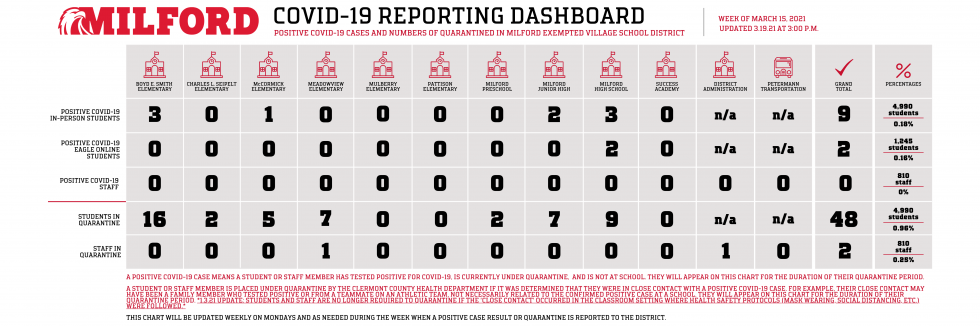
    The school district, like many in the state, provides weekly counts of COVID-19 cases on their website, along with cumulative district-wide data.

    Since Aug. 1, the district has reported 649 total cases in their district of 6,235 students and 810 staff members.

    Currently 4,990 students are enrolled in-person, with 1,245 students enrolled in the district’s virtual program, Eagle Online.

    Planicka said community spread has been the “number one cause of our cases,” followed by spread through athletics or non-school sponsored activities such as family parties.

    “There have been two or three cases where we believe spread happened in an athletic setting — for example when football was in season last fall, at one point almost the entire football team was quarantined due to possible spread,” Planicka said.

    The school implemented protocols that require an investigation into every positive case, including contact tracing in partnership with Clermont County Public Health and a minimum 10-day quarantine period for students and staff who test positive.

    In schools, a mask requirement is in place, and custodians are to disinfect desk areas every evening, along with using an electrostatic sprayer “at least every 30 days” according to Milford’s protocol list.

    Milford’s reopening plan was developed to make the return to school as safe as possible, but not to return the school to exactly as it was, according to the plan itself.

    “School will not look the same as it did prior to March 2020,” the plan stated. “These changes may be temporary or they may be permanent. Time will tell.”

    Milford’s latest COVID 19 Dashboard (https://www.milfordschools.org/services-and-programs/return-to-learning-20/covid-case-reporting-61/)

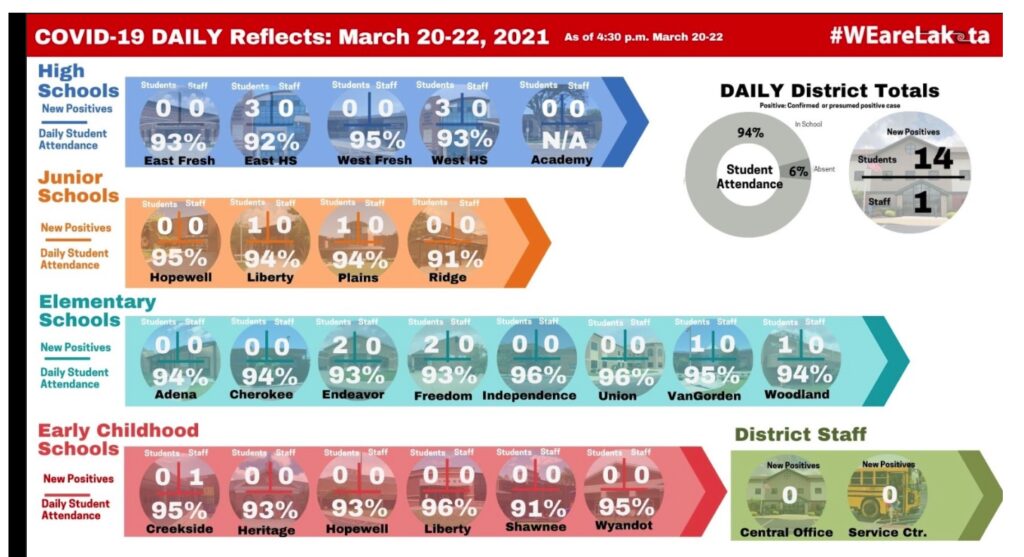
    Butler County’s Lakota Local Schools had the highest number of cases since the pandemic counts began, with more than 700 total student cases, according to state data. The school is also home to 14,000 students, having reopened to in-person learning on August 17.

    “Since then, our students have had the opportunity to attend school all day, every day,” said Betsy Fuller, community relations director for the district.

    There is a virtual learning option at Lakota, being utilized by 3,000 students, according to Fuller.

    In the five months that made up their first semester, the school reported 5,172 students in quarantine. The worst month for positive cases in students was December, with 221 of the 468 reported in that semester happening then.

    “We traced many of the positive cases to holiday gatherings and celebrations happening outside of school between Halloween and Thanksgiving,” Fuller said. “It is also important to note that very few cases, if any, could actually be linked back to classroom spread.”

    The district had guidelines in place as soon as it reopened, including requiring face coverings for all K-12 students, desk cleanings between classes, assigned seating at lunch, and block scheduling to avoid frequent class changes.

    In the three months of the second semester so far, the district has reported 345 positive cases, but a 93% student attendance rate.

    Lakota’s latest COVID 19 Dashboard (https://www.lakotaonline.com/cms/One.aspx?portalId=216799&pageId=24411613)

    In February, the state implemented a vaccination program specifically for teachers and school personnel, making returning to school or already conducting in-person instruction a pre-requisite to districts receipt of vaccination doses.