

Tag: ohio Senate Bill 326

  • Hemp industry workers testify against bill that would ban intoxicating hemp products

    Hemp industry workers testify against bill that would ban intoxicating hemp products

    People who spoke out against Senate Bill 326 bill called for regulations, not a ban on sales — arguing that would cause the illicit market to flourish.

    By:  Ohio Capital Journal

    Workers in the hemp industry spoke out against a bill that would ban intoxicating hemp products in Ohio, effectively putting them out of business. These are known as delta-8 THC products that are often sold at smoke shops and corner stores.

    Those who spoke out against Senate Bill 326 during last week’s Senate Government Committee Meeting called for regulations, not a ban on sales — arguing that would cause the black market to flourish.

    “Strict bans will only support illicit sales of these products, with no enforceable safety or age requirements, which does nothing to address the issues legislators have cited as the need for new hemp legislation,” said Jonathan Miller, general counsel for the U.S. Hemp Roundtable.

    Ohio Gov. Mike DeWine has been asking lawmakers to regulate or ban delta-8 THC products and State Sen. Steve Huffman, R-Tipp City, introduced S.B. 326 last month.

    Twenty-five people submitted opponent testimony on S.B. 326 last week and nearly 20 people submitted proponent testimony on the bill last month.

    Marijuana is legal in Ohio and is not considered an intoxicating hemp product. The 2018 Farm Bill says hemp can be grown legally if it contains less than 0.3% THC.

    “Senate Bill 326 aims to make illegal an industry made up of thousands of small businesses but in fact it will simply strengthen the black market,” said JD McCormick, president of the American Healthy Alternatives Association.

    Several Ohioans have turned to hemp as an alternative to opioid pain prescriptions, he said.

    “A 2023 economic impact report on the United States cannabinoid industry indicates that Ohio’s hemp-derived cannabinoid market is responsible for $704,782,000.00 in revenue,” he said. “It also estimates the hemp-derived product industry provides 8,157 jobs with $327,448,000.00 in wages for the employees of the industry, and approximately $40,524,970.00 in annual sales tax receipts.”

    GET THE MORNING HEADLINES.


    Mo Dayem owns six smoke shops across the state that sells hemp products.

    “S.B. 326 bill would jeopardize my business and my employees,” he said. “I assure you that the industry is in support of reasonable regulations. We want the responsible businesses to continue to operate and ensure there are not bad actors, and unsafe products, in the market.”

    The hemp industry supports banning sales to people under 21, testing products, labeling requirements, and restrictions, Dayem said.

    “Some products that have garnered media attention are packaged like known children’s candy brands,” he said. “This should be prohibited, and the industry agrees they should be off the market.”

     Delta-8 products purchased from a gas station. (Photo by Megan Henry, Ohio Capital Journal). 

    Doug Strahm owns two CBD stores — Happy Harvest Delaware and Happy Harvest Marion — and he said this bill would destroy his business.

    “My family’s financial stability and well-being, as well as the jobs of our employees, are all tied to this industry,” he said.

    About 80% of their sales come from delta products, which they only sell to customers 21 and older.

    “The median age of our customers is actually around 45 years old,” Strahm said.

    Jaimee Courtney owns a CBD store in Bellefontaine where most of their customers are over 55.

    “These are responsible adults seeking relief and wellness without the intoxicating effects of marijuana,” she said.

    Courtney shared the story of a 90-year-old customer who says taking CBD gummies has helped her stop having seizures.

    “I think this ban would hurt people more than it would actually help,” she said.

    Lawmakers are trying to get their bills passed before the current General Assembly comes to a close at the end of the month, meaning any bills that don’t pass will die and would have to be reintroduced in the next General Assembly, which starts in January.

    Follow OCJ Reporter Megan Henry on X.


    Megan Henry
    Megan Henry

    Megan Henry is a reporter for the Ohio Capital Journal and has spent the past five years reporting in Ohio on various topics including education, healthcare, business and crime. She previously worked at The Columbus Dispatch, part of the USA Today Network.

    Ohio Capital Journal is part of States Newsroom, the nation’s largest state-focused nonprofit news organization.

    MORE FROM AUTHOR

  • Poison control center workers support Ohio Senate bill that would ban intoxicating hemp products

    Poison control center workers support Ohio Senate bill that would ban intoxicating hemp products

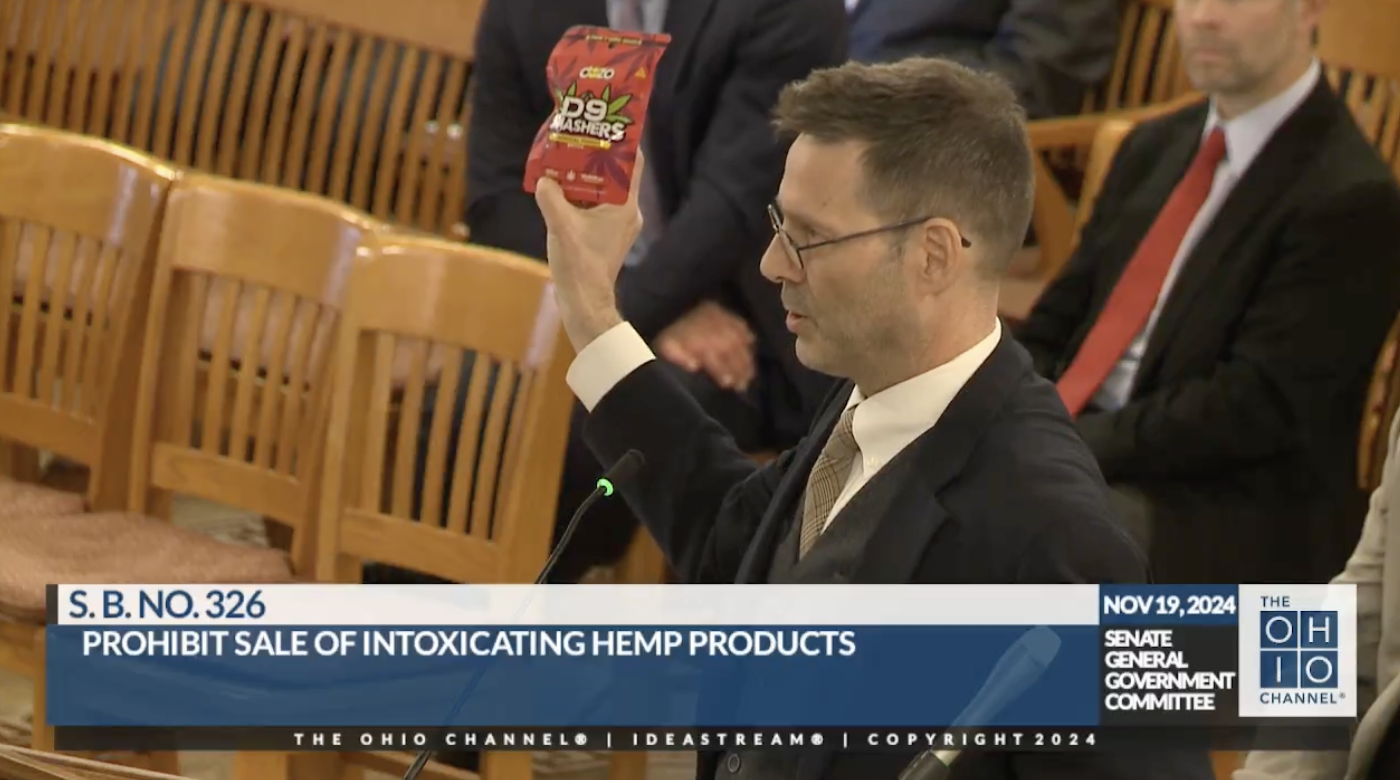
    Chris Lindsey, director of state advocacy and public policy for the American Trade Association for Cannabis and Hemp, holds up a bag of Delta-9 THC smashers as part of proponent testimony for Senate Bill 326 during the Senate General Government Committee on Nov. 19, 2024. (Screenshot courtesy of The Ohio Channel).

    Ohio Gov. Mike DeWine called on lawmakers earlier this year to regulate or prohibit delta-8 THC products.

    By:  Ohio Capital Journal

    Health care workers and some folks in the hemp and cannabis industry spoke at the Statehouse in favor of a bill that would ban intoxicating hemp products in Ohio.

    Nearly 20 people submitted proponent testimony for Senate Bill 326 during Tuesday’s Senate General Government Committee meeting. State Sen. Steve Huffman, R-Tipp City, introduced the bill earlier this month after Ohio Gov. Mike DeWine called on lawmakers earlier this year to regulate or ban delta-8 THC products.

    “Currently in Ohio, delta-8 and other intoxicating hemp products are frequently sold in places where young people have easy access such as convenience stores, gas stations, and online marketplaces without any age limits,” said Maggie Lutterus, the advocacy and public policy coordinator of Prevention Action Alliance. “These products are often in the form of gummies, cookies, vapor products, even breakfast cereals, and other consumables that are particularly appealing to younger individuals.”

    SB 326 is necessary for the health and safety of consumers, she said.

    “Unlike traditional cannabis, hemp products— often marketed as “natural” or “wellness” products, are not manufactured or packaged consistently,” Lutterus said.

    Eleven percent of high school seniors nationwide and 15% of high school seniors from the Midwest reported using delta-8 products in the last year, according to a study published earlier this year by the Keck School of Medicine of the University of Southern California.

    GET THE MORNING HEADLINES.


    The bill defines intoxicating hemp products as containing more than 0.5 of a milligram of delta-9 THC per serving, two milligrams of delta-9 THC per package, or 0.5 of a milligram of total non-delta-9 THC per package, according to the bill’s language. Marijuana is not considered an intoxicating hemp product and is legal in Ohio.

    The 2018 Farm Bill says hemp can be grown legally if it contains less than 0.3% THC.

    “The problem is that the Farm Bill was never intended to set up a system for consumer products,” said Chris Lindsey, director of state advocacy and public policy for the American Trade Association for Cannabis and Hemp.

    An adult serving of marijuana is generally considered to be about 10 milligrams of delta-9 THC, he said.

    “You buy a gummy in a licensed dispensary in Ohio, and there’s a limit to how potent that gummy can be,” Lindsey said. “That’s to protect consumers so they don’t consume too much.”

    He went to a Columbus convenience store before the committee meeting and bought some intoxicating hemp products, including a bag of Delta-9 smashers that says it has 500 milligrams of THC per piece of candy and 10,000 milligrams in one package.

    “This would cause an overdose in any adult,” he said, holding up the product. “How you can get a product like this out to the market, I don’t understand. The good news is this is almost certainly not accurate, that’s the best version of this, this is simply lying.”

    Not having clear labeling leaves customers in the dark about what they are buying and the potential dangers involved, Lutterus said.

    “If we are to allow them to continue selling THC, they would need the same oversight as our adult-use marijuana facilities,” said Mike Getlin, director of licensing & public Affairs, of Nectar Markets of Ohio. “We must have extensive camera coverage of every square foot of every gas station, convenience store, and vape shop in the state. … There must be state sanctioned and regulated labs testing all products throughout the supply chain and product tracking systems capable of tracing back to origin sources.”

    Accidental poisonings reported to the Ohio Poison Center have increased 280% since 2021, around the time when hemp products containing delta-8 THC became more accessible, said Dr. Hannah Hays, medical director of the Central Ohio Poison Center and Chief of Toxicology at Nationwide Children’s Hospital.

    “When children access these products, they can experience severe symptoms including hallucinations, confusion, loss of consciousness, and respiratory failure,” she said. “We currently receive several calls each day for exposures to cannabinoids, including intoxicating hemp products, in children under 6 years. A quarter of children who consume intoxicating hemp products require admission to the hospital, and more than a third of those admitted require ICU level care.”

    Follow OCJ Reporter Megan Henry on X.

    Megan Henry
    Megan Henry

    Megan Henry is a reporter for the Ohio Capital Journal and has spent the past five years reporting in Ohio on various topics including education, healthcare, business and crime. She previously worked at The Columbus Dispatch, part of the USA Today Network.

    Ohio Capital Journal is part of States Newsroom, the nation’s largest state-focused nonprofit news organization.

    MORE FROM AUTHOR