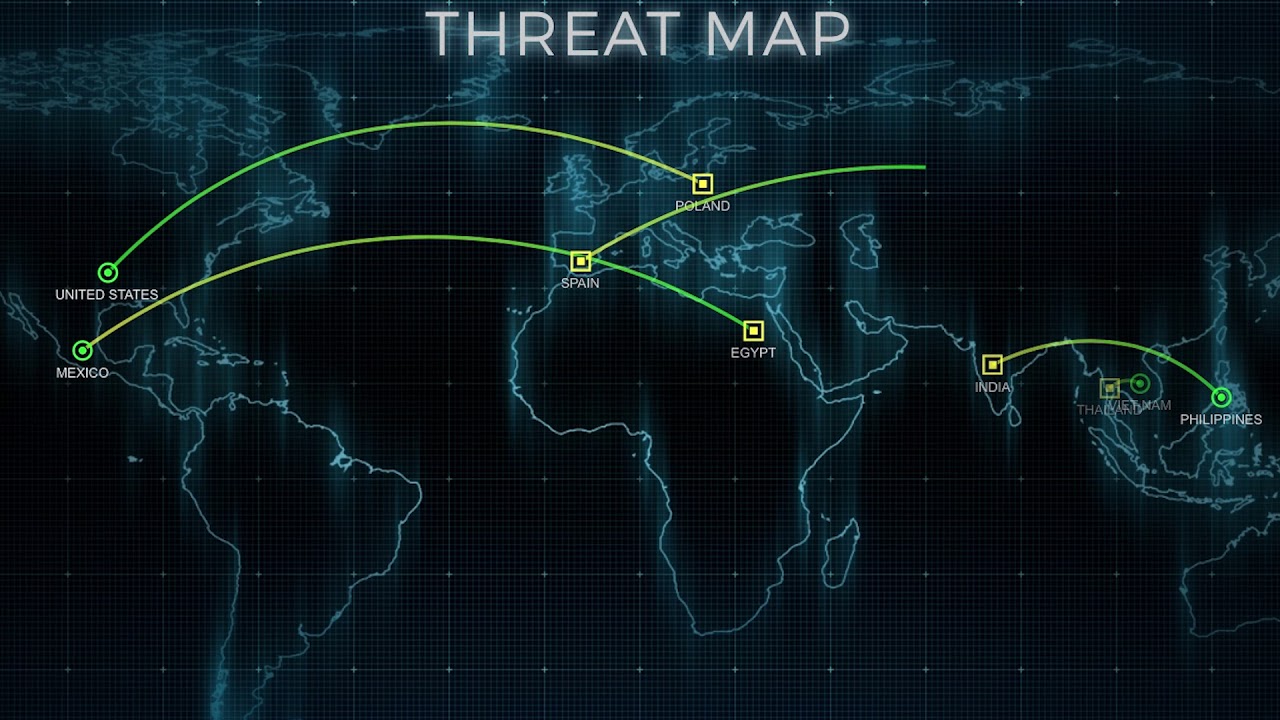
Springfield, Ohio – Following a series of unfounded bomb threats made to schools within the Springfield City School District, Ohio Governor Mike DeWine announced today that he has authorized a contingent of troopers from the Ohio State Highway Patrol’s Mobile Field Force to provide added security at each of the district’s 18 school buildings.
“Many of these threats are coming in from overseas, made by those who want to fuel the current discord surrounding Springfield. We cannot let the bad guys win,” said Governor DeWine. “We must take every threat seriously, but children deserve to be in school, and parents deserve to know that their kids are safe. The added security will help ease some of the fears caused by these hoaxes.”
Beginning tomorrow and continuing for the foreseeable future, 36 troopers will be stationed throughout the Springfield City School District. Troopers will sweep each building for threats before students and faculty arrive and will stay on-site to provide security throughout the school day and during dismissal.
“None of the threats that have come in to Springfield to date have been legitimate. We’re doing this purely as a precaution to prevent further disruption within the Springfield City School District,” said Governor DeWine.
Governor DeWine also directed Ohio Homeland Security to begin conducting vulnerability assessments on critical infrastructure in Springfield and to provide various tower cameras for use by the Springfield Police Department to enhance situational awareness. The Ohio Department of Public Safety has also arranged for bomb detection dogs to be stationed in Springfield each day.
When the new distracted driving law took effect on April 4, 2023, the Ohio State Highway Patrol and local law enforcement issued warnings for six months for violations as part of the effort to educate and help motorists adapt to the new law.
Beginning October 5, 2023, law enforcement will start issuing citations for violating this law.
It is illegal to use or hold a cell phone or electronic device in your hand, lap, or other parts of the body while driving on Ohio roads. If an officer sees a violation, they can pull you over.
Drivers over 18 years old can make or receive calls via hands-free devices, including:
Speakerphone
Earpiece
Wireless headset
Electronic watch
Connecting phone to vehicle
In most cases, anything more than a single touch or swipe is against the law.
Penalties
1st offense in two years: 2 points assessed to driver’s license, up to a $150 fine.*
2nd offense in two years: 3 points assessed to license, up to a $250 fine.
3rd or more offense in two years: 4 points assessed to license, up to a $500 fine, possible 90-day suspension of driver license.
Fines doubled if the violation occurs in a work zone.
* Completion of a distracted driving course can help avoid the fine and points.
Ohio Gov. Mike DeWine is cozying up to the people cozying up to a twice-impeached insurrectionist. That’s bad enough. But he’s doing it at our expense in state resources, tax dollars and community safety. He hoped you wouldn’t notice. That’s why news about the governor sending Ohio State Highway Patrol troopers to the Texas-Mexico border garnered three sentences in a press release sure to get scant attention over the Fourth of July holiday. Nothing to see here.
Also on the recent holiday weekend, the governor’s office released a brief mention of another contingent of Ohio National Guard troops going to the southern border. That brings the total to 300 activated at the behest of the federal government and its seemingly endless military border mission. DeWine tried to spin the Ohio deployments to the border as being in Ohio’s best interest. Let’s unpack that, shall we?
Ohio taxpayers are paying to send state highway patrol troopers two thousand miles away on a two-week stint in which they will “assist local law enforcement with border surveillance” but “will not be tasked with making arrests.” So, Ohio communities will be arguably less safe with less troopers just to fulfill a vague and costly border excursion requested by the Texas governor. Plus, Ohio will be down 300 National Guard soldiers, who will be stuck on the Mexico border in a “non-law enforcement support” capacity with no end in sight.
How is this in Ohio’s best interest again, governor? You defended your curiously timed border deployments as “the right thing to do” to stop drugs from Mexico coming into the state. But why now? What changed? Could it be the caravan of Republican politicians jostling to hold photo ops at the border or to join their notorious standard-bearer in railing against the Biden administration for its immigration policies?
Absolutely. Might it be in Mike DeWine’s best interest to jump on the crazy train at the border with a string of Republican governors — including Florida’s Ron DeSantis and South Dakota’s Kristi Noem — to boost his bona fides with party extremists? Ditto. DeWine is already being primaried by at least one right-wing rival and he’s no hit with the MAGA crowd after a year of protested shutdowns and mask mandates. Even the disgraced ex-president slammed DeWine after the governor acknowledged then President-elect Biden when the defeated candidate wouldn’t.
But a missive from two Republican border governors gave the Ohio Republican an opening to regain favor with the Mar-a-Lago menace who still enthralls the party base DeWine needs to win reelection. The joint letter to all 50 governors from Greg Abbott of Texas and Doug Ducey of Arizona leaves little doubt about the political motivation behind their pleas for assistance. “Securing our border with Mexico is the federal government’s responsibility,” they wrote. “But the Biden Administration has proven unwilling or unable to do the job. This failure to enforce federal immigration laws causes harms that spill over into every state.”
What follows are a litany of Republican talking points about the apocalyptic fallout of “the Biden Administration’s open-border disaster” warning of an impending avalanche of drugs and criminals flowing “to far too many of your communities.” The two governors boasted that their states “have stepped up to secure the border in the federal government’s absence” and urged other states “to stand with us.”
To amplify the GOP’s sure-fire campaign message of Democrats being soft on illegal immigration and border security, Gov. Ducey traveled to the border, surrounded by Republicans, and blamed President Biden, his administration and the Democratic Congress for everything going wrong with a decades-old problem. Gov. Abbott did the same with Biden’s shameless predecessor and echoed the rhetoric of his “great friend” in attacking Biden and bemoaning the “unfinished wall.” DeWine presumably wanted the national notoriety he received by being another Republican governor suddenly consumed with securing the southern border. It was apparently a worthwhile gamble to snag some right-wing cred, if not a coveted endorsement from the deposed grifter still lying about a stolen election.
Gubernatorial candidate DeWine packaged his political stunt to send state troopers to the Mexican border as a benefit to Ohio, but taxpayers aren’t getting a thing for their money. And what benefits, exactly, do Ohioans receive from having 300 Ohio National Guard soldiers parked on the border for months waiting for an exit strategy from an undefined operation?
Sorry, governor. Your decision to deploy Ohio forces in an immigration war shaped by Republicans to inflame supporters was to benefit your reelection campaign. Your political incentives could not have been more transparent. Ohioans see right through your trumped-up rationale. Next time, maybe consider a different plan to pander for votes that wouldn’t include taxpayer money and state resources but still score points with the right people.
Perhaps next time the DeWine campaign could just mail a check to help Abbott and Co. build the border wall — provided Steve Bannon isn’t the one cashing it. Just saying. Could be in your best interest.
Gov. Mike DeWine said Tuesday it is in the state’s best interest to send more Ohio National Guard troops and other law enforcement officials to help protect the southern border with Mexico.
The decision reflects Ohio’s broader effort to aid fellow states — or the federal government — when help is requested, the governor said.
DeWine recently announced Ohio will send 185 troops later this year to assist with the “Southwest Border mission.” They will provide “non-law enforcement support” to the U.S. Custom and Border Protection agency.
These troops join the 115 Ohio National Guard members who were deployed to the southern border in 2020 and remain on active duty.
The federal government will be paying for these ONG deployments, a spokesperson for the governor told the Ohio Capital Journal.
The governor separately approved a request from Texas Gov. Greg Abbott to send about a dozen Ohio State Highway Patrol officials to help law enforcement there with border surveillance. They will not be making arrests during this two-week assignment set to begin this month.
A spokesperson for the Ohio State Highway Patrol confirmed this mission to Texas will be paid for using state funds.
“The Patrol will not know the exact cost until after the detail is complete,” they wrote to the Ohio Capital Journal in an email.
DeWine defended his decision in a Tuesday press conference.
“What happens at the southern border of the United States impacts Ohio,” DeWine said. “I can tell you, from eight years as the attorney general of this state, that the vast majority, almost all the drugs that are coming into the state of Ohio come across the southern border. So we have a real interest in securing the southern border.”
DeWine said his administration makes a decision on each deployment request based on the circumstances.
“When we are requested to send support by another state or by the federal government, it is something that does not occur very often … we have to weigh what detriment it might be to the state of Ohio versus the benefit,” he said.
In the case of the southern border mission, DeWine said it was worth it to approve these requests.
“We were asked to play a small part in (securing the border), and I said yes,” he said. “I think it’s in Ohio’s interest to do that. I think it’s the right thing to do.”
The Ohio National Guard and State Highway Patrol have had a busy few years since DeWine took office in 2019.
Ohio agreed in April to send 100 state troopers to Minnesota when the verdict was announced in the Derek Chauvin murder trial.
DeWine also sent around 1,000 troops to protect the nation’s capital in the aftermath of the deadly Jan. 6 insurrection. Troops stayed to provide security for the inauguration of President Joe Biden.
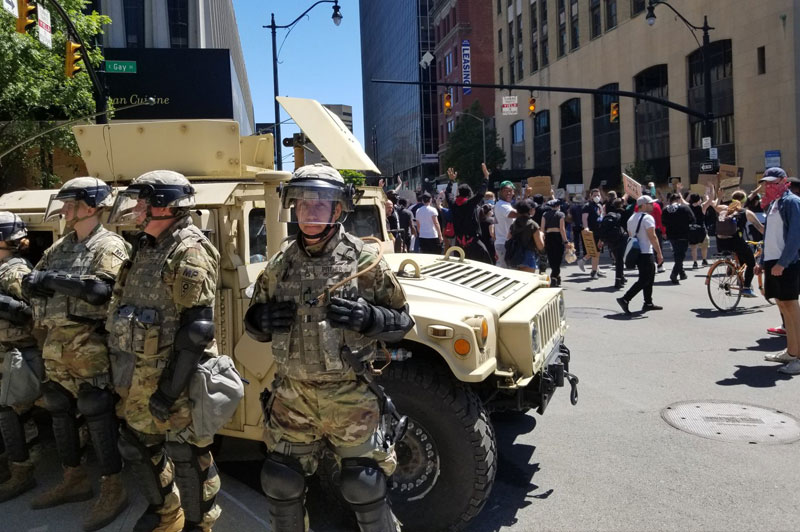
There was an earlier deployment of Ohio National Guard troops to Washington D.C. to help with protest security following Chauvin’s killing of George Floyd. An Ohio service member was reportedly sent home after it was learned they expressed white supremacist ideology online prior to the 2020 mission.
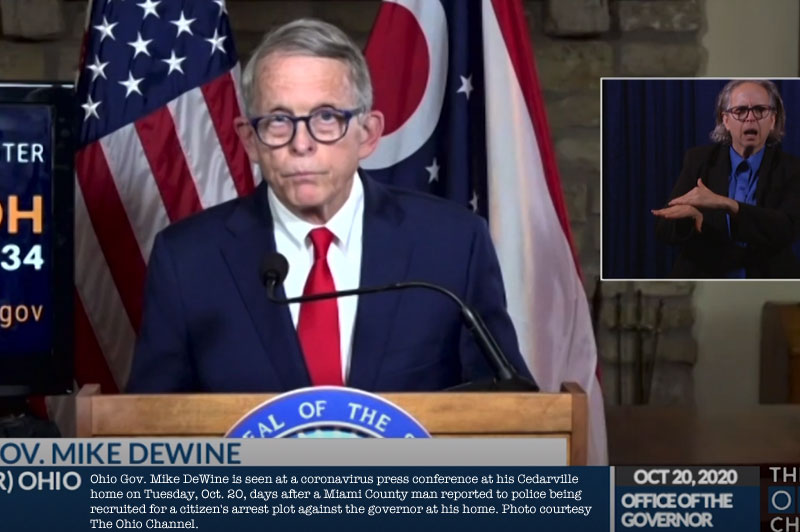
Piqua, Ohio – A Miami County resident reported to police being recruited to take part in a citizen’s arrest of Gov. Mike DeWine at his Cedarville home a week ago, but the plot evidently never materialized.
The plot is alleged to have involved Renea Turner, a former write-in candidate for governor who ran against DeWine in 2018. A state representative says he recently met with Turner prior to the alleged call and she inquired about the governor’s home, the Ohio Capital Journal has learned.
The Ohio State Highway Patrol, which handles security for the governor and his residences, was notified of the report by local law enforcement and is investigating.
At a press conference Friday afternoon to discuss allocation of CARES Act funding in Ohio, DeWine told reporters he was unaware of the alleged plot and had not been briefed on it to that point.
This report to police came just a week after 13 men were arrested for reportedly planning to kidnap Michigan Gov. Gretchen Whitmer and it follows months of protests against DeWine and state health officials.
According to a Piqua Police Department report from Oct. 16, a citizen told an officer about being called earlier that morning by Turner, a Springfield native who is an outspoken critic of DeWine. Turner reportedly asked if they wanted to take part in an attempt to arrest the governor at his home later that weekend and try him for allegations of tyranny.
The Ohio Capital Journal initially declined to identify Turner as the alleged caller, as law enforcement would not confirm if she had been under investigation or charged with a crime and she could not be reached by the Ohio Capital Journal for comment.
The Ohio State Highway Patrol has been made aware of the police report but would not say if an investigation has been launched.
Since the original publication of this story, Turner has spoken on the record with cleveland.com about the call, which she confirmed took place. She told the outlet that she did speak to the Miami County person about placing DeWine under house arrest, but reportedly denied discussing any specific plans.
The Capital Journal is not identifying the person who reported the incident to police after the person asked to remain anonymous for safety reasons, having already followed up with Piqua law enforcement about a threat made against them online.
The person who reported the call told Ohio Capital News that the plot stemmed from anger toward the governor’s response to the COVID-19 pandemic. The person said they too are a critic of DeWine and claimed to have recently filed a citizen affidavit seeking criminal charges against the governor. State Rep. John Becker, R-Union Twp., who has led an impeachment effort against DeWine in the Statehouse, has urged Ohioans to submit such affidavits about the governor.
“Do I think (DeWine) needs to be arrested? Absolutely,” the person said. “But all that needs to happen within the confines of the law.”
They claimed they were initially excited when receiving the call last Friday, thinking the conversation would be about the ongoing search from DeWine critics to find a prosecutor willing to bring charges against him.
“(The caller) said ‘no, we the people, we’re going to arrest him,’” the source said.
According to this person, the caller described several supposed penalties for a citizen’s trial on tyranny — permanent exile or execution.
According to this person, the caller described several supposed penalties for a citizen’s trial on tyranny — permanent exile or execution.
Soon after the call, they decided to contact the police.
“If I don’t do something about this and something happens, I’m either legally culpable or at least I’m going to feel bad,” they said. “Not that I have any love lost between me and Gov. Mike DeWine. Again, I think he needs to be in prison. But again, if (the caller) had done something … I would have felt ethically responsible, right?”
State legislator says Turner recently asked about DeWine’s home in private chat
Becker told the Capital Journal he met with Turner a few weeks ago in Columbus at her request to speak about theoretical criminal charges against the governor. While his focus has been on locating a willing prosecutor, he said Turner spoke about finding a county sheriff to make the arrest.
“I just kind of shrugged my shoulders and said, ‘good luck with that,’” Becker recalled.
Then came an unusual change in subject: Turner wanted to know more about the governor’s residence in Cedarville. Becker said Turner asked whether the personal residence constituted public property during DeWine’s term as governor.
“It was kind of a strange question,” Becker said.
John Becker aided Turner by providing information about DeWine’s residence and if it constituted public property.
After the conversation ended, Becker asked Turner’s question to the Legislative Service Commission, a nonpartisan group which gives private law research to lawmakers. He learned the home remains a private residence, and passed that information along to her.
Becker did not hear again from Turner after that. Earlier this week, he heard from the Miami County resident about the alleged plot. The person told him about Turner and Becker recognized her name from their recent meeting.
Becker said he informed the Statehouse’s sergeant at arms about the situation when returning to work earlier this week. He later posted a YouTube video about the incident, referring to the person who reported the call to police as a “hero.”
Becker confirmed to the Capital Journal he was contacted by the Ohio State Highway Patrol on Friday. The lawmaker said he described to the Patrol his interactions with Turner and the Miami County resident.
Piqua Police Chief Rick Byron told the Capital Journal on Thursday the citizen’s report was turned over to the Patrol.
“At this point, we have not followed up with them and have no plans to do so,” Byron said, noting the alleged caller is not from Piqua and therefore his department does not have jurisdiction. “We’re pretty confident that (the Patrol is) going to handle this situation.”
Dan Tierney, a spokesperson for the governor’s office, referred questions about the situation to the Patrol.
In a brief statement on Thursday, Lt. Tiffany Meeks told the Capital Journal: “For security, the Patrol does not discuss threats or security operations involving the governor.” The Patrol later confirmed to the Dayton Daily News it was “currently investigating the incident.”
Cleveland.com quoted Turner on Friday as saying officials with the Patrol came to her home that morning “to check out my temperament and what my plans are.”
Since the report was made on Oct. 16, the governor has hosted three press conferences at his Cedarville home: his traditional virus-related updates on Oct. 20 and 22, and the CARES Act press conference with legislative leaders on Friday.
After this story was first published, reporters asked DeWine during his CARES Act press conference about his reaction to the alleged plot.
“I don’t know the details of the so-called plan,” he said. “I can’t really comment on that.”
Asked if he was shocked to learn about such a plot, DeWine answered: “No. I’m not shocked by it. At this point in my life, not much shocks me anymore. It’s a sad thing.”
This is the latest in a series of alleged plots targeting political leaders in 2020 for their responses to the pandemic. In Michigan, state and federal law enforcement foiled a plot to kidnap and try Gov. Whitmer, with seven of the men being charged under the state’s anti-terrorism law.
Police in that case have alleged the Whitmer plot was hatched in a meeting held in Dublin, Ohio this summer. The same groupof men also hoped to target Virginia Gov. Ralph Northam.
There is no known connection between these plots and the one reported in Piqua.
Turner is former governor candidate
Turner, of Springfield in Clark County, campaigned for governor as a write-in candidate in 2018.
Turner encountered DeWine on the campaign trail, later posting a picture of themselves together to social media. A post on her Facebook page claims she pretended to be a supporter of DeWine’s, then told him after the picture was taken she was actually campaigning against him.
Turner received 185 votes in the 2018 general election, including one from the person who later reported her call to Piqua police.
Turner has shared several posts from state Rep. Nino Vitale, R-Urbana, who has made headlines throughout 2020 for posting falsehoods about the virus — such as an April claim that it may have been created by Bill Gates.
Turner received 128 more votes as a write-in candidate for Springfield mayor in 2019 before turning her attention back to DeWine amid the coronavirus pandemic.
Her social media pages are littered with conspiracy theories involving the virus, government microchips and vaccine mandates. Many of the posts have been flagged by Facebook as spreading misinformation.
Turner has shared several posts from state Rep. Nino Vitale, R-Urbana, who has made headlines throughout 2020 for posting falsehoods about the virus — such as an April claim that it may have been created by Bill Gates.
Turner shared one post by Vitale from May 18, in which he accused DeWine of “giving himself total dictatorial power.” Vitale also falsely suggested the governor knew about the virus in March 2019, many months before the novel coronavirus was ever discovered.
In July, Turner posted photos of herself protesting health orders at the Ohio Statehouse with a signs referring to the governor as Hitler.
Turner took to the Statehouse again on Thursday, proclaiming she had removed the governor from office through a self-issued declaration. A video shared to Facebook shows Turner taking an oath of office, with a signed sheet of paper claiming her to be the next governor of Ohio.
Turner did not address the Thursday incident in her interview with cleveland.com.
‘It’s wrong morally, it’s wrong legally’
DeWine reiterated on Friday that the plot against Whitmer was “despicable” and added he denounced any effort by people to subvert the legal system and target public officials.
“We are seeing people out there who believe that,” the governor said. “We have an obligation, each one of us as elected officials, opinion leaders, to denounce that and say ‘that is wrong.’ It’s wrong morally, it’s wrong legally, it’s anti-democratic, it’s anti-everything this country stands for.”
While DeWine has enjoyed widespread, bipartisan support throughout 2020 for his response to the pandemic, his administration has also been the subject of intense condemnation. Four legislators have endorsed his impeachment, and dozens of others have supported various bills seeking to limit the executive’s power to handle an infectious disease.
Ohio Gov. Mike DeWine in a Zoom call with reporters in August outside his Cedarville home. Screenshot by Marty Schladen, Ohio Capital Journal.
Repeated protests at the Statehouse led DeWine to move his press conferences from Capitol Square to a government building elsewhere due to “security reasons,” WKYC reported in April.
That same month, Cleveland.com reported that Ohioans protesting the state’s public health orders were seen “driving by DeWine’s Greene County house, filming it and counting cars.” The outlet quoted a DeWine spokesperson as saying security officials were aware of this surveillance but could not comment further.
In May, protesters repeatedly targeted the home of Dr. Amy Acton, who was then serving as director of the Ohio Department of Health. There were reports that some of the protesters were armed with guns, and one person was photographed carrying an anti-Semitic sign. Not long after, Acton resigned as state health director.
In May, protesters repeatedly targeted the home of Dr. Amy Acton, who was then serving as director of the Ohio Department of Health. There were reports that some of the protesters were armed with guns, and one person was photographed carrying an anti-Semitic sign. Not long after, Acton resigned as state health director.
The state has been without a permanent health director in the months since. A replacement was announced in September, but the person selected withdrew from consideration after learning of the harassment leveled against Acton. The Ohio Department of Health continues to be led by an interim director.
Also in May, Democratic House Minority Leader Emilia Sykes reported a phone call to police threatening to kill her father, state Sen. Vernon Sykes, if she did not “step aside” politically.
(This story was edited by Loveland Magazine)
Tyler Buchanan is an award-winning journalist who has covered Ohio politics and government for the past decade. A Bellevue native and graduate of Bowling Green State University, he most recently spent 6 1/2 years as a reporter and editor of The Athens Messenger and Vinton-Jackson Courier newspapers. He is a member of the BG News Alumni Society Board and was a 2019 fellow in the Kiplinger Program in Public Affairs Journalism.
Loveland, Ohio – Alex Burnett was sworn into office on Tuesday, June 11 at City Hall during the council meeting. Chief Sean Rahe introduced Burnett and Mayor Kathy Bailey administered the oath.
Brunett’s bio provided by the City:
Chief Rahe introduced Officer Burnett by stating that he immigrated to the United States from Russia in 2001. Officer Burnett joined the United States Marines thereafter and was deployed to Iraq in 2004. After a seven-month deployment he was assigned to a reconnaissance training where he was deployed to Iraq a second time with a scout team. After four years of service, Alex was honorably discharged from the Marine Corps. Alex put himself through the police academy and was hired by the Ohio State Highway Patrol where he served for the past seven years.
What is ?
Did you know that you can watch this movie on the Loveland Magazine Youtube Channel in high definition on your television in your living room? It’s where we have published all of our videos since 2014!
Most TV’s have the YouTube app built-in. Go to the app and search for Loveland Magazine TV. Bookmark us so you can easily return to see new videos! Thanks for watching!
Ohio Homeland Security’s Richard C. Baron Cybersecurity Center was established in 2016 for the purpose of enhancing the state’s posture against cyber-related crimes, criminal cases, and threats.
The Ohio State Highway Patrol’s Computer Crimes Unit (CCU) and Ohio Homeland Security’s cyber analysts work together with other public and private sector partners within the center.
The CCU provides technical support for criminal cases and Ohio Homeland Security’s analysts conduct case support for the CCU as well as work alongside other state analysts to identify trends and cyber-related threats facing Ohio.
Take Home Tano is about fresh, wholesome food for the frenzied family Our goal is to meet the needs of busy families.





![[Video] Alex Burnett takes Loveland Police Department oath](https://lovelandmagazine.com/wp-content/uploads/2019/06/maxresdefault-13.jpg)