Tag: Ohio unemployment

  • Ohio near the top in April unemployment

    Ohio near the top in April unemployment

    Stock photo from Getty Images.

    State spends billions on job incentives that mostly benefit the wealthy

     Ohio Capital Journal

    Ohio had the sixth-highest unemployment of any state in April. The news comes after years of state officials spending billions on economic growth programs tilted heavily toward the wealthy.

    It might seem ironic, but Ohio’s economy added jobs in April even as unemployment continued to grow. That’s because job growth isn’t keeping up with the numbers joining the workforce. And there are reasons to believe that things will get worse, according to the think tank Policy Matters Ohio.

    Data released last week by the Ohio Department of Job and Family Services estimated that the state added 22,200 jobs in April. But statewide unemployment rose for the fifth consecutive month, to 4.9%. That’s the sixth-highest of any state, according to the U.S. Bureau of Labor Statistics.

    Heather Smith, a researcher at Policy Matters Ohio, said the new state data raise some questions.

    “The civilian labor force has increased at about the same rate as the number of unemployed workers, suggesting that while more Ohioans are entering the job market, they are not all securing employment,” she said in a written statement. “This raises questions around the reported increases in jobs across service-providing industries – why aren’t Ohioans getting hired?”

    The Department of Job and Family Services conducts a monthly survey, releases its estimate of the number of new jobs, and then often revises it downward. For example, it initially estimated that 7,500 jobs were created in March, and then cut that number to 5,200.

    Of the jobs thought to be created in April, the great majority were in the service sector, 18,800. More than 6,500 of those were in hospitality as those businesses staff up for summer.

    Construction and manufacturing added 1,200 and 1,100 jobs, respectively, while the number of government jobs increased by 1,300.

    A separate household survey indicated that 15,000 joined the Ohio job market in April. But only 6,000 found jobs while the rest were unemployed.

    “Legislators ought to pay attention to the growing unemployment rate, given its steady increase over the last five months,” Smith said. “The last time we saw the unemployment rate in Ohio decrease was between September and October – prior to the November election.”

    Ohio’s economy has lagged for more than a decade after the creation of billion-dollar programs mostly benefitting the well off on the promise that they would create jobs for average Ohioans.

    Created in 2013 under the auspices of then-Gov. John Kasich, the LLC tax loophole costs about $1 billion a year.

    It was sold as a way to boost small business. But an analysis showed that hiring in that sector has fallen relative to other states, while the wealthiest 7% are claiming nearly 40% of the benefit.

    Started around the same time, JobsOhio is funded through a state liquor franchise that used to flow into state coffers. Its well-paid staff has grown rapidly as it has doled out more than $1 billion in incentives to businesses. But it hasn’t proven that those incentives have created any jobs.

    Even so, the Ohio Controlling Board in February extended JobsOhio’s control of the state liquor franchise to 2053. The “private” corporation paid the state $1.41 billion for its initial lease of the franchise. But the state didn’t require an additional penny to extend it another 15 years.

    Meanwhile, Smith of Policy Matters Ohio warned that several developments at the federal level could further drag down the Ohio job market.

    “A recent survey of Fourth District businesses by the Federal Reserve of Cleveland found that 22% of respondents anticipated the tariffs would force them to decrease their staff,” she wrote. “This is already underway: Several large employers across the state have submitted mass layoff notices, including 744 manufacturing jobs in Fremont. A Chillicothe paper plant, which was set to layoff 826 union workers by the end of June, agreed to remain open until December. While this buys impacted Ohioans a bit more time, the plant closing will be a devastating hit to workers in the area.”

    In addition to potential harm from tariffs, the Trump administration is trying to cut hundreds of thousands of federal jobs and to slash services as it tries to fund further tax cuts.

    “Ohio policymakers need to hold their federal counterparts accountable for the impact of funding cuts on the state and stop preemptively cutting critical public services with trigger language in the state budget,” Smith said. “If federal budget hawks get their way and force the state to pick up a greater share of the Medicaid budget, proposed trigger language could cut off the health insurance of 770,000 Ohioans.”

    Marty Schladen
    Marty Schladen

    Marty Schladen has been a reporter for decades, working in Indiana, Texas and other places before returning to his native Ohio to work at The Columbus Dispatch in 2017. He’s won state and national journalism awards for investigations into utility regulation, public corruption, the environment, prescription drug spending and other matters.

    Ohio Capital Journal is part of States Newsroom, the nation’s largest state-focused nonprofit news organization.

    MORE FROM AUTHOR

  • Without supporting data, Ohio to end federal unemployment supplement

    Without supporting data, Ohio to end federal unemployment supplement

    By Marty Schladen and Ohio Capital Journal

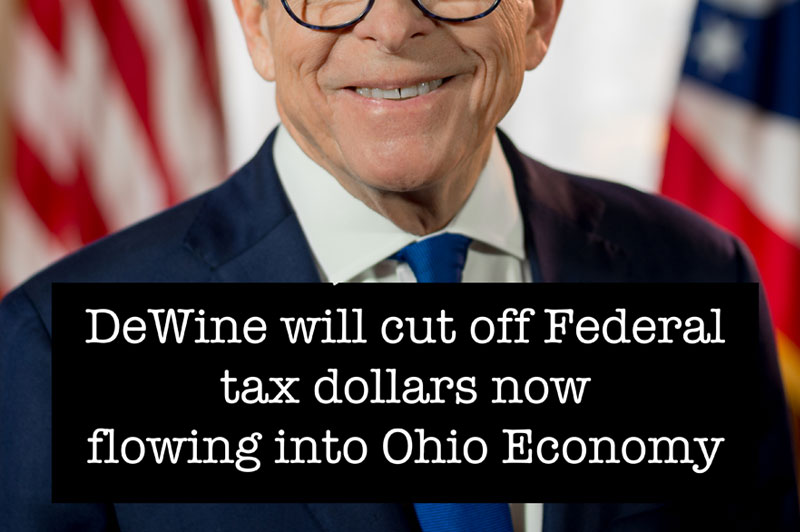
    Citing fears that a $300-a-week federal unemployment supplement was keeping Ohioans from returning to the workforce, Gov. Mike DeWine on Thursday announced that he would end it. 

    However, the governor was unable to cite any data showing that businesses’ trouble finding workers was due to the supplement and not other dislocations caused by the coronavirus pandemic.

    Ohio will join 13 other Republican-led states in cutting off the payments to hundreds of thousands of Americans even though the benefit is shouldered entirely by the federal government. DeWine said he will wait until June 26 to terminate the supplement so those who haven’t already been vaccinated can do so before re-entering the workforce.

    The governor said he was undertaking the move because Ohio unemployment is near pre-pandemic levels and employers around the state are complaining that they can’t find needed workers. He said that problem is made worse because the extra $300 a week made some Ohioans calculate that it’s a better deal to just stay home.

    “The federal assistance is in some cases certainly discouraging people from going back,” DeWine said.

    That theme has been echoed by other Republican governors as they justify ending the benefit. DeWine’s move also was applauded by the National Federation of Independent Business, which has received hefty funding from the billionaire Koch family and in the past has fought laws requiring paid sick leave.

    “Ohio’s economy is growing and growing faster than our neighboring states. We need a robust workforce to maintain our positive trajectory,” Roger Geiger, NFIB’s Ohio executive director, said in a statement. “The time for additional unemployment payments is over. We appreciate Ohio Gov. Mike DeWine for recognizing that now is the time to strongly encourage everyone to get back to work.”

    But some independent experts have said the issue is more complex. They believe problems with child and adult care, ongoing disruptions in certain industries and other dislocations caused by the pandemic are keeping many on unemployment.

    Republican governors are “misguided in their thinking about why people aren’t returning to work,” Rebecca Dixon, executive director of the National Employment Law Project, told the Washington Post last week. “There are all of these ways our care infrastructure is not back up.” 

    The argument that increased benefits are keeping people out of the workforce also doesn’t seem to be supported by the most recent employment numbers, Paul Krugman, a Nobel Prize-winning economist and self-described liberal, wrote Monday in the New York Times.

    One would expect a $300-a-week supplement to most impact the behavior of low-wage workers. But Krugman pointed out that the April jobs report shows low-wage jobs like leisure and hospitality growing robustly while better-paid work in professional and business services actually fell.

    Asked whether he had data showing that federal supplements are keeping large numbers of Ohioans on the unemployment rolls, DeWine said, “If you look at why jobs are not being filled, I’m sure it’s multiple reasons. But whenever you go in and the market is distorted in that sense, you have certain consequences when you do that and should do that when you have a crisis.

    “And we’re coming out of the crisis economically… This couldn’t go on forever. The federal government was going to end this — unless they change their mind — they were going to end this in September. We’re moving it up a little bit. We think that’s the appropriate thing.”

    Dayton Mayor Nan Whaley, who is seeking the Democratic nomination for governor, released a statement saying she emphatically does not believe that ending the federal benefit early is the appropriate thing.

    “As we come out of this crisis, the problem facing Ohioans is the same one we had before coronavirus: wages are too low,” she said. “One good job should be enough, and for too many of our friends and neighbors, it isn’t. Mike DeWine is turning down money that could help Ohioans because he’s worried about politics. When I’m governor, I’ll be worried about paychecks.”