Oxford, Ohio (Nov. 1, 2024) – Miami University students fielded a survey of Ohio voters from Oct. 28-30. The results show tight races. Donald Trump leads Kamala Harris 49% to 46% among registered voters in the presidential race, while Sherrod Brown leads Bernie Moreno 48% to 46% in the senate race. Issue 1 also remains close with the Yes vote leading the No vote 46% to 45% with a large number of voters (9%) reporting that they are still not sure. The margin of error (which does not account for error from sampling coverage or survey language) is 5%.
The survey was fielded by the students using a text-to-web modality. The students texted a random sample of registered voters in Ohio. The results were weighted to Ohio registered voters using education (3 categories) by sex, race (white/non-white) by sex, age (3 categories), vote history, and party registration. The latter two variables were taken from L2 voter file data.
The tables below show the results for all registered voters and then the subset of voters that reported that they either had already voted or definitely would vote.
The survey was supported by the Menard Family Center for Democracy and the Center for Career Exploration and Success at Miami University.
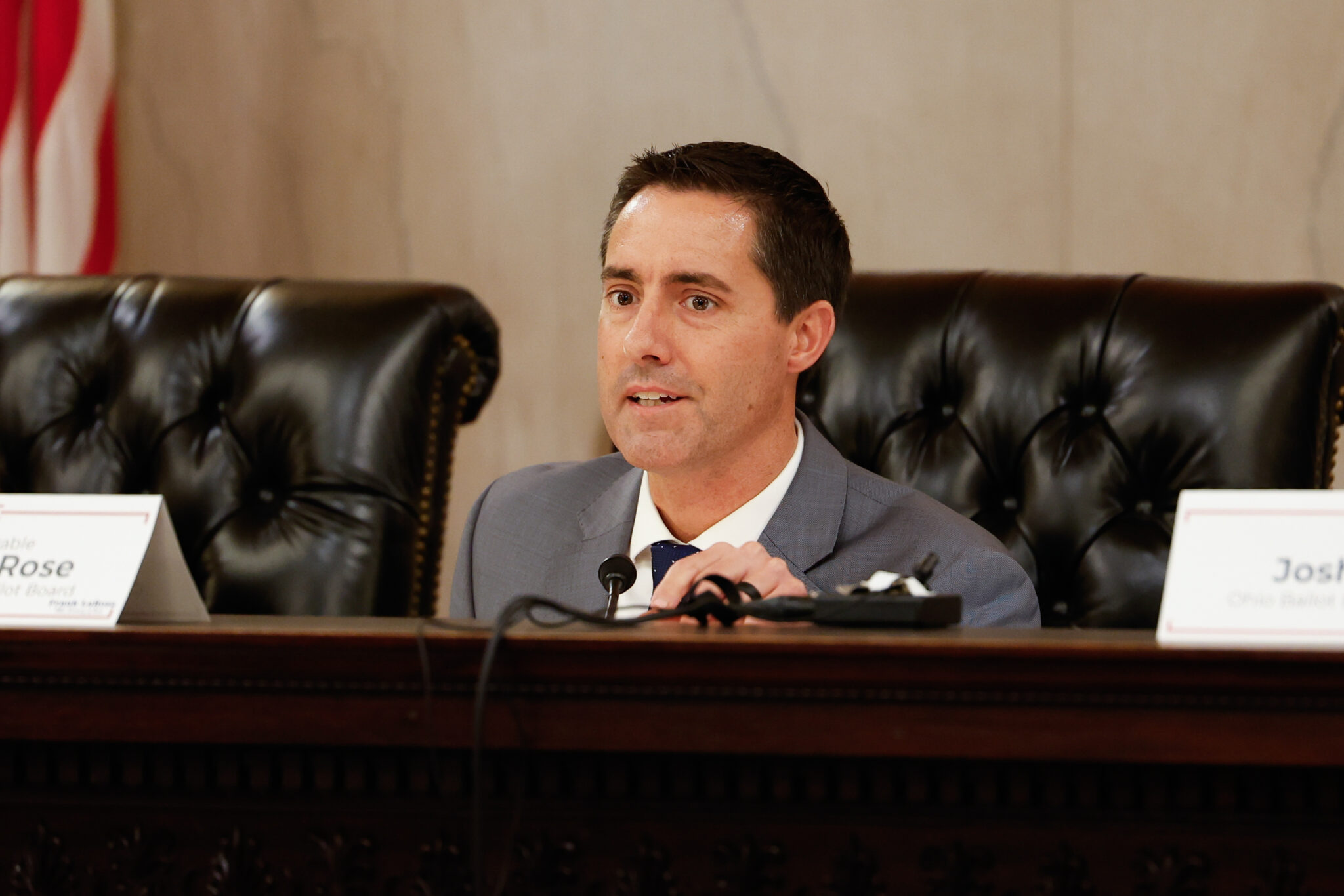
The office of Ohio Secretary of State Frank LaRose has drafted ballot language for the Ohio Ballot Board to consider Friday that supporters of an anti-gerrymandering amendment say is deceptive and unconstitutional. The Ballot Board decides the text of proposed amendments that voters actually see on their ballots when they vote.
The anti-gerrymandering amendment before Ohio voters in November, according to the language drafted by LaRose’s office, would “eliminate the longstanding ability of Ohio citizens to hold their representatives accountable for establishing fair state legislative and congressional districts.”
The Citizens Not Politicians group that authored the ballot initiative and collected more than 535,000 necessary signatures from Ohio voters to get the measure on the ballot, has proposed their own language for the ballot as well, saying it would remove politicians from the redistricting process in favor of a citizen board.
The group is proposing a redistricting amendment that would replace Ohio’s politician-led redistricting commission with a citizen-led commission made up of Republicans, Democrats and independents. Currently, the Ohio Secretary of State is one of the politicians sitting on Ohio’s redistricting commission, along with the governor, the Ohio Auditor, two lawmakers from the majority party and two lawmakers from the minority party.
The language drafted by the Secretary of State’s Office claims in its proposed title that the amendment’s purpose is, “To create an appointed redistricting commission not elected by or subject to removal by the voters of the state.”
Moreover, the draft language says its purpose is to “repeal constitutional protections against gerrymandering approved by nearly three-quarters of Ohio electors participating in the statewide elections of 2015 and 2018.”
Backers say the amendment is actually intended to protect voters against gerrymandering by removing politicians who stand to benefit from the process, and to not allow them to continue drawing gerrymandered district maps.
After the 2015 and 2018 reforms were.passed by voters, Republican politicians on the Ohio Redistricting Commission including Ohio Secretary of State LaRose repeatedly voted for Statehouse and U.S. Congressional district maps that were declared unconstitutional gerrymanders by a bipartisan majority on the Ohio Supreme Court. Nevertheless, Ohio voters were forced to use the maps as the politicians refused to produce a maps that reflected voting preferences of Ohioans.
The Ohio Secretary of State’s Office further claims in its proposed language that the new amendment would also “limit the right of Ohio citizens to freely express their opinions to members of the commission or to commission staff regarding the redistricting process or proposed redistricting plans.”
It claims the amendment would “prohibit any citizen from filing a lawsuit challenging a redistricting plan in any court, except if the lawsuit challenges the proportionality standard applied by the commission, and then only before the Ohio Supreme Court,” and that new “taxpayer-funded costs” would be imposed by the amendment, with “an unlimited amount for legal expenses incurred by the commission in any related litigation.”
Ohio Gov. Mike DeWine recently publicly opposed the ballot measure because of its emphasis on proportionality, alleging there was no way the measure could work as written. In opposing the measure, he said whether or not it passes in November, he’s considering going to the legislature to adapt Iowa’s redistricting process for Ohio. Iowa’s process leaves lawmakers with final say over maps.
The proposed constitutional amendment penned by Citizens Not Politicians calls for a 15-person redistricting commission made up of citizens, rather than the Ohio Redistricting Commission that is currently made up entirely of elected officials.
The language proposed by Citizens Not Politicians to the ballot board states the proposed amendment would “require that the commission consist of 15 members who have demonstrated the absence of any disqualifying conflicts of interest and who have shown an ability to conduct the redistricting process with impartiality, integrity and fairness.”
The amendment would “provide that each redistricting plan shall contain single-member districts that are geographically contiguous, comply with federal law, closely correspond to statewide partisan preferences of Ohio voters and preserve communities,” according to the Citizens Not Politicians proposed language.
The current Ohio Redistricting Commission made up of politicians produced six different Statehouse maps and two congressional maps over the two years it did its work. Five of the Statehouse maps were ruled unconstitutional by the Ohio Supreme Court and neither of the congressional maps passed constitutional muster, according to the state’s highest court. The second of the congressional maps remains the state’s congressional district map, despite being found to be unduly partisan by the state supreme court.
Retired Republican Chief Justice of the Supreme Court of Ohio, Maureen O’Connor. (Poto by Graham Stokes for Ohio Capital Journal. Republish photo only with original article.)
Former Ohio Supreme Court Chief Justice Maureen O’Connor, a leader for Citizens Not Politicians, who has called for reforms to redistricting since she left the bench, said the Secretary of State’s proposed language violates the Ohio Constitution.
“The self-dealing politicians who have rigged the legislative maps now want to rig the Nov. 5 election by illegally manipulating the ballot language,” O’Connor said in a statement. “We will make our case for fair and accurate language before the Ballot Board and if necessary take it to court.”
O’Connor’s statement claims the language proposed by the Secretary of State’s Office violates an article of the Ohio Constitution that prohibits ballot language that “is such as to mislead, deceive, or defraud voters,” according to the law.
Ohio law also states ballot titles “shall give a true and impartial statement of the measures in such language that the ballot title shall not be likely to create prejudice for or against the measure.”
It’s not the first time even in the last year that ballot language has been criticized as a misleading representation of the proposed initiative. Last year’s reproductive rights ballot measure went through the same process, with language written by Ohio Secretary of State staff approved as the language to appear on the ballots.
The creators of the ballot measure sued, with the Ohio Supreme Court approving the ballot language, but sending it back to the board for small changes.
Despite the language, which critics said intentionally misrepresented the reproductive rights amendment, the measure passed with 57% of the vote last November.
State Secretary of State LaRose is the head of the Ohio Ballot Board that will consider the language on Friday. The board is also made up of Republican state Sen. Theresa Gavarone, Democratic state Sen. Paula Hicks-Hudson, Democratic state Rep. Terrence Upchurch and citizen-member William Morgan.
A spokesperson for the Secretary of State’s Office did not respond to request for comment on the language Thursday afternoon.
Susan Tebben
Susan Tebben is an award-winning journalist with a decade of experience covering Ohio news, including courts and crime, Appalachian social issues, government, education, diversity and culture. She has worked for The Newark Advocate, The Glasgow (KY) Daily Times, The Athens Messenger, and WOUB Public Media. She has also had work featured on National Public Radio.
Ohio Capital Journal is part of States Newsroom, the nation’s largest state-focused nonprofit news organization.
Issue 1 does not “protect our constitution;” it does the opposite.
Jennifer Ginder is a writing consultant, wife and mother of two college-aged daughters in Loveland, Ohio.
by Jennifer Ginder
I voted no last week on Issue 1 because it would end simple majority rule, making my vote matter less.
The language on the actual ballot is confusing, so it’s important to know the facts. Issue 1 would make it harder for citizen groups to change the Ohio Constitution by raising the percentage of people who have to vote “yes” to future proposed amendments from 50% +1 (majority) to 60% (super majority). It would also require that petition signatures be obtained from all of Ohio’s 88 counties rather than the current 44. This means a single county without enough signatures could kill an entire initiative. Issue 1 also eliminates the 10-day “cure” period, during which amendment campaigns can collect additional signatures if needed due to invalid signatures being tossed out.
The “Vote Yes” campaign rhetoric is misleading and designed to divide and create fear. While proponents initially insisted Issue 1 was only about protecting the integrity of the constitution, they now say the quiet part out loud: they want to stop the popular reproductive rights amendment from passing.
So, Issue 1 is designed to protect the Ohio Constitution from the will of Ohio voters.
● Issue 1 does not “protect our constitution;” it does the opposite. The campaign itself is funded by an Illinois billionaire and supported by a handful of powerful interest groups. Issue 1’s onerous requirements would make it nearly impossible for citizen groups to get an amendment on the ballot and passed. This would invite more – not less – influence by wealthy, out-of-state interests because they will be the only forces that can afford to participate in the process. The current citizen-led amendment process is ambitious and comprehensive.
● Rather than wait for the general election in November, where we typically vote on important, statewide questions, we are having a special election on August 8 for this proposal only. Lawmakers voted for this even though it will cost taxpayers $20 million, and even though they passed a law last December prohibiting special elections in August.
● Some say the constitution has been amended too many times already. But most of those changes were initiated by the legislature, not citizen groups. Over the last 111 years, only 19 of 71 citizen-initiated amendments have been adopted.
● Opposition to Issue 1 is widespread and bipartisan. It includes all of Ohio’s living former governors and five attorneys general, mayors and local leaders, as well as more than 200 hundred organizations.
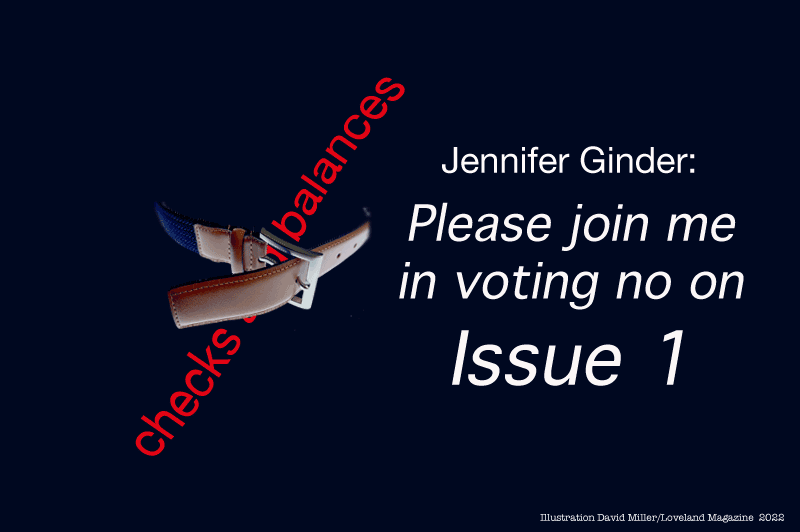
Issue 1 is not about reproductive rights or any other, single issue. It’s about control, and would effectively eliminate citizen-led amendments in Ohio, regardless of their objective. When legislators are not responsive on issues important to us – like school funding, responsible gun ownership, minimum wage, or gerrymandering – we will have no recourse if Issue 1 passes. No checks and balances. Please join me in voting no on Issue 1.
Supporters now set sights on collecting enough signatures by July to put the measure to Ohio voters in November
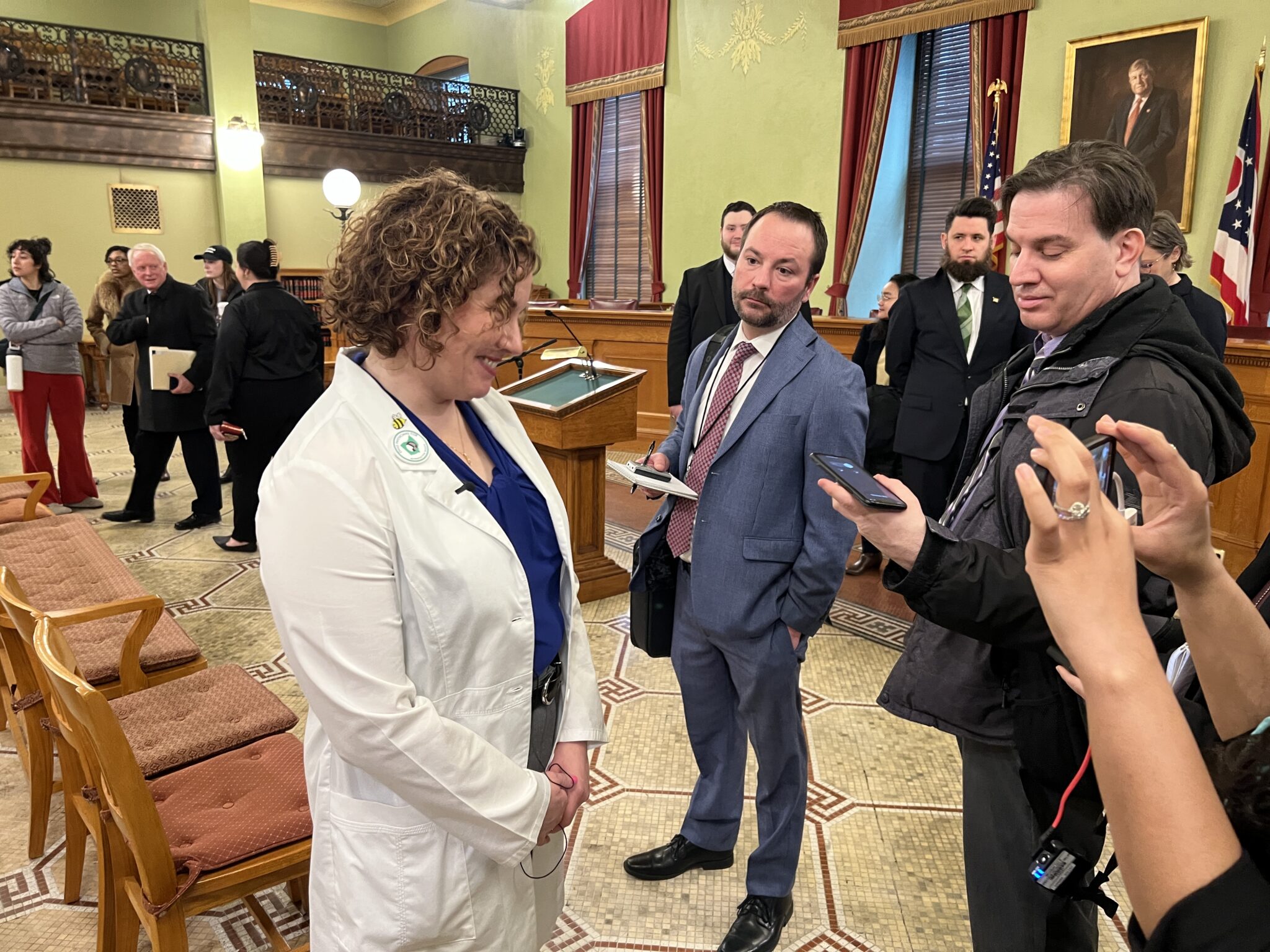
Dr. Amy Burkett, OB/GYN and member of Ohio Physicians for Reproductive Rights, speaks to media Monday following the Ohio Ballot Board’s vote to verify the language of a proposed constitutional amendment on abortion. Photo: Susan Tebben, OCJ
This article has been updated to include the proposed constitutional amendment (bottom)
The Ohio Ballot Board verified Monday that a proposed amendment for the November ballot to cement abortion rights in the Ohio Constitution can now move forward to the full signature-gathering stage.
In a short Monday meeting, the board, composed of Secretary of State Frank LaRose; Republican state Sen. Theresa Gavarone, Democratic state Sen. Paula Hicks-Hudson, Democratic state Rep. Elliot Forhan, and Bill Morgan, voted unanimously that the proposed ballot initiative only involved one constitutional issue.
The board only heard from two people outside of the board after LaRose insisted that content be kept away from the merits of the amendment or opinions about abortion itself.
John Grove, of Cincinnati Right to Life, still took time to try to discredit the amendment itself, called it “intentionally unjust and misleading.”
Attorney Don McTigue spoke on behalf of the groups proposing the amendment, choosing not to dive into the legal aspects of the amendment, instead saying the “common purpose of the amendment” was individuals having control of one’s own reproductive decisions.
Gavarone acknowledged that the purpose of the Ballot Board business was “procedural,” but still input her opinion before the unanimous vote was recorded.
COLUMBUS, OH — FEBRUARY 22: State Sen. Theresa Gavarone, R-Bowling Green, during the Ohio Senate session, February 22, 2023, at the Statehouse in Columbus, Ohio. (Photo by Graham Stokes for Ohio Capital Journal. Republish photo only with original story.)
“I am horrified at the thought of this amendment, I mean, the right to kill babies being put into Ohio’s constitution,” Gavarone said.
Now that the proposal has been certified by the Ohio Attorney General and verified by the Ohio Ballot Board, groups attempting to get the measure on the ballot can move forward with collecting the more than 400,000 valid signatures needed to officially get the measure to statewide voters.
Laura Strietmann, executive director for Cincinnati Right to Life, said pro-life organizations throughout the state have joined together as well, with a full strategy to fight against the measure.
“We are unified in protecting women in Ohio, in stopping this bill from becoming law,” Strietmann said after the vote.
Abortion rights groups say they are prepared to go forward with field planning, volunteers and petition circulators as early as the end of this week, according to Jordyn Close, deputy director for the Ohio Women’s Alliance and board president for Abortion Fund of Ohio.
The organizations are planning to hit the ground running to get more than enough signatures in a short amount of time. The deadline to submit signatures so the proposal can appear on the November ballot is July.
Part of the plan to bring support to the measure includes informing voters about the true aims of the constitutional amendment on which they would be voting. Claims have already been made by opposition groups that the amendment would bar all abortions, including for baby’s who have reached full term, something supporters of the amendment say won’t happen.
“We are not interested in doing full-term abortion,” said Dr. Amy Burkett, board-certified OB/GYN in northeast Ohio, and member of Ohio Physicians for Reproductive Rights. “This is about protecting the rights to reproductive health care including abortion, up to viability.”
Viability, Burkett said, should be determined by the physician and patient “based on the technology that is available at the time.”
Amendment supporters aren’t shying away from their pro-abortion stance, despite the trend toward using “pro-choice” as a way of including all options.
“When we talk about reproductive freedom and bodily autonomy, we have to be really specific about what (opposition groups) are attacking,” Close said. “And that is abortion access.”
————————-
Amendment Summary and Text:
TITLE: The Right to Reproductive Freedom with Protections for Health and Safety
SUMMARY The Amendment would amend Article I of the Ohio Constitution by adding Section 22, titled “The Right to Reproductive Freedom with Protections for Health and Safety.”
The Amendment provides that: 1. Every individual has a right to make and carry out one’s own reproductive decisions, including but not limited to decisions on contraception, fertility treatment, continuing one’s own pregnancy, miscarriage care, and abortion. 2. The State shall not, directly or indirectly, burden, penalize, prohibit, interfere with, or discriminate against either an individual’s voluntary exercise of this right or a person or entity that assists an individual exercising this right, unless the State demonstrates that it is using the least restrictive means to advance the individual’s health in accordance with widely accepted and evidence-based standards of care. 3. However, abortion may be prohibited after fetal viability. But in no case may such an abortion be prohibited if in the professional judgment of the pregnant patient’s treating physician it is necessary to protect the pregnant patient’s life or health. 4. As used in this Section, “Fetal viability” means “the point in a pregnancy when, in the professional judgment of the pregnant patient’s treating physician, the fetus has a significant likelihood of survival outside the uterus with reasonable measures. This is determined on a case-by-case basis”; and “State” includes any governmental entity and political subdivision. 5. This Section is self-executing.
FULL TEXT OF PROPOSED AMENDMENT
Be it Resolved by the People of the State of Ohio that Article I of the Ohio Constitution is amended to add the following Section: Article I, Section 22. The Right to Reproductive Freedom with Protections for Health and Safety
A. Every individual has a right to make and carry out one’s own reproductive decisions, including but not limited to decisions on:
contraception;
fertility treatment;
continuing one’s own pregnancy;
miscarriage care; and
abortion.
B. The State shall not, directly or indirectly, burden, penalize, prohibit, interfere with, or discriminate against either:
An individual’s voluntary exercise of this right or
A person or entity that assists an individual exercising this right, unless the State demonstrates that it is using the least restrictive means to advance the individual’s health in accordance with widely accepted and evidence-based standards of care. However, abortion may be prohibited after fetal viability. But in no case may such an abortion be prohibited if in the professional judgment of the pregnant patient’s treating physician it is necessary to protect the pregnant patient’s life or health.
C. As used in this Section:
“Fetal viability” means “the point in a pregnancy when, in the professional judgment of the pregnant patient’s treating physician, the fetus has a significant likelihood of survival outside the uterus with reasonable measures. This is determined on a case-by-case basis.”
“State” includes any governmental entity and any political subdivision.
Two groups who had already committed to separate efforts to get reproductive rights in the hands of Ohio voters have now merged and set an end goal: abortion access on the November ballot.
Ohioans for Reproductive Freedom and Ohio Physicians for Reproductive Rights announced Thursday that they are joining together to “file language with the Ohio Attorney General to place a citizen-initiated constitutional amendment to restore and protect reproductive rights and abortion access on the November 2023 statewide general election ballot.”
“This grassroots initiative – by and for the people of Ohio – is foundational to ensuring access to abortion and the right to bodily autonomy, not only for ourselves, but for generations to come,” said Kellie Copeland, executive director of Pro-Choice Ohio and member of Ohioans for Reproductive Freedom, said in the announcement.
The groups said the constitutional amendment will look similar to a Michigan amendment which voters approved in November 2022.
After the amendment is drafted and reviewed by the state Attorney General and Ohio Ballot Board, the groups plan to circulate petitions to place the issue on the ballot.
Rumblings of a constitutional amendment have been floating for months now, spurred on by the Dobbs v. Jackson Women’s Health Organization case, in which the U.S. Supreme Court overturned decades old nationwide rights to abortion nationwide in Roe v. Wade.
Placing the measure on the 2023 ballot was called a “moral imperative” which “offers the best prospects for success,” according to Dr. Lauren Beene, executive director of the OPRR.
“The lives and health of Ohioans have been at risk since Roe was overturned,” Beene said in a statement. “That is why we must seize the earliest possible opportunity to ensure that doctors and patients, rather than politicians and the government, are empowered to make decisions about pregnancy, contraception and abortion.”
The ballot measure might have another issue if in-fighting within the state’s Republican caucus continues. One side of the caucus is promoting the controversial legislation that would raise the threshold to approve constitutional amendments, while House Speaker Jason Stephens didn’t list it as one of the priority bills he and his faction unveiled on Wednesday.
Republicans on both sides of the aisle have expressed interest in legislative prohibitions to abortion since the downfall of Roe, and both sides are awaiting the resolution of a court case under which a six-week abortion ban is paused indefinitely as appeals go through.
Secretary of State Frank LaRose (speaking) alongside Rep. Brian Stewart, R-Ashville, introducing a constitutional amendment requiring a 60% supermajority for all future citizen-led ballot amendments. (Photo by Nick Evans, OCJ.)
Legislative Republican leaders also negotiating other changes, nix plan for automated voter registration
Lawmakers raised two ideas Thursday with massive implications for Ohio voters. One is an initiative requiring citizen-led constitutional amendments gain a 60% supermajority at the ballot for passage, the other is a House bill aimed at rewriting the underlying infrastructure of how the state conducts elections.
The amendment
State Rep. Brian Stewart, R-Ashville, joined Ohio Secretary of State Frank LaRose to introduce their plan to “safeguard Ohio’s constitution from special interests,” by proposing the supermajority for passage.
“We have repeatedly watched as special interests buy their way onto the statewide ballot and then spend millions of dollars drowning the airwaves to secure fundamental changes to our state by a vote margin of 50% plus one vote,” Stewart argued.
Their plan singles out the citizen-led process for amending the state constitution and raises the threshold for passage to 60%. The signature threshold for making the ballot would remain unchanged. LaRose argued lifting that benchmark would give the same interest groups a relative advantage.
Ohio Secretary of State Frank LaRose. Official photo.
“If a special interest group can afford to pay, you know, million dollars to hire people with clipboards,” LaRose reasoned, “they can afford to pay a million and a half dollars to hire more people with more clipboards.”
The stakes are high for any groups whose ideas have fallen on deaf ears in Columbus. The prospects for abortion protection, recreational marijuana, minimum wage increases, gun violence prevention, or further redistricting reform provisions are effectively non-existent in the GOP-controlled Statehouse. LaRose and Stewart’s proposal would move the goal posts for any of those ideas.
The proposal itself, of course, will need to go to voters and get just 50% plus one to alter the Ohio Constitution. It will follow a different process, too. Stewart’s resolution would make the ballot through a General Assembly vote rather than the citizen signature-gathering process.
That lawmaker-led process won’t see any changes in the threshold for passage, either. LaRose and Stewart dismissed any suggestion their approach is unfair. Lawmakers have to meet a supermajority benchmark, too, they argued. It’s on “the front end” where they have to clear a 2/3 supermajority to make the ballot.
Under maps declared to be unconstitutional gerrymandering by a bipartisan majority on the Ohio Supreme Court, Ohio Republicans once again won rock-solid supermajorities in the Ohio House and the Ohio Senate last week.
LaRose and Stewart highlighted how 11 of 16 citizen-led amendments have failed since 2000, so it wasn’t clear exactly why they want to raise the bar higher as they also noted of the five measures that passed, three cleared 60% at the ballot box.
The legislation
Republican Ohio House Majority Leader Bill Seitz. Official photo.
Meanwhile, state Rep. Bill Seitz, R-Green Township, kicked off Thursday morning by proposing sweeping changes to an already sweeping elections bill. The biggest move involved nixing the automated voter registration language contained in the initial proposal.
Those provisions would’ve leaned heavily on the Bureau of Motor Vehicles to help voters register or update their registration any time they interact with the agency. If voters’ registration is regularly updated, the thinking goes, there will be fewer names to purge. But Seitz said after months of negotiations, the Ohio Senate hasn’t budged.
“If we’re going to get anything done,” Sietz said, “we’ve got to have an agreement between two chambers, and the Senate does not yet feel comfortable with automated voter registration, even though I am comfortable with it.”
“But it takes two to tango as they say,” he added with a wry chuckle.
Among other changes, voters would be able to request absentee ballots online, but they’d have to submit paper requests on a specific form. The deadline for requesting one would be seven days before an election. The bill trims the deadline for absentee ballots to arrive post-election to seven days as well.
Drop boxes would be available for the duration of early voting, but they’d be restricted — no more than three, all on board of elections premises and under 24/7 video surveillance.
The bill eliminates the final day of early voting but distributes those hours in the week prior by extending weekday hours.
Seitz also dropped a number of ID provisions from the original bill. He noted Senate legislation plans to offer free photo-ID to anyone — not just poor Ohioans as his bill envisioned.
“They can be, you know, Leslie Wexner or Carlin Lindner III and they could still get a free photo ID,” he quipped referencing the founder of The Limited and the co-CEO of American Financial Group.
Pushback
A slew of press releases were released Thursday afternoon from good government groups and voters rights organizations slamming the Stewart and LaRose proposal to increase the passage threshold for citizen-initiated amendments.
As for the Seitz proposal, voting rights advocates applauded the inclusion of online ballot requests and funding for electronic poll books. But League of Women Voters of Ohio Director Jen Miller warned the proposal would make elections “more complicated, expensive and inefficient.”
She urged lawmakers to expand in person voting hours during the final weekend of early voting. Miller argued boards will get more bang for their buck expanding weekend voting compared to tacking on extra early morning hours during the week.
Miller also pushed them to reconsider the automated voter registration they’d just removed. She argued 22 other states have similar policies including West Virginia, Georgia and Michigan.
“It removes barriers to registration, but it also helps every voter because the accuracy of voter rolls are improved and it can reduce administrative costs for the boards of elections,” Miller explained. “And we reduce our provisional ballot counts which are typically very high in Ohio.”
Miller returned to the idea of excessive provisional ballots in a discussion of stricter voter ID requirements.
“When someone votes provisionally, which of course we support, that actually takes away all workers from the process,” Miller explained. “It increases lines, and it also increases a lot of post-election work for boards of elections. So we think that the system as is works.”
Speaking afterward, Seitz rejected out of hand the idea that more stringent voter ID requirements could increase the number of provisional ballots cast.
“I don’t buy that at all, that’s crap,” he said, “look at everything you need a photo ID for in life, okay?”
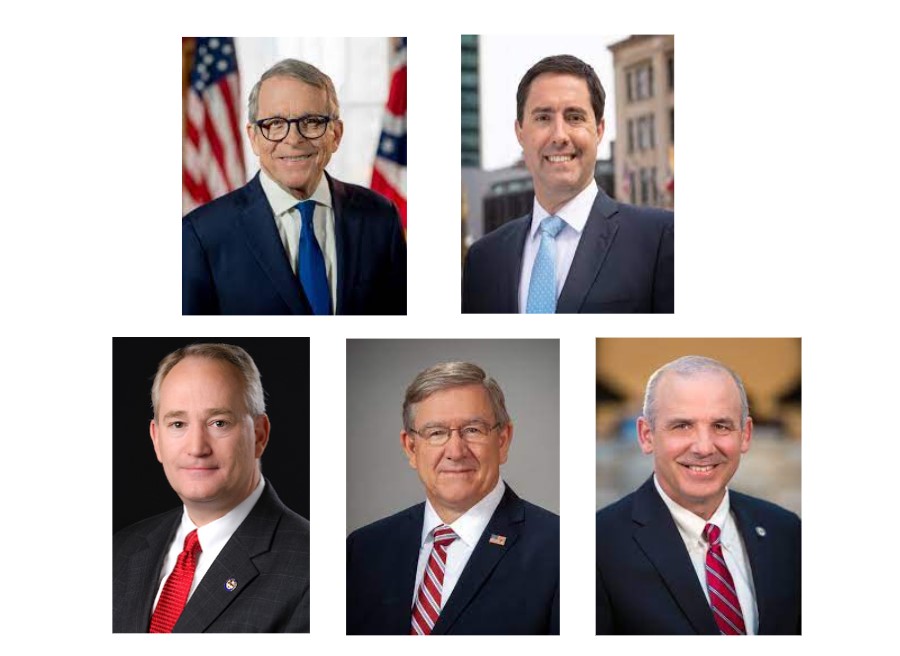
The Republican majority members of the Ohio Redistricting Commission. Top row from left, Ohio Gov. Mike DeWine and Secretary of State Frank LaRose. Bottom row from left Ohio Auditor Keith Faber, House Speaker Bob Cupp, and Senate President Matt Huffman. Official photos.
Anti-gerrymandering groups are again asking the Ohio Supreme Court to determine if the Ohio Redistricting Commission should be held in contempt, and to force the commission to meet by the end of the week to redraw legislative maps.
The ACLU, on behalf of several groups including the League of Women Voters of Ohio and the A. Philip Randolph Institution of Ohio and some individual Ohio voters, asked the court to yet again demand answers from the Ohio Redistricting Commission as to why they shouldn’t be held in contempt for making no moves to meet a deadline to draw “entirely new” legislative maps.
The fourth effort by the ORC was rejected by the Ohio Supreme Court on April 14, and found not to be an “entirely new map” they were ordered to create, but merely a tweak of the third attempt, which was also rejected as unduly partisan.
The commission has until May 6 to adopt and submit a map, but the groups say the urgency of the situation has “dramatically increased” because of a federal court’s decision to implement the third map found unconstitutional by the supreme court as the map to use during the 2022 election season. The U.S. District Court said they would order the use of the map, which was found to be unduly advantageous to Republicans, if no plan was adopted by May 28.
“Based on the commission’s conduct to date, this appears to be exactly what the commission is trying to do,” the ACLU wrote to the supreme court. “The Court should not allow the commission to intentionally avoid its constitutional obligations.”
GOP members of the commission argued that the court did not have the authority to hold them in contempt for several reasons, most important of which was the fact that the commission had passed a map by the court-ordered March 28 date. They said they conducted their legislative duties, and also were protected by the separation of powers doctrine from being held in contempt.
One member of the state supreme court, Justice Sharon Kennedy, has consistently sided with the Republican members in saying they should not be held in contempt and the court does not have the power to do so.
The Ohio Supreme Court rejected a previous request to hold the ORC in contempt at the same time they rejected the fourth map by the group.
The ACLU, however, argues in their most recent challenge for contempt that legislative immunity is not “unlimited” and separation of powers principles do not “constitute an insurmountable barrier to a contempt order against the majority of the commission.”
“In ordering (the ORC) to reconvene and to draft and adopt a constitutionally valid General Assembly-district plan, this Court is not ‘asserting control’ over purely legislative duties … but simply ensuring that the commission itself undertake those duties,” attorneys said in their Monday filing.
GOP members of the ORC told the court in the last debate over contempt that they could not be charged as individuals for something decided by the commission as a whole.
The ACLU called the argument an “improper attempt to evade responsibility” in their Monday filing. The argument also does not hold when it comes to calling a meeting of the commission, the court challengers said. Calling a meeting only requires three commission members, leaving five others “fully responsible for the defiance of the court’s order,” court documents stated.
Attorneys urged the court to force the commission to convene no later than Friday if they are held in contempt, as a way to “purge” their contempt charges.
The commission has not announced any plans to meet on or before the May 6 deadline. Democrats, including commission co-chair state Sen. Vernon Sykes, attempted to bring a meeting together on Monday, but ended up alone in front of the room where the ORC has met in the past, having had their offer rejected by every other member of the commission.
A representative with House Speaker and commission co-chair Bob Cupp said no meetings have been scheduled, and a spokesperson for Senate President Matt Huffman said meeting dates were up to the co-chairs.
Ohio Gov. Mike DeWine has signed Statehouse Republicans’ congressional map for Ohio giving the GOP a substantial advantage, claiming that of all the maps presented it “makes the most progress to produce a fair, compact and competitive map.”
DeWine pointed to fewer county splits in the map and the number of Ohio cities the map keeps whole.
“With seven competitive congressional districts in the SB 258 map, this map significantly increases the number of competitive districts versus the current map,” DeWine said.
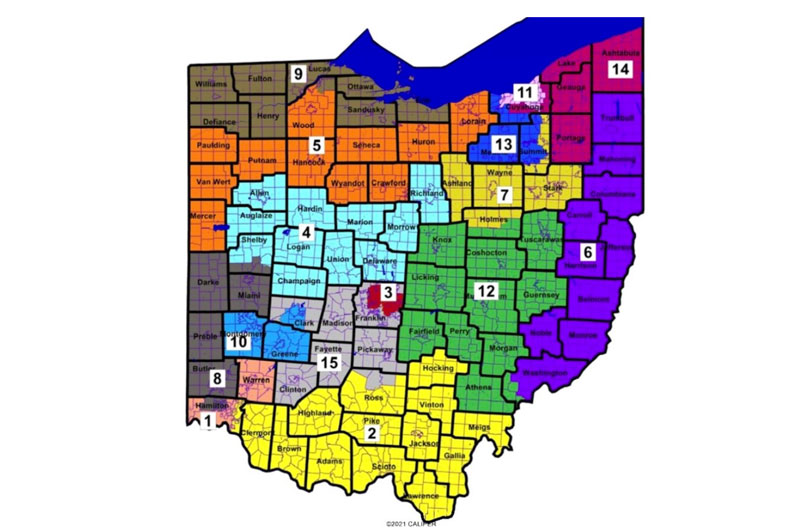
The GOP congressional map signed by Gov. Mike DeWine. (Right-Click to enlarge map)
Without bipartisan support, the map is slated to only be in place for four years. With DeWine’s signature, legal challenges are expected to be forthcoming. Statehouse legislative maps approved by the Ohio Redistricting Commission with only Republican support in September are facing legal challenges currently before the Ohio Supreme Court.
DeWine’s son, Justice Pat DeWine, has refused to recuse himself from the case, making Chief Justice Maureen O’Connor the potential swing vote on the constitutionality of the Republican plans that continue Republican supermajorities in the Ohio House and Senate and now an 11-2 advantage in congressional maps with two potential toss-up districts.
Ohio voters passed redistricting reform for state legislative maps in 2015, with more than 70% support, and congressional redistricting reform in 2018 with nearly 75% support. Those reforms called for maps that do not “unduly favor or disfavor” one political party or another.
The map approved Thursday in the House was introduced just Monday night as an amendment replacing the maps previously discussed in committee hearings. After the map was unveiled, it had one hearing in which a committee heard public comment. Every speaker was an opponent. The Princeton Gerrymandering gave the map a flunking grade.
An analysis of the map on Dave’s Redistricting App shows seven Republican districts, two Democratic districts and six districts listed as competitive for being within a 54-46 margin. Five in six of the “competitive” districts lean Republican, and the one that leans Democratic, Ohio’s 13th district, does so by 0.88%. It was passed along partisan lines in both the Ohio Senate and Ohio House this past week.
DeWine’s signing of the GOP congressional maps was criticized by anti-gerrymandering advocates.
“Once again, Gov. DeWine has failed to stand up to the extremists in his party. He could have rejected gerrymandered maps, but chose weakness instead,” said Desiree Tims, president and CEO of Innovation Ohio. “These rigged districts will lead to more extreme politicians who pass dangerous laws that devastate Ohio communities.”
The map will give Republicans 80% to 87% of Ohio’s congressional seats, the advocates noted, despite the fact that Republicans only win about 55% of Ohio’s statewide vote.
“Regardless of our skin color or zip code, everybody deserves to have a meaningful influence on our political process and choosing who gets to represent us,” said Jeniece Brock, Policy and Advocacy Director of the Ohio Organizing Collaborative. “By cracking and packing communities of color, this congressional map dilutes the power and voices of Black and brown Ohioans.”
Just 21 days ahead of the November 6 General Election, Ohio Secretary of State Jon Husted said today that as of Friday, October 12, an estimated 910,982 absentee ballots had been requested and 42,470 had been cast statewide. This includes more than 7,900 ballot requests from military and overseas voters, whose absentee ballots started going out on Saturday, September 22, of which nearly 1,200 have been cast. Ballots for all other voters started going out on October 10 and more than 41,000 have been cast by mail and in person.
2018 General Election By-the-Numbers
8,025,232 Ohioans are registered to vote.
910,982 voters have requested an absentee ballot by mail as of Friday.
Of those, 42,470 have been cast.
34,252voters have requested and cast an absentee ballot in person as of Friday.
7,914military & overseas voters have requested an absentee ballot as of Friday.
Of those, 1,176 have been cast.
At this same point during absentee voting in 2014, nearly 741,000 absentee ballots had been requested and more than 49,000 ballots had already been cast.
Ohio voters have multiple options available to them to cast a ballot over a four week period that began October 10. A registered voter can cast an absentee ballot by mail or early in person, which gives them 24 hours a day to vote from home or nearly 200 hours to vote in person that includes weeknights and weekends, respectively. There is also Election Day, during which voters have 13 hours to cast a ballot at their neighborhood polling location. The voting schedule is accessible on the Secretary of State’s website.
Loveland Sweets is a purveyor of hand-crafted chocolates, caramels, marshmallows, and ice creams. Our house-made candies are prepared in small batches.