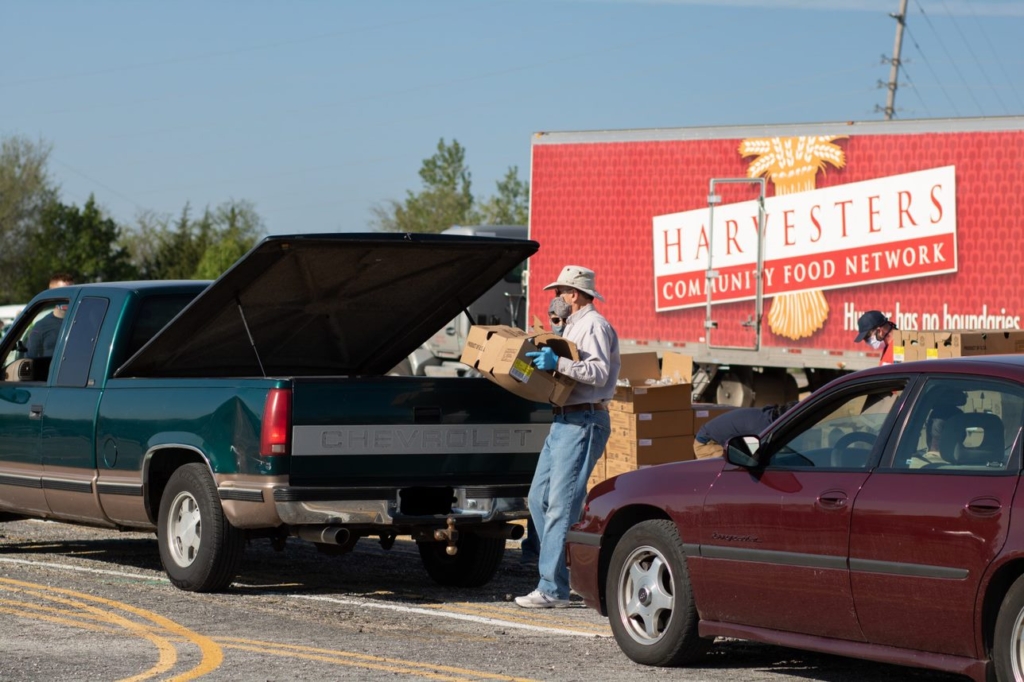
Throughout the pandemic, families have turned to food banks for help. Harvesters, a private food bank, saw the amount of food distributed increase from 54 million pounds in 2019 to 65 million in 2020. In this picture, food is distributed at a drive-in in Kansas City, Kansas. (Harvesters — The Community Food Network).
After Congress ended pandemic food assistance in February, 70,000 older Ohioans have seen food benefits slashed to $23 a month, in some cases down from $280.
That has many making excruciating choices between food, medicine and utilities like electricity and gas, Lisa Hamler-Fugitt, executive director of the Ohio Association of Foodbanks, said Wednesday.
And while it’s dire for anybody to live in hunger, that’s especially true the older you are, she said, because insufficient nutrition exacerbates conditions such as diabetes and depression and can take away seniors’ ability to live on their own. The end of COVID-era enhancements to benefits under the Supplemental Nutrition Assistance Program — or SNAP — has added to the already increasing number of older Ohioans seeking help at Ohio’s groaning food pantries, Hamler-Fugitt said.
“They’re the canaries in the hunger coal mine,” she said, explaining that because most older Ohioans live on fixed incomes, they can’t earn their way out of food insecurity. “When they join the food line, they’re not leaving until they go into the nursing home or they pass away.”
To help low-income people deal with the economic shocks from the coronavirus epidemic, Congress and the Trump administration in 2020 enhanced benefits under SNAP, the program formerly known as food stamps, and it eased eligibility to include households with somewhat higher incomes. And by literally putting food on the table, it had a big effect on poverty, the Center on Budget and Policy Priorities reported.
“The temporary benefits pushed back against hunger and hardship during COVID,” the report said. “A study estimated that (enhanced allotments) kept 4.2 million people above the poverty line in the last quarter of 2021, reducing poverty by 10 percent — and child poverty by 14 percent — in states with (enhanced allotments) at the time. The estimated reduction in poverty rates due to (enhanced allotments) was highest for Black and Latino people.”
But last December, Congress and the Biden administration decided to end the enhancements effective in February.
“This change was made as part of a bipartisan compromise that created a permanent Summer Electronic Benefit Transfer (EBT) program to provide grocery benefits to replace school meals for some 30 million children in low-income families when schools are closed in the summer — a time when families with school-aged children are at higher risk for food insecurity,” the Center on Budget and Policy Priorities reported.
Hamler-Fugitt said that in Ohio, the group over 60 was particularly hard hit in part because it’s an aging state. It has the 18th-highest percentage of residents over 65, for example.
In some cases, seniors don’t have support systems and some are even supporting others, such as grandchildren and great-grandchildren. And the older one becomes, the more health complaints accumulate, often making it impossible to perform many of the jobs that are available.
Hamler-Fugitt said her agency has been hearing about the real-life consequences of cutting back food benefits to older Ohioans.
“You just can’t even believe these horror stories,” she said. “We’re interviewing them now about what their coping strategies are and it’s really, really scary. Before they had about $2 a meal — that was a best-case scenario. Now it’s 75 cents a day. That’s 25 cents a meal.”
She explained that the permanent fix to the problem is at the federal level, where providing the U.S. Department of Agriculture with more resources could make the enhanced benefits permanent.
But over the short term, advocates for the poor are asking the Ohio General Assembly to pony up $21 million for each of the next two years to ensure that every eligible Ohio household has at least a $50 monthly SNAP benefit.
“The economic consequences of this for an aging state like Ohio are just huge,” Hamler Fugitt said.
_____________________________
 MARTY SCHLADEN