Tag: opioid crisis

  • Justice Department sues CVS over opioid practices, including some in Ohio

    Justice Department sues CVS over opioid practices, including some in Ohio

    A CVS store. (Photo by Lynne Terry, Oregon Capital Chronicle, States Newsroom.)

    By:  Ohio Capital Journal

    The U.S. Justice Department is suing pharmacy giant CVS, accusing it of putting profits over patient safety and thus fueling the opioid crisis. The accusations bear similarities to violations for which the Ohio Board of Pharmacy last year fined the company, and the DOJ complaint cites some of board’s findings in its suit.

    The complaint was unsealed last week in Providence, R.I.

    In essence, it accuses CVS of understaffing its pharmacies to such an extent that pharmacists and technicians could not ensure they were filling opioid prescriptions properly. Additionally, it accuses CVS of even graver conduct.

    “CVS also allegedly filled large quantities of prescriptions for controlled substances written by prescribers it knew to be engaged in ‘pill mill practices’ — that is, prescribers who issue large numbers of controlled substance prescriptions without any medical purpose,” a statement announcing the lawsuit said. “According to the complaint, CVS ignored substantial evidence from multiple sources, including its own pharmacists and internal data, indicating that its stores were dispensing unlawful prescriptions.”

    Particularly notorious pill mills were located in and around Portsmouth, Ohio, in a region that was particularly hard hit by the opioid epidemic.

    In a statement, CVS said it has already worked law enforcement on opioids.

    “We have cooperated with the DOJ’s investigation for more than four years, and we strongly disagree with the allegations and false narrative within this complaint,” it said. “We will defend ourselves vigorously against this misguided federal lawsuit, which follows on the heels of years of litigation over these issues by state and local governments—claims that already have been largely resolved by a global agreement with the participating state Attorneys General.”

    CVS added that it has taken extensive action to stop overprescription of opioids.

    “CVS Health has been an industry leader in developing innovative programs to fight opioid misuse,” the statement said. “As one example, 12 years ago CVS Pharmacy pioneered a first-of-its-kind program to block controlled-substance prescriptions written by doctors of potential concern. To date, we have blocked more than 1,250 practitioners, including nearly 600 prescribers who the government continues to license. This program is not required by any statute or regulation, and CVS Health repeatedly has defended lawsuits from those alleging we go too far in blocking opioid prescribers. “

    However, the Justice Department is accusing CVS of not wanting to spend enough money to staff its pharmacies adequately to operate safely. The Ohio Board of Pharmacy concluded the same thing in February, when it fined the company $250,000, placed a CVS store in Canton on indefinite probation and imposed sweeping new rules in an attempt to ensure adequate staffing. CVS later paid $1.25 million in fines to settle violations the Board of Pharmacy said it found at 22 Ohio CVS stores.

    Inspection reports from those stores described waits as long as a month to fill prescriptions, expired and adulterated drugs on shelves and a lack of controls as hundreds of doses of opioids such as oxycodone and hydromorphone went missing. Current and former CVS employees told the Capital Journal that upper management didn’t listen when pharmacy workers pleaded for extra help. They added that the problems weren’t limited to CVS’s Ohio stores.

    The Justice Department suit cited the Ohio findings and leveled similar charges.

    “The complaint alleges that CVS’ violations resulted from corporate-mandated performance metrics, incentive compensation, and staffing policies that prioritized corporate profits over patient safety,” it said in the statement announcing the suit. “CVS set staffing levels far too low for pharmacists to both meet their performance metrics and comply with their legal obligations. CVS also allegedly deprived its pharmacists of crucial information (including, for example, by preventing pharmacists from warning one another about certain prescribers) that could have reduced the number of unlawful prescriptions filled. The complaint alleges that CVS’ actions helped to fuel the opioid crisis and that, in some particularly tragic instances, patients died after overdosing on opioids shortly after filling unlawful prescriptions at CVS.”

    The suit was brought as a result of a whistleblower complaint by a former employee. Under federal law, whistleblowers are entitled to a share of the money recovered in such suits.

    Among its demands, the Justice Department suit asks for triple damages, other financial penalties and a permanent injunction requiring it to dispense opioids in accordance with its legal obligations.

    Marty Schladen
    Marty Schladen

    Marty Schladen has been a reporter for decades, working in Indiana, Texas and other places before returning to his native Ohio to work at The Columbus Dispatch in 2017. He’s won state and national journalism awards for investigations into utility regulation, public corruption, the environment, prescription drug spending and other matters.

    Ohio Capital Journal is part of States Newsroom, the nation’s largest state-focused nonprofit news organization.

    MORE FROM AUTHOR

  • Ohio Republican Senate candidate forum devolves into near fight

    Ohio Republican Senate candidate forum devolves into near fight

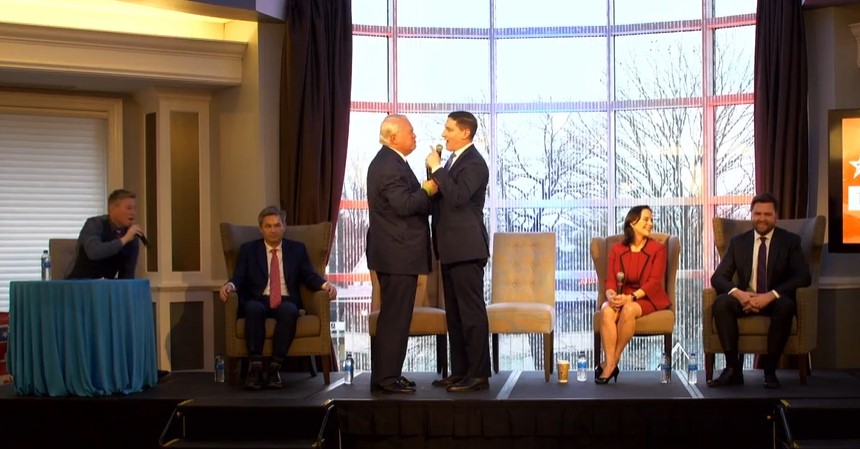
    Mike Gibbons, left, and Josh Mandel, right, have a heated exchange. Photo by Nick Evans, OCJ.

    BY: NICK EVANS – Ohio Capital Journal

    The leading candidates for the Ohio Republican U.S. Senate nomination met in Gahanna Friday. Two of them nearly came to blows.

    The candidate forum hosted by FreedomWorks didn’t make it through opening statements before former Ohio Treasurer Josh Mandel began attacking investment banker Mike Gibbons. The other candidates, state Sen. Matt Dolan, former GOP chair Jane Timken and author J.D. Vance did their best to avoid the fracas.

    The substance

    The moderator took candidates through foreign policy, big tech “censorship” (twice), critical race theory, the opioid crisis and their feelings on Donald Trump’s presidency. The candidates largely agreed on support for Ukraine, but complained about how Congress approved a nearly $14 billion support package.

    “You can not just put, in the dark of night, all of these spending provisions into a bill, plop it on peoples’ desks and say you’ve got 12 hours to vote for this,” Dolan argued.

    Vance has argued against engaging the Ukraine war — raising eyebrows by saying he didn’t really care what happened. His position hasn’t really changed, but the framing has. Instead of emphasizing neglect, he uses the conflict to criticize establishment Republicans who couldn’t fund Trump’s border wall and to warn against American adventurism.

    “The only thing that will salvage Joe Biden’s presidency is if a bunch of stupid, weak-willed Republicans let this guy bumble us into a war that we have no business fighting,” he told the crowd.

    Biden has, from the outset and repeatedly since, insisted that American troops will not be sent to fight in Ukraine.

    Timken decried big tech as, “the weapon of the cancel culture and the woke left.”

    But beneath the red meat rhetoric, their arguments weren’t that dissimilar from what many on the left have demanded. Break them up, don’t let companies profit on your data, reform or eliminate section 230, the candidates argued.

    “There is no reason that Facebook or Meta as it’s called should be as powerful as it is, and also, meddling in our elections,” Timken said.

    The confrontation

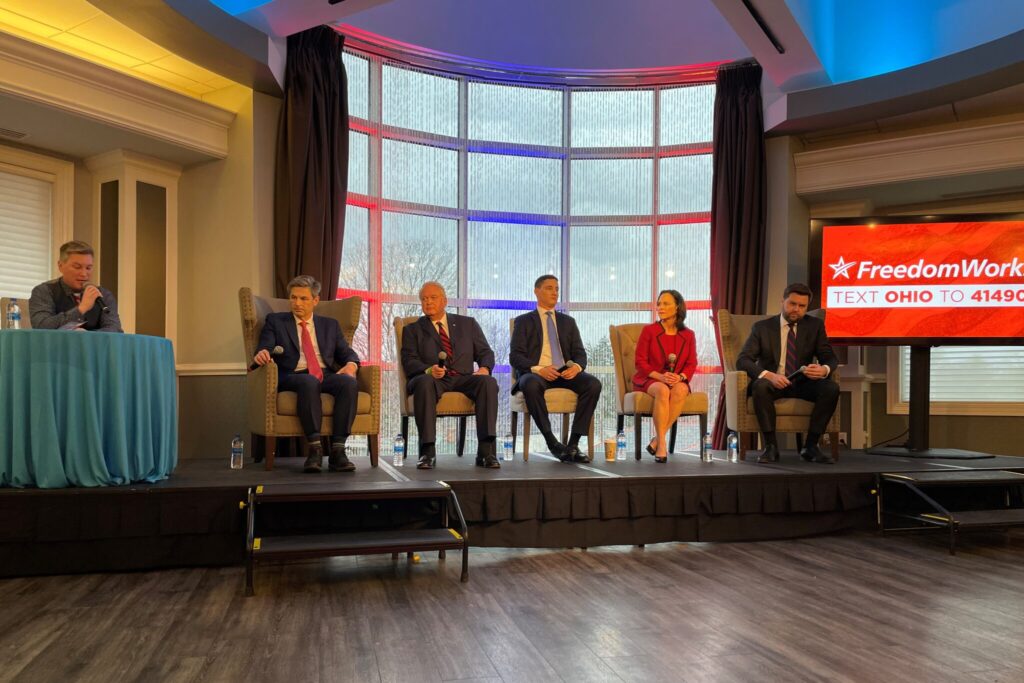
     From left, moderator Brandon Boxer, Matt Dolan, Mike Gibbons, Josh Mandel, Jane Timken and J.D. Vance. Photo by Nick Evans, OCJ.

    Almost immediately, it became clear that Mandel would use the forum to attack Gibbons. In his opening statements Mandel argued the fight for the “soul of the Republican Party” was even more important than the fight against Democrats.

    “Here’s the fork in the roads,” he argued. “Down one path goes these squishy, RINO Republicans many of whom have been pro-China over the years.”

    He rattled off the list of excommunicated Republicans — Liz Cheney, Adam Kinzinger, Mitt Romney — before turning to Gibbons.

    “(He) had all these companies here in America and made money selling them to China,” Mandel said. “That is not the path that we should be taking in this country.”

    Mandel repeatedly steered his answers into Gibbons’ investment holdings criticizing him for shipping Ohio jobs overseas, selling companies “to China,” or simply holding stock in Chinese firms. By the third time he tried it, Mandel’s tactic was met with sustained boos from the crowd.

    “Again Josh is showing his ignorance,” Gibbons said after one critique tied to Lordstown Motors. He then turned to the former state treasurer and asked, “Josh, do you know anything about economics or finance at all?”

    Gibbons also made a dig he uses regularly on the campaign trail — Mandel has “zero” experience in the private sector.

    That’s incorrect. Mandel has served on corporate boards and advised payday lenders since leaving office in 2019. He also served in the military.

    The confrontation between the two became more heated, with Mandel jumping out of his seat after Gibbons told Mandel, “You might not understand this,” about a stock trade.

    “You’ve never been in the private sector in your entire life,” Gibbons insisted. “You don’t know squat.”

    “Two tours in Iraq,” Mandel growled, “don’t tell me I haven’t worked.”

    The other candidates traded uncomfortable laughs as the moderator broke up the incident while the crowd booed.

    “You’re dealing with the wrong guy,” Mandel said returning to his seat. “You watch what happens, p—-, you watch what happens.”

    The incident is in keeping with Mandel’s increasingly belligerent campaign. He’s taken to ending campaign ads with the tag line “send in the marine.”

    A few minutes after the confrontation, Vance, who is also a marine corps veteran, chastised Mandel.

    “I think the way you use the U.S. Marine Corps, Josh, is disgraceful,” Vance said. “It’s not a political football for you to toss around.”

    After the event ended, Gibbons waded out into the crowd to shake hands with attendees, but refused to talk to reporters. Instead, his campaign sent out a press release after the fact calling Mandel “unhinged, unfit and flailing.”

    Mandel handled things differently.

    When the forum concluded, he shook hands with his opponents and rushed off stage. He weaved through attendees and made a beeline for the service kitchen.

    In a straw poll, Mandel got just 4.6%, dead last among the candidates on stage. The winner was J.D. Vance with about 43% of votes.

    Speaking after the event Vance called Mandel’s conduct “embarrassing,” but he didn’t want to belabor it, instead focusing on how the crowd had reacted to the points he made during the evening. But asked about Mandel’s exit, Vance smiled and paused.

    “Well,” he said. “If I’d had his debate I may have run for the kitchen, too.”

  • Indigent burial program may see more action amid opioid epidemic, COVID-19 pandemic

    Indigent burial program may see more action amid opioid epidemic, COVID-19 pandemic

    By Susan Tebben and Ohio Capital Journal

    A state program to help those who can’t afford to bury their loved ones might see more action than usual, and cause the need for re-education for townships that have to pay for these burials.

    The Indigent Burial and Cremation program works with townships and municipalities to reimburse some of the costs of funeral disposition. When a resident is found to fall below the federal poverty line, Ohio law requires that a local government pay for the burial or cremation.

    But local government officials have said the program wasn’t used often in its last version, nearly two decades ago.

    More recently, however, several townships have called the state’s Board of Embalmers and Funeral Directors to get information about the program, and there are currently 450 applications being processed, according to Cheryl Grossman, the board’s executive director.

    “We look for that number to grow dramatically,” Grossman said.

    While a death certificate isn’t required with the application for funding reimbursement, Grossman and others have said the ongoing opioid epidemic and the COVID-19 pandemic could cause the program to have increased use.

    “The opioid crisis is not going away and in some places it’s only being exacerbated by the COVID-19 crisis,” said Heidi Fought, executive director of the Ohio Township Association.

    The program was a part of the budget more than a decade ago, but budget cuts led to the elimination of it until the last budget bill, passed in July of 2019.

    The new budget line item moved the program from the state Department of Job and Family Services to the Board of Embalmers and Funeral Directors and allowed the reimbursement of a total of $2 million.

    Under the new version of the program, a township can get reimbursed for up to $1,000 in burial or cremation expenses for an adult, and up to $750 for a child. Those numbers are a slight increase from the previous program, where reimbursements were set at $750 for an adult and $500 for a child.

    The Board of Embalmers and Funeral Directors seems to be the only state agency with information on the program. Representatives from the Ohio Department of Job and Family Services, the Department of Health, the Office of Budget and Management and the Auditor of State all referred questions about the use and payment of the program to the board.

    “While the local governments in the Southeast Region receive some funding, it is usually sporadic and nominal,” said Denise A. Blair, assistant chief auditor in the Southeast Region for the Auditor of State. “It would not rise to the level of materiality that would be included in our scope.”

    The OTA specifically lobbied to bring back the funding for the indigent burial program in the last budget, despite the rarity of a cut program returning to the state budget.

    “The fact that it did come back does show that the need is there,” Fought said.

    The need to re-educate townships on the existence of the program and how to be reimbursed for it is also there, because of the turnover over of local officials in the period between the program’s existence, according to Fought.

    Only local government representatives can apply for the reimbursement, so individuals have to go through those government officials to get help with their funeral disposition.

    The Ohio Township Association says the push to increase the program’s funding will continue, especially considering local governments are required to pay for indigent burials whether or not there is money in the program’s coffers to reimburse them.

    “A local government entity must carry out this duty even if funds are no longer available through the program,” according to the embalming and funeral directors board page on the program.

    The program is needed as a state program because poverty does not focus on one particular county, nor does the need for burials or cremations.

    “Indigency knows no boundaries,” said Fought. “They’re in central Ohio or Cleveland or Cincinnati, they’re everywhere.”

  • Warren County Commissioners plan community forum on addiction

    Warren County Commissioners plan community forum on addiction

    The Warren County Commissioners invite you to participate in an important community meeting to learn about ways to address the opioid crisis in our county. The forum will take place on Tuesday, July 17, from 6:30 to 8 p.m. at the Warren County Career Center in Lebanon.

    The commissioners will present details from a recent study conducted by the Addiction Policy Forum and outline the organization’s recommendations for implementing a comprehensive blueprint for the county’s opioid response.

    An increase in the number of pain medicine prescriptions and rising access to heroin caused growing opioid abuse over the past several decades. According to a report by the county’s Opioid Reduction Task Force, from 1991 to 2011 opioid prescriptions in the U.S. rose from 76 million to 219 million. In Warren County, there were more than 10.6 million annualized opioid prescriptions written in 2015, the equivalent of 48 doses per person. Additionally, the number of overdose deaths in the county rose 264 percent from 2004 to 2014.

    The Addiction Policy Forum is a partnership of organizations, policymakers and stakeholders working to increase awareness about addiction and encourage a holistic response that includes prevention, treatment, recovery and criminal justice reform.

    To RSVP for the meeting, email commissioners@co.warren.oh.us. You can also learn more about the Addiction Policy Forum’s recommendations for Warren County online.


  • November is National Adoption Month; 19 youth in Clermont await adoption

    November is National Adoption Month; 19 youth in Clermont await adoption

    Teens Need Families, No Matter What.

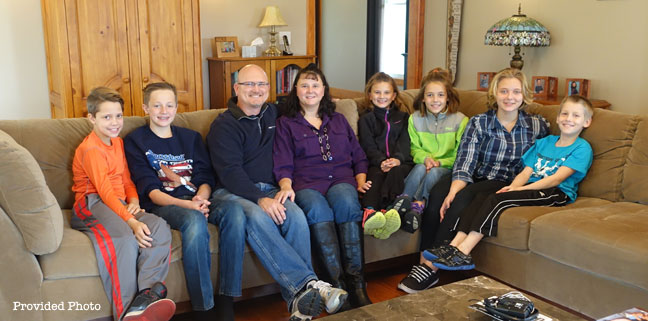
    Dan and Viola Rice with their six children, five of whom have been adopted. (Photo taken in November 2016)

    Clermont County, Ohio – That’s the theme of 2017’s National Adoption Awareness Month, which is recognized nationally and in Clermont County in November every year. And finding homes for older children, particularly teens, can be difficult, said Julie Jordan, Adoption Supervisor at Children’s Protective Services.

    “Most of the children we have waiting for adoption are 12 and older,” Jordan said. “Parents often think that older children are more challenging, but that is not necessarily the case. Their need for a home is just as great as it is for a younger child.”

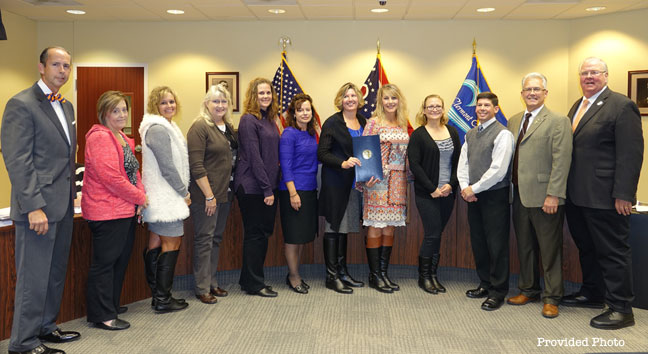
    Commissioners and staff of Clermont Children’s Protective Services on Oct. 25, 2017, as Commissioners proclaimed November Adoption Awareness Month.

    “This is a critical time for these kids,” Jordan said. “They need support and guidance, just like any other teen.”

    According to the most recent report from the Children’s Bureau, which advocates for the welfare of children and families, more than 110,000 children and youth in foster care are waiting to be adopted across the United States, and close to 12,500 of them are between the ages of 15 and 17 years old.

    Currently, Clermont County has 19 children awaiting adoption. These are children who were removed from their parents’ home due to abuse and/or neglect. Most of these children then entered foster care. After parental rights were terminated – typically after two years, when parents fail to take the steps necessary for reunification – the children can be adopted.

    One pathway to adopting older children is to become a foster parent first.

    In Clermont County, these teens include Clarissa, who is 16, and Kennedy, 17; Caleb who is 14, and  Jayden, who is 13. Brief biographies can be found on each child at http://www.clermontforkids.org/waiting-children/.

    The opioid crisis in Clermont County has contributed to the cases of abuse and neglect that compel CPS to remove children from their parents’ home, Jordan said. And that’s also a reason why there are more tweens and teens waiting for a family.

    One pathway to adopting older children is to become a foster parent first. The adoption team at Children’s Protective Services promotes foster-to-adopt certification as the best way to offer children a stable and nurturing home. Dan and Viola Rice of Mount Orab, who have adopted five children through CPS’s foster-to-adopt, and have fostered more than 40 children, are strong advocates of this method.

    “We love being foster care parents,” Dan says. “We ask our friends, or those we are just meeting – have you ever thought about foster-to-adopt?”

    In 2017, 38 children have been adopted by 23 families to date.

    To find out more about foster care or adoption through Clermont County Children’s Protective Services, please call 513.732.7765. The website www.clermontforkids.org has information on the foster-to- adopt process, and also has a list of children currently waiting for a forever family.


    Take Home Tano Consumer Meal Market

    Take Home Tano is about fresh, wholesome food for the frenzied family   Our goal is to meet the needs of busy families