Tag: outbreak

  • Warren County Health District: Extremely high number of pediatric pneumonia cases

    Warren County Health District: Extremely high number of pediatric pneumonia cases

    Photo from the The Christ Hospital Health Network

    A Press Release from the Warren County Health District

    The Warren County Health District has received an extremely high number of pediatric pneumonia cases being reported this fall season. Since August, there have been 142 cases of pediatric pneumonia reported. Not only is this above the county average, it also meets the Ohio Department of Health definition of an outbreak.

    We do not think this is a novel/new respiratory disease but rather a large uptick in the number of pneumonia cases normally seen at one time.

    To date, there has not been a definitive etiology determined or a common thread linking these pneumonias. We have an ongoing investigation to examine possible linkages and risk factors.

    The average age thus far is around 8 years old, the cases span multiple school districts and there have been no conclusive patterns among the children diagnosed. Based on some data responses from a recent parent questionnaire, most common symptoms included cough, fever and fatigue.

    Among the pathogens recovered included Mycoplasma pneumoniae, Streptococcus pnuemoniae and Adenovirus.

    WCHD is working with the Ohio Department of Health, local children’s hospitals and primary care providers in hopes to determine a cause and further prevent the spread of illness. One recommendation is for providers to have a lower threshold to test children presenting with cough, fever and/or fatigue and consider nasopharyngeal swabs for respiratory viruses, mycoplasma and pertussis.

    WCHD sent out a notification with education to Warren County providers last week in an effort to further clarify the nature of the outbreak.

    As we approach the holiday season, when many of us will be gathering together with family and friends, please remember to take necessary precautions to protect your health: wash your hands, cover your cough, stay home when ill, and stay up to date on vaccines.

    If you have any questions or need to report a pneumonia case, please contact the Warren County Health District at 513-695-2097.

  • How an Ohio state senator and 33 family members caught COVID-19

    How an Ohio state senator and 33 family members caught COVID-19

    Senator Tina Maharath (Ohio Senate photo)

    Jake ZuckermanJake Zuckerman is a statehouse reporter. He spent three years chronicling the West Virginia Legislature for The Charleston Gazette-Mail after covering cops and courts for The Northern Virginia Daily.
    It started with a funeral.

    Tina Maharath, a Democratic state senator from Canal Winchester, attended a wake Aug. 9 after her brother-in-law’s funeral, who died of non-COVID-19 illness.

    Two of his family members, who Maharath said tested positive for COVID-19, came to the wake. Maharath described them as skeptical of the gravity of the COVID-19 pandemic.

    “Slowly, one by one, we started getting the phone calls from each one of our family members,” she said in an interview.

    Maharath comes from a big family — common, she said, among Laotians. Her husband has 19 siblings, she has 16. The new coronavirus, which causes COVID-19, left from the wake to invade 11 different family households, infecting 33 family members including a 9-month-old baby.

    As of Thursday, two have died: Maharath’s 44-year-old sister-in-law, who had been battling brain cancer for a year, and her sister-in-law’s father-in-law.

    Five family members were hospitalized, including one who Maharath said is likely to die soon from COVID-19. The five people hospitalized are between 34- and 76-years old. They were hospitalized anywhere from two to six weeks. Mahrath’s sister-in-law was ventilated for three weeks.

    All five had underlying health conditions like asthma, high blood pressure and diabetes, all common conditions in Ohio.

    The familial outbreak, Maharath said, is hopefully over. But uncertainty over longevity of symptoms or long term damage is frightening.

    “We’re concerned because of the five people who were hospitalized, they still have lingering symptoms too, and another sister-in-law who was pregnant, she has lingering symptoms too,” Maharath said. “I don’t have underlying conditions, I’m not pregnant. So why do I have symptoms?”

    Patient groups, calling themselves “long haulers,” have insisted they’ve been experiencing COVID-19 symptoms for month. The CDC has found COVID-19 can result in prolonged illness, even among younger and healthier adults.

    Six weeks out from the positive test result, Maharath said she still feels COVID-19’s symptoms. She said she feels dehydrated, experiences coughing spells, and headaches.

    Her lungs, she said, take most the heat.

    “I just feel weak,” she said. “My lungs feel like something is just punching them. Randomly, it feels like something is just stabbing my lungs.”

    Nearly 148,000 Ohioans have contracted COVID-19 according to state data, which officials believe to be an undercount. At least 4,715 have died.

    Maharath’s diagnosis drew headlines in August. On Wednesday, however, Maharath shared the story of the outbreak through her family in a floor speech opposing Senate Bill 311.

    The legislation, which Senate Republicans passed, would forbid the Ohio Department of Health from issuing anything like the stay-at-home order it issued in March, which closed “non-essential” businesses in an effort to slow the spread of the recently-detected coronavirus.

    It would also allow lawmakers — who have repeatedly expressed skepticism about the virus, ODH’s data tracking the virus, and non-pharmaceutical interventions to control the virus like masks and social distancing — to rescind ODH orders.

    However, a COVID-19 diagnosis did not prove to be a proxy vote against the legislation.

    Sen. Bob Peterson, R-Washington C.H., who contracted the disease earlier this month, voted in favor.

    Sen. Frank Hoagland, R-Adena, did as well. He contracted a mild case of the disease in August. According to a Herald Star report, Hoagland’s wife was hospitalized with the disease as well. Both his wife’s parents reportedly died from COVID-19.

    With what they hope to be the worst of the outbreak behind them, Maharath said her family is planning funerals for the deceased. They plan stricter social distancing and mask requirements.

    Maharath said she’s not planning to attend.

  • Milford IHOP employee diagnosed with hepatitis A

    Milford IHOP employee diagnosed with hepatitis A

    Milford, Ohio – Clermont County Public Health has identified a case of hepatitis A in an employee at the IHOP restaurant at 5699 Romar Drive in Milford.

    According to the Clermont County Board of Health the risk to patrons is extremely low. However, as a precaution they are asking anyone who has eaten at IHOP from December 25 – December 31 to monitor for symptoms of the virus for up to 50 days.

    Symptoms of hepatitis A include:

    • Fatigue
    • Low appetite
    • Stomach pain
    • Nausea
    • Clay-colored stools
    • Jaundice (yellowish color to the skin and eyes)

    The disease, which affects the liver, can be spread through eating or drinking contaminated food. Food can get contaminated if a person who has the virus does not wash their hands properly after using the bathroom and before preparing or touching food.

    “The restaurant management has been very cooperative and we are working with them to review safe food handling techniques,” said Assistant Health Commissioner Tim Kelly.

    A vaccine can protect you from getting sick if received within two weeks of contact with the virus. Patrons should contact their health care provider if they have questions or concerns.

    “Though it is possible to spread hepatitis A through contaminated food, the risk is extremely low,” said Kelly. “The majority of cases we are seeing during this outbreak are from other risk factors.”

    The Ohio Department of Health declared a statewide outbreak of hepatitis A in June. So far, there have been 1,370 cases statewide and 42 cases in Clermont County that are linked to this outbreak.

    People at the highest risk of hepatitis A during this outbreak include:

    • People with direct contact with anyone who has the virus
    • People who use illegal drugs
    • People who are homeless
    • People who have traveled to other areas of the U.S. that are currently experiencing an outbreak
    • People who have been incarcerated
    • Men who have sex with men

    In addition to getting a vaccine, the best way to protect yourself from hepatitis A is to wash your hands thoroughly after using the bathroom and before eating.

    Illness from hepatitis A can range from a mild case that lasts a few weeks to a severe illness lasting several months.

    For more information on hepatitis A, click here.


    Bethel McDonald’s employee diagnosed with hepatitis A


    Felicity IGA employee diagnosed with hepatitis A
  • CDC is advising consumers, restaurants, and retailers not to eat, serve, or sell any romaine lettuce

    CDC is advising consumers, restaurants, and retailers not to eat, serve, or sell any romaine lettuce

    Illustration with a triangle and exclamation mark and text reading Food Safety Alert

    Illustration of a clipboard with check marks on it.

    CDC is advising that U.S. consumers not eat any romaine lettuce, and retailers and restaurants not serve or sell any, until we learn more about the outbreak. This investigation is ongoing and the advice will be updated as more information is available.

    • Consumers who have any type of romaine lettuce in their home should not eat it and should throw it away, even if some of it was eaten and no one has gotten sick.
      • This advice includes all types or uses of romaine lettuce, such as whole heads of romaine, hearts of romaine, and bags and boxes of precut lettuce and salad mixes that contain romaine, including baby romaine, spring mix, and Caesar salad.
      • If you do not know if the lettuce is romaine or whether a salad mix contains romaine, do not eat it and throw it away.
      • Wash and sanitize drawers or shelves in refrigerators where romaine was stored. Follow these five steps to clean your refrigerator.
    • Restaurants and retailers should not serve or sell any romaine lettuce, including salads and salad mixes containing romaine.
    • Take action if you have symptoms of an E. coli infection:
      • Talk to your healthcare provider.
      • Write down what you ate in the week before you started to get sick.
      • Report your illness to the health department.
      • Assist public health investigators by answering questions about your illness.

    Advice to Clinicians

    • Antibiotics are not recommended for patients with E. coli O157 infections. Antibiotics are also not recommended for patients in whom E.coli O157 infection is suspected, until diagnostic testing rules out this infection.
    • Some studies have shown that administering antibiotics to patients with E. coli O157 infections might increase their risk of developing hemolytic uremic syndrome (a type of kidney failure), and the benefit of antibiotic treatment has not been clearly demonstrated.
    Illustration of a megaphone.

    At A Glance

    Photo of romaine lettuce in a wood bowl.

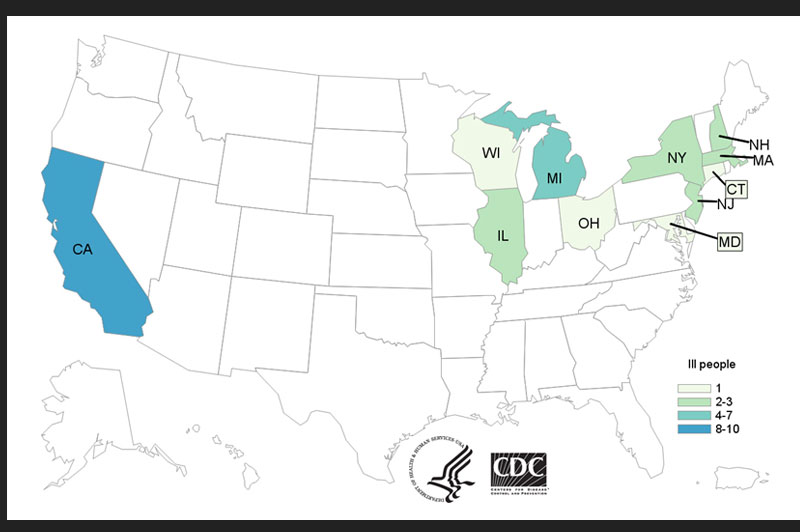
    • Thirty-two people infected with the outbreak strain of Shiga toxin-producing E. coli O157:H7 have been reported from 11 states.
      • Illnesses started on dates ranging from October 8, 2018 to October 31, 2018.
      • Thirteen people were hospitalized, including one person who developed hemolytic uremic syndrome, a type of kidney failure. No deaths have been reported.
    • The Public Health Agency of Canada has identified 18 ill people infected with the same DNA fingerprint of E. coli O157:H7 bacteria in two Canadian provinces: Ontario and Quebec.
    • Epidemiologic evidence from the United States and Canada indicates that romaine lettuce is a likely source of the outbreak.
    • Ill people in this outbreak were infected with E. coli bacteria with the same DNA fingerprint as the E. coli strain isolated from ill people in a 2017 outbreak linked to leafy greens in the United States and to romaine lettuce in Canada. The current outbreak is not related to a recent multistate outbreak of E. coli O157:H7 infections linked to romaine lettuce.
    • CDC is advising that consumers do not eat any romaine lettuce because no common grower, supplier, distributor, or brand of romaine lettuce has been identified.
    • This investigation is ongoing, and CDC will provide more information as it becomes available.
    Illustration of a person with stomach pain.
    • People usually get sick from Shiga toxin-producing E. coli (STEC) 2–8 days (average of 3–4 days) after swallowing the germ.
    • Some people with a STEC infection may get a type of kidney failure called hemolytic uremic syndrome (HUS).
    • E. coli infection is usually diagnosed by testing a stool sample.
    • Antibiotics are not recommended for patients with suspected E. coli infections until diagnostic testing can be performed and E. coli infection is ruled out. Some studies have shown that administering antibiotics to patients with E. coli infections might increase their risk of developing HUS, and a benefit of treatment has not been clearly demonstrated.
    • For more information, see Symptoms of E. coli Infection.