Tag: Oxford

  • Miami U. Board of Trustees approves site for the design phase of an event district with multipurpose arena

    Miami U. Board of Trustees approves site for the design phase of an event district with multipurpose arena

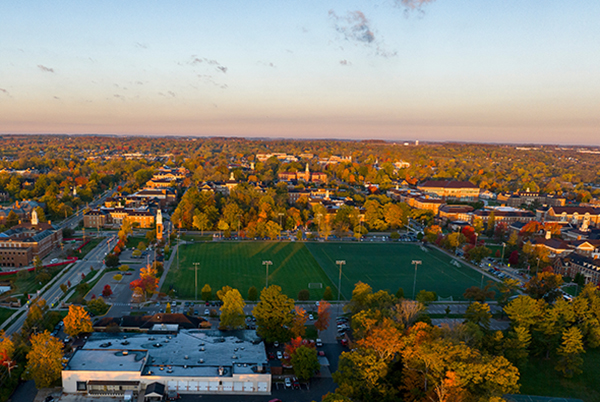
    Cook Field, with Cole Service Building in the foreground, State Route 73 at left, Farmer School of Business at right (drone image by Jeff Sabo)

    Cook Field site chosen

    Oxford, Ohio – During its Feb. 28 meeting, the Miami University Board of Trustees approved the site location to continue the initial concept and design phase for a potential new multipurpose arena on its Oxford campus at Cook Field.

    Miami University Director of Athletics David Sayler provided an update on the project and delivered the site recommendation made by a committee of university faculty, staff, and alumni. Sayler spoke about the need for a new multipurpose arena and the current vision for the site, noting that the project is still in the exploratory phase.

    “Our focus will be to make this a student-centered project first and foremost,” Sayler said. “That will drive the design and amenity choices.”

    A press release said, “That to best support student-athletes, the proposed arena would include more facilities than currently exist at Millett Hall, including two basketball practice courts and a volleyball arena. It is also expected to include additional revenue generation opportunities that Millett Hall cannot accommodate.”

    Senior Vice President of Finance and Business Services and CFO David Creamer shared some preliminary projected costs for the proposed new multipurpose arena and related projects. Cost of construction of the arena and practice facilities are expected to not exceed $187.7 million. Given the preliminary nature of the project, the estimate includes contingency and escalation costs for inflation during the period of design according to the press release.

    “This is the marquee athletic project of our billion-dollar fundraising campaign, ‘For Love. For Honor. For those who will.’” said Brad Bundy, vice president for Advancement. “All along, our thinking on this, should the project move forward, is to significantly fund it with philanthropy. We are confident there is appetite to do so given initial donor and alumni excitement and feedback.”

    Creamer said that building a new arena at the Cook Field site also allows the university to invest a projected $9.9 million-$13 million in Miami’s intramural recreation space, which would be relocated to the south lawn area of Millett. Much of these costs will be offset by other projects already funded and philanthropic gifts. Additionally, in support of the university’s commitment of carbon neutrality by 2040, geothermal wells are being installed in the Millett Hall south lawn area. These wells will prevent building construction on the ground above them, however provide a setting for recreation and intramural fields.

    “We want to create something very special for our students at the Millett Hall location, with their input and involvement,” Sayler said.

    Built in 1968, Millett Hall originally housed one varsity sport in men’s basketball. Volleyball and women’s basketball were both added in 1974. It would cost at least $130 million to repair Millett (which has $85 million in deferred maintenance) and add practice facilities (estimated at $50 million). An additional investment would be needed to make renovations, bring up to current code, and add amenities expected in modern facilities.

    A new multipurpose arena would address space limitations and systems operations and maintenance challenges at Millett Hall, as well as “modernize the fan experience”.

    “This will create a new and vibrant space for people to come together and support Miami in many different ways,” Sayler said. “We also have an opportunity to hold even more events in a new facility, including ones that are not athletics related, and the arena can serve as an anchor piece of an events district that drives economic development within Oxford.”

    According to the statement, the location of the site will allow the multipurpose arena to facilitate concurrent, student-related activities and other campus events, such as commencements, concerts, creative arts performances, career fairs, and more.

    The site also has a large footprint with abundant space and gives the ability to add additional facilities, including connection to potential future hotel and/or restaurants. Its location at the intersection of State Route 73 and U.S. 27 would allow for improved control of traffic flow and direct entrance and exit from State Route 73, limiting traffic congestion on campus.

    There is no timetable currently on the construction of a new multipurpose arena.

    “As innovative, student-first ideas and programming move forward from the MiamiTHRIVE strategic planning process, Miami is prioritizing these and other projects that directly benefit students and the community by supporting a vibrant and reinvigorated campus experience, as well as those that strengthen the local economy,” President Gregory Crawford said.

    Established in 1809, Miami University is located in Oxford, Ohio, with regional campuses in Hamilton and Middletown, a learning center in West Chester, and a European study center in Luxembourg.
  • Groundbreaking Quantum Computing major approved by Miami University Board of Trustees

    Groundbreaking Quantum Computing major approved by Miami University Board of Trustees

    Next step is approval by Ohio Department of Higher Education

    Oxford, Ohio – During its regular meeting on Friday, Dec. 13, the Miami University Board of Trustees approved the new Quantum Computing major, the first of its kind for an Ohio institution.

    Following approvals from University Senate and the Board of Trustees, the next step is approval from the Ohio Department of Higher Education.

    “It is with great enthusiasm that we successfully complete another phase in the approval process for our Bachelor of Science in Quantum Computing degree,” Miami President Gregory Crawford said. “This has been developed with great input from researchers from Cleveland Clinic and members of the industry, and we look forward to delivering an innovative and comprehensive curriculum and continuing to build partnerships within quantum computing.”

    The Quantum Computing degree is expected to launch in August 2025 and is believed to be not only the first in Ohio, but the first of its type nationwide to focus on the software aspects of quantum computing.

    Beena Sukumaran, the Dinesh & Ila Paliwal Dean of the College of Engineering and Computing, said the groundbreaking Quantum Computing degree program would equip graduates with the knowledge and skills to navigate this exciting and growing field.

    “By offering a unique blend of disruptive computing skills as applied to a specific application area, including the health sciences, this degree program is poised to create a new generation of trailblazers that can apply advanced computational skills to solve the world’s most challenging problems,” Sukumaran said.

    Quantum computing is a multidisciplinary field which combines properties of mathematics, computer science, and physics. Quantum computers are able to solve complex problems faster than a classical computer by determining several solutions in parallel rather than sequentially.

    By developing Ohio’s first specialized degree program, Miami will provide research experiences in quantum computing that will cultivate the scientific and entrepreneurial talent needed to create companies, elevate businesses, and advance organizations that leverage quantum computing.

    A new generation of students will obtain expertise across a spectrum of computing platforms, from classical systems to advanced high-performance and quantum computing techniques (i.e., disruptive computing). The new degree will keep Ohio at the forefront of the quantum computing industry, establish a quantum computing pipeline in the state, and attract, retain, and anchor quantum computing talent in Ohio.

    “Quantum technology is a rapidly expanding market globally,” President Crawford said. “Miami’s bachelor’s degree in Quantum Computing will help address workforce needs in Ohio as well as provide economic resilience through innovation in quantum technology.”

  • ‘It’s become a tradition’ for Coates and Miami RedHawks

    ‘It’s become a tradition’ for Coates and Miami RedHawks

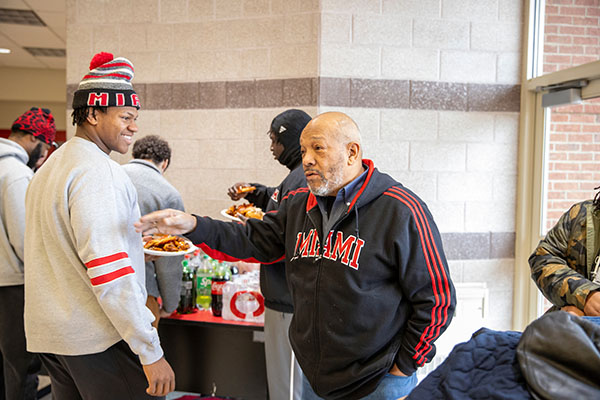
    Rodney Coates, right, talks with members of the Miami University football program on Wednesday, Dec. 11, during a luncheon at the Gross Student-Athlete Development Center organized by Coates to celebrate Miami’s bowl berth. The luncheon has become an annual tradition.

    Oxford, Ohio/Miami University – As members of the Miami University football team filed into – and later out of – the Gross Student-Athlete Development Center on Wednesday afternoon, many offered handshakes and words of appreciation to Rodney Coates.

    The thanks weren’t only for the meal provided, an annual tradition Coates first organized about a decade ago to celebrate when the RedHawks earn a bowl bid, but also for the role Coates plays each year.

    Coates, professor of Global and Intercultural Studies, teaches as part of the Summer Bridge Program, which helps many student-athletes prepare for the academic experience.

    “It’s above and beyond to feed us for a bowl game, but really more so than that what we appreciate is Dr. Coates’ relationship,” said Chuck Martin, head coach of Miami football. “It’s very unique. He’s helped our kids so many different ways. He really helps our kids get ready for college.

    “I couldn’t put a price tag on what he does for our kids.”

    A former Miami football player inspired the initial lunch. The player had a long-term spinal injury, and that resonated with Coates.

    “I said, ‘We need to celebrate it. Not wait for things to happen,’” Coates said. “Let’s make it something really special where Miami comes together to say thank you for what you’ve done. That’s how it started.”

    Coates has taught at Miami since 1990. He received the Distinguished Educator Award from the College of Arts and Science in 2021, as well as the President’s Medal that year.

    Coates has worked with the Summer Bridge Program for more than a decade.

    “Professor Coates is incredibly supportive of our outstanding student-athletes here at Miami,” Miami President Gregory Crawford said. “He works tirelessly with our student-athletes both in and outside the classroom. His December football luncheon is a cherished tradition, celebrating their success and showing our gratitude for all they contribute to Miami and our community.”
    After winning eight games this season and advancing to the Mid-American Conference championship game, the RedHawks will play Colorado State in the Snoop Dogg Arizona Bowl presented by Gin & Juice By Dre and Snoop on Dec. 28 in Tucson, Arizona.

    Kickoff is 4:30 PM at Arizona Stadium. The game will be broadcast on The CW Network.

    This is the fifth straight bowl appearance for the RedHawks and eighth in the last nine years, which has meant several Coates luncheons for many players.

    “As soon as I hear about it, it’s circled on the calendar,” said John Young, a senior offensive lineman.

    “It’s a way for all of us at the end of the year to get together for a couple of last meals,” added senior offensive lineman Reid Holskey. “It’s kind of good to have these moments with the guys who are here right now.”

    David Sayler, Miami’s director of athletics, called the luncheon “a bonding moment.”

    “It’s really nice for the football student-athletes to see deans, the President’s Office, and everybody else who supports it helping provide food for them,” Sayler said. “It’s really a nice gesture and doesn’t go unappreciated by the players.”

    Dec. 28 marks the 16th overall bowl appearance for Miami, beginning with the 1948 Sun Bowl (a 13-12 victory over Texas Tech).

    The last five years have included stops in the LendingTree Bowl (2020), the Frisco Football Classic (2021), the HomeTown Lenders Bahamas Bowl (2022), and the Avocados from Mexico Cure Bowl (2023).

    During that stretch, Martin became Miami’s all-time winningest coach.

    “We’ve done this a few times now,” Coates said. “It’s become a tradition amongst them (the team) too.”

    Established in 1809, Miami University is located in Oxford, Ohio, with regional campuses in Hamilton and Middletown, a learning center in West Chester, and a European study center in Luxembourg.

  • Miami University students conduct survey of Ohio voters

    Miami University students conduct survey of Ohio voters

    Oxford, Ohio (Nov. 1, 2024) – Miami University students fielded a survey of Ohio voters from Oct. 28-30. The results show tight races. Donald Trump leads Kamala Harris 49% to 46% among registered voters in the presidential race, while Sherrod Brown leads Bernie Moreno 48% to 46% in the senate race. Issue 1 also remains close with the Yes vote leading the No vote 46% to 45% with a large number of voters (9%) reporting that they are still not sure. The margin of error (which does not account for error from sampling coverage or survey language) is 5%.

    DonkeyHotey’s photos on Fiicker

    The survey was fielded by the students using a text-to-web modality. The students texted a random sample of registered voters in Ohio. The results were weighted to Ohio registered voters using education (3 categories) by sex, race (white/non-white) by sex, age (3 categories), vote history, and party registration. The latter two variables were taken from L2 voter file data.

    The tables below show the results for all registered voters and then the subset of voters that reported that they either had already voted or definitely would vote.

    The survey was supported by the Menard Family Center for Democracy and the Center for Career Exploration and Success at Miami University.

    Issue 1 Reg Voters Screened: Will Vote
    Yes 46% 46%
    No 45% 44%
    Not Sure 9% 9%
    N 853 844
    MoE 5% 5%


    President Reg Voters Screened: Will Vote
    Donald J. Trump (Republican) 49% 50%
    Kamala Harris (Democratic) 46% 47%
    I’m not sure 3% 2%
    Chase Oliver (Libertarian) <1% <1%
    Robert J Kennedy Jr. <1% <1%
    Jill Stein <1% <1%
    N 859 851
    MoE 5% 5%


    Senate Reg Voters Screened: Will Vote
    Sherrod Brown (Democratic) 48% 48%
    Bernie Moreno (Republican) 46% 47%
    Don Kissick (Libertarian) 3% 3%
    I’m not sure 2% 2%
    Other <1% <1%
    N 857 849
    MoE 5% 5%
  • A curated reading list to become better acquainted with the meaning behind Juneteenth

    A curated reading list to become better acquainted with the meaning behind Juneteenth

    Oxford, OhioThe Juneteenth holiday, commemorates the date enslaved Black people in Galveston, Texas learned of their emancipation, more than two years after the proclamation was issued. The holiday has long been celebrated by African Americans. In 2021, President Joe Biden signed legislation establishing Juneteenth as a federal holiday. Miami University will observe Juneteenth on Monday, June 19.

    Rodney Coates, professor of Critical Race and Ethnic Studies in the Department of Global and Intercultural Studies at Miami University, provided a list of curated books to become better acquainted with the history and meaning of Junteenth.

    Coates has selected three books that he references as voices of liberation and jubilation.  “A Voice from the South,” “The Souls of Black Folks,” and “I Know Why the Caged Bird Sings.”

    Coates provides a brief synopsis of each:

    No voice is as proactive, clear, and poignant as that of Anna Julia Cooper, writing her classic, “A Voice from the South,”  21 years after the end of the Civil War, 142 years ago. Her message — the plight, reality, and future of Black people — depended upon the Black woman’s success. For too long, the Church and clergy, the politicians and educators, and even the Black man thwarted these efforts by placing constraints upon the Black woman’s hopes, dreams, and opportunities. Cooper’s “Voice” provides a clarion call not to look back with inflated conceit, but to glean wisdom from experiences, to capture the spiritual essence of our being and to look to the future with hope and trust. This Voice shrugged condescension and victimhood yet shouted determination and “the radical amelioration,” liberation, and regeneration of the Black woman and community. Cooper ends with hope, believing black women shall arrive at the “promised land.”

    Almost a decade after Cooper’s “Voice” was published, W.E.B. Du Bois published “The Souls of Black Folks.” This collection of essays articulated Du Bois’ dreams toward an action plan for Black freedom in the 20th century. He began with a question, “What is it like to be a problem?” A problem complicated by prejudice, lawlessness, and ruthless competition. What is it like to be a Black and an American, two unreconciled selves, two paradoxes, two ends of a spectrum — in one body? Forty years after the promise of emancipation, freedom was still illusive to the freedman. Constantly vilified and condemned, over policed and undervalued, within just one generation, Blacks crafted institutions that provided escapes from the prison of poverty, mediocrity, and complacency. Yet, the soul of Black folks, the spiritual strivings of a people, was made manifest as they went from enslaved person to free, from forced laborers to skilled artisans and farmers. They created thousands of business people, clergy, teachers, and doctors in the process.

    While Black history is marked by progress, resilience, and perseverance, it is easy to ignore the trials, tribulations, and suffering endured by many Blacks over the ages. Maya Angelou’s “I Know Why the Caged Bird Sings” reminds us that it is not always a bed of roses. This is particularly true in this autobiographical work that traces a life often interrupted by tragedy, moving from kin to kin, grandparents to separated parents, and back to grandparents. Being the ugly duckling, battered and abused (sexually, mentally, and spiritually). But after being raped, pregnant, and disgraced, she continued onward. She did not allow these obstacles to drag her into hopelessness and despair. Head held high, she continued to pursue her path, gave birth to a marvelous son, graduated from high school, and the rest is history. So why can the caged bird sing? She dreams of freedom.  

    Lastly, while reading and contemplating the meaning of the Juneteenth holiday, listen to “Blackbird” written by Paul McCartney and featured on the Beatles’ iconic White Album in 1968. A young McCartney was inspired to write the song after meeting civil rights pioneers Thelma Mothershed Wair and Elizabeth Eckford. Wair and Eckford are two members of the Little Rock Nine, a group of nine black students who faced discrimination and the lasting impact of segregation after enrolling in the all-white Little Rock Central High School in 1957, following the Supreme Court’s Brown v. Board of Education decision.

    “Blackbird singing in the dead of night. Take these broken wings and learn to fly. All your life. You were only waiting for this moment to arise. Blackbird singing in the dead of night. Take these sunken eyes and learn to see. All your life. You were only waiting for this moment to be free.” McCartney (1968).

  • A message to the community from Miami University President Crawford

    A message to the community from Miami University President Crawford

    Residential students not expected to “move-in” until the week of September 14

    Dear Miami University Community:

    Today the Butler County General Health District (BCGHD) and Miami University issued a joint message urging our students to avoid travel and large gatherings this holiday weekend. I want to strongly affirm this message. We have updated our COVID-19 Case Reporting Dashboard with the numbers affecting campus. These numbers continue to reflect a concerning spread in cases in Oxford, and both travel and gatherings put oneself and others at risk, here or in the communities they might visit.
    Our ability to have residential students move-in the week of September 14 and to begin our in-person and hybrid classes on September 21 depends on our ability to stop the increasing spread of the virus. This means each of us must comply with all of the Healthy Together standards by wearing face masks; maintaining physical distancing; quarantining or isolating when needed; and avoiding gatherings of 10 persons or more. This is the only way to stop the spread. The health of all of us depends on each of us.

    As we look ahead, we are monitoring several key metrics: number of daily positives; positivity rate on surveillance testing; compliance around social distancing and masks in our community; hospitalizations (right now we do not have any); participation in contact tracing; compliance with quarantine and isolation orders and protocols; and our capacity within our community to handle caseloads. Our decision also will depend upon the ability to maintain a healthy workforce to serve our students. As we consider all of these variables, we must also stay mindful of the health and safety of the entire Oxford community.

    We continue to take aggressive measures to prevent this pandemic from impacting our plans for the remainder of the semester. Our ability to return to our campuses is directly dependent on individual compliance with our adherence to the Healthy Together standards.

    Should we need to make a change to our fall operational plans, we will communicate that no later than Wednesday, September 9.

    Let’s all do our part to protect our own health and the health of others. I wish to thank our students and families for their patience, our faculty and staff for their commitment, and our alumni and friends for their support. We all want to be Healthy Together and to be together on our campuses.

    Love and Honor
    Gregory Crawford

  • All Miami University student-athletes who returned to campus ordered to quarantine for 14 days

    All Miami University student-athletes who returned to campus ordered to quarantine for 14 days

    Oxford, Ohio – Following our report of 4 days ago that since the start of classes, that they had 10 positive COVID-19 tests among students and 2 among employees on the Oxford campus, Miami University now has announced that it learned on August 24, that twenty-seven student-athletes from various teams have now tested positive for COVID-19.

    Fall classes began on Monday, August 17, mostly remote, with graduate students and some programs in person. Students who will be living off campus have been encouraged to stay home, if they can, until face-to-face courses start on Monday, September 21.

    The university said, “Many, but not all, had attended an off-campus social gathering, over a week ago. The Butler County General Health District “out of an abundance of caution” is quarantining all Miami University student-athletes who have returned to Oxford, and any coaches and staff who were in contact with them.

    The Butler County General Health District issued the blanket quarantine order to ensure no student-athletes would be missed through the normal method of contact tracing.

    In the announcement by the university, Jennifer Bailer, Health Commissioner for Butler County General Health District, said, “As we know, the COVID-19 virus can spread quickly between people and infect groups of people in a hurry. This disease is serious. In young adults it is often mild, but has the potential to become critical for those with underlying disease or other risk factors.”

    “One of the main functions of public health is to identify persons who have been in contact with COVID-19 cases as quickly as possible and ask them to quarantine for 14 days and monitor themselves for symptoms. This helps in preventing the disease to spread any further,” stated Bailer.

    “My concern for the health of all of our student-athletes is paramount,” said David Sayler, director of athletics. “I am disappointed that poor judgment has led to this quarantine order and put in jeopardy our efforts to have our teams study and practice together.”

    The announcement by the university did not say the total number of student-athletes who have been ordered to quarantine.

    Because of concerns related to COVID-19, the Mid-American Conference announced Aug. 8 the postponement of all fall sports.

  • [12 positive cases] COVID-19 Oxford Campus Dashboard now available

    [12 positive cases] COVID-19 Oxford Campus Dashboard now available

    Oxford, Ohio – Miami University President Gregory Crawford said in an announcement Friday, “This week we have all been witnessing a troubling spread of COVID-19 on university campuses across the nation, and we will continue to monitor developments as many more schools begin to reopen next week so we can learn from their challenges and decisions.”

    Miami University President Gregory Crawford (Photo Miami University)

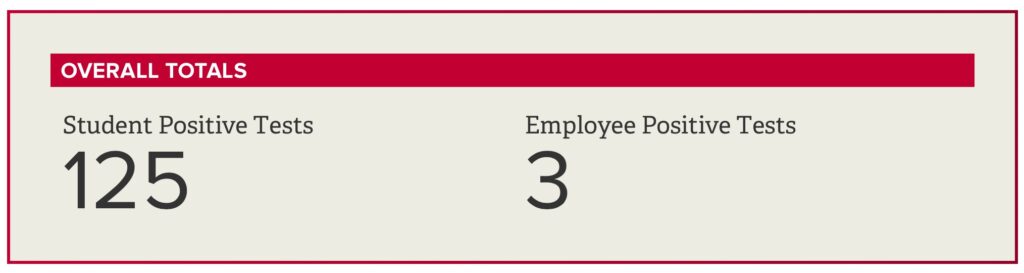
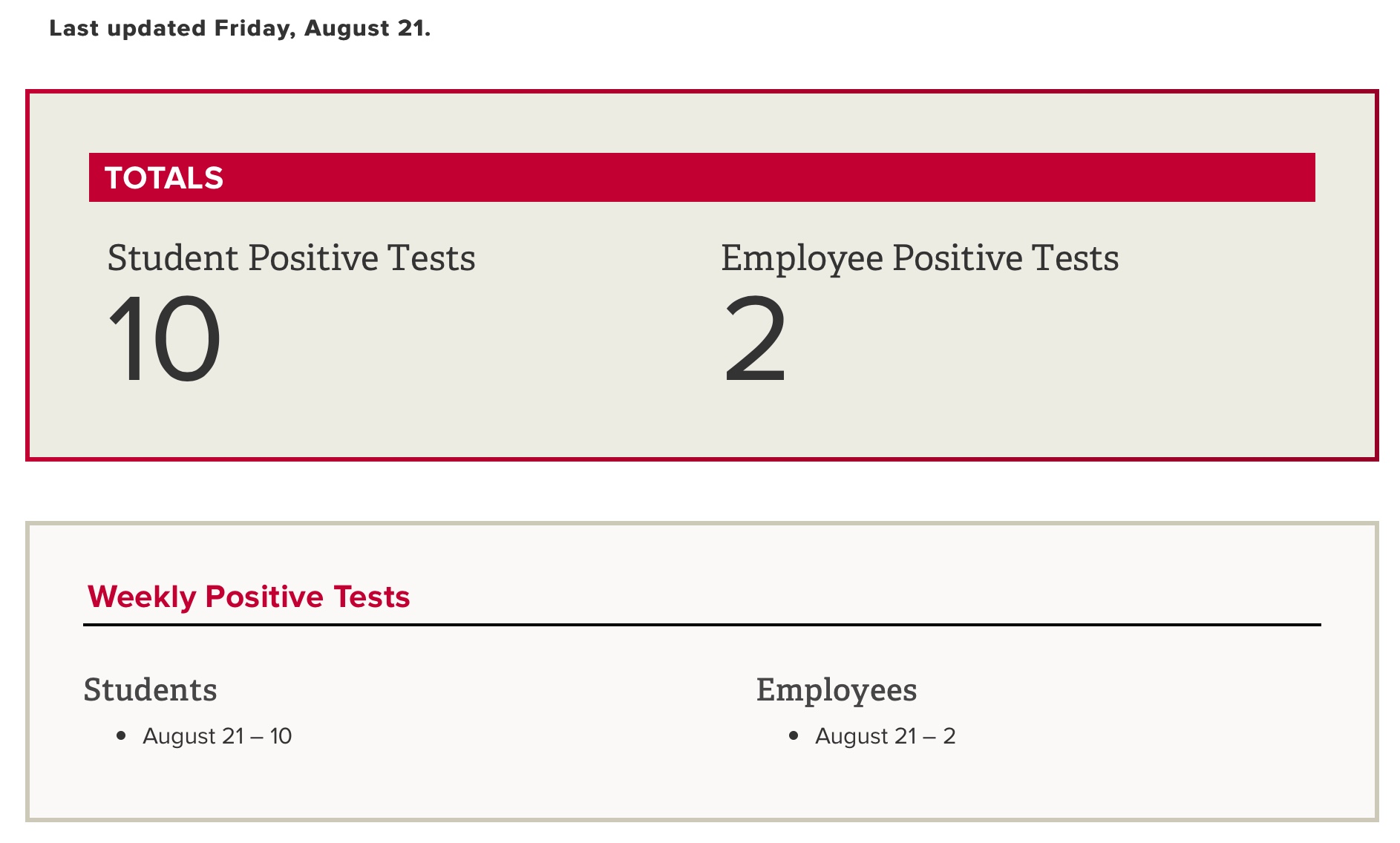
    Along with the statement Crawford reported that on the Oxford campus, since the start of classes, they have had 10 positive COVID-19 tests among students and 2 among employees.

    Miami has now created a dashboard to track positive results from tests conducted at the Employee Health Center and Student Health Service managed by TriHealth.

    The announcement also introduced a symptom tracking app, Campus Clear (available for download from the app store on a mobile device), which must be completed daily if coming to campus. An illness/absence reporting system is also in place to help track potential outbreaks in the Oxford community.

    Buildings on all campuses have reopened. Miami has begun to phase-in on-campus operations, and in the coming weeks students will be returning in stages.

    Fall classes began on Monday, August 17, mostly remote, with graduate students and some programs in person.

    Classrooms are organized to maintain six-foot physical distancing, and cleaning materials are available to clean desks and common spaces before and after each use.

    Students who will be living off campus are encouraged to stay home, if they can, until face-to-face courses start on Monday, September 21. All students are expected to follow health and safety protocols, “like those in our residence halls, in their off-campus living arrangements.”

    All returning students must sign the Healthy Together Community Pledge, committing to take responsibility for their health and others’ through recommended precautions to help prevent the spread of COVID-19 on campus and in the community. The pledge focuses on preventative measures such as social distancing, face coverings, cleaning practices, handwashing and sanitation, daily symptom assessment, limiting indoor or outdoor gatherings to fewer than 10 people, and not attending or hosting any gathering where physical distancing is not possible. It also asks students to pledge to participate in testing, contact tracing, and quarantine or isolation if they or their close contacts become ill with COVID-19.

    The phased-in strategy will culminate with the students residing on campus moving into the residence halls during the week of September 14. Face-to-face and hybrid offerings will begin on campus on Monday, September 21.

  • Reopening begins for Ohio’s colleges: Here’s how it looks

    Reopening begins for Ohio’s colleges: Here’s how it looks

    Susan Tebben

    By Susan Tebben – The Ohio Capital Journal

    Some of Ohio’s colleges and universities have begun moving students in, but the navigation of a school year amid a pandemic is still a balancing act.

    For Miami University, classes began this week, with all undergraduate courses online or remote. The plan is to keep it that way until at least Sept. 21, according to the plan posted to the school’s website. 

    “When we began planning last spring, we had hoped that the COVID-19 pandemic would be in significant decline before classes were scheduled to begin,” Miami president Greg Crawford told students. “Instead, cases are rising in many states. With 40% of our Oxford students coming from outside Ohio, we’ve been monitoring the situation closely.”

    Those that are on campus are required to wear masks, and as students come back, they can be reported to the Office of Community Standards if they repeatedly refuse to comply with an instructor’s direction to use a mask or face covering.

    Mask requirements are the norm among Ohio’s public colleges and universities, as are 14-day quarantines for students coming from states considered COVID-19 hotspots. 

    Also the norm this school year are phased reopenings, like those at The Ohio State University, Ohio University, Kent State University, Shawnee State University, Cleveland State University, and the University of Cincinnati.

    The first move-in dates for UC, Aug. 14 and 15 were considered “drop-off only,” meaning students could bring their stuff to campus, but then had to return home until the 16th. 

    Another regular part of public colleges’ and universities’ schedules is a return to at least some form of in-person class instruction that ends after Thanksgiving break. The last two weeks, including final exams, will be taken remotely at OSU, Central State University, UC, KSU and Wright State University, among others.

    Kent State and the University of Toledo have eliminated their fall break to allow students to receive a full semester despite adjusted opening dates.

    Toledo said they adjusted their Fall semester “based on the possibility of having a second wave of COVID-19 in late fall,” taking into account CDC data on the pandemic and state recommendations for higher education.

    Bowling Green State University went so far as to cancel their Winter 2021 session and provide a $1,500 credit for the first 2,000 students who cancelled their housing assignment before the school year began this week. 

    “It is important you understand that we are HIGHLY encouraging you not to live on campus this fall,” information on the university’s COVID-19 plan page stated.

    BGSU started their staggered move-in this week for those that had no other option than to take up residence, and are set to begin classes on Aug. 31. Students there will also be online only beginning Nov. 30. 

    OU phased in their reopening by allowing certain graduates and undergraduates “in a carefully selected set of academic programs” to begin their time on campus. Most students will begin remotely on Aug. 24, but students like third-year students in the College of Health Sciences and Professions’ nursing program and juniors and seniors in the Army Reserve Officer Training Corps (ROTC) are eligible to participate in the university’s first phase of schooling. 

    Universities throughout the state sticking with in-person instruction have instituted class-size reductions, along with “hybrid-remote” forms of teaching. Central State spelled out a “cohort attendance” model in its reopening plan, which would break large classes into groups, with the cohorts attending classes on alternating days. This model goes along with a 50% reduction in class sizes, something Wright State anticipates as part of its plan as well.

    “At this time, the university conservatively estimates that one-third of classes will have in-person components while the majority of in-person classes will also deliver all content remotely to provide flexibility to students who are unable or do not feel comfortable returning to campus,” said Wright State president Susan Edwards in a letter to the university community.

    Many of Ohio’s public higher education institutions have also created pledges for students connected to prevention of coronavirus, and in some cases can spur disciplinary action if not signed. 

    Testing and contact tracing for COVID-19 are a regular part of all public school plans, though the ways in which the testing is done vary from school to school

    The spring semester plan is still to be determined for most schools. The University of Akron plans to continue hybrid online and in-person instruction into the spring, but others are still watching the success of their fall semesters to plan for the future.

    “Decisions are forthcoming,” stated the UC reopening plan.


    Susan Tebben

    Susan Tebben is an award-winning journalist with a decade of experience covering Ohio news, including courts and crime, Appalachian social issues, government, education, diversity and culture. She has worked for The Newark Advocate, The Glasgow Daily Times, The Athens Messenger, and WOUB Public Media. She has also had work featured on National Public Radio.
  • Possible Cases of Coronavirus in Butler County at Miami University

    Possible Cases of Coronavirus in Butler County at Miami University

    Up-date from the Butler County General Health District on January 30, 2020, 3:20 PM:

    In Ohio, two possible cases are being monitored in Miami University students in Butler County. The students have been isolated, and ODH is awaiting test results from the CDC. There are no confirmed cases in Ohio.  Both possible cases had recently traveled and returned from China. Both possible cases are not severely ill and currently in isolation to keep the illness from spreading. Samples were sent to the Centers for Disease Control and Prevention (CDC) Monday January 27th, 2020 .

    Oxford, Ohio – Earlier today, Miami University Student Health Services notified the Butler County General Health District (BCGHD) of two possible cases of the novel coronavirus (2019-nCoV).

    Both possible cases had recently traveled and returned from China. Both possible cases are not severely ill and currently in isolation to keep the illness from spreading.

    Samples were sent to the Centers for Disease Control and Prevention (CDC) Monday afternoon.

    BCGHD recommends that unless you have recently traveled from China or have been around someone ill with this new virus, your risk of getting sick is low. “If you have traveled from China and are, experiencing signs and symptoms contact your doctor BEFORE going to the office.”

    Miami students, who meet this criteria, and are experiencing signs or symptoms contact Student Health Services at 513-529-3000 before seeking care according to BCGHD.

    Public health officials have described the immediate health risk to the campus community as low and say they continue to work closely with Miami University Student Health Services and the Ohio Department of Health to monitor the novel (new) coronavirus that has emerged from Wuhan, China, over the past few weeks.

    “This is what public health does and why we train,” expressed Jennifer Bailer. “Our staff, officials at Miami University and the Ohio Department of Health are taking every precaution to keep the community safe. The same precautions that protect against catching and spreading the flu are likely to be helpful for this respiratory virus: Wash your hands regularly, avoid touching your nose and eyes, cover your mouth when you cough and sneeze and don’t go to work if ill. Displaying compassion to all people will be vital as the situation evolves.” This is a rapidly evolving situation and information will be updated as it becomes available. Guidance on the virus is available on the Centers for Disease Control website, www.cdc.gov.

    Message to the Community from the Vice President of Student Life

    January 28, 2020

    On Monday morning, one student at Miami University presented at Student Health Services with very mild symptoms, and with their recent travel, met the criteria and are being tested for possible infection with the 2019 Novel Coronavirus (2019-nCoV). Health providers quickly recognized that the presenting patient met the criteria for 2019-Coronavirus testing; results should be back from the CDC in the coming days. This student and his traveling companion are isolated in their off-campus residence while awaiting the test results. Miami and healthcare professionals continue to communicate and collaborate daily with the Butler County Health District and the Ohio Department of Health and are following their recommendations and protocols. We will share information with the community as it becomes available.

    We are assisting and supporting these Miami students who are awaiting test results. We continue to work closely with local and state healthcare professionals and the Butler County Health District and Ohio Department of Health. If you are experiencing symptoms and have traveled to the impacted area, please first call Student Health Services at 513-529-3000 to receive guidance on next steps. Miami has set up a call center to address any general questions or concerns at 513-529-9000.

      • Meanwhile, we are still in flu season, and these precautions are recommended for both the flu and Coronavirus:
      • Wash hands often with soap and water for at least 20 seconds.
      • It is especially important to wash your hands:
        • Before, during, and after you prepare food.
        • Before you eat and after you use the bathroom.
        • After handling cash.
        • More frequently when someone in your house is sick.
        • Before/after smoking/vaping.
      • Use an alcohol-based hand sanitizer if soap and water are not available.
      • Clean your doorknobs/light switches and areas commonly touched with disinfectant wipes frequently.
      • Avoid contact with sick people.

    Miami Health Services and Student Life professionals acted quickly with appropriate protocol, and we will continue to follow the best practices currently known. We have proactive partners in local and state healthcare. We will post updated information on myMiami as it becomes available. Please check announcements there regularly.

    Jayne Brownell
    Vice President, Student Life

    Terri Buzzell
    Director, Student Health Service