

Tag: PACT Act

  • More than 1 million veterans receiving benefits via PACT Act ahead of anniversary

    More than 1 million veterans receiving benefits via PACT Act ahead of anniversary

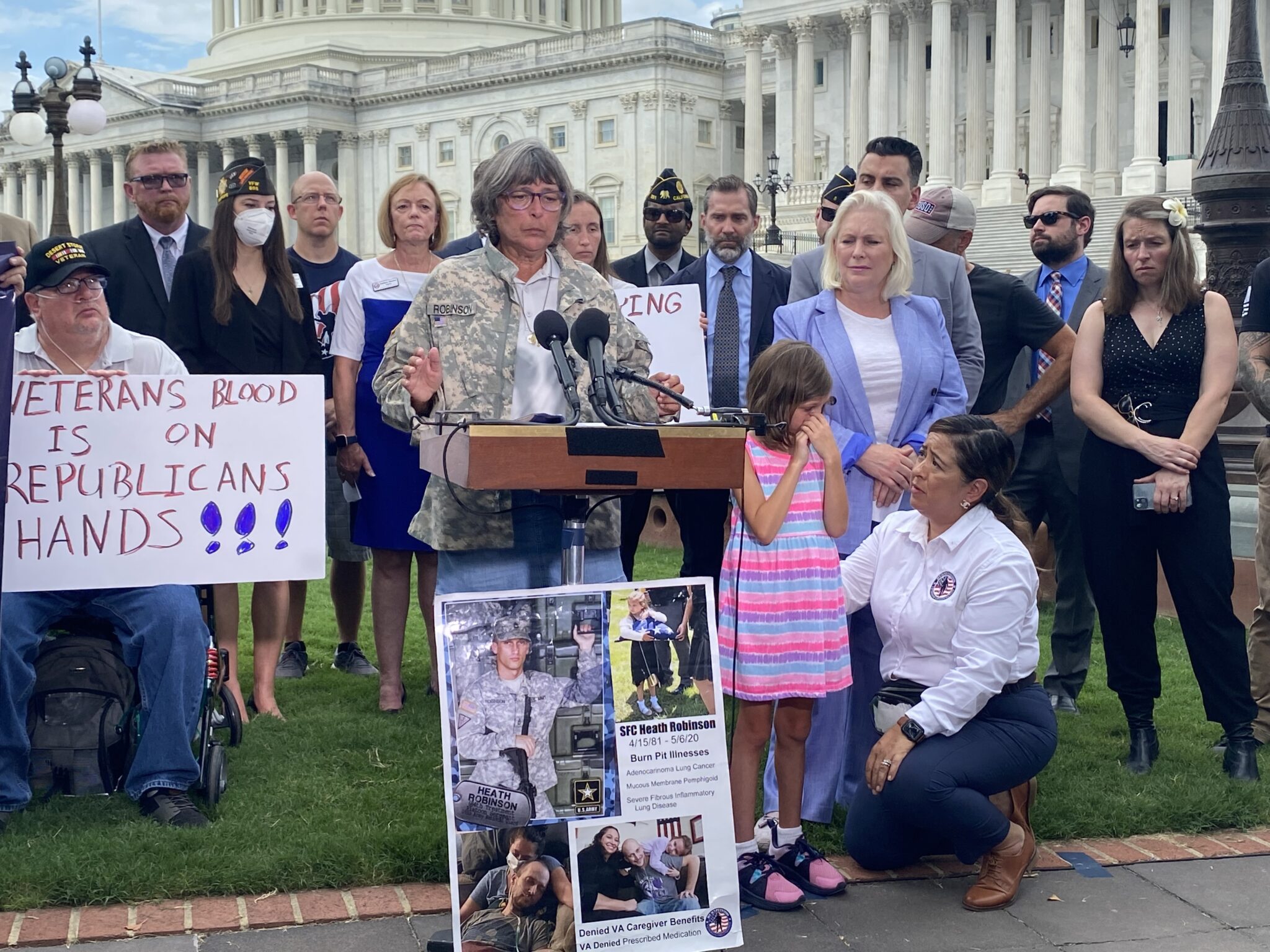
    Susan Zeier, mother-in-law of late Sgt. First Class Heath Robinson of the Ohio National Guard, speaks during a press conference on the PACT Act on July 28, 2022 while Rosie Torres, co-founder of Burn Pits 360, comforts Robinson’s daughter, Brielle Robinson. (Photo by Jennifer Shutt, States Newsroom.)

    By:  –  Ohio Capital Journal

    WASHINGTON — President Joe Biden on Friday celebrated the number of veterans enrolled in VA health care and benefits as part of a law he signed nearly two years ago, though he said more work must be done for troops who were stationed at a base in Uzbekistan in the early 2000s.

    “Two years ago, I signed the bipartisan Sergeant First Class Heath Robinson Honoring Our Promise to Address Comprehensive Toxins (PACT) Act enacting the most significant expansion of benefits and health care for toxic exposed veterans and their survivors in over thirty years,” Biden wrote in a statement.

    The law, which spent years gaining the support it needed in Congress, expanded health care coverage and benefits for veterans exposed to toxic substances like Agent Orange and open-air burn pits.

    To date, more than 1 million veterans and 10,000 survivors of veterans who died have begun to receive disability benefits stemming from the law, accounting for approximately $6.8 billion in earned benefits.

    Biden said in his statement that his administration would continue studying veterans’ other illnesses for a “presumptive status,” which could ensure them access to health care and benefits without having to prove to the VA that their conditions are directly linked to their military service.

    The VA is also planning to “close loopholes for certain veterans exposed to harmful toxins during their military service,” Biden wrote, without elaborating.

    A White House fact sheet says the VA is looking into providing benefits for 16,000 veterans who served at Karshi-Khanabad in Uzbekistan, also known as K2, between 2001 and 2005, since there were “several contaminants…in either the air, water, soil, or soil gas.”

    “VA plans to take steps to consider veterans who served in Uzbekistan as Persian Gulf Veterans so that any veteran who served at K2 and who experience undiagnosed illness and medically unexplained chronic multi-symptom illnesses can get the benefits they deserve,” it states. “VA will also create new training materials for claims processors and examiners on the hazards identified at K2.”

    Since the law — known as the Promise to Address Comprehensive Toxics Act or the PACT Act — took effect nearly two years ago, the VA says that 739,421 veterans have enrolled in its health care programs.

    Of that total, 333,767 veterans are covered under the new law, including those who served in the Vietnam War, the Gulf War and the wars that followed the Sept. 11 attacks.

    The numbers released Friday are significantly higher than they were when Biden gave a speech on the law’s one-year anniversary. The VA said at the time, which was one year ago, that 408,581 veterans had filed their claims and that 348,469 of those had been approved.

    But Friday’s announcement is somewhat similar to one Biden made in May when he cheered the VA granting 1 million claims under the law.

    Secretary of Veterans Affairs Denis McDonough said on a call with reporters at the time the law had led to “more than $5.7 billion in earned benefits for veterans.”

    The exact number of veterans with approved PACT Act claims as of Friday stood at 1,005,341 while the number of survivors approved had reached 10,777.

    A total of 1,251,720 veterans so far have completed filing Pact Act claims as have 21,416 survivors.

    The VA has an interactive dashboard that provides veterans with information about how to apply for health care and benefits under the PACT Act as well as how many claims have been submitted.

    The VA has a calendar of in-person events that can be found here. Veterans or their family members can also call the VA at 800-698-2411 to inquire about PACT Act benefits.

    Jennifer Shutt
    Jennifer Shutt

    Jennifer covers the nation’s capital as a senior reporter for States Newsroom. Her coverage areas include congressional policy, politics and legal challenges with a focus on health care, unemployment, housing and aid to families.

    Ohio Capital Journal is part of States Newsroom, the nation’s largest state-focused nonprofit news organization.

    MORE FROM AUTHOR

  • Nine rare cancers tied to burn pit exposure added to VA benefits list

    Nine rare cancers tied to burn pit exposure added to VA benefits list

    BY: JENNIFER SHUTT Ohio Capital Journal

    WASHINGTON — The U.S. Department of Veterans Affairs is adding nine rare respiratory cancers linked to burn pit exposure to the list of illnesses eligible for disability and health benefits.

    President Joe Biden, who has said his son Beau Biden’s exposure to toxic fumes from the pits could have led to his death, announced the policy change Monday, saying in a statement he hopes to avoid repeating mistakes of the past.

    “We learned a horrible lesson after Vietnam, when the harmful effects of exposure to Agent Orange sometimes took years to manifest, and too many veterans were left unable to access the care they needed,” Biden said. “I refuse to repeat that mistake when it comes to the veterans of our wars in Iraq and Afghanistan.”

    The VA said Monday that it will begin processing disability compensation claims for former U.S. military members who were in Southwest Asia from Aug. 2, 1990, to the present or in Afghanistan, Djibouti, Syria, or Uzbekistan from Sept. 19, 2001, to the present.

    The cancers include squamous cell carcinoma of the larynx, squamous cell carcinoma of the trachea, adenocarcinoma of the trachea, salivary gland-type tumors of the trachea, adenosquamous carcinoma of the lung, large cell carcinoma of the lung, salivary gland-type tumors of the lung, sarcomatoid carcinoma of the lung and typical and atypical carcinoid of the lung.

    The VA said it plans to contact veterans who fall under the new rule, which will be published on Tuesday, or survivors, to tell them how to apply for benefits.

    Veterans or survivors who had prior claims denied can file a supplemental claim for benefits, according to the VA announcement.

    VA Secretary Denis McDonough said in a statement the change in policy will ensure “veterans who suffer from these rare respiratory cancers will finally get” the health care and benefits they “deserve, without having to prove causality between their service and their condition.”

    The VA said “a focused review of scientific and medical evidence” determined that “there is biological plausibility between airborne hazards and carcinogenesis of the respiratory tract — and the unique circumstances of these rare cancers warrant a presumption of service connection.”

    Biden originally announced the VA would add nine cancers to the eligibility list during his State of the Union address in March. 

    At the time, Biden said burn pits — which incinerated medical and hazard material, jet fuel and other substances — were one of the many dangers U.S. soldiers faced during deployments.

    “When they came home, many of the world’s fittest and best trained warriors were never the same,” Biden said during his speech. “Headaches. Numbness. Dizziness. A cancer that would put them in a flag-draped coffin.”

    Biden, in his State of the Union address and his statement Monday, called on Congress to “pass bipartisan legislation to comprehensively address toxic exposures and further deliver the vital benefits our veterans have earned.”

    The U.S. Senate unanimously approved a bipartisan bill from Montana Democratic Sen. Jon Tester and Kansas GOP Sen. Jerry Moran in mid-February that is the first of three pieces of legislation meant to address health care needs linked to burn pits.

    When announcing the $1 billion legislation in early February, Moran said that 3.5 million combat veterans have experienced some level of toxic exposure since 9/11.

    “This is the first step on a continuum of trying to make certain that those who experienced toxic exposure, and as a result are suffering in their health and well-being, receive medical benefits,” Moran said at the time.

    The U.S. House voted 256-174 in early March to approve a separate bill that would be much larger in scope and price.

    That legislation, referred to as the Promise to Address Comprehensive Toxics or PACT Act, would cost about $280 billion during the next decade.

    House Majority Leader Steny Hoyer, a Maryland Democrat, said during floor debate the legislation would “expand veterans’ health care access and benefits to address the effects of these toxic exposures that occurred during their military service.”

    “We asked our veterans to go to battle for America, and they answered that call,” Hoyer said. “When they return home, veterans should not have to go to battle against red tape to receive the medical treatment and benefits they have earned through their service.”