
Tag: partisan gerrymandering

  • The business case for rejecting Ohio gerrymandering

    The business case for rejecting Ohio gerrymandering

    COMMENTARY

    Steven H. Steinglass is Dean Emeritus and Professor Emeritus at the College of Law of Cleveland State University.

    by Steven H. Steinglass

    This article delves into the history of redistricting of the Ohio General Assembly and presents the business case for rejecting partisan gerrymandering. It also identifies the Citizens Not Politicians amendment, which its supporters believe will end partisan gerrymandering by assigning redistricting to an independent 15-person commission composed of five Democrats, 5 Republicans, and five independents.

    The Focus on State-Level Gerrymandering

    Partisan gerrymandering at the state results in the election of highly partisan super-majorities within the General Assembly. I focus on the state legislature, not Congress, because of the outsized impact of what happens in Columbus on all Ohioans. And with the July 3, 2024, deadline approaching for the submitting of the 413,487 valid signatures to place the Citizens Not Politicians amendment on the ballot, those contemplating signing the petition for the amendment (or ultimately voting on it) should be aware of the threats posed by partisan gerrymandering.

    The History of Redistricting in Ohio

    The seeds for partisan gerrymandering in Ohio were planted in our first constitution, the Constitution of 1802, which brought us into the Union as the 17th state. That constitution established a system of legislative supremacy and gave the General Assembly unlimited power to draw district lines for both the General Assembly and the U.S. House of Representatives. The only standard was that state legislative lines were to be based on “the number of white male inhabitants above twenty-one years of age” in each county.

    Reform of the Ohio Constitution was the major political issue in Ohio in the late 1840s, and it took a gerrymandering crisis in Hamilton County to break the legislative deadlock and put a constitutional call on the ballot.

    The voters approved the call for a constitutional convention, and the resulting Ohio Constitution of 1851 curtailed many of the powers of the General Assembly. This included removing the General Assembly completely from the process of state legislative redistricting. In its place, this power was given to three statewide officers — the governor, the secretary of state, and the State Auditor.

    In 1903, Ohio abandoned its commitment to population equality with the adoption of the notorious Hanna Amendment to the Ohio Constitution. This amendment guaranteed every county at least one representative in the Ohio House of Representative, leading to significant population inequality and rural dominance.

    The iconic 1912 Ohio Constitutional Convention did not address redistricting, but it created the constitutional initiative, a tool for a future generation to tackle such issues.

    Substantial changes have occurred since 1802 regarding who is responsible for redistricting. But after losing its role in redistricting in the 1851 Constitution, the General Assembly gradually clawed back its power, leading to the current legislator-dominated Ohio Redistricting Commission.

    The Impact of “One Person, One Vote”

    In the 1960s, the U.S. Supreme Court revolutionized redistricting by embracing the principle of “one person one vote” for both state legislatures and Congress. This led to efforts to amend the Ohio Constitution, resulting in the 1967 amendment that repealed the Hanna Amendment and required that districts be equal in population as well as compact and contiguous. Despite these reforms, the General Assembly regained some of its lost power by adding two legislators to the redistricting commission.

    How Partisan Gerrymandering Produces Super-Majorities

    Partisan gerrymandering involves the drawing of legislative district lines to protect incumbents, to seek partisan advantage, or — in most instances — both.

    Practitioners of partisan gerrymandering use “cracking” and “packing” to skew electoral results, diluting the opposing party’s power by spreading their voters across multiple districts (cracking) or concentrating them in a few districts (packing). These tactics, combined with the magic of advanced computer modeling, can result in a state with a 55-45% partisan split in the voting population having a legislature composed of 60-67% of the dominant party.  If this sounds familiar, it essentially describes what has happened in Ohio.

    How Partisan Gerrymandering Hobbles State Government

    Partisan gerrymandering typically results in the election of the most extreme members of the majority political party. In primaries, candidates have little incentive to move to the center, resulting in partisan super-majorities that can ignore the constitutional guardrails that our state constitution places on the General Assembly. Specifically, this leads to:

    • The emasculation of the governor’s veto power as partisan gerrymandering makes it too easy for the General Assembly to reach the three-fifths majority in each House necessary to override a veto;
    • The unchecked power to put proposed constitutional amendments on the ballot, which requires a three-fifths vote in each House of the General Assembly; and
    • The power to include emergency provisions in legislation with a two-thirds vote of the vote in each House of the General Assembly, allowing laws to take effect immediately and preventing the voters from using the referendum to challenge adopted statutes.

    The Substantive Impact of Partisan Gerrymandering

    A strong case can be made that partisan gerrymandering in Ohio has contributed to or will contribute to:

    • The erosion of municipal home rule;
    • The abdication of the state’s constitutional responsibility to fund “a thorough and efficient system of common schools;”
    • The decline in  the quality of higher education;
    • The denial of a respectable minimum wage for Ohio workers;
    • The fouling of our environment;
    • The undermining of our new reproductive rights amendment;
    • The vilification of the LGBTQ community;
    • The weakening of our system of public health system; and
    • The desirability of our state as a venue for conferences and a destination for tourists.

    Cumulatively, partisan gerrymandering threatens Ohio’s business climate, risking its reputation as a business-friendly state.

    Redistricting in the 1960s and the Persistence of Gerrymandering

    Although embracing the principle of “one person one vote” in its decisions in the 1960s, the U.S. Supreme Court did not address partisan gerrymandering. Nor did the 1967 Ohio amendment. And every decade since its adoption has been marked by redistricting controversies with both Democrats and Republicans seeking partisan advantage at various times.

    And in 2011, the Ohio Supreme Court washed its hands of the issue, holding that “[t]he Ohio Constitution does not mandate political neutrality in the reapportionment of house and senate districts…”

    Recent Reform Efforts

    In the 21st century, partisan gerrymandering has been the subject of reform efforts through ballot measures.

    In 2005 and 2012, good government groups proposed amendments to create an independent redistricting commission and to bar partisan gerrymandering. But there was no broad understanding of the pernicious effect of partisan gerrymandering and thus no groundswell of support for ending it. Significantly, the opponents were able to control the message and skillfully employed the traditional tool of ballot measure opponents: obfuscation — a fancy word for misleading advertising. And the voters rejected these proposals by wide margins.

    Unfortunately, the U.S. Supreme Court, which had once been seen as the place where partisan gerrymandering would die, declined to get involved. Though the Court had barred racial gerrymandering in 1960 five years before the adoption of the historic 1965 federal Voting Rights Act, in 2019 it refused to address the constitutionality of partisan gerrymandering, thus leaving the issue to the states.

    Meanwhile, partisan gerrymandering was the target of two Ohio constitutional amendments proposed by strong bipartisan majorities in the General Assembly less than a decade ago.

    In 2015, Ohio voters approved an amendment to alter redistricting of the General Assembly, and in 2018, the voters approved a separate amendment to alter redistricting of Congress. Both amendments, which were sold to the voters as ending partisan gerrymandering, were approved by more than 70% of Ohio voters. Both included detailed standards to govern redistricting by, among other things, barring the drawing of district lines that favor or disfavor a political party. Neither amendment created an independent redistricting commission.

    2022 and the Failure of the Rule of Law

    In retrospect, we  now know that these amendments had two fatal flaws.  First, in providing that a redistricting plan adopted by a bipartisan majority would last 10 years, the proponents assumed that the prospect of having to redistrict more than once in a decade would be an incentive to bring the parties together. Second, the amendments appeared to deny the Ohio Supreme Court the power to prepare its own plan in the event of an impasse.

    The proponents were wrong on both counts. In late 2021, the Ohio Redistricting Commission adopted by partisan votes four-year redistricting plans for the General Assembly.

    On January 12, 2022, the Ohio Supreme Court in a 4-3 bipartisan decision written by Justice Melody Stewart held the state redistricting plan was unconstitutional,

    All that seemed like good news to those who wanted to eliminate partisan gerrymandering, but one member of the majority — former Chief Justice Maureen O’Connor — in a prescient concurring opinion in the first state redistricting case saw the handwriting on the wall. In effect, she told us that this was not going to work, and she argued that Ohio should look to the model of other states that had created independent redistricting commissions.

    And Justice O’Connor got it right.

    Despite five rulings in 2022 by the Ohio Supreme Court holding that state redistricting plans violated the Ohio Constitution, the court effectively concluded that it lacked the power to enforce its judgments. And the rule of law took a serious hit when a majority of the members of the Ohio Redistricting Commission refused to abandon their unconstitutional redistricting plans.

    2024 — Unique Challenges and The Business Community

    So here we are in 2024, and the question before us is: what is different?

    Today there is a broader understanding of the impact that partisan gerrymandering has on the functioning of our representative democracy, on the business climate of our state, and on the quality of life in Ohio.

    Ohioans, however, have the tool — the constitutional initiative — to address partisan gerrymandering. Adopted in 1912 to provide a way around an unresponsive legislature, the initiative is not a substitute for representative democracy; rather, it is a supplement. It permits the citizenry to have a voice when they believe that the General Assembly has become an obstacle to the common-sense resolution of the challenges that our state faces.

    And there is an important ally in this effort — prominent members of the business community.

    In the past, the business community has played an important role in campaigns on state ballot issues. Often this has been in opposing initiated amendments that it viewed as flawed. For example, think about business opposition in 2015 to the proposal to grant a marijuana monopoly to a group of investors.

    The business community has also played an important supportive role on ballot issues that enabled economic development, and no better example is the adoption of Governor Bob Taft’s ground-breaking Third Frontier program.

    To date, the major business organizations in the state have not taken positions on the proposed Citizens Not Politicians amendment, but in the past two years, a relatively new organization, the Leadership Now Project, has added a business voice to the effort to protect the Ohio Constitution and support representative democracy. Leadership Now opposed the infamous August 2023 ballot measure that would have undercut majority rule by imposing a 60% threshold on proposed constitutional amendments.

    And Leadership Now, which is composed of prominent business and thought leaders throughout the state, is strongly supporting the proposed Citizens Not Politicians amendment and the use of a truly independent redistricting commission to draw state legislative district lines and to eliminate partisan gerrymandering.

    Conclusion

    Partisan gerrymandering poses a serious threat to Ohio’s democratic processes and business climate. The proponents of the Citizens Not Politicians amendment believe that Ohioans can ensure fair representation and foster a more stable and attractive state for businesses and residents alike. And they view the business community’s support as being an important part of the effort to drive the necessary change for a fair and prosperous Ohio.

    Steven H. Steinglass
    STEVEN H. STEINGLASS

    Steven H. Steinglass is Dean Emeritus and Professor Emeritus at the College of Law of Cleveland State University. His teaching areas include Civil Procedure, Federal Jurisdiction, Section 1983 Litigation, State Constitutional Law, and Ohio Constitutional History. He is also the author of, “The Ohio State Constitution,” (Oxford Univ. Press 2022) (2nd ed.) (with Gino J. Scarselli), which was published in 2004 by Greenwood Publishing (and now published by Oxford University Press as part of its state constitutional law series). From March 2013 to June 2017, Professor Steinglass served as Senior Policy Advisor for the Ohio Constitutional Modernization Commission. Beginning in 2019, Professor Steinglass was the Course Planner for the annual Ohio State Bar Association program on The Importance of the Ohio Constitution.

    MORE FROM AUTHOR

  • State Supreme Court dismisses congressional redistricting cases

    State Supreme Court dismisses congressional redistricting cases

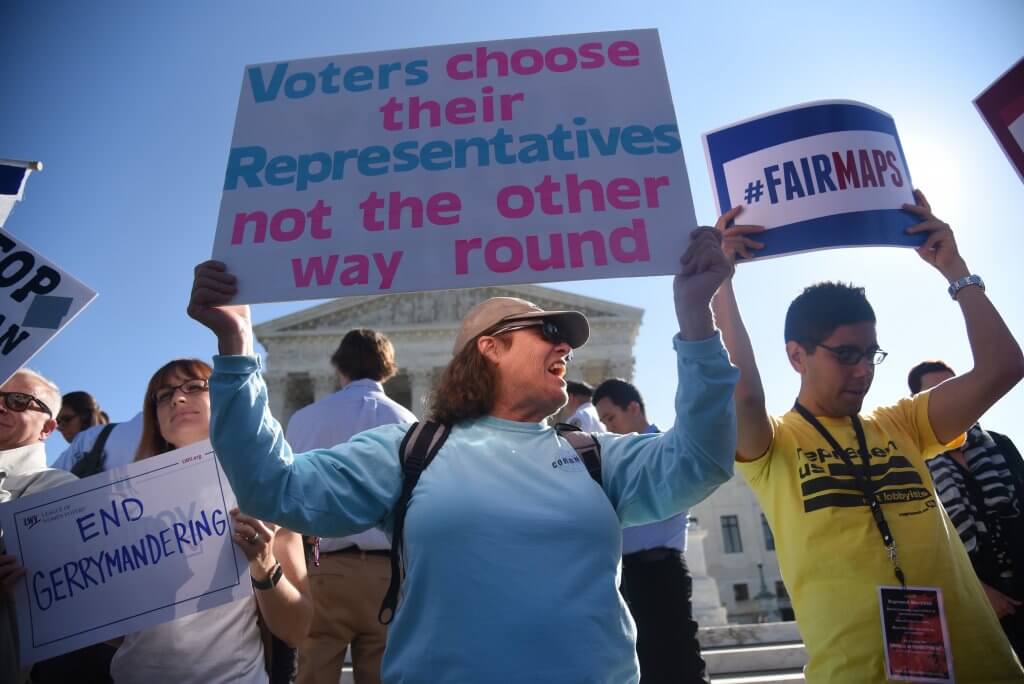
    Anti-gerrymandering protest in Washington, DC. | Olivier Douliery, Getty Images.

    BY:  Ohio Capital Journal

    The Ohio Supreme Court on Thursday dismissed two cases over congressional districts in Ohio.

    The decision isn’t a complete surprise because the groups filing the complaints asked for the dismissals earlier this week. But struggles over partisan gerrymandering in Ohio and elsewhere are far from over.

    The complainants continue to maintain that Ohio’s congressional districts — as well as its legislative districts — are unfairly gerrymandered. They simply calculate that it’s better to dismiss the cases in light of other developments and because the state Constitution already requires that districts be redrawn after next year’s General Election.

    In claiming that Ohio is extremely gerrymandered, the plaintiffs appear to have a point. Former president Donald Trump won the state with less than 54% of the vote in 2020, yet Republicans control 66% of the state’s congressional seats — a 12-point differential.

    Many political scientists and other experts say extreme gerrymandering is a problem because by making general elections uncompetitive, it incentivizes candidates to pander to the most extreme elements of their primary electorate. Also, by imposing one-party rule, it creates unaccountable, corrupt majorities, they say.

    In May 2018, an amendment to the state Constitution that banned extreme partisan gerrymandering and gave the Ohio Supreme Court the power to throw out maps on that basis passed with an overwhelming 75% of the vote.

    Yet the Republican-dominated Redistricting Commission created by the amendment twice ignored rulings by a bipartisan majority on the Ohio Supreme Court rejecting maps it drew in the wake of the 2020 Census. With the clock effectively run out, a panel of three federal judges kept the unconstitutional congressional maps in place for the 2022 election.

    Ohio Republicans argued to the U.S. Supreme Court that the state judiciary has almost no power to regulate how legislatures draw congressional districts — no matter what state law says or how gerrymandered those legislatures might already be. That’s known as the “independent legislature doctrine” — which Carolyn Shapiro blasted as “an unprecedented, unconstitutional, and potentially chaos-inducing intrusion into state election law,” in an article this year in the University of Chicago Law Review.

    On June 27, six members of U.S. Supreme Court agreed in Moore v Harper. The ruling said the North Carolina Supreme Court had the power to enforce a state law banning excessively partisan congressional maps.

    However, gerrymandering foes in Ohio might not find much solace in the decision.

    Former state Supreme Court Chief Justice Maureen O’Connor, a Republican, repeatedly joined the court’s three Democrats in ruling that Republican-drawn congressional and legislative maps were excessively partisan. But then she was forced to retire last year because of her age and the new court has a more partisan makeup.

    Other recent developments might not hold much hope for Ohio’s anti–gerrymandering groups, either.

    The U.S. Supreme Court last October struck down Alabama’s congressional maps in Allen v Milligan. The surprise ruling said that the state’s congressional districts violate the Voting Rights Act by being unduly gerrymandered against Blacks.

    It ordered that the state legislature redraw maps so that Alabama Blacks will have a chance at a second seat in the state’s six-seat delegation in which they can select a representative of their choice.

    That doesn’t necessarily mean picking a Black representative — or that by merely being Black, a representative meets the requirements of the Voting Rights Act. The law requires that minority communities have a legitimate shot at picking representatives in numbers proportional to their own.

    Blacks make up about 27% of Alabama’s population and the ruling in Milligan would give them a chance at power over 33% of its congressional seats, as compared to the current 17% they have power over now.

    However, the state’s Republican-dominated legislature twice defied orders to comply with the ruling. On Tuesday, a panel of federal judges rebuked the body and ordered that the new map be independently drawn.

    The ruling in Milligan has implications for several other states, such as Louisiana, which have large, underrepresented minority populations.

    But Ohio might not be one of them because it doesn’t have the diversity those states do. Whites make up 80% of the state’s population, while Blacks make up just over 13%. The next closest group, Latinos, make up 4.5%.

    Louisiana, by contrast, is 63% White, but that group controls 80% of the state’s five congressional districts.

    In her role as now-retired chief justice, O’Connor is helping to lead an effort to build even more stringent anti-gerrymandering amendments into the Ohio Constitution. The amendment she’s working to put on the November 2024 ballot would do what the federal panel did to the Alabama legislature on Tuesday — take district drawing out of the hands of partisans and give it to an independent commission.


    Marty Schladen
    MARTY SCHLADEN

    Marty Schladen has been a reporter for decades, working in Indiana, Texas and other places before returning to his native Ohio to work at The Columbus Dispatch in 2017. He’s won state and national journalism awards for investigations into utility regulation, public corruption, the environment, prescription drug spending and other matters.

    MORE FROM AUTHOR

  • GOP officials and a collegiate political scandal could nix Dem’s ballot slot in SE Ohio

    GOP officials and a collegiate political scandal could nix Dem’s ballot slot in SE Ohio

    Ohio Secretary of State Frank LaRose talks to reporters. (Photo by Susan Tebben, OCJ.)

    BY: JAKE ZUCKERMAN – Ohio Capital Journal

    The story of the ballot fight includes a scandal in Ohio University’s Student Senate, a primary election delayed by Ohio’s messy redistricting clash, a Democrat’s resignation after winning an uncontested race, and some of the finer points of election law.

    The result is Jay Edwards, a three-term Republican incumbent, currently running unopposed in one of the more competitive districts in the November General Election.

    Ohio law allows the two major political parties to replace candidates who withdraw after primaries. The Democratic Party chose Tanya Conrath — a southeast Ohio native, attorney and nonprofit leader — to fill a hole left by the victor who dropped out.

    Republicans on the Athens County Board of Elections, however, objected, leaving the matter tied 2-2. Ohio Secretary of State Frank LaRose, a Republican responsible for casting the deciding vote, voted against letting Conrath on the ballot.

    He said because Rhyan Goodman, the Democratic candidate who won an uncontested primary, resigned before officials formally counted the vote and certified his victory, then the law doesn’t guarantee the Democrats the right to replace a candidate.

    “They’re trying to cheat their way into not giving [incumbent GOP Rep. Jay Edwards] an opponent and not giving voters a choice,” Conrath said in an interview.

     Tanya Conrath. Courtesy photo.

    The issue traces back to February when Goodman, as a 19-year-old Ohio University student, filed to run in Ohio’s 94th House District using his dorm as his filing address. In a matter of weeks, however, Goodman met his first brush with political scandal — not via state politics but with the Ohio University Student Senate.

    Goodman faced impeachment for allegations that he lodged false accusations in an anonymous letter against the student treasurer and encouraged other student senators to accuse her of intimidation, according to student publication The New Political. He resigned just before his trial was set to start.

    In the fallout of some “mistakes that might have been made,” Goodman drifted away from the Ohio House race, according to Athens County Democratic Party Chairman Sean Parsons. In the runup to the primary, Goodman had no campaign website, no social media, and did not respond to phone calls from a reporter.

    He won 100% of the 1,174 votes cast in the Aug. 2 primary. Regardless, six days after he won the election but before county officials formally certified the vote, Goodman withdrew his name from contention for the November election. He did not respond to calls or emails.

    Rep. Allison Russo, the ranking House Democrat, defended the lack of failsafe candidates in the race. She said candidate recruitment is difficult in districts that weren’t finalized at the time, some of which were later found to be unconstitutional gerrymanders. What Democrat would step into that uncertainty knowing Republicans control the game?

    She said the party developed “some concerns” about Goodman in the spring, but there was little to be done without a certain election date or district lines to go off. Conrath, Russo said, followed the rules and the Republicans are just afraid of the competition.

    “Not surprisingly, Secretary LaRose once again put partisan interests over running fair elections and couldn’t even cite any case law to support his decision,” she said.

    Deadlines

    Ohio law allows a “party candidate” who withdraws after a primary but before a general election to be replaced by whomever party officials see fit. This must be done by 4 p.m. on the 86th day before a general election — Aug. 15.

    Primary elections are typically held in May. However, the Ohio Supreme Court repeatedly found Republicans’ proposed decennial redistricting maps to be unconstitutional partisan gerrymanders. The court’s majority demanded fairer maps. Republicans refused. The standoff ended with a second primary election in August after a federal court ordered the election to proceed with a map the state Supreme Court found unconstitutional.

    Although the election date changed, some of the relevant administrative deadlines did not. Conrath, who had been contacted by the party and urged to run, had until Aug. 15 to file. The board of elections didn’t certify Goodman’s victory until Aug. 17.

    However, Republicans on the Athens County Board of Elections argued that because Goodman wasn’t certified at the time of Conrath’s filing, the party therefore has no eligible candidate to replace. Larose agreed.

    “As such, Rhyan Goodman was not the official nominee and party candidate at the time of his withdrawal,” he said in casting his tie-breaking vote. “The Athens County Democratic Party … could not replace him prior to the official certification of the Aug. 2, 2022 primary results.”

    Conrath’s lawsuit in the Supreme Court disputes the idea that the lack of certification means Conrath can’t be chosen as a replacement. In court documents, she cites a similar case from 1992 in which a Republican candidate running for county recorder withdrew from the ballot after some primary votes were cast and his name was already printed on the ballot. The secretary of state at the time ordered against certifying the candidacy.

    The Ohio Supreme Court reversed, finding boards of election have a “clear duty” to count ballots cast for a candidate even despite an “untimely withdrawal” from consideration. The court also held that candidacies “retain vitality” for some purposes even after withdrawing.

    LaRose, through a spokesman, did not respond to inquiries. The Supreme Court ordered him to respond in court to Conrath’s lawsuit by Wednesday.

    Edwards, reached via text message, didn’t respond when asked if he thought the court should let Conrath run.

    Parsons tentatively acknowledged that the Democrats should have fielded another candidate for the race. However, he said the chronic uncertainty given redistricting and the mishmash of deadlines weakened the process. And Republicans’ reasoning, he said, doesn’t pass the smell test.

    “They’re not operating in good faith on this issue; It’s an attempt to keep somebody off the ballot,” he said. “It’s always better to have choice. That’s the way representative democracies work.”

    Conrath

    Conrath describes herself as a fifth generation Appalachian. She was born and raised in southeast Ohio and married a fellow native. After graduating Ohio University as an undergrad and Ohio State University for law school, she worked in a law practice in Athens.

    She owns a home appraisals business, works as associate director of the Ohio University Innovation Center, and works at an adult career center as well. She has served on nonprofit boards including My Sister’s Place and Planned Parenthood of Southeast Ohio.

    She said she was invited to run after Goodman’s resignation in August and made the decision and filing in a “whirlwind.” She had previously toyed around with the idea of running, but the U.S. Supreme Court’s decision to overturn its landmark ruling establishing women’s constitutional right to abortion access cemented her decision.

    “The Dobbs decision and watching Ohio put in a six-week abortion ban was the straw that broke the camel’s back,” she said.

    Besides the court’s findings of partisan gerrymandering, the vast majority of statehouse elections are unlikely to produce competitive general elections. Edwards’ district, however, is comparatively tight. Dave’s Redistricting App estimates it gives Republicans a 52%-45% edge. While President Donald Trump won the district in a landslide, Gov. Mike DeWine won it by a narrow 1.5%, according to analysis from the Ohio Manufacturers’ Association.

    Conrath expressed confidence she’d prevail in court. She said voters, not partisan officials, should pick their representatives.

    “This is a political play, and I think everyone knows it,” she said. “And I hope the Supreme Court sees this for what it is.”

  • Ohio State Leaders Must Allow Voter Education Collaboration

    Ohio State Leaders Must Allow Voter Education Collaboration

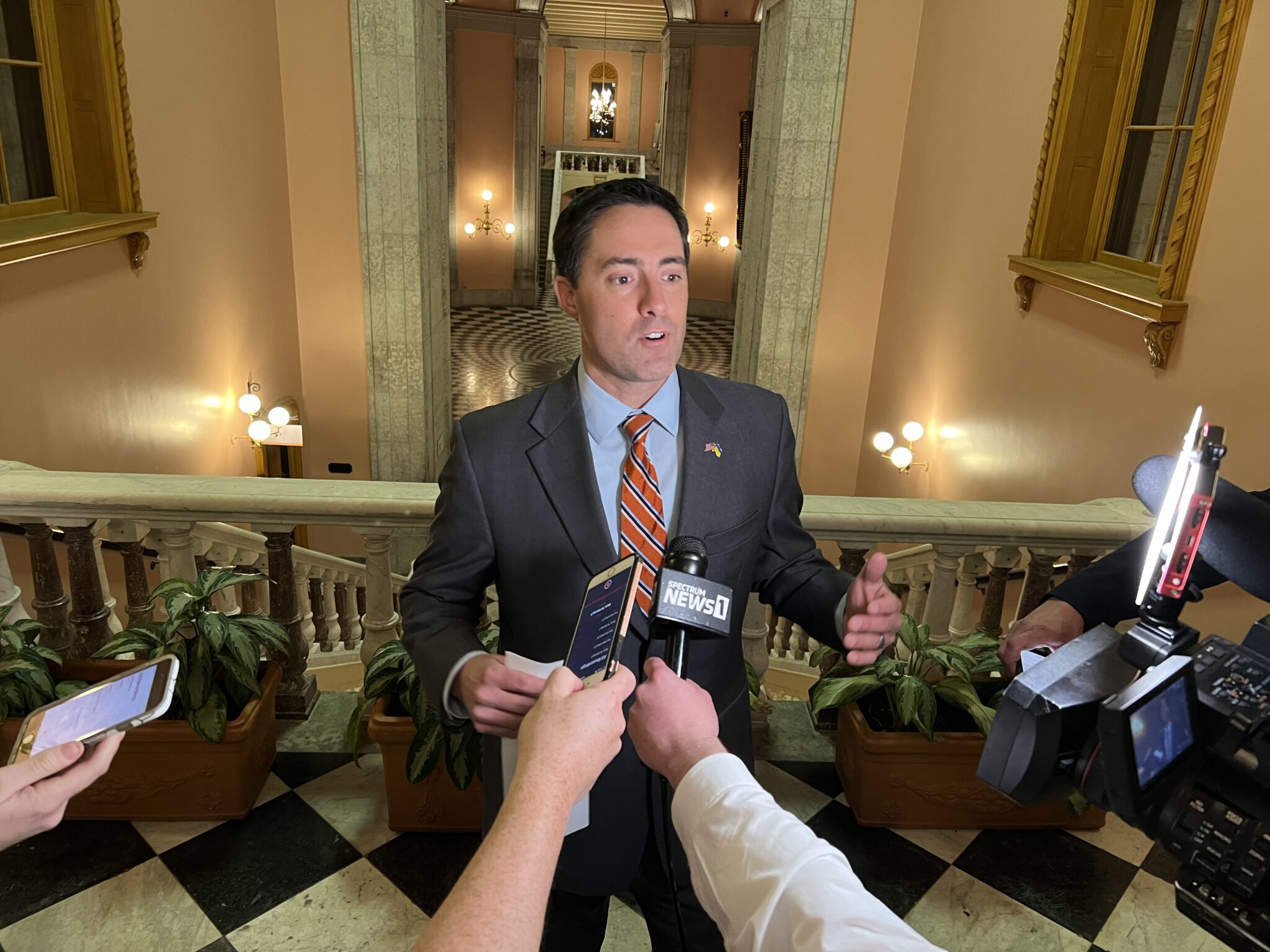
    CLEVELAND — In response to the Ohio Supreme Court’s rejection of the third proposed state map due to partisan gerrymandering, All Voting is Local Ohio State Director Kayla Griffin released the following statement: 

    Background: At the moment, state and local officials are preparing for a May 3 primary. On its face, Revised Code § 3501.054, known as the collaboration ban, purports to bar any public official responsible for administering or conducting an election from collaborating with any nongovernmental entity on activities related to voter registration, education, poll worker recruitment, or similar election-related activities.

    As there are no solidified maps at this time, elections officials are facing uncertainty while preparing for the upcoming primary, which is leaving voters in limbo. We are urging Senate President Matt Huffman and the Ohio Senate to allow elections officials and community groups to collaborate on voter education by repealing the collaboration ban immediately. Election officials and nongovernmental entities must not be held back from working together to mitigate the impact upon voters brought on due to the delay in finalizing congressional and state maps.  

    Voters all across the state could face last-minute poll consolidations, changes, and/or closures. As districts change, they will have little, if any, time to figure out what candidates are on the ballot. Our leaders and elections officials must allow for an all-hands-on-deck approach for accurate and fair preparation. This will only be possible if elections officials and community groups — including faith, service, and civic groups — are allowed to work together towards educating voters on last-minute changes and keeping voters up to date on information they may need to ensure they can accurately and fairly cast their ballot.