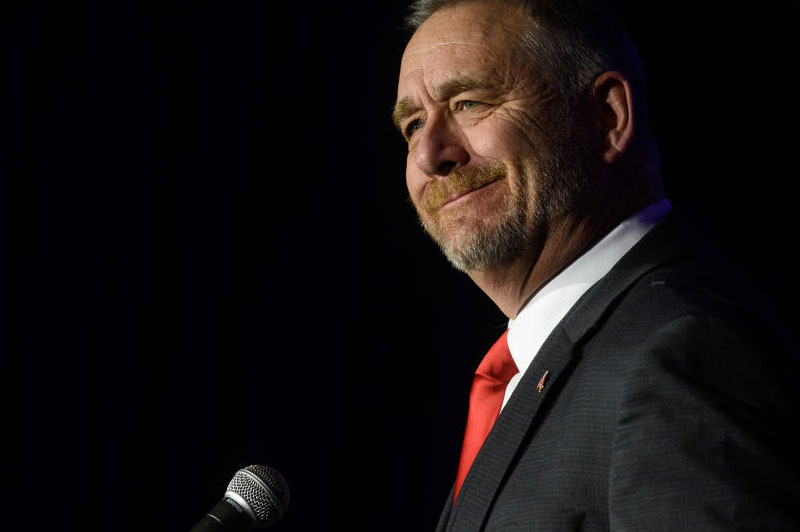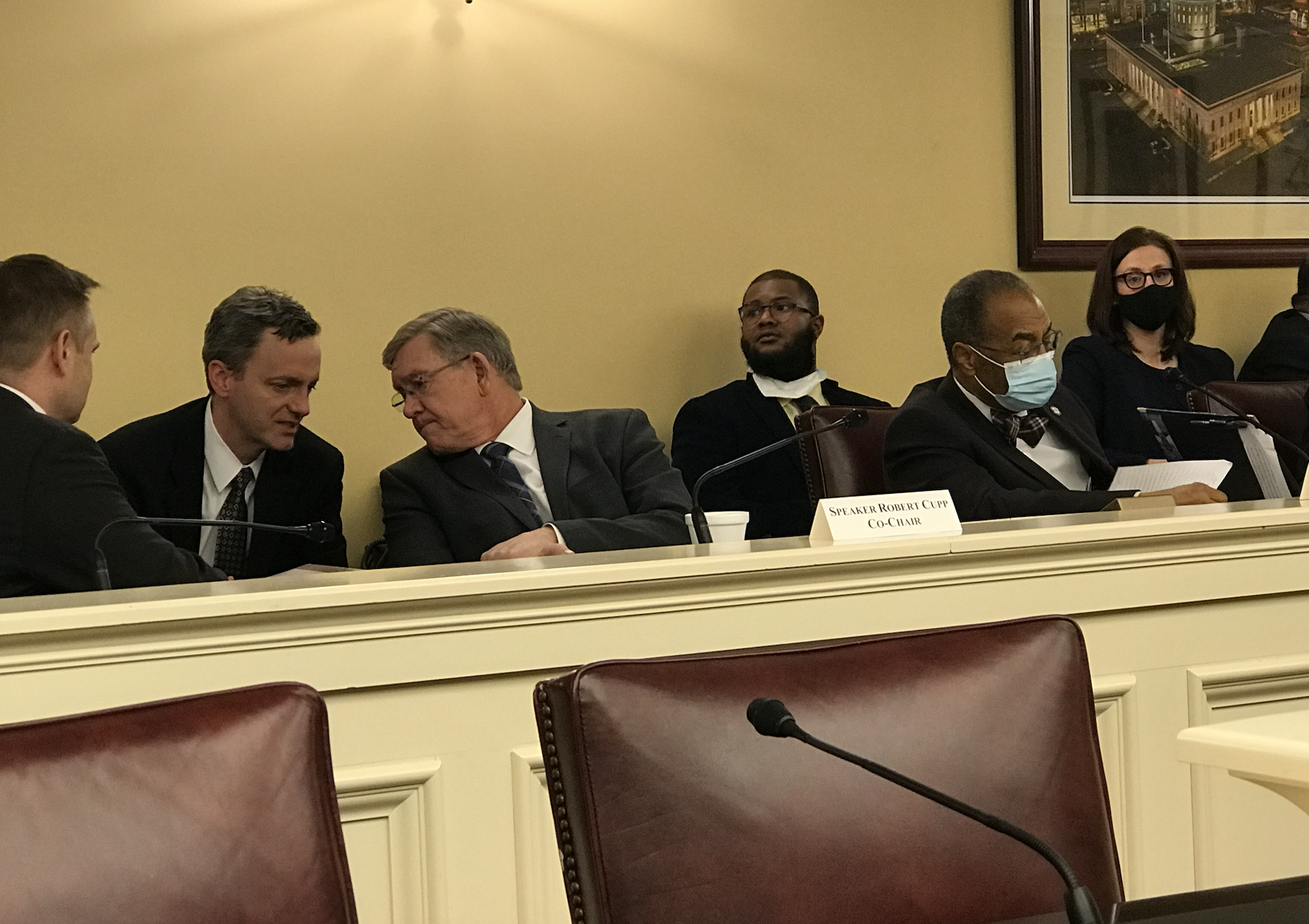
The Ohio Redistricting Commission co-chairs, House Speaker Bob Cupp, second from left, and state Sen. Vernon Sykes, second from right, prepare to restart the Ohio Redistricting Commission meeting on Thursday after a recess. The ORC adjourned the meeting without sending a new legislative redistricting map to the Ohio Supreme Court, as they ordered it to do. (Photo: Susan Tebben, OCJ)
BY: SUSAN TEBBEN – Ohio Capital Journal
Heated questioning and behind-the-scenes discussions between Ohio Redistricting commissioners led to a deadline-breaking decision to make no decision Thursday after the Ohio Supreme Court rejected two previous attempts at Statehouse maps as unconstitutional gerrymanders.
The Ohio Redistricting Commission could now face contempt of court, and the state faces a constitutional crisis after the commission adjourned without adopting a legislative redistricting map to submit by their court-ordered Thursday midnight deadline.
The GOP members of the commission, of which there are five, did not present a map during Thursday’s meeting. Senate President Matt Huffman, who did most of the talking for the majority party, said there was no reason to, because mapmakers had told commissioners that they could not comply with the supreme court’s directives and all the redistricting provisions of the constitution simultaneously.
“Under these circumstances, I don’t believe the commission is able to ascertain a General Assembly district plan,” Huffman told the commission before they adjourned.
Gov. Mike DeWine only spoke at one point during the meeting, which was as the impasse became clear, and a map did not appear to be forthcoming.
He did not agree that the commission could leave without bringing a map before the court, and did not think that was what the commission should do anyway.
“I don’t think we have the luxury of saying we’re just quitting,” DeWine said.
After the meeting adjourned, DeWine doubled down on his opinion that the commission had an obligation, and a legal one at that, to produce some sort of map for the state’s high court to consider.
I think it is a mistake for this commission to stop and basically say that we’re at an impasse. I don’t think that is an option that the law gives us.
– Ohio Gov. Mike DeWine
The commission was offered a map by the two Democrats on it with a 54-45 partisan breakdown, but GOP members voted down the measure along party lines after lengthy and tense criticism by Republicans, for the most part Senate President Matt Huffman.
Taking the brunt of GOP criticism was House Minority Leader Allison Russo, who made the motion for the commission to accept the Democratic drawn maps.
Huffman took the commission through the Democrats’ maps region by region, pointing out different GOP-incumbent districts that he said violated the constitutional provision prohibiting the favoring or disfavoring of one political party over another.
He accused the Democratic caucus of racial gerrymandering in a few districts, specifically the Ohio Senate’s 25th District, made up mostly of Lake County, and House District 44, covering Ottawa and parts of Lucas County. Huffman accused the Democrats of gerrymandering by redrawing the districts and the communities therein to favor their candidates.
Russo denied any existence of “packing and cracking,” the strategy of packing communities into a smaller area than necessary to benefit one party or another, or spreading a community out among a larger space than necessary to dilute its voting power.
“What you’re asserting is just simply false,” Russo said.
Throughout the meeting, she parried with Huffman and other Republicans, consistently asking the commission members to spell out specific constitutional violations in the Democratic maps.
“If you have a map to propose that achieves this or suggestions to propose that address some of these concerns that you have, so far I have not yet seen a constitutional violation,” Russo said.
When asked by Russo if the GOP had a map proposal to bring before the commission, Huffman hedged, saying he needed to finish his questions and “see how it goes.”
He brought up the idea to “let the public decide” on the Democratic maps as he continued his dissection of the map, but said there were hours of testimony to refer to in lieu of more public hearings.
“I’m not proposing additional public input,” Huffman said.
What’s next?
After the commission adjourned without doing as the Ohio Supreme Court asked, legislative leaders didn’t have a plan as to what would come next.
“I don’t know; I don’t have a next step,” Huffman said.
Cupp, a former Ohio Supreme Court justice himself, refused to speculate on what the courts might do, but said the commission will “try to keep working and if there’s some ideas that come forward on how to develop a legislative district map,” he said, the commission “would work very hard to do that.”
Auditor Keith Faber made a motion to change the rules of the commission well into Thursday evening, after the commission went into a recess to discuss the Democrats’ presentation. The change, which was passed 6-1 with only Russo voting against the motion, allows the commission to reconvene at the request of three members of the commission. Those members do not have to be the co-chairs, and it does not have to be a bipartisan request.
Co-chair state Sen. Vernon Sykes, D-Akron, confirmed that the court can not adopt the maps themselves, but as far as what happens next, he, too, was in the dark.
He did, however, say it is possible the commission members could be held in contempt of court for failing to follow a court order.
“I believe that is a possibility,” Sykes said.
When asked if he would be okay with that happening as a consequence, he said he is “okay with us moving forward, whatever can be done to help us move forward.”
When pressed on if that included contempt: “Including whatever we can do.”
Constitutional scholars remain uncertain about the next steps of the process, mostly because the state hasn’t gone through it before.
“This is a new process, and Ohio voters clearly wanted more collaboration and a more bipartisan process than we’ve seen so far,” said Mike Gentithes, associate professor who teaches constitutional law at the University of Akron.
The University of Akron’s Seiberling Chair of Constitutional Law, Dr. Tracy Thomas, gave the outside perspective on the situation, saying it was “likely to end up in the courts for a while regardless of the outcome today.”
Several states have invalidated maps because of partisan favoritism and sent them back for revisions without a solution for a stalemate.
“In the absence of some constitutional mandate or overriding federal legislation, which we don’t really have, the line-drawing is part of the political process and subject to the usual majoritarian control,” Thomas told the OCJ.
The Ohio Supreme Court is not likely to let this lack of action slide, in Gentithes’ opinion, and this could potentially lead to yet another overhaul of the process, since it seems the incentive to have 10-year maps with bipartisan agreement didn’t have the desired effect.
“That might teach us how to restructure an amendment to actually have some teeth,” Gentithes said.
The primary election is an entirely different bear, and Secretary of State Frank LaRose spent his short time speaking at the commission meeting impressing upon the commission the urgency of making decisions.
“This challenge is not one that can be met with creativity, and grit and tenacity … instead this one is simply dictated by logistical deadlines,” LaRose said.
Adding to the threat of legal trouble for the commission, without district lines, LaRose said the commission is in danger of missing a federal deadline to send absentee ballots to Ohio citizens who are overseas or in the military.
“We are dangerously close to possibly violating federal law,” LaRose said.
Cupp chuckled at a question about whether or not he accepted the idea of breaking federal law, saying, “I’m not okay with breaking any law.”
The primary date is unlikely to change, in his mind, because of a lack of support for the idea in his chamber.
“I don’t think in the House that there is a majority vote for moving the primary election at this time,” Cupp said. “Let alone, the two-thirds vote we would need for it to happen immediately.”