WASHINGTON — The U.S. Food and Drug Administration on Monday approved the latest round of COVID-19 boosters, as public health officials brace for another cold and flu season.
An advisory panel at the Centers for Disease Control and Prevention is scheduled to vote on recommendations Tuesday, the final step in the process before people will be able to get the shots.
“Vaccination remains critical to public health and continued protection against serious consequences of COVID-19, including hospitalization and death,” said Peter Marks, director of the FDA’s Center for Biologics Evaluation and Research.
“The public can be assured that these updated vaccines have met the agency’s rigorous scientific standards for safety, effectiveness, and manufacturing quality,” Marks added. “We very much encourage those who are eligible to consider getting vaccinated.”
The updated COVID-19 booster shots are made by Moderna and Pfizer.
The FDA said in a statement that people 5 and older can get one dose of the updated mRNA COVID-19 vaccine as long as it’s been at least two months since their last dose of the vaccine.
Vaccinated children between six months and 4 years old can get one or two doses of the updated vaccine. Unvaccinated children in the same age range are eligible for three doses of the updated Pfizer-BioNTech vaccine or two doses of the updated Moderna shot.
“The updated vaccines are expected to provide good protection against COVID-19 from the currently circulating variants,” the FDA said in a statement. “Barring the emergence of a markedly more virulent variant, the FDA anticipates that the composition of COVID-19 vaccines may need to be updated annually, as is done for the seasonal influenza vaccine.”
Hospitalizations and deaths from COVID-19 have been trending upward in recent weeks, though officials aren’t expressing alarm at the rise in severe illness.
The number of hospitalizations has risen by nearly 16% while deaths increased by almost 11%, according to data from the CDC.
The percentage of Americans getting COVID-19 shots has steadily decreased since the first round of vaccinations rolled out in the last weeks of 2020.
More than 81% of the country got at least one dose of the original vaccine, but 70% completed the primary two-dose series. Just 17% of the U.S. population decided to get the bivalent vaccine that was approved last year, according to CDC data.
JENNIFER SHUTT
Jennifer covers the nation’s capital as a senior reporter for States Newsroom. Her coverage areas include congressional policy, politics and legal challenges with a focus on health care, unemployment, housing and aid to families.
WASHINGTON — A COVID-19 vaccine for young children will be delayed by at least two months as Pfizer and BioNTech gather more information on a three-dose regimen.
The disappointing news for many parents came after the Biden administration earlier had announced it was preparing to get the vaccines out to states as soon as it could following federal approval.
The pharmaceutical companies and the Food and Drug Administration released separate statements Friday saying a review of the vaccine for children under 5 years old will likely not take place until early April.
“Based on the agency’s preliminary assessment, and to allow more time to evaluate additional data, we believe additional information regarding the ongoing evaluation of a third dose should be considered as part of our decision-making for potential authorization,” the FDA said in a statement.
The FDA said it would postpone the Vaccines and Related Biological Products Advisory Committee meeting scheduled for Tuesday to “give the agency time to consider the additional data, allowing for a transparent public discussion as part of our usual scientific and regulatory processes for COVID-19 vaccines.”
Pfizer and BioNTech began submitting data to the FDA on a two-dose regimen for children under 5 earlier this month at the request of the agency.
Pfizer Chairman and Chief Executive Officer Albert Bourla said at the time the company would submit data on a two-dose regimen while it continued researching a three-dose regimen.
“Ultimately, we believe that three doses of the vaccine will be needed for children 6 months through 4 years of age to achieve high levels of protection against current and potential future variants,” he said on Feb. 1.
The Biden administration immediately began getting ready for approval of the emergency use authorization request. White House Coronavirus Response Coordinator Jeffrey Zients said the next day the federal government was preparing to ship the vaccine to states as soon as it was approved.
“Following FDA authorization, we would immediately begin packing and shipping doses to states and health care providers,” Zients said, noting the federal government had already “secured ample doses and the necessary needles and supplies” designed for this age group.
The White House was also preparing to work with local and state health officials as well as pediatricians to distribute information about the vaccine, including to hesitant parents.
That process now won’t get underway until at least April, as Pfizer and BioNTech gather more data on what will likely be a three-shot vaccine.
“Given that the study is advancing at a rapid pace, the companies will wait for the three-dose data as Pfizer and BioNTech continue to believe it may provide a higher level of protection in this age group,” the companies said in a statement. “The companies expect to have three-dose protection data available in early April.”
WASHINGTON — Pfizer and BioNTech on Tuesday asked the federal government to begin the approval process for a two-dose COVID-19 vaccine for children under 5.
The companies said in a joint statement they began the rolling submission process for an emergency use authorization at the request of the Food and Drug Administration “in response to the urgent public health need in this population.”
While the approval process is underway for the two-dose regimen, the company will continue researching a third dose that would likely be given at least eight weeks after a child receives the second dose.
Pfizer Chairman and Chief Executive Officer Albert Bourla said in the statement that increasing infections and hospitalizations of young children led the two companies to begin the approval process.
“As hospitalizations of children under 5 due to COVID-19 have soared, our mutual goal with the FDA is to prepare for future variant surges and provide parents with an option to help protect their children from this virus,” Bourla said.
“Ultimately, we believe that three doses of the vaccine will be needed for children 6 months through 4 years of age to achieve high levels of protection against current and potential future variants.”
Bourla said that if the FDA authorizes the two doses, that would allow parents to begin vaccinating their young children while waiting on approval of a third dose.
The submission announcement on Tuesday comes sooner than previously expected.
In mid-December, Pfizer and BioNTech announced they were modifying their trial to include a third dose of the vaccine for children between 2 and 4 years old after the two-dose approach didn’t lead to the type of immune response researchers sought. The trial did, however, produce the levels desired in children between six months and 2 years old.
The company said at the time that if the three-dose trial was successful, it would likely submit its emergency use request to the federal government in the first half of 2022.
Dr. Anthony Fauci, director of the National Institute of Allergy and Infectious Diseases, then said last week that parents needed to be patient in waiting for approval of the vaccine for younger children.
“I don’t think we can predict when we will see an [emergency use authorization] with that because the company is still putting the data before the FDA,” Fauci said during a White House briefing on the pandemic.
A poll released Tuesday by the Kaiser Family Foundation indicated about 31 percent of parents would get their small children vaccinated immediately.
Another 29 percent said they would wait and see while 12 percent said only if required and 26 percent of respondents said they definitely would not give their young child the vaccine.
Top U.S. health officials announced a plan Wednesday to begin offering COVID-19 booster shots to Americans starting Sept. 20, with the scheduling of the additional shot to be based on when a person was fully vaccinated.
The new round of jabs will be extended to those who received the two-dose vaccine from either Pfizer or Moderna, and can be taken eight months after an individual’s second dose.
Dr. Vivek Murthy, the U.S. surgeon general, told reporters Wednesday that recent data makes clear that while the current COVID-19 vaccines have been highly effective against severe disease, hospitalization and death, the protection against mild and moderate disease has appeared to decrease over time.
“This is likely due to both waning immunity and the strength of the widespread delta variant,” Murthy said, adding that health officials are concerned that the decline in immunity could reduce protection against severe disease and death in the months ahead.
The more than 13 million Americans who received the one-dose shot from Johnson & Johnson may also need boosters, but will not yet be eligible.
Federal health officials said they are awaiting data from J&J in the next few weeks before urging additional doses. The J&J shot wasn’t approved until March, so those who received it will not hit eight months past inoculation until November.
The new booster rollout plan is subject to formal authorization from the Food and Drug Administration and the Centers for Disease Control and Prevention’s vaccine panel.
Those agencies will hold public meetings before the booster rollout can begin. But officials said they were detailing the booster plan ahead of those meetings in part to give state and local health officials time to prepare for another wave of vaccination logistics.
State and local health officials again under pressure
The plan for offering a third shot puts yet another layer of pressure on state and local health departments that have carried out the massive vaccination campaign.
Those officials are still seeking to boost vaccination rates that have lagged in certain regions amid skepticism and misinformation. Meanwhile, vaccine manufacturers are expected this fall to seek approval for administering shots to children under 12, who so far have not been eligible.
During Wednesday’s news briefing, Dr. Rochelle Walensky, the CDC director, cited several new studies that tracked vaccine effectiveness, including among New Yorkers across age groups and another following case counts from nursing homes.
Those studies have shown that protection against severe infection has held up but not against milder infections, she said, adding that other countries, such as Israel, also are starting to see “worsening outcomes.”
“In the context of all of these studies, different cohorts, different settings across the country, and our international colleagues, we’ve made the decision to plan for these booster doses,” Walensky said.
The booster shots will be available at roughly 80,000 sites nationally, including 40,000 local pharmacies. As with the other COVID-19 shots, the boosters will be free of charge.
The CDC had already approved a third COVID-19 shot for some immunocompromised individuals, who may not have received strong protection from the initial doses of the vaccine.
While the booster plan does not specifically mention other categories of individuals to receive a priority for boosters, the initial vaccine rollout did put certain groups first in line. So the first individuals to hit eight months after their second shot should be those in the earliest priority categories, such as health care workers and nursing home residents.
Nursing home workers are passing on their chance at early access to the COVID-19 vaccine, officials say, blowing a crosswind against a scarce supply of doses and a pandemic in a tailspin.
“I think in this case, [DeWine] is on target,” said Pete Van Runkle, executive director of an industry association representing Ohio’s long term care facilities.
“I talk to a lot of members on a regular basis. They are reporting a pretty low uptake among staff.”
Patrick Schwartz
Patrick Schwartz, a spokesman for Leading Age Ohio, an elder advocacy group, said he’s hearing mixed reports of some providers finding that 90% of staff chose to take the vaccine while others are “well below 50%.”
He attributed the shortfalls to misinformation and fear surrounding the potential for an adverse reaction to the vaccine.
“Many staff are simply ‘not yet ready,’ which will hopefully change as they see more and more colleagues vaccinated without side effects and confidence continues to build,” he said.
“By contrast, an overwhelming majority of residents seem willing to accept the vaccine, with many coming from the generation that saw polio and other deadly diseases wiped out by life-saving vaccines.”
The local Service Employees International Union surveyed its members on the issue, it said in a statement Monday.
The responses, according to SEIU 1199 President Becky Williams, indicate a trust problem between an exhausted, underpaid, underappreciated, and in many cases already-infected staff and health authorities.
She said this is a “substantial issue” that’s bigger than just the union and requires outreach and education from the state.
“Workers commented that the vaccine appeared rushed and unproven without enough data to show that it would be effective,” she said.
“Some workers are also concerned that the vaccine could cause fertility issues among women who may want to have a child. There are trust issues among frontline health care workers — some of which preceded the pandemic. These trust issues continue after so many nursing home workers have been on the frontlines of the pandemic without hazard pay and support such as needed personal protective equipment.”
Several news outlets have debunkedthisnotion of ‘fertility issues’ related to the vaccine. A quick scroll through the right Facebook group can deluge visitors with this and similar pieces of misinformation relating to the vaccine.
The Ohio Capital Journal called 13 state long-term care facilities Monday, who have each reported at least 100 COVID-19 cases among their residents, to discuss vaccination among their staffs. No administrators agreed to an interview.
Two vaccines (one from Moderna and one jointly from Pfizer and BioNTech) are currently approved for emergency use against COVID-19. They are both two-dose vaccines, taken several weeks apart.
Company data reviewed by the Food and Drug Administration shows both vaccines are about 95% effective preventing symptoms of COVID-19. While side effects (sometimes more intense than a standard flu vaccine) have been reported with both products, none of the vaccine trials have reported any serious safety concerns, according to information from Johns Hopkins University.
Before coming to market, both vaccines underwent large scale clinical trials over the course of months. They are now under review via continuous monitoring for problems and side effects from the FDA and the CDC.
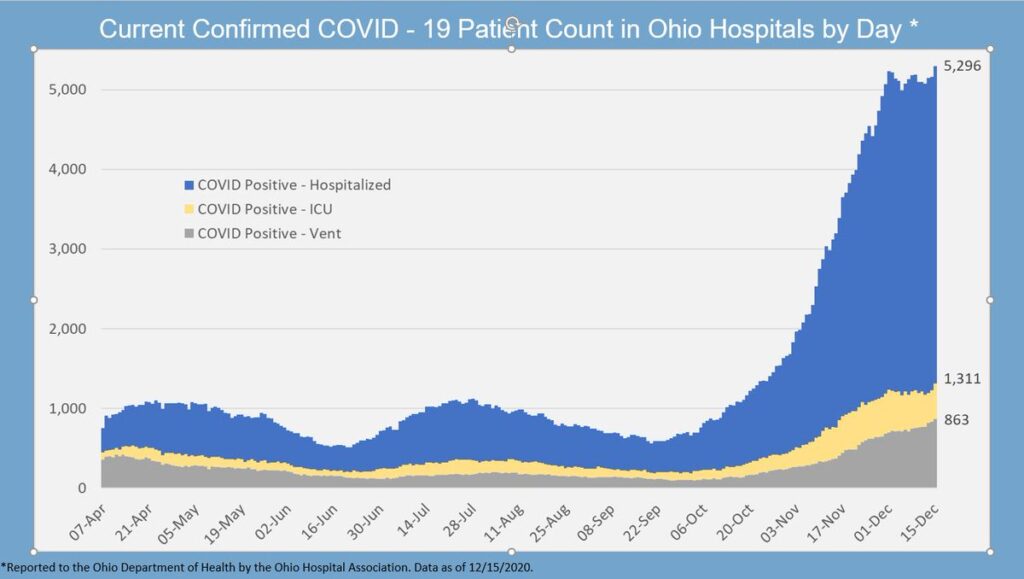
The vaccine hesitancy comes as COVID-19 has infected 727,000 Ohioans, put about 39,000 in the hospital, and killed at least 9,143 since March.
At least 4,856 of those deaths occurred among residents of Ohio’s long-term care facilities.
There are several theories as to why nursing home workers would rebuff a vaccine dose, according to Tory Hogan, an Ohio State University professor who researches nursing homes and infection control.
She said some probably just don’t trust health authority; some have “been in the trenches” of the pandemic for a year now, prompting them to shrug off the unknown risk of vaccine for the better-known risk of infection; some probably just don’t want to be the guinea pigs.
“There has been so much misinformation about everything in this process,” she said.
Wood County Health Commissioner Ben Robison said he’s detected some vaccine hesitancy and refusal across all industries. However, some who deny at first are likely to come around.
“Anecdotally, we’ve heard among some of the populations we’re reaching with our vaccine, some have initially said no and then later said yes,” he said.
Some employers, especially in the health care industry, mandate the flu vaccine and other immunization. However, Van Runkle said the industry is already dealing with a widespread staffing shortage, only worsened by the pandemic.
He said most of Ohio’s nursing homes do not even mandate the flu vaccine. Mandating a COVID-19 vaccine would worsen staffing problems.
“We don’t need another reason for people not to work in our facilities,” he said.
A vaccine mandate would backfire
Hogan agreed that a vaccine mandate would backfire, and Williams, from SEIU, said education and outreach should drive universal vaccination.
The Ohio Department of Health has shipped 341,100 Moderna first-doses, as well as 9,750 Pfizer first-doses plus another 9,750 Pfizer second-doses, according to ODH spokeswoman Melanie Amato. Only about 162,942 Ohioans have started the vaccination process, which is prioritizing health care workers, first responders and nursing home staff and residents.
“We do not have visibility to how many staff members at a facility decline to be vaccinated,” said CVS Health Spokesman Charlie Rice-Minoso.
“While we aren’t provided with full staff rosters, based on feedback from our teams in the field we’re seeing more vaccine hesitancy among staff when compared with residents.”
Walgreens, another company administering the vaccines, did not respond to inquiries.
Looking at the bigger picture, Hogan said governments from the federal to local level need to do a better job understanding why some are declining vaccination. Similarly, she said they need to emphasize, as they did during the polio years, that vaccination is the patriotic thing for Americans to do.
“It takes consistently pushing the right message, the correct and accurate information,” she said. “That takes money, a federal response, all levels. We’re struggling with that a lot.”
Gov. Mike DeWine called Monday “a great day” in the annals of the Buckeye State as the first doses of coronavirus vaccine were injected into the arms of medical workers deemed to be at high risk.
Another great day as more vaccine shipments arrive in Ohio! Fran and I were at @mercy_health Springfield Regional Medical Center as vaccines were delivered here this morning. Springfield is one of several hospitals across the state receiving vaccines today. #InThisTogetherOhiopic.twitter.com/kzuGzHx7nI
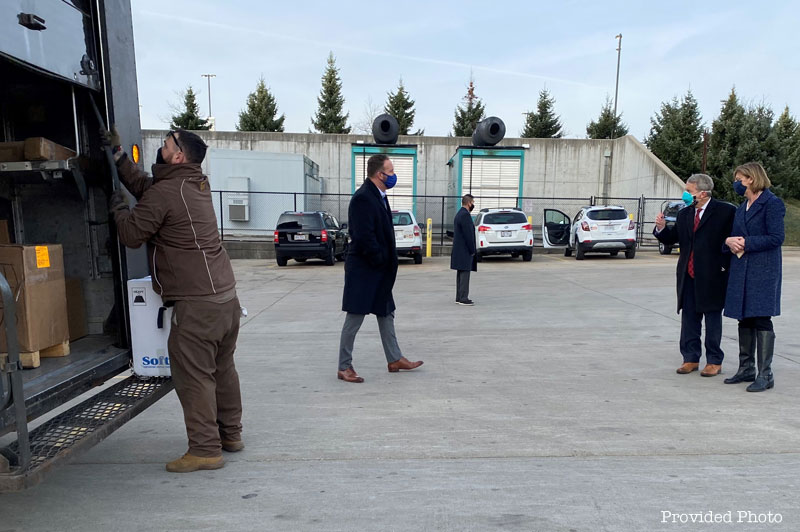
He and his wife, Fran, were on the Ohio State campus Monday morning as the first staffers at Wexner Medical Center got the first of two shots manufactured by Pfizer that together are expected to confer strong immunity to the disease. At the same time, first doses were being delivered to the University of Cincinnati Medical Center.
Additional doses are expected to be delivered in eight Ohio counties on Tuesday, and pharmacy chains CVS and Walgreens will start inoculating nursing home residents on Friday.
Coming as it did on a day when the United States recorded its 300,000th coronavirus death, it’s undoubtedly good news that Ohioans are starting to be vaccinated.
Adding to the good news it is if, as expected, a vaccine made by Moderna gets regulatory approval in the coming days, Ohio will be on track to deliver enough vaccines in December and January to immunize more than 600,000 people.
But that’s far from enough to achieve herd immunity that would allow Ohioans to go back to their pre-pandemic lives and it’s unclear when enough vaccine will be available to do that.
It didn’t have to be that way.
“We don’t know in the months ahead how fast the vaccine is going to come to Ohio,” DeWine said, later adding, “It’s going to take awhile for us to get even close to the herd immunity people are talking about.”
Making predictions difficult is whether any of the other drug makers who have been working with the federal government will see their vaccines approved, how quickly production can be scaled up, how effectively vaccines can be distributed and how many have been reserved for Americans.
One failure by the Trump administration almost certainly delayed the day when enough Ohioans have been vaccinated that the virus will find it difficult to spread.
The New York Times last week reported that Pfizer, a U.S. company, in the summer offered the federal government the chance to lock in hundreds of millions of dosesof its vaccine in addition to the 100 million it had already reserved. Pfizer said the government would only have to pay for the vaccine if it were proven to be effective.
For some reason, the feds declined the deal. The European Union then locked in 200 million doses of the vaccine, which in November was shown to be 95% effective in clinical trials.
The Times reported that Pfizer now can’t guarantee the United States any more than the 100 million doses it initially locked in. Since it takes two doses of the vaccine to get its full effect, that’s enough to inoculate 50 million Americans, or about 15% of the population. Ohio is expecting enough of the Pfizer and Moderna vaccines by the end of January to inoculate about 11% of the state’s population.
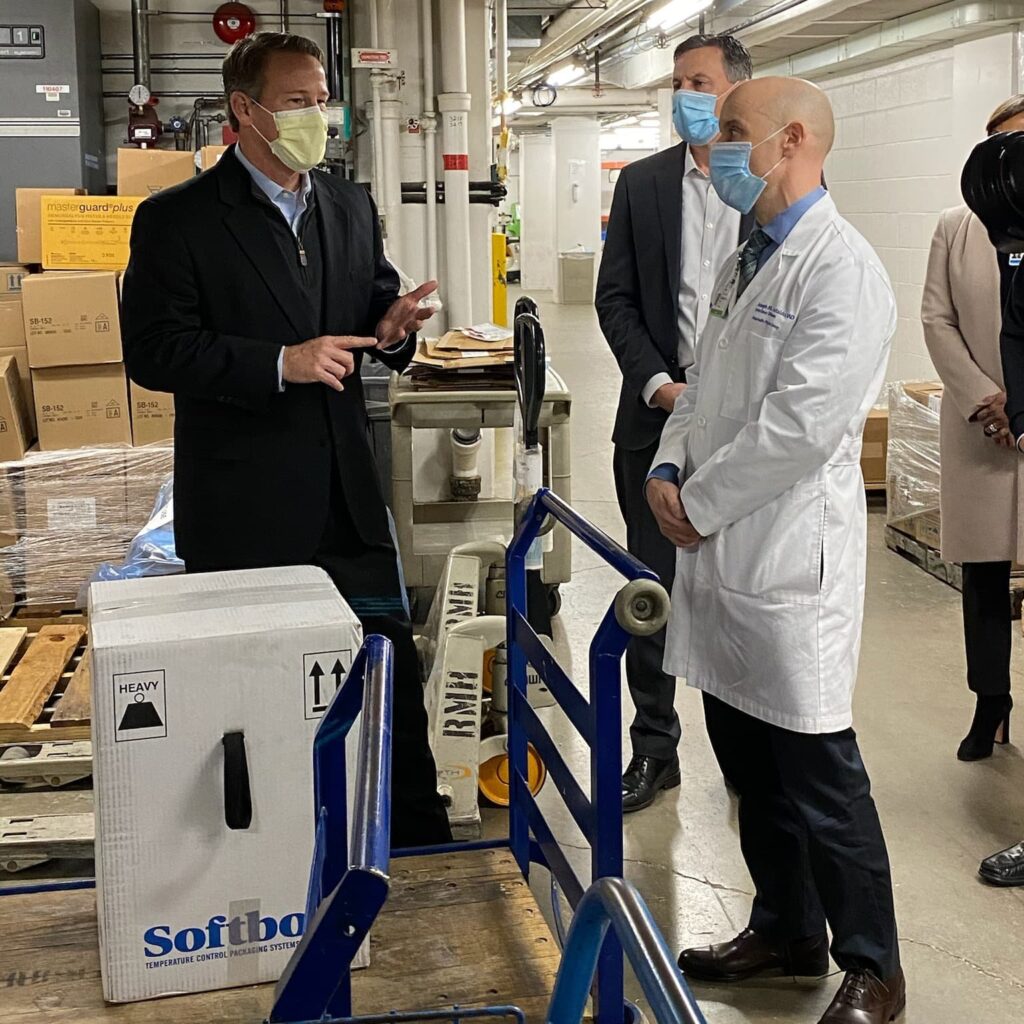
Lt. Gov. John Husted discusses the COVID 19 vaccines that were arriving at OhioHealth Riverside Methodist Hospital. ,
There are still questions about how much immunity one gets from catching covid and then recovering. But assuming that it’s durable, scientists estimate that 70% of the population will have to be vaccinated against or have recovered from a coronavirus infection for herd immunity to be achieved.
U.S. Vice President Mike Pence and Ohio Gov. Mike DeWine greet one another onstage before President Donald Trump was to speak at a campaign rally at U.S. Bank Arena on August 1, 2019 in Cincinnati, Ohio. (Photo by Andrew Spear/Getty Images)
In his coronavirus press briefings, DeWine has frequently praised Vice President Mike Pence for his openness and willingness to help governors with covid-related issues.
But DeWine on Monday had no memory of Pence discussing why his administration didn’t take Pfizer up on an offer to supply vastly more of its vaccine to the most infected country in the world.
“I don’t recall that,” DeWine said, adding that the governors were going to hold a virtual meeting with Pence later in the afternoon.
If approvals go according to plan, Ohio will get more than a half-million doses of coronavirus vaccine between Dec. 15 and the end of the month, Gov. Mike DeWine said on Friday.
While more than expected, the amount is far from adequate in a state with a population approaching 12 million.
“The race has started and it’s started in a very robust way,” said Bruce Vanderhoff, medical director for the Ohio Department of Health.
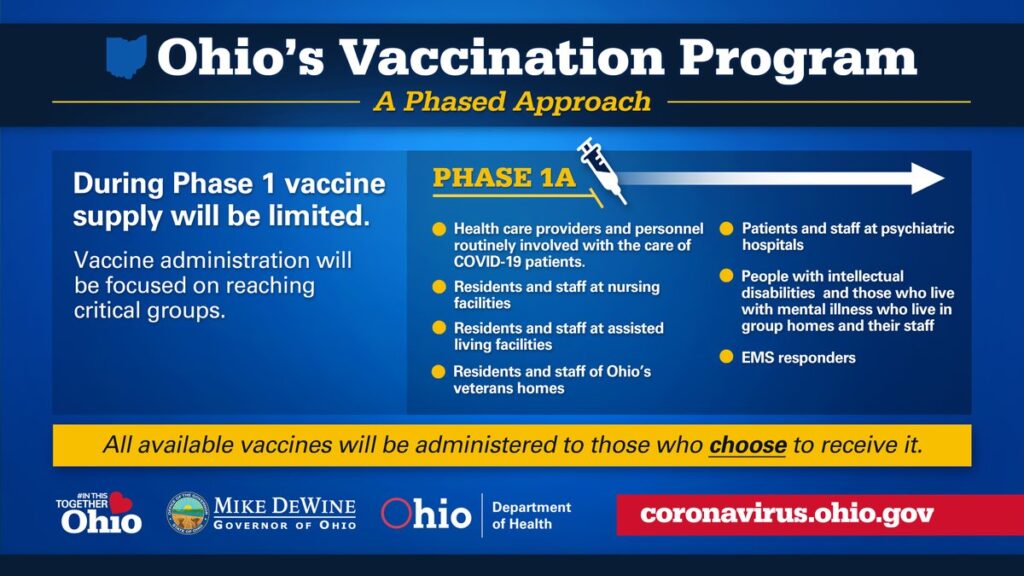
Even so, officials had to make some painful choices about who would be first in line for a first dose, to be followed by a booster either three or four weeks later, depending on the vaccine, DeWine said.
That means prisons and jails, where inmates and staff have been dying of covid since the start of the pandemic, will not be among the first to be vaccinated. Nor will service workers such as grocery store clerks, who potentially are exposed to the virus every day.
Health care workers and staff caring for covid patients
Emergency medical responders
People with underlying health conditions living close to each other and their caregivers. They include people and workers in nursing homes, assisted living centers, veterans homes and the like.
DeWine stressed that the exact number of doses won’t be known until the week they’re due to arrive. He added that as initial rounds are doled out, they’ll be paired with boosters to be sent later.
Joseph Gastaldo, director of infectious diseases at OhioHealth, said the vaccines awaited in Ohio are being made by Pfizer and Moderna. They still are awaiting final approval by independent panels of experts working under the auspices of the U.S. Food and Drug Administration and the Centers for Disease Control and Prevention. That approval is expected in the next two weeks.
Approvals of other vaccines are hoped for, but there are a few factors that make it hard to predict when a big enough portion of the Ohio population will have been vaccinated to it difficult for the virus to spread.
One is that about half of Ohioans are reluctant to get it, DeWine said. He said he hopes public information campaigns and news of the vaccines’ safety and efficacy will counteract the skepticism.
Also, it’s unclear what other vaccines might be coming online, how quickly, or how fast production and distribution can be scaled up. Add those together and it’s uncertain when average folks can line up for a shot in the arm.