Tag: photo ID

  • Ohio senators working to resurrect recently eliminated August elections to fight abortion amendment

    Ohio senators working to resurrect recently eliminated August elections to fight abortion amendment

    “If we save 30,000 lives as a result of spending $20 million,” Senate President Matt Huffman argued, “I think that’s a great thing.”

    BY: NICK EVANS – Ohio Capital Journal

    Only about three months ago, Ohio lawmakers passed a wide-ranging elections bill that will require voters present a photo ID when they cast a ballot. But it didn’t start out that way. Lawmakers bolted on the photo ID requirements only at the last minute.

    The bill began as a proposal to eliminate August special elections. The bill’s sponsor, Rep. Thomas Hall, R-Madison Township, argued there should only be two elections a year “a primary election, and a general election.”

    “August special elections are costly to taxpayers and fail to engage a meaningful amount of the electorate in the process,” he argued.

    So why are lawmakers now preparing to un-eliminate the elections they just scrapped?

    The Senate’s proposal

    Sens. Rob McColley, R-Napoleon, and Theresa Gavarone, R-Bowling Green, introduced a bill Wednesday that would, once again, allow August special elections.

     COLUMBUS, Ohio — MARCH 22: State Rep. Allison Russo, D-Upper Arlington, speaks to reporters after the House Constitutional Resolutions committee meeting first hearing on HJR 1 that would require 60% vote to approve any constitutional amendment, March 22, 2023, at the Statehouse in Columbus, Ohio. (Photo by Graham Stokes for Ohio Capital Journal. Republish photo only with original story.)

    Despite the most recent August election barely clearing 8% in statewide voter turnout, the sponsors specifically add legislature-initiated amendments to the brief list of proposals that can go on an August ballot. Citizen-led amendments can still only go before voters in November

    McColley and Gavarone’s change of heart has to do with one such proposal working its way through the Ohio House. That resolution would put a proposal on the ballot raising the threshold for passage of all future amendments from a simple majority to 60%.

    After that resolution’s hearing, House minority leader Allison Russo criticized the unnecessary expense.  Of Republicans’ about face, she said, “the hypocrisy here has no bounds.”

    “Really what this is about is silencing the voice of voters and shutting down direct democracy,” she argued, “Because again, this is a legislature who has no interest in being checked by voters — they picked their voters.”

    The sponsors readily acknowledge the expense of their gambit. The bill appropriates $20 million to help county boards conduct a special election. If lawmakers were to wait about three months, they could save that money. As it happens, there’s an election every November, and it’s relatively cheap to add one more question.

    But Senate president Matt Huffman is calculating the question differently, and to him, the math adds up.

    Huffman’s take

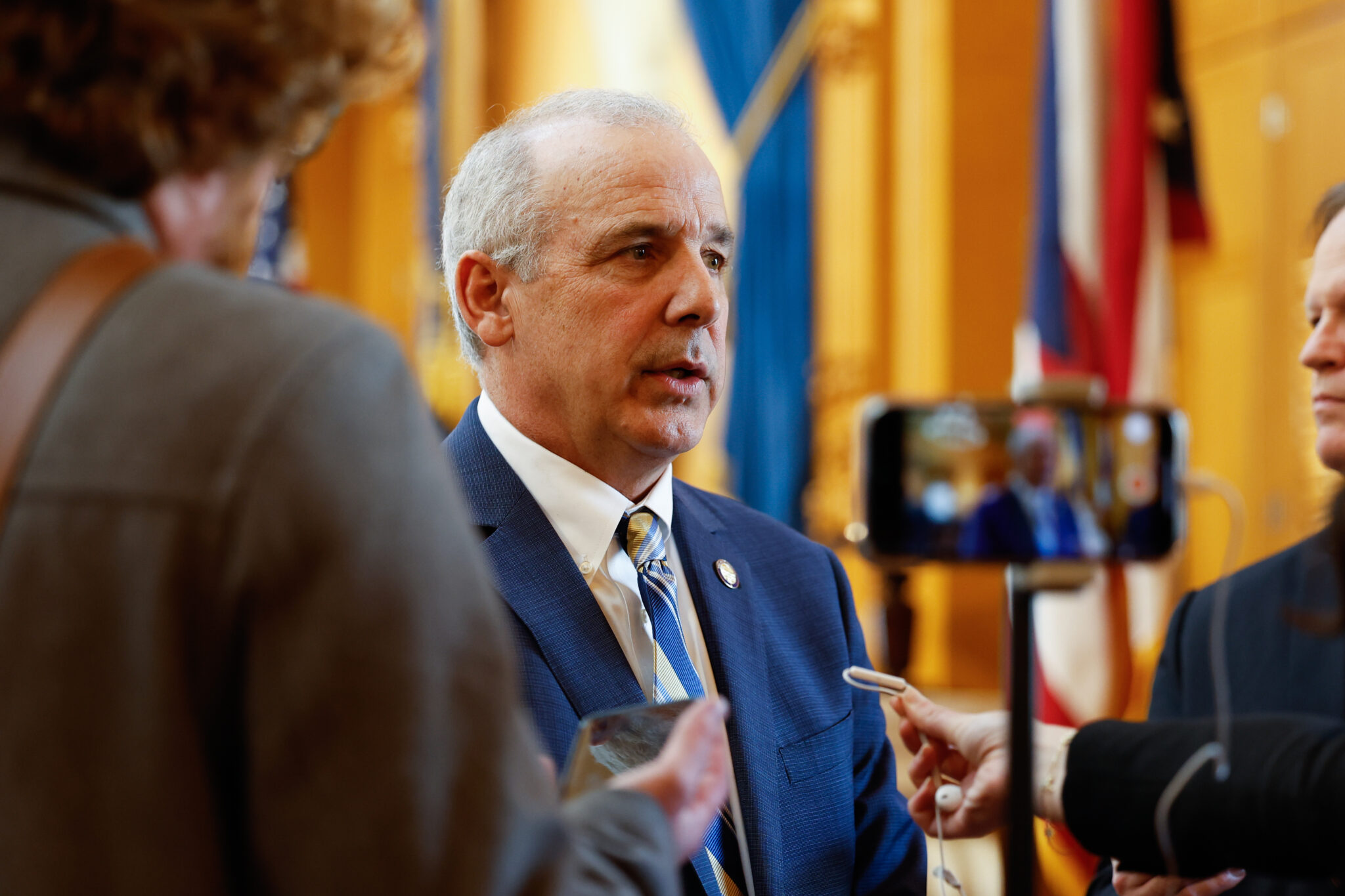
    “If we save 30,000 lives as a result of spending $20 million, I think that’s a great thing,” Huffman told reporters after a Senate session Thursday. “Now I know a lot of people don’t look at it that way, but that’s the way I look at it.”

    His comments are an explicit connection between efforts to raise the threshold for amending the constitution and undermining an abortion rights amendment. Organizers are currently gathering signatures for that proposal and hope to have it on the ballot this November.

    The senate president over-shot the mark, however. Department of Health statistics put the number of induced abortions at more like 21,000-22,000 per year on average.

    Huffman defended the push for an August election. He said he’d expected the House to have the supermajority resolution passed in time for the May primaries.

     COLUMBUS, OH — JANUARY 03: Newly elected Ohio House Speaker Rep. Jason Stephens (R-Kitts Hill) gives brief remarks at the opening day ceremonies of the 135th General Assembly of the State of Ohio, January 3, 2023, in the House Chamber at the Statehouse in Columbus, Ohio. (Photo by Graham Stokes for Ohio Capital Journal. Republish photo only with original story.)

    Still Huffman attempted to draw a distinction between the current proposal and lawmakers eliminating August elections as a standing “as-needed” date on the election calendar.

    “Do I have turnout concerns in school levies in August because very few people come out, and they’re done when people are on vacation, and they don’t know about it? And liquor permits and things like that, that typically happen? Yeah.” Huffman said.

    “But I think in this case, it’s something that a lot of people are going to be very fired up about,” he added.

    Huffman said he plans to have the special elections measure passed by mid to late April. He wants the House to have “ample consideration,” before the deadline to get the supermajority amendment on the ballot.

    House headwinds

    If House Speaker Jason Stephens has his way, though, the special elections bill may be dead on arrival.

    “We just voted to not have those anymore just a few months ago,” Stephens told reporters Thursday. “The county election officials I’ve talked to are not interested in having it.”

    “I’m frankly not interested in having an election in August,” he said.

    Follow OCJ Reporter Nick Evans on Twitter.
  • Exercising your right to vote on Election Day

    Exercising your right to vote on Election Day

    Commentary by Michael Hamper III

    Michael Hamper III is a partner at Lemire & Hamper LLC, a firm in Jefferson, Ohio that focuses on the areas of bankruptcy, oil and gas, probate, real estate, and municipal law. Michael has served as the Solicitor for the Village of Jefferson since 2016 and has a passion for helping his local community that inspired him to run for office in 2018.

    Turn on the news or read a newspaper today and you will see political candidates and public officials making the rounds throughout the country trying to earn your vote. While the issues and formats are much different today, those candidates and public officials are participating in America’s time-honored tradition of democracy.

    When it comes to elections, both the voter and precinct election officials have responsibilities to protect voting rights. It is important to be prepared when you vote and to know what your rights are at the polling place in order to ensure a smooth Election Day.

    Voter Responsibilities

    In Ohio, you are generally eligible to vote if you are a citizen of the United States, a resident of Ohio for at least 30 days prior to the election in which you desire to vote, at least 18 years old on or before the next general election, and if you are not currently incarcerated for a felony conviction.

    You must be registered 30 days prior to Election Day to be able to vote. You can register to vote in future elections online at the Ohio Secretary of State’s website or visit your office, local Board of Elections office, Bureau of Motor Vehicles, or public library, among other places.

    In order to cast your ballot on Election Day, you must bring one of the following proofs of identification (note, though an option, it does not have to be a photo ID):

    • Current photo ID card with your name and address, such as a driver’s license or state ID;
    • Other government ID (but not a U.S. Passport or student ID as those do not prove current address);
    • S. Military ID card with your name and photo (address is not required); or
    • A form of identification that shows your name and address, such as a utility bill, bank statement, paycheck, government check or other government document, such as a benefits letter from the Social Security Administration or the Ohio Department of Job & Family Services.

    On Election Day, it is also your responsibility to show up at the correct precinct to vote. If you do not know this information, you can look it up on the Ohio Secretary of State’s website.

    Precinct Responsibilities: Protecting Your Rights

    If you are at the proper precinct, have registered to vote at least 30 days before the election and brought a proper form of identification (see list above), then you should have no problems at the polling place. However, it is still helpful to know some more details about your rights and the duty of precinct election officials to enforce them.

    If you are at the correct precinct and are eligible to vote, but you do not have the proper identification or are not on the poll list, then the precinct election official has the responsibility to allow you to vote by provisional ballot. You also have the right to vote by provisional ballot if you moved to a different precinct within Ohio in the 30 days before the election. A provisional ballot is like a regular ballot, except the board of elections will review the information for the voter and determine if the voter was eligible and should have their vote counted. Each provisional ballot voter must receive a provisional ballot notice that details how a voter can determine if their vote was counted and why or why not.

    There are several other voting rights that you should also be aware of, such as:

    • It is the responsibility of the polling place to allow you to vote as long as you are in line before the polls are scheduled to close.
    • You are not required to provide proof of citizenship in order to vote.
    • If you need assistance to vote due to blindness, disability or illiteracy, you are permitted to receive assistance from a person of your choice, so long as that person is not your employer, representing your union or a candidate whose name is on the ballot. You can also receive assistance from two precinct election officials (one from each political party).

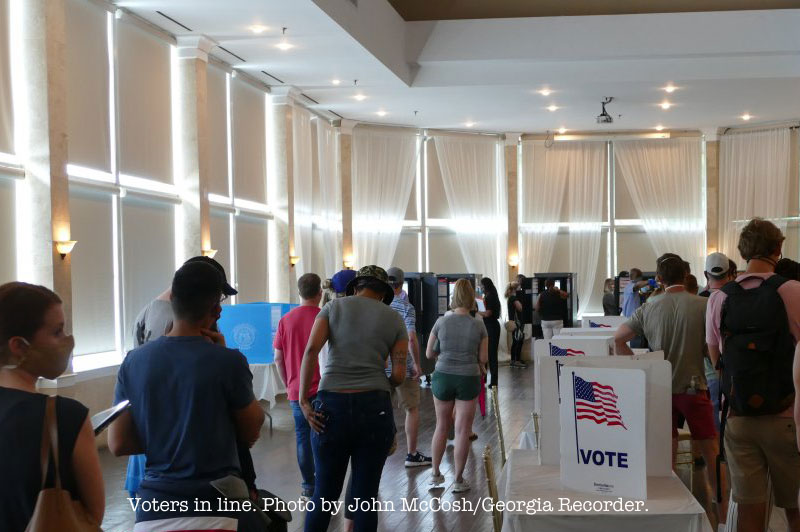
    It is also important for you to know that polling places are neutral ground. This means there should be no election official wearing campaign materials, attire or paraphernalia. Election officials cannot advise, instruct or educate voters on candidates or the issues. They are there to ensure a fair, unbiased voting process, and it is not their goal to influence voters in any way. Voters should also follow these rules and should not wear campaign materials, attire or paraphernalia. Candidates and volunteers are also not permitted to campaign within 100 feet of the polling place, which is often marked by small American flags.

    What Should You Do if You Believe Your Rights Are Being Violated?

    If you believe you are being wrongfully denied the ability to vote, ask to speak to the voting location manager and they will work with you to fill out the form to report the issue (Form 10-U) and then have you vote by provisional ballot.

    If you believe there are violations of voting laws occurring at a polling place, whether by candidates, advocates, precinct election officials or voters, you should report the violations to the local board of elections.

    How an Attorney Can Help

    Should you run into problems, an attorney can help you determine whether your voting rights have been violated and to decide on an appropriate course of action. An attorney can also help you make contact with the appropriate local and state officials to notify them of how your rights were violated and seek to resolve the matter and correct the issues before the next election so that no other voter experiences the same hardship. An attorney will also be able to advise you of the different methods of reporting election complaints to the local board of elections, Ohio Secretary of State and United States Department of Justice.

    A Note on COVID-19 and Voting

    In-person voting may look different this year in response to COVID-19. Be sure to check your polling place in advance, as it may have changed. You may also be required to wear a face mask, and there will likely be markers to keep you distant from the other voters. If you have questions, be sure to check with your county’s Board of Elections. For more information about voting by an absentee ballot, read this article.


    Clermont County Board of Elections

    Hamilton County Board of Elections

    Warren County Board of Elections