Tag: Piqua

  • Ohio lawmakers wrestle with how to make amends for land denied the Randolph Freedpeople

    Ohio lawmakers wrestle with how to make amends for land denied the Randolph Freedpeople

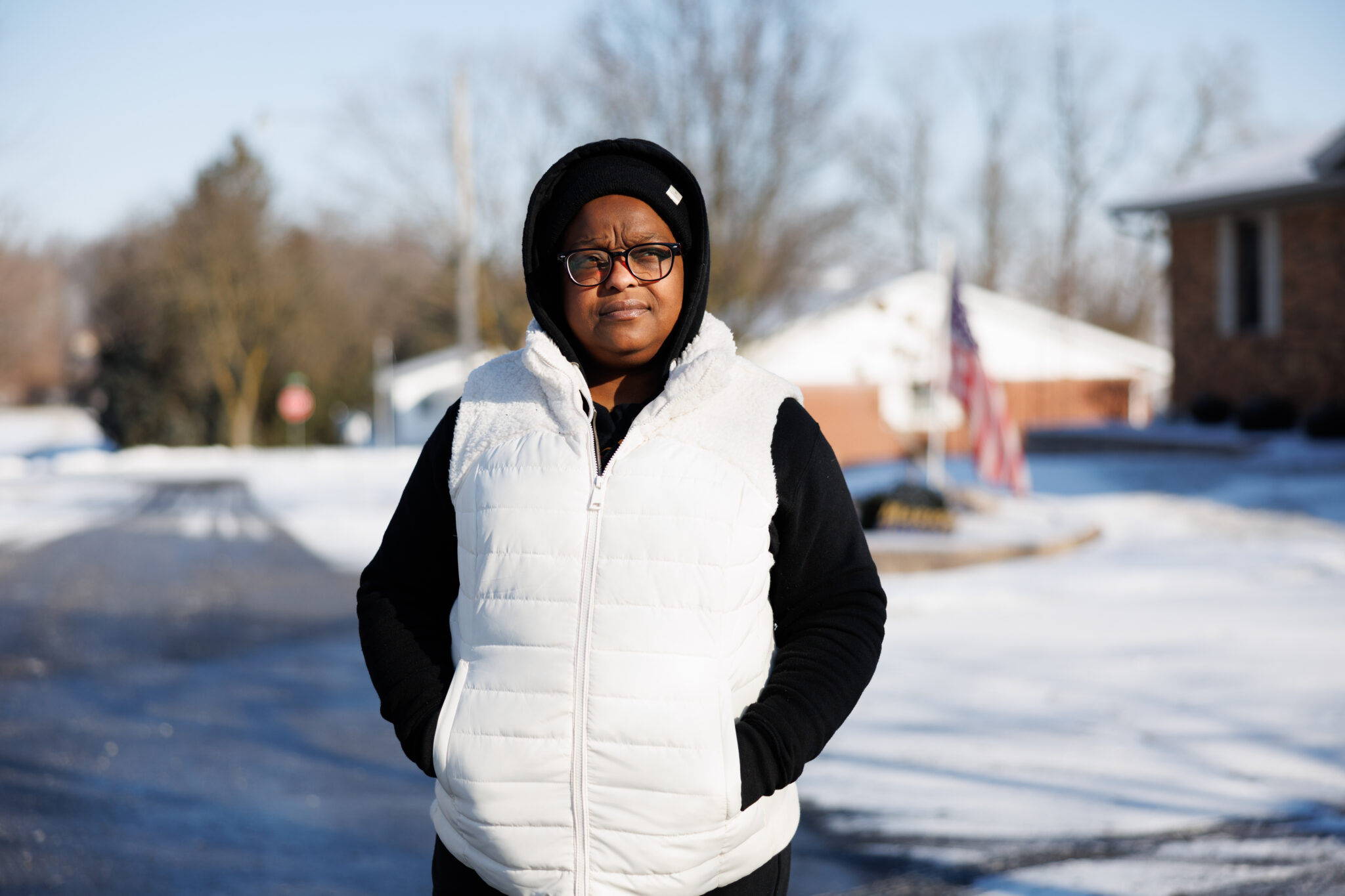
    CHICKASAW, OH — JANUARY 24: Seventh-generation Randolph Freepeople descendant Paisha Thomas, January 24, 2025, on Virginia Street in Chickasaw, Ohio. (Photo by Graham Stokes for Ohio Capital Journal. Republish photo only with original article.)

    By:  Ohio Capital Journal

    This story is the second in a two-part series on mapping land denied the Randolph Freedpeople and state efforts to make amends. You can read the first part here.

    CHICKASAW — “So, this could’ve been my neighborhood,” Paisha Thomas said, trudging down a snowy street in Chickasaw, Ohio. “That’s infuriating.”

    The Mercer County village sits about six miles west the heart of New Bremen, the Miami and Erie Canal stop where Thomas’ ancestors were turned away from their land by a white mob almost 180 years ago.

    The Randolph Freedpeople were a group of roughly 400 men and women released from slavery in their former owner’s will. John Randolph was a prominent Virginia politician and landowner, but state laws prohibited freed slaves from remaining in the state. Randolph’s will not only freed his slaves but set aside money with which his executor, William Leigh, could purchase land on their behalf.

    GET THE MORNING HEADLINES.


    Leigh was drawn to western Ohio. Although the state had harsh “Black codes” of its own, requiring employers post a $200 bond against a Black employee becoming a public charge, those laws were rarely enforced. Instead, Leigh saw a sparsely populated and agrarian region with a small but thriving Black community called Carthagena not far from New Bremen.

    Leigh bought roughly 3,200 acres for the freedpeople, but when they arrived white men armed with muskets turned them back and even marched along the canal until they crossed the county line.

    The Randolph Freedpeople eventually settled in several towns, like Rossville outside of Piqua, but they were never able to get the land purchased on their behalf. Instead of homesteading, many found work as laborers or domestic servants. In the early 1900s, a group of descendants petitioned Ohio courts to return their land, but the case was dismissed under the statute of limitations.

    Although the deeds for that land didn’t disappear, the specific location of the parcels wasn’t well understood until a group of Miami University students took the story on as a class project. Late last year they produced a map of the Randolph parcels for the first time, encompassing 3,140 of the total acreage purchased.

    But while that makes the loss more tangible, the question of how to atone is still very much up in the air.  One state lawmaker wants Ohio to officially acknowledge the mob incident and formally apologize.

    The lawmaker who represents the area, however, seems more inclined to leave it in the past. Meanwhile, descendants like Thomas want to see far more than just an apology — they want some form of compensation for what was lost.

    What could be

    Today, the Randolph Freedpeople’s land makes up about 200 parcels scattered south and west of Grand Lake St. Marys. Nearly all of it is still dedicated to agriculture, but there are a handful of commercial or industrial parcels and in the northeast corner of what is now Chickasaw, several residential parcels.

    Thomas chuckled at the irony of the street names that sprung up on a plot of land meant for the Randolph Freedpeople — Liberty Street, curving smoothly into Virginia Street. The homes are nice but not extravagant; a tiny neighborhood of 1970s ranch-style homes with broad front lawns and no fences. She described growing up in Piqua with her family spread throughout the city.

    “Here could have been just like a neighborhood of people, you know, walking, yelling across the yard,” Thomas said. “That’s frustrating.”

    She was particularly struck by the large grain silos a couple hundred yards from the street.

    “When we came around that corner over there and saw the farm and the grain storage right next to a residential home, it just felt very in your face, like I asked for it because I came here, but it just felt very like now there’s no denying or guessing. There’s actual evidence of what could be, because it is — but it’s for somebody else.”

     CHICKASAW, OH — JANUARY 24: Seventh-generation Randolph Freepeople descendant Paisha Thomas, January 24, 2025 in Mercer County Ohio. (Photo by Graham Stokes for Ohio Capital Journal. Republish photo only with original article.) 

    What amount?

    Thomas thinks about what was lost in generational terms. To her, the Randolph Freedpeople didn’t just miss out on the roughly five square miles worth of land that has appreciated in value over the years, they missed out on nearly two centuries of income that farmland could’ve produced.

    It’s likely impossible to put a dollar figure on that, but she wants the state to try.

    Thomas has started a nonprofit called Land of the Freed to raise awareness and advocate on behalf of descendants. The group has taken the lead on renovating African Jackson Cemetery in Rossville — a settlement just outside Piqua where several Randolph Freedpeople families landed after being turned away in Mercer County.

    Butch Hamilton grew up with Thomas and is a member of the Land of the Freed board. Like Thomas, he’s taking a long view.

    “What amount of money has Paisha’s family been denied by not being able to settle and claim that land? That’s the thought that comes to my mind,” he said. “And then the then the second thought is, well, what is going to be done to make the make the whole situation right?”

    His wife Sherri Hamilton sits on the board as well, and she acknowledged the seeming impossibility of the task.

    “There, quite literally, is probably no way to give back what was stolen so many generations later,” she said. “But something needs to be done.”

    The Miami University study tallied the current assessed value of the Randolph plots at roughly $14 million. But with much of the acreage valued for its agricultural use, that’s likely far lower than what the land would fetch on the open market. At $14 million, the land students identified would be worth about $4,500 an acre. An Ohio State University survey put agricultural land in the Western region of Ohio at more like $11,500 an acre, and a handful of recent Mercer County agricultural land sales listed on Zillow range from $16,500 to $21,600 an acre.

    Although the question of value is tricky, Butch Hamilton argued it’s unavoidable.

    “We keep saying something has to be done,” he said. “The thing that needs to be done is the family needs to be compensated with money. I mean, there needs to be a payout.”

    Regardless of what you call it, it amounts to reparations — a political third rail, particularly among Republicans. Compensating descendants, the argument goes, rewards people who weren’t directly harmed by taking from those who did no wrong.

    That said, there are notable historical precedents. In the 1980s, President Ronald Reagan signed off on payments to Japanese Americans interned during World War II. In the 1990s, Florida Gov. Lawton Chiles approved a $2.1 million measure to compensate residents of Rosewood, a Black town razed by a white mob in 1923.

     COLUMBUS, Ohio — MARCH 22: State Rep. Dontavius Jarrells, D-Columbus, March 22, 2023, at the Statehouse in Columbus, Ohio. (Photo by Graham Stokes for Ohio Capital Journal. Republish photo only with original article.) 

    State repsonse

    While Thomas and the Hamiltons are thinking in terms of generations, state Rep. Donatvius Jarrells, D-Columbus, has to think in terms of votes. His long-term ambitions are nearly as high, but in a General Assembly controlled by Republicans he’s conscious of what is and isn’t possible.

    He wants to begin with a resolution formally apologizing for what happened to the Randolph Freedpeople. Jarrells is expecting to introduce that proposal sometime in February to align with Black History Month.

    “I think that resolution is kind of the first step,” he explained, because many of his colleagues aren’t aware of what occurred.

    “And so, it gives us an opportunity to, one, have a baseline of knowledge across our chamber on what happened to these Ohioans, and then opens the door for conversations about what we can do.”

    Jarrells floated the idea of a museum or a scholarship fund as ways the state might make amends to Randolph Freedpeople descendants, and he said Thomas and the Hamiltons have a point when it comes to money. Jarrells said many of the struggles he’s heard about from descendants trace their way back to “this one point of time where they could have built wealth, and then that wealth was taken away from them.”

    But Jarrells may face headwinds simply getting the General Assembly to take up an apology resolution.

    He wants to co-sponsor the measure with state Rep. Angie King, R-Celina, whose district covers the entirety of Mercer County. But speaking after a recent session, King said she didn’t know what Jarrells was working on. Although King said she’s “familiar” with the Randolph Freedpeople story, she did not answer questions about what, if anything, the state should do now.

    “That’s my comment,” she said. “As a county recorder, I’m familiar with it because we digitized the records.”

    Ohio Capital Journal sent King’s office a follow up email seeking additional comment. She did not reply.

     CELINA, OH — JANUARY 24: Mercer County Historical Society Director Cait Clark January 24, 2025, at the Mercer County Historical Museum in Celina, Ohio. (Photo by Graham Stokes for Ohio Capital Journal. Republish photo only with original article.) 

    What’s possible

    The Mercer County Historical Society is based at the Riley House Museum in Celina, Ohio. The organization has a small mountain of documents related to the Randolph Freedpeople as part of its collection. But museum Director Cait Clark, acknowledges even in Mercer County the event is largely forgotten.

    “I’d say the broader population probably doesn’t know, and they definitely should,” she said.

    When it comes to how public officials should make amends, Clark is quick to note that’s a decision outside her purview. But drawing a comparison to how native Americans were pushed off their land, she argued, “if there’s nothing that can be done to fix the past directly, the minimum you can do for these people is to acknowledge what happened. If nothing else, acknowledge it.”

    Clark expressed doubts about the possibility of compensating descendants in the current political climate, but added, “if it was my family, I would definitely want acknowledgement and some form of compensation, because this was highly disruptive to a group of people.”

    As for what her organization can do, Clark emphasized education through articles, public displays, or historical markers.

    “Our role in it could be small or large,” she said, “it just depends on how far we get.”

    Meanwhile, Thomas and the Hamiltons aren’t exactly impressed with an apology resolution.

    “That’s an example of crumbs,” Butch Hamilton said. “And we’re in a day and age where that’s not acceptable anymore.”

    Even if it’s a first step, he insisted that there need to be further steps, and fast — “This case has been going on since 1846,” he argued.

    If the state acts, whether through direct payments to descendants or something more diffuse like a scholarship program, there will likely be those who see it as a misguided response to a historical wrong. Sherri Hamilton acknowledged how wary people become when reparations become part of the conversation. But she argued that’s not an excuse to sweep past-wrongs under the rug.

    “Take the African American experience out of it. Take the Blackness out of it,” she said. “Just say these are human beings who had land stolen from them. Now, if they were whomever, the German immigrants that settled in New Bremen, what would be done for them? And then that’s the answer.”

    Follow Ohio Capital Journal Reporter Nick Evans on X or on Bluesky.

    YOU MAKE OUR WORK POSSIBLE.

    ______________
    Nick Evans
    Nick Evans

    Nick Evans has spent the past seven years reporting for NPR member stations in Florida and Ohio. He got his start in Tallahassee, covering issues like redistricting, same sex marriage and medical marijuana. Since arriving in Columbus in 2018, he has covered everything from city council to football. His work on Ohio politics and local policing have been featured numerous times on NPR.

    Ohio Capital Journal is part of States Newsroom, the nation’s largest state-focused nonprofit news organization.

    MORE FROM AUTHOR

  • Ohioan reports being recruited for plot targeting Gov. DeWine at his home

    Ohioan reports being recruited for plot targeting Gov. DeWine at his home

    Piqua, Ohio – A Miami County resident reported to police being recruited to take part in a citizen’s arrest of Gov. Mike DeWine at his Cedarville home a week ago, but the plot evidently never materialized.

    The plot is alleged to have involved Renea Turner, a former write-in candidate for governor who ran against DeWine in 2018. A state representative says he recently met with Turner prior to the alleged call and she inquired about the governor’s home, the Ohio Capital Journal has learned. 

    The Ohio State Highway Patrol, which handles security for the governor and his residences, was notified of the report by local law enforcement and is investigating. 

    At a press conference Friday afternoon to discuss allocation of CARES Act funding in Ohio, DeWine told reporters he was unaware of the alleged plot and had not been briefed on it to that point.

    This report to police came just a week after 13 men were arrested for reportedly planning to kidnap Michigan Gov. Gretchen Whitmer and it follows months of protests against DeWine and state health officials. 

    According to a Piqua Police Department report from Oct. 16, a citizen told an officer about being called earlier that morning by Turner, a Springfield native who is an outspoken critic of DeWine. Turner reportedly asked if they wanted to take part in an attempt to arrest the governor at his home later that weekend and try him for allegations of tyranny.

    The Ohio Capital Journal initially declined to identify Turner as the alleged caller, as law enforcement would not confirm if she had been under investigation or charged with a crime and she could not be reached by the Ohio Capital Journal for comment.

    The Ohio State Highway Patrol has been made aware of the police report but would not say if an investigation has been launched.

    Since the original publication of this story, Turner has spoken on the record with cleveland.com about the call, which she confirmed took place. She told the outlet that she did speak to the Miami County person about placing DeWine under house arrest, but reportedly denied discussing any specific plans. 

    The Capital Journal is not identifying the person who reported the incident to police after the person asked to remain anonymous for safety reasons, having already followed up with Piqua law enforcement about a threat made against them online.

    The person who reported the call told Ohio Capital News that the plot stemmed from anger toward the governor’s response to the COVID-19 pandemic. The person said they too are a critic of DeWine and claimed to have recently filed a citizen affidavit seeking criminal charges against the governor. State Rep. John Becker, R-Union Twp., who has led an impeachment effort against DeWine in the Statehouse, has urged Ohioans to submit such affidavits about the governor.

    “Do I think (DeWine) needs to be arrested? Absolutely,” the person said. “But all that needs to happen within the confines of the law.”

    They claimed they were initially excited when receiving the call last Friday, thinking the conversation would be about the ongoing search from DeWine critics to find a prosecutor willing to bring charges against him.

    “(The caller) said ‘no, we the people, we’re going to arrest him,’” the source said.

    According to this person, the caller described several supposed penalties for a citizen’s trial on tyranny — permanent exile or execution.

    According to this person, the caller described several supposed penalties for a citizen’s trial on tyranny — permanent exile or execution.

    Soon after the call, they decided to contact the police.

    “If I don’t do something about this and something happens, I’m either legally culpable or at least I’m going to feel bad,” they said. “Not that I have any love lost between me and Gov. Mike DeWine. Again, I think he needs to be in prison. But again, if (the caller) had done something … I would have felt ethically responsible, right?”

    State legislator says Turner recently asked about DeWine’s home in private chat

    Becker told the Capital Journal he met with Turner a few weeks ago in Columbus at her request to speak about theoretical criminal charges against the governor. While his focus has been on locating a willing prosecutor, he said Turner spoke about finding a county sheriff to make the arrest.

    “I just kind of shrugged my shoulders and said, ‘good luck with that,’” Becker recalled.

    Then came an unusual change in subject: Turner wanted to know more about the governor’s residence in Cedarville. Becker said Turner asked whether the personal residence constituted public property during DeWine’s term as governor.

    “It was kind of a strange question,” Becker said.

    John Becker aided Turner by providing information about DeWine’s residence and if it constituted public property.

    After the conversation ended, Becker asked Turner’s question to the Legislative Service Commission, a nonpartisan group which gives private law research to lawmakers. He learned the home remains a private residence, and passed that information along to her.

    Becker did not hear again from Turner after that. Earlier this week, he heard from the Miami County resident about the alleged plot. The person told him about Turner and Becker recognized her name from their recent meeting.

    Becker said he informed the Statehouse’s sergeant at arms about the situation when returning to work earlier this week. He later posted a YouTube video about the incident, referring to the person who reported the call to police as a “hero.”

    Becker confirmed to the Capital Journal he was contacted by the Ohio State Highway Patrol on Friday. The lawmaker said he described to the Patrol his interactions with Turner and the Miami County resident.

    Piqua Police Chief Rick Byron told the Capital Journal on Thursday the citizen’s report was turned over to the Patrol.

    “At this point, we have not followed up with them and have no plans to do so,” Byron said, noting the alleged caller is not from Piqua and therefore his department does not have jurisdiction. “We’re pretty confident that (the Patrol is) going to handle this situation.”

    Dan Tierney, a spokesperson for the governor’s office, referred questions about the situation to the Patrol.

    In a brief statement on Thursday, Lt. Tiffany Meeks told the Capital Journal: “For security, the Patrol does not discuss threats or security operations involving the governor.” The Patrol later confirmed to the Dayton Daily News it was “currently investigating the incident.”

    Cleveland.com quoted Turner on Friday as saying officials with the Patrol came to her home that morning “to check out my temperament and what my plans are.”

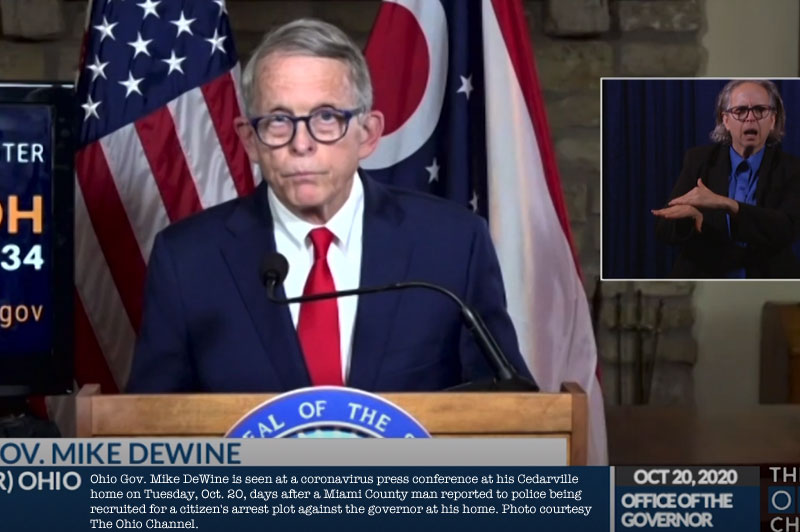
    Since the report was made on Oct. 16, the governor has hosted three press conferences at his Cedarville home: his traditional virus-related updates on Oct. 20 and 22, and the CARES Act press conference with legislative leaders on Friday.

    After this story was first published, reporters asked DeWine during his CARES Act press conference about his reaction to the alleged plot.

    “I don’t know the details of the so-called plan,” he said. “I can’t really comment on that.”

    Asked if he was shocked to learn about such a plot, DeWine answered: “No. I’m not shocked by it. At this point in my life, not much shocks me anymore. It’s a sad thing.”

    This is the latest in a series of alleged plots targeting political leaders in 2020 for their responses to the pandemic. In Michigan, state and federal law enforcement foiled a plot to kidnap and try Gov. Whitmer, with seven of the men being charged under the state’s anti-terrorism law. 

    Police in that case have alleged the Whitmer plot was hatched in a meeting held in Dublin, Ohio this summer. The same groupof men also hoped to target Virginia Gov. Ralph Northam. 

    There is no known connection between these plots and the one reported in Piqua.

    Turner is former governor candidate

    Turner, of Springfield in Clark County, campaigned for governor as a write-in candidate in 2018. 

    Turner encountered DeWine on the campaign trail, later posting a picture of themselves together to social media. A post on her Facebook page claims she pretended to be a supporter of DeWine’s, then told him after the picture was taken she was actually campaigning against him.

    Turner received 185 votes in the 2018 general election, including one from the person who later reported her call to Piqua police. 

    Turner has shared several posts from state Rep. Nino Vitale, R-Urbana, who has made headlines throughout 2020 for posting falsehoods about the virus — such as an April claim that it may have been created by Bill Gates. 

    Turner received 128 more votes as a write-in candidate for Springfield mayor in 2019 before turning her attention back to DeWine amid the coronavirus pandemic. 

    Her social media pages are littered with conspiracy theories involving the virus, government microchips and vaccine mandates. Many of the posts have been flagged by Facebook as spreading misinformation.

    Turner has shared several posts from state Rep. Nino Vitale, R-Urbana, who has made headlines throughout 2020 for posting falsehoods about the virus such as an April claim that it may have been created by Bill Gates. 

    Turner shared one post by Vitale from May 18, in which he accused DeWine of “giving himself total dictatorial power.” Vitale also falsely suggested the governor knew about the virus in March 2019, many months before the novel coronavirus was ever discovered. 

    In July, Turner posted photos of herself protesting health orders at the Ohio Statehouse with a signs referring to the governor as Hitler. 

    Turner took to the Statehouse again on Thursday, proclaiming she had removed the governor from office through a self-issued declaration. A video shared to Facebook shows Turner taking an oath of office, with a signed sheet of paper claiming her to be the next governor of Ohio. 

    Turner did not address the Thursday incident in her interview with cleveland.com.

    ‘It’s wrong morally, it’s wrong legally’

    DeWine reiterated on Friday that the plot against Whitmer was “despicable” and added he denounced any effort by people to subvert the legal system and target public officials.

    “We are seeing people out there who believe that,” the governor said. “We have an obligation, each one of us as elected officials, opinion leaders, to denounce that and say ‘that is wrong.’ It’s wrong morally, it’s wrong legally, it’s anti-democratic, it’s anti-everything this country stands for.”

    While DeWine has enjoyed widespread, bipartisan support throughout 2020 for his response to the pandemic, his administration has also been the subject of intense condemnation. Four legislators have endorsed his impeachment, and dozens of others have supported various bills seeking to limit the executive’s power to handle an infectious disease.

    Ohio Gov. Mike DeWine in a Zoom call with reporters in August outside his Cedarville home. Screenshot by Marty Schladen, Ohio Capital Journal.

    Repeated protests at the Statehouse led DeWine to move his press conferences from Capitol Square to a government building elsewhere due to “security reasons,” WKYC reported in April.

    That same month, Cleveland.com reported that Ohioans protesting the state’s public health orders were seen “driving by DeWine’s Greene County house, filming it and counting cars.” The outlet quoted a DeWine spokesperson as saying security officials were aware of this surveillance but could not comment further.

    In May, protesters repeatedly targeted the home of Dr. Amy Acton, who was then serving as director of the Ohio Department of Health. There were reports that some of the protesters were armed with guns, and one person was photographed carrying an anti-Semitic sign. Not long after, Acton resigned as state health director.

    In May, protesters repeatedly targeted the home of Dr. Amy Acton, who was then serving as director of the Ohio Department of Health. There were reports that some of the protesters were armed with guns, and one person was photographed carrying an anti-Semitic sign. Not long after, Acton resigned as state health director.

    The state has been without a permanent health director in the months since. A replacement was announced in September, but the person selected withdrew from consideration after learning of the harassment leveled against Acton. The Ohio Department of Health continues to be led by an interim director.

    Also in May, Democratic House Minority Leader Emilia Sykes reported a phone call to police threatening to kill her father, state Sen. Vernon Sykes, if she did not “step aside” politically.


    (This story was edited by Loveland Magazine)


    Tyler Buchanan

    Tyler Buchanan is an award-winning journalist who has covered Ohio politics and government for the past decade. A Bellevue native and graduate of Bowling Green State University, he most recently spent 6 1/2 years as a reporter and editor of The Athens Messenger and Vinton-Jackson Courier newspapers. He is a member of the BG News Alumni Society Board and was a 2019 fellow in the Kiplinger Program in Public Affairs Journalism.
  • Lawrence (Larry) Edwin Hamilton: An opportunity to promote The RIGHT Concept

    Lawrence (Larry) Edwin Hamilton: An opportunity to promote The RIGHT Concept

    This is the acceptance speech that Loveland-born Lawrence (Larry) Edwin Hamilton Jr. gave when he was honored as a Distinguished Alumni and inducted into the Loveland Schools Foundation Hall of Fame on September 21. Hamilton was introduced by his son Lawrence Hamilton III.

    James Baldwin wrote, “History is not the past. It is the present. We carry our history with us. We are our history.”  

    Larry Hamilton

    I thank my son for the beautiful introduction and his divinely appointed role as a father and teacher in service to the community as well as the inspiration in part for an inclusive historical heritage. His oldest son is named Omavi which means the Highest gift from GOD and Asali his youngest son’s name means one who honors the ancestors.  I recognize the presence of my uncle the Rev. Ralph Hamilton, the last survivor of the children of Esther Hannon Hamilton who was surrounded by a family of distinguished teachers and preachers and finally I am blessed to have my living history making and loving mother Mary F. Greene Hamilton the oldest surviving elder at a soon to be 94 years young. It is her biological legacy, by way of her mitochondrial DNA that give me historical connection to the Nubians of the Nile Valley and southern Egypt. 

     Larry Hamilton, a native of Loveland, Ohio, is a retired teacher of African American History, World Studies and Current Events from Piqua, OH.

    Larry graduated cum laude with a B.S. in Education in 1971 from Central State University where he was a member of Phi Alpha Theta History Honor Society, Alpha Kappa Mu National Honor Society and President of Delta Xi Chapter of Alpha Phi Alpha Fraternity Inc.

    He earned a Masters Degree in Education from Wright State University in 1979

    When I received the letter from Linda Slusher notifying me of my selection to the Loveland Schools Foundation Hall of Fame, I was humbled that I would be considered and wrote her back that If the LORD is willing I intend to come in recognition of the sacrifice and struggle on behalf of those whose shoulders I have stood upon and who have made a way for me to honor them in Doing the RIGHT Thing.

    Every morning, after I arise and stumble toward the kitchen for my morning cup of coffee, I then sit and turn on my computer and the screensaver is a picture of my great grandmother Cynthia Ann Ross Hannon, whose family had moved to Loveland by 1890 but she returned to Kentucky after attending Berea College to teach black children at the Colored School in Gallatin County, perhaps because she wouldn’t have been allowed to teach in Loveland.

    Linda, I thank you personally and the members of the Loveland Schools Foundation collectively for this surprising recognition and opportunity to promote The RIGHT Concept.

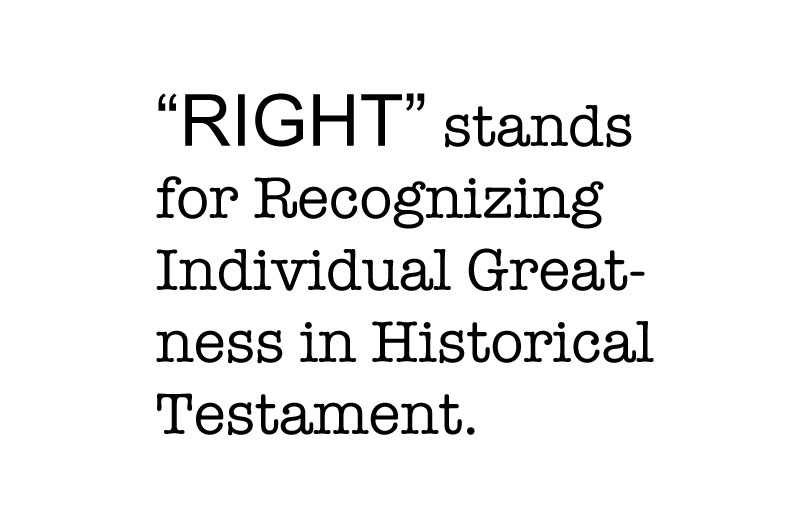
    RIGHT stands for Recognizing Individual Greatness in Historical Testament.

    RIGHT stands for Recognizing Individual Greatness in Historical Testament.  This concept was given to me as an epiphany on the early Sunday morning of Jan. 23, of 2005 and employs a biblical standard that embodies the concern over the historical bias in naming patterns and the contemporary artificial barriers limiting the expansion of ownership identity of public properties, to the least among us.  RIGHT seeks to re-evaluate the standards of heroism and societal acceptance of those who may have been deemed not to be valued or worthy of having their names adorn public facilities.   RIGHT advocates a proactive effort in naming public properties that is more reflective of the diversity within the community and that acknowledges from a historical perspective the merit of greater inclusion with regards to race, gender, ethnic and national origin in expanding ownership identity.

    The declining prospects for saving the Loveland Predestinarian Baptist Church falls within the parameter of Doing the RIGHT Thing.

    The declining prospects for saving the Loveland Predestinarian Baptist Church falls within the parameter of Doing the RIGHT Thing. My personal remembrances and the family legacy associated with that church,  that I had attended as a child, and my father before me, and His mother before him, my grandma Esther, who had been my Sunday School teacher.  Her mother Cynthia the teacher later married John W. Hannon who would pastor the Loveland church for nearly fifty years.  Cynthia’s, mother was Lucy Sams Ross who was born a slave in Kentucky and had weathered many storms of life in the form of personal losses, social indignities and political denials, but her faith was her refuge and shortly after migrating to Ohio she became a founding member of the Loveland Predestinarian Baptist Church in 1892.  https://lovelandmagazine.com/2012/07/a-historic-review-of-chest-street-church.html 

    In the release of Book III of Lucy’s Story the cover painted by wife Linda, depicts two women-one white and one black (Helen Medert & Mary Sidney Wells) two ‘prayer warriors’ during the 1913 Loveland Flood. My great uncle Dee Ross, the son of Lucy and brother to Cynthia, was a hero of that 1913 flood story in Loveland but I believe, he went unrecognized for his heroism due to his skin color, but I am committed to telling his story and OUR Story while ‘keeping the faith’ and doing the RIGHT thing. 

    I have gifted my fellow inductees with a copy of Book II of Lucy’s Story Between Two Suns: The Berean Experience and I wish to donate a copy of Book III of Lucy’s Story to the Loveland High School Library as a donation by Linda Slusher.

    As I prepare to take my seat, I’ll close and ask your consideration of a brief poem titled:

    YOUR ANCESTORS

    If you could see your ancestors all standing in a row.

    Would you be proud of them? Or don’t you really know.

    Strange discoveries are often made, climbing the family tree.

    Sometimes one is found in line who shocks the progeny.

    If you could see your ancestors all standing in a row.

    Perhaps there might be one or two you wouldn’t care to know.

    Now turn the question right about and take another view.

    When you shall meet your ancestors, will they be proud of you?

    (Author unknown)


    Follow this LINK to hear Lawrence Hamilton III introducing his father.


  • Loveland Schools’ distinguished alumni honored at annual dinner

    Loveland Schools’ distinguished alumni honored at annual dinner

    FOUR TO BE INDUCTED IN SEPTEMBER

    Loveland, Ohio – For many years, Loveland Schools have produced outstanding graduates who have excelled in their professional and personal lives and have had an impact on their communities, society, and the lives of others on a local, national and global level. It is the purpose of the Loveland Schools Foundation to identify these individuals, recognize then and to make current Loveland students, employees of the school district and the Loveland community as a whole aware of their qualities and accomplishments. The following four individuals will be inducted into the Loveland Schools Foundation “Hall of Fame” on Friday evening, September 21, at the Oasis Golf and Conference Center.  

    COLONEL (DR.) JEFFREY SCOTT CALDER

    Colonel (Dr.) Jeffrey Scott Calder, Loveland Class of 1984, received his commission from the Reserve Officer Training Corps graduating from Miami University in 1988. He earned his medical degree from The Ohio State University College of Medicine in 1992 on a Health Professions Scholarship. He completed residency in general surgery at Wright State University in 1997. After moving up the ranks from Staff General Surgeon he received his promotion to Colonel in May of 2010.  

    He has attended the Air War College, and the Aerospace Medicine Primary Course as well as others as he continued his Professional Military Education.

    Scott has served both at home and abroad, accepting his first overseas assignment to Misawa AB, Japan in July 1997. Later he was assigned to Bitburg AB, Germany where he was the Surgical Services Flight Commander. He served in Oman in support of Operation Enduring Freedom and later in Afghanistan and Italy. American shore assignments have included Barksdale AFB, LA, San Antonia – Lackland, Texas and Florida.

    He holds an Unrestricted Medical License from the State Medical Board of Ohio, is Board Certified, American Board of Surgery and is a Certified Physician Executive.

    During his years of service Colonel Calder has received numerous decorations and awards:  Meritorious Service with five oak leaf clusters, the Air Medal, The Air Force Commendation Medal, the Army Commendation Medal, The Humanitarian Service Medal, the NATO Medal, as well as 13 additional decorations and eight Awards for leadership and excellence in his service to our country.

    Colonel Calder is a fellow, American College of Surgeons, a Certified Physician Executive, American College of Physician Executives and is board certified in General Surgery.  He is a Senior Flight Surgeon with 409.5 flying hours in 10 aircraft.

    LARRY HAMILTON

    Larry Hamilton is a native of Loveland and a Loveland High School graduate in 1967. He is a retired teacher of African American History, World Studies and Current Events from Piqua, Ohio. Mr. Hamilton is a founding member of the African American Genealogy Group on the Miami Valley and is a presenter on family history and genealogy.

    He was selected for Who’s Who Among America’s Teachers and was awarded the Ohio Tri-County NAACP’s Martin Luther King Outstanding African American Award as well as the state of Ohio’s MLK Cultural Awareness Award in 2005.

    Mr. Hamilton authored a book in August of 2009 titled Lucy’s Story: Right Choices But Wrongs Still Left. Book II of Lucy’s Story became available in November of 2011 and the trilogy was completed with the release of Book III in January of 2013 titled Refuge from the Deluge: On Being Railroaded.  This heroic story commemorates the 100th anniversary of the Loveland/Little Miami Flood of 1913 and a struggle for justice, equality and inclusion in Ohio’s Upper Miami Valley relating to the Randolph Freedmen, one of the largest manumissions in U.S. History.

    He continues to make presentations about his book series, Lucy’s Story, and family history research in support of his interest in genealogy as well as his work for equality among all.

    DAVID LITTERAL

    A 1980 graduate of Loveland High School, David has given over thirty-three years of honorable service to the United States Army Medical Department, culminating as the Commandant of the Army’s Medical Noncommissioned Officer Academy. He has served on the home front as well as in Iraq where he was the Enlisted Personnel Director of the U.S. Army, 10th Combat Support Hospital. He also assisted the Iraqi Government in establishing training programs for Medics, Physicians and Nurses as well as planning and executing the pre-deployment training necessary to ensure mission success at six locations across Iraq.

    David implemented the training programs for Advanced and Senior Leader Noncommissioned Officer Courses for the Army Medical Department which earned a rating as TRADOC Institute of Excellence.

    He received his Doctorate of Psychology in 2014 and was an Adjunct Instructor at both Kentucky Christian University and Morgan Community College. He served as Chief Instructor, Department of Combat Medic Training, Fort Sam Houston, Texas.

    During his many years of service he has acquired numerous medals among which are the Legion of Merit, Bronze Star, National Defense Service Medal, Iraqi Campaign Medal (2 campaign stars) and the Global War on Terrorism Service Medal. Currently David is Director of Military Initiatives for Morehead State University, Morehead, KY.

    KEVIN TAYLOR 

     A graduate of Loveland High School in 1972, Kevin Taylor has devoted his life to teaching, coaching and inspiring youth to attain their highest goals.  A native of Loveland, he has spent over 45 years as a member of the “Tiger Family” as a student, teacher, coach, Assistant Athletic Director and Facilities Manager.  He has been a role model for generations of students and has provided them with lifelong experiences that go beyond the classroom. He provides faculty, staff and students with a sense of history and respect for the “Tiger Tradition.”

    Loveland City Schools produces outstanding graduates who have demonstrated leadership and excellence in their professional and personal lives. Kevin Taylor is this person.

    Mr. Taylor is the founder and chairman of the present Loveland High School Athletic Hall of Fame into which he was inducted in 2016. In retirement he continues to support Tiger athletics. Each year he schedules a banquet and awards ceremony which honors Loveland athletes who, during their high school career, reached high levels of achievement in their chosen sport of sports.

    If you would like additional information about the Loveland Schools Foundation or would like to actively participate, call the Foundation office at  513/774-6228, or email Linda Slusher – Executive Director at slucheli@lovelandschools.org.

    Read more about the Loveland School’s Foundation

    See bios of past honorees


      RP Diamond is the exclusive retailer of LOVELAND HIGH SCHOOL SPIRIT WEAR Welcome to  RP Diamond Printing & Embroidery located at 370 Loveland Madeira Road.