Advocates pledge renewed fight for abortion access
BY: SUSAN TEBBEN AND NICK EVANS – Ohio Capital Journal
As Ohio Attorney General Dave Yost filed court motions to enact Ohio’s six-week abortion ban, a motley bunch of protesters gathered near the Ohio Statehouse on Friday in a tiny sliver of shade cast by the William McKinley statue.
They held signs declaring “abortion is healthcare” or “abortion is a human right.” Another read “our democracy, it is broken.”

Cheri Wells stood next to her one-year-old daughter, Lux, who was strapped into a stroller.
“I brought my daughter down here because this absolutely has everything to do with her, too,” she said.
“It’s taking away her rights to overturn Roe vs. Wade, as well,” she said. “I mean, it’s all about controlling women, period.”
Advocates surge ahead
Advocacy groups and leaders for and against abortion spoke out on the U.S. Supreme Court’s ruling overturning the nationwide right to abortion included in Roe v. Wade.
Religious and anti-abortion groups praised the decision that overturned abortion legalization that had been in place since the early 1970s, and continued their push for prohibitions in Ohio.
“Ohio Right to Life encourages our pro-life legislative majorities and Governor DeWine to be ambitious and end abortion once and for all in our great state,” said anti-abortion lobby Ohio Right to Life’s president Michael Gonidakis.
The anti-abortion groups have state leaders on their side, as Gov. Mike DeWine promised backing for the six-week ban that has been tied up in federal court, and Attorney General Yost put the wheels in motion for that ban to become effective.
In a motion filed less than an hour after the Dobbs decision was released by the U.S. Supreme Court, Yost’s office asked to dissolve the injunction that kept the state abortion ban from going into effect in 2019 when it was passed by the Ohio General Assembly.
“Because there exists no just reason for delay, defendants respectfully request this court immediately dissolve the preliminary injunction and dismiss this case,” Yost wrote in the motion to the U.S. District Court for the Southern District of Ohio.
Later Friday night, a court granted the motion, and Gov. Mike DeWine signed an executive order permitting the Ohio Department of Health to set rules for the law.
Those in the pro-abortion realm are not sitting on their laurels after the much-anticipated decision came through.
In a Friday afternoon press call, members of Planned Parenthood of Ohio said while the ruling had been expected, even before a draft opinion leaked to the public, the results were no less devastating.
“Ohioans should not have to figure out how to safely provide health care for themselves,” said Iris Harvey, president and CEO of Planned Parenthood of Greater Ohio. “It’s an attack on your rights, an attack on your privacy and your freedom.”
Though abortion is now legal at six weeks rather than 20 weeks after a missed period, pro-abortion advocates maintained a message that until a court rules or another ban is put in place, abortion is still legal in the state of Ohio.
Case Western Reserve University law professor Jessie Hill, who has worked on cases defending reproductive rights, said there “are still legal moves to be made” and lawyers intend to continue pursuing options.
One way in which Hill said abortion advocates can move forward is by giving advice that is protected under the First Amendment.
“The state can not, as a general matter, ban truthful, factual information,” Hill said.
Working within the state’s legal system is also in the playbook to keep abortion legal.
“Our in-state strategy ensures that we protect the Ohio Supreme Court, which has been a backstop for securing reproductive justice,” said Rhiannon Carnes, co-founder and co-executive director of the Ohio Women’s Alliance Action Fund.
The group is working with partners to “implement harm reduction measures to ensure that people who need an abortion can obtain the essential health care they deserve,” according to a statement by the OWA. A “voter education plan is also” being launched as the August 2 primary and November general election approach.
“We are all coming together to build independent political power against those stigmatizing abortion and forcing their political objective on our lives and bodies,” Carnes said in the statement.
One Small Step
In the Ladies Gallery at the Ohio Statehouse, a group of anti-abortion activists held a press conference to applaud the Dobbs decision. The room, set aside to honor the achievements of women in Ohio politics, regularly hosts events of all kinds, but the setting wasn’t lost on the speakers.
Beth Vanderkooi of Greater Columbus Right to Life described abortion as a “systemic injustice” meant to discriminate against women.
“True advocates for women’s rights would work together to bring down these injustices rather than tell women that their path to equality, to liberty and to freedom, rests on the dismembered bodies of their dead children,” she said.
The organizers sought to cast Friday’s decision as a watershed achievement for civil rights, comparing it to the reversal of Dredd Scott and Plessy and invoking the words of Martin Luther King, Jr. They also propped it up as a landmark historical event on the order of the moon landing or D-Day.
“It’s one small step for babies,” Created Equal vice president Seth Drayer insisted, “one massive leap for humankind, because Dr. King famously said that injustice anywhere is a threat to justice everywhere.”
While abortion advocates prepare for their next moves, Created Equal’s president Mark Harrington said their fight was far from over. Invoking Winston Churchill, he called the Dobbs decision “the end of the beginning.”
That posture certainly means advocating for greater restrictions or even the elimination of abortion at the state level, but given Justice Clarence Thomas’ suggestion that the court should next revisit rulings on the legality of same-sex marriage and relationships, as well as contraceptives, some worry the right to an abortion is far from the only one under threat.
Despite promising continued action, Harrington distanced his organization from Thomas’ remarks.
“The idea that one justice which we may or may not agree with on these other issues, says that from the bench in his opinion, doesn’t really matter unless the court actually has a case,” Harrington said. “And there’s no future that I can see where that’s actually going to occur in the short term.”
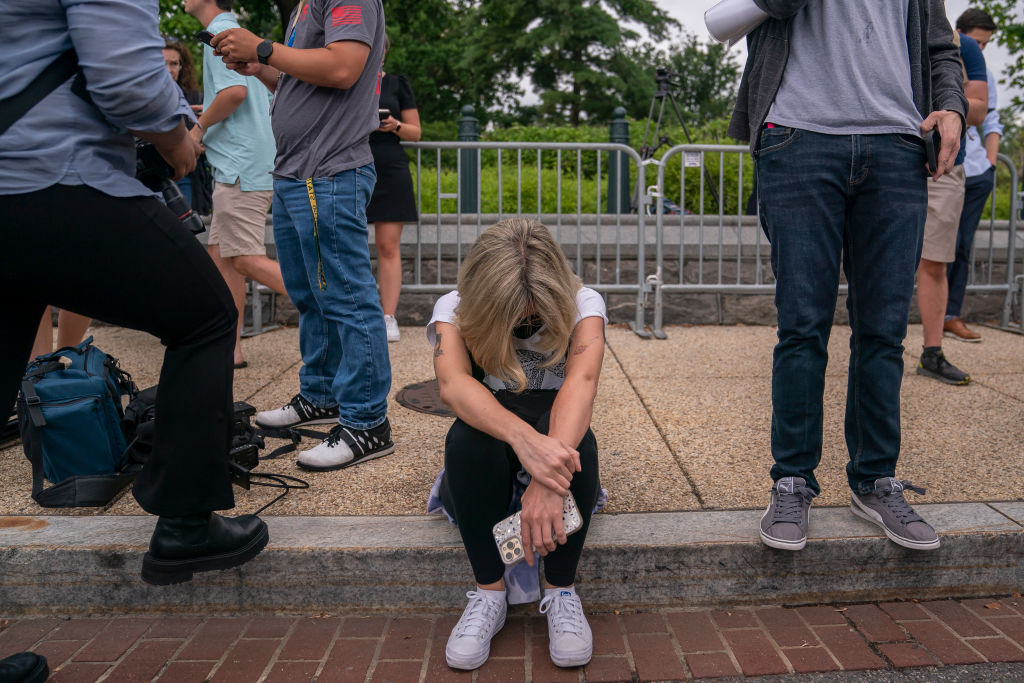
While Harrington and others who spent years fighting abortion look to the future with the wind in their sails, people like Cheri Wells are looking ahead with uncertainty. The leak of Justice Samuel Alito’s draft opinion in Dobbs may have undercut the shock of the decision, but the despair is just as deep.
“For some reason, in the back of my mind,” she said, “I thought someone was gonna save us.”