Loveland, Ohio – The Charter of the City of Loveland mandates that an annual report be prepared and made available to the public. It provides an overview of city finances, personnel, police, fire, public works, and economic development. In addition, the 2024 report highlights capital projects.
On his way out of town, Ohio Democratic U.S. Sen. Sherrod Brown was able to notch one final long-sought legislative victory that will benefit public sector workers in Ohio and around the country. The Social Security Fairness Act ensures former government workers like police, firefighters and teachers can collect their full retirement benefits by repealing two provisions that reduce social security payouts.
Many public sector workers aren’t covered by Social Security because their employer runs a pension program for their retirement. But eventually, a lot of those workers move on to other jobs that do pay into the Social Security system. Even though many of them end up working the requisite 40 quarters to be fully eligible for Social Security benefits, the program reduces their payouts because they’re also collecting retirement benefits from their other pension program.
GET THE MORNING HEADLINES.
William Johnson, who heads up the National Association of Police Organizations explained, “Most police officers must retire after specific time served, usually in their early to mid-fifties, (but) many look for new opportunities to serve their community.”
Those workers are penalized by what’s known as the Windfall Elimination Provision, he explained.
“Instead of receiving full support from their rightfully earned Social Security retirement benefit, their pension heavily offsets it, thus vastly reducing the amount they receive,” Johnson said.
Surviving spouses can come off even worse though. The Government Pension Offset requires reductions in Social Security dependent benefits if one spouse receives benefits from a public pension. Johnson argued that offset often results in “eliminating most or all of the payment.”
Those provision were approved by lawmakers in the 1970s and 80s in a bid to keep the program solvent.
In all, Brown’s office said, the reductions affect 3 million Americans including almost a quarter million Ohioans.
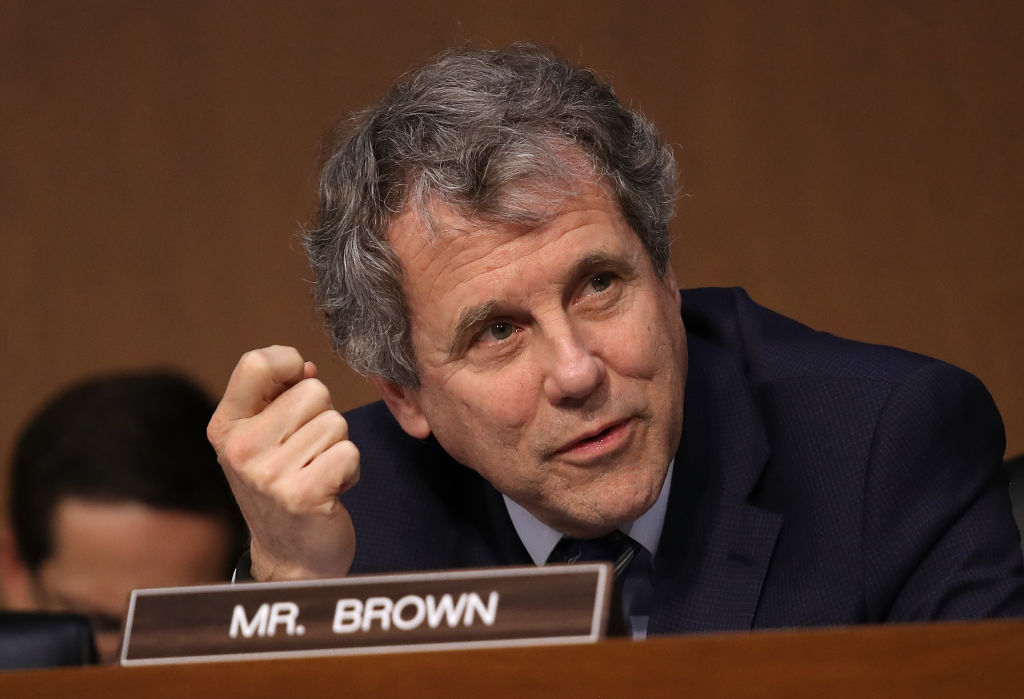
U.S. Sen. Sherrod Brown, D-OH, leading a panel discussion on public workers’ Social Security benefits. (Photo by Nick Evans for Ohio Capital Journal.)
How we got here
Following an election in which Republicans criticized Brown’s long service in Washington, passage of the Social Security Fairness Act offers one data point in favor of experience. Brown held a field hearing in Columbus discussing the proposal earlier this year and he’s been working to pass it since serving in the U.S. House of Representatives.
He last served in that chamber 17 years ago.
In a press release following the vote Brown described working for years to eventually cobble together more than 60 cosponsors.
“We have spent decades working to pass this legislation and tonight is a victory for all the public servants who will finally get the Social Security they have earned,” he said. “Tonight, Congress ensured that police officers, firefighters, teachers, and public servants across Ohio will be able to retire with the Social Security they spent their lives paying into.”
Brown’s effort has also been the beneficiary of shifting attitudes in the Republican Party. For many, many years, a core tenet of Republican politics was searching for a way to get Social Security spending under control. Former House Speaker Paul Ryan’s chief legislative goal was privatizing the program. More recently U.S. Sen. Rick Scott, R-FL, proposed a Rescue America Plan in 2023 that would sunset Social Security and Medicare.
But since the emergence of Donald Trump as the leader of the Republican Party, efforts to overhaul the retirement program have largely taken a back seat. Within weeks of introducing his plan, for instance, Scott backtracked on sunsetting Social Security and Medicare. Last week, he even voted in favor of the Social Security Fairness Act.
It’s not hard to see why. With Trump leading the party there’s no longer a top-down rhetorical push for cutting spending on a popular program. At the same time, traditionally Republican-leaning constituencies like police have a strong case that it’s unfair to limit Social Security benefits they earned simply because they earned other benefits from a different career.
All the same, the measure does nothing to improve the long-term balance sheet for Social Security. The most recent report on the Social Security Trust Fund puts its depletion date at 2033. Meanwhile, although Trump has not proposed cutting retirement benefits he has proposed cutting the taxes that pay for that trust fund—potentially burning through its reserves more quickly.
Reactions
In the moment however, passage of the bill was met with praise from organizations representing public sector workers. National Fraternal Order of Police President Patrick Yoes argued the WEP and GPO are “inherently unfair provisions that unjustly penalize our nation’s public employees.”
“No one, even those who did not vote for our bill today, argued that the provisions treated workers fairly,” he went on. “If this scheme were being run by a pension board or private money management group, instead of the social security administration, they would not call it an elimination of a windfall or an offset — it would be considered embezzlement.”
International Association of Fire Fighters General President Edward Kelly chimed in that “for over 40 years,” firefighters and other public workers have had retirement benefits “stolen” by Congress.
“But today,” he said, “the United States Senate, in a rarely seen bipartisan effort, stood up to say, ‘No more,’ voting to ensure retirees finally get the benefits they paid into and earned.”
Ohio Education Association President Scott DiMauro said, “for too long, the federal government has failed to provide the full Social Security benefits many public school educators earned.”
“For too long,” he added, “potentially great educators have chosen not to enter this profession because they would lose much of the Social Security benefits they had previously earned if they entered a life of public service. That changes now.”
Nick Evans has spent the past seven years reporting for NPR member stations in Florida and Ohio. He got his start in Tallahassee, covering issues like redistricting, same sex marriage and medical marijuana. Since arriving in Columbus in 2018, he has covered everything from city council to football. His work on Ohio politics and local policing have been featured numerous times on NPR.
Ohio Capital Journal is part of States Newsroom, the nation’s largest state-focused nonprofit news organization.
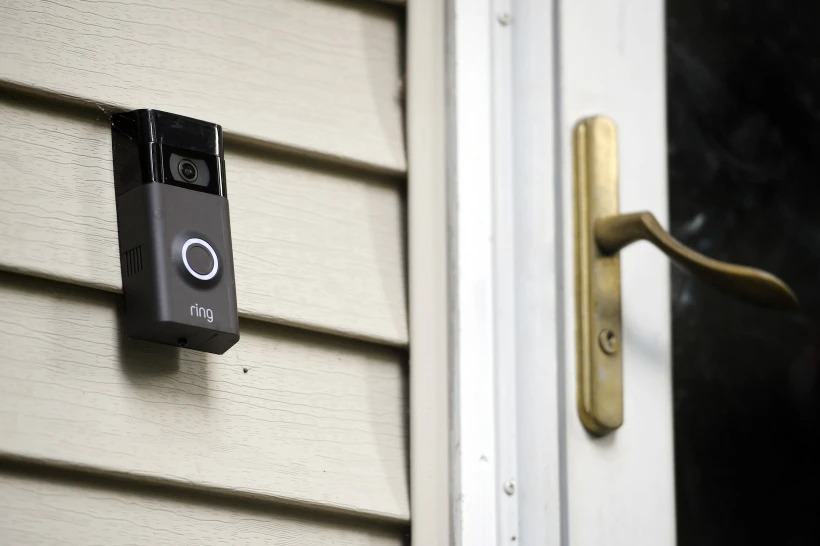
NEW YORK (AP) — Amazon-owned Ring will stop allowing police departments to request doorbell camera footage from users, marking an end to a feature that has drawn criticism from privacy advocates. Read on at the Associated Press
Goshen Township, Ohio – Ohio Governor Mike DeWine announced today that the state will award nearly $4.8 million in grant funding to help local law enforcement agencies across Ohio cover costs associated with body-worn camera programs.
A total of 108 law enforcement agencies will receive funding as part of the third round of the Ohio Body-Worn Camera Grant Program. Of those agencies, 32 will use funding to create new body-worn camera programs and 76 agencies will dedicate funding toward expanding or upgrading existing technology.
Goshen Township will receive $48,421.20.
Governor DeWine created the Ohio Body-Worn Camera Grant Program in 2021. In total, more than 300 law enforcement agencies have received funding as part of the program, including over 200 law enforcement agencies that received nearly $10 million in grants in the 2022-2023 biennium. The Ohio General Assembly allotted an additional $10 million to the program as part of the current 2024-2025 biennium, $5 million of which will be awarded next year.
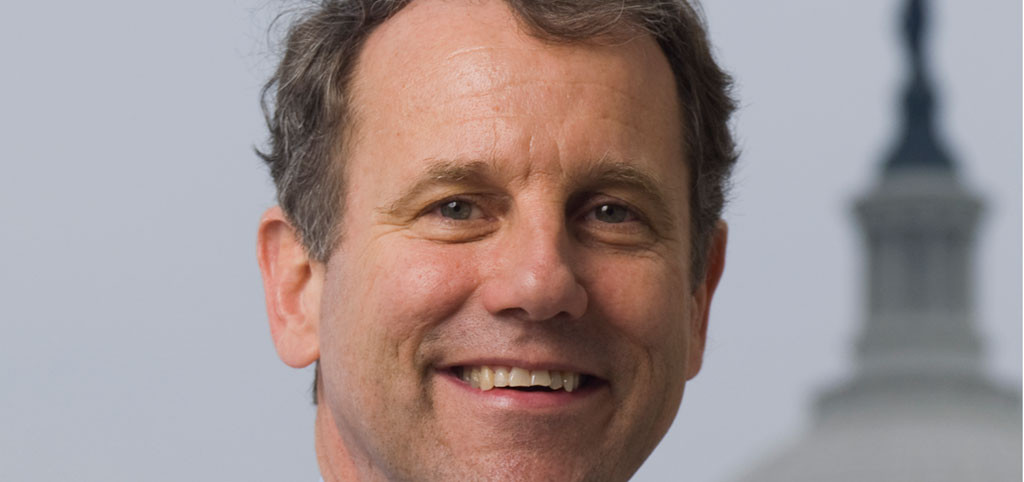
Washington, D.C. – U.S. Senator Sherrod Brown (D-OH) joined a bipartisan group of colleagues to applaud the unanimous Senate passage of his bipartisan legislation to help police, fire, emergency medical, and 911 personnel cope with the stresses of responding to crisis situations. The Fighting Post-Traumatic Stress Disorder Act of 2023 would establish mental health programs for America’s first responders who often have long-term consequences from providing life-saving services in moments of crisis. Brown first introduced the Fighting Post-Traumatic Stress Disorder Act in May 2022 and reintroduced it in January 2023.
“Law enforcement officers and other first responders put their lives on the line each day, facing stressful and often dangerous situations, to protect Ohioans. This legislation will ensure that law enforcement professionals have access to the care they need to deal with the trauma they experience on the job, and keep our communities safer,”Brown said.
U.S. Senator Sherrod Brown
“Law enforcement personnel, firefighters, emergency medical technicians, and 911 dispatchers routinely encounter high-stress situations, putting them at risk of developing post-traumatic stress disorder (PTSD), which increases the risk of suicide,” according to Brown’s office. The Fighting Post-Traumatic Stress Disorder Act would require the U.S. Department of Justice (DOJ) to establish evidence-based treatment programs for first responders across the country. These programs would be similar to services already available to military personnel who develop PTSD or acute stress disorders. The bill requires the DOJ to consult with stakeholders, including public safety officer organizations, to develop the program, which would be available to serve first responders from communities of all sizes.
The bill is cosponsored by Senators Chuck Grassley (R-IA) Chris Coons (D-DE), Todd Young (R-IN), Josh Hawley (R-MO), Maggie Hassan (D-NH), John Kennedy (R-LA), Dianne Feinstein (D-CA), Marsha Blackburn (R-TN) and Richard Blumenthal (D-CT).
Text of the Fighting Post-Traumatic Stress Disorder Act is available HERE.
Miami Township, Ohio – Police have arrested a 23-year-old male, and have charged him with reckless assault for shooting himself and a female. A 24-year-old male has also been arrested and he was charged with tampering with evidence. The incident was first reported by the Miami Township Police at 11: 30 AM.
Task Force One divers were on the scene searching for the gun in a small body of water on the property at 818 Wards Corner Road.
Loveland, Ohio – The Loveland Police Department have reported that approximately 3:32 AM on Thursday December 13 several shots were fired into a home on Marbea Drive. No one was injured.
The Loveland Police Department is at the home processing evidence and visiting neighbors.
Anyone with any information is encouraged to contact Detective Anthony Pecord: Phone: 513-583-3000 apecord@lovelandoh.gov
Bradley Pauley charged with Felony assault and is now in custody
Loveland, Ohio – Loveland Police Chief Sean Rahe told Loveland Magazine on Thursday, “We were just contacted by the Clermont County jail approximately an hour ago. They have Mr. Pauly in custody. I do not have any additional information regarding where or when he was located.”
On April 22, at approximately 2:17 AM a vehicle struck the south side of Zappz bar at 409 Loveland Madeira Road. The driver, and at least one patron were injured. The driver was identified as Bradley Pauley, who was transported from the scene by helicopter for medical care. Andrew Attinger, a patron, was transported by life squad.
Several witnesses reported the driver was involved in an altercation inside the bar prior to the vehicle striking the building. Loveland Police are trying to verify this information, and other evidence in this case. Rahe said, “Please contact Detective Anthony Pecord at the Loveland Police Department if you have any information about this incident.” The Loveland Police can be reached at 513-583-3000.
Pauley was charged with felony assault, a felony of the second degree. Pauley could be facing a prison term of 2-8 years and a $20,000 fine. Felonious assault in Ohio means either knowingly causing serious physical harm to another, or using a deadly weapon to knowingly causing physical harm to another. The court can also impose a class two suspension of the offender’s driver’s license if the deadly weapon used in the commission of the violation is a motor vehicle.
5th annual Loveland Food Truck Rally Saturday, May 12
“Our law enforcement officers, firefighters, and EMS workers put their lives on the line each day to protect us. Increasing access to federal scholarship dollars is the least we can do for the children of our fallen heroes,” said Brown. “We must do all we can to support the families of these selfless men and women that served our communities and made the ultimate sacrifice.”
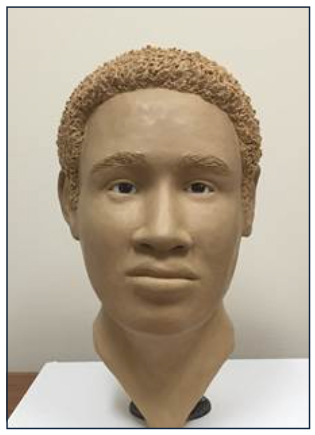
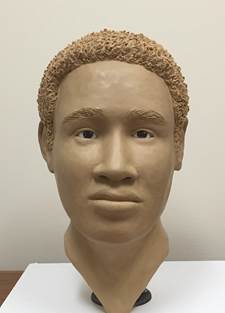
Columbus, Ohio – Ohio Attorney General Mike DeWine, Summit County Medical Examiner Dr. Lisa Kohler, and Twinsburg Police Chief Christopher J. Noga today unveiled the forensic facial reconstruction of a man whose skeletal remains were found more than 20 years ago.
The clay model was created by a forensic artist with the Attorney General’s Ohio Bureau of Criminal Investigation (BCI) in an effort to help Summit County authorities identify the man.
“This person is someone’s son, and there is a family out there who loved him. Now we need the public’s help to find this person’s loved ones some answers,” said Attorney General Mike DeWine. “This facial reconstruction we recently started doing at BCI is a new tool we hope will lead to positively identifying remains in cases like this one.”
His remains were found on February 18, 1982 behind a business at 3047 Cannon Road in Twinsburg. He is believed to be an African American male between 20 and 30 years old and approximately 5’6″ tall. Additional details such as weight, hair, or eye color are unknown.
Items such as hairstyle are the artist’s estimations to complete the reconstruction and should not be considered significant markers for identification.
More than 900 law enforcement agencies today received this bulletin in an effort to bring widespread attention to the case.
“While his remains were discovered in 1982, we believe that his death occurred approximately a year and half before that,” said Chief Christopher J. Noga. “We are really hoping people take a good look at this BCI facial reconstruction. It may lead to us being able to finally identify him.”
BCI’s forensic artist is available to assist local law enforcement with the creation of forensic facial reconstruction models to help identify unidentified skeletal remains. This is the second facial reconstruction created by BCI in northeast Ohio, and the fifth reconstruction statewide. A Greene County Jane Doe was identified as a Florida woman following BCI’s creation of a clay model in December 2016. A Jane Doe reconstruction and John Doe reconstruction were created for two separate, still-unidentified decedents in Marion County earlier this year, and the clay model of a John Doe in an unsolved Akron investigation was created in July.
Missing Persons Unit analysts can also provide case review, investigative assistance, link charts, and mapping.
BCI also offers the Ohio LINK (Linking Individuals Not Known) Program, a free service to police, coroners, and families of missing individuals. The LINK Program was established through the Attorney General’s Office in 1999 to help match DNA taken from family members of missing individuals to DNA from unidentified remains. Samples of DNA submitted by family members as part of the LINK Program are compared only to DNA samples of unidentified remains submitted through similar programs nationwide. There are currently 194 open cases in the Ohio LINK database.
For tips about this Summit County John Doe case or for information about BCI’s Missing Persons Unit call 855-BCI-OHIO (855-224-6446).










![[Video Interviews] Police and witness on felony assault at Zappz Bar](https://lovelandmagazine.com/wp-content/uploads/2018/05/qtq80-mjqcjP.jpeg)



 Missing Persons Unit analysts can also provide case review, investigative assistance, link charts, and mapping.