Loveland, Ohio, and Columbus
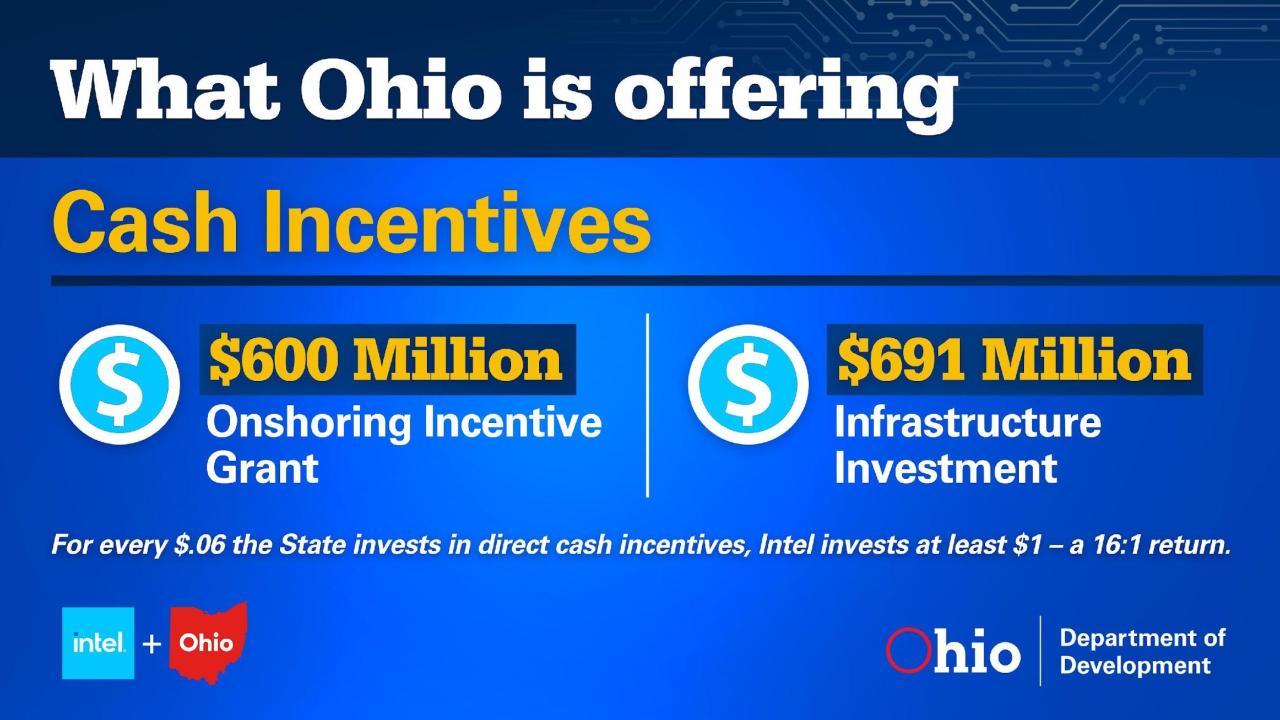
Part of the incentive package offered to Intel by the state of Ohio. (Screenshot from Ohio Dept. of Development presentation)
A new analysis says that 15 new tax breaks — many benefiting wealthy people and corporations — are coming online in Ohio.
That will swell the total cost of tax breaks in the state to $11 billion a year, equal to 37% of the state’s annual revenue, the report by Policy Matters Ohio said.
The new breaks will cost the state an additional $450 million a year as the state has ended a process to review the worthiness of its tax breaks, the report said.
“Tax breaks are ballooning with little oversight,” Zach Schiller, Policy Matters’ research director, said in a written statement. “The General Assembly should restore a tax expenditure review committee, eliminated in the state budget two years ago, and rein in unproductive tax breaks that reinforce inequality in our state.”
A big portion of the new tax breaks will go to Intel as part of a $2 billion incentive package in exchange for an investment of at least $20 billion to build a chip plant in New Albany and create at least 3,000 jobs. The new jobs are good news for Ohio, but some economic research indicates that in all but a fraction of cases, businesses would make the same location or expansion decisions regardless of the tax incentives they’re given.
Meanwhile, the poorest Ohioans shoulder a disproportionate share of the state and local tax burden and House Republicans are proposing to make that burden heavier with House Bill 1, which would flatten that state income tax.
The Policy Matters report said too many Ohio tax breaks favor people and corporations that need them the least.
“While some tax breaks are well-directed, such as the Earned Income Tax Credit, which provides needed aid to low and moderate-income working families, a host of them should be repealed or cut back,” it said. “The business income deduction, also known as the LLC loophole, disproportionately rewards a small number of high-income individuals and costs an estimated $1 billion a year with negligible economic impact. Owners of data centers such as Facebook, Amazon and Google are receiving a sales-tax exemption worth more than $250 million over two years, though these facilities employ few workers.”
The report also called out huge tax breaks to drug wholesalers Cardinal Health, McKesson and AmeriSource Bergen. The companies got those breaks even as the state sued them over claims that they fed and profited from Ohio’s opioid epidemic.
“Suppliers to big drug distributors including Cardinal Health don’t have to pay much or any Commercial Activity Tax, though this was exposed as a tax dodge by the Kasich Administration’s budget director six years ago,” the report said. “Big retailers like Wal-Mart and Target are profiting from the discount on sales tax they collect, as then-taxation department commissioner Joe Testa testified years ago.”
The report also called on lawmakers to resume evaluations of how effective tax breaks are at achieving their stated purpose. While many of Ohio’s tax breaks have been sold as job creators, the Buckeye State had the third-worst job growth of any state between February 2022 and February 2023, according to the U.S. Bureau of Labor Statistics.
“Some tax breaks, such as Governor (Mike) DeWine’s proposed low-income housing tax credit, can be beneficial,” Schiller said. “But the General Assembly should set up a mechanism to rigorously scrutinize the tax breaks we have and cut back on unproductive exemptions and deductions that are proliferating in our tax code.”
___________________________
 MARTY SCHLADEN
___________________________