

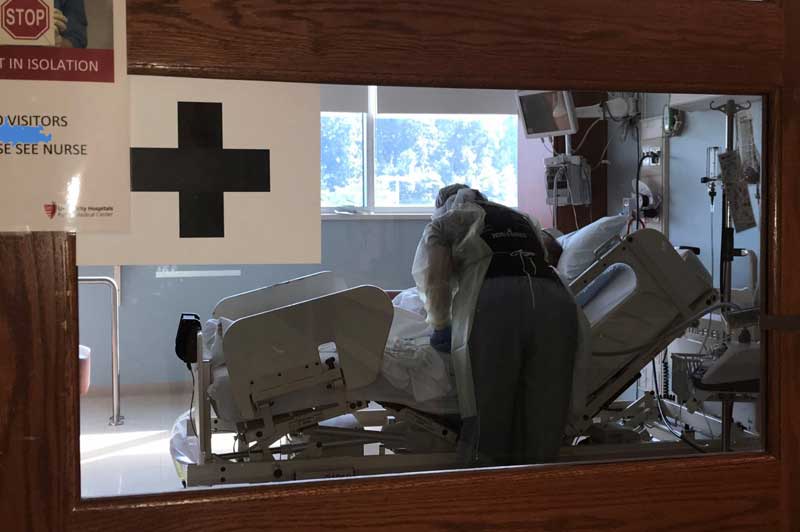
Medical staff tend to a COVID-19 patient. Courtesy of University Hospitals
By Marty Schladen and the Ohio Capital Journal
By many measures, the Ohio coronavirus pandemic is quickly worsening — and that’s before any of the effects of holiday travel and visiting are factored in.
Thursday saw almost 9,000 new cases in the state, with almost 400 new hospitalizations due to COVID-19 and 82 more dead, bringing the toll throughout the pandemic to 6,753.
Also, with 33 new admissions to Ohio intensive-care units, the state now has more than 1,200 coronavirus patients in those beds, many for long stretches.
“That’s been one of the biggest concerns around the state right now,” said Andrew Thomas, chief clinical officer at Ohio State’s Wexner Medical Center. “The hardest area for hospitals to increase their capacity or increase the number of beds is in their intensive care unit.”
“In those intensive care units, right now one out of every three patients has covid,” Thomas said. “If that number continues to grow, that is going to crowd out the ability of non-covid patients to get the care they need in the intensive care unit. Hospitals do not have the capacity to in unending ways grow the number of ICU beds that they have.”
Even worse, perhaps, is that as the number of Ohioans who are tested for coronavirus rises, the percentage of positive results is also rising — to alarming levels. That means the spread of the disease is snowballing instead of levelling off.
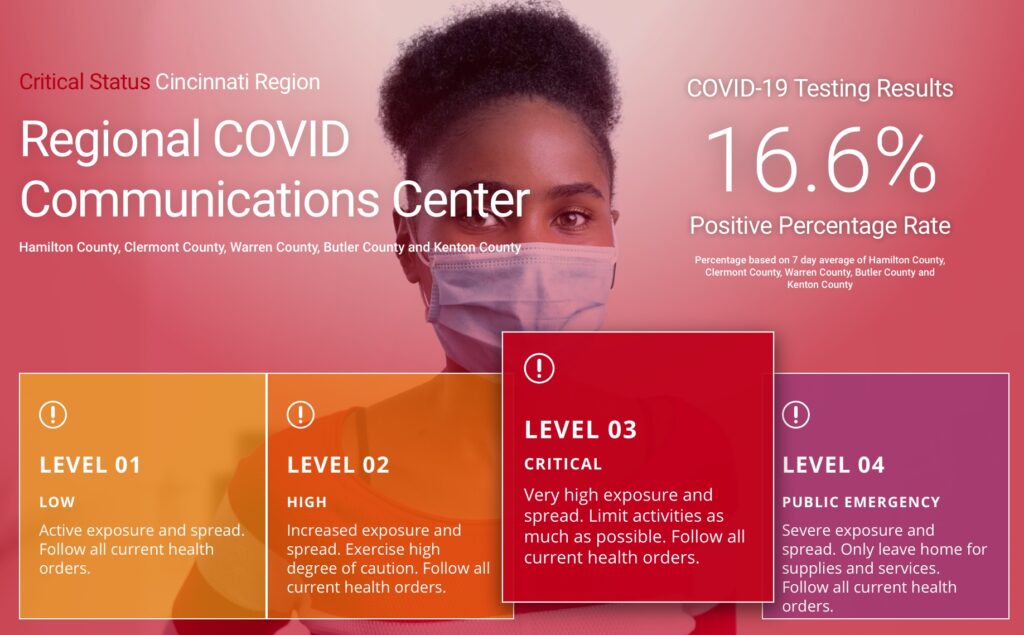
On Tuesday, 16.1% of the 53,000 tested came back positive for the virus, the highest positivity rate since mid-April. Back then, fewer than 5,000 tests a day were available, so they were more likely to be used for people displaying obvious symptoms of the disease.
That and other data combine to show the inexorable march of the disease across Ohio.
The increasing positivity rate prompted Gov. Mike DeWine to add Ohio to the list of states that he warned people not to travel to.
“We warn people about going to any state with above 15% positivity,” DeWine said. “Now we’re one of those states.”
In a press conference hosted by the governor, Thomas and other health officials warned that hospitals across the state already are canceling non-emergency procedures such as knee replacements and diagnostics to keep strained capacity and overworked staff from being overwhelmed by the pandemic.
And the expected surge from Thanksgiving isn’t even showing itself yet.
Thomas explained that from the time of exposure to the onset of symptoms is usually three to 10 days, while the time from exposure to hospitalization is typically seven to 14 day. So that window only began to crack open on Thursday.
“The surge that you’re seeing is not about Thanksgiving,” Thomas said.
When Thanksgiving-related cases begin showing up at hospitals, their numbers are likely to be large. Federal officials reported that record numbers of Americans traveled for the holiday despite admonitions to stay home.
Top U.S. health officials also are forecasting a dire few months ahead — even though vaccines are expected to start flowing in a few weeks, including an initial 98,000 doses to Ohio.
On Wednesday, Centers for Disease Control and Prevention Director Richard Redfield said the United States might see more than half as many covid deaths over the next two months as we’ve seen over the previous nine.
“The mortality concerns are real,” Redfield said. “And I do think unfortunately, before we see February, we could be close to 450,000 Americans (who) have died from this virus.”
Redfield, DeWine and other officials have repeatedly implored Americans to protect themselves and others against the disease, but they’re up against fatigue and a powerful strain of coronavirus denial.
Despite Redfield’s warnings, the Trump White House and State Department both are planning large, indoor holiday gatherings. They’ll be replete with food and drink that will require attendees to remove masks — if they’re even wearing them. In previous White House superspreaders, masks were notoriously absent.
In Ohio, DeWine on Thursday vetoed a bill passed by his fellow Republicans in the state legislature that would gut the governor’s ability to issue health orders in a pandemic.
The GOP-led Ohio House had already shot down a requirement that its members mask up while in the state Capitol.
“Having essential strategies to protect the public against the spread of infectious, contagious disease is not only important in our efforts to eradicate COVID-19, but it is also necessary to help stop the spread of all infectious diseases and prevent future health crises in Ohio,” DeWine said in his veto message.
However, Senate President Larry Obhof said he has the votes to override DeWine’s veto.
Altogether, it would appear that we’re in for a long, painful winter.
“This is not the beginning of the end,” Thomas said. “This is not even the end of the beginning. We are really in a difficult spot here.”

