Ohio Attorney General Dave Yost is appealing a Hamilton County judge’s order blocking the state’s six-week abortion ban indefinitely as the case over it proceeds.
In a news release, Yost’s office said they filed the notice of appeal after consulting with the office of Ohio Gov. Mike DeWine.
The release said the brief arguing its appeal would be filed after the trial court record is filed, as per Ohio law. As of Thursday afternoon, the brief was not available online from the Hamilton County Clerk of Courts.
In an Oct. 7 order, Hamilton County Judge Christian Jenkins said that abortion is health care to which Ohioans have a right.
Jenkins pointed to affidavits that had been submitted to the court by the ACLU and abortion clinics, telling stories of pregnancies that were not viable or caused patients to forgo cancer treatment, but were forced to continue because they were past the six-week gestation mark.
He said Ohio’s constitution does not allow women to be subject to such regulations, and gives no preference to any religion of specific ideological group under “rights of conscience.”
“Ohio’s constitution specifically and unambiguously recognized as fundamental the right to liberty … and the right to seek and obtain safety,” Jenkins said.
Before issuing the indefinite injunction against the ban, Jenkins had previously issued two temporary injunctions of two weeks each.
In arguing against the injunctions, Yost’s office claimed the abortion ban had become the status quo in Ohio after it was implemented at Yost’s request following the U.S. Supreme Court’s Dobbs decision overturning national abortion rights.
The Attorney General’s Office pointed to the case not being filed in the Hamilton County for two months after the law was implemented.
The two-month waiting period came as the Ohio Supreme Court had not yet moved forward on a lawsuit the clinics had filed in its court, but had denied an emergency stay of the ban.
Because of the delay, and harm the litigants said Ohioans were suffering, they asked the state supreme court to dismiss the lawsuit, so it could be moved to the current venue in southwest Ohio. The dismissal was granted.
Ohio’s abortion ban, Senate Bill 23, was passed in 2019 by the state legislature and signed into law by DeWine, but had been blocked by courts until the U.S. Supreme Court decision June 24.
A Hamilton County judge said he needs more time to decide whether or not to put a pause on a six-week abortion ban in Ohio.
Judge Christian Jenkins said in a Thursday hearing that he would not issue an opinion because the court still has questions about how the case moves forward.
“The court would like to investigate the threshold issue of jurisdiction and the effect of the (state) supreme court still not having dismissed the case,” Jenkins said on Thursday.
Abortion clinics moved the case from the Ohio Supreme Court to the Hamilton County Common Pleas Court because, as they said in court documents, waiting for the state’s highest court to make a decision was allowing “irreparable harm to the clinics and the patients” throughout the state.
Representatives for the state argued that the jurisdiction remains with the Ohio Supreme Court, since no dismissal order has been issued.
Temporary restraining orders on laws typically work to stop a law from taking effect, leaving previous standards in place. In this case, the ACLU and Planned Parenthood want to bring back the previous law that banned abortion beyond 22 weeks gestation.
Attorneys for the state countered the request for a temporary restraining order, saying the six-week abortion ban has been effective law for two months, making it the “status quo” in the state.
Law challengers are hoping for a quicker resolution in the lower court, starting with Thursday’s hearing on abortion supporters’ request for a temporary restraining order to be put on Senate Bill 23, the 2019 law that banned abortion in Ohio after six weeks gestation.
“Every day that SB 23 remains in effect, more and more pregnant women are forced either to attempt to travel hundreds of miles out of state to access care, or to continue pregnancies against their will, or to attempt to self-induce abortion outside the medical system, all at risk to the physical, mental and emotional wellbeing,” said Jessie Hill, lead counsel for the ACLU of Ohio, told the judge.
The clinics are not only challenging the law as a violation of the right to abortion, but also as an equal protection violation, based on the fact that the law only applies to those who can become pregnant.
The law had been tied up in courts since it was passed by the General Assembly in 2019, and signed by Gov. Mike DeWine. But the U.S. Supreme Court’s ruling in Dobbs v. Jackson this year, overturning the 1970s decision in Roe v. Wade legalizing abortion nationwide, opened the door for the state to implement the law. At the request of state Attorney General Dave Yost, a federal court dissolved the injunction keeping the state law from being enforced just hours after Roe v. Wade was overturned.
t appears that a 10-year-old rape victim had to leave Ohio for an abortion. But Ohio Gov. Mike DeWine isn’t commenting on the fact that a law he signed making that necessary if she didn’t want to become a mother.
Shortly after the U.S. Supreme Court overturned Roe v Wade and cleared the way for the law to take effect, the child was on her way to Indiana for an abortion because she couldn’t get one in Ohio, an Indianapolis OB-GYN told the Indianapolis Star. The doctor, Caitlin Bernard, told the paper that an Ohio child-abuse doctor had called, saying the child was six weeks and three days pregnant and needed help.
That was three days after the six-week limit the DeWine-signed law places on abortion in Ohio. It makes no exceptions for women and children who are victims of rape and incest.
The story has made national news. But DeWine seemed unprepared Wednesday to discuss whether legislation he championed is forcing children out of state if they don’t want to have their rapists’ babies.
“Yeah, first of all, I have no more information than you do or anybody does. Reading in the in the paper, it came came as you know, from a story out of out of Indiana from from a doctor over there,” he said as part of a rambling answer to a question from the Cincinnati Enquirer, according to a transcript.
DeWine went on to say it was “gut-wrenching” as a father and grandfather to think about a 10-year-old being raped, and that he hoped the doctors caring for her reported the assault to law enforcement. But he didn’t address the fact that a law he signed put girls like her in such an onerous situation.
In a follow-up on Thursday, DeWine Press Secretary Dan Tierney was asked whether the governor thinks juvenile rape victims who become pregnant should be able to get abortions, or whether he believes they should be forced to carry their pregnancies to term. Tierney didn’t answer directly.
“You have access to Governor DeWine’s recent comments on these issues, including that the only information available on the Indiana matter was from Indiana media reports,” Tierney said in an email. “I do not have further comment for you beyond yesterday’s remarks and the Governor’s numerous and extensive comments since the” Supreme Court decision overturning Roe v Wade.
While DeWine and his spokesman underscored that media reports were all they knew about the incident involving the Ohio 10-year-old, there have been warnings that something like this was likely to happen.
Shortly after DeWine signed the six-week ban in 2019, CBS News reported on an Ohio 11-year-old who was repeatedly raped by a 26-year-old, impregnating her. If the Ohio law was cleared by the Supreme Court, the story said, the girl could be left with few options after six weeks of pregnancy.
The story also describes victim-blaming the child experienced at a “pregnancy care center.” It cited a police report quoting an employee describing the 11-year-old rape victim as “rebellious” and that she “refuses to listen to her mother and runs away from home all the time.”
At six weeks, as many as a third of women don’t know they’re pregnant, and it’s a safe bet that even fewer girls do. And while statistics on pregnancies resulting from rape are sparse, it seems likely that Ohio and other states that don’t allow abortions in cases of rape or incest are going to force more children into the most difficult of situations.
The U.S. Centers for Disease Control and Prevention estimates that about 18 million women experience vaginal rape in their lifetimes and that almost 3 million become pregnant from it. The 2018 research from which those statistics were drawn said it was “the first in over 20 years to offer a nationally representative prevalence estimate of (rape-related pregnancy) of U.S. women…”
That’s an apparent reference to a 1996 paper published in the American Journal of Obstetrics and Gynecology. It was based on a three-year survey of 4,008 women that sought to determine “the prevalence and incidence of rape and related physical and mental health outcomes.”
Its findings relating to young rape victims are not reassuring.
“Among 34 cases of rape-related pregnancy, the majority occurred among adolescents and resulted from assault by a known, often related perpetrator,” an abstract of the study said. “Only 11.7% of these victims received immediate medical attention after the assault, and 47.1% received no medical attention related to the rape.”
It added that almost a third of adolescent rape victims didn’t know they were pregnant for 12 weeks — more than double the point at which their abortions would now be illegal in Ohio.
“A total 32.4% of these victims did not discover they were pregnant until they had already entered the second trimester; 32.2% opted to keep the infant whereas 50% underwent abortion and 5.9% placed the infant for adoption; an additional 11.8% had spontaneous abortion,” the paper said.
DeWine and his spokesman were reluctant this week to say whether he thinks young rape victims should be forced to carry pregnancies to term. But his office earlier this month confirmed his support of a bill restricting abortion in Ohio even further — and also making no exceptions for rape and incest.
For Aileen Day, communications director for Planned Parenthood Advocates of Ohio, DeWine owns the consequences of the abortion bills he signs — whether he addresses them directly or not.
“DeWine signed the six-week ban into law and he is the reason the 10-year-old Ohioan had (to) jump through repeated obstacles to get the health care she needed,” Day said in an email. “It is truly disgusting that he’s not being held accountable for all the harm he has caused Ohio. DeWine’s team has bragged that he is the most anti-abortion governor in Ohio’s history and his history backs that up by signing 10 dangerous abortion restrictions and bans into law.”
“If you can’t bring yourself to do that, then please, try to listen a little longer, and seek to somehow, in some way, understand.”
by Stefanie Badders Laufersweiler
I’ve been pregnant 7 times. Four progressed successfully; three did not.
Half of the times I’ve been in the ultrasound room, the news was bad. The first time, a heartbeat was no longer detectable at 10 weeks, but my body didn’t naturally miscarry, so ultimately I opted for a D&C, where my OB removed the fetus. The few weeks that I waited for natural miscarriage were traumatic and sad. I was 28.
The second time I got pregnant, I went in for an ultrasound and a very slow heartbeat was detected—too slow. My OB told me it didn’t look good, but he couldn’t say for certain at that point. I went home and later that evening, miscarried at home, at 6 weeks. I was 29.
I had a healthy pregnancy with our first child, Amy, when I was 30. But, the entire time I fretted. When you have your first pregnancy at that age or older, more odds, complications and viability testing options are shared with you. More risk is involved, and though you aren’t nudged in any direction, they (and you) want to progress with eyes wide open.
I had two more healthy pregnancies, with Paul and Em. Then, at age 39, a chemical pregnancy. I had had some bleeding before that ultrasound; I didn’t bother telling Matt to meet me there. “What’s your due date?” the doctor (not my usual OB) asked me as she prepped me for the scan. “I’ve no idea,” I said. “I don’t do that anymore, because I’ve not always walked out of this room with good news.”
Ben came last, a beautiful blindside, at age 42. It’s the only time I had to sit down to catch my breath after taking a pregnancy test. I was old. We were blessed, everyone would say, but few knew what that pregnancy was like for us. You don’t really ready for a child; you prepare yourself for whatever may come. Miscarriage. Birth defects. Potential loss. And any pregnancy-related trauma you’ve ever felt, mental and physical, comes roaring back. You count on nothing, and brace for anything.
“We all have different experiences and opinions. We all live this life differently, not always by choice. I’m not foolish enough to think my experience will change your mind. I had miscarriages, after all, not abortions. But, every time, I had choices. Choices I’m grateful for, because they were mine to make.“
Every time prior to Ben, after we had a pregnancy or a pregnancy loss, we had to make a decision—not whether to have another child, but whether to put ourselves through the process that may or may not end with a child. And once I was pregnant with Ben—whose conception happened by failed contraception—we had another decision to make: whether to risk future pregnancies, in middle age with a body that had served me well but suffered complications along the way.
We chose a vasectomy for Matt while I was in my seventh month of pregnancy with Ben. I say that out loud because society in general doesn’t do that enough, although we are quite comfortable speaking of contraception and prevention in regards to women.
By age 45, I had fully entered menopause, and I no longer had to worry about getting pregnant. After all of my adult life having to weigh the risks and benefits of taking birth control pills, or using condoms, or trying “natural” prevention, or considering surgery, or taking chances, or hoping the vasectomy “took,” I didn’t have to worry anymore. At 45.
I share this, perhaps oversharing, because many people think they know how they feel about pregnancy. And contraception. And having babies. And abortion. And, most importantly, what they would do. What others should do. What they DID do. Their own experiences. My own experience.
Others speak from experience they don’t personally have, but think they know enough about to judge someone else’s.
We all have different experiences and opinions. We all live this life differently, not always by choice. I’m not foolish enough to think my experience will change your mind. I had miscarriages, after all, not abortions. But, every time, I had choices. Choices I’m grateful for, because they were mine to make.
Give an ear and perhaps some grace to those who’ve been there. Who’ve been in that room where your odds of coming out with a due date are 50/50. Who’ve had a pregnancy they terminated under unimaginable circumstances. Who’ve carried the trauma of losing, or being faced with a painful choice; of having to explain something so personal to others who may not understand or ever have to experience what you did; of having to piece together a life afterward.
Look around you. Talk to women you know, and maybe some you don’t. Ask questions about what pregnancy is like. Better yet, just listen. Hear their stories. Learn their experiences. Not just the happy endings or desired outcomes.
Then support them. Support their right to have some control over what largely feels like something happening TO them, not just IN them. If you can’t bring yourself to do that, then please, try to listen a little longer, and seek to somehow, in some way, understand.
The Ohio Department of Health’s 2017 Annual Abortion Report presents information derived from both the “Confidential Abortion Reports” and “Post-Abortion Care Reports for Complications” in Ohio.
Readers should note that abortion statistics in this report are limited to terminations occurring in Ohio; they do not include Ohio residents who obtained abortions outside the state.
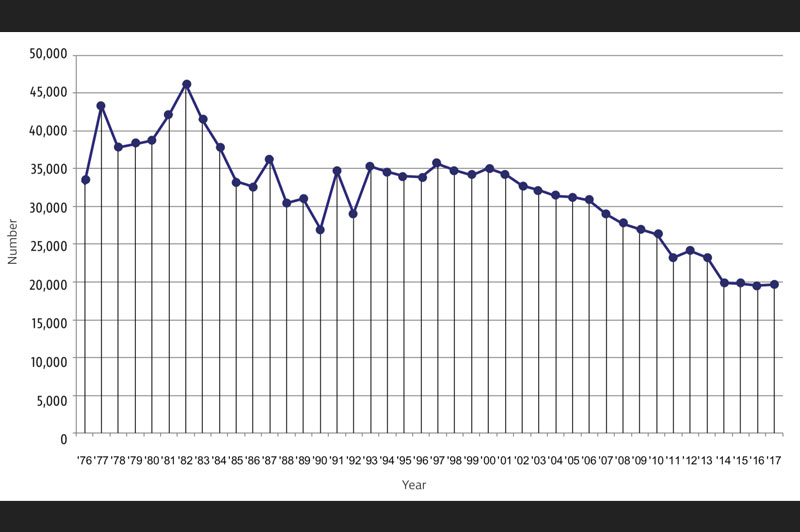
Induced abortion statistics have been prepared in Ohio since 1976. Several trend comparisons in the 2017 Annual Abortion Report date back to 2003. A total of 20,893 induced pregnancy terminations were reported in Ohio for 2017, including 19,615 obtained by Ohio resident women (93.9%). This represents a 1% increase in induced pregnancy terminations from 2016 to 2017. Overall, since 2001 there has been a steady decline in terminations. When examined from 2001 to 2017, the annual decline averaged approximately 830 per year
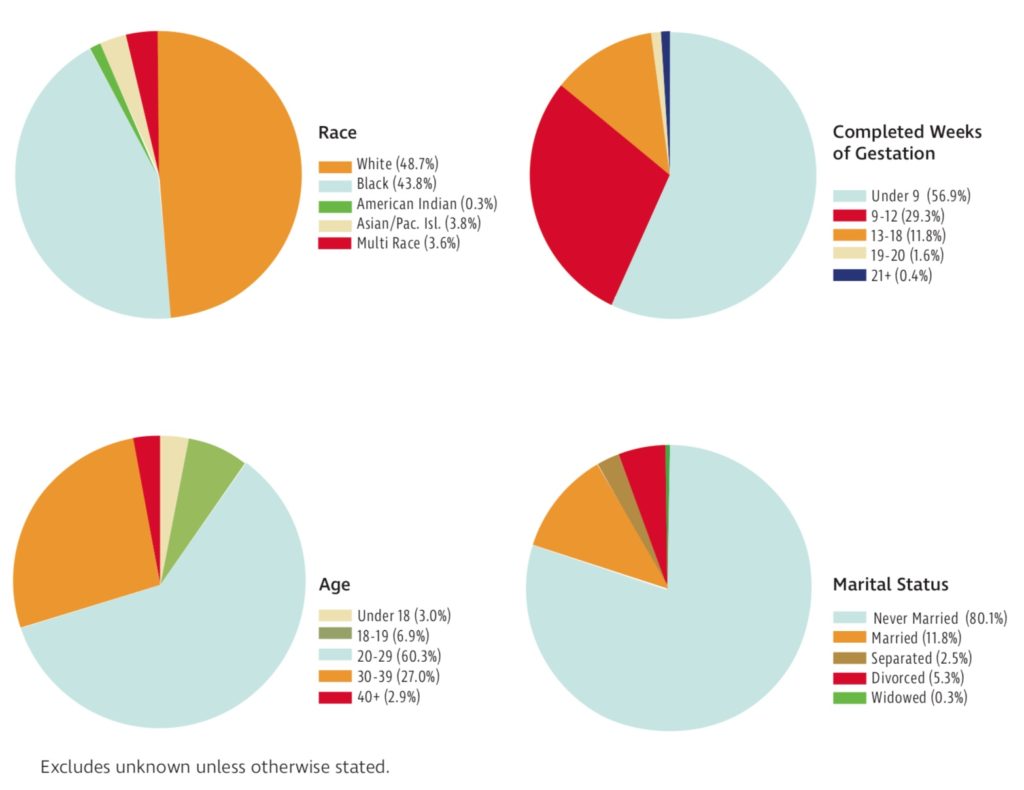
Approximately one in ten women who obtained abortions in 2017 were under 20 years of age, with another one-third between the ages of 20-24 years of age.
While the age distribution of women obtaining abortions has remained relatively unchanged since 2001, the age-specific abortion rates for women under age 25 have steadily decreased. Approximately 85% of women with known marital status who obtained abortions were never married, divorced, or widowed. Fifteen percent of women who obtained abortions and whose marital status was known were married or separated.
Forty-nine percent of resident women who obtained abortions and for whom race was reported were White; 44% were African American; 4% were Asian/ Pacific Islander; and 4% reported more than one race (Figure 2). Five percent of women with known ethnicity who obtained abortions were of Hispanic origin.
The 2017 Ohio abortion rate was 8.9 per 1,000 resident women ages 15-44 years old; unchanged from the rate in 2016. The 2017 Ohio resident abortion ratio was 144 abortions per 1,000 live births; slightly increased from the ratio in 2016.
More than half of all induced abortions involved pregnancies of less than nine weeks (56%), with approximately 29% involving pregnancies of nine to 12 weeks. The proportion involving abortions of less than nine weeks increased from 49% in 1997, while the proportion between nine and 12 weeks declined from 35% to 29%. There were 454 abortions in 2017 involving pregnancies of 19 or more completed weeks of gestation. That represents a decrease from the 508 reported in 2016. The abortion reporting form requests method used to determine gestational age: ultrasound was used in 92% of cases. The vast majority of reported abortions were obtained in six major metropolitan areas of Ohio.
Curettage was the most used method of termination in 2017 (58%). That method has decreased since 2001, when 87% of terminations were by curettage. Mifepristone was reported as the medication for non-surgical termination for 5,279 abortions, followed by 489 terminations using misoprostol, and 40 terminations using methotrexate.





 Forty-nine percent of resident women who obtained abortions and for whom race was reported were White; 44% were African American; 4% were Asian/ Pacific Islander; and 4% reported more than one race (Figure 2). Five percent of women with known ethnicity who obtained abortions were of Hispanic origin.