Tag: Pregnant women

  • Ohio Senate budget attacks poor people on food assistance, affordable housing, and other programs

    Ohio Senate budget attacks poor people on food assistance, affordable housing, and other programs

    COMMENTARY

    by Rob Moore – Ohio Capital Journal

    The Ohio Senate Republican budget passed last week put forth a new vision for social safety net spending in Ohio.

    The proposal suggests reduced spending on food banks, housing for pregnant women, affordable housing, and school meals for poor children. It also proposes making it harder for low-income people to get access to Medicaid, SNAP (formerly known as “food stamps”), and other public benefits.

    These changes to the budget are used to fund income and commercial activity tax cuts.

    When Senate President Matt Huffman was asked about this range of cuts to social services, his explanation was that he is trying to “stimulate” a conversation about sustainability of the Temporary Assistance for Needy Families fund. He expressed worry that the fund would be insolvent in five years if spending and revenue continues at current levels for years into the future.

    So let’s talk about it.

    Temporary Assistance for Needy Families (often shortened to “TANF”) is a relatively small program that mainly provides income to very poor Ohioans. It is the successor to the Aid for Families with Dependent Children (AFDC) program. This was the program that had gained the dreaded label of “welfare” in the early 90s.

    Many politicians did not like AFDC because it gave cash to low-income families. It became a massive dog whistle punching bag for the Reagan administration, who was able to vilify it to such effect that it was ultimately the Clinton administration that finished the program, following up on a campaign promise to “end welfare as we know it.”

    And he did. The new TANF program was a block grant given out to states to not only provide cash assistance, but also to pilot a range of different programs focused on getting people to work.

    Early on, this change was seen as a success. Poverty abated and employment, especially among single mothers, increased. But this was the 90s–a period of economic expansion.

    The subsequent recession of the early 00s followed by the Great Recession of 2007 to 2009 exposed how these changes to the social safety net had made it less resilient and kicked out many of the supports previously in place to hold struggling families up.

    While new programs from the 90s like the earned income tax credit are a good tool for supporting families who have work, they fail when structural problems make work unavailable on a massive scale.

    All this is to say Huffman has a little bit of a point here. Block granting TANF took one of the most straightforward and effective income support programs in U.S. history and capped it, limiting its potential effectiveness greatly. Now the dollars available for supporting low-income families need to come from somewhere else.

    Is the answer to this problem to cut social spending left and right and use that as a tool to fund income tax cuts and cuts to commercial activity? Probably not. If the plan put forth in the Senate is adopted, it will represent a massive transfer of income from the most needy Ohioans to those with the most resources already. Seems like a big cost to try to make a point.


    Rob Moore
    ROB MOORE

    Rob Moore is the principal for Scioto Analysis, a public policy analysis firm based in Columbus. Moore has worked as an analyst in the public and nonprofit sectors and has analyzed diverse issue areas such as economic development, environment, education, and public health. He holds a Master of Public Policy from the University of California Berkeley’s Goldman School of Public Policy and a Bachelor of Arts in Philosophy from Denison University.

    MORE FROM AUTHOR

  • Judge holds off on Ohio abortion ban decision

    Judge holds off on Ohio abortion ban decision

    BY: SUSAN TEBBEN – Ohio Capital Journal

    A Hamilton County judge said he needs more time to decide whether or not to put a pause on a six-week abortion ban in Ohio.

    Judge Christian Jenkins said in a Thursday hearing that he would not issue an opinion because the court still has questions about how the case moves forward.

    “The court would like to investigate the threshold issue of jurisdiction and the effect of the (state) supreme court still not having dismissed the case,” Jenkins said on Thursday.

    Abortion clinics moved the case from the Ohio Supreme Court to the Hamilton County Common Pleas Court because, as they said in court documents, waiting for the state’s highest court to make a decision was allowing “irreparable harm to the clinics and the patients” throughout the state.

    Representatives for the state argued that the jurisdiction remains with the Ohio Supreme Court, since no dismissal order has been issued.

    Temporary restraining orders on laws typically work to stop a law from taking effect, leaving previous standards in place. In this case, the ACLU and Planned Parenthood want to bring back the previous law that banned abortion beyond 22 weeks gestation.

    Attorneys for the state countered the request for a temporary restraining order, saying the six-week abortion ban has been effective law for two months, making it the “status quo” in the state.

    Law challengers are hoping for a quicker resolution in the lower court, starting with Thursday’s hearing on abortion supporters’ request for a temporary restraining order to be put on Senate Bill 23, the 2019 law that banned abortion in Ohio after six weeks gestation.

    “Every day that SB 23 remains in effect, more and more pregnant women are forced either to attempt to travel hundreds of miles out of state to access care, or to continue pregnancies against their will, or to attempt to self-induce abortion outside the medical system, all at risk to the physical, mental and emotional wellbeing,” said Jessie Hill, lead counsel for the ACLU of Ohio, told the judge.

    The clinics are not only challenging the law as a violation of the right to abortion, but also as an equal protection violation, based on the fact that the law only applies to those who can become pregnant.

    The law had been tied up in courts since it was passed by the General Assembly in 2019, and signed by Gov. Mike DeWine. But the U.S. Supreme Court’s ruling in Dobbs v. Jackson this year, overturning the 1970s decision in Roe v. Wade legalizing abortion nationwide, opened the door for the state to implement the law. At the request of state Attorney General Dave Yost, a federal court dissolved the injunction keeping the state law from being enforced just hours after Roe v. Wade was overturned.

    Doctorsmedical studentsabortion rights advocatesreligious leaders and even some of Ohio’s major cities have spoken out about the dangers they say could come from the near-total abortion ban, including unintended consequences that may impact Ohioans in the middle of wanted pregnancies.

    Jenkins said a decision on the temporary restraining order would be released “as quickly as the court is able.”

    Follow OCJ Reporter Susan Tebben on Twitter.

  • The bedeviling details: Roe decision leaves Ohio health providers scrambling

    The bedeviling details: Roe decision leaves Ohio health providers scrambling

    BY: MARTY SCHLADEN – Ohio Capital Journal

    Abortion foes celebrated victory in a 50-year fight on June 24, when the U.S. Supreme Court overturned Roe v Wade and allowed states to severely restrict — or even eliminate — women’s access to abortion. But for those who care for pregnant women, the ideological victory posed a swarm of burdensome questions they haven’t begun to answer.

    Jason Sayat, a Central Ohio OB-GYN, said the Friday the decision came down started as any other. He and his colleagues juggled a full office load with duties in the labor-and-delivery ward. 

    “Then we were hit with the information that Roe v Wade was reversed,” he said, describing how through the rest of the day they dealt with not just patients’ medical conditions, but also their fears about what the cancellation of a constitutional right to abortion meant for them.

    Within hours, the confusion increased when Attorney General Dave Yost filed a motion to lift an injunction against a 2019 Ohio law prohibiting abortions after six weeks of pregnancy — a point at which as many as a third of women don’t even know they’re pregnant

    Sayat said “it really put things dramatically and quickly into focus in terms of how these restrictions were well in place within hours.”

    The six-week ban is far from the only abortion restriction that could be coming down the pike in Ohio. One lawmaker says she has the votes and support of Gov. Mike DeWine to ban almost all abortions, even in the case of rape or incest.

    The flurry of anti-abortion laws and proposals has Ohio’s major health systems on their heels. 

    Individual practitioners such as Sayat, who declined to name his employer, are saying they need to know that Ohio health systems will have their backs in the months ahead. But he said that as of last week, “we’re still waiting for directives.”

    He explained that while the political debate over abortion tends toward the simplistic, caring for pregnant women in the real world is anything but.

    For example, Ohio’s six-week law allows later abortions if there’s a “medically diagnosed condition that so complicates the pregnancy of the woman as to directly or indirectly cause the substantial and irreversible impairment of a major bodily function.” But who determines whether those conditions have been met? The Department of Health? The police?

    “What this has all come down to is the violation or disruption of personal medical decision-making between the decisions of the patient and their trusted health care team or physician,” Sayat said. “It’s so individualized and complex that laws like this can’t apply to that. It’s not as black-and-white.”

    And, he said, in situations where continuing a pregnancy is incompatible with the health of the mother, doctors and patients need to be able to make decisions “without fear of reprimand or imprisonment on felonious charges.”

    The American Medical Association didn’t mince words in the wake of the Supreme Court decision overturning Roe v Wade.

    The organization “is deeply disturbed by the U.S. Supreme Court’s decision to overturn nearly a half century of precedent protecting patients’ right to critical reproductive health care — representing an egregious allowance of government intrusion into the medical examination room, a direct attack on the practice of medicine and the patient-physician relationship, and a brazen violation of patients’ rights to evidence-based reproductive health services,” AMA President Jack Resneck Jr. said the day of the decision. “States that end legal abortion will not end abortion—they will end safe abortion, risking devastating consequences, including patients’ lives.”

    Ohio’s major hospital systems — operating in a state dominated by anti-abortion officeholders — have been much more cautious in their public statements. 

    The Capital Journal last week asked them four questions:

    • Will your organization provide out-of-state abortion care to your employees should they need it?
    • Will it defend practitioners making medically sound decisions — for example, terminating a pregnancy to protect the mother — to the fullest extent should they be accused of violating current or future restrictions on abortion in Ohio?
    • Are you concerned that current or future restrictions might make it more difficult to attract and retain talented practitioners?
    • Does your organization believe that, in restricting abortion, lawmakers and the courts are inserting their religious beliefs into the doctor-patient relationship?

    Many responded by saying they don’t have any answers yet. Tausha Moore of Toledo-based ProMedica gave a typical response.

    “Regarding your inquiry, we are in the process of evaluating recent changes to better understand the impact they will have on health care in the communities we serve,” she said in an email.

    Marti Leitch of Ohio State’s Wexner Medical Center made a similar statement.

    “Ohio State is closely examining the decision from the Supreme Court and changes in state law,” she said. “If necessary, the medical center and College of Medicine will make adjustments to be in compliance with the law.”

    Dorsena Drakeford of Cleveland’s MetroHealth also said her system is also reviewing the situation.

    Amanda Nageleisen of the University of Cincinnati Health System also said it was continuing to review the situation, but “We remain deeply committed to the sanctity of the patient-health care provider relationship and will balance patients’ and health care providers’ interests in accordance with all federal and state laws.”

    It appears that a big question the state’s hospital systems are grappling with involves ending pregnancies when they’re deemed medically necessary.

    “While OhioHealth hospitals and clinics have not and do not provide elective termination procedures, we acknowledge that there are times when the life and safety of a patient may be threatened by acute medical complications, even early in pregnancy,” spokeswoman Stephanie Stanavich said in an email. “We will continue to offer care to our patients within the confines of any new regulatory landscape and always within the best practice standards of care.”

    As the big hospital systems formulate their policies, Sayat, the OB-GYN, said he hopes they keep practitioners in mind.

    “I think that the biggest part is that we as providers need to feel supported and feel like we have the resources to navigate the complexity of scenarios we’re presented with,” he said.


  • Hamilton County reports new developments in the battle against COVID-19

    Hamilton County reports new developments in the battle against COVID-19

    Loveland, Ohio – The U.S. Food and Drug Administration issued an emergency use authorization (EUA) for the third vaccine for the prevention of coronavirus disease 2019 (COVID-19), according to the Hamilton County Department of Health. The EUA allows the Janssen (Johnson & Johnson) COVID-19 Vaccine to be distributed in the U.S for use in individuals 18 years of age and older. The vaccine is administered as a single dose, which will allow vaccination for more people while also providing opportunities for vaccination for groups requiring special consideration, such as the homebound.

    Expanded Vaccine Eligibility
    In response to this significant increase in the amount of vaccine coming into Ohio, Governor DeWine outlined the individuals who are included in Phase 1C and Phase 2 of Ohio’s vaccination plan which will go into effect on March 4.

    Phase 1C:
    Ohioans with certain occupations and with certain medical conditions not addressed in previous phases.

    Medical Groups Eligible in 1C
    Type 1 diabetes, Pregnant women, Bone marrow transplant recipients, and ALS (Lou Gehrig’s Disease)

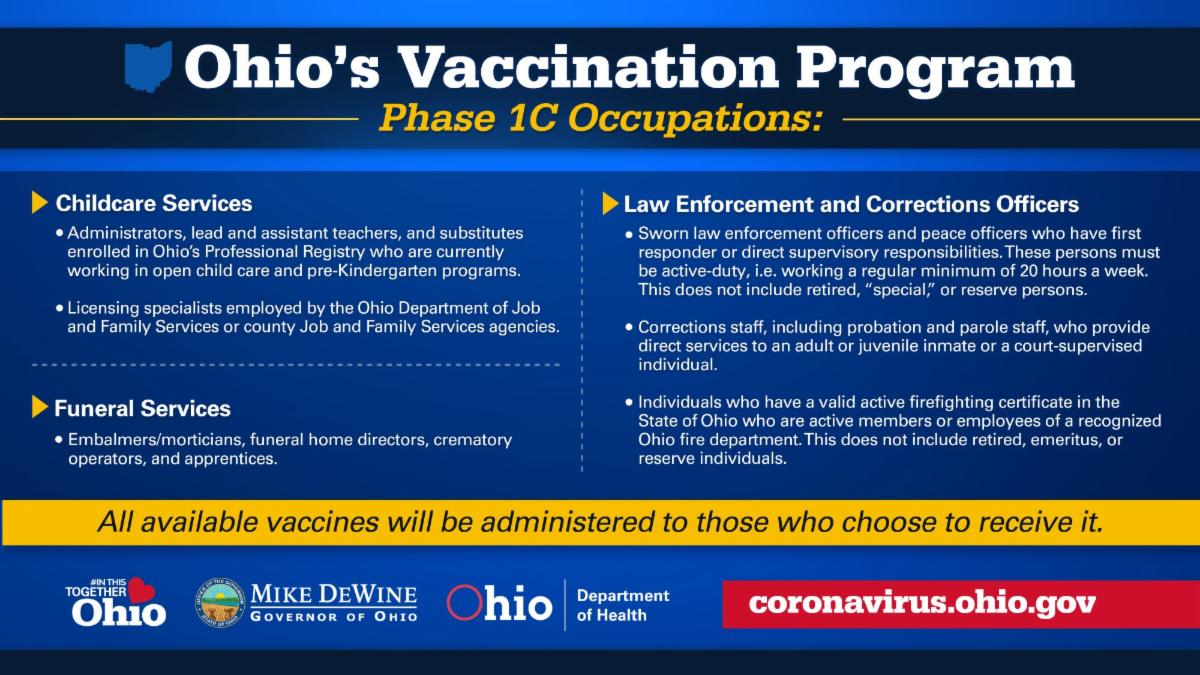
    Occupations Eligible in 1C (see full description in the graphic below)
    Childcare Services, Funeral Services, Law Enforcement, and Corrections Officers
    Follow the hyperlink to read the full press release from the Ohio Department of Health on the expanded vaccine eligibility criteria

    Phase 2:
    Because the risk of more severe reactions and outcomes of COVID-19 increase with age, Phase 2 will open vaccinations based on age, beginning with Ohioans ages 60 and older.

    IF YOU ARE NEWLY ELIGIBLE PER THE EXPANDED GUIDELINES ABOVE:
    The Health Department is asking that you register on their website. They have added these occupations and conditions to the registration that were not previously included.

    Click HERE to re-register*

    If you already registered and do not have a newly eligible occupation or condition per the above you DO NOT need to re-register.*

    Reduced Restrictions
    Last week, Governor Mike DeWine announced that sporting and entertainment events will be able to reopen with 25 percent maximum indoor capacity and 30 percent maximum outdoor capacity, provided they follow established precautions such as mandatory mask wearing for employees and customers, spectator pathways that allow for social distancing, and seating in groups in six-foot intervals of no more than six people from the same household.

    General admission (lawns, standing room, infields) will be permitted if masks are worn and if six-foot distancing can be marked and maintained.  New guidance for proms, banquets, wedding receptions, fairs, festivals, and parades is forthcoming.
    *If you are needing a vaccine appointment please do not unsubscribe. Unsubscribing will disable our ability to contact you for appointments.
    VISIT THE HCPH COVID-19 PAGE