Editor’s Note: An attendee and her husband who walked the venue reports: “We counted around 900. I know a lot of people had been there earlier and already left so I’m sure it got decently over 1000 during the day.
Loveland, Ohio – A thousand Loveland Area residents with a hundred grievances lined a 1/3 mile stretch of Loveland Madeira Road centered in front of the Loveland Primary/Elementary school campus and Shoppers Haven on Saturday afternoon. Not since the Loveland Tigers won the State Division II football championship in 2013 had so many united for a cause. Hundreds more honked horns, showing support as they drove past the rally.
On the same day that tanks and artillery launchers rolled through Washington D.C. on the Army’s 250th anniversary, the day that President Donald Trump turned 79 and wanted a national birthday party for himself, local organizers had called for a “No Kings” rally in Loveland.
The organizing rallying cry was, “NO KINGS is a national day of action and mass mobilization in response to increasing authoritarian excesses and corruption from Trump and his allies. We’ve watched as they’ve cracked down on free speech, detained people for their political views, threatened to deport American citizens, and defied the courts. They’ve done this all while continuing to serve and enrich their billionaire allies.”
FOX News reported that “millions of people were said to have turned out at “No Kings” protest marches in nearly 2,000 cities across the U.S.”
Alt National Park Service reported last night, “We’re honored to report that over 11 million showed up for today’s No Kings protest, and totals are still coming in.”
The committee was designed to reduce barriers to care for people of color, LGBTQ+ people and rural Americans. A new executive order deemed it “unnecessary.”
President Donald Trump has directed the Centers for Medicare and Medicaid Services (CMS) to disband a committee to identify and reduce systemic barriers that people of color, LGBTQ+ people and rural Americans encounter when trying to access government health care programs.
The directive came as part of an executive order on “commencing the reduction of the federal bureaucracy.”
Trump directed the heads of relevant agencies to disband within two weeks entities that include the Health Equity Advisory Committee at CMS, the Advisory Committee on Voluntary Foreign Aid at the U.S. Agency for International Development, the Community Bank Advisory Council at the Federal Deposit Insurance Corporation, and Secretary’s Advisory Committee on Long COVID at the Department of Health and Human Services.
“It is the policy of my Administration to dramatically reduce the size of the Federal Government,” Trump wrote in the order. “This order commences a reduction in the elements of the Federal bureaucracy that the President has determined are unnecessary.”
The establishment of the CMS Health Equity Advisory Committee was prompted by an executive order “On Advancing Racial Equity and Support for Underserved Communities Through the Federal Government” that Democratic President Joe Biden signed on his first day in office.
Xavier Becerra, the head of the Department of Health and Human Services under Biden, published the committee’s charter in July 2024, with the stated goal of making “recommendations on the identification and resolution of systemic barriers in the CMS programs that hinder access and quality for beneficiaries and consumers.”
The committee’s purview included Medicare, the government health insurance program for the elderly and disabled; Medicaid, the government health insurance program for lower-income Americans; the Children’s Health Insurance Program (CHIP) for children from low-income families; and the marketplace of health insurance programs established by the Affordable Care Act. Its mandate included addressing systemic barriers to access that included structural racism, which Trump labeled a “divisive concept” during his first administration.
A December 2024 notice in the Federal Register soliciting nominations for committee members said that the panel would, “focus on health disparities in underserved communities … such as but not limited to Black, Latino, and Indigenous and Native American persons, Asian Americans and Pacific Islanders and other persons of color; members of religious minorities; lesbian, gay, bisexual, transgender, and queer persons; persons with disabilities; persons who live in rural areas; and persons otherwise adversely affected by persistent poverty or inequality.”
Health disparities in underserved communities are well documented, as are disparities in accessing medical care.
Research shows that Type 2 diabetes, a condition that often worsens with age and requires frequent doctor’s visits, impacts Black and Latinx Americans at higher rates than White Americans. Rates are also higher in rural areas, with Alabama, Kentucky, Georgia and West Virginia reporting some of the highest. An April 2024 CMS report showed that Indigenous and Black Americans in particular faced barriers to accessing care for diabetes and related conditions.
In the first month of his second presidency, Trump has focused on reducing the size of the federal government and dismantling diversity, equity and inclusion (DEI) and accessibility (DEIA) efforts within federal agencies. Civil rights groups on Wednesday sued the Trump administration over a series of DEI-related executive orders, arguing they were unconstitutional because Trump both exceeded his presidential authority and because the orders discriminated against Black and transgender Americans.
Researchers have warned that the DEI orders are so broad that they could hamper efforts to study race- and gender-identity-related disparities across a variety of subjects, including health care.
A list of diversity-related words that are allegedly banned from being used by federal agencies has been circulating in Washington. Reuters reported Thursday that some scientists at the Food and Drug Administration (FDA) had been told to stop using the words “woman,” “disabled” and “elderly” in external communications. The White House told the newswire that the agency had misinterpreted Trump’s executive orders.
Trump said in an interview with Fox News this week that “Medicare, Medicaid, none of that stuff is going to be touched.” Hours later, he endorsed a GOP budget proposal in the House of Representatives that would gut Medicaid funding. A White House spokesperson told Politico that “the Trump administration is committed to protecting Medicare and Medicaid while slashing the waste, fraud, and abuse within those programs.”
U.S. Senator J.D. Vance (R-OH) and Ohio Republican candidate for US Senate Bernie Moreno listen as Republican presidential candidate former President Donald Trump speaks during a rally at the Dayton International Airport on March 16, 2024 in Vandalia, Ohio. (Photo by Scott Olson/Getty Images.)
Terroristic threats continued against Springfield officials and public buildings over the weekend and into Monday. In the midst of them, Republican U.S. Senate candidate Bernie Moreno called for the protected status of legal Haitian migrants in Springfield to be revoked and for them to be deported back to their violence-riven country.
The Republican presidential nominee, former President Donald Trump, debates the Democratic presidential nominee, Vice President Kamala Harris, for the first time during the presidential election campaign at The National Constitution Center on Sept. 10, 2024 in Philadelphia, Pennsylvania. (Photo by Win McNamee/Getty Images)
The city in southwestern Ohio has been the center of a national political firestorm after former president Donald Trump in last Tuesday’s debate repeated a debunked claim that Haitian immigrants who have flocked to the community over the past five years were stealing neighbors’ pets and eating them.
The claim has been debunked by public safety officials, Gov. Mike DeWine, and even one of the first people to post it on Facebook. She said she misunderstood what a neighbor told her about “an acquaintance of a friend” whose cat was missing.
Other GOP officials, including Ohio Attorney General Dave Yost, have amplified rumors that Black immigrants to Springfield have been killing and eating geese. Officials said there was no evidence to support that claim, either.
Springfield’s health and education infrastructure has been strained as 12,000 to 15,000 Haitians fleeing chaos in their country have moved over the past five years to what had been a shrinking community. A big reason was the availability of warehouse and manufacturing jobs.
The strains and the influx of immigrants of color has sparked a wave of hatred. An armed neo-Nazi group marched through the city last month, and over the weekend, Ku Klux Klan fliers appeared in Springfield neighborhoods, saying, “Foreigners and Haitians Out.”
Schools, City Hall and other public buildings were evacuated and closed every day since Thursday due to bomb threats, some explicitly tied to the Haitian immigrants. Most recently, two elementary schools were evacuated on Monday after receiving bomb threats, WKEF reported. DeWine said Monday that “at least 33” bomb threats have been made.
Public officials have received death threats, and Mayor Rob Rue, Republican, on Friday blamed Trump and his running mate, Ohio U.S. Sen. J.D. Vance for the strife.
“All these federal politicians that have negatively spun our city, they need to know they’re hurting our city, and it was their words that did it,” Rue told Columbus TV station WSYX.
Despite Rue’s plea, Trump on Friday falsely claimed Springfield had been destroyed by the immigrants, who are in the United States legally, and promised to deport them.
On Sunday, Vance appeared on CNN and defended his false statements about Springfield.
“If I have to create stories so that the American media actually pays attention to the suffering of the American people, then that’s what I’m going to do,” he said, then adding that he was “creating the American media focusing on it.”
Moreno, a Cleveland car dealer who is challenging Democratic Ohio U.S. Sen. Sherrod Brown, went to Springfield on Saturday and called for the legal immigrants’ deportation.
“What’s happened is that Sherrod Brown and Kamala Harris have waved the magic wand, corrupted our immigration system and shielded them through Temporary Protected Status and asylum — two loopholes in our immigration system that were corrupted by corrupt politicians,” Moreno said, according to the Springfield News-Sun.
Asked on Monday if Moreno was concerned that such comments would encourage more hate and further threats, his spokeswoman took umbrage at the suggestion. Despite the Republican mayor’s admonishment, she attacked the press and linked the matter to an apparent assassination attempt Sunday against Trump at one of his South Florida golf courses.
“It is vile that the liberal media is blaming Republicans for these threats in Springfield — with no evidence — when a leftwing lunatic who echoed talking points from Joe Biden and Kamala Harris attempted to assassinate President Trump just yesterday,” the spokeswoman, Reagan McCarthy, said in an email.
Meanwhile, the situation in Springfield continues to be tense.
In addition to bomb threats leveled at schools, government buildings and health care facilities, Rue, city commissioners and staffers have received multiple death threats, WSYX reporter Darrel Rowland posted on X.
In midst of the tension, Rue discouraged a possible visit from Trump, which he is reportedly considering, and one from Vice President Kamala Harris, which hasn’t been mentioned, Rowland also posted.
Spectrum News’s Taylor Popielarz posted a list of public buildings that had been “placed on lockdown, evacuated, closed, or searched at some point over the last week due to threats.” There were 21 facilities, including eight educational institutions, four county buildings, three related to car and driver licensing, two health facilities, and two municipal government buildings.
For his part, Moreno, the Senate candidate, blames problems in Springfield not on false claims by Trump, Vance or himself, but on their political opponents.
“Kamala Harris and Sherrod Brown wreaked havoc on Springfield with their reckless decision to extend (temporary protected status) and allow thousands of unvetted migrants to resettle in Springfield, with no regard for the devastating effects it would have on the citizens of that community,” McCarthy, Moreno’s spokeswoman, said.
Brown isn’t part of the executive branch and the Department of Homeland Security determines whom to grant temporary protected status. So Brown wasn’t involved in that determination for the Haitians in Springfield.
It’s also false that the migrants there are unvetted. The U.S. Citizenship and Immigration Services last month posted a document entitled “Processes for Cubans, Haitians, Nicaraguans, and Venezuelans.” It says that people from those counties receiving temporary protected status must “Undergo and clear robust security vetting.”
For his part, Brown, the senator whom Moreno is challenging, said it’s time to stop politicizing what’s happening in Springfield.
“Springfield reminds me of Mansfield, my hometown,” he said in a Monday post on X. “It’s a proud city with a rich manufacturing history. This community deserves better than to be used as a political pawn. We must work together to keep everyone safe & address the city’s challenges. That’s what I’ll keep doing.”
Moreno is himself an immigrant, moving with his family from Colombia to South Florida in the early 1970s. His father was a politically connected surgeon. Unlike the often-impoverished undocumented, Moreno says, his family came to the United States the right way.
McCarthy didn’t respond to a question asking whether, now that Moreno wants to deport refugees who are here legally, he believes only the wealthy and well-connected should be the only ones eligible to immigrate.
Lynn Tramonte, director of the Ohio Immigrant Alliance, urged public figures to think about the consequences their rhetoric might have.
“I don’t know how the people peddling lies about immigrants can live with themselves,” she said. “Most Ohioans are horrified at their behavior and its consequences. We choose love, not hate.”
Marty Schladen
Marty Schladen has been a reporter for decades, working in Indiana, Texas and other places before returning to his native Ohio to work at The Columbus Dispatch in 2017. He’s won state and national journalism awards for investigations into utility regulation, public corruption, the environment, prescription drug spending and other matters.
Ohio Capital Journal is part of States Newsroom, the nation’s largest state-focused nonprofit news organization.
It now appears that secrets of the most sensitive nature were among the documents former President Donald Trump hung onto after more than a year of entreaties by the government to return them. Having to do with another nation’s nuclear-weapons capabilities, one set of documents in Trump’s possession was so sensitive that only a few senior government officials are allowed to see them and only then on a need-to-know basis, the Washington Post reported Tuesday.
One might think that the most senior Republican on the Senate Homeland Security and Government Affairs Committee would want to know what Trump was doing with those documents and how much his possession of them might have jeopardized national security. But since the Aug. 8 search of Trump’s South Florida club and residence, it appears that the only statement Sen. Rob Portman, R-Ohio, has made about the matter has been to call for a congressional investigation of the FBI.
“As the Lead Republican on the Senate Homeland & Governmental Affairs Committee, I call on @SenGaryPeters to utilize the broad jurisdiction of the Cmte, which includes jurisdiction over the National Archives & Records Admin, to perform oversight on this issue & ensure transparency,” Portman tweeted on Aug. 14.
The Attorney General and the FBI should now demonstrate unprecedented transparency and explain to the American people why they authorized the raid.
Portman quickly followed that with, “The Attorney General and the FBI should now demonstrate unprecedented transparency and explain to the American people why they authorized the raid.”
As the Lead Republican on the Senate Homeland & Governmental Affairs Committee, I call on @SenGaryPeters to utilize the broad jurisdiction of the Cmte, which includes jurisdiction over the National Archives & Records Admin, to perform oversight on this issue & ensure transparency
Many other Republicans — eager to stay in Trump’s good graces — were quick to attack the FBI for conducting the court-sanctioned search. They also attacked the Justice Department for seeking it after trying more voluntary methods to get Trump to return the classified documents.
“I’ve seen enough,” House Minority Leader Kevin McCarthy said in a tweeted statement. “The Justice Department has reached an intolerable state of weaponized politicization.”
Republicans on the House Judiciary Committee, led by Ohio Republican Rep. Jim Jordan, in two separate tweets said, “This is what happens in third world countries. Not the United States,” and, “If they can do it to a former President, imagine what they can do to you.”
And Rep. Marjorie Taylor Greene, R-Ga., simply tweeted “DEFUND THE FBI!”
Portman’s staff didn’t respond to questions for this story. And some observers are confused as to why Portman wouldn’t speak out against attacks on federal law enforcement or call on Trump to explain his actions as he has called for the FBI and Justice Department to do.
“He’s been a real puzzle to me,” Paul Beck, a political science professor emeritus at Ohio State, said last week. “You’d think by the time he decided to retire, he’d kind of freed himself from the clutches of Trump. But for some reason or another, he doesn’t feel that way.”
With his mild, polite demeanor, Portman is far from the Trumpiest member of the Senate. But he has been enthusiastic about some of the former president’s initiatives — particularly the 2017 tax cut.
“But that’s done,” Beck said. “The question now is, what more does he want from (Trump)? It may well be that what Portman wants is for Republicans to retake the Senate in 2022 and maybe… stymie the Biden administration for the next two years.”
Similarly to Portman, former Vice President Mike Pence on Aug. 17 said he was “deeply troubled” by the search of Trump’s club and residence. And he called on Attorney General Merrick Garland to explain more about the Justice Department’s reasons for undertaking the search — which the department has done through subsequent court filings.
But, the Washington Post reported, Pence also called on his fellow Republicans to tone down their rhetoric.
“These attacks on the FBI must stop,” the paper reported Pence as saying. “Calls to defund the FBI are just as wrong as calls to defund the police.”
Pence, whom Trump attacked during the Jan. 6 Capitol riot even as rioters were chanting to hang the vice president, is widely believed to be positioning himself for a presidential run. And he’s taken several other steps to distance himself from the former president.
Is it possible that Portman by contrast is considering becoming a lobbyist post-retirement and he doesn’t want to alienate Trumpworld?
“The question is, where does he want to live?” Beck said. “I don’t know that he’s ready to go back and live in Lebanon, Ohio. Does he want to settle in Washington, D.C. and earn fairly big bucks as a lobbyist? It may well be that to do that he can’t be on the outs with Trump, but he also doesn’t have to be at all aggressive in supporting Trump’s efforts to rescind the results of the 2020 election.”
“You would think that Portman would be distancing himself from Trump,” Beck said. “Maybe he’s doing what Mitch McConnell is doing and that is saying nothing. And McConnell can’t be happy.”
A rapidly rising number of federal lawmakers are calling for President Donald Trump to be removed from office, either through a process outlined in the 25th Amendment or through impeachment.
Democratic Ohio U.S. Sen. Sherrod Brown Thursday called for invocation of the 25th Amendment to hold the president accountable for Wednesday’s riots.
“The cabinet and vice president should immediately invoke the 25th Amendment to remove him from office, to prevent him from doing more damage between now and Inauguration Day,” Brown said in a statement.
The Democratic leaders of the U.S. House and Senate gave their support to calls for his removal that began Wednesday, after Trump incited the crowd of supporters that swiftly became a violent, destructive mob that ransacked the Capitol.
House Speaker Nancy Pelosi on Thursday condemned Trump as having “committed an unspeakable assault on our nation,” and said that if the vice president and Cabinet officials do not seek to remove Trump, that Congress may begin another impeachment process.
“That is the overwhelming sentiment of my caucus,” Pelosi said, calling it an “emergency of the highest magnitude.”
Amid those mounting pressures for his removal, Trump released a video Thursday, finally acknowledging that “a new administration” will begin later this month and that he would focus on “ensuring a smooth, orderly, and seamless transition of power.”
He did not acknowledge any responsibility for the riot, and told his supporters: “Our incredible journey is only just beginning.”
Trump’s tenure is set to end in a matter of days, when President-elect Joe Biden is sworn in on Jan. 20. It’s not clear if House Democrats would be able to act before then to carry out articles of impeachment, but in theory, invoking the 25th Amendment could be done quickly.
Seventeen Democrats on the House Judiciary Committee signed a letter urging Vice President Mike Pence to invoke the 25th Amendment. That group included Reps. Jamie Raskin of Maryland; Steve Cohen of Tennessee; Ted Deutch of Florida; Joe Neguse of Colorado; Mary Gay Scanlon and Madeleine Dean of Pennsylvania; Greg Stanton of Arizona; Cori Bush of Missouri; and Hank Johnson and Lucy McBath of Georgia.
Here’s more on what the 25th Amendment says, and when it has been used before:
Why was the 25th Amendment added?
The 25th Amendment to the U.S. Constitution was approved in 1967, in the wake of President John F. Kennedy’s assassination. It was intended to clarify succession procedures in the event that the president dies, is removed from office, or is “unable to discharge the powers and duties of his office.”
What exactly does the amendment say?
It makes clear that the vice president becomes president if the president dies, resigns or is removed from office, and that a new vice president must be nominated.
There’s also a section on temporarily transferring presidential authority to the vice president, intended for scenarios like the president undergoing anesthesia for surgery.
A final section provides for transferring presidential power if the president is unable to fulfill his constitutional role but he or she cannot or will not step aside. That provision requires approval from the vice president and a majority of either the Cabinet or another body that Congress may designate. Congress has never created such a commission, though Raskin introduced legislation to do so.
The number of Cabinet officials who could be involved in such a discussion shrunk by one Thursday, when Transportation Secretary Elaine Chao — who is married to Senate Majority Leader Mitch McConnell (R-Ky.) — resigned.
When has the 25th Amendment been used?
President Ronald Reagan invoked it once, and President George W. Bush did twice when the men underwent medical procedures. They transferred authority to their vice presidents for a matter of hours, according to the National Constitution Center.
What about impeachment?
Trump already was impeached by the House in December 2019 on charges of abusing his power and obstructing Congress. The Senate acquitted him of those charges in February 2020.
That process is legally complex and typically unfolds over a matter of weeks or months. And Pelosi declined on Thursday to offer a timeline on what comes next. If Trump were to be impeached and found guilty, it would prevent him from being eligible for public office in the future.
Who has signed on to the efforts to remove Trump from office?
A tally from CNN shows more than 30 congressional Democrats in support of removing Trump through the 25th Amendment or impeachment.
Some Republicans have joined. U.S. Rep. Adam Kinzinger, (R-Ill.), has called for Trump’s removal. Maryland Gov. Larry Hogan, another Republican, told reporters Thursday that the country “would be better off” if Trump resigned or was removed.
Biden declined to address calls to invoke the 25th Amendment on Thursday, instead blaming the president for inciting a mob, and labeling the rioters as “domestic terrorists.”
Washington – Democrat Joe Biden’s native state of Pennsylvania on Saturday secured his victory to become the next president of the United States when The Associated Press reported he had gained enough votes there to win the electoral college.
The AP called Pennsylvania for Biden at 11:25 a.m., which gave the former vice president 284 electoral college votes to 214 for President Donald Trump. That tally includes Arizona, which the AP and Fox News have called for Biden, but other news outlets have not due to the narrow margin and remaining ballots.
“JOE BIDEN DEFEATS PRESIDENT DONALD TRUMP,” the news organization tweeted.
“I am honored and humbled by the trust the American people have placed in me and in Vice President-elect Harris,” Biden said in a statement. “In the face of unprecedented obstacles, a record number of Americans voted. Proving once again, that democracy beats deep in the heart of America. With the campaign over, it’s time to put the anger and the harsh rhetoric behind us and come together as a nation. It’s time for America to unite. And to heal. We are the United States of America. And there’s nothing we can’t do, if we do it together.”
Trump, who was at his Virginia golf course Saturday morning, issued a statement vowing to keep contesting the results, accusing Biden of “rushing to falsely pose as the winner.”
“The simple fact is this election is far from over,” Trump said in the statement. “Joe Biden has not been certified as the winner of any states, let alone any of the highly contested states headed for mandatory recounts, or states where our campaign has valid and legitimate legal challenges that could determine the ultimate victor.”
The AP call for Biden came after several excruciating days of mail-ballot counting in a handful of battleground states, where early in-person votes had favored Trump. But an unprecedented number of mail ballots — which Trump had portrayed as fraudulent and urged his supporters not to use — favored Biden, allowing him to overcome deficits in Michigan, Wisconsin, Pennsylvania and Georgia.
Trump has challenged those results, through lawsuits in those critical states and in a statement from the White House Thursday evening, in which he cast aspersions on the vote-counting process without citing any specific evidence for his claims.
“This election is not over,” the Trump campaign legal counsel, Matt Morgan, said in a statement after Pennsylvania’s updated vote totals gave Biden a lead on Friday morning.
Responding to reports that Trump may not concede once the race is called, a Biden spokesman said in a statement Friday: “As we said on July 19th, the American people will decide this election. And the United States government is perfectly capable of escorting trespassers out of the White House.”
Biden made a short public statement late Friday in Delaware, urging patience with the vote-counting process and expressing confidence that he would ultimately be declared the winner.
“The numbers tell us a clear and convincing story: We’re going to win this race,” Biden said.
Ohio Democratic Party Chair David Pepper sent an email to supporters congratulating Biden and Vice President-elect Kamala Harris, and thanking supporters.
“Today we celebrate the end of the Trump presidency and thank every person in Ohio and across the country who played a role in making that happen,” he said. “You were there when your country needed you most.”
Even with the presidential result appearing to be clear, there remain ballots that were received by Election Day to be counted in a number of states. As in every election, states will still be receiving ballots from overseas and military voters, and will need to certify their initial vote totals.
And in Georgia, where Biden also pulled ahead overnight, a recount is expected due to the very narrow margin between the candidates.
Where do the vote totals stand in Pennsylvania?
As of 11:30 a.m. Saturday, Pennsylvania’s state election data showed Biden with a lead of 28,393 votes. That narrow lead had been growing since Friday morning, when Biden pulled ahead after trailing Trump in Pennsylvania’s early vote totals.
The tsunami of mail ballots from more than 2.6 million Pennsylvania voters favored Biden 3 to 1, allowing him a deficit of nearly 700,000 votes late on election night.
The volume of those ballots in a state that had massively expanded access to mail balloting just last fall, combined with rules preventing county officials from starting to open those ballots until Tuesday morning, resulted in a slow counting process.
Legal action from the Trump campaign also slowed down Philadelphia’s counting process. A judge ruled in favor of the campaign’s request for closer access to observe the city’s ballot counting, leading to a two-hour pause Thursday and a shift to only use the equipment where observers could watch, the Inquirer reported.
Philadelphia officials said Friday afternoon they still had 40,000 ballots to tally, estimating it could take several days to finish, according to the Philadelphia Inquirer. State data showed 76,000 mail ballots left to tally Saturday morning.
The Trump campaign did win a favorable ruling from the U.S. Supreme Court Friday evening, when Justice Samuel Alito approved a request from Republicans to require late-arriving mail ballots be segregated from the state’s tallying. But the Pennsylvania Capital-Star reported that state officials already had requested county election officials to do so.
Will Biden’s new lead in Georgia hold?
Pennsylvania wasn’t the only state where Biden came from behind on Friday: He also had notched a slim lead in Georgia, which had grown to 7,200 votes as of Saturday morning, according to the Georgia Recorder. Mail ballots there had been steadily reducing Trump’s lead in what has been a Republican stronghold, and updated tallies from suburban Clayton County pushed him into the lead.
But it may not be clear for weeks who has secured the state’s 16 electoral votes. Georgia’s secretary of state told reporters Friday there will be a recount.
What about Arizona?
Biden has a shrinking lead in Arizona, where he was ahead of Trump by 20,573 votes Saturday morning. That’s down from a lead of 68,000 votes as of Thursday morning, according to the Arizona Mirror.
Arizona also was still sifting through stacks of mail ballots at the end of the week. As of Friday morning, Maricopa County had about 140,000 early ballots left to count, plus nearly 6,000 early ballots that required signature verification, and another 16,000 provisional ballots.
When will Nevada wrap up its count?
Biden had a lead of 22,657 votes as of Friday, according to the Nevada Current, but the state was still far from finished counting.
Clark County, Nevada’s most populous county and also its bluest, still had approximately 63,000 mail ballots to process and count as of Friday morning, the Current reported. Additionally, there were 44,000 identification-required ballots and 60,000 provisional ballots to tally.
Laura Olson Laura covers the nation’s capital as a senior reporter for States Newsroom, a network of nonprofit outlets that includes Ohio Capital Journal. Her areas of coverage include politics and policy, lobbying, elections, and campaign finance.
Heading into Election Day, Ohio appears to be in the midst of a sharp, broadly based spike in coronavirus cases with no end in sight, Gov. Mike DeWine said Tuesday.
Marty Schladen has been a reporter for decades, working in Indiana, Texas and other places before returning to his native Ohio to work at The Columbus Dispatch in 2017. He’s won state and national journalism awards for investigations into utility regulation, public corruption, the environment, prescription drug spending and other matters.
Continuing a trend, the 2,509 new cases reported from the previous 24 hours were a 27% increase over the 21-day average and the 198 new hospitalizations represented a 69% increase over the three-week average for that metric.
And as it is elsewhere in the United States, the virus is spreading into rural corners of Ohio that previously had been spared.
“Right now, 92.8% of Ohioans are living in a county that is high incidence and/or has very high exposure and spread,” DeWine’s office said in a tweet.
Adding to the alarm, the “positivity rate,” or the percentage of tests turning out to be positive for coronavirus, is nearing 6%. That’s about double what it was in late September.
Given the fact that Ohio continues to increase the number of tests that are administered, the higher rate indicates that people are spreading the disease to one another at a pace that is snowballing.
“We have no indication that we’ve plateaued out at all,” DeWine said during his Tuesday coronavirus press conference.
He said he found the situation so alarming that he was calling on medical, government, education and other leaders in each of the state’s 88 counties to work together on strategies to arrest the spread of the disease as cold, wet weather drives Ohioans indoors.
DeWine also had an appeal relating to Halloween and football parties and Thanksgiving gatherings.
“Please reconsider hosting gatherings of any size,” he said.
The dire statements brought the kinds of questions the governor has often faced since he started holding coronavirus briefings back in March.
One was whether he would reimpose orders closing businesses not deemed to be essential. Lt. Gov. Jon Husted said one reason such a move might be unnecessary is that much of the spread happening now in Ohio doesn’t seem to be occurring inside businesses.
DeWine also started to rule out the possibility of another shutdown but then seemed to think better of being too definite.
“We just can’t shut down twice, or we certainly don’t want to do it twice,” he said.
Then, after describing what could happen if the spread of the disease is unchecked, DeWine said things could get so bad that “we will one way or the other be shut down.”
DeWine also faced more questions about statements and actions concerning the pandemic by President Donald Trump and his staff.
One was a proposal to allow uncontrolled spread among populations without other health risks in an attempt to achieve “herd immunity.” If successful, it would mean that such a large chunk of the population would be immune to the virus that it would have a hard time spreading.
The idea has been endorsed by Scott Atlas, a doctor who doesn’t specialize in infectious diseases, but was placed on the White House coronavirus team after Trump saw him on Fox News.
DeWine echoed that on Tuesday, saying, “There’s no reputable scientist I’m aware of anywhere in the world” who thinks herd immunity can be achieved without a vaccine anytime soon.
DeWine was also asked why he greeted Trump at the airport Saturday. Trump was on his way to Circleville for a rally where people crowded together and at which Trump said the coronavirus is being overhyped by the media.
DeWine at first seemed to distance himself from Trump, saying he was merely respecting the dignity of Trump’s office. But then…
“Please understand exactly what it was. It was the governor of Ohio greeting the president of the United States,” DeWine said. “Again, I’ve also endorsed him and I continue to endorse him.”
Jake Zuckerman is a statehouse reporter. He spent three years chronicling the West Virginia Legislature for The Charleston Gazette-Mail after covering cops and courts for The Northern Virginia Daily.
This story was written by Jake Zuckerman with local news added by Loveland Magazine staff.
–
Thursday was Ohio’s worst day of the pandemic and all evidence suggests things are likely to worsen, according to interviews and new state data.
Nearly 2,200 new COVID-19 infections were reported Thursday, the state’s third record breaking day last week.
There were 1,041 Ohioans in the hospital with COVID-19 — about 100 shy of the all-time high set in late July. The COVID-19-hospitalized population has nearly doubled since mid-September.
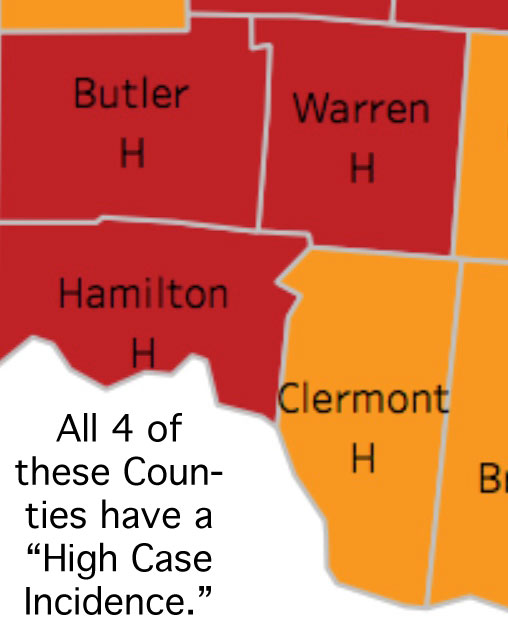
A “Public Emergency” has been declared in RED counties – with very high exposure and spread.
On Thursday, Governor DeWine released Ohio’s updated Public Health Advisory System map. New health data compiled by the Ohio Department of Health found that 29 counties currently have a very high risk of exposure and spread (Level 3): Hamilton, Butler, and Warren are among the “RED” counties.
“We’ve gone up dramatically in a relatively short period of time,” Gov. Mike DeWine said to reporters Thursday.
“What you’re seeing in today’s numbers should get our attention,” DeWine said. “There’s a red tide flowing all over the state of Ohio.”
Thirteen new counties turned red this week indicating “very high exposure and spread” on the Ohio Public Health Advisory System — a product of seven inputs like hospital visits, outpatient care visits in a county, population-adjusted infection rates and others. Twenty-nine counties are red, spanning about two-thirds of the state’s population.
“What you’re seeing in today’s numbers should get our attention,” DeWine said. “There’s a red tide flowing all over the state of Ohio.”
DeWine said some of the newly-turned red counties are slated to host community events like political rallies, pub crawls and social gatherings and that “now is really the time to rethink whether these are in the best interest of the community.”
He did not address his own administration’s decision to exempt recent rallies for President Donald Trump from the statewide mask requirement.
While DeWine said there are no plans in store for any kind of statewide stay-at-home order, he declined to promise against instituting the policy down the line.
All told, nearly 176,000 Ohioans have contracted COVID-19. Nearly 17,000 have been hospitalized, and 5,038 have died since March.
In red counties, health department staff said they continue to see spread at family gatherings like bonfires, birthday parties and barbeques.
Jennifer Hiestand, a public information officer at the Zanesville-Muskingum County Health Department, estimated 60% of people in public are wearing masks. Contact tracers have found “mini outbreaks” that are seemingly the result of people letting their guards down.
In red counties, health department staff said they continue to see spread at family gatherings like bonfires, birthday parties and barbeques.
“People just made the decisions not to social distance or not to wear a mask, those things that they probably should have,” she said.
Mahoning County Health Commissioner Ryan Tekac said he is seeing a lot of the county’s progress this summer start to erode as cold weather drives people inside.
“I think there are some concerns right now that individuals are putting their guards down,” he said.
Ohio’s recent case surge fits in with a national trend. The New York Times reports cases are trending upward in 41 states, especially in the Midwest.
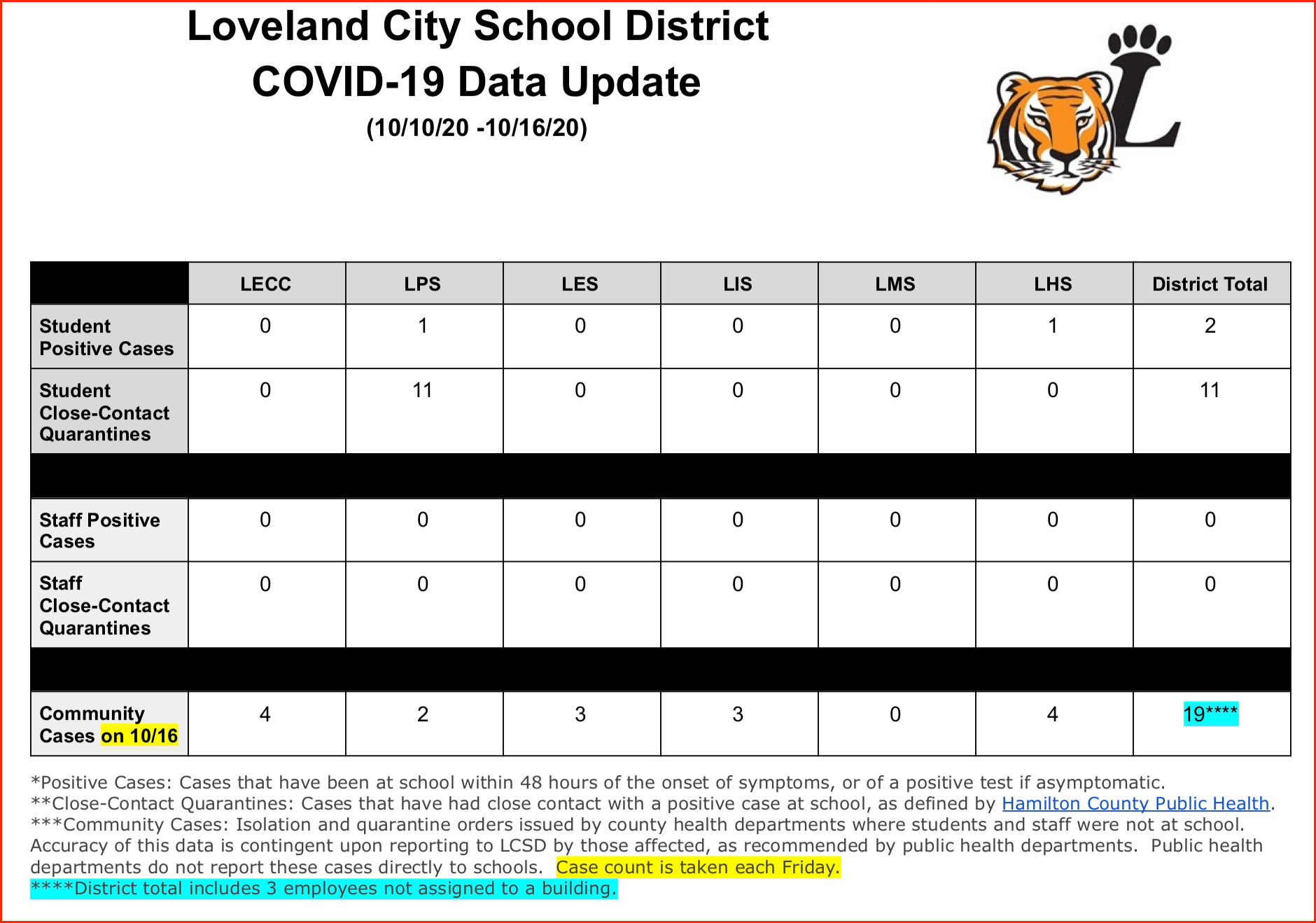
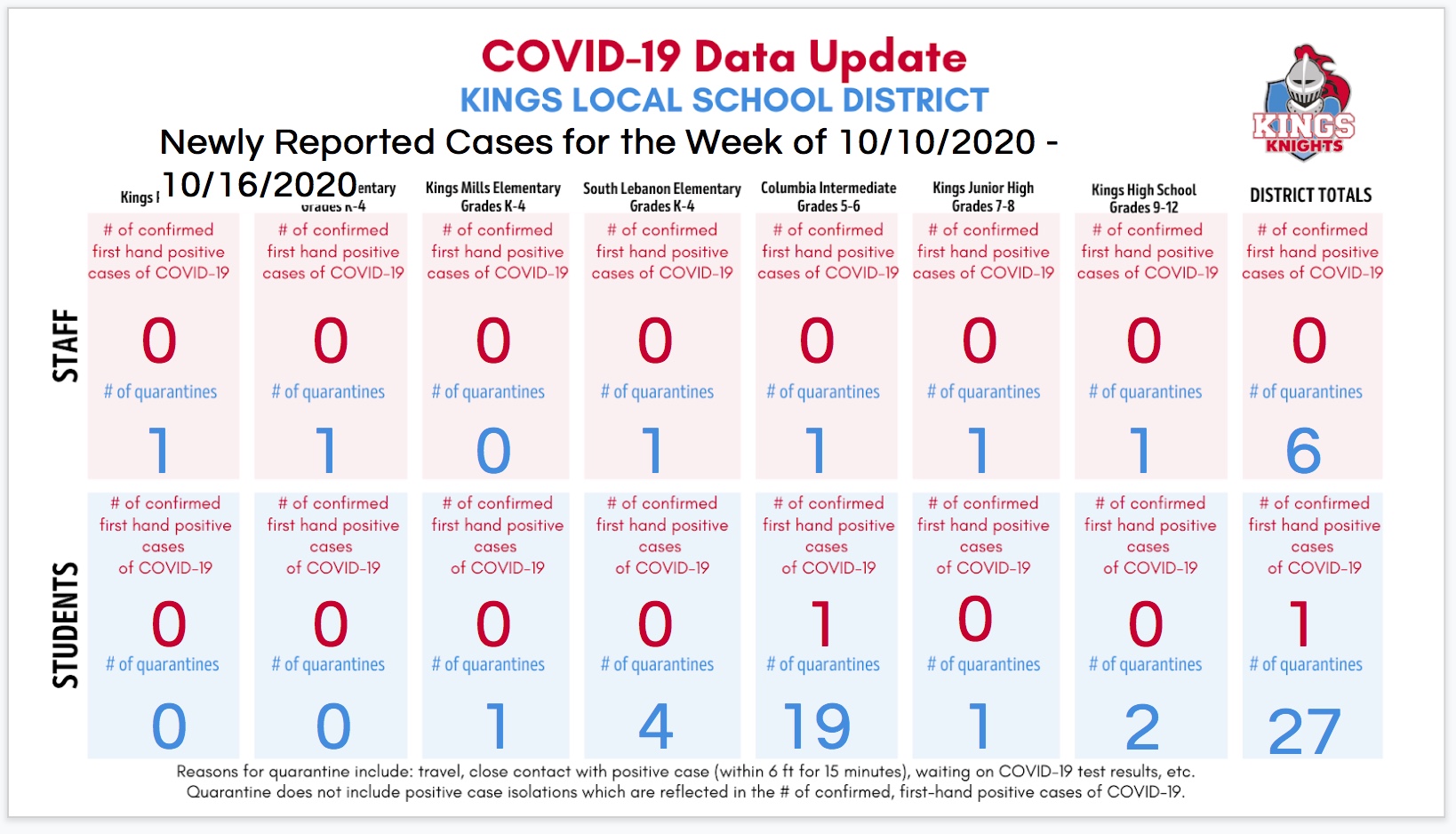
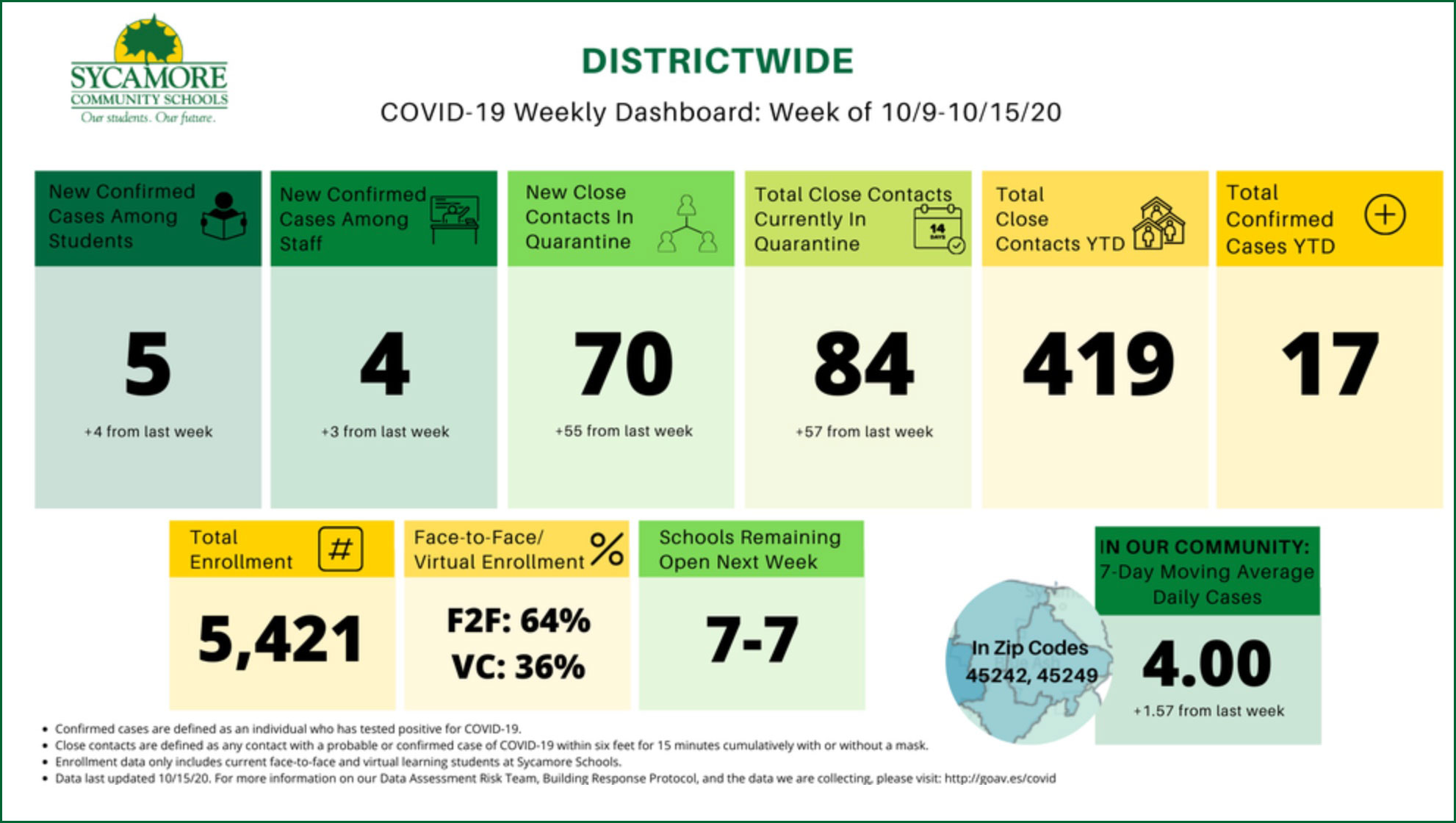
Sycamore Aves mom reminds us of the importance to stay home if you’re experiencing COVID-19 symptoms. These next few weeks will be crucial. Please do your part so we can stay in school!
Two holidays are coming up that will test Ohio’s public health discipline — Halloween and Thanksgiving.
Tekac said there’s a lot of concern, especially with Thanksgiving, about the potential for outbreaks. However, he said people know the guidance; wear masks, keep your distance, wash your hands, outside is better than inside.
He said at a certain point it comes to individuals making their own good decisions.
Dr. Anthony Fauci, the top infectious disease expert at the National Institute of Health, told CBS News it’s an “unfortunate fact” that Thanksgiving will cause a lot of spread and suggested skipping out on the tradition this year.
“I think given the fluid and dynamic nature of what’s going on right now and the spread and uptick of infections, I think people should be very careful and prudent about social gatherings,” he said.
A man protesting Ohio’s health orders at the state Capitol on May 1. Gov. Mike DeWine later repealed most of them only to start reimposing orders on Tuesday as coronavirus cases continued to surge. Capital Journal photo by Marty Schladen
This summer, a cabal of a least 15 extremists meeting in Dublin, Ohio began crafting a violent plan to “storm” the Michigan state Capitol and kidnap Gov. Gretchen Whitmer, law enforcement officials say.
Jake Zuckerman is a statehouse reporter. He spent three years chronicling the West Virginia Legislature for The Charleston Gazette-Mail after covering cops and courts for The Northern Virginia Daily.
The federal allegation, unsealed Thursday morning, details plans of armed assaults on the Michigan State Police, construction of improvised explosive devices, covert meetings held in a Grand Rapids basement accessible by secret trap door, nighttime surveillance of Whitmer’s home, and quasi-military “field training exercises” to prepare for an abduction sometime before the November elections.
“When the time comes, there will be no need to try and strike fear through presence,” Brandon Caserta said Sept. 17, according to prosecutors, opting against attending an armed protest at the State Capitol. “The fear will be manifested through bullets.”
Michigan Attorney General Dana Nessel said to reporters Thursday the group crafted “elaborate plans” that posed a “serious and credible threat to public safety.”
What brought the men to two meetings in central Ohio is unclear: The suspects are all from Michigan and Delaware.
However, the charging document states one paid informant assisted the FBI and secretly recorded the meetings in Dublin on June 6 and July 18. No threats were reported against Ohio government.
At the first meeting, Michigan man Adam Fox and Delaware man Barry Croft huddled for a meeting at an undisclosed Dublin location with 13 other people, including a confidential informant.
They discussed creating a society that followed the U.S. Bill of Rights where they could be “self-sufficient.” They discussed “state governments” they believed violated the U.S. Constitution, and specifically mentioned Whitmer.
They also discussed murdering “tyrants” or “taking” a sitting governor. Fox then reached out to a “Michigan based militia group.” The charging document does not identify the group, though Nessel said affiliates of the “Wolverine Watchmen” were charged.
Fox, working with Croft, met members of the militia group several times in June, including at a Second Amendment rally in Lansing. He later described the Dublin meeting and said he would need 200 men to storm the Capitol to abduct Whitmer.
“Fox explained they would try the Governor of Michigan for ‘treason’ and he said they would execute the plan before the November 2020 elections,” the charging document states.
The alleged conspirators engaged in “field training exercises” in rural Michigan including firearms training and combat drills, and unsuccessfully attempted to construct two improvised explosive devices.
On July 18, the men again met, secretly recorded by an informant, in Ohio. They discussed attacking a Michigan State Police facility and floated the idea of shooting up Whitmer’s vacation home. They eventually settled on kidnapping.
“Snatch and grab, man,” Fox allegedly said. “Grab the fuckin’ governor. Just grab the bitch. Because at that point, we do that, dude — it’s over.”
Prosecutors detailed two episodes of “surveillance” of Whitmer’s home and determined the conspirators considered demolishing a bridge to stave off a police response. An informant provided the FBI with a map of the lake near Whitmer’s home, distance from nearest police departments and estimated response time.
By mid-September, the men successfully detonated an explosive device at a field training exercise.
“I can see several states takin’ their fuckin’ tyrants,” Fox allegedly said. “Everybody takes their tyrants.”
The allegations come amid a time of unprecedented unrest and instability in the U.S., likely a combination of a pandemic, perceived overreach when governments responded, racial unrest, economic devastation of the pandemic, and extremism proliferating on various social media platforms.
Whitmer attracted national attention during the spring and summer for a forceful response to the COVID-19 pandemic. She also drew ire from libertarian and small-government groups for what they saw as overly heavy-handed stay-at-home orders and mask mandates.
In May, hundreds of protesters, many of whom were armed, stormed the Michigan Capitol. President Donald Trump only accelerated instability, calling for Whitmer to “LIBERATE MICHIGAN.”
Political demonstrations this summer have consistently featured armed demonstrators and counter-demonstrators. In Ohio, a violent, self-described neo-Nazi wielded an anti-Semitic sign at a coronavirus protest. Another anti-Semitic sign appeared at a protest outside the home of Ohio’s health director, who is Jewish. She resigned in June.
Earlier this month, the U.S. Department of Homeland Security issued a threat assessment warning of increased extremism in the country.
“The domestic situation surrounding the COVID-19 pandemic creates an environment that could accelerate some individuals’ mobilization to targeted violence or radicalization to terrorism. Social distancing may lead to social isolation, which is associated with depression, increased anxiety, and social alienation, the assessment states.
“Similarly, work disruptions, including unexpected unemployment and layoffs, can also increase risk factors associated with radicalization to violence and willingness to engage in acts of targeted violence.”












 Jake Zuckerman