

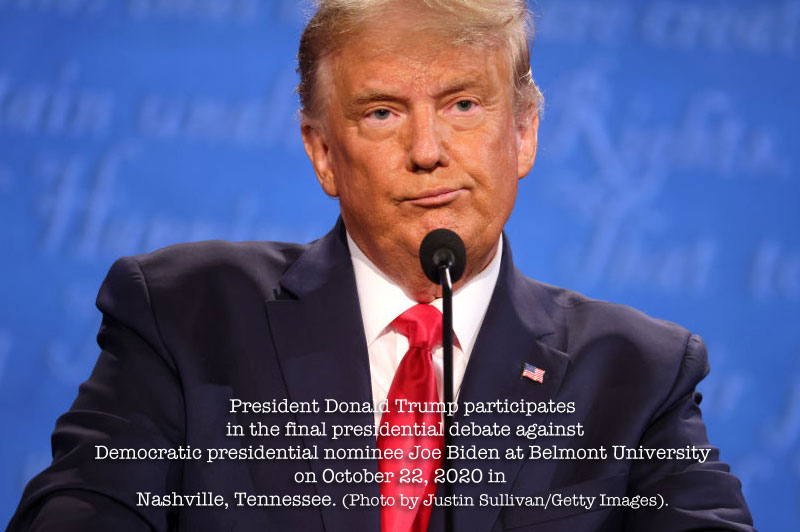
Tag: President-elect Joe Biden

  • How Trump could quickly be removed from office using the 25th Amendment

    How Trump could quickly be removed from office using the 25th Amendment

    By Laura Olson and Ohio Capital Journal

    A rapidly rising number of federal lawmakers are calling for President Donald Trump to be removed from office, either through a process outlined in the 25th Amendment or through impeachment.

    Democratic Ohio U.S. Sen. Sherrod Brown Thursday called for invocation of the 25th Amendment to hold the president accountable for Wednesday’s riots.

    “The cabinet and vice president should immediately invoke the 25th Amendment to remove him from office, to prevent him from doing more damage between now and Inauguration Day,” Brown said in a statement.

    The Democratic leaders of the U.S. House and Senate gave their support to calls for his removal that began Wednesday, after Trump incited the crowd of supporters that swiftly became a violent, destructive mob that ransacked the Capitol.

    House Speaker Nancy Pelosi on Thursday condemned Trump as having “committed an unspeakable assault on our nation,” and said that if the vice president and Cabinet officials do not seek to remove Trump, that Congress may begin another impeachment process.

    “That is the overwhelming sentiment of my caucus,” Pelosi said, calling it an “emergency of the highest magnitude.”

    Amid those mounting pressures for his removal, Trump released a video Thursday, finally acknowledging that “a new administration” will begin later this month and that he would focus on “ensuring a smooth, orderly, and seamless transition of power.”

    He did not acknowledge any responsibility for the riot, and told his supporters: “Our incredible journey is only just beginning.”

    Trump’s tenure is set to end in a matter of days, when President-elect Joe Biden is sworn in on Jan. 20. It’s not clear if House Democrats would be able to act before then to carry out articles of impeachment, but in theory, invoking the 25th Amendment could be done quickly.

    Seventeen Democrats on the House Judiciary Committee signed a letter urging Vice President Mike Pence to invoke the 25th Amendment. That group included Reps. Jamie Raskin of Maryland; Steve Cohen of Tennessee; Ted Deutch of Florida; Joe Neguse of Colorado; Mary Gay Scanlon and Madeleine Dean of Pennsylvania; Greg Stanton of Arizona; Cori Bush of Missouri; and Hank Johnson and Lucy McBath of Georgia.

    Here’s more on what the 25th Amendment says, and when it has been used before:

    Why was the 25th Amendment added?

    The 25th Amendment to the U.S. Constitution was approved in 1967, in the wake of President John F. Kennedy’s assassination. It was intended to clarify succession procedures in the event that the president dies, is removed from office, or is “unable to discharge the powers and duties of his office.”

    What exactly does the amendment say?

    It makes clear that the vice president becomes president if the president dies, resigns or is removed from office, and that a new vice president must be nominated.

    There’s also a section on temporarily transferring presidential authority to the vice president, intended for scenarios like the president undergoing anesthesia for surgery.

    A final section provides for transferring presidential power if the president is unable to fulfill his constitutional role but he or she cannot or will not step aside. That provision requires approval from the vice president and a majority of either the Cabinet or another body that Congress may designate. Congress has never created such a commission, though Raskin introduced legislation to do so.

    The number of Cabinet officials who could be involved in such a discussion shrunk by one Thursday, when Transportation Secretary Elaine Chao — who is married to Senate Majority Leader Mitch McConnell (R-Ky.) — resigned.

    When has the 25th Amendment been used? 

    President Ronald Reagan invoked it once, and President George W. Bush did twice when the men underwent medical procedures. They transferred authority to their vice presidents for a matter of hours, according to the National Constitution Center.

    What about impeachment?

    Trump already was impeached by the House in December 2019 on charges of abusing his power and obstructing Congress. The Senate acquitted him of those charges in February 2020.

    That process is legally complex and typically unfolds over a matter of weeks or months. And Pelosi declined on Thursday to offer a timeline on what comes next. If Trump were to be impeached and found guilty, it would prevent him from being eligible for public office in the future.

    Who has signed on to the efforts to remove Trump from office?

    A tally from CNN shows more than 30 congressional Democrats in support of removing Trump through the 25th Amendment or impeachment.

    Some Republicans have joined. U.S. Rep. Adam Kinzinger, (R-Ill.), has called for Trump’s removal. Maryland Gov. Larry Hogan, another Republican, told reporters Thursday that the country “would be better off” if Trump resigned or was removed.

    Even the president of the National Association of Manufacturers has urged Pence to invoke the 25th Amendment.

    Biden declined to address calls to invoke the 25th Amendment on Thursday, instead blaming the president for inciting a mob, and labeling the rioters as “domestic terrorists.”
  • A presidential election like none other, and now an inauguration like none other

    A presidential election like none other, and now an inauguration like none other

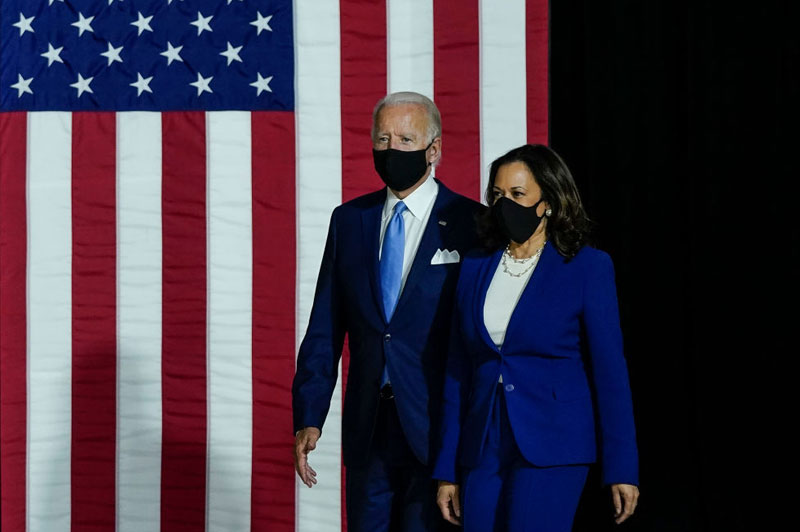
    President-elect Joe Biden and Vice President-elect Kamala Harris. Photo by Drew Angerer/Getty Images

    By Laura Olson and Ohio Capital Journal

    Washington D.C. – As with so many other events during the year preceding it, the inauguration of President-elect Joe Biden will be a ceremony unlike those of his predecessors.

    Tempering the celebratory tone is a directive from Biden’s inaugural team for supporters to refrain from traveling to D.C. for the Jan. 20 swearing-in. Instead, they’ve urged Americans to participate in the inaugural activities from home.

    It’s not yet clear what exactly those virtual festivities will include — or if President Donald Trump will attend Biden’s swearing-in. But the event will be scaled down in size, with an emphasis on safety precautions.

    “First and foremost, my objective is to keep America safe but still allow people to celebrate,” Biden said at a news conference this month.

    The crowd on the platform of the west front of the Capitol will be far less crowded than a typical inauguration. The Joint Congressional Committee on Inaugural Ceremonies typically would be distributing 200,000 tickets, but instead will hand out enough for each of the 535 members of Congress to attend with only one guest each.

    U.S. Sen. Roy Blunt (R-Mo.), who is chairman of the joint committee, said in a statement this month that the ongoing coronavirus pandemic and rising case counts “warranted a difficult decision to limit attendance.”

    Blunt added that the committee is “working on enhanced opportunities to watch the ceremonies online, in addition to the traditional televised national broadcast.”

    “The election of President-elect Biden and Vice President-elect Harris was historic and we know that many Americans would have wanted to attend the inauguration in-person,” said Sen. Amy Klobuchar (D-Minn.), who also serves on the inaugural committee. “At the same time, safety must be our top priority.”

    Biden’s inaugural committee has tapped medical experts to oversee safety precautions, including former Food and Drug Administration Commissioner David Kessler as its chief medical adviser.

    The details released so far have been vague beyond the limited number of tickets. A news release from Biden’s inaugural team described an “extremely limited” footprint for the swearing-in ceremony, and a parade that will be “reimagined.”

    That revamped parade could look similar to the Democratic National Convention’s virtual roll call, which featured video clips of delegates in their home states.

    “There probably will not be a gigantic inaugural parade down Pennsylvania Avenue,” Biden said. “But my guess is you’ll see a lot of virtual activity in states all across America, engaging even more people.”

    Crowded inaugural balls also are likely out of the question due to the pandemic.

    The Walter E. Washington Convention Center that typically would host soirees was once again prepped this month for use as a COVID-19 field hospital.

    Another question looming over the inauguration: What will Trump do?

    Traditionally, the outgoing president and first lady would meet with the incoming first family at the White House, and then ride together to the Capitol for the noontime ceremony.

    But Trump has refused to accept the election results, launching a failed series of legal challenges and posting unfounded claims of election fraud, even after the Electoral College certified his defeat. Asked in a Fox News interview this month if he’ll attend Biden’s inauguration, Trump replied: “I don’t want to talk about that.”

    The last time a president did not participate in their successor’s inauguration was in 1869, when President Andrew Johnson left office and Ulysses S. Grant was sworn in.

  • Trump swipe at DeWine follows year of campaign support, and COVID-19 praise

    Trump swipe at DeWine follows year of campaign support, and COVID-19 praise

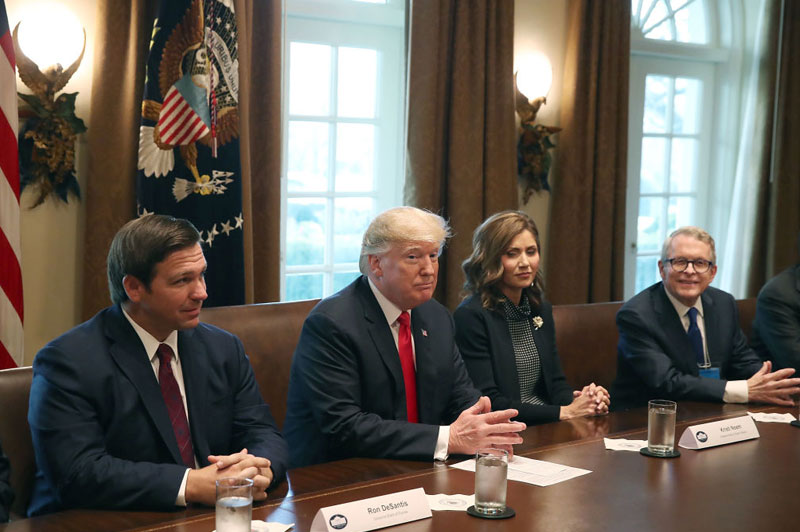
    President Donald Trump meeting with governors, including Ohio Gov. Mike DeWine. Photo by Mark Wilson/Getty Images.


    By Tyler Buchanan

    A year of Gov. Mike DeWine defending the president’s pandemic response and supporting his reelection effort was undone by a brief acknowledgment of reality on cable TV.

    To President Donald Trump, one comment is all it takes for someone to go from political ally to persona non grata.

    On Sunday, DeWine said on CNN that Trump has a right to legally challenge the 2020 election result, but should begin working toward a transition for President-elect Joe Biden. That clip was aired Monday morning on Fox News, a network Trump frequently watches at the White House, leading the president to target DeWine’s own reelection hopes in 2022:

    This tweet to the president’s 89 million followers bookends a year in which DeWine has consistently praised Trump and frequently dodged questions related to the president’s handling of the pandemic.

    DeWine’s office issued this statement in response to the president’s tweet: “I have always had a great working relationship with the President. I am proud to have served as President Trump’s Campaign Co-Chairman in Ohio where we won by the largest margin of any swing state in the country. And I intend to run a winning campaign for governor in 2022.”

    DeWine served as an honorary co-chair to Trump’s campaign in Ohio and recorded a video in support of Trump for the 2020 Republican National Convention. His lieutenant governor, Jon Husted, spoke at a Trump rally in September in favor of the president’s reelection — though the crowd of Trump supporters booed Husted for promoting mask-wearing to prevent COVID-19 spread. 

    While DeWine has emphasized the need for masks and social distancing, Trump has often undercut this public health message by hosting large campaign rallies and downplaying the effectiveness of face coverings.

    DeWine has sidestepped questions from reporters about these contradicting messages, instead choosing to praise the White House for its conference calls with governors and for its work in helping develop a vaccine. 

    The Trump tweet came anyway. 

    The president’s suggestion of a Republican primary comes as DeWine faces increasingly sharp attacks from seemingly all sides regarding his handling of the COVID-19 pandemic. Democratic leaders, who have generally been supportive of the Republican governor and the Ohio Department of Health, want him to take more aggressive steps to slow the spread as Ohio sees record numbers of infections and hospitalizations.

    Republican legislators have dialed up their own criticism of their party’s leader, insisting DeWine should refrain from issuing any further health orders such as business shutdowns.

    DeWine earned very high marks from the general public early in the pandemic for his aggressive response in partnership with then-Ohio Department of Health Director Dr. Amy Acton. That support led to widespread cooperation in the early weeks as the two enacted business closures and a stay-at-home order.

    Support for DeWine has gradually waned in the months since, though a Great Lakes poll in September found a majority of Ohioans still viewed DeWine’s coronavirus response favorably.

    Hours after Trump’s tweet, DeWine did receive a compliment from President-elect Joe Biden at a Monday afternoon press conference. Biden referred to DeWine as a leader in having “stepped up” to issue a mask mandate in Ohio.

    Outside of the electoral ramifications of Trump’s tweet, the public sentiment over the Ohio pandemic approach may impact DeWine’s ability to amass future cooperation for any health orders still to come.

    DeWine has hinted that orders pertaining to bars, restaurants and social gatherings could come as soon as this week. 

    The governor spent early Monday in West Virginia speaking to TV stations which broadcast to the southern and eastern portions of Ohio. DeWine has offered region-specific messages to Ohioans about the virus spike and how residents can slow the spread in their areas.

    With this year’s election now over, some Ohio Republicans have begun turning their attention to 2022. Among them is Jim Renacci, a former Congressman from Medina County and fervent Trump supporter who ran for governor against DeWine in 2017. Renacci quit the Republican primary to instead campaign for U.S. Senate against Democratic incumbent Sherrod Brown, who defeated Renacci in the 2018 General Election.

    State Rep. Jena Powell, R-Arcanum, has offered a similar view.

    “The solution today is taking away (DeWine’s) emergency powers,” Powell wrote on Facebook after the governor’s statewide address on Nov. 11. “The solution in two years is to not re-elect Mike DeWine.”

    Powell shared Trump’s tweet in agreement.

    “Even President Donald J. Trump knows Governor Mike DeWine is doing a terrible job,” she posted. “Ohio needs conservative leadership that actually represent the people first.”

    Some Ohio Democrats see the Trump tweet as a political lesson.

    U.S. Sen. Rob Portman, R-Ohio, is another Republican facing reelection in 2022. He has not yet acknowledged the presidential election result.