Tag: private schools

  • House budget document will hurt Ohioans

    House budget document will hurt Ohioans

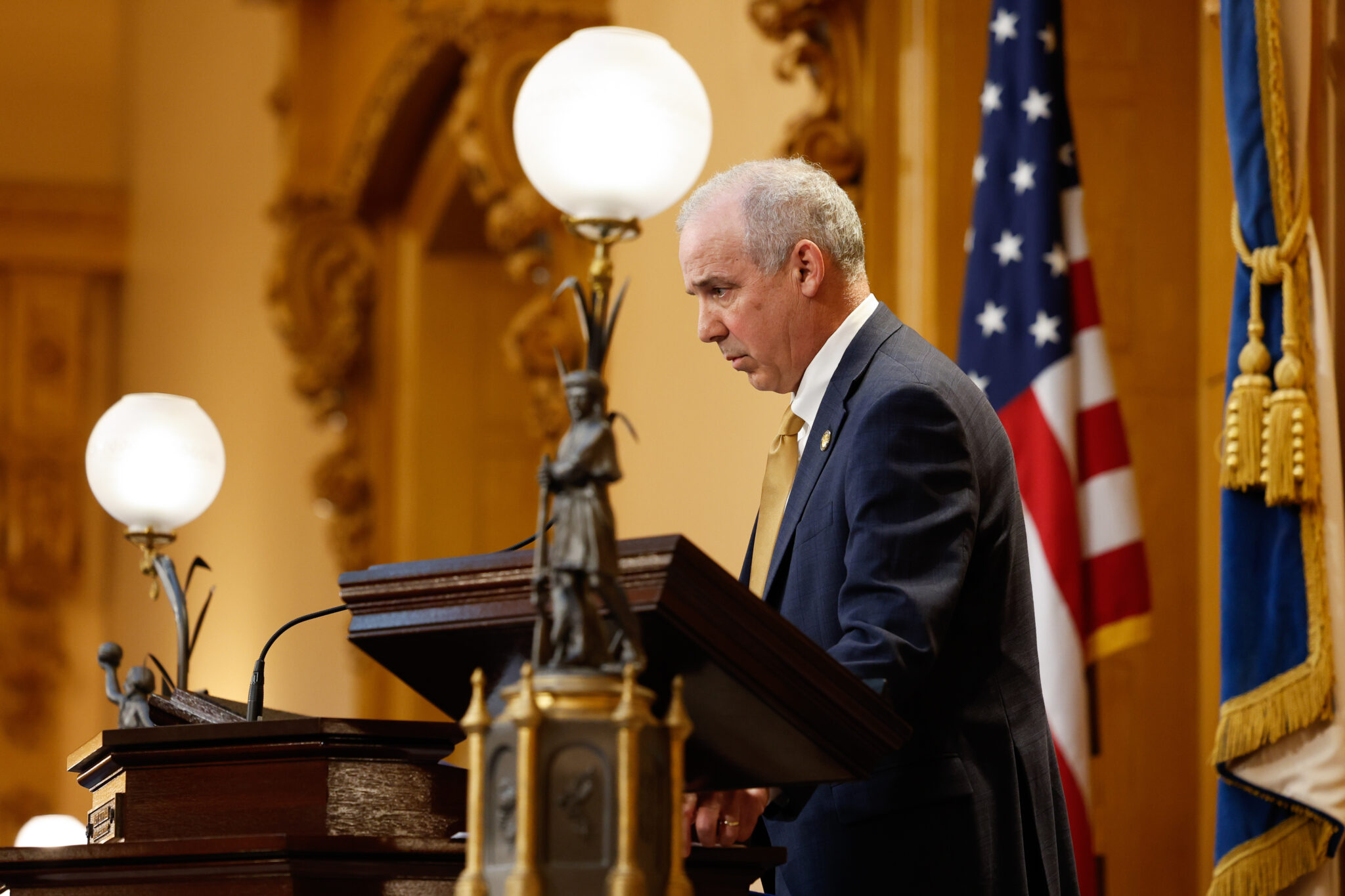
    Ohio House Speaker Matt Huffman. (Photo by Morgan Trau, WEWS.)

    by Marilou Johanek – Ohio Capital Journal

    Just as Elon Musk’s so-called Department of Government Efficiency (DOGE) was never really about improving government efficiency – quite the opposite, in fact – the 5,000-plus page biennial budget rewrite the Ohio House slapped together and sent to the Ohio Senate was never really about improving the common good of everyday Ohioans.

    It was about advancing the hard-right priorities of powerful politicians who answer to big money – not constituents in gerrymandered voting districts.   

    Yet even for the supremely arrogant kingpin of state government, Ohio House Speaker Matt Huffman, the budget bill passed out of the General Assembly’s lower chamber on April 9 was beyond the pale in cruelty and cunning.

    It is the Ohio version of Project 2025 with all the unsparing, exacting hallmarks of the Trumpian blueprint, recklessly destroying federal institutions and agencies that, however imperfectly, protect, serve and promote the welfare of we, the people.

    But that’s the MAGA nihilistic way and Ohio Republicans are doing their part in tearing down what made Ohio great. Huffman, the Lima Republican who runs the state under the one party rule he rigged with unconstitutional redistricting, is in the catbird seat calling the shots. The speaker (and former Ohio Senate president) lords over the GOP supermajority in the Ohio House while his political protégé, Ohio Senate President Rob McColley, accommodates the boss.

    Huffman, who once said the quiet part out loud about GOP gerrymandering (“We can kind of do what we want”), now has a straight runway to enact his blueprint on Ohioans whether they like it or not. I suspect his budget proposal will survive, largely intact, with the House caucus he controls and the one he led with an iron fist for four years in the Senate.

    Local public schools, public libraries, clean drinking initiatives, lead poisoning prevention, pediatric cancer funding, home visits for new mothers, food assistance programs and health care coverage for the poor are all on the chopping block in Huffman’s House Bill 96.

    What wasn’t on his slash-and-burn budget list were government handouts (taxpayer-funded vouchers) to upper-income private school families. But doling out unlimited government subsidies to the affluent, whose darlings are already attending and affording elite high schools and religious institutions, is Huffman’s thing.

    He is on a crusade to shower hundreds of millions of public education dollars on unaccountable private and predominantly religious schools – despite clear prohibitions against such a diversion of public money in the Ohio Constitution.

    “No religious or other sect, or sects, shall ever have any exclusive right to, or control of, any part of the school funds of this state,” the state constitution reads.

    But Huffman has defied the state constitution before with impunity (on gerrymandering) and did so again by ramrodding his universal voucher bonanza through the legislature for everyone, regardless of income. Never mind that the giant state giveaway – to offset private school costs for the well-off – blew a $1 billion dollar hole in the general revenue budget its first year.

    Never mind that public schools in the state, forever cash-strapped and dependent on tapped out property owners, labored under an unequal, inadequate school funding formula (ruled unconstitutional by the Ohio Supreme Court) for 26 years before a bipartisan coalition agreed to a phased-in funding solution over six years. The final two-year phase was expected to be fully funded in the current biennial budget negotiations.

    Not under Huffman. Not in a state where the Republican lock on power is absolute and the Statehouse heavyweight has free, unchecked rein to flout the law and grossly defund the public schools that educate the vast majority of Ohio students (approximately 1.6 million) while greatly expanding appropriations for private school tuitions, homeschooling expenses and even unchartered, nonpublic schools with deeply held religious beliefs that are virtually unregulated by the state!

    Funding for the “thorough and efficient system of common schools” state government is constitutionally obligated to secure – and that would have been secured under the Fair School Funding Plan from 2021 – shrank by over $400 million. House Republicans added insult to injury by robbing fiscally prudent school districts of surplus revenue for future planning to give uneven, one-time property tax relief in some districts and not others. They also ensured that property tax owners will face more school levies from local districts forced to deplete that surplus operating revenue. Sound policymaking (or genuine property tax relief) this is not.

    But it is a gut punch to public schools, just as a $100 million reduction in funding to Ohio’s public libraries is, or cutting over $22 million from the Help Me Grow program is for in-home visits to newborn babies to mitigate the state’s infant mortality problem. But Matt Huffman’s Ohio-centric Project 2025 is also a kick in the teeth to democratic self-governance.

    Last budget go-around Republican lawmakers stripped the Ohio Board of Education of most of its power and gave it to the governor. This two-year budget proposes cutting all 11 elected members of the board and shrinking the gubernatorial appointments from nine to five. This is Matt Huffman removing voters entirely from state education policy as he engineers total opaque privatization of Ohio schools.

    How is silencing the electorate improving the common good?


    Marilou Johanek

    Marilou Johanek is a veteran Ohio print and broadcast journalist who has covered state and national politics as a longtime newspaper editorial writer and columnist.

    MORE FROM AUTHOR

  • Ohio Supreme Court will hear Senate president’s fight against deposition in private school vouchers case

    Ohio Supreme Court will hear Senate president’s fight against deposition in private school vouchers case

    BY:  Ohio Capital Journal

    The Ohio Supreme Court has agreed to hear arguments as part of a lawsuit against private school vouchers in the state, to decide whether or not Senate President Matt Huffman needs to answer questions on the topic.

    The court announced on Tuesday that it would take up the case, in which Huffman is asking to avoid answering questions related to the state’s private school voucher program challenge taking place in the Franklin County Court of Common Pleas.

    Huffman appealed to the high court in April, invoking Article 11 of the Ohio Constitution, which states during a session of the General Assembly, senators and representatives are protected from treason, felony, or breach of the peace, “and for any speech, or debate, in either house, they shall not be questioned elsewhere.”

    “This appeal raises significant – and, to date, unanswered – questions about the scope of the constitutional protections provided to the Ohio General Assembly’s members that ‘for any speech, or debate, in either house, they shall not be questioned elsewhere,’ which is commonly referred to as the Speech and Debate Clause,” Columbus attorney Mark D. Wagoner wrote on behalf of Huffman.

    Huffman was one of many parties asked to participate in a deposition or answer questions about the program and its funding. The Senate president was subpoenaed – and is now fighting the subpoena – for an April 2023 deposition “on his knowledge of school funding in Ohio and his involvement in the enactment and expansion of the EdChoice program.”

    The case for which Huffman doesn’t want to provide a deposition is an effort to eliminate the private school voucher program in the state, a program that provides subsidies for public school students enrolled in what are considered by the state to be underperforming schools, allowing those students to attend private schools, often religiously affiliated.

    Huffman was Senate president when when the budget bill that included the private voucher expansion was passed in 2021.

    The program and its most recent expansion have been criticized for taking funding out of public school coffers, funding higher income white students more than the original program’s goal to assist lower income students and minorities, and violating the state constitution which requires the state to properly fund a system of public schools throughout Ohio.

    In December of last year, Franklin County Common Pleas Judge Jaiza Page said Huffman did not need to submit to the in-person deposition, but instead could answer questions “that do not implicate legislative privilege” in a written form.

    The judge ruled that the legislative privilege Huffman argued didn’t extend to everything done or related to a legislative process, “but attaches only to meetings, processes, conversations and documents which are an integral part of the deliberative and communicative process by which legislators participate in legislative or committee proceedings.”

    Page also said if the written deposition demonstrated “that an in-person oral deposition of Huffman is likely to provide additional information,” the judge would reconsider the written deposition order.

    Huffman appealed to the Tenth District Court of Appeals in January of this year, asking to be released from the order for written deposition answers, citing the same “legislative testimonial privilege” in the Speech and Debate Clause.

    The appellate court dismissed Huffman’s appeal in March, saying the lower court’s order “permits (voucher challengers) to submit questions but stops short of compelling (Huffman) to answer.”

    The appellate decision said Huffman could again sue on legislative privilege grounds after the questions were submitted to him, “and the trial court will have the opportunity to review (Huffman’s) concerns in the context of the questions being posed.”

    In his appeal to the state supreme court, Huffman’s attorney said “the importance of this language is clear.”

    “The Speech and Debate Clause does not require President Huffman to jump through the additional hoops suggested by the Tenth District Court of Appeals,” the appeal stated.

    Justice Michael Donnelly, Melody Stewart and Jennifer Brunner all voted against accepting the case. Ninth District Court of Appeals Judge Jill Flagg Lanzinger sat in for Justice Joe Deters.

    The court will now set deadlines for documents to be submitted to the court, and oral arguments will be scheduled in the case.


    Susan Tebben
    SUSAN TEBBEN

    Susan Tebben is an award-winning journalist with a decade of experience covering Ohio news, including courts and crime, Appalachian social issues, government, education, diversity and culture. She has worked for The Newark Advocate, The Glasgow (KY) Daily Times, The Athens Messenger, and WOUB Public Media. She has also had work featured on National Public Radio.

    Ohio Capital Journal is part of States Newsroom, the nation’s largest state-focused nonprofit news organization.

    MORE FROM AUTHOR

  • Ohio public education supporters look to 2024, lawsuit to hold private voucher system accountable

    Ohio public education supporters look to 2024, lawsuit to hold private voucher system accountable

    Getty Images

    BY:  Ohio Capital Journal

    While marijuana legislation and other bills still sit on the horizon in the second year of this term’s General Assembly, education policy can always be counted on to be a part of the discussion. 2024 should be no different.

    Ohio’s private school voucher program has been a source of strong debate among legislators and education advocates of all kinds since the 1990s, when the program began as a way to allow lower-income students to access private schools, proposed as an effort to improve education outcomes in poor-performing public school districts.

    But as public school advocates still hope to see full funding of the Fair School Funding Plan for districts across the state, they saw eye-popping increases in private school funding through vouchers that worry them almost as much as the foot-dragging that they believe has occurred when talking of public school funding.

    “You should be funding the public schools,” said Stephen Dyer, former state representative and former chair of the Ohio House Primary and Secondary Education subcommittee for the House Finance Committee. “If you want to fund the private schools, fund the private schools, but there’s no reason you can’t do both.”

    Private school voucher expansion by the numbers

    The Ohio Department of Education reported 23,272 participants in the voucher expansion for the 2023 fiscal year, up from the 20,702 reported in 2022 and even more from the year prior, when 17,155 students participated in the state-subsidized program.

    In 2021, 85% of the voucher expansion participants were below 200% of the federal poverty line, and 93% of 2022 participants were below 250% of the poverty line.

    In 2023, language on the ODE data changed to “low-income qualified” to “not low-income qualified,” removing the breakdown of federal poverty percentages. In this year’s report, 67% of participants were “low-income qualified” and 32% were “not low-income qualified.”

    With the most recent state budget, passed this summer, a GOP-led effort to expand eligibility for private school vouchers led to a ballooning of the poverty level allowed for the voucher program to 450% of the poverty line, or a household income of $135,000 or less for a family of four.

    Those receiving a scholarship can move to a private school with $6,165 in state funding for K-8 students, and $8,407 for high schoolers.

    Families with incomes above the $135,000 threshold can still be eligible for at least 10% of the maximum scholarship, even with a higher income, Senate President Matt Huffman’s office said when the budget was passed.

    Public school advocates took issue with the expansion, saying the Fair School Funding Plan, seeking to support public school districts based on their individual needs, should be the focus, considering the vast majority of students in Ohio attend traditional public schools.

    ‘A perversion of the idea behind a voucher’

    Since the most recent voucher participation numbers were released, Dyer did his own analysis of the voucher program, finding “a very different goal” compared to when it began.

    “It’s now going to wealthier, white families to subsidize the decisions they’d already made to send their kids to private schools,” Dyer told the OCJ.

    In an analysis he posted to his blog, Dyer said ODE data showed nearly nine in 10 new applications to the voucher expansion went to white students, and more new vouchers for high schoolers went to families making more than $150,000 annually than went to families making less.

    Dyer also makes an argument that has been made before by those opposing the voucher expansion: increasing private school voucher program causes “resegregation” in the public schools, with the number of white students who are leaving for private schools, vouchers in hand.

    “It’s frankly a perversion of the idea behind a voucher, which was sold as allowing poor students, students of color, students who haven’t traditionally had access to private schools, to have access,” Dyer said in an OCJ interview.

    The most recent data on Ohio’s EdChoice voucher expansion showed 66.4% of participants are white, with the Black population of voucher recipients coming in at 15%, the second highest number reported.

    In 2022, 65.9% of expansion vouchers went to white students, up from 64.1% in 2021.

    A vast majority – 9 in 10 – vouchers come from just 31 school districts, according to Dyer.

    “Those districts’ racial makeup is, on average, 21% white,” he writes in his analysis. “Yet 46% of EdChoice voucher recipients are white – more than double the percentage of white students than attend the 31 public school districts where nine in 10 voucher students would otherwise attend.”

    At the very least as the voucher program continues in Ohio, Dyer hopes a plan to audit the program is forthcoming for the billions of dollars spent to subsidize it. He pointed to an audit of the defunct Electronic Classroom of Tomorrow (ECOT), which exposed false enrollment numbers and led to court battles to claw back more than $60 million in state funding from the online charter school.

    “It’s all of our dollars, so we have a right to say what happens with all of our dollars, and we certainly have a right to audit where our dollars are going,” Dyer said.

    The lawsuit

    With a Republican supermajority in both chambers of the legislature, support of private school vouchers and “school choice” seems assured at least for the foreseeable future, so public school advocates are looking to other avenues to make change.

    Another court battle is still simmering in the Franklin County Court of Common Pleas, a lawsuit that seeks to tamp down on the voucher program in favor of the constitutional obligations the legislature has to properly fund public schools.

    The lawsuit was filed in Jan. 2022, accusing the state of Ohio of improperly and unequally funding private schools, specifically targeting the growth of the voucher program as a drain on public school resources.

    “The legislature has only moved to further expand private school vouchers in Ohio,” the leading group in the lawsuit, Vouchers Hurt Ohio, wrote in a recent statement on the program. “We do not stand a chance of changing their minds or direction so we are forced to sue to get a fair hearing in a court of law where the Ohio Constitution is respected and means something.”

    Amidst the nearly two years the case has been ongoing, time extensions have been granted and Ohio Senate President Matt Huffman has asked to be excused from a deposition due to “legislative privilege,” also arguing the testimony sought from Huffman “is neither legally relevant nor necessary.”

    Franklin County Judge Jaiza Page has not ruled on Huffman’s subpoena, but allowed subpoenas for 42 “non-party private schools” in Ohio as part of the case, selected, according to the lawsuit filers “as a representative sample based on their location, demographics, percent of EdChoice students enrolled and total EdChoice funds received.”

    Parties standing against the public school advocates in the case said the passage of the state budget, including an increase in funding for the Fair School Funding Plan along with the voucher expansion should allow for the dismissal of their complaints on funding of public schools.

    “And while plaintiffs presumably still take issue with the new, amendment program, that does not change the fact that their current complaint challenges legislation that ‘is no longer the operative legislation governing EdChoice,” attorneys arguing for dismissal stated.

    A deadline for documents and evidence in the case was Nov. 30, and the court has requested “expert reports” from both sides by Feb. 23 of next year, with a trial date set for Nov. 4, 2024.


    Susan Tebben
    SUSAN TEBBEN

    Susan Tebben is an award-winning journalist with a decade of experience covering Ohio news, including courts and crime, Appalachian social issues, government, education, diversity and culture. She has worked for The Newark Advocate, The Glasgow (KY) Daily Times, The Athens Messenger, and WOUB Public Media. She has also had work featured on National Public Radio.

    MORE FROM AUTHOR

  • Advocates, legislators want more from governor’s education budget

    Advocates, legislators want more from governor’s education budget

    Students in a classroom. Getty Images

    By Susan Tebben and Ohio Capital Journal

    With no changes planned for the state education funding formula included in Gov. Mike DeWine’s proposed budget, education advocates and some state legislators are left wanting more.

    “The devil is always in the details,” said Scott DiMauro, head of the Ohio Education Association, in a statement after the release of the budget. “Education spending must be a top priority in Ohio to ensure our students, educators and communities receive the resources they need to succeed.”

    Scott DiMauro

    DeWine’s budget proposal brings funding back to pre-pandemic levels and includes a jump in non-academic wraparound services, but saves the bulk of changes to education funding for the legislature to figure out.

    The OEA said they were encouraged by an expansion to broadband access and mental health services as part of the support for schools.

    “However, OEA is disheartened to see the same amount of general revenue fund money is going into the state’s foundation formula as in (fiscal year) 18,” the association wrote in their statement.

    Another of Ohio’s biggest teachers unions, the Ohio Federation of Teachers, agreed that DeWine “chose to punt” on overhauling the school funding system without acknowledging the Cupp-Patterson plan, some of which went into the capital budget last year, but for the most part stays in limbo as the General Assembly begins anew.

    Melissa Cropper

    “Additionally, the governor’s budget maintains the disastrous local funding deductions for charter and private schools that have been draining public school budgets,” said OFT President Melissa Cropper in a statement.

    The non-profit Ohio Children’s Alliance praised the “key investments for Ohio’s children and families” that the governor carried over from the previous biennial budget, and said they were pleased to see more money go toward student wellness and youth services.

    “With the unprecedented challenges COVID-19 has caused to communities and providers, targeting investments in telehealth and the child and family services workforce are critical parts of a comprehensive solution,” said Mark Mecum, CEO of the OCA.

    State Sen. Teresa Fedor

    State Sen. Teresa Fedor, D-Toledo, called the governor’s proposal “shortsighted” when it comes to education and support for children.

    “We should be fixing our unconstitutional funding formula — not continuing to siphon more public school dollars to private education,” Fedor said after the budget proposal was released.

    With the school funding now in the legislature’s hands, House Minority Leader Emila Strong Sykes, D-Akron, said it would be a primary issue as the House Democrats begin their work, including “fully and fairly funding our public schools.”

    “We look forward to digging into the details of the governor’s proposal to see how it makes sense long-term without one time money and that it delivers on the promise of opportunity for all Ohioans,” Sykes wrote.