Tag: Pro-Life

  • Ohio legislative leaders brush off concerns over Alabama IVF ruling’s impacts

    Ohio legislative leaders brush off concerns over Alabama IVF ruling’s impacts

    The Ohio Statehouse, Columbus, Ohio. (Photo by Graham Stokes for the Ohio Capital Journal. Republish photo only with original story.)

    BY:  Ohio Capital Journal

    After an Alabama Supreme Court decision that ruled frozen embryos housed outside of a human body were still considered children, states across the country are debating the implications of such a decision.

    Ohio legislative leaders are saying bills that would ban IVF are not being considered, but one lawmaker who has introduced a “personhood” bill in the past says it’s still “great policy” that’s being blocked by politics.

    National groups have said the Alabama decision will have impacts on the work that embryologists do, with the Society of Reproductive Biologists and Technologists saying the state’s supreme court ruling “stands in stark contrast to scientific understanding and the experiences of individuals navigating fertility treatments.”

    The concept of “fetal personhood” is not a new one for Ohio. Long before the Alabama decision threw into question the concept of in-vitro fertilization treatments in that state, legislators in the Buckeye state were considering a bill that would consider life’s beginning at conception, a theory conservatives and pro-life politicians have long pushed.

    Ohio House Bill 704 was introduced in 2022 by state Rep. Gary Click, R-Vickery, who claimed “one class of people has erroneously been denied their constitutional rights: the unborn.”

    “From the moment of fertilization, that zygote, embryo or whichever depersonalizing term you choose to use is not merely a potential human but rather (a) human with potential,” Click said in a statement announcing the legislation.

    The bill died as the General Assembly’s two-year session ended, but the fact that the idea was broached is still being brought up by Democrats and pro-choice groups around the state.

    Click himself didn’t rule out the idea of reintroducing his personhood legislation, saying in a Feb. 23 tweet that reintroducing it has “not been my plan at the moment.”

    “But plans do change,” the tweet went on.


    The legislator — who was also the creator of a successful bill that bans gender-affirming care for transgender minors, a controversial bill that succeeded with a veto-override in January — also told the Statehouse News Bureau in February that while he supported IVF if all embryos are used, he considered his personhood bill “great policy” blocked by politics.

    Since Click’s bill was introduced (and subsequently foiled by time limits), however, 57% of Ohio voters passed November’s Issue 1, which not only enshrined abortion rights into the Ohio Constitution, but also listed “fertility treatment” as one of the rights Ohio individuals have to “make and carry out one’s own reproductive decisions,” according to the amendment.

    IVF patients represented a group of people who spoke out in favor of Issue 1 as a protection against unnecessary regulation and uncertainty in the IVF process.

    But Republican legislators in particular have not seen this development as the roadblock to reproductive rights legislation one might expect, as policymakers at the Statehouse have continued to push anti-abortion legislation and bills that target the rights now protected under the state constitution.

    The state’s legal representatives are also still pushing against a lawsuit that seeks to eliminate a six-week abortion ban that became law in 2019 (and has been tied up in court ever since).

    Still, Ohio’s legislative leaders have said the Alabama decision has yet to spur any policy in the state at this point.

     Left, Ohio House Speaker Jason Stephens. Right, Ohio Senate President Matt Huffman. (Photos by Graham Stokes for the Ohio Capital Journal. Republish only with original article.) 

    House Speaker Jason Stephens, R-Kitts Hill, said the chamber is “monitoring any potential ramifications the Alabama decision may have in Ohio,” but also said, from his perspective, “IVF provides hope and is 100% pro-family.”

    “We look forward to advancing our values and continuing our pro-life legislative agenda,” Stephens told the OCJ in a statement.

    Senate President Matt Huffman said he has not heard of any legislation and there hasn’t been “any discussion by any member of my caucus or anybody else as far as in the state of Ohio as far as I know.”

    “We seem to be in this national culture that if some court in Alabama or some other state says something that we all should be reacting to it,” Huffman said.

    The senate leader acknowledged that “we have a constitutional amendment that affects some of this.”

    “But you know, with other things going on right now, it’s just not a discussion that’s taking place,” he said.

    A spokesperson for Gov. Mike DeWine said his office would “continue to monitor any bills in this policy area,” but they were not aware of any at the moment.

    DeWine’s office did not respond to questions as to whether or not the governor supported the consideration of frozen embryos as children.

    Megan Henry contributed to this story.

    _____________

    Susan Tebben
    SUSAN TEBBEN

    Susan Tebben is an award-winning journalist with a decade of experience covering Ohio news, including courts and crime, Appalachian social issues, government, education, diversity and culture. She has worked for The Newark Advocate, The Glasgow (KY) Daily Times, The Athens Messenger, and WOUB Public Media. She has also had work featured on National Public Radio.

    MORE FROM AUTHOR

  • For some religious Ohioans, Issue 1 about autonomy more than beliefs

    For some religious Ohioans, Issue 1 about autonomy more than beliefs

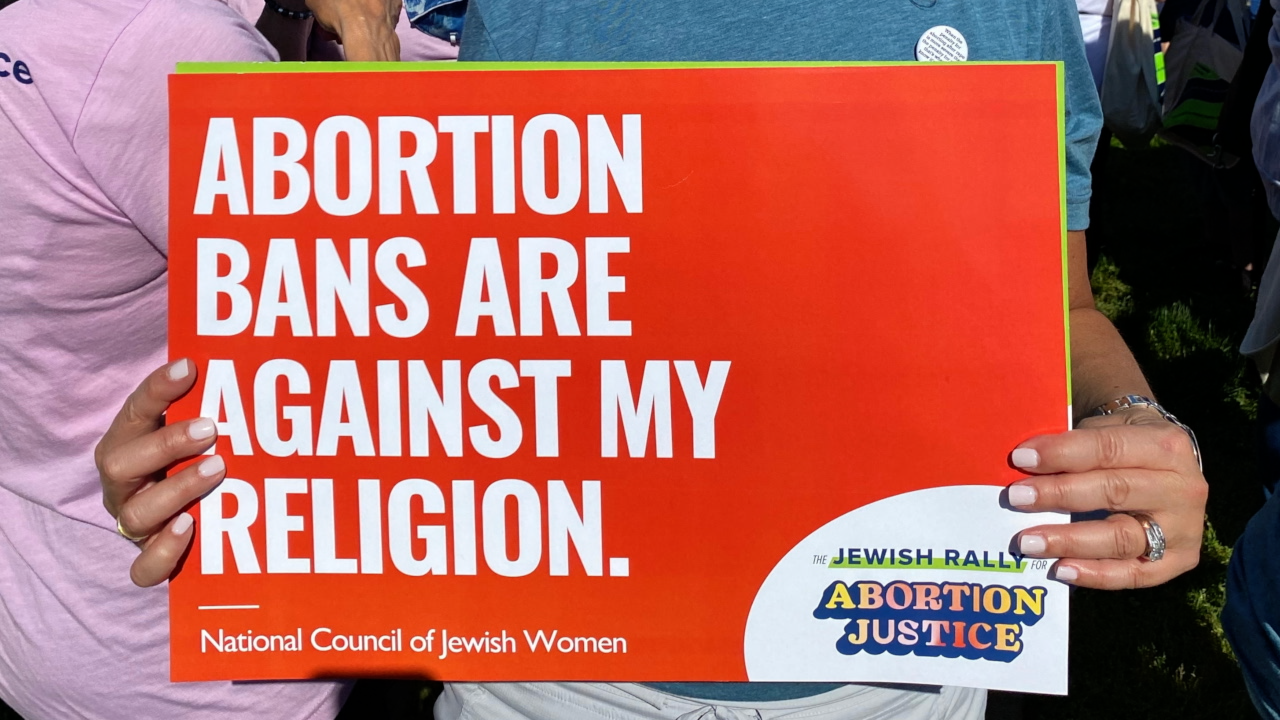
    Members of the Jewish community have spoken out against abortion bans in Ohio, saying it infringes on their religious freedom. Photo by Morgan Trau, WEWS.

    BY:  AND Ohio Capital Journal

    Religious variations abound in the state of Ohio, and some members of different churches are taking what they’ve learned in their lives and through decades of experience into the ballot box as they vote on Issue 1, the reproductive rights constitutional amendment.

    For Catholics like Alexandra Belcher and Jennifer Perry, Issue 1 is a choice between the opinions of their religious leaders and their experiences with bodily autonomy.

    For Perry, a physician assistant from Tiffin, growing up Catholic meant she believed in pro-life messages up until she voted in her first election.

    “I voted Republican because that’s what the religious leaders said supported pro-life values,” Perry said.

    Now that she works in medicine and has gone through multiple complicated pregnancies, Perry developed a perspective built on her experiences and not the values of far-away leaders.

    “My view of what defines pro-life and what defines pro-choice has become just so much broader, and it’s not a black and white issue at all,” Perry told the OCJ.

    With the “narrow” view that life begins at conception, Perry said she felt her belief system did “a disservice” to her in preparing for the future.

    “We weren’t given both sides of the coin,” she said. “We weren’t given both perspectives.”

    Struggling with infertility, and losing a “desperately wanted” child in a second-trimester miscarriage brought her new light on the struggles even individuals who want to become parents must go through.

    “I desperately wanted that child, my husband desperately wanted that child, and I had to go through labor and delivery knowing that child wasn’t going to be ours,” Perry said. “To think that a mother … would have to go through that out-of-state, not with her family and friends or her chosen doctor, that’s just excruciating to me.”

    Perry is still a practicing Catholic, and feels strongly that she and those like her should stay in the church and help bring those perspectives to fellow parishioners, in hopes of bringing change to the opinions of the religion.

    The Catholic Conference of Ohio, which calls itself “the official voice of the Catholic Church in Ohio on matters of public policy,” has taken a strong opposing stance on Issue 1. The conference produced a letter signed by nine leaders in Ohio dioceses including Cincinnati, Cleveland, Toledo, Steubenville, Columbus, Youngstown, Canton and Parma.

    “The Church must not be silent and cannot remain on the sidelines when confronted with such a clear threat to human life,” the letter from Feb. 28 stated.

     COLUMBUS, OH — MAY 14, 2022: Hundreds gather at a rally to support abortion rights less than two weeks after a leaked Supreme Court draft opinion showed a likely reversal of Roe v. Wade, May 14, 2022, at the Ohio Statehouse, Columbus, Ohio. (Photo by Graham Stokes for the Ohio Capital Journal. Republish photo only with original article.) 

    For Cleveland-area pharmacist Alexandra Belcher, she has no problem ignoring the opinions the church has on abortion, but remains open to talking with her friends and fellow parishioners about the nuances of reproductive health.

    “The more I grew up, the more I realized this can not be up to somebody else,” Belcher told the OCJ.

    Belcher went to Catholic school for 12 years, and is still a practicing Catholic, but nothing could have prepared her for her ectopic pregnancy, an unviable pregnancy that can be life-threatening for the pregnant person.

    “In my medical chart, the resolution is coded as an abortion,” she said.

    But that resolution involved medication that was administered in a hospital, so Belcher could be monitored by a doctor.

    “The awful thing about those drugs is that they take you into labor and delivery,” she said. “So all you can hear is crying babies, the song they play (when a baby is born), and I sat there for hours while they made sure everything was going well with my medication.”

    Even after leaving the hospital, Belcher suffered “excruciating” pain, so much so that when she went into labor in her next pregnancy, she was surprised to find how much less severe the pain of childbirth was for her.

    “Nobody is going into a decision to have an abortion joyfully, whatever has happened to get them to the point of an abortion,” Belcher said. “It’s still not a joyful decision.”

    Members of other religions, including faith leaders, are thinking about Issue 1 with a focus on the freedom to decide rather than the wrath of a higher power.

    Rev. Timothy Ahrens showed his support for Issue 1 in an ad by Ohioans United For Reproductive Rights.

    “As a pastor I’ve counseled families on the most important personal decisions, even abortion,” he said in the 30-second ad. “Abortion is a private family decision. Government needs to stay out of family decision making.”

    Ahrens is the senior minister of the First Congregational Church of the United Church of Christ in downtown Columbus, a role he has served in since 2000. He has been a pastor for nearly 40 years.

    The United Church of Christ supports reproductive issues and a woman’s right to have an abortion, according to the denomination’s general synod and statements regarding freedom of choice.

    “The laws of Ohio right now hurt my mother, my sister, my sister-in-law, my wife, my daughters, my daughter-in-laws and my granddaughters,” Ahrens said. “I feel very strongly that the government needs to get out of trying to manage people’s lives in relation to reproductive freedom.”

    Ahrens acknowledged that other Christians denominations disagree with his stance on abortion.

    “Those who stand against abortion do so based on biblical, foundational thoughts,” Ahrens. “I don’t look at what they’re saying as groundless.”

    He mentioned Psalm 139 as a passage that mentions God “knit me together in my mother’s womb.”

    “It never says I knew you at the moment of conception,” Ahrens said. “This has a range of perspectives, if we really sat down and boiled it down to the moment of conception.”

    While it’s clear what most religious denominations think abortion, it’s ultimately up to the individual members of a congregation to cast their ballot on Issue 1.

    “It comes down to how closely people who are part of religious congregations are listening to the cues that they are being given,” said Kim Conger, University of Cincinnati’s director of the masters of public administration, who studies how religious advocacy groups impact politics.

    “There seems to be more variation across different parishes about how strongly a priest is pushing on the idea of not just that abortion is a sin, but voting for issue 1 would be a sin,” Conger said.

    The idea of one religion stepping up to tell individuals what they should believe about reproductive health doesn’t sit well with Belcher or Perry, and as medical professionals, they don’t agree with the state getting involved either.

    “The reasoning is not because it’s in the best interest, or because there is evidence-based medicine, the reasoning is this magical belief that this group of cells is a person who has rights,” Belcher said.

    For Perry, the reproductive debate comes down to American roots in religious freedom and the necessity for separation of church and state.

    “Because we allow for so many different expressions of religion, or at least we’re supposed to, if that starts to crumble, I feel like the fabric or the foundation of what America was build on starts to crumble,” Perry said.

    Watching battles with insurance companies and socio-economic issues for patients having necessary medical treatment, Perry also sees much bigger issues the state could be addressing instead.

    “It’s very hard to be in health care right now, and this is another huge burden you’re placing on these providers,” she said.

    Having faced these moral and professional questions, Perry and Belcher both hope for a future for their children where medical decisions are made between a patient and a medical provider, without the intervention of either the government or their chosen religion.

    “I think that when it comes down to it, if I’m ever faced with the pearly gates, the God that I believe in will understand,” Belcher said.


    Megan Henry
    MEGAN HENRY

    Megan Henry is a reporter for the Ohio Capital Journal and has spent the past five years reporting in Ohio on various topics including education, healthcare, business and crime. She previously worked at The Columbus Dispatch, part of the USA Today Network.

    MORE FROM AUTHOR

    Susan Tebben
    SUSAN TEBBEN

    Susan Tebben is an award-winning journalist with a decade of experience covering Ohio news, including courts and crime, Appalachian social issues, government, education, diversity and culture. She has worked for The Newark Advocate, The Glasgow (KY) Daily Times, The Athens Messenger, and WOUB Public Media. She has also had work featured on National Public Radio.

    MORE FROM AUTHOR

  • John Becker: I’m a conservative Republican who is vetted, tested, and proven

    John Becker: I’m a conservative Republican who is vetted, tested, and proven


    Guest Column

    by John Becker,

    On October 26th, Loveland Magazine published, Patricia Lawrence: I’m running because our community deserves effective leadership. My liberal Democrat opponent repeatedly misrepresented, mischaracterized, fabricated, and twisted facts beyond recognition. But hey, that can be expected from a desperate politician.

    John Becker has been serving as the State Representative for Ohio’s 65th House District since January 2013. It includes the cities of Milford and Loveland (inside Clermont County) and the townships of Union, Miami, Goshen, Stonelick, and Wayne.

    Rather than picking apart her statements and correcting the record line-by-line, I’m going to reintroduce myself and then compare and contrast our positions and values:

    It is my honor and privilege to serve as your State Representative. I’ve been involved with the Clermont County Republican Party since 1993, served southern Ohio as a State Committeeman for the Ohio Republican Party from 2004-2012, and I’ve been a member of the Ohio General Assembly since January 2013.

    My MBA, with an emphasis in Taxation, was earned at Xavier University. I also have a Bachelor of Science degree in Business Management with a minor in Psychology from Northern Kentucky University. Additionally, I also hold a Certified Treasury Professional (CTP) designation, a school district treasurer’s license, and am a graduate of the Union Township Citizens Police Academy.

    I am running for re-election to continue being a champion in Columbus for our shared conservative values. My platform is very simple: Pro-Life, Pro-Gun, Limited Government, and Lower Taxes.

    With a 30-year career in the private sector, my experience has spanned four major industries including Manufacturing, Health Care Insurance, Banking/Financial, and Charter Education. The companies I’ve worked for include household names like GE, Ford, MetLife, Prudential, Provident Bank, Fifth Third Bank, and Check ‘n Go. I’ve held positions such as supervisor, manager of health care information systems, senior financial analyst, finance officer, assistant vice president, business analyst, and treasurer.

    I am running for re-election to continue being a champion in Columbus for our shared conservative values. My platform is very simple: Pro-Life, Pro-Gun, Limited Government, and Lower Taxes.

    Endorsements are a key indicator of a candidate’s values and effectiveness. My growing list are as follows:

    Party Endorsements

    • Clermont County Republican Party
    • Ohio Republican Party

    Business Endorsements

    • NFIB Ohio – National Federation of Independent Business (small business)
    • Ohio Chamber of Commerce
    • The Ohio Society of CPAs
    • Ohio Valley Associated Builders and Contractors ABC-PAC
    • Ohio State Medical Association PAC
    • 2018 Ohio Farm Bureau “Friend of Agriculture”
    • Ohio State Chiropractors Association
    • Cincinnati Area Board of REALTORS® and the Ohio REALTORS®

    Pro-Life and Grass Roots Values Voters Endorsements

    • Cincinnati Right to Life – PAC
    • Ohio Right to Life – PAC
    • Ohio Value Voters
    • Family First PAC
    • Janet Folger Porter
    • “Very Conservative” from iVoterGuide. (This is their highest rating.)

    Gun Voters

    • NRA with the highly exclusive A+ rating
    • Buckeye Firearms PAC with the highly exclusive A+ rating
    • Ohioans for Concealed Carry (OFCC)

    TEA Party, Liberty, and Tax Voters

    • Ohio Citizens PAC
    • Republican Liberty Caucus of Ohio
    • Coalition Opposed to Additional Sending and Taxes (COAST)

    Military and Veterans Voters

    • “Highly Recommended” by Ohio Veterans United

    In contrast, my liberal Democrat opponent boasts of her endorsements by a collective of labor unions, gun control, and left-wing, pink hat-wearing, feminist pro-abortion groups, including Planned Parenthood.

    If the people of Clermont County want to continue winning with a pro-life, pro-gun, fiscal conservative, they will send me back to Columbus.

    If the people of Clermont County are tired of winning, they will vote for my liberal Democrat opponent. If they want to continue winning with a pro-life, pro-gun, fiscal conservative, they will send me back to Columbus.

    To learn more about me and my candidacy for state representative, please visit my website at www.BeckerGOP.com. If you’d like to subscribe to my monthly newsletter, The Becker Report, email me at John@BeckerGOP.com.

    Election Day is quickly approaching. I’m a conservative Republican who is vetted, tested, and proven. I humbly ask for your vote on November 6, 2018.